Raj RamabadranPlatform Strategy AdvisorDeveloper & Platform EvangelismRaj.Ramabadran@microsoft.comBlog: http://rajramabadran.wordpress.com
Objectives
Challenges Facing Today’s Enterprise1Cutting Cost and Lowering CapexInfrastructure uses up valuable IT resources40% CIOs plan to cut IT budgets 2Driving value for the business with tight IT budgetsLeveraging and extending past IT investments to provide future value72% CIOs have cut or plan to cut discretionary IT projects*“Live with what we have”34Maintaining security while increasing access and transparency internally and externallyMany data centers are a limitation59% of surveyed CIOs view security and datacenter efficiency as “must do” projects5Finding the right transformative capabilities across the enterprise: cloud computing, data-center strategies, SaaS, mobility, IT automation ?6Top Projects:  SaaS, VoIP, Green IT, Web 2.0 and outsourcingSource:  CIO Magazine, October 21, 2008, “Cloud Computing Survey: IT Leaders See Big Promise, Have Big Security Questions”
Challenges Building Apps# of users? After 1 month? 6 months? 1 yr?
Capacity? Servers? Bandwidth? Storage?
How do you scale up or down over time?
How can you handle peak loads?
How do you provide high availability?
What are the upfront capital costs?
How quickly can you go live?
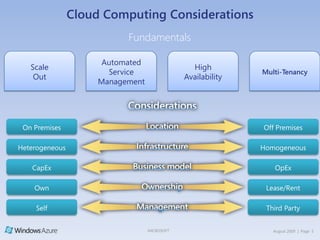
How do you reduce your operations costsCloud Computing ConsiderationsFundamentalsScaleOutAutomated Service ManagementHigh AvailabilityMulti-TenancyConsiderationsOff PremisesOn PremisesLocationHomogeneousHeterogeneousInfrastructureCapExOpExBusiness modelOwnLease/RentOwnershipSelfThird PartyManagement
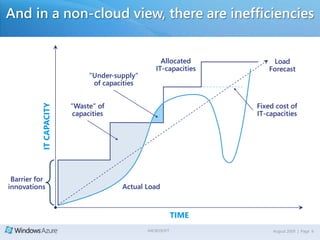
And in a non-cloud view, there are inefficienciesAllocated IT-capacitiesLoad Forecast“Under-supply“ of capacities“Waste“ of capacitiesFixed cost of IT-capacitiesIT CAPACITYBarrier forinnovationsActualLoadTIME
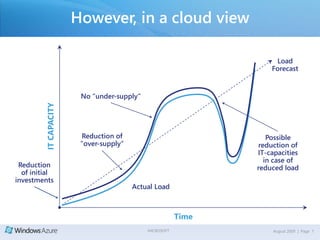
However, in a cloud viewLoad ForecastAllocated IT capacitiesNo “under-supply“IT CAPACITYReduction of “over-supply“Possible reduction of IT-capacities in case of reduced loadReduction of initial investmentsActualLoadTime
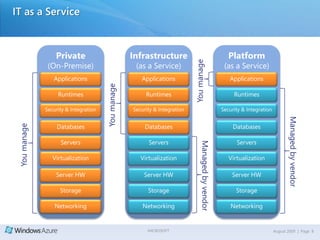
IT as a ServicePrivate(On-Premise)Infrastructure(as a Service)Platform(as a Service)You manageApplicationsApplicationsApplicationsYou manageRuntimesRuntimesRuntimesSecurity & IntegrationSecurity & IntegrationSecurity & IntegrationManaged by vendorDatabasesDatabasesDatabasesYou manageServersServersServersManaged by vendorVirtualizationVirtualizationVirtualizationServer HWServer HWServer HWStorageStorageStorageNetworkingNetworkingNetworking
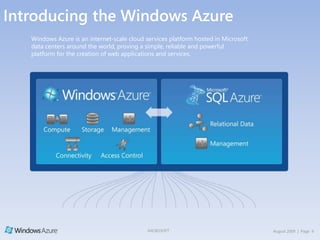
Introducing the Windows AzureWindows Azure is an internet-scale cloud services platform hosted in Microsoft data centers around the world, proving a simple, reliable and powerful platform for the creation of web applications and services.
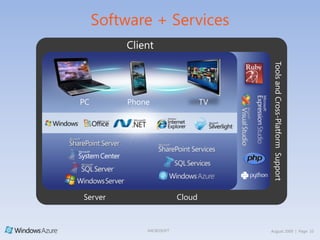
Software + ServicesClientPCPhoneTVTools and Cross-Platform  SupportServerCloud
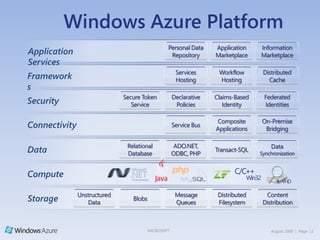
Windows Azure PlatformApplicationMarketplaceInformation MarketplacePersonal Data RepositoryApplication ServicesWorkflow HostingDistributed CacheServices HostingFrameworksClaims-Based IdentityFederated IdentitiesSecure Token ServiceDeclarative PoliciesSecurityComposite ApplicationsOn-Premise BridgingService BusConnectivityTransact-SQLData SynchronizationRelational DatabaseADO.NET, ODBC, PHPDataC / C++ComputeWin32VHDUnstructured DataBlobsMessage QueuesDistributed FilesystemContent DistributionStorage
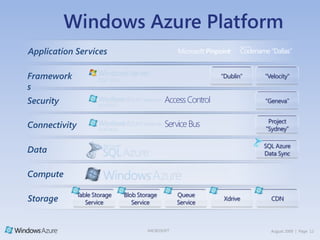
Windows Azure PlatformApplication Services“Dublin”“Velocity”Frameworks“Geneva”SecurityAccess ControlProject “Sydney”ConnectivityService BusSQL Azure Data SyncDataComputeTable Storage ServiceBlob Storage ServiceQueue ServiceXdriveCDNStorage
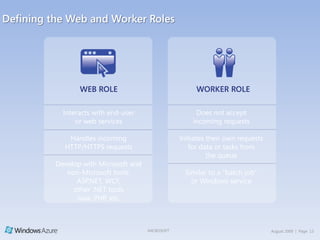
Defining the Web and Worker RolesWEB ROLEWORKER ROLEInteracts with end-useror web servicesHandles incomingHTTP/HTTPS requestsDevelop with Microsoft andnon-Microsoft tools:ASP.NET, WCF, other .NET toolsJava, PHP, etc.Does not acceptincoming requestsInitiates their own requestsfor data or tasks from the queueSimilar to a "batch job"or Windows service
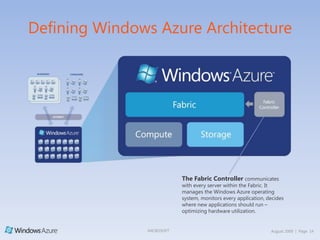
Defining Windows Azure ArchitectureThe Fabric Controller communicates with every server within the Fabric. It manages the Windows Azure operating system, monitors every application, decides where new applications should run – optimizing hardware utilization.
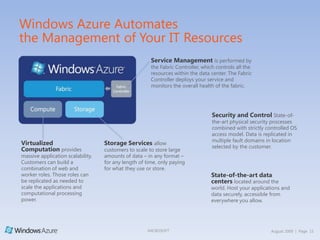
Service Management is performed by the Fabric Controller, which controls all the resources within the data center. The Fabric Controller deploys your service and monitors the overall health of the fabric.Security and Control State-of-the-art physical security processes combined with strictly controlled OS access model. Data is replicated in multiple fault domains in location selected by the customer. Virtualized Computation provides massive application scalability.  Customers can build a combination of web and worker roles. Those roles can be replicated as needed to scale the applications and computational processing power.Storage Services allow customers to scale to store large amounts of data – in any format – for any length of time, only paying for what they use or store.State-of-the-art data centers located around the world. Host your applications and data securely, accessible from everywhere you allow.Windows Azure Automates the Management of Your IT Resources
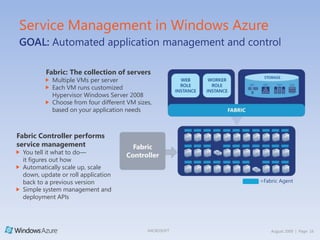
Service Management in Windows AzureGOAL: Automated application management and controlFabric: The collection of servers Multiple VMs per serverEach VM runs customized    Hypervisor Windows Server 2008Choose from four different VM sizes, based on your application needsFabric Controller performs service managementYou tell it what to do—it figures out howAutomatically scale up, scale down, update or roll application back to a previous versionSimple system management and deployment APIs =Fabric Agent
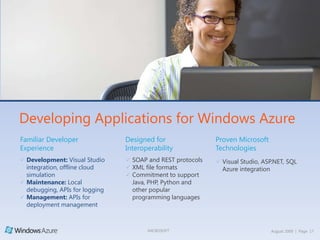
Developing Applications for Windows AzureFamiliar Developer ExperienceDesigned for InteroperabilityProven Microsoft TechnologiesDevelopment: Visual Studio integration, offline cloud simulation
Maintenance: Local debugging, APIs for logging
Management: APIs for deployment management
SOAP and REST protocols
XML file formats
Commitment to support Java, PHP, Python and other popular programming languages

Azure Overview Arc

  • 1.
    Raj RamabadranPlatform StrategyAdvisorDeveloper & Platform EvangelismRaj.Ramabadran@microsoft.comBlog: http://rajramabadran.wordpress.com
  • 2.
  • 3.
    Challenges Facing Today’sEnterprise1Cutting Cost and Lowering CapexInfrastructure uses up valuable IT resources40% CIOs plan to cut IT budgets 2Driving value for the business with tight IT budgetsLeveraging and extending past IT investments to provide future value72% CIOs have cut or plan to cut discretionary IT projects*“Live with what we have”34Maintaining security while increasing access and transparency internally and externallyMany data centers are a limitation59% of surveyed CIOs view security and datacenter efficiency as “must do” projects5Finding the right transformative capabilities across the enterprise: cloud computing, data-center strategies, SaaS, mobility, IT automation ?6Top Projects: SaaS, VoIP, Green IT, Web 2.0 and outsourcingSource: CIO Magazine, October 21, 2008, “Cloud Computing Survey: IT Leaders See Big Promise, Have Big Security Questions”
  • 4.
    Challenges Building Apps#of users? After 1 month? 6 months? 1 yr?
  • 5.
  • 6.
    How do youscale up or down over time?
  • 7.
    How can youhandle peak loads?
  • 8.
    How do youprovide high availability?
  • 9.
    What are theupfront capital costs?
  • 10.
    How quickly canyou go live?
  • 11.
    How do youreduce your operations costsCloud Computing ConsiderationsFundamentalsScaleOutAutomated Service ManagementHigh AvailabilityMulti-TenancyConsiderationsOff PremisesOn PremisesLocationHomogeneousHeterogeneousInfrastructureCapExOpExBusiness modelOwnLease/RentOwnershipSelfThird PartyManagement
  • 12.
    And in anon-cloud view, there are inefficienciesAllocated IT-capacitiesLoad Forecast“Under-supply“ of capacities“Waste“ of capacitiesFixed cost of IT-capacitiesIT CAPACITYBarrier forinnovationsActualLoadTIME
  • 13.
    However, in acloud viewLoad ForecastAllocated IT capacitiesNo “under-supply“IT CAPACITYReduction of “over-supply“Possible reduction of IT-capacities in case of reduced loadReduction of initial investmentsActualLoadTime
  • 14.
    IT as aServicePrivate(On-Premise)Infrastructure(as a Service)Platform(as a Service)You manageApplicationsApplicationsApplicationsYou manageRuntimesRuntimesRuntimesSecurity & IntegrationSecurity & IntegrationSecurity & IntegrationManaged by vendorDatabasesDatabasesDatabasesYou manageServersServersServersManaged by vendorVirtualizationVirtualizationVirtualizationServer HWServer HWServer HWStorageStorageStorageNetworkingNetworkingNetworking
  • 15.
    Introducing the WindowsAzureWindows Azure is an internet-scale cloud services platform hosted in Microsoft data centers around the world, proving a simple, reliable and powerful platform for the creation of web applications and services.
  • 16.
    Software + ServicesClientPCPhoneTVToolsand Cross-Platform SupportServerCloud
  • 17.
    Windows Azure PlatformApplicationMarketplaceInformationMarketplacePersonal Data RepositoryApplication ServicesWorkflow HostingDistributed CacheServices HostingFrameworksClaims-Based IdentityFederated IdentitiesSecure Token ServiceDeclarative PoliciesSecurityComposite ApplicationsOn-Premise BridgingService BusConnectivityTransact-SQLData SynchronizationRelational DatabaseADO.NET, ODBC, PHPDataC / C++ComputeWin32VHDUnstructured DataBlobsMessage QueuesDistributed FilesystemContent DistributionStorage
  • 18.
    Windows Azure PlatformApplicationServices“Dublin”“Velocity”Frameworks“Geneva”SecurityAccess ControlProject “Sydney”ConnectivityService BusSQL Azure Data SyncDataComputeTable Storage ServiceBlob Storage ServiceQueue ServiceXdriveCDNStorage
  • 19.
    Defining the Weband Worker RolesWEB ROLEWORKER ROLEInteracts with end-useror web servicesHandles incomingHTTP/HTTPS requestsDevelop with Microsoft andnon-Microsoft tools:ASP.NET, WCF, other .NET toolsJava, PHP, etc.Does not acceptincoming requestsInitiates their own requestsfor data or tasks from the queueSimilar to a "batch job"or Windows service
  • 20.
    Defining Windows AzureArchitectureThe Fabric Controller communicates with every server within the Fabric. It manages the Windows Azure operating system, monitors every application, decides where new applications should run – optimizing hardware utilization.
  • 21.
    Service Management isperformed by the Fabric Controller, which controls all the resources within the data center. The Fabric Controller deploys your service and monitors the overall health of the fabric.Security and Control State-of-the-art physical security processes combined with strictly controlled OS access model. Data is replicated in multiple fault domains in location selected by the customer. Virtualized Computation provides massive application scalability. Customers can build a combination of web and worker roles. Those roles can be replicated as needed to scale the applications and computational processing power.Storage Services allow customers to scale to store large amounts of data – in any format – for any length of time, only paying for what they use or store.State-of-the-art data centers located around the world. Host your applications and data securely, accessible from everywhere you allow.Windows Azure Automates the Management of Your IT Resources
  • 22.
    Service Management inWindows AzureGOAL: Automated application management and controlFabric: The collection of servers Multiple VMs per serverEach VM runs customized Hypervisor Windows Server 2008Choose from four different VM sizes, based on your application needsFabric Controller performs service managementYou tell it what to do—it figures out howAutomatically scale up, scale down, update or roll application back to a previous versionSimple system management and deployment APIs =Fabric Agent
  • 23.
    Developing Applications forWindows AzureFamiliar Developer ExperienceDesigned for InteroperabilityProven Microsoft TechnologiesDevelopment: Visual Studio integration, offline cloud simulation
  • 24.
  • 25.
    Management: APIs fordeployment management
  • 26.
    SOAP and RESTprotocols
  • 27.
  • 28.
    Commitment to supportJava, PHP, Python and other popular programming languages

Editor's Notes

  • #17 Update storage graphic here with drives
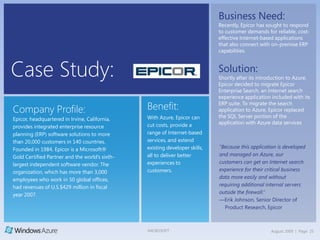
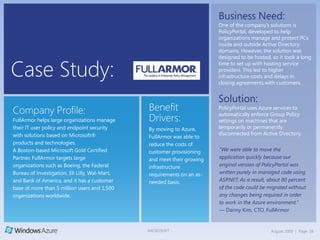
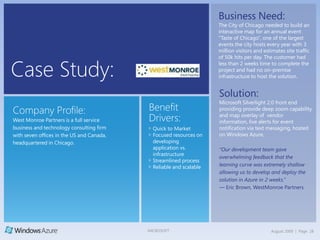
  • #27 One of the company’s solutions is PolicyPortal, developed to help organizations manage and protect PCs both inside and outside Active Directory domains. The application generated a lot of interest from customers. However, the solution was designed to be hosted, so it took a long time to set up with hosting service providers. This led to higher infrastructure costs and delays in closing agreements with customers.
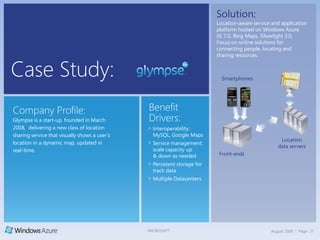
  • #28 Has a set of frontend servers and location servers on the back end – turn out a visual of where you are at any timeWas running on Amazon; Glympse moved this on to the platform ; SQL on the back-end ; silverlightThis is data Tracking solutions solution already existed in a hosted environment. Glympse moved the solution to the cloud, using google maps,