
Eric Nelson | Application Architect | Microsoft UKeric.nelson@microsoft.com | http://bit.ly/ericnelson | http://twitter.com/ericnell
Agenda
The Windows Azure PaaS ...makes it easy and cost effectiveto runyour applications and storeyour datainside Microsoft Data Centresusingexisting skillsand integrate with your existing on-premise applications
7 things that may surprise youAzure is not just about “the next twitter”You can use C++, Java, Ruby, PhP...It is free to tryThere are hundreds of great 3rd party toolsYou can store up to 500TB of dataIt offers a full relational database for £6Millions of developers are “Azure ready”
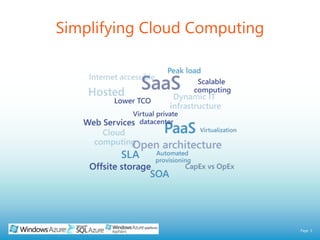
Simplifying Cloud Computing
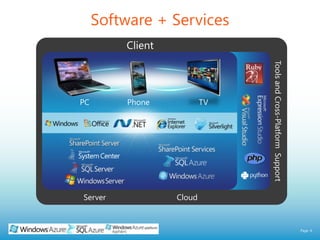
Software + ServicesClientPCPhoneTVTools and Cross-Platform  SupportServerCloud
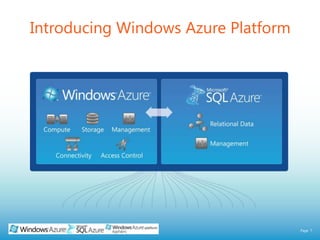
Introducing Windows Azure Platform
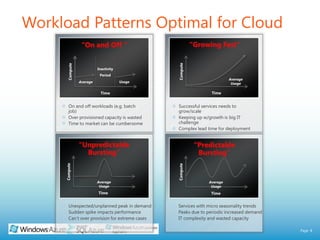
Workload Patterns Optimal for Cloud   “Growing Fast“ “On and Off “  InactivityPeriod Compute Compute Average UsageUsageAverageTime Time On and off workloads (e.g. batch job)Over provisioned capacity is wasted Time to market can be cumbersome Successful services needs to grow/scale  Keeping up w/growth is big IT challenge Complex lead time for deployment“Unpredictable Bursting“  “Predictable Bursting“ Compute Compute Average Usage Average Usage Time Time Unexpected/unplanned peak in demand Sudden spike impacts performance Can’t over provision for extreme cases Services with micro seasonality trends  Peaks due to periodic increased demandIT complexity and wasted capacity
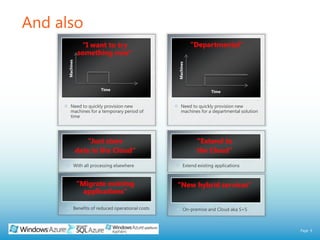
And also “Departmental“ “I want to try something now“  Machines Machines Time Time Need to quickly provision new machines for a temporary period of timeNeed to quickly provision new machines for a departmental solution“Just store data in the Cloud“  “Extend tothe Cloud“  With all processing elsewhereExtend existing applications“Migrate existing applications“  “New hybrid services“  Benefits of reduced operational costsOn-premise and Cloud aka S+S
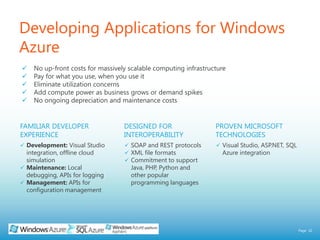
Developing Applications for Windows AzureNo up-front costs for massively scalable computing infrastructure
Pay for what you use, when you use it
Eliminate utilization concerns
Add compute power as business grows or demand spikes
No ongoing depreciation and maintenance costsFAMILIAR DEVELOPER EXPERIENCEDESIGNED FOR INTEROPERABILITYPROVEN MICROSOFT TECHNOLOGIESVisual Studio, ASP.NET, SQL Azure integration
Development: Visual Studio integration, offline cloud simulation
Maintenance: Local debugging, APIs for logging
Management: APIs for configuration management
SOAP and REST protocols
XML file formats
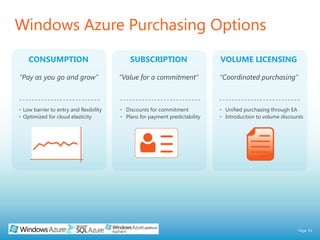
Commitment to support Java, PHP, Python and other popular programming languagesWindows Azure Purchasing OptionsSUBSCRIPTIONCONSUMPTIONVOLUME LICENSING“Pay as you go and grow”“Coordinated purchasing” “Value for a commitment“Low barrier to entry and flexibility

Windows Azure In 30mins for none technical audience

  • 1.
    Eric Nelson |Application Architect | Microsoft UKeric.nelson@microsoft.com | http://bit.ly/ericnelson | http://twitter.com/ericnell
  • 2.
  • 3.
    The Windows AzurePaaS ...makes it easy and cost effectiveto runyour applications and storeyour datainside Microsoft Data Centresusingexisting skillsand integrate with your existing on-premise applications
  • 4.
    7 things thatmay surprise youAzure is not just about “the next twitter”You can use C++, Java, Ruby, PhP...It is free to tryThere are hundreds of great 3rd party toolsYou can store up to 500TB of dataIt offers a full relational database for £6Millions of developers are “Azure ready”
  • 5.
  • 6.
    Software + ServicesClientPCPhoneTVToolsand Cross-Platform SupportServerCloud
  • 7.
  • 8.
    Workload Patterns Optimalfor Cloud “Growing Fast“ “On and Off “ InactivityPeriod Compute Compute Average UsageUsageAverageTime Time On and off workloads (e.g. batch job)Over provisioned capacity is wasted Time to market can be cumbersome Successful services needs to grow/scale Keeping up w/growth is big IT challenge Complex lead time for deployment“Unpredictable Bursting“ “Predictable Bursting“ Compute Compute Average Usage Average Usage Time Time Unexpected/unplanned peak in demand Sudden spike impacts performance Can’t over provision for extreme cases Services with micro seasonality trends Peaks due to periodic increased demandIT complexity and wasted capacity
  • 9.
    And also “Departmental““I want to try something now“ Machines Machines Time Time Need to quickly provision new machines for a temporary period of timeNeed to quickly provision new machines for a departmental solution“Just store data in the Cloud“ “Extend tothe Cloud“ With all processing elsewhereExtend existing applications“Migrate existing applications“ “New hybrid services“ Benefits of reduced operational costsOn-premise and Cloud aka S+S
  • 10.
    Developing Applications forWindows AzureNo up-front costs for massively scalable computing infrastructure
  • 11.
    Pay for whatyou use, when you use it
  • 12.
  • 13.
    Add compute poweras business grows or demand spikes
  • 14.
    No ongoing depreciationand maintenance costsFAMILIAR DEVELOPER EXPERIENCEDESIGNED FOR INTEROPERABILITYPROVEN MICROSOFT TECHNOLOGIESVisual Studio, ASP.NET, SQL Azure integration
  • 15.
    Development: Visual Studiointegration, offline cloud simulation
  • 16.
  • 17.
    Management: APIs forconfiguration management
  • 18.
    SOAP and RESTprotocols
  • 19.
  • 20.
    Commitment to supportJava, PHP, Python and other popular programming languagesWindows Azure Purchasing OptionsSUBSCRIPTIONCONSUMPTIONVOLUME LICENSING“Pay as you go and grow”“Coordinated purchasing” “Value for a commitment“Low barrier to entry and flexibility

Editor's Notes

  • #7 Software-plus-Services is the next logical step in the evolution of computing.  It represents an industry shift toward a design approach that is neither exclusively software-centric nor browser-centric.  Microsoft envisions a world where rich, highly functional and elegant experiences extend from the PC, to the Web, to the devices people use every day. Infrastructure and solutions should extend from the server to the cloud.  Cloud services in the form of Windows Azure and SQL Azure developed hand-in-hand with on-premises server counterparts will deliver much needed choice to enterprise customers—enabling flexibility in developing, scaling, operating and migrating systems that are distributed between the cloud and the enterprise data center.
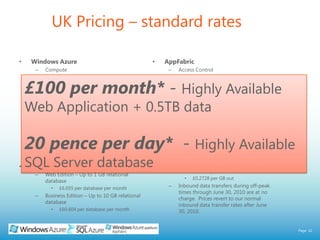
  • #13 £56 per month for 1 node£637 per yearDB – 20pence per day*Approximate – lots of assumptions, blah blah
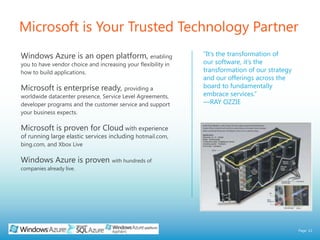
  • #14 First Microsoft purpose-built data centre to accommodate containers on a large scaleCost $500 million, 100,000 square foot facility (10 football fields)40 foot shipping containers can house as many as 2,500 servers Density of 10 times amount of compute in equivalent space in traditional data centreCan deliver an average PUE of 1.22Power Usage Effectiveness benchmark from The Green Grid™ consortium on energy efficiency
  • #21 Update storage graphic here with drives