Migrating your existing Apps to Windows AzureHarish RanganathanDeveloper Evangelist |  Microsoft Corporation India
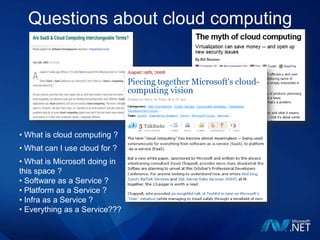
Questions about cloud computing What is cloud computing ?
 What can I use cloud for ?
 What is Microsoft doing in this space ?
 Software as a Service ?
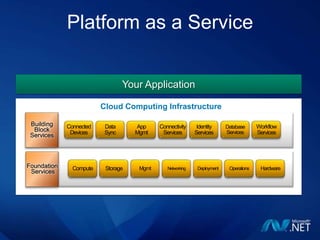
 Platform as a Service ?
 Infra as a Service ?
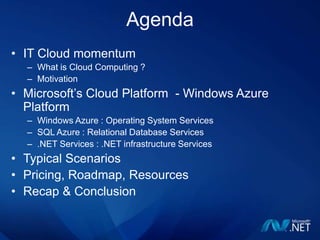
 Everything as a Service???AgendaIT Cloud momentumWhat is Cloud Computing ?MotivationMicrosoft’s Cloud Platform  - Windows Azure PlatformWindows Azure : Operating System ServicesSQL Azure : Relational Database Services.NET Services : .NET infrastructure ServicesTypical ScenariosPricing, Roadmap, Resources Recap & Conclusion
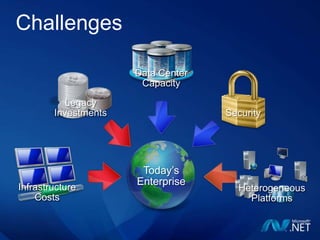
Challenges
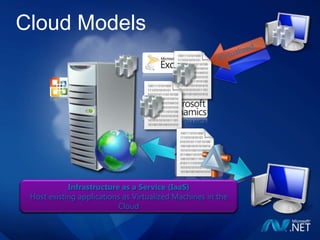
Cloud ModelsVirtualizedSoftware as a Service (SaaS)Subscribe to web editions of traditional packaged applicationsPlatform as a Service (PaaS)Write applications specifically to run on a Cloud platformWeb Based ServicesInternet Web Sites, finished web experiencesApplication Components as a ServiceBuilding block services and features Infrastructure as a Service (IaaS)Host existing applications as Virtualized Machines in the Cloud
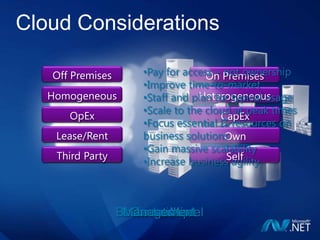
Cloud ConsiderationsPay for access – not ownership
Improve time-to-market
Staff and plan for typical usage
Scale to the cloud at peak times
Focus essential IT resources on business solutions
Gain massive scalability
Increase business agilityOff PremisesOn PremisesOff PremisesHomogeneousHeterogeneousHomogeneousOpExCapExOpExLease/RentOwnLease/RentThird PartySelfThird PartyLocationInfrastructureBusiness ModelOwnershipManagement
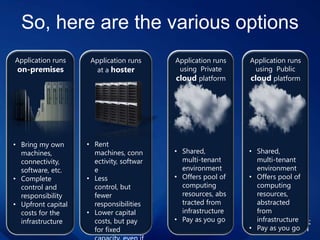
So, here are the various optionsApplication runs on-premisesBuy my own hardware, and manage my own data centerApplication runs on-premisesBring my own machines, connectivity, software, etc.
Complete control and responsibility
Upfront capital costs for the infrastructureApplication runs at a hosterPay someone to host my application using hardware that I specifyApplication runs at a hosterRent machines, connectivity, software
Less control, but fewer responsibilities
Lower capital costs, but pay for fixed capacity, even if idleApplication runs using cloud platformPay someone for a pool of computing resources that can be applied to a set of applicationsApplication runs using  Public cloud platformShared, 	multi-tenant environmentOffers pool of computing resources, abstracted from infrastructure
Pay as you goApplication runs using cloud platformPay someone for a pool of computing resources that can be applied to a set of applicationsApplication runs using  Private cloud platformShared, 	multi-tenant environmentOffers pool of computing resources, abstracted from infrastructure
Pay as you goPlatform as a ServiceYour ApplicationCloud Computing InfrastructureDataSyncAppMgmtIdentity ServicesDatabaseServicesWorkflowServicesConnectivityServicesBuilding Block ServicesConnectedDevicesFoundation ServicesComputeStorageMgmtNetworkingDeploymentOperationsHardware
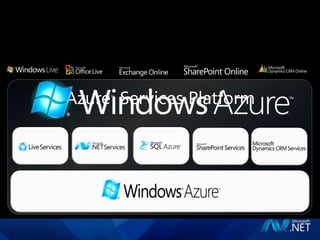
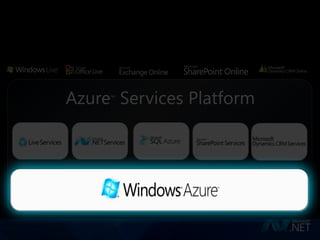
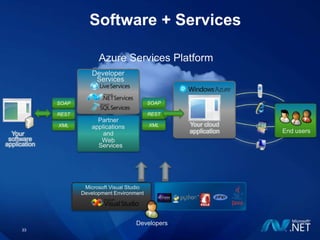
Azure™ Services Platform
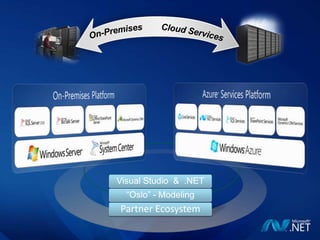
On-PremisesCloud ServicesVisual Studio  &  .NET“Oslo” - ModelingPartner Ecosystem
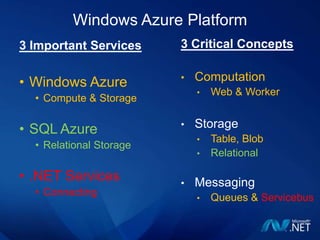
Windows Azure Platform
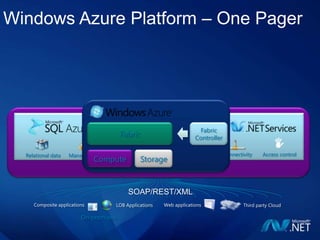
Windows Azure Platform – One PagerFabricFabricControllerDeveloper ExperienceThird party CloudWeb applicationsUse existing skills and tools.ComputeStorageWindows Azure PlatformComputeManagementConnectivityAccess controlStorageManagementRelational dataSOAP/REST/XMLComposite applicationsLOB ApplicationsOn-premises
Azure™ Services Platform
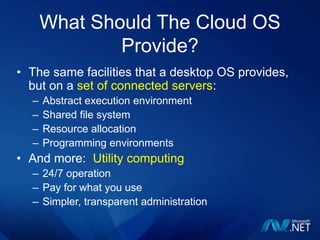
What Should The Cloud OS Provide?The same facilities that a desktop OS provides, but on a set of connected servers:Abstract execution environmentShared file systemResource allocationProgramming environmentsAnd more:  Utility computing24/7 operationPay for what you useSimpler, transparent administration
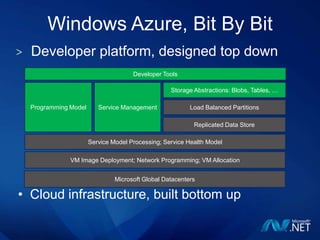
Windows Azure, Bit By BitDeveloper platform, designed top downCloud infrastructure, built bottom upDeveloper ToolsProgramming Model Storage Abstractions: Blobs, Tables, …Service Management Load Balanced PartitionsReplicated Data StoreService Model Processing; Service Health ModelVM Image Deployment; Network Programming; VM Allocation Microsoft Global Datacenters
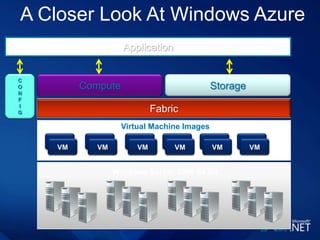
A Closer Look At Windows AzureApplicationCONFIGComputeStorageFabricVirtual Machine ImagesVMVMVMVMVMVMWindows Server 2008 64 Bit
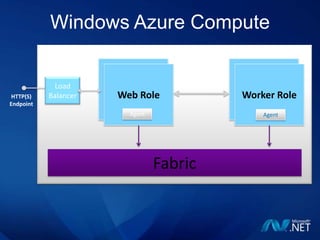
Windows Azure ComputeWeb RoleWorker RoleLoadBalancerHTTP(S)EndpointAgentAgentFabric
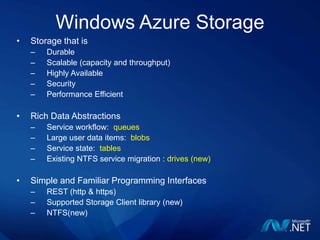
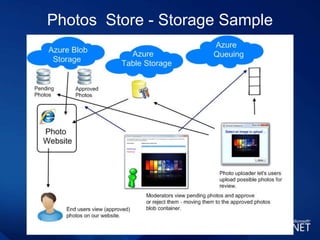
Windows Azure StorageStorage that isDurableScalable (capacity and throughput)Highly AvailableSecurityPerformance EfficientRich Data AbstractionsService workflow:  queuesLarge user data items:  blobsService state:  tablesExisting NTFS service migration : drives (new)Simple and Familiar Programming InterfacesREST (http & https)Supported Storage Client library (new)NTFS(new)
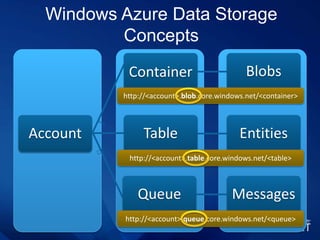
Windows Azure Data Storage Concepts ContainerBlobsAccountTableEntitieshttp://<account>.blob.core.windows.net/<container>QueueMessageshttp://<account>.table.core.windows.net/<table>http://<account>.queue.core.windows.net/<queue>

Migrating Apps To Azure

  • 1.
    Migrating your existingApps to Windows AzureHarish RanganathanDeveloper Evangelist | Microsoft Corporation India
  • 2.
    Questions about cloudcomputing What is cloud computing ?
  • 3.
    What canI use cloud for ?
  • 4.
    What isMicrosoft doing in this space ?
  • 5.
    Software asa Service ?
  • 6.
    Platform asa Service ?
  • 7.
    Infra asa Service ?
  • 8.
    Everything asa Service???AgendaIT Cloud momentumWhat is Cloud Computing ?MotivationMicrosoft’s Cloud Platform - Windows Azure PlatformWindows Azure : Operating System ServicesSQL Azure : Relational Database Services.NET Services : .NET infrastructure ServicesTypical ScenariosPricing, Roadmap, Resources Recap & Conclusion
  • 9.
  • 10.
    Cloud ModelsVirtualizedSoftware asa Service (SaaS)Subscribe to web editions of traditional packaged applicationsPlatform as a Service (PaaS)Write applications specifically to run on a Cloud platformWeb Based ServicesInternet Web Sites, finished web experiencesApplication Components as a ServiceBuilding block services and features Infrastructure as a Service (IaaS)Host existing applications as Virtualized Machines in the Cloud
  • 11.
    Cloud ConsiderationsPay foraccess – not ownership
  • 12.
  • 13.
    Staff and planfor typical usage
  • 14.
    Scale to thecloud at peak times
  • 15.
    Focus essential ITresources on business solutions
  • 16.
  • 17.
    Increase business agilityOffPremisesOn PremisesOff PremisesHomogeneousHeterogeneousHomogeneousOpExCapExOpExLease/RentOwnLease/RentThird PartySelfThird PartyLocationInfrastructureBusiness ModelOwnershipManagement
  • 18.
    So, here arethe various optionsApplication runs on-premisesBuy my own hardware, and manage my own data centerApplication runs on-premisesBring my own machines, connectivity, software, etc.
  • 19.
    Complete control andresponsibility
  • 20.
    Upfront capital costsfor the infrastructureApplication runs at a hosterPay someone to host my application using hardware that I specifyApplication runs at a hosterRent machines, connectivity, software
  • 21.
    Less control, butfewer responsibilities
  • 22.
    Lower capital costs,but pay for fixed capacity, even if idleApplication runs using cloud platformPay someone for a pool of computing resources that can be applied to a set of applicationsApplication runs using Public cloud platformShared, multi-tenant environmentOffers pool of computing resources, abstracted from infrastructure
  • 23.
    Pay as yougoApplication runs using cloud platformPay someone for a pool of computing resources that can be applied to a set of applicationsApplication runs using Private cloud platformShared, multi-tenant environmentOffers pool of computing resources, abstracted from infrastructure
  • 24.
    Pay as yougoPlatform as a ServiceYour ApplicationCloud Computing InfrastructureDataSyncAppMgmtIdentity ServicesDatabaseServicesWorkflowServicesConnectivityServicesBuilding Block ServicesConnectedDevicesFoundation ServicesComputeStorageMgmtNetworkingDeploymentOperationsHardware
  • 26.
  • 27.
    On-PremisesCloud ServicesVisual Studio & .NET“Oslo” - ModelingPartner Ecosystem
  • 28.
  • 29.
    Windows Azure Platform– One PagerFabricFabricControllerDeveloper ExperienceThird party CloudWeb applicationsUse existing skills and tools.ComputeStorageWindows Azure PlatformComputeManagementConnectivityAccess controlStorageManagementRelational dataSOAP/REST/XMLComposite applicationsLOB ApplicationsOn-premises
  • 30.
  • 31.
    What Should TheCloud OS Provide?The same facilities that a desktop OS provides, but on a set of connected servers:Abstract execution environmentShared file systemResource allocationProgramming environmentsAnd more: Utility computing24/7 operationPay for what you useSimpler, transparent administration
  • 32.
    Windows Azure, BitBy BitDeveloper platform, designed top downCloud infrastructure, built bottom upDeveloper ToolsProgramming Model Storage Abstractions: Blobs, Tables, …Service Management Load Balanced PartitionsReplicated Data StoreService Model Processing; Service Health ModelVM Image Deployment; Network Programming; VM Allocation Microsoft Global Datacenters
  • 33.
    A Closer LookAt Windows AzureApplicationCONFIGComputeStorageFabricVirtual Machine ImagesVMVMVMVMVMVMWindows Server 2008 64 Bit
  • 34.
    Windows Azure ComputeWebRoleWorker RoleLoadBalancerHTTP(S)EndpointAgentAgentFabric
  • 35.
    Windows Azure StorageStoragethat isDurableScalable (capacity and throughput)Highly AvailableSecurityPerformance EfficientRich Data AbstractionsService workflow: queuesLarge user data items: blobsService state: tablesExisting NTFS service migration : drives (new)Simple and Familiar Programming InterfacesREST (http & https)Supported Storage Client library (new)NTFS(new)
  • 36.
    Windows Azure DataStorage Concepts ContainerBlobsAccountTableEntitieshttp://<account>.blob.core.windows.net/<container>QueueMessageshttp://<account>.table.core.windows.net/<table>http://<account>.queue.core.windows.net/<queue>

Editor's Notes

  • #15 9422331080
  • #34 Take your application to the next level