State of the Future Index  and Text Mining   Second Semester Class 3 The Azerbaijan State Economic University  March 4, 2011 Ted Gordon, Senior Fellow and Jerome Glenn, Executive Director,  The Millennium Project Alan Porter, Director of R&D, Search Technology, Inc. & Co-Director,  Technology Policy & Assessment Center Georgia Tech
Assignments From Last Session Create a Futures Wheel on the technology you selected Read Chapter on State of the Future Index Read Text Scanning Visit  www.gccsr.org  (collective intelligence example) SOFI Assignment Peace Scenarios Assignment: What are the conditions for Peace and what are previous agreements
Today’s Topics The concept of SOFI  The role of Trend Impact Analysis The role of Real Time Delphi Text Mining
The Class Project  (Session 1) Produce an actual (not just a demonstration) State of the Future Index for Azerbaijan. This requires: Understanding data availability Choosing variables for the SOFI and collecting data Identifying future events that could change the course of the variables Forecasting the variables Computing the SOFI Finding policy implications
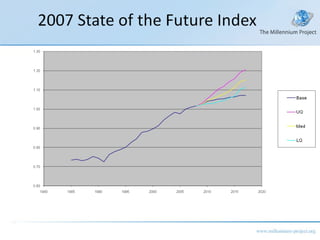
State of the Future Index A synthesis of variables to help answer the question “Is the outlook for the future improving?” A tool for Policy analysis Improving discussion about the future Education National comparisons
The Concept Developed by the Millennium Project in 2002 A dynamic method for studying whether the future seems to be improving or not and for testing the effects of policy on the future outlook Combines 20-30 variables important to the world or the country
Examples of Indexes Human Development Index Dow Jones Industrial Average Index of Leading Indicators
The State of the Future Index (SOFI) Constructed of weighted variables such as life expectancy and employment. Retrospective 20 years; prospective 10 years Judgments about variables, weights, expectations, and future developments For the world index, experts were recommended by the Millennium Project’s Nodes.
Indexes: Caveats Indexes may lead to oversimplification and loss of detail An index may hide cultural differences Data behind the index must be preserved and transparent Apparent precision may be mistaken for accuracy
Three Types of SOFI Global (comprised of global variables) National comparison (comprised of a standard set of variables, national data) National focus (comprised of variables of nation’s choosing, national data)
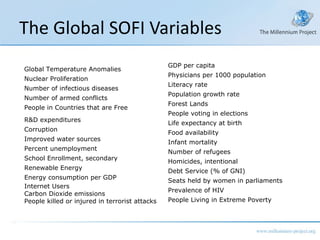
The Global SOFI Variables R&D expenditures  Corruption  Improved water sources  Percent unemployment  School Enrollment, secondary  Renewable Energy   Energy consumption per GDP  Internet Users  Carbon Dioxide emissions People killed or injured in terrorist attacks GDP per capita  Physicians per 1000 population  Literacy rate Population growth rate  Forest Lands  People voting in elections  Life expectancy at birth  Food availability  Infant mortality  Number of refugees Homicides, intentional  Debt Service (% of GNI) Seats held by women in parliaments  Prevalence of HIV  People Living in Extreme Poverty  Global Temperature Anomalies Nuclear Proliferation Number of infectious diseases Number of armed conflicts   People in Countries that are Free
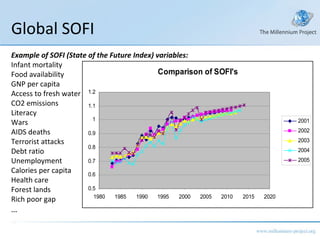
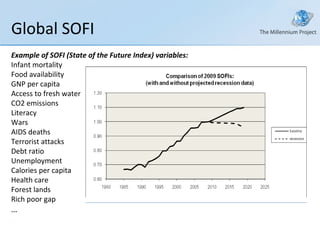
Global SOFI  Example of SOFI (State of the Future Index) variables: Infant mortality Food availability GNP per capita  Access to fresh water CO2 emissions Literacy Wars AIDS deaths Terrorist attacks Debt ratio Unemployment Calories per capita Health care Forest lands Rich poor gap …
.
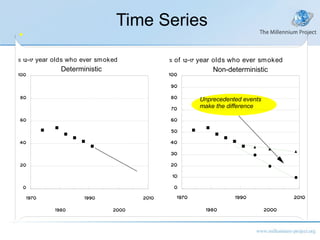
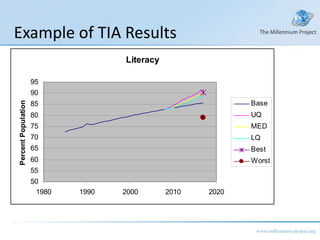
Trend Impact Analysis Used to assess consequences of future developments on the course of the extrapolations of the variables Developments expressed in probabilistic terms Impacts in terms of percentage change in the end point of a variable Monte Carlo solution
Examples of Developments A nuclear accident such as Three Mile Island (causes many nuclear nations to de-nuclearize). (10%) A very good, fast $150 laptop computer becomes available everywhere. (65%) Advent of a “teachers without borders” movement (50,000 new teachers in the field) (30%) A pandemic of the scale of HIV/AIDS (30%) At least 10 countries introduce effective policies designed to increase birth rates to avoid population implosion (75%) Automation and robotics increase productivity 25% in enough countries to make “jobless" economic growth (50%) Availability of a cheap effective anti-aging therapy (35%) Bad weather (storms, hurricanes, floods) cause wide spread crop failures in at least one year (25%)
Example of TIA Results
 
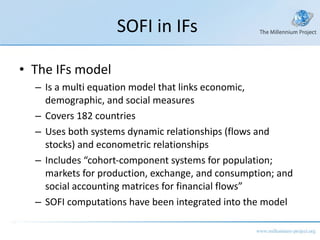
SOFI in IFs The IFs model Is a multi equation model that links economic, demographic, and social measures Covers 182 countries Uses both systems dynamic relationships (flows and stocks) and econometric relationships Includes “cohort-component systems for population; markets for production, exchange, and consumption; and social accounting matrices for financial flows” SOFI computations have been integrated into the model
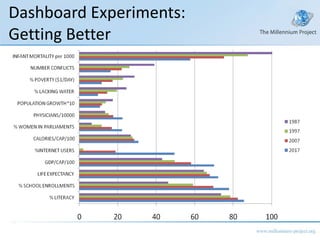
Dashboard Experiments:  Getting Better
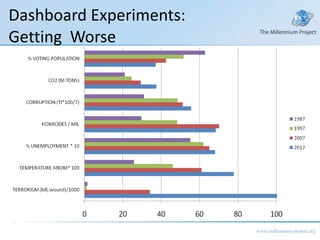
Dashboard Experiments:  Getting  Worse
Global SOFI  Example of SOFI (State of the Future Index) variables: Infant mortality Food availability GNP per capita  Access to fresh water CO2 emissions Literacy Wars AIDS deaths Terrorist attacks Debt ratio Unemployment Calories per capita Health care Forest lands Rich poor gap …
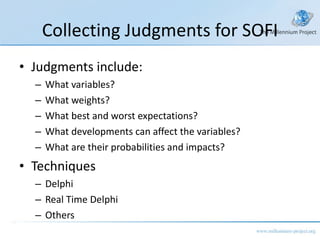
Collecting Judgments for SOFI Judgments include: What variables? What weights? What best and worst expectations? What developments can affect the variables? What are their probabilities and impacts? Techniques Delphi Real Time Delphi Others
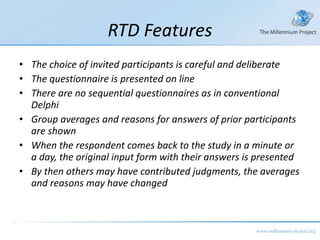
RTD Features The choice of invited participants is careful and deliberate The questionnaire is presented on line There are no sequential questionnaires as in conventional Delphi Group averages and reasons for answers of prior participants are shown When the respondent comes back to the study in a minute or a day, the original input form with their answers is presented By then others may have contributed judgments, the averages and reasons may have changed
An  Azerbaijan Student RTD Collects judgments about variables in SOFI URL:  www.realtimedelphi.net Sign on Use code “azer”  (no quotes, lower case) You may answer the questions
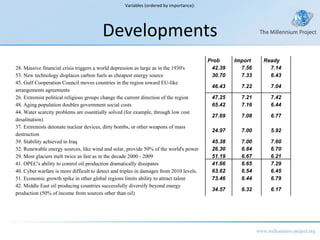
Developments Variables (ordered by importance): Prob Import Ready 28. Massive financial crisis triggers a world depression as large as in the 1930's 42.39 7.56 7.14 53. New technology displaces carbon fuels as cheapest energy source  30.70 7.33 6.43 45. Gulf Cooperation Council moves countries in the region toward EU-like arrangements agreements  46.43 7.22 7.04 26. Extremist political religious groups change the current direction of the region  47.25 7.21 7.42 48. Aging population doubles government social costs  65.42 7.16 6.44 44. Water scarcity problems are essentially solved (for example, through low cost desalination)  27.69 7.08 6.77 37. Extremists detonate nuclear devices, dirty bombs, or other weapons of mass destruction  24.97 7.00 5.92 39. Stability achieved in Iraq  45.38 7.00 7.60 32. Renewable energy sources, like wind and solar, provide 50% of the world's power  26.30 6.84 6.70 29. Most glaciers melt twice as fast as in the decade 2000 - 2009 51.19 6.67 6.21 41. OPEC's ability to control oil production dramatically dissipates 41.66 6.65 7.29 40. Cyber warfare is more difficult to detect and triples in damages from 2010 levels.  63.62 6.54 6.45 51. Economic growth spike in other global regions limits ability to attract talent 73.46 6.44 6.79 42. Middle East oil producing countries successfully diversify beyond energy production (50% of income from sources other than oil)  34.57 6.32 6.17
Resources Real Time Delphi on line realtimedelphi.net  code “azer” Millennium Project reports  <www.stateof thefuture.org> Tutorials for Real Time Delphi and SOFI <http://www.mpcollab.org/learning/course/view.php?id=3 > International Futures (IFs)  http://www.ifs.du.edu/
Why Tech Mining? Welcome to the age of too much information. We need to treat:  text as data to gain intelligence. Mine “ST&I” [Science, Technology & Innovation] information resources to answer technology management questions =  Tech Mining. Enable Open Innovation © 2009 Search Technology, Inc.
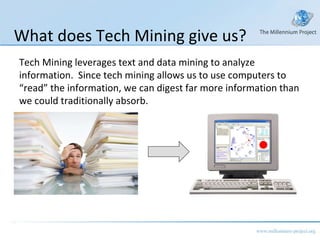
Tech Mining leverages text and data mining to analyze information.  Since tech mining allows us to use computers to “read” the information, we can digest far more information than we could traditionally absorb. What does Tech Mining give us?
Text and data mining techniques are good at addressing: WHO? WHAT? WHEN? WHERE? Additional questions usually require more human insight: HOW? WHY? Types of Questions
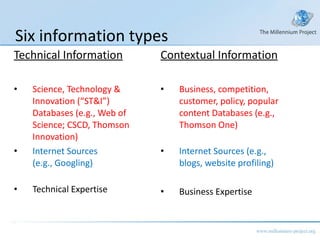
Technical Information Science, Technology & Innovation (“ST&I”) Databases (e.g., Web of Science; CSCD, Thomson Innovation) Internet Sources (e.g., Googling) Technical Expertise Contextual Information Business, competition, customer, policy, popular content Databases (e.g., Thomson One) Internet Sources (e.g., blogs, website profiling) Business Expertise Six information types
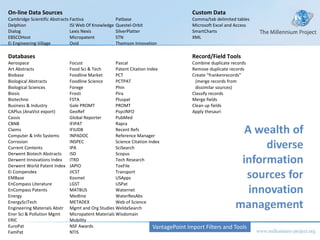
VantagePoint Import Filters and Tools On-line Data Sources Custom Data Cambridge Scientific Abstracts Factiva Patbase Comma/tab delimited tables Delphion  ISI Web Of Knowledge Questel-Orbit Microsoft Excel and Access Dialog Lexis Nexis SilverPlatter  SmartCharts EBSCOHost  Micropatent STN XML Ei Engineering Village Ovid Thomson Innovation Databases Record/Field Tools Aerospace Focust  Pascal Combine duplicate records Art Abstracts Food Sci & Tech Patent Citation Index Remove duplicate records Biobase Foodline Market PCT Create “frankenrecords” Biological Abstracts Foodline Science PCTPAT (merge records from Biological Sciences Forege  Phin dissimilar sources) Biosis Frosti  Pira Classify records Biotechno FSTA Pluspat Merge fields Business & Industry Gale PROMT PROMT Clean up fields CAPlus (AnaVist export) GeoRef  PsycINFO Apply thesauri Cassis Global Reporter PubMed CBNB IFIPAT Rapra  Claims IFIUDB Recent Refs Computer & Info Systems INPADOC Reference Manager Corrosion INSPEC Science Citation Index Current Contents IPA SciSearch Derwent Biotech Abstracts ISD Scopus Derwent Innovations Index ITRD Tech Research Derwent World Patent Index JAPIO ToxFile  Ei Compendex JICST Transport EMBase Kosmet USApps EnCompass Literature LGST USPat  EnCompass Patents MATBUS Waternet Energy Medline WaterResAbs EnergySciTech METADEX Web of Science Engineering Materials Abstr  Mgmt and Org Studies WeldaSearch  Envr Sci & Pollution Mgmt  Micropatent Materials Wisdomain  ERIC Mobility EuroPat  NSF Awards FamPat  NTIS
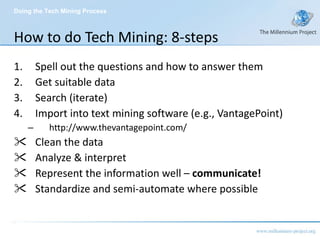
How to do Tech Mining: 8-steps Spell out the questions and how to answer them Get suitable data Search (iterate) Import into text mining software (e.g., VantagePoint) http://www.thevantagepoint.com/ Clean the data Analyze & interpret  Represent the information well –  communicate! Standardize and semi-automate where possible Doing the Tech Mining Process
Sample Applications Developments for use in TIA, a step in SOFI R&D Portfolio Management Research Evaluation Research Profiling Tracking R&D over time Research Network Analyses Monitoring Research Knowledge Flows Geo-mapping ST&I Indicators
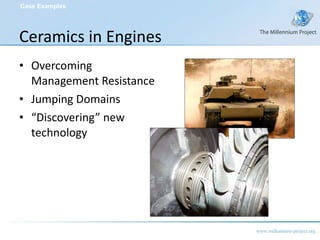
Ceramics in Engines Overcoming Management Resistance Jumping Domains “ Discovering” new technology Case Examples
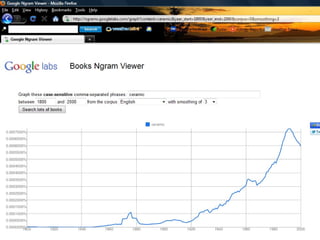
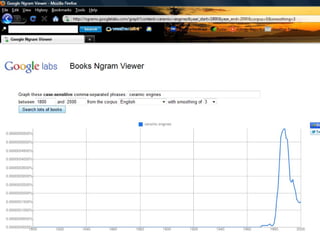
A Success Story:  Ceramics Save Tax Dollars TARDEC (Tank-Automotive Research, Development & Engineering Center)  Task in 1996:  Reassess a “loser technology” – ceramics for automotive engine applications R&D Profile:  Amount of activity declines But -- Uncovers clues of significant maturation Case Examples
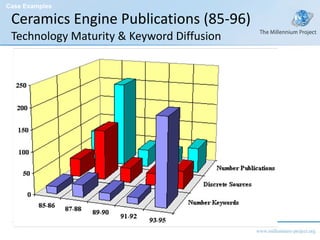
Ceramics Engine Publications (85-96) Technology Maturity & Keyword Diffusion Case Examples


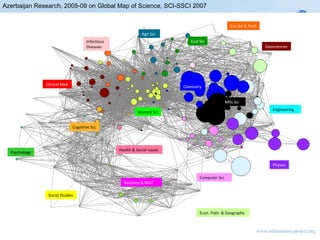
Cognitive Sci. Agri Sci Biomed Sci Chemistry Physics Engineering Env Sci & Tech Mtls Sci Infectious Diseases Psychology Social Studies Clinical Med Computer Sci. Business & MGT Geosciences Ecol Sci Econ. Polit. & Geography Health & Social Issues Azerbaijan Research, 2005-09 on Global Map of Science, SCI-SSCI 2007
Research Profile: Azerbaijan 2005-09 by Disciplines (top 5) Case Examples Macro-Discipline Author Affiliations Key Terms Authors Year   Top 3 Top 5 Top 3 2008-09 Chemistry[475] Natl Acad Sci Azerbaijan [119] Baku State Univ [95] Azerbaijan Acad Sci [48] synthesis [72] thermodynamic properties [27] Density [24] Water [23] methanol [21] Abdulagatov, I M [25] Magerramov, A M [19] Chyragov, F M [18] 48% of 475 Materials Sci[382] Azerbaijan Acad Sci [95] Baku State Univ [66] Azerbaijan Natl Acad Sci [64] effect [29] TlInS2 [19] Incommensurate phase [17] CRYSTALS [17] SINGLE-CRYSTALS [14] Suleymanov, R A [16] Altindal, S [14] Tagiev, O B [13] Mammadov, T S [13] 51% of 382 Engineering[333] Natl Acad Sci Azerbaijan [83] Baku State Univ [74] Azerbaijan Acad Sci [38] methanol [14] Initial stresses [11] sufficient conditions [10] thermodynamic properties [10] approximation [10] boundedness [10] Akbarov, S D [22] Guliyev, V S [16] Khanmamedov, A K [9] Abdulagatov, I M [9] Nasibov, S M [9] 50% of 333 Physics[231] Azerbaijan Acad Sci [58] Baku State Univ [47] Azerbaijan Natl Acad Sci [35] MODEL [22] PHYSICS [12] SCATTERING [10] VARIABILITY [10] SYSTEMS [9] Shahverdiev, E M [13] Shore, K A [13] Aliev, T M [12] Sultansoy, S [12] 51% of 231 Biomed Sci[105] Baku State Univ [27] Azerbaijan Med Univ [9] Azerbaijan Acad Sci [7] EFFICIENCY [10] sturgeons [8] diencephalon [7] CYTOARCHITECTONIC ANALYSIS [7] Azerbaijan [7] EXPRESSION [7] organization [7] Zeynalov, R [9] Musayev, I [9] Rustamov, E K [8] Dadasheva, N [8] 39% of 105
Research Profile: Baku State University – 5 Researchers Case Examples Authors Subject Category Key Terms Authors Year   Top 5 Items Top 5 Items Top 5 Items 2008-09 Magerramov, A M[19] Chemistry, Applied [8] Chemistry, Organic [7] Chemistry, Physical [3] Materials Science, Multidisciplinary [2] Optics [2] reaction [9] synthesis [9] DERIVATIVES [4] reactions [3] formation [3] Magerramov, A M [19] Allakhverdiev, M A [9] Mamedov, I G [5] Bairamov, M R [5] Farzaliev, V M [4] Rzaeva, I A [4] 68% of 19 Chyragov, F M[18] Chemistry, Analytical [14] Chemistry, Inorganic & Nuclear [4] complexation [15] photometric determination [11] stability constants [8] Chyragov, F M [18] Gadzhieva, S R [12] Makhmudov, K T [6] Alieva, R A [5] Guseinov, F E [4] 17% of 18 Allakhverdiev, M A[14] Chemistry, Applied [8] Chemistry, Organic [5] Chemistry, Physical [3] Energy & Fuels [2] Engineering, Chemical [2] Engineering, Petroleum [2] synthesis [8] reaction [6] antioxidant activity [3] cumene [3] Allakhverdiev, M A [14] Magerramov, A M [9] Farzaliev, V M [6] Rzaeva, I A [6] Guseinova, A T [4] 79% of 14 Gadzhieva, S R[14] Chemistry, Analytical [9] Chemistry, Inorganic & Nuclear [5] complexation [11] photometric determination [8] stability constants [6] Gadzhieva, S R [14] Chyragov, F M [12] Makhmudov, K T [6] Guseinov, F E [4] Pashaev, F G [3] 29% of 14 Babanly, M B[12] Materials Science, Multidisciplinary [8] Electrochemistry [2] Chemistry, Inorganic & Nuclear [2] X-ray diffraction [7] thermodynamic properties [6] differential thermal analysis [6] standard entropies [5] Babanly, M B [12] Babanly, N B [2] Sadygov, F M [2] Shykhyev, Y M [2] Imamalieva, S Z [2] Yusibov, Y A [2] 100% of 12
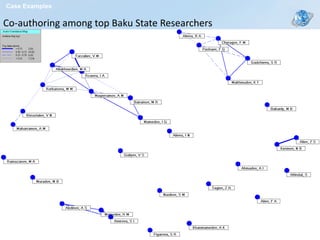
Co-authoring among top Baku State Researchers Case Examples
Assignments Lecture 4, March 11: Delphi, Cross Impact and Trend Impact Analysis; read appropriate chapters in FRMv3 Go to Real Time Delphi on line  www.realtimedelphi.net ; Code: azer Register to participate.  Provide answers to given questions Generate list of variables and developments to consider Peace Scenarios Assignment: Based on the conditions for Peace and previous agreements, generate several “causal paths” by which peace, in retrospect, may have been reached.

Azerbaijan2.2.3 sofi and text scanning

  • 1.
    State of theFuture Index and Text Mining Second Semester Class 3 The Azerbaijan State Economic University March 4, 2011 Ted Gordon, Senior Fellow and Jerome Glenn, Executive Director, The Millennium Project Alan Porter, Director of R&D, Search Technology, Inc. & Co-Director, Technology Policy & Assessment Center Georgia Tech
  • 2.
    Assignments From LastSession Create a Futures Wheel on the technology you selected Read Chapter on State of the Future Index Read Text Scanning Visit www.gccsr.org (collective intelligence example) SOFI Assignment Peace Scenarios Assignment: What are the conditions for Peace and what are previous agreements
  • 3.
    Today’s Topics Theconcept of SOFI The role of Trend Impact Analysis The role of Real Time Delphi Text Mining
  • 4.
    The Class Project (Session 1) Produce an actual (not just a demonstration) State of the Future Index for Azerbaijan. This requires: Understanding data availability Choosing variables for the SOFI and collecting data Identifying future events that could change the course of the variables Forecasting the variables Computing the SOFI Finding policy implications
  • 5.
    State of theFuture Index A synthesis of variables to help answer the question “Is the outlook for the future improving?” A tool for Policy analysis Improving discussion about the future Education National comparisons
  • 6.
    The Concept Developedby the Millennium Project in 2002 A dynamic method for studying whether the future seems to be improving or not and for testing the effects of policy on the future outlook Combines 20-30 variables important to the world or the country
  • 7.
    Examples of IndexesHuman Development Index Dow Jones Industrial Average Index of Leading Indicators
  • 8.
    The State ofthe Future Index (SOFI) Constructed of weighted variables such as life expectancy and employment. Retrospective 20 years; prospective 10 years Judgments about variables, weights, expectations, and future developments For the world index, experts were recommended by the Millennium Project’s Nodes.
  • 9.
    Indexes: Caveats Indexesmay lead to oversimplification and loss of detail An index may hide cultural differences Data behind the index must be preserved and transparent Apparent precision may be mistaken for accuracy
  • 10.
    Three Types ofSOFI Global (comprised of global variables) National comparison (comprised of a standard set of variables, national data) National focus (comprised of variables of nation’s choosing, national data)
  • 11.
    The Global SOFIVariables R&D expenditures  Corruption  Improved water sources  Percent unemployment  School Enrollment, secondary  Renewable Energy   Energy consumption per GDP  Internet Users  Carbon Dioxide emissions People killed or injured in terrorist attacks GDP per capita  Physicians per 1000 population  Literacy rate Population growth rate  Forest Lands  People voting in elections  Life expectancy at birth  Food availability  Infant mortality  Number of refugees Homicides, intentional  Debt Service (% of GNI) Seats held by women in parliaments  Prevalence of HIV  People Living in Extreme Poverty Global Temperature Anomalies Nuclear Proliferation Number of infectious diseases Number of armed conflicts   People in Countries that are Free
  • 12.
    Global SOFI Example of SOFI (State of the Future Index) variables: Infant mortality Food availability GNP per capita Access to fresh water CO2 emissions Literacy Wars AIDS deaths Terrorist attacks Debt ratio Unemployment Calories per capita Health care Forest lands Rich poor gap …
  • 13.
  • 14.
    Trend Impact AnalysisUsed to assess consequences of future developments on the course of the extrapolations of the variables Developments expressed in probabilistic terms Impacts in terms of percentage change in the end point of a variable Monte Carlo solution
  • 15.
    Examples of DevelopmentsA nuclear accident such as Three Mile Island (causes many nuclear nations to de-nuclearize). (10%) A very good, fast $150 laptop computer becomes available everywhere. (65%) Advent of a “teachers without borders” movement (50,000 new teachers in the field) (30%) A pandemic of the scale of HIV/AIDS (30%) At least 10 countries introduce effective policies designed to increase birth rates to avoid population implosion (75%) Automation and robotics increase productivity 25% in enough countries to make “jobless&quot; economic growth (50%) Availability of a cheap effective anti-aging therapy (35%) Bad weather (storms, hurricanes, floods) cause wide spread crop failures in at least one year (25%)
  • 16.
  • 17.
  • 18.
    SOFI in IFsThe IFs model Is a multi equation model that links economic, demographic, and social measures Covers 182 countries Uses both systems dynamic relationships (flows and stocks) and econometric relationships Includes “cohort-component systems for population; markets for production, exchange, and consumption; and social accounting matrices for financial flows” SOFI computations have been integrated into the model
  • 19.
  • 20.
  • 21.
    Global SOFI Example of SOFI (State of the Future Index) variables: Infant mortality Food availability GNP per capita Access to fresh water CO2 emissions Literacy Wars AIDS deaths Terrorist attacks Debt ratio Unemployment Calories per capita Health care Forest lands Rich poor gap …
  • 22.
    Collecting Judgments forSOFI Judgments include: What variables? What weights? What best and worst expectations? What developments can affect the variables? What are their probabilities and impacts? Techniques Delphi Real Time Delphi Others
  • 23.
    RTD Features Thechoice of invited participants is careful and deliberate The questionnaire is presented on line There are no sequential questionnaires as in conventional Delphi Group averages and reasons for answers of prior participants are shown When the respondent comes back to the study in a minute or a day, the original input form with their answers is presented By then others may have contributed judgments, the averages and reasons may have changed
  • 24.
    An AzerbaijanStudent RTD Collects judgments about variables in SOFI URL: www.realtimedelphi.net Sign on Use code “azer” (no quotes, lower case) You may answer the questions
  • 25.
    Developments Variables (orderedby importance): Prob Import Ready 28. Massive financial crisis triggers a world depression as large as in the 1930's 42.39 7.56 7.14 53. New technology displaces carbon fuels as cheapest energy source 30.70 7.33 6.43 45. Gulf Cooperation Council moves countries in the region toward EU-like arrangements agreements  46.43 7.22 7.04 26. Extremist political religious groups change the current direction of the region  47.25 7.21 7.42 48. Aging population doubles government social costs  65.42 7.16 6.44 44. Water scarcity problems are essentially solved (for example, through low cost desalination)  27.69 7.08 6.77 37. Extremists detonate nuclear devices, dirty bombs, or other weapons of mass destruction  24.97 7.00 5.92 39. Stability achieved in Iraq  45.38 7.00 7.60 32. Renewable energy sources, like wind and solar, provide 50% of the world's power  26.30 6.84 6.70 29. Most glaciers melt twice as fast as in the decade 2000 - 2009 51.19 6.67 6.21 41. OPEC's ability to control oil production dramatically dissipates 41.66 6.65 7.29 40. Cyber warfare is more difficult to detect and triples in damages from 2010 levels.  63.62 6.54 6.45 51. Economic growth spike in other global regions limits ability to attract talent 73.46 6.44 6.79 42. Middle East oil producing countries successfully diversify beyond energy production (50% of income from sources other than oil)  34.57 6.32 6.17
  • 26.
    Resources Real TimeDelphi on line realtimedelphi.net code “azer” Millennium Project reports <www.stateof thefuture.org> Tutorials for Real Time Delphi and SOFI <http://www.mpcollab.org/learning/course/view.php?id=3 > International Futures (IFs) http://www.ifs.du.edu/
  • 27.
    Why Tech Mining?Welcome to the age of too much information. We need to treat: text as data to gain intelligence. Mine “ST&I” [Science, Technology & Innovation] information resources to answer technology management questions = Tech Mining. Enable Open Innovation © 2009 Search Technology, Inc.
  • 28.
    Tech Mining leveragestext and data mining to analyze information. Since tech mining allows us to use computers to “read” the information, we can digest far more information than we could traditionally absorb. What does Tech Mining give us?
  • 29.
    Text and datamining techniques are good at addressing: WHO? WHAT? WHEN? WHERE? Additional questions usually require more human insight: HOW? WHY? Types of Questions
  • 30.
    Technical Information Science,Technology & Innovation (“ST&I”) Databases (e.g., Web of Science; CSCD, Thomson Innovation) Internet Sources (e.g., Googling) Technical Expertise Contextual Information Business, competition, customer, policy, popular content Databases (e.g., Thomson One) Internet Sources (e.g., blogs, website profiling) Business Expertise Six information types
  • 31.
    VantagePoint Import Filtersand Tools On-line Data Sources Custom Data Cambridge Scientific Abstracts Factiva Patbase Comma/tab delimited tables Delphion ISI Web Of Knowledge Questel-Orbit Microsoft Excel and Access Dialog Lexis Nexis SilverPlatter SmartCharts EBSCOHost Micropatent STN XML Ei Engineering Village Ovid Thomson Innovation Databases Record/Field Tools Aerospace Focust Pascal Combine duplicate records Art Abstracts Food Sci & Tech Patent Citation Index Remove duplicate records Biobase Foodline Market PCT Create “frankenrecords” Biological Abstracts Foodline Science PCTPAT (merge records from Biological Sciences Forege Phin dissimilar sources) Biosis Frosti Pira Classify records Biotechno FSTA Pluspat Merge fields Business & Industry Gale PROMT PROMT Clean up fields CAPlus (AnaVist export) GeoRef PsycINFO Apply thesauri Cassis Global Reporter PubMed CBNB IFIPAT Rapra Claims IFIUDB Recent Refs Computer & Info Systems INPADOC Reference Manager Corrosion INSPEC Science Citation Index Current Contents IPA SciSearch Derwent Biotech Abstracts ISD Scopus Derwent Innovations Index ITRD Tech Research Derwent World Patent Index JAPIO ToxFile Ei Compendex JICST Transport EMBase Kosmet USApps EnCompass Literature LGST USPat EnCompass Patents MATBUS Waternet Energy Medline WaterResAbs EnergySciTech METADEX Web of Science Engineering Materials Abstr Mgmt and Org Studies WeldaSearch Envr Sci & Pollution Mgmt Micropatent Materials Wisdomain ERIC Mobility EuroPat NSF Awards FamPat NTIS
  • 32.
    How to doTech Mining: 8-steps Spell out the questions and how to answer them Get suitable data Search (iterate) Import into text mining software (e.g., VantagePoint) http://www.thevantagepoint.com/ Clean the data Analyze & interpret Represent the information well – communicate! Standardize and semi-automate where possible Doing the Tech Mining Process
  • 33.
    Sample Applications Developmentsfor use in TIA, a step in SOFI R&D Portfolio Management Research Evaluation Research Profiling Tracking R&D over time Research Network Analyses Monitoring Research Knowledge Flows Geo-mapping ST&I Indicators
  • 34.
    Ceramics in EnginesOvercoming Management Resistance Jumping Domains “ Discovering” new technology Case Examples
  • 35.
    A Success Story: Ceramics Save Tax Dollars TARDEC (Tank-Automotive Research, Development & Engineering Center) Task in 1996: Reassess a “loser technology” – ceramics for automotive engine applications R&D Profile: Amount of activity declines But -- Uncovers clues of significant maturation Case Examples
  • 36.
    Ceramics Engine Publications(85-96) Technology Maturity & Keyword Diffusion Case Examples
  • 37.
  • 38.
  • 39.
  • 40.
    Cognitive Sci. AgriSci Biomed Sci Chemistry Physics Engineering Env Sci & Tech Mtls Sci Infectious Diseases Psychology Social Studies Clinical Med Computer Sci. Business & MGT Geosciences Ecol Sci Econ. Polit. & Geography Health & Social Issues Azerbaijan Research, 2005-09 on Global Map of Science, SCI-SSCI 2007
  • 41.
    Research Profile: Azerbaijan2005-09 by Disciplines (top 5) Case Examples Macro-Discipline Author Affiliations Key Terms Authors Year   Top 3 Top 5 Top 3 2008-09 Chemistry[475] Natl Acad Sci Azerbaijan [119] Baku State Univ [95] Azerbaijan Acad Sci [48] synthesis [72] thermodynamic properties [27] Density [24] Water [23] methanol [21] Abdulagatov, I M [25] Magerramov, A M [19] Chyragov, F M [18] 48% of 475 Materials Sci[382] Azerbaijan Acad Sci [95] Baku State Univ [66] Azerbaijan Natl Acad Sci [64] effect [29] TlInS2 [19] Incommensurate phase [17] CRYSTALS [17] SINGLE-CRYSTALS [14] Suleymanov, R A [16] Altindal, S [14] Tagiev, O B [13] Mammadov, T S [13] 51% of 382 Engineering[333] Natl Acad Sci Azerbaijan [83] Baku State Univ [74] Azerbaijan Acad Sci [38] methanol [14] Initial stresses [11] sufficient conditions [10] thermodynamic properties [10] approximation [10] boundedness [10] Akbarov, S D [22] Guliyev, V S [16] Khanmamedov, A K [9] Abdulagatov, I M [9] Nasibov, S M [9] 50% of 333 Physics[231] Azerbaijan Acad Sci [58] Baku State Univ [47] Azerbaijan Natl Acad Sci [35] MODEL [22] PHYSICS [12] SCATTERING [10] VARIABILITY [10] SYSTEMS [9] Shahverdiev, E M [13] Shore, K A [13] Aliev, T M [12] Sultansoy, S [12] 51% of 231 Biomed Sci[105] Baku State Univ [27] Azerbaijan Med Univ [9] Azerbaijan Acad Sci [7] EFFICIENCY [10] sturgeons [8] diencephalon [7] CYTOARCHITECTONIC ANALYSIS [7] Azerbaijan [7] EXPRESSION [7] organization [7] Zeynalov, R [9] Musayev, I [9] Rustamov, E K [8] Dadasheva, N [8] 39% of 105
  • 42.
    Research Profile: BakuState University – 5 Researchers Case Examples Authors Subject Category Key Terms Authors Year   Top 5 Items Top 5 Items Top 5 Items 2008-09 Magerramov, A M[19] Chemistry, Applied [8] Chemistry, Organic [7] Chemistry, Physical [3] Materials Science, Multidisciplinary [2] Optics [2] reaction [9] synthesis [9] DERIVATIVES [4] reactions [3] formation [3] Magerramov, A M [19] Allakhverdiev, M A [9] Mamedov, I G [5] Bairamov, M R [5] Farzaliev, V M [4] Rzaeva, I A [4] 68% of 19 Chyragov, F M[18] Chemistry, Analytical [14] Chemistry, Inorganic & Nuclear [4] complexation [15] photometric determination [11] stability constants [8] Chyragov, F M [18] Gadzhieva, S R [12] Makhmudov, K T [6] Alieva, R A [5] Guseinov, F E [4] 17% of 18 Allakhverdiev, M A[14] Chemistry, Applied [8] Chemistry, Organic [5] Chemistry, Physical [3] Energy & Fuels [2] Engineering, Chemical [2] Engineering, Petroleum [2] synthesis [8] reaction [6] antioxidant activity [3] cumene [3] Allakhverdiev, M A [14] Magerramov, A M [9] Farzaliev, V M [6] Rzaeva, I A [6] Guseinova, A T [4] 79% of 14 Gadzhieva, S R[14] Chemistry, Analytical [9] Chemistry, Inorganic & Nuclear [5] complexation [11] photometric determination [8] stability constants [6] Gadzhieva, S R [14] Chyragov, F M [12] Makhmudov, K T [6] Guseinov, F E [4] Pashaev, F G [3] 29% of 14 Babanly, M B[12] Materials Science, Multidisciplinary [8] Electrochemistry [2] Chemistry, Inorganic & Nuclear [2] X-ray diffraction [7] thermodynamic properties [6] differential thermal analysis [6] standard entropies [5] Babanly, M B [12] Babanly, N B [2] Sadygov, F M [2] Shykhyev, Y M [2] Imamalieva, S Z [2] Yusibov, Y A [2] 100% of 12
  • 43.
    Co-authoring among topBaku State Researchers Case Examples
  • 44.
    Assignments Lecture 4,March 11: Delphi, Cross Impact and Trend Impact Analysis; read appropriate chapters in FRMv3 Go to Real Time Delphi on line www.realtimedelphi.net ; Code: azer Register to participate. Provide answers to given questions Generate list of variables and developments to consider Peace Scenarios Assignment: Based on the conditions for Peace and previous agreements, generate several “causal paths” by which peace, in retrospect, may have been reached.

Editor's Notes

  • #28 03/03/11
  • #29 03/03/11 Optional
  • #30 03/03/11
  • #33 03/03/11 Works nicely to initiate a live VP demo
  • #34 03/03/11 See the separate set of slides on Tech Mining case examples Our ceramics engine case is appended here too.
  • #36 Loser only in the sense of no return on prior investment Ceramic vapor deposition = the thin films Sandia developed; spun off to a company. Purpose was for electronics mfg – components without etching. People in electronics used different terminology – able to explore very diff discipline with diff applications. (And Bob knew nothing about these) Interest from early analyses – showed publication not up too much, but complexity of the research well up. Beyond standard bibliometrics – counting – “dead area”. Kinds of organizations and richness of R&amp;D – implying transition to real applications advancing. Bridging resources, able to show also patent activity and business lit interest rising. ~1987 talk about this R&amp;D, but settled down to some key areas. Running ceramics to failure. By early 90s depth of R&amp;D up – e.g., Mitsubishi patenting ceramic truck engine.