Ayushman Bharat
By
Vibhansh Agarwal
Roll No. 04
Ayushman Bharat
2
Background of Ayushman Bharat
• Ayushman Bharat is an attempt to move from sectoral and segmented
approach of health service delivery to a comprehensive need-based health
care service.
• About 86% of rural households and 82% of urban households do not have
access to healthcare insurance.
• Over 17% of the country’s population spend a minimum of 1/10th of their
household budgets on availing health services.
• Unexpected and serious healthcare problems often lead families to debt.
• Over 19% and over 24% of the urban and rural households respectively meet
their healthcare financial needs through borrowings.
Source: National Sample Survey Office (76th round )3
Health and Wellness Centres (HWCs)
• Provide Comprehensive Primary Health care (CPHC).
• Centres are made by converting existing primary health centres and subcentres.
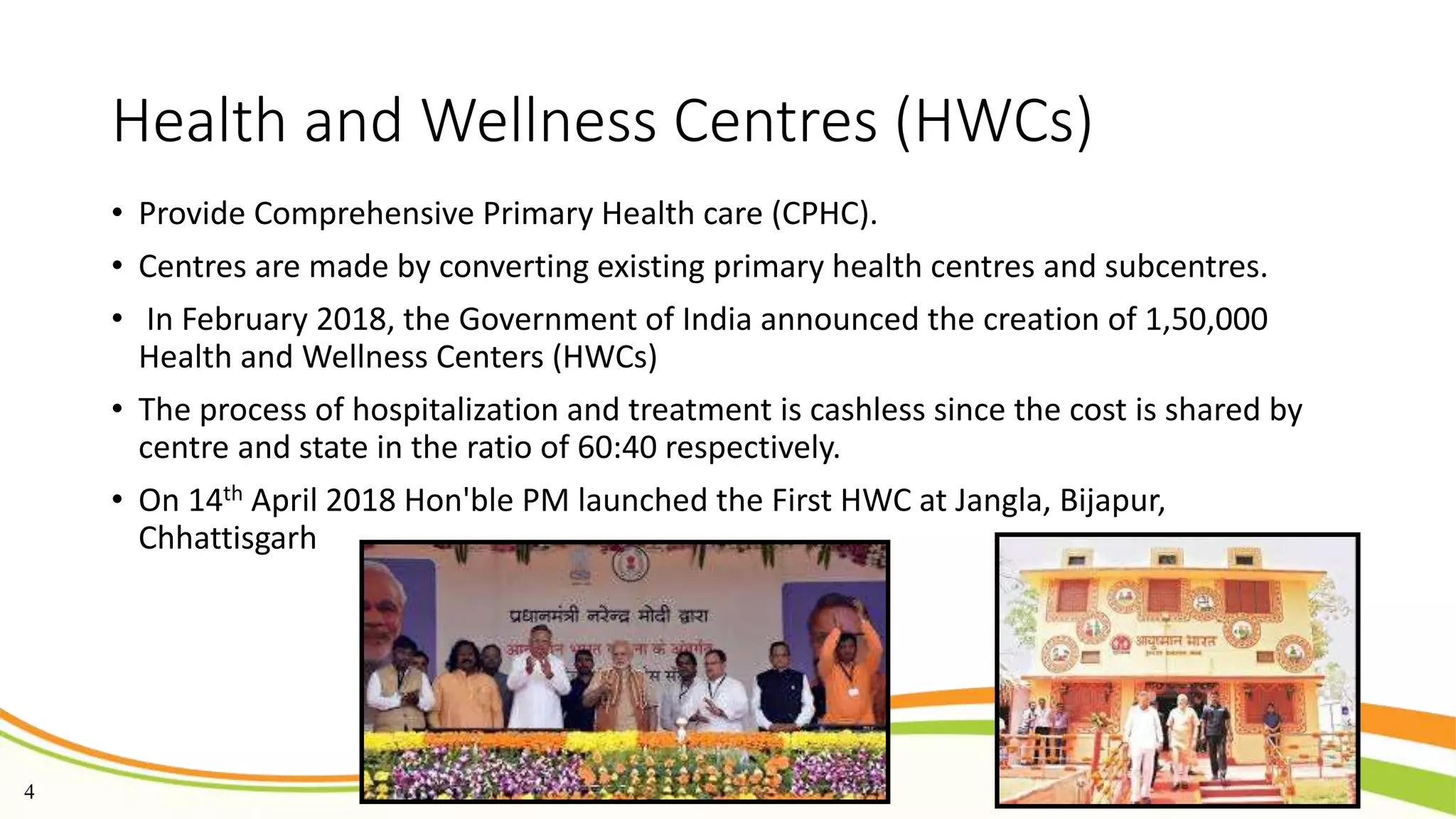
• In February 2018, the Government of India announced the creation of 1,50,000
Health and Wellness Centers (HWCs)
• The process of hospitalization and treatment is cashless since the cost is shared by
centre and state in the ratio of 60:40 respectively.
• On 14th April 2018 Hon'ble PM launched the First HWC at Jangla, Bijapur,
Chhattisgarh
4
Services at Health and Wellness Centres
• Care in pregnancy and child-birth.
• Neonatal and infant health care services
• Childhood and adolescent health care services.
• Family planning, Contraceptive services and other Reproductive Health Care services
• Management of Communicable diseases including National Health Programs
• Management of Common Communicable Diseases and Outpatient care for acute simple illnesses
and minor ailments.
• Screening, Prevention, Control and Management of Non-Communicable diseases
• Care for Common Ophthalmic and ENT problems
• Basic Oral health care
• Elderly and Palliative health care services
• Emergency Medical Services
• Screening and Basic management of Mental health ailments
5
Analysis of HWCs
Source: GOI (In Lok Sabha)6
In the case of health and wellness
centers (19,282 operational as on
June 17, 2019), barring Uttar Pradesh
that has 2,071 operational centers, all
other top-five performers are richer
states.
What is Ayushman Bharat PM-JAY about
• This was launched in September 2018 by the Ministry of Health and Family
Welfare
• A scheme of GOI to provide free access to healthcare for 40% of India’s
population
• Provides Secondary and Tertiary Health Care Services
• It became the World’s Largest Government sponsored healthcare program
Tertiary Health Care
• Advanced medical treatment
• Cancer
• Surgery
• Complex medical intervention
Secondary Health Care
• Serious illness/injury
• Child Birth
• Hospital Care
• Therapists
• Psychologists
7
Structure of Ayushman Bharat PM-JAY
A cover of INR 5 lakh per family per year
Over 10 crore poor and vulnerable families eligible
States given flexibility to decide on mode of
implementation
Benefits will be portable across the country
Entitlement based scheme
8
Some features of the scheme
• Coverage of Rs.5 lakh per family per annum for secondary and tertiary care
across public and private hospitals.
• Approximately 50 crore beneficiaries (over 10 crore poor and vulnerable
entitled families) are eligible for the scheme.
• Covers up to 3 days of pre-hospitalization and up to 15 days of post-
hospitalization expenses such as medicines and diagnostics.
• Includes costs for diagnostic services, drugs, room charges, physician’s fees,
surgeon charges, supplies, ICU and OT charges.
• No restriction on the family size, gender or age.
• The scheme includes 1,393 medical procedures.
9
Implementation of scheme
Diseases which are covered
• Prostate cancer.
• Double valve replacement.
• Coronary artery bypass graft.
• COVID-19.
• Pulmonary valve replacement.
• Skull base surgery.
• Anterior spine fixation.
• Laryngopharyngectomy with gastric
pull-up
• Tissue expander for disfigurement
following burns.
Diseases which are not covered
• Out-Patient Department (OPD)
expenses.
• Drug rehabilitation.
• Cosmetic surgeries.
• Fertility treatments.
• Individual diagnostics.
• Organ transplant.
10
Criticism
• Will reduce medical expenditure for
many families
• Beneficiary families are said to have
saved over Rs.13000 crores.
• Over 60% of the treatments have
been done by private hospitals
• In 2018, it generated more than
50000 jobs
• Economically weaker sections of
society can have access to quality
healthcare services without financial
hardships.
• Fund for PM-JAY is increasing
exponentially whereas fund for
NRHM has gone up by 2% only.
• There is a shortfall of healthcare
professionals and personnel needed
to implement a vast scheme as this.
• There is also a problem of
infrastructure as many primary
healthcare centers run without even
the basic facilities such as electricity,
regular water supply, etc.
Benefits
11
Who all are not eligible for AB PM-JAY
• Those who have mechanized
farming equipment.
• Who owns a two, three or four-
wheeler.
• Those who hold a Kisan card.
• Government employees.
• Those who own a motorized fishing
boat.
• Those who are earning more than
Rs.10,000 per month.
• Those who own more than 5 acres of
agricultural land.
• Those who own landline phones or
refrigerators.
• Those who live in decently built
houses.
E – Cards Issued till 23rd Oct 2020
12,62,70,264
Source: pmjay.gov.in12
Analysis of PM-JAY
Analysis of available disaggregated data
in the public domain (from June 18,
2019) indicates that, barring a few states
like Chhattisgarh in the case of AB-
PMJAY, most top performers are the
richer states.
13 Source: GOI (In Lok Sabha)
14

Presentation on Ayushman bharat Yojana by PM Modi

  • 1.
  • 2.
  • 3.
    Background of AyushmanBharat • Ayushman Bharat is an attempt to move from sectoral and segmented approach of health service delivery to a comprehensive need-based health care service. • About 86% of rural households and 82% of urban households do not have access to healthcare insurance. • Over 17% of the country’s population spend a minimum of 1/10th of their household budgets on availing health services. • Unexpected and serious healthcare problems often lead families to debt. • Over 19% and over 24% of the urban and rural households respectively meet their healthcare financial needs through borrowings. Source: National Sample Survey Office (76th round )3
  • 4.
    Health and WellnessCentres (HWCs) • Provide Comprehensive Primary Health care (CPHC). • Centres are made by converting existing primary health centres and subcentres. • In February 2018, the Government of India announced the creation of 1,50,000 Health and Wellness Centers (HWCs) • The process of hospitalization and treatment is cashless since the cost is shared by centre and state in the ratio of 60:40 respectively. • On 14th April 2018 Hon'ble PM launched the First HWC at Jangla, Bijapur, Chhattisgarh 4
  • 5.
    Services at Healthand Wellness Centres • Care in pregnancy and child-birth. • Neonatal and infant health care services • Childhood and adolescent health care services. • Family planning, Contraceptive services and other Reproductive Health Care services • Management of Communicable diseases including National Health Programs • Management of Common Communicable Diseases and Outpatient care for acute simple illnesses and minor ailments. • Screening, Prevention, Control and Management of Non-Communicable diseases • Care for Common Ophthalmic and ENT problems • Basic Oral health care • Elderly and Palliative health care services • Emergency Medical Services • Screening and Basic management of Mental health ailments 5
  • 6.
    Analysis of HWCs Source:GOI (In Lok Sabha)6 In the case of health and wellness centers (19,282 operational as on June 17, 2019), barring Uttar Pradesh that has 2,071 operational centers, all other top-five performers are richer states.
  • 7.
    What is AyushmanBharat PM-JAY about • This was launched in September 2018 by the Ministry of Health and Family Welfare • A scheme of GOI to provide free access to healthcare for 40% of India’s population • Provides Secondary and Tertiary Health Care Services • It became the World’s Largest Government sponsored healthcare program Tertiary Health Care • Advanced medical treatment • Cancer • Surgery • Complex medical intervention Secondary Health Care • Serious illness/injury • Child Birth • Hospital Care • Therapists • Psychologists 7
  • 8.
    Structure of AyushmanBharat PM-JAY A cover of INR 5 lakh per family per year Over 10 crore poor and vulnerable families eligible States given flexibility to decide on mode of implementation Benefits will be portable across the country Entitlement based scheme 8
  • 9.
    Some features ofthe scheme • Coverage of Rs.5 lakh per family per annum for secondary and tertiary care across public and private hospitals. • Approximately 50 crore beneficiaries (over 10 crore poor and vulnerable entitled families) are eligible for the scheme. • Covers up to 3 days of pre-hospitalization and up to 15 days of post- hospitalization expenses such as medicines and diagnostics. • Includes costs for diagnostic services, drugs, room charges, physician’s fees, surgeon charges, supplies, ICU and OT charges. • No restriction on the family size, gender or age. • The scheme includes 1,393 medical procedures. 9
  • 10.
    Implementation of scheme Diseaseswhich are covered • Prostate cancer. • Double valve replacement. • Coronary artery bypass graft. • COVID-19. • Pulmonary valve replacement. • Skull base surgery. • Anterior spine fixation. • Laryngopharyngectomy with gastric pull-up • Tissue expander for disfigurement following burns. Diseases which are not covered • Out-Patient Department (OPD) expenses. • Drug rehabilitation. • Cosmetic surgeries. • Fertility treatments. • Individual diagnostics. • Organ transplant. 10
  • 11.
    Criticism • Will reducemedical expenditure for many families • Beneficiary families are said to have saved over Rs.13000 crores. • Over 60% of the treatments have been done by private hospitals • In 2018, it generated more than 50000 jobs • Economically weaker sections of society can have access to quality healthcare services without financial hardships. • Fund for PM-JAY is increasing exponentially whereas fund for NRHM has gone up by 2% only. • There is a shortfall of healthcare professionals and personnel needed to implement a vast scheme as this. • There is also a problem of infrastructure as many primary healthcare centers run without even the basic facilities such as electricity, regular water supply, etc. Benefits 11
  • 12.
    Who all arenot eligible for AB PM-JAY • Those who have mechanized farming equipment. • Who owns a two, three or four- wheeler. • Those who hold a Kisan card. • Government employees. • Those who own a motorized fishing boat. • Those who are earning more than Rs.10,000 per month. • Those who own more than 5 acres of agricultural land. • Those who own landline phones or refrigerators. • Those who live in decently built houses. E – Cards Issued till 23rd Oct 2020 12,62,70,264 Source: pmjay.gov.in12
  • 13.
    Analysis of PM-JAY Analysisof available disaggregated data in the public domain (from June 18, 2019) indicates that, barring a few states like Chhattisgarh in the case of AB- PMJAY, most top performers are the richer states. 13 Source: GOI (In Lok Sabha)
  • 14.