AYUSHMAN
BHARAT
Prepared By
Prof. Krupa Mathew.M
B
Y
INTRODUCTION-
AYUSHMAN BHARAT YOJANA/
THE PRADHAN MANTRI JAN AROGYA YOJANA
• Ayushman Bharat or “Healthy India” is a national initiative launched by Prime
Minister Narendra Modi as the part of National Health Policy 2017, in order to
achieve the vision of Universal Health Coverage (UHC).
• It is also known as the Pradhan Mantri Jan Arogya Yojana (PMJAY) Scheme. It is
essentially a health insurance scheme to cater to the poor, lower section of the
society and the vulnerable population. The scheme offers financial protection in
case of hospitalization due to medical emergencies.
• Considered as one of the biggest healthcare schemes in the world, Ayushman Bharat
Yojana aims to cover more than 50 crore Indian citizens. It is designed especially
for the economically weaker sections of the country. The PMJAY was launched in
September 2018 providing health insurance coverage of a maximum sum insured
amount of Rs.5 lakh.
BACKGROUND
• India is the second most populous country with a total population of more than 1.3
billion people, facing inadequate supply of essential health care services.
• Despite making remarkable strides in several sectors, India is still classified as a
Lower Middle-Income Country (LMIC) according to World Bank classification of
countries based on per capita GDP, mostly due to its inconsistent socio-economic and
health indicators.
• Statistics show that more than 20 per cent of India’s population still lives under
150rps per day
• The mission of eradication of major communicable diseases remains unfinished, the
population is also bearing the high burden of non-communicable diseases (NCDs)
and injuries. This leads to an overall rise in the demand for health care over a
prolonged period of time.
• The public sector hospitals in India are understandably
overburdened.
• Their utilization varies widely and they often have to work
under challenging circumstancing arising from the lack of
sufficient funds, a shortage of trained health workers and the
erratic and often deficient supply of drugs and equipment which
adversely impacts their functioning.
• To address these challenges, the Government of India took a
two- pronged approach under the umbrella of Ayushman
Bharat.
COMPONENTS OF AYUSHMAN BHARAT
Ayushman Bharat adopts a continuum of care approach,
comprising of two inter- related components, which are –
• Establishment of Health and Wellness Centres
• Pradhan Mantri Jan Arogya Yojana (PM-JAY)
Health and Wellness Centres :The first component of this
strategy was disease prevention and health promotion to curb
the increasing epidemic of non-communicable diseases.
- This was to be ensured through upgradation of the existing
network of Sub-centres and Primary Health Centres to Health
and Wellness Centres (HWC).
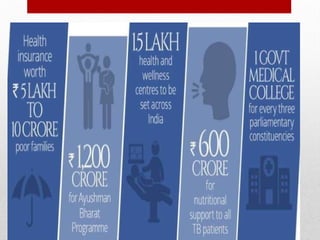
- Nearly 150,000 HWCs are to be set up in the country over the next
few years which will work towards reducing the overall disease
burden and hospitalisation needs of the population.
HEALTH AND WELLNESS CENTRES (HWCs)
a. Subcentres: 1/5th without regular water supply – 1/4th
without electricity – 1 in 10 without all weather road, and
over 6,000 without single ANM
b. Creation of 150,000 health and wellness centres – by
December 2022
c. “Assuring availability of free, comprehensive primary
health care services” by community within 30 min of
walking distance
d. Upgrading all 4,000 primary health centres in urban area to
the HWCs by March 2020
e. 11,000 and 16,000 HWCs are proposed to be made
functional in financial years 2018-19 and 2019-20
Primary care provider team:
1. Mid-Level Healthcare Provider (MLHP): Community
Health Officer (CHO) BSc/-General Nurse Midwifery
or B.Sc. Community Health or AYUSH doctor trained in
6 months Certificate Programme in Community Health
2. Multi-Purpose Worker (MPW) Female- 2
3. Multi-Purpose Worker (MPW) Male – 1
4. Accredited Social Health Activist (ASHA)s as outreach
team
ORGANIZATION OF HWCs
1. Central Diagnostic Unit (CDU): every 20 HWCs
2. Diagnostic runners
3. Electronic health records (EHR)
4. Training: Learner support centres
5. Infrastructure
6. Team incentives
Pradhan Mantri-Jan Arogya Yojana :
The second component was the launch of the Pradhan Mantri-
Jan Arogya Yojana (PM-JAY) which aims to create a system of
demand-led health care reforms that meet the immediate
hospitalisation needs of the eligible beneficiary family in a cashless
manner thus insulating the family from catastrophic financial
shock.
In the long run, the PM-JAY, through its system of incentives, aims
to expand the availability of its services.
- Because of its scope, PM-JAY is the world’s largest health
insurance/assurance scheme that offers a health cover to nearly
10.74 crore poor families which comes to a staggering 50 crore
Indians that form 40% of its bottom population.
- It is fully funded by the Government and provides financial
protection for a wide variety of secondary and tertiary care
hospitalizations.
OBJECTIVE
 The prime objective of PM-JAY is to reduce catastrophic
out-of-pocket health expenditure by improving access to
quality health care for its underprivileged population.
 More details on its evolution, planning, eligibility and
state wise implementation are discussed ahead.
BENEFITS COVERED UNDER AYUSHMAN BHARAT
YOJANA SCHEME
• The government health insurance scheme covers most of the
medical treatment costs, medicines, diagnostics and pre-
hospitalisation expenses.
• Additionally, the scheme offers cashless hospitalisation
services through the Ayushman Bharat Yojana/ PMJAY e-
card.
• With the intention to provide accessible healthcare to the poor
and needy, the Ayushman Bharat Yojana Scheme offers
coverage of up to Rs.5 lakh per family per year for secondary
and tertiary hospitalisation care.
The health insurance under AB-PMJAY includes hospitalization costs
of beneficiaries and includes the below components:
• Medical examination, consultation and treatment.
• Pre-hospitalisation.
• Non-intensive and intensive care services.
• Medicine and medical consumables.
• Diagnostic and laboratory services.
• Accommodation.
• Medical implant services, wherever possible.
• Food services.
• Complication arising during treatment.
• Post-hospitalisation expenses for up to 15 days.
• COVID-19 (Coronavirus) treatment.
Services not Covered Under Ayushman Bharat
Yojana Scheme
Similar to other types of health insurance policies the
Ayushman Bharat Yojana Scheme has some exclusions. Below
components are not covered under the scheme:
• Out-Patient Department (OPD) expenses.
• Drug rehabilitation.
• Cosmetic surgeries.
• Fertility treatments.
• Individual diagnostics.
• Organ transplant.
People Who are Not Entitled for Health Coverage under PMJAY
Scheme
People who are not eligible for availing PMJAY health services
include the ones –
• Owning a two, three, or four-wheeler or a motorized fishing boat
• Have a mechanized farming equipment
• Have a Kisan card with a credit limit of INR 50,000
• Employed by the government
• Working in government-managed non-agricultural enterprises
• Earning a monthly income above INR 10,000
• Owning refrigerators and landlines
• With decently build houses
• Owning 5 acres or more of agricultural land
GET AFFORDABLE SACHET INSURANCE PLANS
FEATURES OF AYUSHMAN BHARAT YOJANA SCHEME:
Below are some of the key features of the PMJAY scheme:
• It is one of the world’s largest health insurance schemes financed by
the government of India.
• Coverage of Rs.5 lakh per family per annum for secondary and
tertiary care across public and private hospitals.
• Approximately 50 crore beneficiaries (over 10 crore poor and
vulnerable entitled families) are eligible for the scheme.
• Cashless hospitalisation.
• Covers up to 3 days of pre-hospitalisation expenses such as medicines
and diagnostics.
• Covers up to 15 days of post-hospitalisation expenses which
include medicines and diagnostics.
• No restriction on the family size, gender or age.
• Can avail services across the country at any of the empanelled
public and private hospitals.
• All pre-existing conditions covered from day one.
• The scheme includes 1,393 medical procedures.
• Includes costs for diagnostic services, drugs, room charges,
physician’s fees, surgeon charges, supplies, ICU and OT
charges.
• Public hospitals are reimbursed with private hospitals.
LIST OF CRITICAL DISEASES OR ILLNESSES COVERED
UNDER AYUSHMAN BHARAT YOJANA SCHEME:
The medical care scheme extended coverage for more than 1300 medical
packages at empanelled public and private hospitals in the country. Below are some
of the critical illnesses covered under the Ayushman Bharat Yojana:
• Prostate cancer.
• Double valve replacement.
• Coronary artery bypass graft.
• COVID-19.
• Pulmonary valve replacement.
• Skull base surgery.
• Anterior spine fixation.
• Laryngopharyngectomy with gastric pull-up
• Tissue expander for disfigurement following burns.
• Carotid angioplasty with stent.
AYUSHMAN BHARAT YOJANA SCHEME
ELIGIBILITY CRITERIA FOR RURALAND
URBAN POPULATION:
 The scheme has been launched to cover the bottom 40%
of poor and economically weaker sections of the
country.
 This was based on the deprivation and occupational
criteria of the Socio-Economic Caste Census 2011 for
rural and urban areas.
 The Ayushman Bharat Yojana Eligibility is designed
with pre-conditions so that only the underprivileged
people of the society benefit from the initiative.
PMJAY RURAL:
The rural households are ranked based on their status of
seven deprivation criteria. Of these, the scheme covers all
beneficiaries who fall under at least one of below six deprivation
categories and automatically includes destitute, manual scavenger
families, living through slums, primitive tribal group, bonded
labourers:
• Households with only one room with Kucha walls and roof.
• No adult member in the age group between 16 and 59 years.
• No adult male member in the age group between 16 and 59 years.
• Disabled member and no-abled bodied member in the household.
• SC and ST
• Landless households and major sources of income are through
manual casual labour.
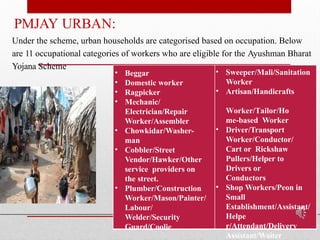
PMJAY URBAN:
Under the scheme, urban households are categorised based on occupation. Below
are 11 occupational categories of workers who are eligible for the Ayushman Bharat
Yojana Scheme
:
• Beggar
• Domestic worker
• Ragpicker
• Mechanic/
Electrician/Repair
Worker/Assembler
• Chowkidar/Washer-
man
• Cobbler/Street
Vendor/Hawker/Other
service providers on
the street.
• Plumber/Construction
Worker/Mason/Painter/
Labour/
Welder/Security
Guard/Coolie
• Sweeper/Mali/Sanitation
Worker
• Artisan/Handicrafts
Worker/Tailor/Ho
me-based Worker
• Driver/Transport
Worker/Conductor/
Cart or Rickshaw
Pullers/Helper to
Drivers or
Conductors
• Shop Workers/Peon in
Small
Establishment/Assistant/
Helpe
r/Attendant/Delivery
Assistant/Waiter
FINANCING OF THE SCHEME
• PM-JAY is completely funded by the Government and costs
are shared between Central and State Governments.
• The Government of India decides a national ceiling amount
per family that is used to determine the maximum limit of the
central share of the contribution.
References:
For more inofmarion
https://www.pmjay.gov.in/
https://ab-hwc.nhp.gov.in/
THANK YOU

AYUSHMAN BHARAT.pptx...................................

  • 1.
  • 2.
    INTRODUCTION- AYUSHMAN BHARAT YOJANA/ THEPRADHAN MANTRI JAN AROGYA YOJANA • Ayushman Bharat or “Healthy India” is a national initiative launched by Prime Minister Narendra Modi as the part of National Health Policy 2017, in order to achieve the vision of Universal Health Coverage (UHC). • It is also known as the Pradhan Mantri Jan Arogya Yojana (PMJAY) Scheme. It is essentially a health insurance scheme to cater to the poor, lower section of the society and the vulnerable population. The scheme offers financial protection in case of hospitalization due to medical emergencies. • Considered as one of the biggest healthcare schemes in the world, Ayushman Bharat Yojana aims to cover more than 50 crore Indian citizens. It is designed especially for the economically weaker sections of the country. The PMJAY was launched in September 2018 providing health insurance coverage of a maximum sum insured amount of Rs.5 lakh.
  • 3.
    BACKGROUND • India isthe second most populous country with a total population of more than 1.3 billion people, facing inadequate supply of essential health care services. • Despite making remarkable strides in several sectors, India is still classified as a Lower Middle-Income Country (LMIC) according to World Bank classification of countries based on per capita GDP, mostly due to its inconsistent socio-economic and health indicators. • Statistics show that more than 20 per cent of India’s population still lives under 150rps per day • The mission of eradication of major communicable diseases remains unfinished, the population is also bearing the high burden of non-communicable diseases (NCDs) and injuries. This leads to an overall rise in the demand for health care over a prolonged period of time.
  • 4.
    • The publicsector hospitals in India are understandably overburdened. • Their utilization varies widely and they often have to work under challenging circumstancing arising from the lack of sufficient funds, a shortage of trained health workers and the erratic and often deficient supply of drugs and equipment which adversely impacts their functioning. • To address these challenges, the Government of India took a two- pronged approach under the umbrella of Ayushman Bharat.
  • 5.
    COMPONENTS OF AYUSHMANBHARAT Ayushman Bharat adopts a continuum of care approach, comprising of two inter- related components, which are – • Establishment of Health and Wellness Centres • Pradhan Mantri Jan Arogya Yojana (PM-JAY) Health and Wellness Centres :The first component of this strategy was disease prevention and health promotion to curb the increasing epidemic of non-communicable diseases. - This was to be ensured through upgradation of the existing network of Sub-centres and Primary Health Centres to Health and Wellness Centres (HWC). - Nearly 150,000 HWCs are to be set up in the country over the next few years which will work towards reducing the overall disease burden and hospitalisation needs of the population.
  • 6.
    HEALTH AND WELLNESSCENTRES (HWCs) a. Subcentres: 1/5th without regular water supply – 1/4th without electricity – 1 in 10 without all weather road, and over 6,000 without single ANM b. Creation of 150,000 health and wellness centres – by December 2022 c. “Assuring availability of free, comprehensive primary health care services” by community within 30 min of walking distance d. Upgrading all 4,000 primary health centres in urban area to the HWCs by March 2020 e. 11,000 and 16,000 HWCs are proposed to be made functional in financial years 2018-19 and 2019-20
  • 7.
    Primary care providerteam: 1. Mid-Level Healthcare Provider (MLHP): Community Health Officer (CHO) BSc/-General Nurse Midwifery or B.Sc. Community Health or AYUSH doctor trained in 6 months Certificate Programme in Community Health 2. Multi-Purpose Worker (MPW) Female- 2 3. Multi-Purpose Worker (MPW) Male – 1 4. Accredited Social Health Activist (ASHA)s as outreach team ORGANIZATION OF HWCs
  • 8.
    ORGANIZATION OF HWCs 1.Central Diagnostic Unit (CDU): every 20 HWCs 2. Diagnostic runners 3. Electronic health records (EHR) 4. Training: Learner support centres 5. Infrastructure 6. Team incentives
  • 9.
    Pradhan Mantri-Jan ArogyaYojana : The second component was the launch of the Pradhan Mantri- Jan Arogya Yojana (PM-JAY) which aims to create a system of demand-led health care reforms that meet the immediate hospitalisation needs of the eligible beneficiary family in a cashless manner thus insulating the family from catastrophic financial shock. In the long run, the PM-JAY, through its system of incentives, aims to expand the availability of its services.
  • 10.
    - Because ofits scope, PM-JAY is the world’s largest health insurance/assurance scheme that offers a health cover to nearly 10.74 crore poor families which comes to a staggering 50 crore Indians that form 40% of its bottom population. - It is fully funded by the Government and provides financial protection for a wide variety of secondary and tertiary care hospitalizations.
  • 11.
    OBJECTIVE  The primeobjective of PM-JAY is to reduce catastrophic out-of-pocket health expenditure by improving access to quality health care for its underprivileged population.  More details on its evolution, planning, eligibility and state wise implementation are discussed ahead.
  • 12.
    BENEFITS COVERED UNDERAYUSHMAN BHARAT YOJANA SCHEME • The government health insurance scheme covers most of the medical treatment costs, medicines, diagnostics and pre- hospitalisation expenses. • Additionally, the scheme offers cashless hospitalisation services through the Ayushman Bharat Yojana/ PMJAY e- card. • With the intention to provide accessible healthcare to the poor and needy, the Ayushman Bharat Yojana Scheme offers coverage of up to Rs.5 lakh per family per year for secondary and tertiary hospitalisation care.
  • 13.
    The health insuranceunder AB-PMJAY includes hospitalization costs of beneficiaries and includes the below components: • Medical examination, consultation and treatment. • Pre-hospitalisation. • Non-intensive and intensive care services. • Medicine and medical consumables. • Diagnostic and laboratory services. • Accommodation. • Medical implant services, wherever possible. • Food services. • Complication arising during treatment. • Post-hospitalisation expenses for up to 15 days. • COVID-19 (Coronavirus) treatment.
  • 14.
    Services not CoveredUnder Ayushman Bharat Yojana Scheme Similar to other types of health insurance policies the Ayushman Bharat Yojana Scheme has some exclusions. Below components are not covered under the scheme: • Out-Patient Department (OPD) expenses. • Drug rehabilitation. • Cosmetic surgeries. • Fertility treatments. • Individual diagnostics. • Organ transplant.
  • 15.
    People Who areNot Entitled for Health Coverage under PMJAY Scheme People who are not eligible for availing PMJAY health services include the ones – • Owning a two, three, or four-wheeler or a motorized fishing boat • Have a mechanized farming equipment • Have a Kisan card with a credit limit of INR 50,000 • Employed by the government • Working in government-managed non-agricultural enterprises • Earning a monthly income above INR 10,000 • Owning refrigerators and landlines • With decently build houses • Owning 5 acres or more of agricultural land GET AFFORDABLE SACHET INSURANCE PLANS
  • 16.
    FEATURES OF AYUSHMANBHARAT YOJANA SCHEME: Below are some of the key features of the PMJAY scheme: • It is one of the world’s largest health insurance schemes financed by the government of India. • Coverage of Rs.5 lakh per family per annum for secondary and tertiary care across public and private hospitals. • Approximately 50 crore beneficiaries (over 10 crore poor and vulnerable entitled families) are eligible for the scheme. • Cashless hospitalisation. • Covers up to 3 days of pre-hospitalisation expenses such as medicines and diagnostics. • Covers up to 15 days of post-hospitalisation expenses which include medicines and diagnostics.
  • 17.
    • No restrictionon the family size, gender or age. • Can avail services across the country at any of the empanelled public and private hospitals. • All pre-existing conditions covered from day one. • The scheme includes 1,393 medical procedures. • Includes costs for diagnostic services, drugs, room charges, physician’s fees, surgeon charges, supplies, ICU and OT charges. • Public hospitals are reimbursed with private hospitals.
  • 18.
    LIST OF CRITICALDISEASES OR ILLNESSES COVERED UNDER AYUSHMAN BHARAT YOJANA SCHEME: The medical care scheme extended coverage for more than 1300 medical packages at empanelled public and private hospitals in the country. Below are some of the critical illnesses covered under the Ayushman Bharat Yojana: • Prostate cancer. • Double valve replacement. • Coronary artery bypass graft. • COVID-19. • Pulmonary valve replacement. • Skull base surgery. • Anterior spine fixation. • Laryngopharyngectomy with gastric pull-up • Tissue expander for disfigurement following burns. • Carotid angioplasty with stent.
  • 19.
    AYUSHMAN BHARAT YOJANASCHEME ELIGIBILITY CRITERIA FOR RURALAND URBAN POPULATION:  The scheme has been launched to cover the bottom 40% of poor and economically weaker sections of the country.  This was based on the deprivation and occupational criteria of the Socio-Economic Caste Census 2011 for rural and urban areas.  The Ayushman Bharat Yojana Eligibility is designed with pre-conditions so that only the underprivileged people of the society benefit from the initiative.
  • 20.
    PMJAY RURAL: The ruralhouseholds are ranked based on their status of seven deprivation criteria. Of these, the scheme covers all beneficiaries who fall under at least one of below six deprivation categories and automatically includes destitute, manual scavenger families, living through slums, primitive tribal group, bonded labourers: • Households with only one room with Kucha walls and roof. • No adult member in the age group between 16 and 59 years. • No adult male member in the age group between 16 and 59 years. • Disabled member and no-abled bodied member in the household. • SC and ST • Landless households and major sources of income are through manual casual labour.
  • 21.
    PMJAY URBAN: Under thescheme, urban households are categorised based on occupation. Below are 11 occupational categories of workers who are eligible for the Ayushman Bharat Yojana Scheme : • Beggar • Domestic worker • Ragpicker • Mechanic/ Electrician/Repair Worker/Assembler • Chowkidar/Washer- man • Cobbler/Street Vendor/Hawker/Other service providers on the street. • Plumber/Construction Worker/Mason/Painter/ Labour/ Welder/Security Guard/Coolie • Sweeper/Mali/Sanitation Worker • Artisan/Handicrafts Worker/Tailor/Ho me-based Worker • Driver/Transport Worker/Conductor/ Cart or Rickshaw Pullers/Helper to Drivers or Conductors • Shop Workers/Peon in Small Establishment/Assistant/ Helpe r/Attendant/Delivery Assistant/Waiter
  • 22.
    FINANCING OF THESCHEME • PM-JAY is completely funded by the Government and costs are shared between Central and State Governments. • The Government of India decides a national ceiling amount per family that is used to determine the maximum limit of the central share of the contribution.
  • 24.
  • 25.