State and Federal Fiscal
Challenges: threats and
opportunities for the nonprofit
sector
Laurel O’Sullivan
Vice President, Public Policy
Donors Forum
A nonprofit membership association that
advocates for a strong nonprofit sector in
Illinois.
What We’ll Talk About
• What’s at stake
– The sustainability of the nonprofit sector
– The nonprofit-government partnership
• Challenges
– state
– federal
• Opportunities: the advocacy imperative
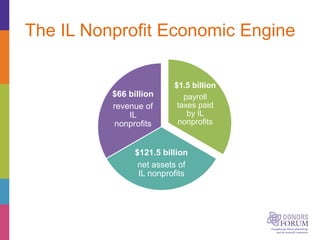
The IL Nonprofit Economic Engine
$1.5 billion
payroll
taxes paid
by IL
nonprofits
$121.5 billion
net assets of
IL nonprofits
$66 billion
revenue of
IL
nonprofits
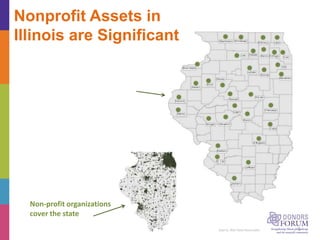
Nonprofit Assets in
Illinois are Significant
5
Non-profit organizations
cover the state
Source: Rob Paral Associates
Nonprofit
Sector
State
Government
Are we Partners?
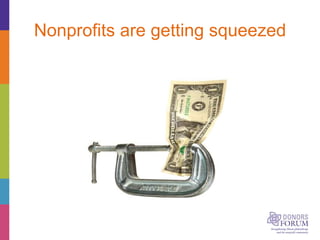
Nonprofits are getting squeezed
 Lack of revenue
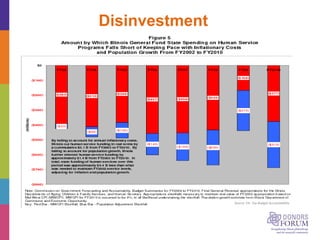
Disinvestment
Source: Ctr. Tax Budget Accountability
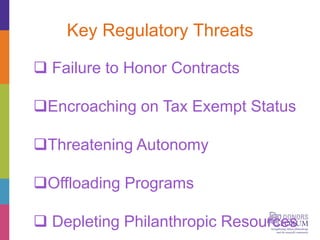
Key Regulatory Threats
 Failure to Honor Contracts
Encroaching on Tax Exempt Status
Threatening Autonomy
Offloading Programs
 Depleting Philanthropic Resources
FEDERAL THREATS
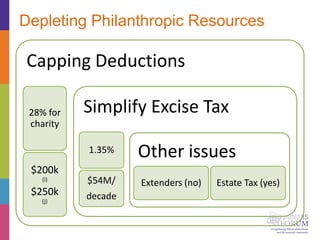
Depleting Philanthropic Resources
Capping Deductions
28% for
charity
$200k
(i)
$250k
(j)
Simplify Excise Tax
1.35%
$54M/
decade
Other issues
Extenders (no) Estate Tax (yes)
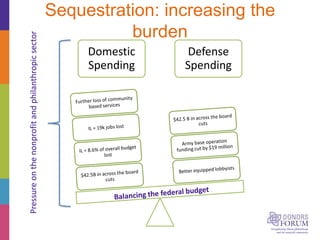
Sequestration: increasing the
burden
Domestic
Spending
Defense
Spending
Pressureonthenonprofitandphilanthropicsector
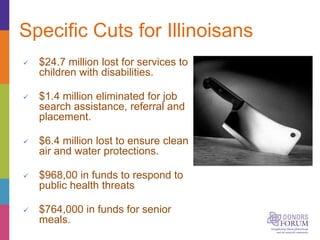
Specific Cuts for Illinoisans
 $24.7 million lost for services to
children with disabilities.
 $1.4 million eliminated for job
search assistance, referral and
placement.
 $6.4 million lost to ensure clean
air and water protections.
 $968,00 in funds to respond to
public health threats
 $764,000 in funds for senior
meals.
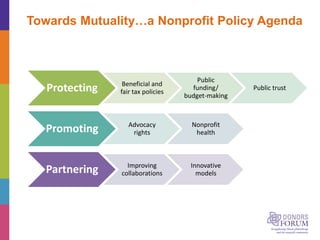
Towards Mutuality…a Nonprofit Policy Agenda
Protecting Beneficial and
fair tax policies
Public
funding/
budget-making
Public trust
Promoting Advocacy
rights
Nonprofit
health
Partnering Improving
collaborations
Innovative
models
A changing context requires
fiscal and system reform
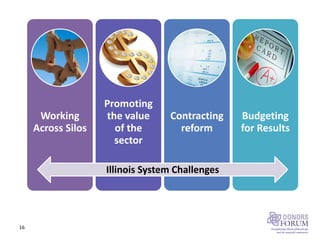
16
Working
Across Silos
Promoting
the value
of the
sector
Contracting
reform
Budgeting
for Results
Illinois System Challenges
Summary
Join us at the Illinois Nonprofit Summit!
Loyola Presentation
18
Mid November 2013
Nonprofit & Foundation Leaders
Strategizing a nonprofit policy agenda for the
2014 Gubernatorial Election
LAUREL O’SULLIVAN,
V.P. PUBLIC POLICY
Questions?
losullivan@donorsforum.org
@lkosullivan (twitter)
www.linkedin.com/in/laurelosullivan

State and Federal Fiscal Policies: Threats and Opportunities for the Nonprofit Sector

Editor's Notes

  • #2 By a show of hands: How many of you work in the nP sector? For 0-5 years, 5-10, 10 or more?Did you know, that the NP Sector is the 4th largest sector in Illinois behind local gov’t, retail and manufacturing. Employs 9% of the workforce or 517,000 employees. That would seem to suggest an economic might that would be taken seriously the same way manufacturing and other corporate interests are in IL. They receive tax breaks and incentives to stay put because their value is understood.Our challenge is we don’t talk about our value in tangible terms, we often act more like supplicants than partners in building communities and we ask for payments but to many lawmakers, the whole value of the transaction and the services delivered is poorly understood. The result is thatfiscal policies and decisions at the state and local level are often made with little to no input from nonprofits, nor with full understanding of the real value nonprofits deliver for the residents of Illiinois.In this way, many of the fiscal policies are a result of policymakers not understanding the value of the sector, and under our control.When is the last time you heard of a nonprofit receiving an incentive to stay put?At our state budget forum Prof. Merriman’s colleagues, Professor Dick Dye said, “Somebody’s ax is going to be gored” I would argue in Illinois, it’s the NP sector’s ax that is repeatedly getting gored,
  • #6 The non-profit sector has substantial representation across the state.Illinois is home to 32 counties or over half where non-profit organizations have assets exceeding $100 million.
  • #12 THE FINAL TREND IS DRAINING THE POOL OF PHILANTHROPIC DOLLARS . Right now in DC nonprofits have become caught in the partisan debate over the much hyped Fiscal Clif. AT THE SAME TIME, THAT GOV’T HAS BEEN OFF LOADING MORE RESPONSIBLIIES ONTO CHARITABLE NONPROFITS, THEY HAVE BEEN TRING TO TAKE AWAY FUNDS AVAILABLE BY PROPSING AND ENACTING WAYS TO REDUCE CHARTIABLE GIVING INCENTIVES AT THE FEDERAL LEVEL. MOST OF THE MEDIA COVERAGE OVER THE FEDERAL BUDGET NEGOTIATIONS HAVE FOCUSED ON THE IMPACT TO THE WEALTHIEST, RATHER THAN THE COMMUNITY LEVEL IMPACT THAT OCCURS WHEN THOSE MOST IN NEED OF RECEIVING SERVICES ARE FORCED TO GO WITHOUT. (SIDENOTE: At the State Level, the ENDOW IL BILL PASSED SENATE, REPRESENTS PROGRESS---WOULD BE STATE’S FIRST EVER CHARITABLEG IVING INCENTIVE). Among its specific provisions, the President's budget:proposes capping itemized deductions, including the charitable deduction, at 28 percent on income above $200,000 for individuals and $250,000 for joint-filersimplements the so-called Buffett Rule, which phases in a minimum 30 percent effective tax rate on those earning $1 million or more annually (under the Buffett Rule, the charitable deduction would be the only itemized deduction available to affected taxpayers) assumes a permanent extension of the federal estate tax at 2009 levels of a $3.5 million individual exemption and a 45% top ratedoes not specifically mention the package of annual tax provisions known as "extenders," which includes charitable provisions such as the IRA Charitable Rollover and enhanced deductions for donations of food inventory and conservation easements includes a provision calling for a single, 1.35% excise tax rate on investment income of private foundations at an estimated cost of $54 million over 10 years proposes $1.06 billion in total funding for the Corporation for National and Community Service, including the:$49 million for the Social Innovation Fund, to provide seed money and scale up innovative programs that leverage private and foundation capital to meet major social challenges ($4 million of this is to improve nonprofit evaluation capacity by facilitating access to State and Federal Administrative data) $10 million for the George H. W. Bush Volunteer Generation Fund to provide grants to States and nonprofit organizations to recruit and manage volunteers. Having already passed competing budget resolutions in both chambers, lawmakers are unlikely to take up individual measures presented in the President’s blueprint. The proposal may instead be used as a groundwork for upcoming negotiations between the White House and Congress over extending the debt limit this summer and for finding common ground during tax reform legislation.
  • #13 This is the most significant outcome of the fiscal cliffThe President’s $3.77 trillion budget plan includes a mixture of revenue increases and spending cuts, as well as investments in education, job creation, and infrastructure. The budget would replace the $1.2 trillion in automatic sequestration spending cuts enacted March 1 with $1.8 trillion in alternative deficit reduction, reducing annual deficits to 1.7 percent of GDP within ten years.