“ Right-to-Work” The Workers Tax It’s Bad for America It’s Bad for Working Families
What is “Right-to-Work?” The 1947 Taft-Hartley of the National Labor Relations Act created a loophole (section 14b) in which states can make union-security clauses illegal in collective bargaining agreements Under a RTW law, employees cannot be required to pay union dues as a condition of employment Last state to pass RTW was Oklahoma in 2001 Most states passed RTW during 1947-1959 period
Paying Fair Share in Non-RTW States Union security clause in non-RTW states Fair share Workers in Union positions, positions which receive all of the wages and benefits of union representation, must pay the costs of that representation RTW states create a  “Right-to-Freeload” Workers get all the same wages and benefits Union must represent them at own expense
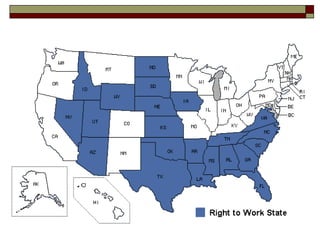
Right-to-Work Laws are a Relic of the Past The RTW campaign began in 1947 To date, more than 60 years later, less than half of our states (22) have adopted a RTW law RTW laws are out-dated, redundant, and a relic of a partisan, anti-union agenda of another era
 
Economic Policy Myths
Economic Development Myths RTW is not among the most important factors related to business decisions on facility location Incentive packages offered by states are the most important  factor: tax rates; education of workforce; cheap energy; abundant labor supply; cheap land; transportation; climate Good growth vs bad growth is the real issue RTW lowers per capita incomes and the standard of living
Oklahoma “Job Creation” Myth To attract new businesses in the 1990s, began giving 5% cash back on payrolls for creating new jobs No requirement on how money is spent Now gives 10% cash back on payrolls of jobs with annual salaries or $94,000 or more No requirement on how money is spent RTW has nothing to do with this situation
Company Location Myth In 2010,  Area Development  magazine ranked the top 10 states for site selection based on survey of site selection industry consultants Indiana ranked number 6 out of 10 The survey revealed 8 main criteria used by consultants to determine site location selection None of the 8 criteria mention RTW
Company Location Myth In 2010,  Chief Executive  magazine polled  600  U.S. CEOs about site  selection criteria: Criteria were grouped and rated as follows: Tax and regulation; workforce quality; living environment Under "workforce quality" the 5 most important items were: Employee work ethic; general education level of workforce; competitiveness of wage rates; employees cooperative relationship with management; availability of labor with specialized skills RTW was not a factor in site location selection Education of workforce is more important factor in site selection
Actual Buying Power Myth Actual buying power is commonly measured as BPI 6 of the top 10 metro areas with the highest BPI in the U.S. are in non-RTW work states (2009 data) 29 of the top 50 metro areas with the highest BPI are in non-RTW states (2009 data) Workers in RTW states do not enjoy greater buying power than workers in non-RTW states
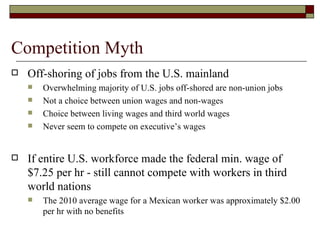
Competition Myth Off-shoring of jobs from the U.S. mainland Overwhelming majority of U.S. jobs off-shored are non-union jobs Not a choice between union wages and non-wages Choice between living wages and third world wages Never seem to compete on executive’s wages If entire U.S. workforce made the federal min. wage of $7.25 per hr - still cannot compete with workers in third world nations The 2010 average wage for a Mexican worker was approximately $2.00 per hr with no benefits
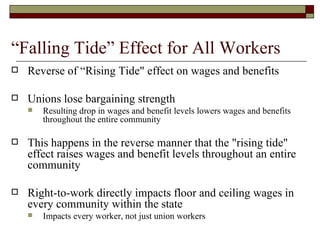
“Falling Tide” Effect for All Workers Reverse of “Rising Tide" effect on wages and benefits Unions lose bargaining strength Resulting drop in wages and benefit levels lowers wages and benefits throughout the entire community This happens in the reverse manner that the "rising tide" effect raises wages and benefit levels throughout an entire community Right-to-work directly impacts floor and ceiling wages in every community within the state Impacts every worker, not just union workers
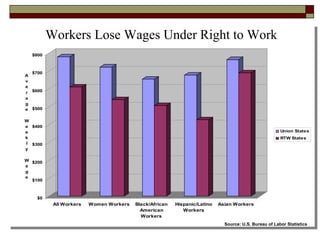
Economic Development Myths Workers Lose Wages Under Right to Work Source: U.S. Bureau of Labor Statistics
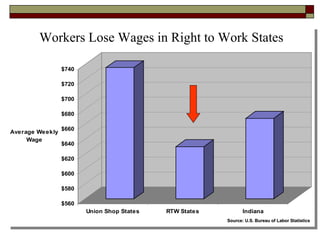
Economic Development Myths Workers Lose Wages in Right to Work States Source: U.S. Bureau of Labor Statistics
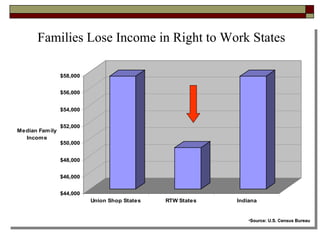
Families Lose Income in Right to Work States Source: U.S. Census Bureau
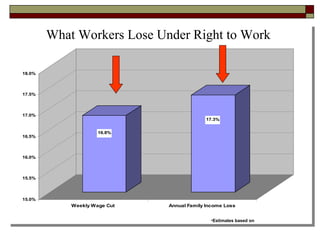
What Workers Lose Under Right to Work   Estimates based on
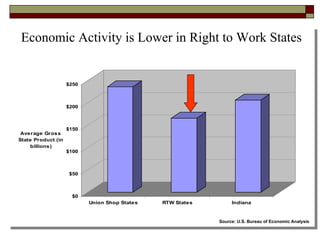
Economic Activity is Lower in Right to Work States Source: U.S. Bureau of Economic Analysis
Race to the Bottom If we attempt to compete with third world wages, it will be a race to the bottom The first one to work for free will win! We are a consumer-based society For our economic engine to run, workers need disposable income to spend Lowering wages in order to compete at a level we can never attain is economic suicide
Forced Unionism Myths
“Forced Unionism” Argument Workers are ‘forced” to join a union to keep their job Workers are “forced” to pay union dues for union political activities with which they do not agree
Facts About “Forced Unionism” A “Right-to-Work” state law is redundant, out-dated, and unnecessary Federal law has protected the rights of workers from “forced unionism” for decades Ultimately, workers are free to choose where to work
The “Forced Unionism” Myth Fact  #1:  Workers cannot be forced” to join a Union 1947 Taft-Hartley amendments to the National Labor Relations Act Right of workers to refrain from joining a union was expressly added to Section 7 Affirmed by the 1963 U.S. Supreme Court case NLRB v. General Motors Corp.  Workers cannot be forced to belong to a union *373 U.S. 734 (1963)
The “Forced Unionism” Myth Fact  #2: Workers cannot be required to pay for Union political activities with which they do not agree Decided by the 1988 U.S. Supreme Court case Communications Workers v. Beck Workers cannot be forced to pay union dues for political activities *487 U.S. 735 (1988)
Worker Choice 93% of the private sector is non-union Only 7% of the U.S. private sector workforce is unionized Workers who choose not to pay their fair share of union dues for the good wages, benefits, and representation services they receive may simply choose to work elsewhere Non-union companies are continually hiring Wal-Mart McDonald's Workers are not bound to work in a union job in which they feel uncomfortable Workers may terminate the employment relationship at any time Workers are free to move to an existing RTW state
“Forced Representation” Unions in RTW states are required, by force of law, to represent non-contributors and non-members Only time in U.S. history that an organization has been "forced" to represent non-members and non-contributors and bear the costs of that representation Federal or state government have never required a U.S. business to perform a similar task
The End

Right to Work: The Worker Tax

  • 1.
    “ Right-to-Work” TheWorkers Tax It’s Bad for America It’s Bad for Working Families
  • 2.
    What is “Right-to-Work?”The 1947 Taft-Hartley of the National Labor Relations Act created a loophole (section 14b) in which states can make union-security clauses illegal in collective bargaining agreements Under a RTW law, employees cannot be required to pay union dues as a condition of employment Last state to pass RTW was Oklahoma in 2001 Most states passed RTW during 1947-1959 period
  • 3.
    Paying Fair Sharein Non-RTW States Union security clause in non-RTW states Fair share Workers in Union positions, positions which receive all of the wages and benefits of union representation, must pay the costs of that representation RTW states create a “Right-to-Freeload” Workers get all the same wages and benefits Union must represent them at own expense
  • 4.
    Right-to-Work Laws area Relic of the Past The RTW campaign began in 1947 To date, more than 60 years later, less than half of our states (22) have adopted a RTW law RTW laws are out-dated, redundant, and a relic of a partisan, anti-union agenda of another era
  • 5.
  • 6.
  • 7.
    Economic Development MythsRTW is not among the most important factors related to business decisions on facility location Incentive packages offered by states are the most important factor: tax rates; education of workforce; cheap energy; abundant labor supply; cheap land; transportation; climate Good growth vs bad growth is the real issue RTW lowers per capita incomes and the standard of living
  • 8.
    Oklahoma “Job Creation”Myth To attract new businesses in the 1990s, began giving 5% cash back on payrolls for creating new jobs No requirement on how money is spent Now gives 10% cash back on payrolls of jobs with annual salaries or $94,000 or more No requirement on how money is spent RTW has nothing to do with this situation
  • 9.
    Company Location MythIn 2010, Area Development  magazine ranked the top 10 states for site selection based on survey of site selection industry consultants Indiana ranked number 6 out of 10 The survey revealed 8 main criteria used by consultants to determine site location selection None of the 8 criteria mention RTW
  • 10.
    Company Location MythIn 2010, Chief Executive  magazine polled 600 U.S. CEOs about site selection criteria: Criteria were grouped and rated as follows: Tax and regulation; workforce quality; living environment Under "workforce quality" the 5 most important items were: Employee work ethic; general education level of workforce; competitiveness of wage rates; employees cooperative relationship with management; availability of labor with specialized skills RTW was not a factor in site location selection Education of workforce is more important factor in site selection
  • 11.
    Actual Buying PowerMyth Actual buying power is commonly measured as BPI 6 of the top 10 metro areas with the highest BPI in the U.S. are in non-RTW work states (2009 data) 29 of the top 50 metro areas with the highest BPI are in non-RTW states (2009 data) Workers in RTW states do not enjoy greater buying power than workers in non-RTW states
  • 12.
    Competition Myth Off-shoringof jobs from the U.S. mainland Overwhelming majority of U.S. jobs off-shored are non-union jobs Not a choice between union wages and non-wages Choice between living wages and third world wages Never seem to compete on executive’s wages If entire U.S. workforce made the federal min. wage of $7.25 per hr - still cannot compete with workers in third world nations The 2010 average wage for a Mexican worker was approximately $2.00 per hr with no benefits
  • 13.
    “Falling Tide” Effectfor All Workers Reverse of “Rising Tide" effect on wages and benefits Unions lose bargaining strength Resulting drop in wages and benefit levels lowers wages and benefits throughout the entire community This happens in the reverse manner that the "rising tide" effect raises wages and benefit levels throughout an entire community Right-to-work directly impacts floor and ceiling wages in every community within the state Impacts every worker, not just union workers
  • 14.
    Economic Development MythsWorkers Lose Wages Under Right to Work Source: U.S. Bureau of Labor Statistics
  • 15.
    Economic Development MythsWorkers Lose Wages in Right to Work States Source: U.S. Bureau of Labor Statistics
  • 16.
    Families Lose Incomein Right to Work States Source: U.S. Census Bureau
  • 17.
    What Workers LoseUnder Right to Work Estimates based on
  • 18.
    Economic Activity isLower in Right to Work States Source: U.S. Bureau of Economic Analysis
  • 19.
    Race to theBottom If we attempt to compete with third world wages, it will be a race to the bottom The first one to work for free will win! We are a consumer-based society For our economic engine to run, workers need disposable income to spend Lowering wages in order to compete at a level we can never attain is economic suicide
  • 20.
  • 21.
    “Forced Unionism” ArgumentWorkers are ‘forced” to join a union to keep their job Workers are “forced” to pay union dues for union political activities with which they do not agree
  • 22.
    Facts About “ForcedUnionism” A “Right-to-Work” state law is redundant, out-dated, and unnecessary Federal law has protected the rights of workers from “forced unionism” for decades Ultimately, workers are free to choose where to work
  • 23.
    The “Forced Unionism”Myth Fact #1: Workers cannot be forced” to join a Union 1947 Taft-Hartley amendments to the National Labor Relations Act Right of workers to refrain from joining a union was expressly added to Section 7 Affirmed by the 1963 U.S. Supreme Court case NLRB v. General Motors Corp. Workers cannot be forced to belong to a union *373 U.S. 734 (1963)
  • 24.
    The “Forced Unionism”Myth Fact #2: Workers cannot be required to pay for Union political activities with which they do not agree Decided by the 1988 U.S. Supreme Court case Communications Workers v. Beck Workers cannot be forced to pay union dues for political activities *487 U.S. 735 (1988)
  • 25.
    Worker Choice 93%of the private sector is non-union Only 7% of the U.S. private sector workforce is unionized Workers who choose not to pay their fair share of union dues for the good wages, benefits, and representation services they receive may simply choose to work elsewhere Non-union companies are continually hiring Wal-Mart McDonald's Workers are not bound to work in a union job in which they feel uncomfortable Workers may terminate the employment relationship at any time Workers are free to move to an existing RTW state
  • 26.
    “Forced Representation” Unionsin RTW states are required, by force of law, to represent non-contributors and non-members Only time in U.S. history that an organization has been "forced" to represent non-members and non-contributors and bear the costs of that representation Federal or state government have never required a U.S. business to perform a similar task
  • 27.