Aws Data Engineer Training | Aws Data Engineer Course
Master AWS Data Engineering online! Learn cloud tools, ETL, real-time processing & more with hands-on training. Advance your career with AccentFuture. Enroll today and get started!
What is AmazonRedshift?
Amazon Redshift is a fully managed data warehouse solution on AWS.
Designed for analyzing large volumes of data using standard SQL.
Built for speed, scalability, and integration with BI tools.
3.
Why Use Redshift?
Fastquery performance (uses columnar storage, MPP)
Scalable from gigabytes to petabytes
Integrates with S3, Glue, QuickSight, and other AWS services
Cost-effective with on-demand and reserved pricing
4.
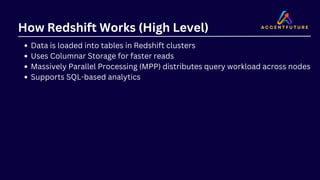
How Redshift Works(High Level)
Data is loaded into tables in Redshift clusters
Uses Columnar Storage for faster reads
Massively Parallel Processing (MPP) distributes query workload across nodes
Supports SQL-based analytics
5.
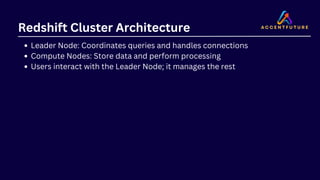
Redshift Cluster Architecture
LeaderNode: Coordinates queries and handles connections
Compute Nodes: Store data and perform processing
Users interact with the Leader Node; it manages the rest
6.
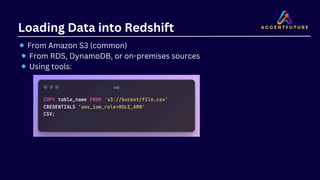
Loading Data intoRedshift
🔹From Amazon S3 (common)
🔹From RDS, DynamoDB, or on-premises sources
🔹Using tools:
7.
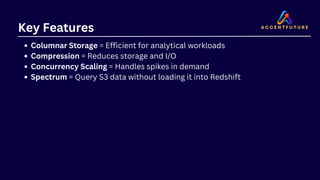
Key Features
Columnar Storage= Efficient for analytical workloads
Compression = Reduces storage and I/O
Concurrency Scaling = Handles spikes in demand
Spectrum = Query S3 data without loading it into Redshift
8.
Data Warehousing withRedshift
Centralizes data from different sources
Enables advanced analytics, reporting, and ML
Works well with BI tools (e.g., Tableau, Power BI, QuickSight)
9.
Use Cases
Business IntelligenceDashboards
Customer 360 View
Marketing & Sales Analytics
Fraud Detection & Operational Reporting
10.
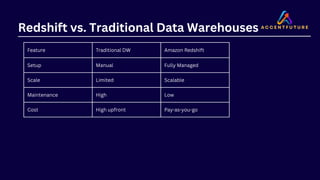
Feature Traditional DWAmazon Redshift
Setup Manual Fully Managed
Scale Limited Scalable
Maintenance High Low
Cost High upfront Pay-as-you-go
Redshift vs. Traditional Data Warehouses
11.
Summary & NextSteps
Redshift simplifies building powerful data warehouses in the cloud
Ideal for organizations needing scalable analytics
Next: Explore Redshift Spectrum, RA3 nodes, performance tuning, and
security best practices
12.
Contact & OnlineTraining
📢We Provide Online Training on Databricks and Big Data Technologies!
✅Hands-on Training with Real-World Use Cases
✅Live Sessions with Industry Experts
✅Job Assistance
✅Certification Guidance
🌐Visit our website: https://www.accentfuture.com/
📩For inquiries, contact us at: contact@accentfuture.com,
📞+91-96400 01789 (Call/WhatsApp)


![[よくわかるAmazon Redshift]Amazon Redshift最新情報と導入事例のご紹介](https://cdn.slidesharecdn.com/ss_thumbnails/20140219redshiftupdatesv1tokyo-140224010117-phpapp02-thumbnail.jpg?width=640&height=640&fit=bounds)


![[よくわかるAmazon Redshift in 大阪]Amazon Redshift最新情報と導入事例のご紹介](https://cdn.slidesharecdn.com/ss_thumbnails/20140221redshiftupdatesv2osaka-140224010309-phpapp02-thumbnail.jpg?width=640&height=640&fit=bounds)


