INTRODUCTION
AWS Cloudprovides a comprehensive platform for computing, storage, networking, and security, enabling
organizations to build scalable and secure applications. The course covers core cloud concepts such as
virtualization, elasticity, and pay-as-you-go pricing. Topics include AWS Cloud Security, Networking and Content
Delivery, and AWS Storage, equipping learners with hands-on experience through labs like Amazon EC2 and
Database Server setup. These skills are essential for deploying and managing cloud-based applications efficiently.
AWS Machine Learning introduces fundamental AI concepts and provides practical insights into building
intelligent applications. The course covers key areas like Computer Vision, Natural Language Processing (NLP),
and Generative AI, showcasing how AWS services empower businesses with automated decision-making and
predictive analytics. Learners explore machine learning workflows, including supervised and unsupervised
learning, to develop AI-driven solutions in real-world scenarios.
The integration of AWS Cloud and Machine Learning provides a powerful foundation for building intelligent,
scalable applications. AWS Cloud services offer the infrastructure needed to store and process vast amounts of
data, while AWS Machine Learning tools enable businesses to extract insights, automate processes, and enhance
user experiences. By combining these technologies, organizations can deploy AI-powered applications efficiently,
leveraging AWS's secure, flexible, and cost-effective solutions.
4.
1.AWS CLOUD FOUNDATIONS
Introductionto Cloud Computing
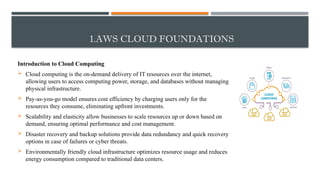
Cloud computing is the on-demand delivery of IT resources over the internet,
allowing users to access computing power, storage, and databases without managing
physical infrastructure.
Pay-as-you-go model ensures cost efficiency by charging users only for the
resources they consume, eliminating upfront investments.
Scalability and elasticity allow businesses to scale resources up or down based on
demand, ensuring optimal performance and cost management.
Disaster recovery and backup solutions provide data redundancy and quick recovery
options in case of failures or cyber threats.
Environmentally friendly cloud infrastructure optimizes resource usage and reduces
energy consumption compared to traditional data centers.
5.
Cloud Service Models
Cloud service models represent how cloud services are delivered to users based on their needs. These models provide
different levels of control, flexibility, and management depending on the type of service. The three primary cloud
service models are:
Infrastructure as a Service (IaaS): Provides virtualized computing resources over the internet, including servers,
storage, and networking.
Platform as a Service (PaaS): Offers a platform with built-in tools for developers to build, test, and deploy
applications without managing infrastructure.
Software as a Service (SaaS): Delivers software applications over the internet on a subscription basis, eliminating the
need for installation.
6.
Aws Cloud Security
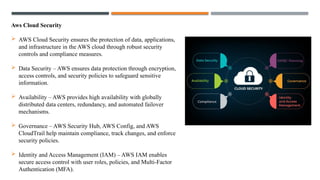
AWS Cloud Security ensures the protection of data, applications,
and infrastructure in the AWS cloud through robust security
controls and compliance measures.
Data Security – AWS ensures data protection through encryption,
access controls, and security policies to safeguard sensitive
information.
Availability – AWS provides high availability with globally
distributed data centers, redundancy, and automated failover
mechanisms.
Governance – AWS Security Hub, AWS Config, and AWS
CloudTrail help maintain compliance, track changes, and enforce
security policies.
Identity and Access Management (IAM) – AWS IAM enables
secure access control with user roles, policies, and Multi-Factor
Authentication (MFA).
7.
Networking and ContentDelivery
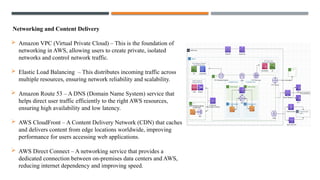
Amazon VPC (Virtual Private Cloud) – This is the foundation of
networking in AWS, allowing users to create private, isolated
networks and control network traffic.
Elastic Load Balancing – This distributes incoming traffic across
multiple resources, ensuring network reliability and scalability.
Amazon Route 53 – A DNS (Domain Name System) service that
helps direct user traffic efficiently to the right AWS resources,
ensuring high availability and low latency.
AWS CloudFront – A Content Delivery Network (CDN) that caches
and delivers content from edge locations worldwide, improving
performance for users accessing web applications.
AWS Direct Connect – A networking service that provides a
dedicated connection between on-premises data centers and AWS,
reducing internet dependency and improving speed.
8.
Aws Storage Services
Simple Storage Service (S3) – A scalable object storage service used for storing and retrieving any amount of data
from anywhere. It provides high availability, durability, and security.
Amazon S3 Glacier – A low-cost storage solution for archiving and long-term data backup, offering retrieval options
based on access speed requirements.
AWS Storage Gateway – A hybrid cloud storage service that integrates on-premises applications with AWS cloud
storage, enabling seamless data transfer.
Elastic File System (EFS) – A managed file storage service that allows multiple EC2 instances to access data
simultaneously, ideal for distributed workloads.
Elastic Block Storage (EBS) – A block storage service designed for use with EC2 instances, providing persistent
storage for applications and databases with high performance.
9.
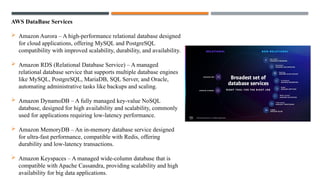
AWS DataBase Services
Amazon Aurora – A high-performance relational database designed
for cloud applications, offering MySQL and PostgreSQL
compatibility with improved scalability, durability, and availability.
Amazon RDS (Relational Database Service) – A managed
relational database service that supports multiple database engines
like MySQL, PostgreSQL, MariaDB, SQL Server, and Oracle,
automating administrative tasks like backups and scaling.
Amazon DynamoDB – A fully managed key-value NoSQL
database, designed for high availability and scalability, commonly
used for applications requiring low-latency performance.
Amazon MemoryDB – An in-memory database service designed
for ultra-fast performance, compatible with Redis, offering
durability and low-latency transactions.
Amazon Keyspaces – A managed wide-column database that is
compatible with Apache Cassandra, providing scalability and high
availability for big data applications.
10.
2.AWS MACHINE LEARNING
IntroductionTo Machine Learning
Machine learning (ML) in AWS enables businesses to build, train, and deploy models using cloud-based tools like Amazon Sage Maker.
It helps solve problems like fraud detection, customer personalization, predictive maintenance, and supply chain optimization.
The ML process involves data collection, preprocessing, model selection, training, evaluation, deployment, and continuous monitoring.
AWS provides various ML tools such as Amazon Sage Maker, AWS Deep Learning AMIs, Amazon Comprehend for different AI
applications.
Challenges in ML include data quality issues, model interpretability, scalability, deployment complexity, and ethical concerns like bias.
AWS offers pre-trained AI services like Amazon Polly for text-to-speech, Amazon Lex for conversational AI, and Amazon Forecast for
time-series forecasting, making ML accessible without deep expertise.
AWS provides automated machine learning (AutoML) with services like Amazon SageMaker Autopilot, which allows users to train and
deploy ML models with minimal manual intervention.
11.
Introduction to ComputerVision
Computer vision enables machines to interpret and analyze visual data, such as images and videos, to make
intelligent decisions. AWS offers computer vision services like Amazon Rekognition, which can detect objects,
faces, text, and activities in images and videos.
It is widely used in applications like facial recognition, autonomous vehicles, medical imaging, and quality
inspection in manufacturing. AWS provides pre-trained models and APIs for computer vision, reducing the need
for extensive data collection and model training.
Edge computing solutions like AWS Panorama enable computer vision applications to run locally on devices for
real-time processing. It is used in various industries, including healthcare (medical imaging diagnostics), retail
(automated checkouts and customer analytics), security (facial recognition and surveillance), and manufacturing
(defect detection and quality control).
Amazon Textract is another AWS service that extracts text, handwriting, and structured data from scanned
documents, making it useful for automated document processing. Deep learning techniques, particularly
Convolutional Neural Networks (CNNs), are widely used in computer vision tasks such as image classification,
object detection, and segmentation.
12.
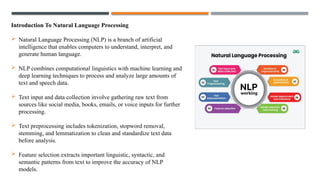
Introduction To NaturalLanguage Processing
Natural Language Processing (NLP) is a branch of artificial
intelligence that enables computers to understand, interpret, and
generate human language.
NLP combines computational linguistics with machine learning and
deep learning techniques to process and analyze large amounts of
text and speech data.
Text input and data collection involve gathering raw text from
sources like social media, books, emails, or voice inputs for further
processing.
Text preprocessing includes tokenization, stopword removal,
stemming, and lemmatization to clean and standardize text data
before analysis.
Feature selection extracts important linguistic, syntactic, and
semantic patterns from text to improve the accuracy of NLP
models.
13.
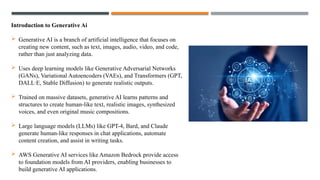
Introduction to GenerativeAi
Generative AI is a branch of artificial intelligence that focuses on
creating new content, such as text, images, audio, video, and code,
rather than just analyzing data.
Uses deep learning models like Generative Adversarial Networks
(GANs), Variational Autoencoders (VAEs), and Transformers (GPT,
DALL·E, Stable Diffusion) to generate realistic outputs.
Trained on massive datasets, generative AI learns patterns and
structures to create human-like text, realistic images, synthesized
voices, and even original music compositions.
Large language models (LLMs) like GPT-4, Bard, and Claude
generate human-like responses in chat applications, automate
content creation, and assist in writing tasks.
AWS Generative AI services like Amazon Bedrock provide access
to foundation models from AI providers, enabling businesses to
build generative AI applications.
14.
CONCLUSION
The AWS Cloudand Machine Learning course provided me with a comprehensive understanding of cloud-
based machine learning solutions, enabling me to leverage AWS services for data-driven applications. It
covered key concepts such as data ingestion, storage, and processing using AWS tools like Amazon S3, AWS
Glue, and Amazon Redshift, ensuring that I can efficiently manage large-scale datasets. Additionally, I gained
hands-on experience with AWS machine learning services, including Amazon SageMaker, which allowed me
to build, train, and deploy models seamlessly in the cloud. The course emphasized the importance of data
preprocessing, feature engineering, and model evaluation, reinforcing best practices for improving model
accuracy and efficiency. These foundational skills are crucial for implementing scalable AI solutions and
optimizing machine learning workflows in a cloud environment. Moreover, I learned how to integrate AWS AI
services like Amazon Rekognition for image analysis, Amazon Comprehend for NLP, and Amazon Forecast for
predictive analytics, broadening my ability to work with various machine learning applications. The practical
approach of the course enabled me to apply ETL processes, handle structured and unstructured data, and utilize
cloud-based tools for efficient model deployment. With this strong foundation, I am well-prepared to explore
advanced machine learning concepts, deep learning models, and big data analytics within the AWS ecosystem,
positioning me for real-world AI-driven problem-solving and innovation.




![7.__Developing_a_Research_Proposal[1].pptx](https://cdn.slidesharecdn.com/ss_thumbnails/7-260131073037-df92dd7d-thumbnail.jpg?width=640&height=640&fit=bounds)


![제 23회 보아즈(BOAZ) 빅데이터 컨퍼런스 - [MBOAX] : ABSA를 활용한 소비자 반응 분석 기반 운영 효율화 대시보드 설계](https://cdn.slidesharecdn.com/ss_thumbnails/3-1boaz23rdconferencemboax-260203102709-9d519923-thumbnail.jpg?width=640&height=640&fit=bounds)