Paul Complin 1 ,  Robert Lyng  2 ,  Hong Liu  3 , Alan Cocks 4   1ORTECH Environmental,  [email_address] 2   Ontario Power Generation Inc.,  rob.lyng@opg.com    3 PhD Candidate, York University,  [email_address] 4  EnviroAnalytics,  alan.cocks@enviroanalytics.com  Application of Two  State-of-the-art  Dispersion Models
Ontario Regulation 419/05  under the Ontario Environmental Protection Act introduced new air requirements including updated air dispersion models.  New Ontario Air Regulatory Regime
All Ambient Air Criteria Met for current Regime But Preliminary Screening Indicated Potential for Hundreds of Hours of Exceedances  SO 2  selected as the basis for assessing compliance risk.  Compliance Issue
Develop a Risk Based Operational Regime that meets the new Requirements Operational Restrictions Fuel Switching Capital Upgrades (e.g. FGD) Overall Project
SO 2  selected as the basis for assessing compliance risk.  AERMOD and ADMS selected as the Assessment Models Modelling Project
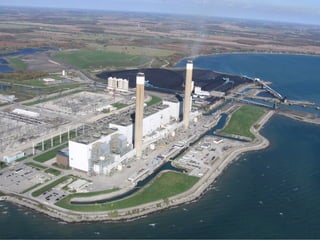
Eight Coal Fired Power Generation Units Range of coal types and blends Two 200 metre stacks with four flues each CEMs measure SO2 emission rates, exhaust velocities, exhaust temperatures Lakeshore site, flat terrain Nanticoke Generating  Station
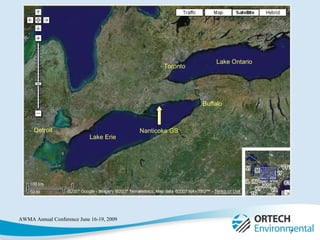
Lake Erie Lake Ontario Nanticoke GS Buffalo Toronto Detroit
Regulation 419/05 and the Air Dispersion Modelling Guideline for Ontario Issued in 2005, updated March 2009 Screen3/AERMOD as the primary model Regional 5 year Meteorological Data Sets Highest 8 hours Excluded as Outliers Alternate Models ‘If Conditions Warrant’ Modelling Protocol
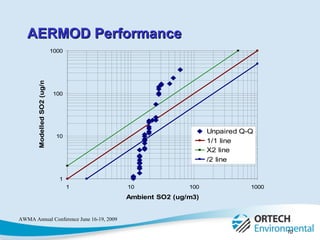
AERMOD Performance
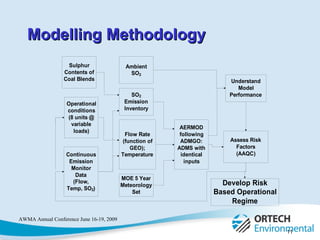
Modelling Methodology
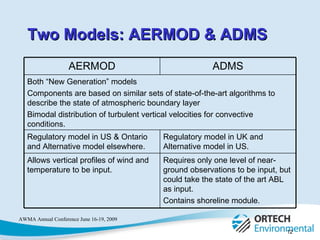
Two Models: AERMOD & ADMS AERMOD ADMS Both “New Generation” models Components are based on similar sets of state-of-the-art algorithms to describe the state of atmospheric boundary layer Bimodal distribution of turbulent vertical velocities for convective conditions. Regulatory model in US & Ontario and Alternative model elsewhere. Regulatory model in UK and Alternative model in US. Allows vertical profiles of wind and temperature to be input. Requires only one level of near-ground observations to be input, but could take the state of the art ABL as input. Contains shoreline module.
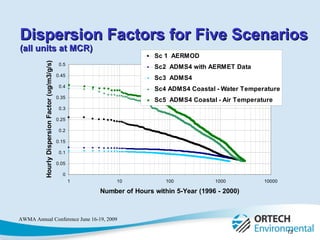
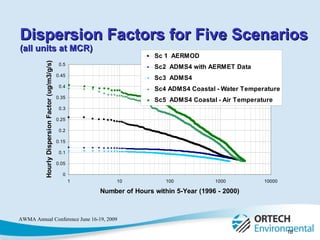
Dispersion Factors for Five Scenarios (all units at MCR)
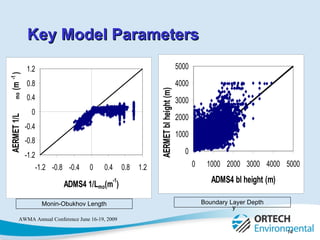
Key Model Parameters Monin-Obukhov Length Boundary Layer Depth y
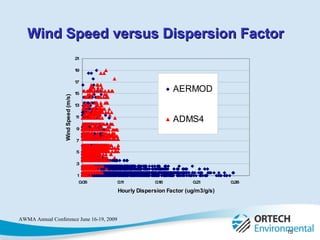
Wind Speed versus Dispersion Factor
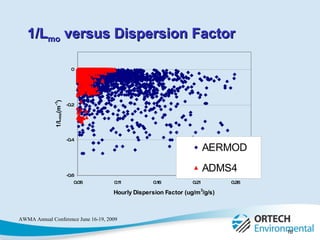
1/L mo  versus Dispersion Factor
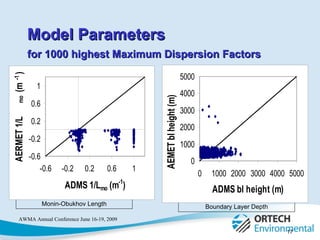
Model Parameters for 1000 highest Maximum Dispersion Factors   Monin-Obukhov Length Boundary Layer Depth
Dispersion Factors for Five Scenarios (all units at MCR)
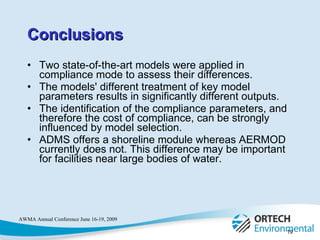
Conclusions Two state-of-the-art models were applied in compliance mode to assess their differences.  The models' different treatment of key model parameters results in significantly different outputs.  The identification of the compliance parameters, and therefore the cost of compliance, can be strongly influenced by model selection.  ADMS offers a shoreline module whereas AERMOD currently does not. This difference may be important for facilities near large bodies of water.
Paul G. Complin Principal- Compliance and Permitting ORTECH Environmental 804 Southdown Road Mississauga, ON, Canada L5J 2Y4 Phone 905 822-4120 e266 or 877-774-6560 e266 Fax 905 855-0406 [email_address]   www.ortech.ca Questions?

AWMA Presentation Application of Two State-of-the-art Dispersion Models

  • 1.
    Paul Complin 1, Robert Lyng 2 , Hong Liu 3 , Alan Cocks 4 1ORTECH Environmental, [email_address] 2 Ontario Power Generation Inc., rob.lyng@opg.com 3 PhD Candidate, York University, [email_address] 4 EnviroAnalytics, alan.cocks@enviroanalytics.com Application of Two State-of-the-art Dispersion Models
  • 2.
    Ontario Regulation 419/05 under the Ontario Environmental Protection Act introduced new air requirements including updated air dispersion models. New Ontario Air Regulatory Regime
  • 3.
    All Ambient AirCriteria Met for current Regime But Preliminary Screening Indicated Potential for Hundreds of Hours of Exceedances SO 2 selected as the basis for assessing compliance risk. Compliance Issue
  • 4.
    Develop a RiskBased Operational Regime that meets the new Requirements Operational Restrictions Fuel Switching Capital Upgrades (e.g. FGD) Overall Project
  • 5.
    SO 2 selected as the basis for assessing compliance risk. AERMOD and ADMS selected as the Assessment Models Modelling Project
  • 6.
    Eight Coal FiredPower Generation Units Range of coal types and blends Two 200 metre stacks with four flues each CEMs measure SO2 emission rates, exhaust velocities, exhaust temperatures Lakeshore site, flat terrain Nanticoke Generating Station
  • 7.
    Lake Erie LakeOntario Nanticoke GS Buffalo Toronto Detroit
  • 9.
    Regulation 419/05 andthe Air Dispersion Modelling Guideline for Ontario Issued in 2005, updated March 2009 Screen3/AERMOD as the primary model Regional 5 year Meteorological Data Sets Highest 8 hours Excluded as Outliers Alternate Models ‘If Conditions Warrant’ Modelling Protocol
  • 10.
  • 11.
  • 12.
    Two Models: AERMOD& ADMS AERMOD ADMS Both “New Generation” models Components are based on similar sets of state-of-the-art algorithms to describe the state of atmospheric boundary layer Bimodal distribution of turbulent vertical velocities for convective conditions. Regulatory model in US & Ontario and Alternative model elsewhere. Regulatory model in UK and Alternative model in US. Allows vertical profiles of wind and temperature to be input. Requires only one level of near-ground observations to be input, but could take the state of the art ABL as input. Contains shoreline module.
  • 13.
    Dispersion Factors forFive Scenarios (all units at MCR)
  • 14.
    Key Model ParametersMonin-Obukhov Length Boundary Layer Depth y
  • 15.
    Wind Speed versusDispersion Factor
  • 16.
    1/L mo versus Dispersion Factor
  • 17.
    Model Parameters for1000 highest Maximum Dispersion Factors Monin-Obukhov Length Boundary Layer Depth
  • 18.
    Dispersion Factors forFive Scenarios (all units at MCR)
  • 19.
    Conclusions Two state-of-the-artmodels were applied in compliance mode to assess their differences.  The models' different treatment of key model parameters results in significantly different outputs.  The identification of the compliance parameters, and therefore the cost of compliance, can be strongly influenced by model selection.  ADMS offers a shoreline module whereas AERMOD currently does not. This difference may be important for facilities near large bodies of water.
  • 20.
    Paul G. ComplinPrincipal- Compliance and Permitting ORTECH Environmental 804 Southdown Road Mississauga, ON, Canada L5J 2Y4 Phone 905 822-4120 e266 or 877-774-6560 e266 Fax 905 855-0406 [email_address] www.ortech.ca Questions?

Editor's Notes

  • #9 WELCOME TO NANTICOKE