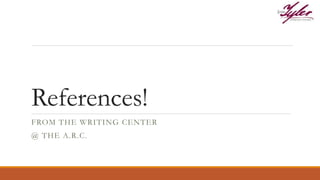
References!
FROM THE WRITING CENTER
@ THE A.R.C.
Vast Amount of Information.
When you are writing a paper there is a vast amount of information you can use to help you with your
topic. Things like:
 Books
 The Internet
 People (Interviews)
 Newspaper
 Journal Articles
 Magazines
 Movies, videos, documentaries
With so many sources to use how do you know which is the best for your paper?
How to avoid information overload and use
credible references.
With so many different things we can use to write, it is easy to get overloaded with information. For
academic writing you want to use scholarly-peer-reviewed sources that are as credible as possible.
John Tyler even has their own academic search engine! Here’ s how you can get there:
 Load the John Tyler webpage
 Click on the ‘Library’ tab that is between “academics” and “pay for John Tyler” in the white banner.
This should bring up John Tyler's library home page. If you’ re having trouble here is the link to
bring you right to the page! http://library.jtcc.edu
Locating the Search Bar
Here is what you should have found. Using this search bar and some of the
other categories, you will be able to find articles, books, and many other
credible references/sources to help you with your paper! There is even a
“Research Guides” tab that will help you get on your way to finding
references/sources to use.
There are also other credible sources you can
use that are not online.
For example: An interview.
Say you were writing a history paper about the civil rights movement, and you
knew someone who lived through that era. It is perfectly fine to use an interview
as part of your paper. A personal interview is also very simple to cite! It goes in
this order:
Persons last name, First name. Personal Interview. Day. Month. Year.
Here is a actual example filled in. “Grayson, Dick. Personal Interview. 4 July.
2016.”
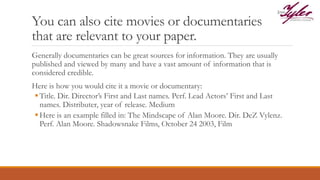
You can also cite movies or documentaries
that are relevant to your paper.
Generally documentaries can be great sources for information. They are usually
published and viewed by many and have a vast amount of information that is
considered credible.
Here is how you would cite it a movie or documentary:
Title. Dir. Director’s First and Last names. Perf. Lead Actors’ First and Last
names. Distributer, year of release. Medium
Here is an example filled in: The Mindscape of Alan Moore. Dir. DeZ Vylenz.
Perf. Alan Moore. Shadowsnake Films, October 24 2003, Film
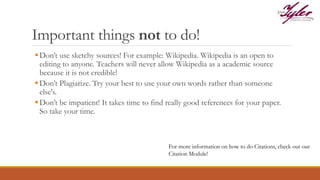
Important things not to do!
Don’t use sketchy sources! For example: Wikipedia. Wikipedia is an open to
editing to anyone. Teachers will never allow Wikipedia as a academic source
because it is not credible!
Don’t Plagiarize. Try your best to use your own words rather than someone
else's.
Don’t be impatient! It takes time to find really good references for your paper.
So take your time.
For more information on how to do Citations, check out our
Citation Module!

References

  • 1.
    References! FROM THE WRITINGCENTER @ THE A.R.C.
  • 2.
    Vast Amount ofInformation. When you are writing a paper there is a vast amount of information you can use to help you with your topic. Things like:  Books  The Internet  People (Interviews)  Newspaper  Journal Articles  Magazines  Movies, videos, documentaries With so many sources to use how do you know which is the best for your paper?
  • 3.
    How to avoidinformation overload and use credible references. With so many different things we can use to write, it is easy to get overloaded with information. For academic writing you want to use scholarly-peer-reviewed sources that are as credible as possible. John Tyler even has their own academic search engine! Here’ s how you can get there:  Load the John Tyler webpage  Click on the ‘Library’ tab that is between “academics” and “pay for John Tyler” in the white banner. This should bring up John Tyler's library home page. If you’ re having trouble here is the link to bring you right to the page! http://library.jtcc.edu
  • 4.
    Locating the SearchBar Here is what you should have found. Using this search bar and some of the other categories, you will be able to find articles, books, and many other credible references/sources to help you with your paper! There is even a “Research Guides” tab that will help you get on your way to finding references/sources to use.
  • 5.
    There are alsoother credible sources you can use that are not online. For example: An interview. Say you were writing a history paper about the civil rights movement, and you knew someone who lived through that era. It is perfectly fine to use an interview as part of your paper. A personal interview is also very simple to cite! It goes in this order: Persons last name, First name. Personal Interview. Day. Month. Year. Here is a actual example filled in. “Grayson, Dick. Personal Interview. 4 July. 2016.”
  • 6.
    You can alsocite movies or documentaries that are relevant to your paper. Generally documentaries can be great sources for information. They are usually published and viewed by many and have a vast amount of information that is considered credible. Here is how you would cite it a movie or documentary: Title. Dir. Director’s First and Last names. Perf. Lead Actors’ First and Last names. Distributer, year of release. Medium Here is an example filled in: The Mindscape of Alan Moore. Dir. DeZ Vylenz. Perf. Alan Moore. Shadowsnake Films, October 24 2003, Film
  • 7.
    Important things notto do! Don’t use sketchy sources! For example: Wikipedia. Wikipedia is an open to editing to anyone. Teachers will never allow Wikipedia as a academic source because it is not credible! Don’t Plagiarize. Try your best to use your own words rather than someone else's. Don’t be impatient! It takes time to find really good references for your paper. So take your time. For more information on how to do Citations, check out our Citation Module!