Instrument Landing System
Project Review - 01
Guided By :- Mr. Sathyanarayan.N
(Assist. Prof.)
Team Members
SIDDHARTH SONI (1755)
RAKESH SARMA (1761)
NIDHEE KUMARI RAJPUT (1811)
NEHA SAMANTA (1745)
Contents
• What is ILS ?
• Working Principle
• How does ILS Work ?
• Types of ILS
• Advantages of the ILS
• References
What is ILS ?
• ILS stands for Instrument Landing System and is a standard
International Civil Aviation Organisation (ICAO) precision landing aid
that is used to provide accurate azimuth and descent guidance signals
for guidance to aircraft for landing on the runway under normal or
adverse weather conditions.
Working Principle
• An instrument landing system operates as a ground-based instrument
approach system that provides precision lateral and vertical guidance to
an aircraft approaching and landing on a runway, using a combination of radio
signals and, in many cases, high-intensity lighting arrays to enable a safe landing
during instrument meteorological conditions (IMC), such as low ceilings or
reduced visibility due to fog, rain, or blowing snow.
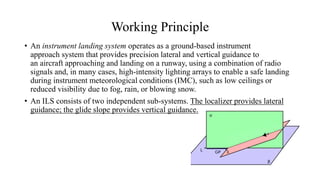
• An ILS consists of two independent sub-systems. The localizer provides lateral
guidance; the glide slope provides vertical guidance.
.
• An ILS Consists of –
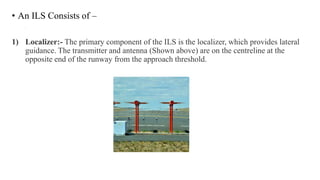
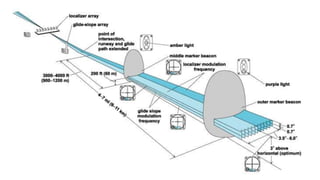
1) Localizer:- The primary component of the ILS is the localizer, which provides lateral
guidance. The transmitter and antenna (Shown above) are on the centreline at the
opposite end of the runway from the approach threshold.
.
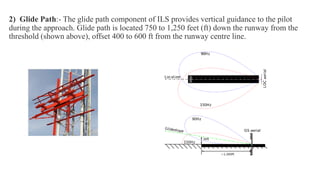
2) Glide Path:- The glide path component of ILS provides vertical guidance to the pilot
during the approach. Glide path is located 750 to 1,250 feet (ft) down the runway from the
threshold (shown above), offset 400 to 600 ft from the runway centre line.
.
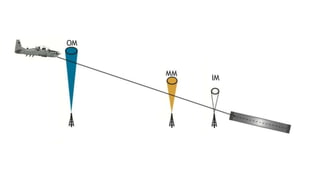
3) Markers Beacon :- Allow us to establish the distance at which the aeroplane is on the
runway.
(i) 🔵 Outer marker (OM): The outer marker (if installed) is located 3 1/2 to 6 NM from the
threshold within 250 ft of the extended runway centreline to provide the pilot with the
ability to make a positive position fix on the localizer.
(ii) 🟠 Middle Marker (MM): The middle marker ( if installed) is located approximately
0.5 to 0.8 NM from the threshold on the extended runway centerline. The middle marker
crosses the glide slope at approximately 200 to 250 ft above the runway elevation.
(iii) ⚪ Internal marker:
Its placement is more optional, it is at 0.24 miles from the runway and its
colour is white. Its identifier is dots.
.
4) DME : Distance Measuring Equipment (DME) is normally collocated with glide path and
provides slant distance to the aircraft with respect to touch down point.
.
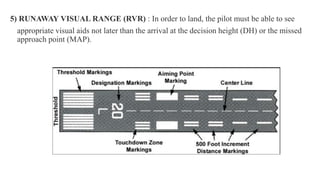
5) RUNAWAY VISUAL RANGE (RVR) : In order to land, the pilot must be able to see
appropriate visual aids not later than the arrival at the decision height (DH) or the missed
approach point (MAP).
.
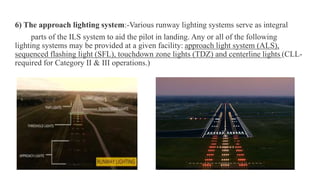
6) The approach lighting system:-Various runway lighting systems serve as integral
parts of the ILS system to aid the pilot in landing. Any or all of the following
lighting systems may be provided at a given facility: approach light system (ALS),
sequenced flashing light (SFL), touchdown zone lights (TDZ) and centerline lights (CLL-
required for Category II & III operations.)
Types of ILS
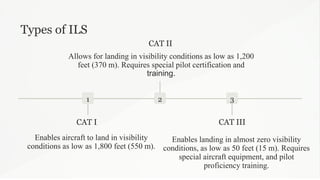
1
CAT I
Enables aircraft to land in visibility
conditions as low as 1,800 feet (550 m).
2
CAT II
Allows for landing in visibility conditions as low as 1,200
feet (370 m). Requires special pilot certification and
training.
3
CAT III
Enables landing in almost zero visibility
conditions, as low as 50 feet (15 m). Requires
special aircraft equipment, and pilot
proficiency training.
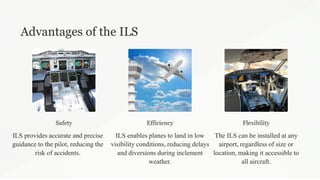
Advantages of the ILS
Safety
ILS provides accurate and precise
guidance to the pilot, reducing the
risk of accidents.
Efficiency
ILS enables planes to land in low
visibility conditions, reducing delays
and diversions during inclement
weather.
Flexibility
The ILS can be installed at any
airport, regardless of size or
location, making it accessible to
all aircraft.
References
• https://www.cfinotebook.net/notebook/avionics-and-
instruments/instrument-landing-system
• https://en.wikipedia.org/wiki/Instrument_landing_system
• https://www.aai.aero/en/content/what-ils-and-its-different-
component#:~:text=ILS%20stands%20for%20Instrument%20Landing,
normal%20or%20adverse%20weather%20conditions.
• https://www.grupooneair.com/what-is-ils-instrument-landing-
system/
Thank You
.

Avionicawgtwrgwrgdsbffefaes Project.pptx

  • 1.
    Instrument Landing System ProjectReview - 01 Guided By :- Mr. Sathyanarayan.N (Assist. Prof.)
  • 2.
    Team Members SIDDHARTH SONI(1755) RAKESH SARMA (1761) NIDHEE KUMARI RAJPUT (1811) NEHA SAMANTA (1745)
  • 3.
    Contents • What isILS ? • Working Principle • How does ILS Work ? • Types of ILS • Advantages of the ILS • References
  • 4.
    What is ILS? • ILS stands for Instrument Landing System and is a standard International Civil Aviation Organisation (ICAO) precision landing aid that is used to provide accurate azimuth and descent guidance signals for guidance to aircraft for landing on the runway under normal or adverse weather conditions.
  • 5.
    Working Principle • Aninstrument landing system operates as a ground-based instrument approach system that provides precision lateral and vertical guidance to an aircraft approaching and landing on a runway, using a combination of radio signals and, in many cases, high-intensity lighting arrays to enable a safe landing during instrument meteorological conditions (IMC), such as low ceilings or reduced visibility due to fog, rain, or blowing snow. • An ILS consists of two independent sub-systems. The localizer provides lateral guidance; the glide slope provides vertical guidance.
  • 6.
    . • An ILSConsists of – 1) Localizer:- The primary component of the ILS is the localizer, which provides lateral guidance. The transmitter and antenna (Shown above) are on the centreline at the opposite end of the runway from the approach threshold.
  • 7.
    . 2) Glide Path:-The glide path component of ILS provides vertical guidance to the pilot during the approach. Glide path is located 750 to 1,250 feet (ft) down the runway from the threshold (shown above), offset 400 to 600 ft from the runway centre line.
  • 8.
    . 3) Markers Beacon:- Allow us to establish the distance at which the aeroplane is on the runway. (i) 🔵 Outer marker (OM): The outer marker (if installed) is located 3 1/2 to 6 NM from the threshold within 250 ft of the extended runway centreline to provide the pilot with the ability to make a positive position fix on the localizer. (ii) 🟠 Middle Marker (MM): The middle marker ( if installed) is located approximately 0.5 to 0.8 NM from the threshold on the extended runway centerline. The middle marker crosses the glide slope at approximately 200 to 250 ft above the runway elevation. (iii) ⚪ Internal marker: Its placement is more optional, it is at 0.24 miles from the runway and its colour is white. Its identifier is dots.
  • 10.
    . 4) DME :Distance Measuring Equipment (DME) is normally collocated with glide path and provides slant distance to the aircraft with respect to touch down point.
  • 11.
    . 5) RUNAWAY VISUALRANGE (RVR) : In order to land, the pilot must be able to see appropriate visual aids not later than the arrival at the decision height (DH) or the missed approach point (MAP).
  • 12.
    . 6) The approachlighting system:-Various runway lighting systems serve as integral parts of the ILS system to aid the pilot in landing. Any or all of the following lighting systems may be provided at a given facility: approach light system (ALS), sequenced flashing light (SFL), touchdown zone lights (TDZ) and centerline lights (CLL- required for Category II & III operations.)
  • 14.
    Types of ILS 1 CATI Enables aircraft to land in visibility conditions as low as 1,800 feet (550 m). 2 CAT II Allows for landing in visibility conditions as low as 1,200 feet (370 m). Requires special pilot certification and training. 3 CAT III Enables landing in almost zero visibility conditions, as low as 50 feet (15 m). Requires special aircraft equipment, and pilot proficiency training.
  • 15.
    Advantages of theILS Safety ILS provides accurate and precise guidance to the pilot, reducing the risk of accidents. Efficiency ILS enables planes to land in low visibility conditions, reducing delays and diversions during inclement weather. Flexibility The ILS can be installed at any airport, regardless of size or location, making it accessible to all aircraft.
  • 16.
    References • https://www.cfinotebook.net/notebook/avionics-and- instruments/instrument-landing-system • https://en.wikipedia.org/wiki/Instrument_landing_system •https://www.aai.aero/en/content/what-ils-and-its-different- component#:~:text=ILS%20stands%20for%20Instrument%20Landing, normal%20or%20adverse%20weather%20conditions. • https://www.grupooneair.com/what-is-ils-instrument-landing- system/
  • 17.