 ground-based instrument approach system
that provides precision guidance to an
aircraft approaching a runway, using a
combination of radio signals and, in many
cases, high-intensity lighting arrays
 Localizer
 Glideslope
 Provides lateral guidance
 LOC (LZZ in Europe)
 Facility indication by periodically transmitting a 1020 Hz
morse code identification signal
 Directional
 Glidepath (GP)
 sited to one side of the runway touchdown zone
 signal is transmitted on a carrier frequency between
329.15 and 335 MHz using a technique similar to that of
the localizer
 centerline of the glideslope signal is arranged to define
a glideslope of approximately 3° above horizontal
(ground level)
 activates an indicator on the pilot's
instrument panel and the tone of the beacon
is audible to the pilot
 Outer, Middle, Inner
 located 7.2 km (3.9 NM) from the threshold
 Morse-style dashes of a 400 Hz tone
 blue lamp that flashes in unison with the received audio code
 provide height, distance and equipment functioning checks to
aircraft on intermediate and final approach
 ideally at a distance of approximately 3,500 ft (1,100 m) from the
threshold
 modulated with a 1300 Hz tone as alternating dots and dashes
at the rate of two per second
 amber lamp that flashes in unison with the received audio code
 Ideally at a distance of approximately 100 ft (30 m) from the
threshold
 Morse-style dots at 3000 Hz
 white lamp that flashes in unison with the received audio code
 Distance Measuring Equipment
 provides pilots with a slant range measurement of
distance to the runway in nautical miles
 provides more accurate and continuous monitoring of
correct progress on the ILS glideslope to the pilot, and
does not require an installation outside the airport
boundary
 assess the vital characteristics of the transmissions
 medium or high intensity
 assists the pilot in transitioning from instrument to visual
flight, and to align the aircraft visually with the runway
centerline
 Category I
 Category II
 Category III
› A
› B
› C
 A precision instrument approach and landing with a
decision height not lower than 200 feet (61 m) above
touchdown zone elevation and with either a visibility not
less than 800 meters (2,625 ft) or a runway visual range
not less than 550 meters (1,804 ft)
 A precision instrument approach and landing
with a decision height lower than 200 feet
(61 m) above touchdown zone elevation but
not lower than 100 feet (30 m), and a runway
visual range not less than 350 meters
(1,148 ft)
 a decision height lower than 100 feet (30 m) above touchdown
zone elevation, or no decision height
 a runway visual range not less than 200 meters (656 ft)
 a decision height lower than 50 feet (15 m) above touchdown zone
elevation, or no decision height
 a runway visual range less than 200 meters (656 ft) but not less
than 50 meters (164 ft)
 A precision instrument approach and landing with no decision
height and no runway visual range limitations
 capable of using an aircraft's autopilot to land the aircraft and can
also provide guidance along the runway surface
 all-weather, precision landing system
originally intended to replace or supplement
the Instrument Landing System (ILS)
 provides azimuth, elevation, and distance, as
well as "back azimuth"
 used for short-range communications with
airport controllers
 MLS employs 5GHz transmitters at the
landing place which use passive
electronically scanned rays to send scanning
beams towards approaching aircraft. An
aircraft that enters the scanned volume uses
a special receiver that calculates its position
by measuring the arrival times of the beams.
 wide selection of channels to avoid interference
with other nearby airports
 excellent performance in all weather
 small "footprint" at the airports
 antennas were much smaller
 did not have to be placed at a specific point
at the airport
 signals covered a very wide fan-shaped area
off the end of the runway
 uses a single frequency, broadcasting the
azimuth and altitude information one after
the other
 Approach azimuth
 Back azimuth
 Approach elevation
 Range communications
 Data communications
 analogous to ILS localizer but has a proportionally wider
coverage
 transmits MLS angle and data
 located 1000 ft beyond the end of the runway
 coverage is reliable up to 20 nm from runway threshold
and 20000ft of height
 laterally 40° on either side of the runway centerline
 frequency Range of 5031-5091 MHz
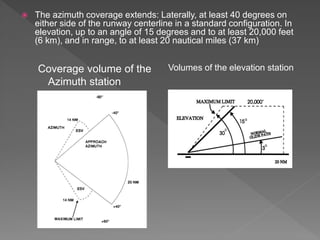
Coverage volume of the
Azimuth station
Volumes of the elevation station
 The azimuth coverage extends: Laterally, at least 40 degrees on
either side of the runway centerline in a standard configuration. In
elevation, up to an angle of 15 degrees and to at least 20,000 feet
(6 km), and in range, to at least 20 nautical miles (37 km)
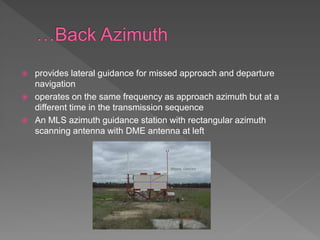
 provides lateral guidance for missed approach and departure
navigation
 operates on the same frequency as approach azimuth but at a
different time in the transmission sequence
 An MLS azimuth guidance station with rectangular azimuth
scanning antenna with DME antenna at left
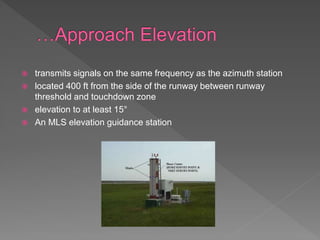
 transmits signals on the same frequency as the azimuth station
 located 400 ft from the side of the runway between runway
threshold and touchdown zone
 elevation to at least 15°
 An MLS elevation guidance station
 provided by the precision Distance Measuring
Equipment (DME, DME/P)
 provides continuous and highly accurate distance
information
 can include both the basic and auxiliary data words
 MLS data are transmitted throughout the azimuth (and
back azimuth when provided) coverage sectors
 Representative data
› Station identification
 four-letter
designation starting
with the letter M
› Exact locations of
azimuth elevation and
DME/P stations (for
MLS receiver
processing functions)
› Ground equipment
performance level
› DME/P channel and
status
 Auxiliary data content
› 3-D locations of MLS
equipment
› Waypoint coordinates
› Runway conditions and
Weather (e.g., RVR,
ceiling, altimeter setting,
wind, wake vortex, wind
shear)

5B_Instrument Landind System.ppt

  • 2.
     ground-based instrumentapproach system that provides precision guidance to an aircraft approaching a runway, using a combination of radio signals and, in many cases, high-intensity lighting arrays
  • 3.
  • 4.
     Provides lateralguidance  LOC (LZZ in Europe)  Facility indication by periodically transmitting a 1020 Hz morse code identification signal  Directional
  • 5.
     Glidepath (GP) sited to one side of the runway touchdown zone  signal is transmitted on a carrier frequency between 329.15 and 335 MHz using a technique similar to that of the localizer  centerline of the glideslope signal is arranged to define a glideslope of approximately 3° above horizontal (ground level)
  • 7.
     activates anindicator on the pilot's instrument panel and the tone of the beacon is audible to the pilot  Outer, Middle, Inner
  • 8.
     located 7.2km (3.9 NM) from the threshold  Morse-style dashes of a 400 Hz tone  blue lamp that flashes in unison with the received audio code  provide height, distance and equipment functioning checks to aircraft on intermediate and final approach
  • 9.
     ideally ata distance of approximately 3,500 ft (1,100 m) from the threshold  modulated with a 1300 Hz tone as alternating dots and dashes at the rate of two per second  amber lamp that flashes in unison with the received audio code
  • 10.
     Ideally ata distance of approximately 100 ft (30 m) from the threshold  Morse-style dots at 3000 Hz  white lamp that flashes in unison with the received audio code
  • 11.
     Distance MeasuringEquipment  provides pilots with a slant range measurement of distance to the runway in nautical miles  provides more accurate and continuous monitoring of correct progress on the ILS glideslope to the pilot, and does not require an installation outside the airport boundary
  • 12.
     assess thevital characteristics of the transmissions  medium or high intensity  assists the pilot in transitioning from instrument to visual flight, and to align the aircraft visually with the runway centerline
  • 13.
     Category I Category II  Category III › A › B › C
  • 14.
     A precisioninstrument approach and landing with a decision height not lower than 200 feet (61 m) above touchdown zone elevation and with either a visibility not less than 800 meters (2,625 ft) or a runway visual range not less than 550 meters (1,804 ft)
  • 15.
     A precisioninstrument approach and landing with a decision height lower than 200 feet (61 m) above touchdown zone elevation but not lower than 100 feet (30 m), and a runway visual range not less than 350 meters (1,148 ft)
  • 16.
     a decisionheight lower than 100 feet (30 m) above touchdown zone elevation, or no decision height  a runway visual range not less than 200 meters (656 ft)  a decision height lower than 50 feet (15 m) above touchdown zone elevation, or no decision height  a runway visual range less than 200 meters (656 ft) but not less than 50 meters (164 ft)
  • 17.
     A precisioninstrument approach and landing with no decision height and no runway visual range limitations  capable of using an aircraft's autopilot to land the aircraft and can also provide guidance along the runway surface
  • 19.
     all-weather, precisionlanding system originally intended to replace or supplement the Instrument Landing System (ILS)  provides azimuth, elevation, and distance, as well as "back azimuth"  used for short-range communications with airport controllers
  • 20.
     MLS employs5GHz transmitters at the landing place which use passive electronically scanned rays to send scanning beams towards approaching aircraft. An aircraft that enters the scanned volume uses a special receiver that calculates its position by measuring the arrival times of the beams.
  • 21.
     wide selectionof channels to avoid interference with other nearby airports  excellent performance in all weather  small "footprint" at the airports
  • 22.
     antennas weremuch smaller  did not have to be placed at a specific point at the airport  signals covered a very wide fan-shaped area off the end of the runway  uses a single frequency, broadcasting the azimuth and altitude information one after the other
  • 23.
     Approach azimuth Back azimuth  Approach elevation  Range communications  Data communications
  • 24.
     analogous toILS localizer but has a proportionally wider coverage  transmits MLS angle and data  located 1000 ft beyond the end of the runway  coverage is reliable up to 20 nm from runway threshold and 20000ft of height  laterally 40° on either side of the runway centerline  frequency Range of 5031-5091 MHz
  • 25.
    Coverage volume ofthe Azimuth station Volumes of the elevation station  The azimuth coverage extends: Laterally, at least 40 degrees on either side of the runway centerline in a standard configuration. In elevation, up to an angle of 15 degrees and to at least 20,000 feet (6 km), and in range, to at least 20 nautical miles (37 km)
  • 26.
     provides lateralguidance for missed approach and departure navigation  operates on the same frequency as approach azimuth but at a different time in the transmission sequence  An MLS azimuth guidance station with rectangular azimuth scanning antenna with DME antenna at left
  • 27.
     transmits signalson the same frequency as the azimuth station  located 400 ft from the side of the runway between runway threshold and touchdown zone  elevation to at least 15°  An MLS elevation guidance station
  • 28.
     provided bythe precision Distance Measuring Equipment (DME, DME/P)  provides continuous and highly accurate distance information
  • 29.
     can includeboth the basic and auxiliary data words  MLS data are transmitted throughout the azimuth (and back azimuth when provided) coverage sectors
  • 30.
     Representative data ›Station identification  four-letter designation starting with the letter M › Exact locations of azimuth elevation and DME/P stations (for MLS receiver processing functions) › Ground equipment performance level › DME/P channel and status  Auxiliary data content › 3-D locations of MLS equipment › Waypoint coordinates › Runway conditions and Weather (e.g., RVR, ceiling, altimeter setting, wind, wake vortex, wind shear)