P R O M O T I N G A P P R O P R I AT E T E C H N O L O G Y A N D
                          C ON S E R VAT I O N B A S E D L I V E L I H O O D O P P O RT U N I T I E S


                                    AVANI - GSBI™ Class of 2010

Headquarters:        Pithoragarh,           Problem Statement:
Uttarakhand, India                          Over 7 million people in the Central Himalayan Region live
Established: 1999                           close to large tracts of pine forests with diminishing access to
                                            fuel wood, water, and other life support systems, because fires
Impact Areas: India                         caused by the pine needles destroy the ecosystem.
Type: Non-Profit/NGO
Sectors: Environment
Staff Size: 28 and 120 volunteers
Annual Budget: $362,360
Major Funders: Ford Foundation,
Volkart Foundation
Awards: Ashden Awards, Honorary
Mention, 2007


Theory of Change:
Avani provides a village-level cook-
ing energy solution that reduces fuel
gathering time by 70% over wood,
provides smoke-free homes, and
reduces deforestation, which protects
the health of people and forests,
while generating income and reducing
carbon emissions by generating clean         Solution:
electricity.                                 AVANI’s latest energy initiative generates energy from locally
                                             gathered pine needles. Unlike most bioenergy projects, this one
                                             uses a feedstock (pine needles) that is harmful if it is not har-
                                             vested, to generate combustible gases that produce electricity
                                             which it sells to the local grid utility. It also addresses the most
                                             energy intensive and vital household process – cooking by sup-
                                             plying charcoal, which is a by-product, at a price cheaper than
                                             gas or kerosene. Families can pay for the charcoal either in cash
                                             or by collecting pine needles.


             “AVANI has generated optimism by initiating programs that bring technology and employ-
             ment to over 5,000 families which promises to reverse the trend of migration in search of
             work.” - Rajnish Jain, Director


       | www.avani-kumaon.org           |     rajnish@avani-kumaon.org | +91.9412092982 |
P R O M O T I N G A P P R O P R I AT E T E C H N O L O G Y A N D
                          C ON S E R VAT I O N B A S E D L I V E L I H O O D O P P O RT U N I T I E S .


Milestones Achieved:                           Impact to Date:
1999: Rural poor started paying for            •    25 villages electrified and a thriving business that produces
solar technology services                           solar energy and employs rural youth
                                               •    Over 500 artisans and farmers earning income from our silk
2003: Electrified 9 villages with EU                and wool textile enterprise
Funding                                        •    Team of 30 rural youth trained in-house to run the enter-
                                                    prise
2005: Ford Foundation grant to start
                                               •    Almost 50% of the management team is women
wild silk cultivation project
2006: Pine needle gasifier started
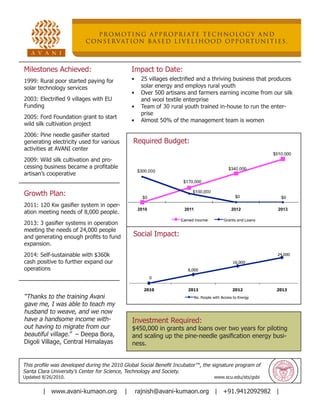
generating electricity used for various        Required Budget:
activities at AVANI center
2009: Wild silk cultivation and pro-
cessing business became a profitable
artisan’s cooperative


Growth Plan:
2011: 120 Kw gasifier system in oper-
ation meeting needs of 8,000 people.
2013: 3 gasifier systems in operation
meeting the needs of 24,000 people
and generating enough profits to fund          Social Impact:
expansion.
2014: Self-sustainable with $360k
cash positive to further expand our
operations


“Thanks to the training Avani
gave me, I was able to teach my
husband to weave, and we now
have a handsome income with-                   Investment Required:
out having to migrate from our                 $450,000 in grants and loans over two years for piloting
beautiful village.” – Deepa Bora,              and scaling up the pine-needle gasification energy busi-
Digoli Village, Central Himalayas              ness.


This profile was developed during the 2010 Global Social Benefit Incubator™, the signature program of
Santa Clara University’s Center for Science, Technology and Society.
Updated 8/26/2010.                                                               www.scu.edu/sts/gsbi


        | www.avani-kumaon.org             |       rajnish@avani-kumaon.org | +91.9412092982 |

Avani gsbi 2010

  • 1.
    P R OM O T I N G A P P R O P R I AT E T E C H N O L O G Y A N D C ON S E R VAT I O N B A S E D L I V E L I H O O D O P P O RT U N I T I E S AVANI - GSBI™ Class of 2010 Headquarters: Pithoragarh, Problem Statement: Uttarakhand, India Over 7 million people in the Central Himalayan Region live Established: 1999 close to large tracts of pine forests with diminishing access to fuel wood, water, and other life support systems, because fires Impact Areas: India caused by the pine needles destroy the ecosystem. Type: Non-Profit/NGO Sectors: Environment Staff Size: 28 and 120 volunteers Annual Budget: $362,360 Major Funders: Ford Foundation, Volkart Foundation Awards: Ashden Awards, Honorary Mention, 2007 Theory of Change: Avani provides a village-level cook- ing energy solution that reduces fuel gathering time by 70% over wood, provides smoke-free homes, and reduces deforestation, which protects the health of people and forests, while generating income and reducing carbon emissions by generating clean Solution: electricity. AVANI’s latest energy initiative generates energy from locally gathered pine needles. Unlike most bioenergy projects, this one uses a feedstock (pine needles) that is harmful if it is not har- vested, to generate combustible gases that produce electricity which it sells to the local grid utility. It also addresses the most energy intensive and vital household process – cooking by sup- plying charcoal, which is a by-product, at a price cheaper than gas or kerosene. Families can pay for the charcoal either in cash or by collecting pine needles. “AVANI has generated optimism by initiating programs that bring technology and employ- ment to over 5,000 families which promises to reverse the trend of migration in search of work.” - Rajnish Jain, Director | www.avani-kumaon.org | rajnish@avani-kumaon.org | +91.9412092982 |
  • 2.
    P R OM O T I N G A P P R O P R I AT E T E C H N O L O G Y A N D C ON S E R VAT I O N B A S E D L I V E L I H O O D O P P O RT U N I T I E S . Milestones Achieved: Impact to Date: 1999: Rural poor started paying for • 25 villages electrified and a thriving business that produces solar technology services solar energy and employs rural youth • Over 500 artisans and farmers earning income from our silk 2003: Electrified 9 villages with EU and wool textile enterprise Funding • Team of 30 rural youth trained in-house to run the enter- prise 2005: Ford Foundation grant to start • Almost 50% of the management team is women wild silk cultivation project 2006: Pine needle gasifier started generating electricity used for various Required Budget: activities at AVANI center 2009: Wild silk cultivation and pro- cessing business became a profitable artisan’s cooperative Growth Plan: 2011: 120 Kw gasifier system in oper- ation meeting needs of 8,000 people. 2013: 3 gasifier systems in operation meeting the needs of 24,000 people and generating enough profits to fund Social Impact: expansion. 2014: Self-sustainable with $360k cash positive to further expand our operations “Thanks to the training Avani gave me, I was able to teach my husband to weave, and we now have a handsome income with- Investment Required: out having to migrate from our $450,000 in grants and loans over two years for piloting beautiful village.” – Deepa Bora, and scaling up the pine-needle gasification energy busi- Digoli Village, Central Himalayas ness. This profile was developed during the 2010 Global Social Benefit Incubator™, the signature program of Santa Clara University’s Center for Science, Technology and Society. Updated 8/26/2010. www.scu.edu/sts/gsbi | www.avani-kumaon.org | rajnish@avani-kumaon.org | +91.9412092982 |