Autonomous Vehicles
Submittedto- SubmittedBy-
DRRajashreeT
apariaMam RishabhJain
21/522
Autonomous Vehicles
Autonomous vehicles are transforming the way we think about
transportation.From personal cars to drones, theyhave the potential to
revolutionize the way we move goodsand people.
byRishabhJain
RJ
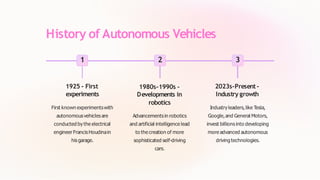
History of Autonomous Vehicles
1925 - First
experiments
First known experimentswith
autonomousvehicles are
conducted by the electrical
engineer FrancisHoudinain
his garage.
1 2
1980s-1990s -
Developments in
robotics
Advancementsin robotics
and artificial intelligence lead
to the creation of more
sophisticated self-driving
cars.
3
2023s-Present-
Industry growth
Industryleaders,like Tesla,
Google,and General Motors,
invest billions into developing
more advanced autonomous
drivingtechnologies.
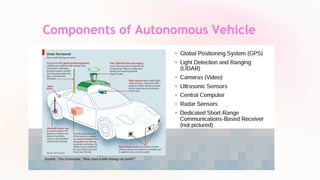
Components of Autonomous Vehicle
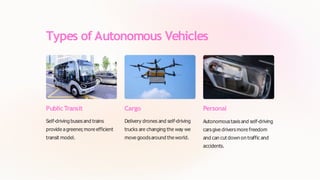
Types of Autonomous Vehicles
PublicTransit
Self-driving busesand trains
provide agreener
,more efficient
transit model.
Cargo
Delivery drones and self-driving
trucks are changing the way we
move goodsaround the world.
Personal
Autonomoustaxisand self-driving
carsgive driversmore freedom
and can cut down on traffic and
accidents.
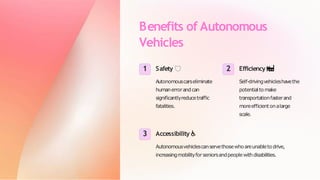
Benefits of Autonomous
Vehicles
1 Safety 🛡
Autonomouscarseliminate
humanerrorandcan
significantlyreducetraffic
fatalities.
2 Efficiency 🏭
Self-drivingvehicleshavethe
potential tomake
transportationfasterand
moreefficientonalarge
scale.
3 Accessibility ♿
Autonomousvehiclescanservethosewhoareunableto drive,
increasingmobilityfor seniorsandpeoplewithdisabilities.
Challenges of Autonomous Vehicles
T
echnology Limitations 🔧
Autonomousvehicles rely on complex,
sophisticated hardware and software that can
be difficult to develop and maintain.
Security Concerns 🔒
Self-driving carsare prone to hacking, leading to
concernsabout privacy and datasecurity.
Infrastructure🏗
The success of autonomous vehicles depends
on developinginfrastructure,such as charging
stations and communication systems, which can
be achallenge.
Regulations 📜
Governmentsare strugglingto develop
regulations for autonomousvehicles that are
both effective and fair
.
Regulations and Safety Concerns
1 Limited testing
Regulationsvaryfromcountryto
country
,andrestrictedtestingcanslow
downprogressintheindustry
.
2
Safety concerns
Somepeoplearehesitanttotrust
autonomousvehicles,creating
skepticismaroundsafetyandreliability. 3 Newlaws
Governmentsneedtodeveloppolicies
andregulationsthatwillensurethe
safetyandaccessibilityof autonomous
vehicles.
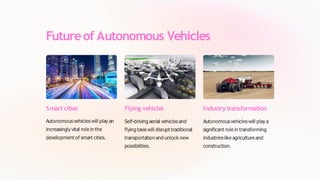
Futureof Autonomous Vehicles
Smartcities
Autonomousvehicles will play an
increasingly vital role in the
development of smart cities.
Flying vehicles
Self-driving aerial vehicles and
flying taxis will disrupt traditional
transportation and unlock new
possibilities.
Industry transformation
Autonomousvehicles will play a
significant role in transforming
industrieslike agriculture and
construction.
TheFutureis Now
Autonomousvehicleshavethepotentialto reshapeourworldinexcitingand
profound ways.Though there arechallenges ahead,the technology is
advancingatanunprecedentedpace.

Autonomous-Vehicles ppt.pptx

  • 1.
  • 2.
    Autonomous Vehicles Autonomous vehiclesare transforming the way we think about transportation.From personal cars to drones, theyhave the potential to revolutionize the way we move goodsand people. byRishabhJain RJ
  • 3.
    History of AutonomousVehicles 1925 - First experiments First known experimentswith autonomousvehicles are conducted by the electrical engineer FrancisHoudinain his garage. 1 2 1980s-1990s - Developments in robotics Advancementsin robotics and artificial intelligence lead to the creation of more sophisticated self-driving cars. 3 2023s-Present- Industry growth Industryleaders,like Tesla, Google,and General Motors, invest billions into developing more advanced autonomous drivingtechnologies.
  • 4.
  • 5.
    Types of AutonomousVehicles PublicTransit Self-driving busesand trains provide agreener ,more efficient transit model. Cargo Delivery drones and self-driving trucks are changing the way we move goodsaround the world. Personal Autonomoustaxisand self-driving carsgive driversmore freedom and can cut down on traffic and accidents.
  • 6.
    Benefits of Autonomous Vehicles 1Safety 🛡 Autonomouscarseliminate humanerrorandcan significantlyreducetraffic fatalities. 2 Efficiency 🏭 Self-drivingvehicleshavethe potential tomake transportationfasterand moreefficientonalarge scale. 3 Accessibility ♿ Autonomousvehiclescanservethosewhoareunableto drive, increasingmobilityfor seniorsandpeoplewithdisabilities.
  • 7.
    Challenges of AutonomousVehicles T echnology Limitations 🔧 Autonomousvehicles rely on complex, sophisticated hardware and software that can be difficult to develop and maintain. Security Concerns 🔒 Self-driving carsare prone to hacking, leading to concernsabout privacy and datasecurity. Infrastructure🏗 The success of autonomous vehicles depends on developinginfrastructure,such as charging stations and communication systems, which can be achallenge. Regulations 📜 Governmentsare strugglingto develop regulations for autonomousvehicles that are both effective and fair .
  • 8.
    Regulations and SafetyConcerns 1 Limited testing Regulationsvaryfromcountryto country ,andrestrictedtestingcanslow downprogressintheindustry . 2 Safety concerns Somepeoplearehesitanttotrust autonomousvehicles,creating skepticismaroundsafetyandreliability. 3 Newlaws Governmentsneedtodeveloppolicies andregulationsthatwillensurethe safetyandaccessibilityof autonomous vehicles.
  • 9.
    Futureof Autonomous Vehicles Smartcities Autonomousvehicleswill play an increasingly vital role in the development of smart cities. Flying vehicles Self-driving aerial vehicles and flying taxis will disrupt traditional transportation and unlock new possibilities. Industry transformation Autonomousvehicles will play a significant role in transforming industrieslike agriculture and construction.
  • 10.
    TheFutureis Now Autonomousvehicleshavethepotentialto reshapeourworldinexcitingand profoundways.Though there arechallenges ahead,the technology is advancingatanunprecedentedpace.