Copyright © 2020, 2017, 2015 Pearson Education, Inc. All Rights Reserved
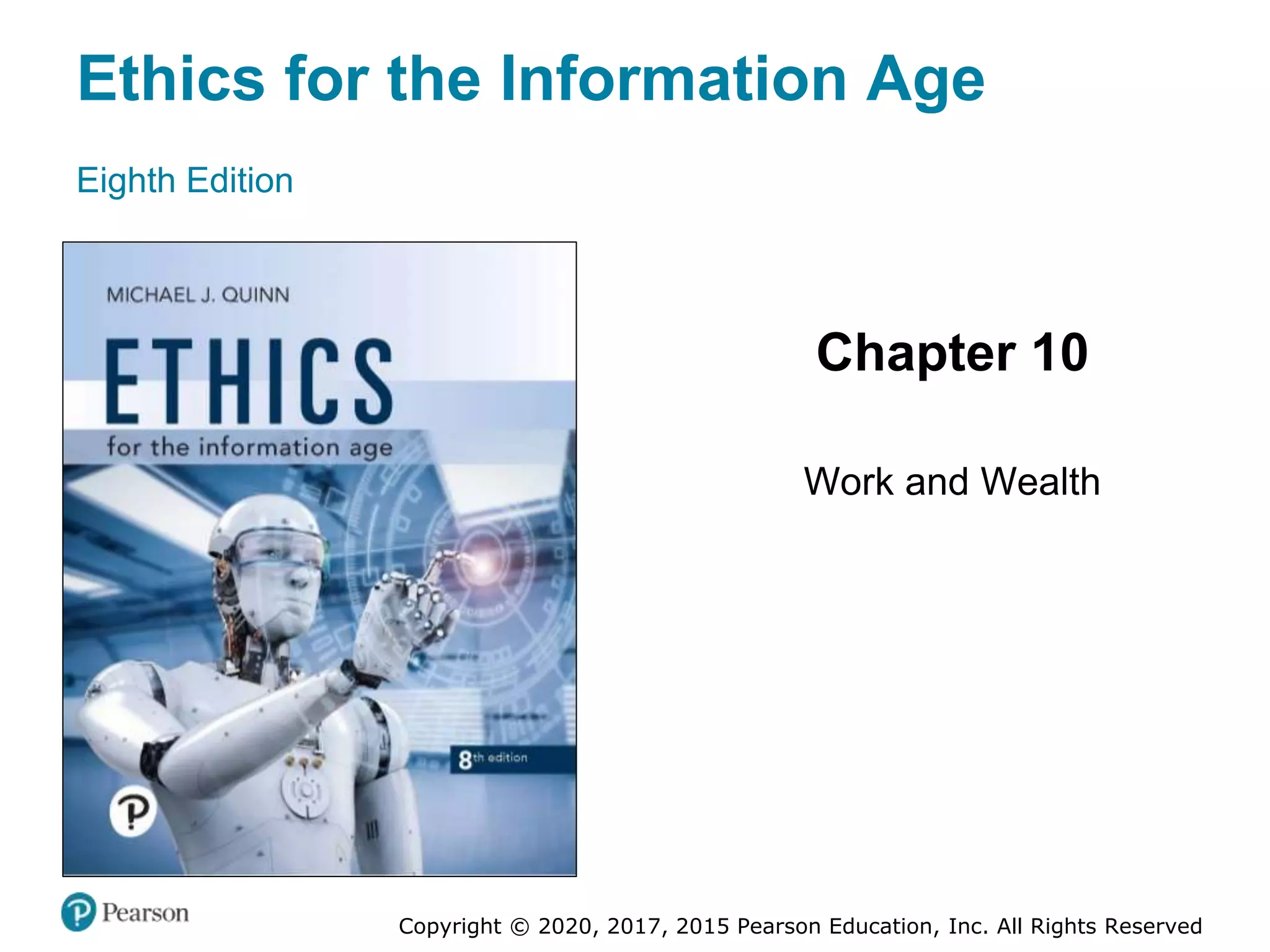
Work and Wealth
Chapter 10
Eighth Edition
Ethics for the Information Age
Copyright © 2020, 2017, 2015 Pearson Education, Inc. All Rights Reserved
10.1 Introduction
10.2 Automation and employment
10.3 Workplace changes
10.4 Globalization
10.5 The digital divide
10.6 The “winner-take-all society”
Learning Objectives
Copyright © 2020, 2017, 2015 Pearson Education, Inc. All Rights Reserved
10.1 Introduction
Copyright © 2020, 2017, 2015 Pearson Education, Inc. All Rights Reserved
• Information technology and automation affecting workplace
– Increases in productivity
– Job creation and destruction
– Globalization of job market
– Organization of companies
– Telework
– Workplace monitoring
• Impacts of information technology on society
– Digital divide
– Winner-take-all effects
10.1 Introduction
Copyright © 2020, 2017, 2015 Pearson Education, Inc. All Rights Reserved
10.2 Automation and Employment
Copyright © 2020, 2017, 2015 Pearson Education, Inc. All Rights Reserved
• Between 1979 and 2011…
– U.S. population increased 39%
– Manufacturing employment dropped 40%, from 19.4
million jobs to 11.7 million jobs
• Lost white-collar jobs
– Secretarial and clerical positions
– Accountants and bookkeepers
– Middle managers
• Juliet Schor: Work week got longer between 1979 and
1990
Automation and Job Destruction
Copyright © 2020, 2017, 2015 Pearson Education, Inc. All Rights Reserved
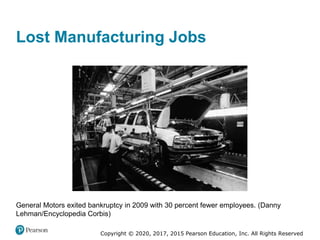
General Motors exited bankruptcy in 2009 with 30 percent fewer employees. (Danny
Lehman/Encyclopedia Corbis)
Lost Manufacturing Jobs
Copyright © 2020, 2017, 2015 Pearson Education, Inc. All Rights Reserved
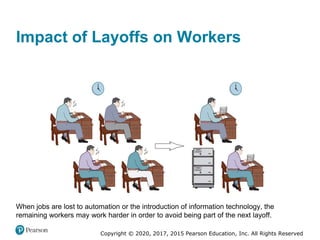
When jobs are lost to automation or the introduction of information technology, the
remaining workers may work harder in order to avoid being part of the next layoff.
Impact of Layoffs on Workers
Copyright © 2020, 2017, 2015 Pearson Education, Inc. All Rights Reserved
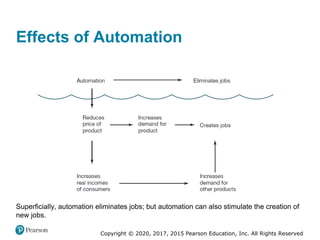
• Automation lowers prices
• That increases demand for the product
• It also increases real incomes, increasing demand for
other products, which means more jobs for people making
those products
• Number of manufacturing jobs worldwide is increasing
• Martin Carnoy: Workers today work less than workers did
100 years ago
Automation and Job Creation
Copyright © 2020, 2017, 2015 Pearson Education, Inc. All Rights Reserved
Superficially, automation eliminates jobs; but automation can also stimulate the creation of
new jobs.
Effects of Automation
Copyright © 2020, 2017, 2015 Pearson Education, Inc. All Rights Reserved
• We have used higher productivity to achieve a higher
material standard of living
• This is in contrast to medieval or ancient times (before
modern capitalism)
• In medieval or ancient times
– Low caloric intake meant pace of work was slow
– Work was seasonal and intermittent
– Laborers resisted working if they had enough money
(i.e., they weren’t consumers)
– When wages rose, laborers worked less
Effects of Increase in Productivity
Copyright © 2020, 2017, 2015 Pearson Education, Inc. All Rights Reserved
• Stuart is a software developer for Seattle start-up
• Everybody works 60 hours/week
• Company’s vacation policy is 3 weeks/year
– Nobody takes that much
– Some of Stuart’s coworkers have had zero vacation in 2+
years
• Six months ago, Stuart learns his parents are moving from San
Diego to Australia
– He gets permission for one week’s vacation in San Diego
– Doesn’t tell parents
Case Study: The Canceled Vacation (1 of 2)
Copyright © 2020, 2017, 2015 Pearson Education, Inc. All Rights Reserved
• One week before vacation, supervisor asks Stuart to delay
vacation
– Important product update
– Offers Stuart
▪ Three weeks’ vacation next year
▪ Round-trip airfare
• Stuart agrees to request and cancels vacation to San Diego
Case Study: The Canceled Vacation (2 of 2)
Copyright © 2020, 2017, 2015 Pearson Education, Inc. All Rights Reserved
• Stuart broke no promises and didn’t deceive anyone
• Stuart was not obligated to visit his parents before they
moved from San Diego to Australia
• Stuart did nothing wrong
Kantian/Social Contract Theory
Evaluation
Copyright © 2020, 2017, 2015 Pearson Education, Inc. All Rights Reserved
• Stuart had two alternatives: accept or reject supervisor’s
request
• Consider duration, certainty, propinquity, and purity of two
alternatives
• Duration
– San Diego: 1 week
– Australia: 3 weeks
– Trip to Australia 3 times better
Act Utilitarian Evaluation (1 of 3)
Copyright © 2020, 2017, 2015 Pearson Education, Inc. All Rights Reserved
• Purity
– San Diego: Will be worrying about upset boss
– Australia: Realistically, will also be worrying about
upset boss
– Two options equivalent
• Propinquity
– San Diego: Next week
– Australia: Next year
– Trip to San Diego much better (2 times better)
Act Utilitarian Evaluation (2 of 3)
Copyright © 2020, 2017, 2015 Pearson Education, Inc. All Rights Reserved
• Certainty
– San Diego: 100%
– Australia: Much less certain, given history of Stuart’s
manager and fact no one has ever taken 3 weeks’
vacation, say 25%
– San Diego the better choice
• Summary:
– San Diego: 1 × 1 × 2 × 100% = 2
– Australia: 3 × 1 × 1 × 25% = 0.75
– San Diego the better option
– Stuart made the wrong decision
Act Utilitarian Evaluation (3 of 3)
Copyright © 2020, 2017, 2015 Pearson Education, Inc. All Rights Reserved
• Stuart demonstrated a lack of courage and a lack of
consideration for himself, his coworkers, and his parents
• By caving in to his boss, Stuart
– let his boss get away with bad behavior
– made reasonable vacations less likely for himself and
for his fellow employees
– deprived his parents of the pleasure of his company for
at least a year
• Stuart’s decision is not characteristic of a good co-worker
or a good son
Virtue Ethics Evaluation
Copyright © 2020, 2017, 2015 Pearson Education, Inc. All Rights Reserved
• Some experts suggest most jobs will be taken over by
machines
• Artificial intelligence: Field of computer science focusing
on intelligent behavior by machines
• Rapid increases in microprocessor speeds have led to
various successes in AI
• What will happen as computers continue to increase in
speed?
Rise of the Robots?
Copyright © 2020, 2017, 2015 Pearson Education, Inc. All Rights Reserved
• Computer-controlled minivan “drove” on freeways across
USA in 1995
• IBM supercomputer Deep Blue defeated chess champion
Gary Kasparov in 1997
• Honda’s ASIMO android climbed and descended stairs
(2000)
• Electrolux introduced robotic vacuum cleaner in 2001
• Five autonomous vehicles successfully completed 128-
mile course in Nevada desert in 2005
Notable Achievements in AI Since 1995 (1 of 2)
Copyright © 2020, 2017, 2015 Pearson Education, Inc. All Rights Reserved
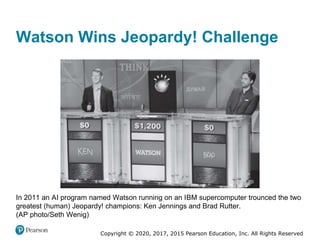
• Watson trounced two most successful human Jeopardy!
champions in 2011
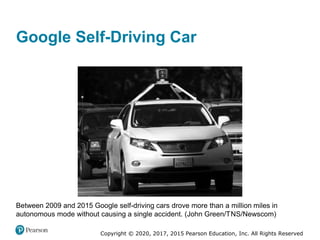
• Google’s self-driving cars logged more than one million
miles between 2009 and 2015 without an accident
(caused by the car)
• AlphaGo program created by Google trounced Ke Jie,
world’s #1 Go player, in multiplayer match in 2017
Notable Achievements in AI Since 1995 (2 of 2)
Copyright © 2020, 2017, 2015 Pearson Education, Inc. All Rights Reserved
In 2011 an AI program named Watson running on an IBM supercomputer trounced the two
greatest (human) Jeopardy! champions: Ken Jennings and Brad Rutter.
(AP photo/Seth Wenig)
Watson Wins Jeopardy! Challenge
Copyright © 2020, 2017, 2015 Pearson Education, Inc. All Rights Reserved
Between 2009 and 2015 Google self-driving cars drove more than a million miles in
autonomous mode without causing a single accident. (John Green/TNS/Newscom)
Google Self-Driving Car
Copyright © 2020, 2017, 2015 Pearson Education, Inc. All Rights Reserved
• Is it wrong to create machines capable of making human labor
obsolete?
• Would intelligent robots demoralize humanity?
• Is it wrong to work on an intelligent machine if it can’t be
guaranteed the machine will be benevolent toward humans?
• What if a malevolent human puts intelligent machines to an evil
use?
• How would creative computers change our ideas about
intellectual property?
• How will our ideas about privacy change if superfast computers
constantly analyze our electronic records?
Moral Question Related to Robotics
Copyright © 2020, 2017, 2015 Pearson Education, Inc. All Rights Reserved
10.3 Workplace Changes
Copyright © 2020, 2017, 2015 Pearson Education, Inc. All Rights Reserved
• Information technology integration into firms
– Automating back office functions (e.g., payroll)
– Improving manufacturing
– Improving communication among business units
• Results
– Flattened organizational structures
– Eliminating transactional middlemen (supply-chain
automation)
Organizational Changes
Copyright © 2020, 2017, 2015 Pearson Education, Inc. All Rights Reserved
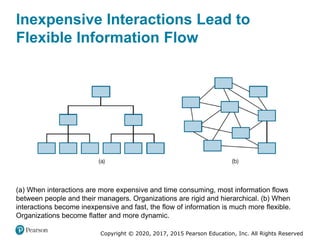
(a) When interactions are more expensive and time consuming, most information flows
between people and their managers. Organizations are rigid and hierarchical. (b) When
interactions become inexpensive and fast, the flow of information is much more flexible.
Organizations become flatter and more dynamic.
Inexpensive Interactions Lead to
Flexible Information Flow
Copyright © 2020, 2017, 2015 Pearson Education, Inc. All Rights Reserved
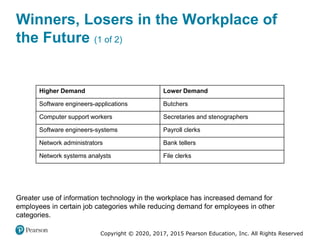
Greater use of information technology in the workplace has increased demand for
employees in certain job categories while reducing demand for employees in other
categories.
Higher Demand Lower Demand
Software engineers-applications Butchers
Computer support workers Secretaries and stenographers
Software engineers-systems Payroll clerks
Network administrators Bank tellers
Network systems analysts File clerks
Winners, Losers in the Workplace of
the Future (1 of 2)
Copyright © 2020, 2017, 2015 Pearson Education, Inc. All Rights Reserved
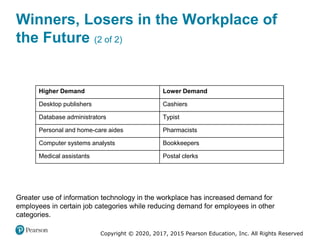
Greater use of information technology in the workplace has increased demand for
employees in certain job categories while reducing demand for employees in other
categories.
Higher Demand Lower Demand
Desktop publishers Cashiers
Database administrators Typist
Personal and home-care aides Pharmacists
Computer systems analysts Bookkeepers
Medical assistants Postal clerks
Winners, Losers in the Workplace of
the Future (2 of 2)
Copyright © 2020, 2017, 2015 Pearson Education, Inc. All Rights Reserved
• Employees work away from traditional place of work
• Examples
– Home office
– Commuting to a tele center
– Salespersons with no office
• About 37% of Americans do some telework
Telework
Copyright © 2020, 2017, 2015 Pearson Education, Inc. All Rights Reserved
• Increases productivity
• Reduces absenteeism
• Improves morale
• Helps recruitment and retention of top employees
• Saves overhead
• Improves company resilience
• Helps environment
• Saves employees money
Advantages of Telework
Copyright © 2020, 2017, 2015 Pearson Education, Inc. All Rights Reserved
• Threatens managers’ control and authority
• Makes face-to-face meetings with customers impossible
• Sensitive information less secure
• Team meetings more difficult
• Teleworkers less visible
• Teleworkers “out of the loop”
• Isolation of teleworkers
• Teleworkers work longer hours for same pay
Disadvantages of Telework
Copyright © 2020, 2017, 2015 Pearson Education, Inc. All Rights Reserved
• Companies less committed to employees
• Lay-offs not taboo as they once were
• Companies hiring more subcontractors and temporary
employees
– Saves money on benefits
– Makes it easier to downsize
The Gig Economy (1 of 3)
Copyright © 2020, 2017, 2015 Pearson Education, Inc. All Rights Reserved
• Some start-ups make money by connecting people who
want a service with people willing to provide that service
• Gig economy: Service workers making a living by
completing short-term jobs for clients
• Examples
– Uber, Lyft: Connect riders and drivers
– Instacart: Grocery delivery service
– Airbnb: Connect travelers and those with
accommodations
The Gig Economy (2 of 3)
Copyright © 2020, 2017, 2015 Pearson Education, Inc. All Rights Reserved
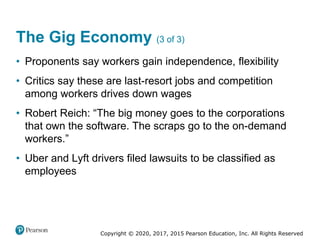
• Proponents say workers gain independence, flexibility
• Critics say these are last-resort jobs and competition
among workers drives down wages
• Robert Reich: “The big money goes to the corporations
that own the software. The scraps go to the on-demand
workers.”
• Uber and Lyft drivers filed lawsuits to be classified as
employees
The Gig Economy (3 of 3)
Copyright © 2020, 2017, 2015 Pearson Education, Inc. All Rights Reserved
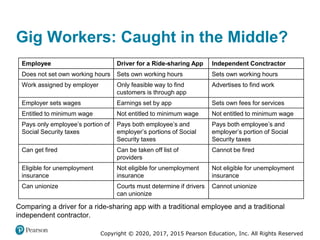
Comparing a driver for a ride-sharing app with a traditional employee and a traditional
independent contractor.
Employee Driver for a Ride-sharing App Independent Conctractor
Does not set own working hours Sets own working hours Sets own working hours
Work assigned by employer Only feasible way to find
customers is through app
Advertises to find work
Employer sets wages Earnings set by app Sets own fees for services
Entitled to minimum wage Not entitled to minimum wage Not entitled to minimum wage
Pays only employee’s portion of
Social Security taxes
Pays both employee’s and
employer’s portions of Social
Security taxes
Pays both employee’s and
employer’s portion of Social
Security taxes
Can get fired Can be taken off list of
providers
Cannot be fired
Eligible for unemployment
insurance
Not eligible for unemployment
insurance
Not eligible for unemployment
insurance
Can unionize Courts must determine if drivers
can unionize
Cannot unionize
Gig Workers: Caught in the Middle?
Copyright © 2020, 2017, 2015 Pearson Education, Inc. All Rights Reserved
• Two-thirds of companies monitor Internet use of their
employees
• Other examples of monitoring
– Video surveillance
– Monitoring keyboard activity
– Monitoring time spent on phone
– Monitoring emails
• Purpose: Identify inappropriate use of company resources
– Can also detect illegal activities
Monitoring (1 of 2)
Copyright © 2020, 2017, 2015 Pearson Education, Inc. All Rights Reserved
• Other uses of monitoring
– Gauge productivity
– Improve productivity
– Improve security; i.e., in schools
• Evidence shows that monitoring…
– Makes employees more focused on work
– Reduces job satisfaction
Monitoring (2 of 2)
Copyright © 2020, 2017, 2015 Pearson Education, Inc. All Rights Reserved
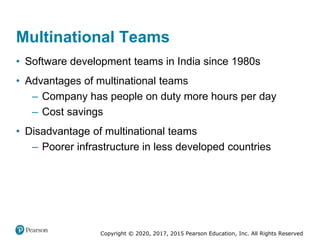
• Software development teams in India since 1980s
• Advantages of multinational teams
– Company has people on duty more hours per day
– Cost savings
• Disadvantage of multinational teams
– Poorer infrastructure in less developed countries
Multinational Teams
Copyright © 2020, 2017, 2015 Pearson Education, Inc. All Rights Reserved
10.4 Globalization
Copyright © 2020, 2017, 2015 Pearson Education, Inc. All Rights Reserved
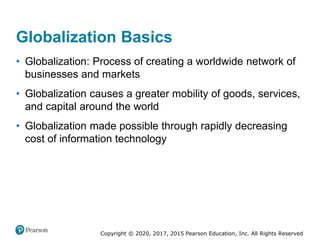
• Globalization: Process of creating a worldwide network of
businesses and markets
• Globalization causes a greater mobility of goods, services,
and capital around the world
• Globalization made possible through rapidly decreasing
cost of information technology
Globalization Basics
Copyright © 2020, 2017, 2015 Pearson Education, Inc. All Rights Reserved
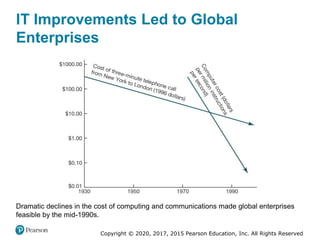
Dramatic declines in the cost of computing and communications made global enterprises
feasible by the mid-1990s.
IT Improvements Led to Global
Enterprises
Copyright © 2020, 2017, 2015 Pearson Education, Inc. All Rights Reserved
• Increases competition
• People in poorer countries deserve jobs, too
• It is a tried-and-true route for a poor country to become
prosperous
• Global jobs reduce unrest and increase stability
Arguments for Globalization
Copyright © 2020, 2017, 2015 Pearson Education, Inc. All Rights Reserved
• Makes the United States subordinate to the World Trade
Organization
• Forces American workers to compete with foreigners who
do not get decent wages and benefits
• Accelerates exodus of manufacturing and white-collar
jobs from United States
• Hurts workers in foreign countries, too
– Example: Individual Mexican corn farmers cannot
compete with large US agribusinesses subsidized by
American government
Arguments against Globalization
Copyright © 2020, 2017, 2015 Pearson Education, Inc. All Rights Reserved
• Dot-com: Internet-related start-up company
• Early 2000: stock prices of dot-coms fell sharply
• Hundreds of dot-coms went out of business
• Half a million high-tech jobs lost
Dot-Com Bust Increases IT Sector
Unemployment
Copyright © 2020, 2017, 2015 Pearson Education, Inc. All Rights Reserved
• Visas allow foreigners to work inside United States
• H-1B visa
– Right to work up in United States to six years
– Company must show no qualified Americans available
– Congress still authorizes 65,000 H-1B visas per year, plus 20,000 more
for foreigners with advanced degrees
• L-1 visa
– Allows a company to transfer a worker from an overseas facility to the
United States
– Workers do not need to be paid the prevailing wage
– In 2017 about 78,000 foreigners employed in US under L-1 visa
Foreign Workers in the US IT Industry
Copyright © 2020, 2017, 2015 Pearson Education, Inc. All Rights Reserved
• China is world’s number one producer of computer
hardware, making 90 percent of all PCs
• IT outsourcing to India is growing rapidly
• Number of college students in China increasing rapidly
• ACM Collegiate Programming Contest provides evidence
of global competition
– No American team has placed first since 1997
– From 2011-2015, only 1 of 20 teams earning gold
medals was from the United States
Foreign Competition
Copyright © 2020, 2017, 2015 Pearson Education, Inc. All Rights Reserved
10.5 The Digital Divide
Copyright © 2020, 2017, 2015 Pearson Education, Inc. All Rights Reserved
• Digital divide: Some people have access to modern
information technology while others do not
• Underlying assumption: people with access to telephones,
computers, Internet have opportunities denied to those
without access
• Concept of digital divide became popular with emergence
of World Wide Web
Concept of the Digital Divide
Copyright © 2020, 2017, 2015 Pearson Education, Inc. All Rights Reserved
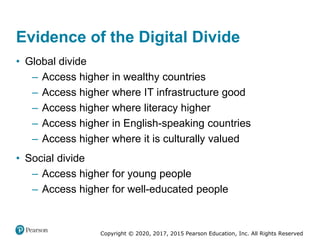
• Global divide
– Access higher in wealthy countries
– Access higher where IT infrastructure good
– Access higher where literacy higher
– Access higher in English-speaking countries
– Access higher where it is culturally valued
• Social divide
– Access higher for young people
– Access higher for well-educated people
Evidence of the Digital Divide
Copyright © 2020, 2017, 2015 Pearson Education, Inc. All Rights Reserved
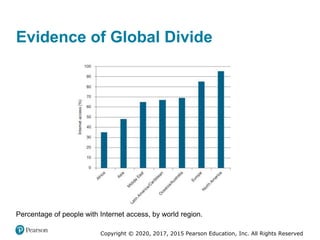
Percentage of people with Internet access, by world region.
Evidence of Global Divide
Copyright © 2020, 2017, 2015 Pearson Education, Inc. All Rights Reserved
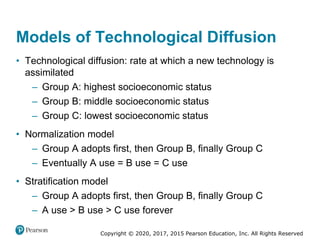
• Technological diffusion: rate at which a new technology is
assimilated
– Group A: highest socioeconomic status
– Group B: middle socioeconomic status
– Group C: lowest socioeconomic status
• Normalization model
– Group A adopts first, then Group B, finally Group C
– Eventually A use = B use = C use
• Stratification model
– Group A adopts first, then Group B, finally Group C
– A use > B use > C use forever
Models of Technological Diffusion
Copyright © 2020, 2017, 2015 Pearson Education, Inc. All Rights Reserved
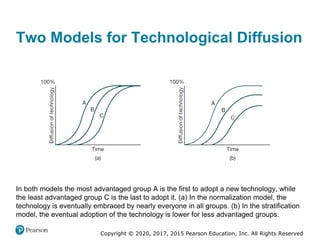
In both models the most advantaged group A is the first to adopt a new technology, while
the least advantaged group C is the last to adopt it. (a) In the normalization model, the
technology is eventually embraced by nearly everyone in all groups. (b) In the stratification
model, the eventual adoption of the technology is lower for less advantaged groups.
Two Models for Technological Diffusion
Copyright © 2020, 2017, 2015 Pearson Education, Inc. All Rights Reserved
• Technological optimists
– Global adoption of information technology will follow
normalization model
– IT will reduce poverty in developing countries
– Greater opportunities elsewhere will reduce immigration into US
• Technological pessimists
– Adoption of IT will follow the stratification model, leading to a
permanent condition of “haves” and “have nots”
– IT will exacerbate existing inequalities between rich and poor
countries and between rich and poor people within each nation
– Evidence: Gap between rich and poor countries continues to
grow
Technological Optimists versus Pessimists
Copyright © 2020, 2017, 2015 Pearson Education, Inc. All Rights Reserved
• Mark Warschauer: 3 reasons why term “digital divide” not
helpful
– Promotes false idea that difference between “haves”
and “have nots” is simply matter of access
– In reality, people are somewhere on continuum, not
simply in “haves” category or “have nots” category
– Does lack of access lead to a less advantaged
position in society, or is it actually the other way
round?
• Warschauer also notes that the Internet is not the
pinnacle of IT development
Critiques of Digital Divide
Copyright © 2020, 2017, 2015 Pearson Education, Inc. All Rights Reserved
• Rate of tuition increases at US universities has exceeded inflation for
several decades
• Financing college education increasingly difficult for poorer families
• Free massive open online courses (MOOCs) promoted as a way to
make higher education more affordable
• Study by Community College Research Center
– Students less likely to complete and do well in MOOCs than
traditional courses
– MOOCs widen achievement gap between white and black
students and between those with higher GPAs and those with
lower GPAs
Massive Open Online Courses
Copyright © 2020, 2017, 2015 Pearson Education, Inc. All Rights Reserved
• Tiered service: Charging more for high-priority routing of
Internet packets
• Supporters of tiered service say it is needed to support
Voice-over-IP and other services
• Opponents to tiered service (e.g., Google, Yahoo!) say it
would hurt small start-up companies and lower innovation
• Other critics believe companies controlling Internet might
favor some content over other content
Net Neutrality (1 of 2)
Copyright © 2020, 2017, 2015 Pearson Education, Inc. All Rights Reserved
• Net neutrality legislation would require all Internet packets
be treated the same
• Opponents of proposed legislation say consumers should
be able to pay more to get higher quality service; e.g.,
those doing video conferencing willing to pay more than
those sending email
• February 2015: Under President Obama, FCC issued the
Open Internet Order to preserve net neutrality
• December 2017: Under President Trump, FCC changed
course and repealed net neutrality rules; some states
introducing legislation to preserve rules
Net Neutrality (2 of 2)
Copyright © 2020, 2017, 2015 Pearson Education, Inc. All Rights Reserved
10.6 The “Winner-Take-All” Society
Copyright © 2020, 2017, 2015 Pearson Education, Inc. All Rights Reserved
• Winner-take-all: markets in which a few top performers
have disproportionate share of wealth
• Causes
– IT and efficient transportation systems
– Network economies
– Dominance of English language
– Changing business norms
The Winner-Take-All Phenomenon
Copyright © 2020, 2017, 2015 Pearson Education, Inc. All Rights Reserved
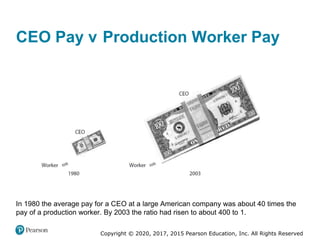
In 1980 the average pay for a CEO at a large American company was about 40 times the
pay of a production worker. By 2003 the ratio had risen to about 400 to 1.
CEO Pay versus Production Worker Pay
Copyright © 2020, 2017, 2015 Pearson Education, Inc. All Rights Reserved
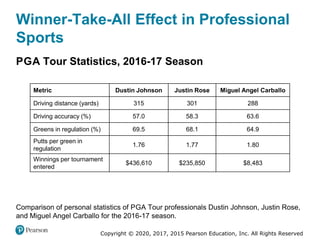
Comparison of personal statistics of PGA Tour professionals Dustin Johnson, Justin Rose,
and Miguel Angel Carballo for the 2016-17 season.
Metric Dustin Johnson Justin Rose Miguel Angel Carballo
Driving distance (yards) 315 301 288
Driving accuracy (%) 57.0 58.3 63.6
Greens in regulation (%) 69.5 68.1 64.9
Putts per green in
regulation
1.76 1.77 1.80
Winnings per tournament
entered
$436,610 $235,850 $8,483
PGA Tour Statistics, 2016-17 Season
Winner-Take-All Effect in Professional
Sports
Copyright © 2020, 2017, 2015 Pearson Education, Inc. All Rights Reserved
• Limit number of hours that stores remain open
• Businesses form cooperative agreements to reduce
positional arms races
– Example: salary caps on pro sports teams
• More progressive tax structures
• Campaign finance reform
Reducing Winner-Take-All Effects
Copyright © 2020, 2017, 2015 Pearson Education, Inc. All Rights Reserved
– Standard work week roughly the same
– Has led to an increase in standard of living
• Globalization has impacted the IT sphere, not just manufacturing
• Concept of “digital divide” dividing world into technological “haves” and “have
nots” is too simplistic
• IT and other factors are causing “winner-take-all” effects
II
• Productivity has more than doubled since World War
• Automation
– Results in job gains as well as job losses
– Widespread unemployment has not occurred in countries where it is used
the most
– Will developments in AI change pattern and result in massive job losses?
Summary
Copyright © 2020, 2017, 2015 Pearson Education, Inc. All Rights Reserved
This work is protected by United States copyright laws and is
provided solely for the use of instructors in teaching their
courses and assessing student learning. Dissemination or sale of
any part of this work (including on the World Wide Web) will
destroy the integrity of the work and is not permitted. The work
and materials from it should never be made available to students
except by instructors using the accompanying text in their
classes. All recipients of this work are expected to abide by these
restrictions and to honor the intended pedagogical purposes and
the needs of other instructors who rely on these materials.
Copyright

Automation and future.pptx

  • 1.
    Copyright © 2020,2017, 2015 Pearson Education, Inc. All Rights Reserved Work and Wealth Chapter 10 Eighth Edition Ethics for the Information Age
  • 2.
    Copyright © 2020,2017, 2015 Pearson Education, Inc. All Rights Reserved 10.1 Introduction 10.2 Automation and employment 10.3 Workplace changes 10.4 Globalization 10.5 The digital divide 10.6 The “winner-take-all society” Learning Objectives
  • 3.
    Copyright © 2020,2017, 2015 Pearson Education, Inc. All Rights Reserved 10.1 Introduction
  • 4.
    Copyright © 2020,2017, 2015 Pearson Education, Inc. All Rights Reserved • Information technology and automation affecting workplace – Increases in productivity – Job creation and destruction – Globalization of job market – Organization of companies – Telework – Workplace monitoring • Impacts of information technology on society – Digital divide – Winner-take-all effects 10.1 Introduction
  • 5.
    Copyright © 2020,2017, 2015 Pearson Education, Inc. All Rights Reserved 10.2 Automation and Employment
  • 6.
    Copyright © 2020,2017, 2015 Pearson Education, Inc. All Rights Reserved • Between 1979 and 2011… – U.S. population increased 39% – Manufacturing employment dropped 40%, from 19.4 million jobs to 11.7 million jobs • Lost white-collar jobs – Secretarial and clerical positions – Accountants and bookkeepers – Middle managers • Juliet Schor: Work week got longer between 1979 and 1990 Automation and Job Destruction
  • 7.
    Copyright © 2020,2017, 2015 Pearson Education, Inc. All Rights Reserved General Motors exited bankruptcy in 2009 with 30 percent fewer employees. (Danny Lehman/Encyclopedia Corbis) Lost Manufacturing Jobs
  • 8.
    Copyright © 2020,2017, 2015 Pearson Education, Inc. All Rights Reserved When jobs are lost to automation or the introduction of information technology, the remaining workers may work harder in order to avoid being part of the next layoff. Impact of Layoffs on Workers
  • 9.
    Copyright © 2020,2017, 2015 Pearson Education, Inc. All Rights Reserved • Automation lowers prices • That increases demand for the product • It also increases real incomes, increasing demand for other products, which means more jobs for people making those products • Number of manufacturing jobs worldwide is increasing • Martin Carnoy: Workers today work less than workers did 100 years ago Automation and Job Creation
  • 10.
    Copyright © 2020,2017, 2015 Pearson Education, Inc. All Rights Reserved Superficially, automation eliminates jobs; but automation can also stimulate the creation of new jobs. Effects of Automation
  • 11.
    Copyright © 2020,2017, 2015 Pearson Education, Inc. All Rights Reserved • We have used higher productivity to achieve a higher material standard of living • This is in contrast to medieval or ancient times (before modern capitalism) • In medieval or ancient times – Low caloric intake meant pace of work was slow – Work was seasonal and intermittent – Laborers resisted working if they had enough money (i.e., they weren’t consumers) – When wages rose, laborers worked less Effects of Increase in Productivity
  • 12.
    Copyright © 2020,2017, 2015 Pearson Education, Inc. All Rights Reserved • Stuart is a software developer for Seattle start-up • Everybody works 60 hours/week • Company’s vacation policy is 3 weeks/year – Nobody takes that much – Some of Stuart’s coworkers have had zero vacation in 2+ years • Six months ago, Stuart learns his parents are moving from San Diego to Australia – He gets permission for one week’s vacation in San Diego – Doesn’t tell parents Case Study: The Canceled Vacation (1 of 2)
  • 13.
    Copyright © 2020,2017, 2015 Pearson Education, Inc. All Rights Reserved • One week before vacation, supervisor asks Stuart to delay vacation – Important product update – Offers Stuart ▪ Three weeks’ vacation next year ▪ Round-trip airfare • Stuart agrees to request and cancels vacation to San Diego Case Study: The Canceled Vacation (2 of 2)
  • 14.
    Copyright © 2020,2017, 2015 Pearson Education, Inc. All Rights Reserved • Stuart broke no promises and didn’t deceive anyone • Stuart was not obligated to visit his parents before they moved from San Diego to Australia • Stuart did nothing wrong Kantian/Social Contract Theory Evaluation
  • 15.
    Copyright © 2020,2017, 2015 Pearson Education, Inc. All Rights Reserved • Stuart had two alternatives: accept or reject supervisor’s request • Consider duration, certainty, propinquity, and purity of two alternatives • Duration – San Diego: 1 week – Australia: 3 weeks – Trip to Australia 3 times better Act Utilitarian Evaluation (1 of 3)
  • 16.
    Copyright © 2020,2017, 2015 Pearson Education, Inc. All Rights Reserved • Purity – San Diego: Will be worrying about upset boss – Australia: Realistically, will also be worrying about upset boss – Two options equivalent • Propinquity – San Diego: Next week – Australia: Next year – Trip to San Diego much better (2 times better) Act Utilitarian Evaluation (2 of 3)
  • 17.
    Copyright © 2020,2017, 2015 Pearson Education, Inc. All Rights Reserved • Certainty – San Diego: 100% – Australia: Much less certain, given history of Stuart’s manager and fact no one has ever taken 3 weeks’ vacation, say 25% – San Diego the better choice • Summary: – San Diego: 1 × 1 × 2 × 100% = 2 – Australia: 3 × 1 × 1 × 25% = 0.75 – San Diego the better option – Stuart made the wrong decision Act Utilitarian Evaluation (3 of 3)
  • 18.
    Copyright © 2020,2017, 2015 Pearson Education, Inc. All Rights Reserved • Stuart demonstrated a lack of courage and a lack of consideration for himself, his coworkers, and his parents • By caving in to his boss, Stuart – let his boss get away with bad behavior – made reasonable vacations less likely for himself and for his fellow employees – deprived his parents of the pleasure of his company for at least a year • Stuart’s decision is not characteristic of a good co-worker or a good son Virtue Ethics Evaluation
  • 19.
    Copyright © 2020,2017, 2015 Pearson Education, Inc. All Rights Reserved • Some experts suggest most jobs will be taken over by machines • Artificial intelligence: Field of computer science focusing on intelligent behavior by machines • Rapid increases in microprocessor speeds have led to various successes in AI • What will happen as computers continue to increase in speed? Rise of the Robots?
  • 20.
    Copyright © 2020,2017, 2015 Pearson Education, Inc. All Rights Reserved • Computer-controlled minivan “drove” on freeways across USA in 1995 • IBM supercomputer Deep Blue defeated chess champion Gary Kasparov in 1997 • Honda’s ASIMO android climbed and descended stairs (2000) • Electrolux introduced robotic vacuum cleaner in 2001 • Five autonomous vehicles successfully completed 128- mile course in Nevada desert in 2005 Notable Achievements in AI Since 1995 (1 of 2)
  • 21.
    Copyright © 2020,2017, 2015 Pearson Education, Inc. All Rights Reserved • Watson trounced two most successful human Jeopardy! champions in 2011 • Google’s self-driving cars logged more than one million miles between 2009 and 2015 without an accident (caused by the car) • AlphaGo program created by Google trounced Ke Jie, world’s #1 Go player, in multiplayer match in 2017 Notable Achievements in AI Since 1995 (2 of 2)
  • 22.
    Copyright © 2020,2017, 2015 Pearson Education, Inc. All Rights Reserved In 2011 an AI program named Watson running on an IBM supercomputer trounced the two greatest (human) Jeopardy! champions: Ken Jennings and Brad Rutter. (AP photo/Seth Wenig) Watson Wins Jeopardy! Challenge
  • 23.
    Copyright © 2020,2017, 2015 Pearson Education, Inc. All Rights Reserved Between 2009 and 2015 Google self-driving cars drove more than a million miles in autonomous mode without causing a single accident. (John Green/TNS/Newscom) Google Self-Driving Car
  • 24.
    Copyright © 2020,2017, 2015 Pearson Education, Inc. All Rights Reserved • Is it wrong to create machines capable of making human labor obsolete? • Would intelligent robots demoralize humanity? • Is it wrong to work on an intelligent machine if it can’t be guaranteed the machine will be benevolent toward humans? • What if a malevolent human puts intelligent machines to an evil use? • How would creative computers change our ideas about intellectual property? • How will our ideas about privacy change if superfast computers constantly analyze our electronic records? Moral Question Related to Robotics
  • 25.
    Copyright © 2020,2017, 2015 Pearson Education, Inc. All Rights Reserved 10.3 Workplace Changes
  • 26.
    Copyright © 2020,2017, 2015 Pearson Education, Inc. All Rights Reserved • Information technology integration into firms – Automating back office functions (e.g., payroll) – Improving manufacturing – Improving communication among business units • Results – Flattened organizational structures – Eliminating transactional middlemen (supply-chain automation) Organizational Changes
  • 27.
    Copyright © 2020,2017, 2015 Pearson Education, Inc. All Rights Reserved (a) When interactions are more expensive and time consuming, most information flows between people and their managers. Organizations are rigid and hierarchical. (b) When interactions become inexpensive and fast, the flow of information is much more flexible. Organizations become flatter and more dynamic. Inexpensive Interactions Lead to Flexible Information Flow
  • 28.
    Copyright © 2020,2017, 2015 Pearson Education, Inc. All Rights Reserved Greater use of information technology in the workplace has increased demand for employees in certain job categories while reducing demand for employees in other categories. Higher Demand Lower Demand Software engineers-applications Butchers Computer support workers Secretaries and stenographers Software engineers-systems Payroll clerks Network administrators Bank tellers Network systems analysts File clerks Winners, Losers in the Workplace of the Future (1 of 2)
  • 29.
    Copyright © 2020,2017, 2015 Pearson Education, Inc. All Rights Reserved Greater use of information technology in the workplace has increased demand for employees in certain job categories while reducing demand for employees in other categories. Higher Demand Lower Demand Desktop publishers Cashiers Database administrators Typist Personal and home-care aides Pharmacists Computer systems analysts Bookkeepers Medical assistants Postal clerks Winners, Losers in the Workplace of the Future (2 of 2)
  • 30.
    Copyright © 2020,2017, 2015 Pearson Education, Inc. All Rights Reserved • Employees work away from traditional place of work • Examples – Home office – Commuting to a tele center – Salespersons with no office • About 37% of Americans do some telework Telework
  • 31.
    Copyright © 2020,2017, 2015 Pearson Education, Inc. All Rights Reserved • Increases productivity • Reduces absenteeism • Improves morale • Helps recruitment and retention of top employees • Saves overhead • Improves company resilience • Helps environment • Saves employees money Advantages of Telework
  • 32.
    Copyright © 2020,2017, 2015 Pearson Education, Inc. All Rights Reserved • Threatens managers’ control and authority • Makes face-to-face meetings with customers impossible • Sensitive information less secure • Team meetings more difficult • Teleworkers less visible • Teleworkers “out of the loop” • Isolation of teleworkers • Teleworkers work longer hours for same pay Disadvantages of Telework
  • 33.
    Copyright © 2020,2017, 2015 Pearson Education, Inc. All Rights Reserved • Companies less committed to employees • Lay-offs not taboo as they once were • Companies hiring more subcontractors and temporary employees – Saves money on benefits – Makes it easier to downsize The Gig Economy (1 of 3)
  • 34.
    Copyright © 2020,2017, 2015 Pearson Education, Inc. All Rights Reserved • Some start-ups make money by connecting people who want a service with people willing to provide that service • Gig economy: Service workers making a living by completing short-term jobs for clients • Examples – Uber, Lyft: Connect riders and drivers – Instacart: Grocery delivery service – Airbnb: Connect travelers and those with accommodations The Gig Economy (2 of 3)
  • 35.
    Copyright © 2020,2017, 2015 Pearson Education, Inc. All Rights Reserved • Proponents say workers gain independence, flexibility • Critics say these are last-resort jobs and competition among workers drives down wages • Robert Reich: “The big money goes to the corporations that own the software. The scraps go to the on-demand workers.” • Uber and Lyft drivers filed lawsuits to be classified as employees The Gig Economy (3 of 3)
  • 36.
    Copyright © 2020,2017, 2015 Pearson Education, Inc. All Rights Reserved Comparing a driver for a ride-sharing app with a traditional employee and a traditional independent contractor. Employee Driver for a Ride-sharing App Independent Conctractor Does not set own working hours Sets own working hours Sets own working hours Work assigned by employer Only feasible way to find customers is through app Advertises to find work Employer sets wages Earnings set by app Sets own fees for services Entitled to minimum wage Not entitled to minimum wage Not entitled to minimum wage Pays only employee’s portion of Social Security taxes Pays both employee’s and employer’s portions of Social Security taxes Pays both employee’s and employer’s portion of Social Security taxes Can get fired Can be taken off list of providers Cannot be fired Eligible for unemployment insurance Not eligible for unemployment insurance Not eligible for unemployment insurance Can unionize Courts must determine if drivers can unionize Cannot unionize Gig Workers: Caught in the Middle?
  • 37.
    Copyright © 2020,2017, 2015 Pearson Education, Inc. All Rights Reserved • Two-thirds of companies monitor Internet use of their employees • Other examples of monitoring – Video surveillance – Monitoring keyboard activity – Monitoring time spent on phone – Monitoring emails • Purpose: Identify inappropriate use of company resources – Can also detect illegal activities Monitoring (1 of 2)
  • 38.
    Copyright © 2020,2017, 2015 Pearson Education, Inc. All Rights Reserved • Other uses of monitoring – Gauge productivity – Improve productivity – Improve security; i.e., in schools • Evidence shows that monitoring… – Makes employees more focused on work – Reduces job satisfaction Monitoring (2 of 2)
  • 39.
    Copyright © 2020,2017, 2015 Pearson Education, Inc. All Rights Reserved • Software development teams in India since 1980s • Advantages of multinational teams – Company has people on duty more hours per day – Cost savings • Disadvantage of multinational teams – Poorer infrastructure in less developed countries Multinational Teams
  • 40.
    Copyright © 2020,2017, 2015 Pearson Education, Inc. All Rights Reserved 10.4 Globalization
  • 41.
    Copyright © 2020,2017, 2015 Pearson Education, Inc. All Rights Reserved • Globalization: Process of creating a worldwide network of businesses and markets • Globalization causes a greater mobility of goods, services, and capital around the world • Globalization made possible through rapidly decreasing cost of information technology Globalization Basics
  • 42.
    Copyright © 2020,2017, 2015 Pearson Education, Inc. All Rights Reserved Dramatic declines in the cost of computing and communications made global enterprises feasible by the mid-1990s. IT Improvements Led to Global Enterprises
  • 43.
    Copyright © 2020,2017, 2015 Pearson Education, Inc. All Rights Reserved • Increases competition • People in poorer countries deserve jobs, too • It is a tried-and-true route for a poor country to become prosperous • Global jobs reduce unrest and increase stability Arguments for Globalization
  • 44.
    Copyright © 2020,2017, 2015 Pearson Education, Inc. All Rights Reserved • Makes the United States subordinate to the World Trade Organization • Forces American workers to compete with foreigners who do not get decent wages and benefits • Accelerates exodus of manufacturing and white-collar jobs from United States • Hurts workers in foreign countries, too – Example: Individual Mexican corn farmers cannot compete with large US agribusinesses subsidized by American government Arguments against Globalization
  • 45.
    Copyright © 2020,2017, 2015 Pearson Education, Inc. All Rights Reserved • Dot-com: Internet-related start-up company • Early 2000: stock prices of dot-coms fell sharply • Hundreds of dot-coms went out of business • Half a million high-tech jobs lost Dot-Com Bust Increases IT Sector Unemployment
  • 46.
    Copyright © 2020,2017, 2015 Pearson Education, Inc. All Rights Reserved • Visas allow foreigners to work inside United States • H-1B visa – Right to work up in United States to six years – Company must show no qualified Americans available – Congress still authorizes 65,000 H-1B visas per year, plus 20,000 more for foreigners with advanced degrees • L-1 visa – Allows a company to transfer a worker from an overseas facility to the United States – Workers do not need to be paid the prevailing wage – In 2017 about 78,000 foreigners employed in US under L-1 visa Foreign Workers in the US IT Industry
  • 47.
    Copyright © 2020,2017, 2015 Pearson Education, Inc. All Rights Reserved • China is world’s number one producer of computer hardware, making 90 percent of all PCs • IT outsourcing to India is growing rapidly • Number of college students in China increasing rapidly • ACM Collegiate Programming Contest provides evidence of global competition – No American team has placed first since 1997 – From 2011-2015, only 1 of 20 teams earning gold medals was from the United States Foreign Competition
  • 48.
    Copyright © 2020,2017, 2015 Pearson Education, Inc. All Rights Reserved 10.5 The Digital Divide
  • 49.
    Copyright © 2020,2017, 2015 Pearson Education, Inc. All Rights Reserved • Digital divide: Some people have access to modern information technology while others do not • Underlying assumption: people with access to telephones, computers, Internet have opportunities denied to those without access • Concept of digital divide became popular with emergence of World Wide Web Concept of the Digital Divide
  • 50.
    Copyright © 2020,2017, 2015 Pearson Education, Inc. All Rights Reserved • Global divide – Access higher in wealthy countries – Access higher where IT infrastructure good – Access higher where literacy higher – Access higher in English-speaking countries – Access higher where it is culturally valued • Social divide – Access higher for young people – Access higher for well-educated people Evidence of the Digital Divide
  • 51.
    Copyright © 2020,2017, 2015 Pearson Education, Inc. All Rights Reserved Percentage of people with Internet access, by world region. Evidence of Global Divide
  • 52.
    Copyright © 2020,2017, 2015 Pearson Education, Inc. All Rights Reserved • Technological diffusion: rate at which a new technology is assimilated – Group A: highest socioeconomic status – Group B: middle socioeconomic status – Group C: lowest socioeconomic status • Normalization model – Group A adopts first, then Group B, finally Group C – Eventually A use = B use = C use • Stratification model – Group A adopts first, then Group B, finally Group C – A use > B use > C use forever Models of Technological Diffusion
  • 53.
    Copyright © 2020,2017, 2015 Pearson Education, Inc. All Rights Reserved In both models the most advantaged group A is the first to adopt a new technology, while the least advantaged group C is the last to adopt it. (a) In the normalization model, the technology is eventually embraced by nearly everyone in all groups. (b) In the stratification model, the eventual adoption of the technology is lower for less advantaged groups. Two Models for Technological Diffusion
  • 54.
    Copyright © 2020,2017, 2015 Pearson Education, Inc. All Rights Reserved • Technological optimists – Global adoption of information technology will follow normalization model – IT will reduce poverty in developing countries – Greater opportunities elsewhere will reduce immigration into US • Technological pessimists – Adoption of IT will follow the stratification model, leading to a permanent condition of “haves” and “have nots” – IT will exacerbate existing inequalities between rich and poor countries and between rich and poor people within each nation – Evidence: Gap between rich and poor countries continues to grow Technological Optimists versus Pessimists
  • 55.
    Copyright © 2020,2017, 2015 Pearson Education, Inc. All Rights Reserved • Mark Warschauer: 3 reasons why term “digital divide” not helpful – Promotes false idea that difference between “haves” and “have nots” is simply matter of access – In reality, people are somewhere on continuum, not simply in “haves” category or “have nots” category – Does lack of access lead to a less advantaged position in society, or is it actually the other way round? • Warschauer also notes that the Internet is not the pinnacle of IT development Critiques of Digital Divide
  • 56.
    Copyright © 2020,2017, 2015 Pearson Education, Inc. All Rights Reserved • Rate of tuition increases at US universities has exceeded inflation for several decades • Financing college education increasingly difficult for poorer families • Free massive open online courses (MOOCs) promoted as a way to make higher education more affordable • Study by Community College Research Center – Students less likely to complete and do well in MOOCs than traditional courses – MOOCs widen achievement gap between white and black students and between those with higher GPAs and those with lower GPAs Massive Open Online Courses
  • 57.
    Copyright © 2020,2017, 2015 Pearson Education, Inc. All Rights Reserved • Tiered service: Charging more for high-priority routing of Internet packets • Supporters of tiered service say it is needed to support Voice-over-IP and other services • Opponents to tiered service (e.g., Google, Yahoo!) say it would hurt small start-up companies and lower innovation • Other critics believe companies controlling Internet might favor some content over other content Net Neutrality (1 of 2)
  • 58.
    Copyright © 2020,2017, 2015 Pearson Education, Inc. All Rights Reserved • Net neutrality legislation would require all Internet packets be treated the same • Opponents of proposed legislation say consumers should be able to pay more to get higher quality service; e.g., those doing video conferencing willing to pay more than those sending email • February 2015: Under President Obama, FCC issued the Open Internet Order to preserve net neutrality • December 2017: Under President Trump, FCC changed course and repealed net neutrality rules; some states introducing legislation to preserve rules Net Neutrality (2 of 2)
  • 59.
    Copyright © 2020,2017, 2015 Pearson Education, Inc. All Rights Reserved 10.6 The “Winner-Take-All” Society
  • 60.
    Copyright © 2020,2017, 2015 Pearson Education, Inc. All Rights Reserved • Winner-take-all: markets in which a few top performers have disproportionate share of wealth • Causes – IT and efficient transportation systems – Network economies – Dominance of English language – Changing business norms The Winner-Take-All Phenomenon
  • 61.
    Copyright © 2020,2017, 2015 Pearson Education, Inc. All Rights Reserved In 1980 the average pay for a CEO at a large American company was about 40 times the pay of a production worker. By 2003 the ratio had risen to about 400 to 1. CEO Pay versus Production Worker Pay
  • 62.
    Copyright © 2020,2017, 2015 Pearson Education, Inc. All Rights Reserved Comparison of personal statistics of PGA Tour professionals Dustin Johnson, Justin Rose, and Miguel Angel Carballo for the 2016-17 season. Metric Dustin Johnson Justin Rose Miguel Angel Carballo Driving distance (yards) 315 301 288 Driving accuracy (%) 57.0 58.3 63.6 Greens in regulation (%) 69.5 68.1 64.9 Putts per green in regulation 1.76 1.77 1.80 Winnings per tournament entered $436,610 $235,850 $8,483 PGA Tour Statistics, 2016-17 Season Winner-Take-All Effect in Professional Sports
  • 63.
    Copyright © 2020,2017, 2015 Pearson Education, Inc. All Rights Reserved • Limit number of hours that stores remain open • Businesses form cooperative agreements to reduce positional arms races – Example: salary caps on pro sports teams • More progressive tax structures • Campaign finance reform Reducing Winner-Take-All Effects
  • 64.
    Copyright © 2020,2017, 2015 Pearson Education, Inc. All Rights Reserved – Standard work week roughly the same – Has led to an increase in standard of living • Globalization has impacted the IT sphere, not just manufacturing • Concept of “digital divide” dividing world into technological “haves” and “have nots” is too simplistic • IT and other factors are causing “winner-take-all” effects II • Productivity has more than doubled since World War • Automation – Results in job gains as well as job losses – Widespread unemployment has not occurred in countries where it is used the most – Will developments in AI change pattern and result in massive job losses? Summary
  • 65.
    Copyright © 2020,2017, 2015 Pearson Education, Inc. All Rights Reserved This work is protected by United States copyright laws and is provided solely for the use of instructors in teaching their courses and assessing student learning. Dissemination or sale of any part of this work (including on the World Wide Web) will destroy the integrity of the work and is not permitted. The work and materials from it should never be made available to students except by instructors using the accompanying text in their classes. All recipients of this work are expected to abide by these restrictions and to honor the intended pedagogical purposes and the needs of other instructors who rely on these materials. Copyright

Editor's Notes

  • #2 If this PowerPoint presentation contains mathematical equations, you may need to check that your computer has the following installed: 1) MathType Plugin 2) Math Player (free versions available) 3) NVDA Reader (free versions available)