J.B. Institute of Engineering & Technology
(UGC AUTONOMOUS)
(Accredited by NBA & NAAC, Approved by AICTE, Permanently Affiliated to JNTUH)
Bhaskar Nagar, Yenkapally, Moinabad Mandal, R.R. District, Telangana, India-500075
A SEMINAR ON
AUTOMATIC SOLAR TRACKING SYSTEM
PRESENTED BY
S.SAI GANESH
(21675A0219)
EEE-B
CONTENTS
▪ Introduction
▪ What is Solar Tracker?
▪ Types of Solar Trackers
▪ Block Diagram
▪ Components
▪ Working Principle
▪ Conditions For Maximum Output
▪ Comparison of Solar Energy
▪ Conclusion
▪ References
INTRODUCTION
▪ Renewable energy solutions are becoming popular.
▪ Maximizing output from solar systems increases efficiency.
▪ Presently solar panels are of fixed type which lowers the efficiency.
▪ Maintaining vertical direction between light and panel maximizes efficiency.
▪ Solar tracking system has 35% higher generating power than fixed.
▪ Solar tracking system based on PLC can adjust automatically the orientation of the panel.
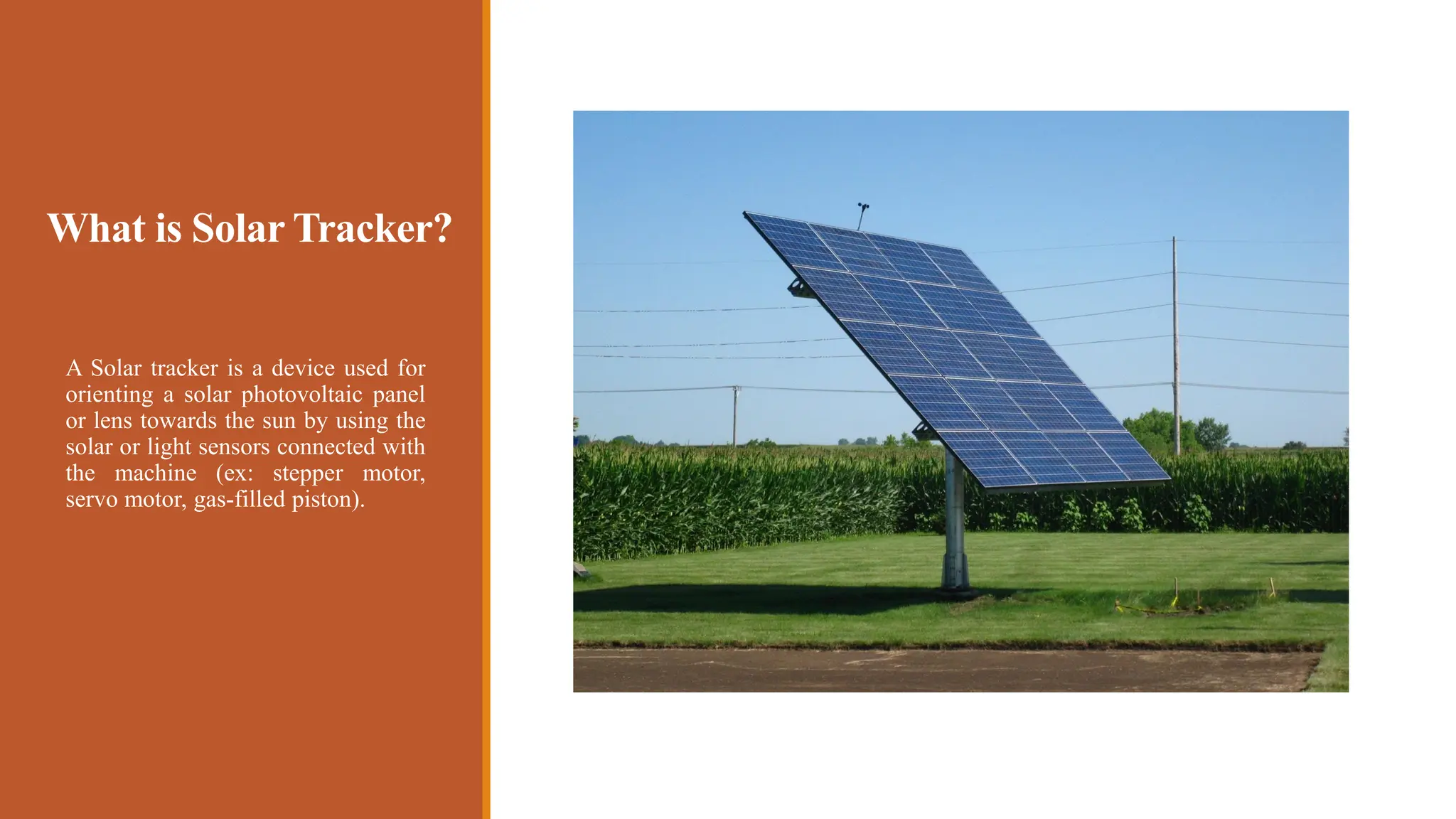
What is Solar Tracker?
A Solar tracker is a device used for
orienting a solar photovoltaic panel
or lens towards the sun by using the
solar or light sensors connected with
the machine (ex: stepper motor,
servo motor, gas-filled piston).
TYPES OF SOLAR TRACKERS
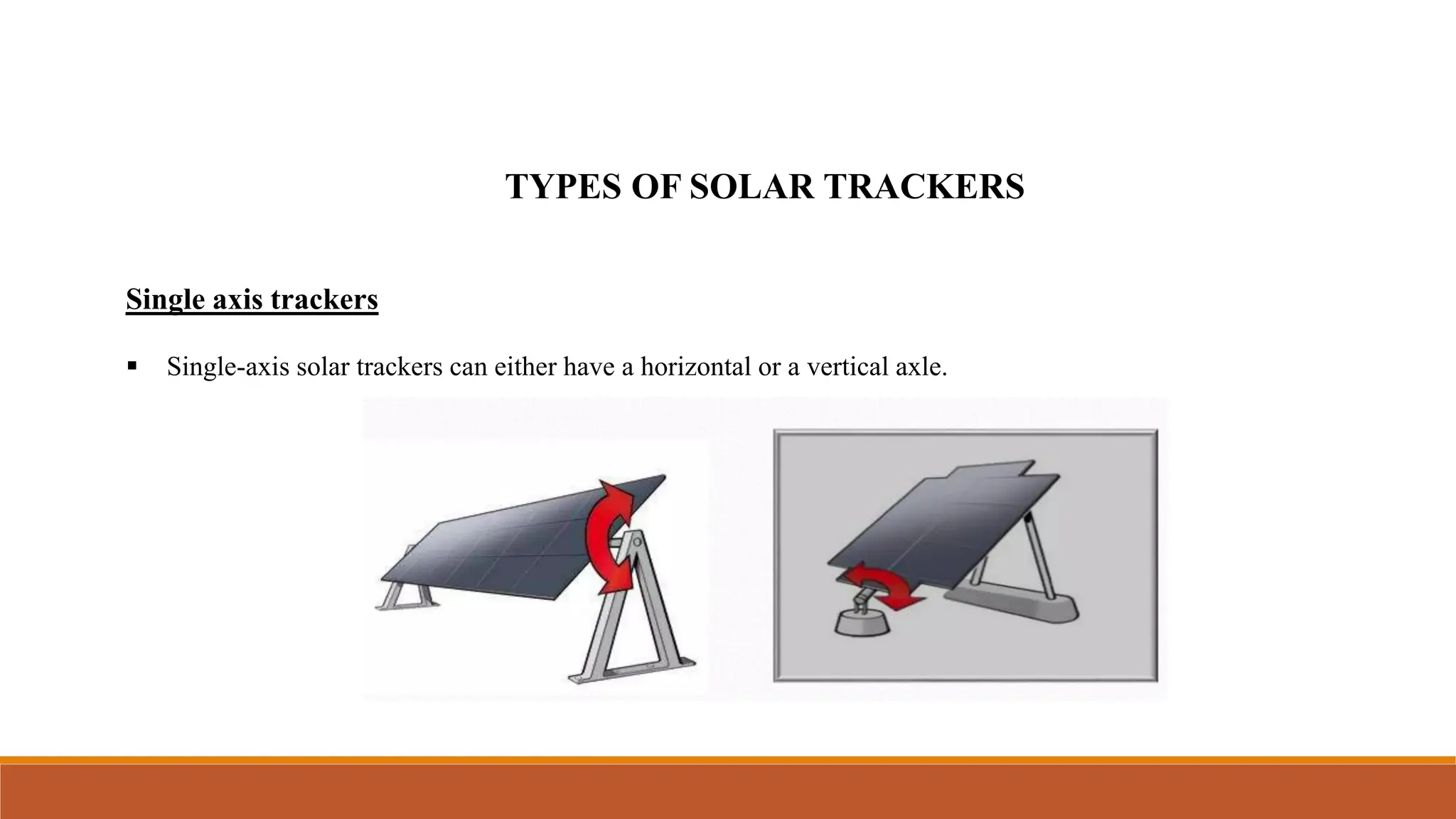
Single axis trackers
▪ Single-axis solar trackers can either have a horizontal or a vertical axle.
Dual Axis Trackers
▪ Double-axis solar trackers have both a horizontal and vertical axis.
▪ It can track the Sun's apparent motion exactly anywhere in the world.
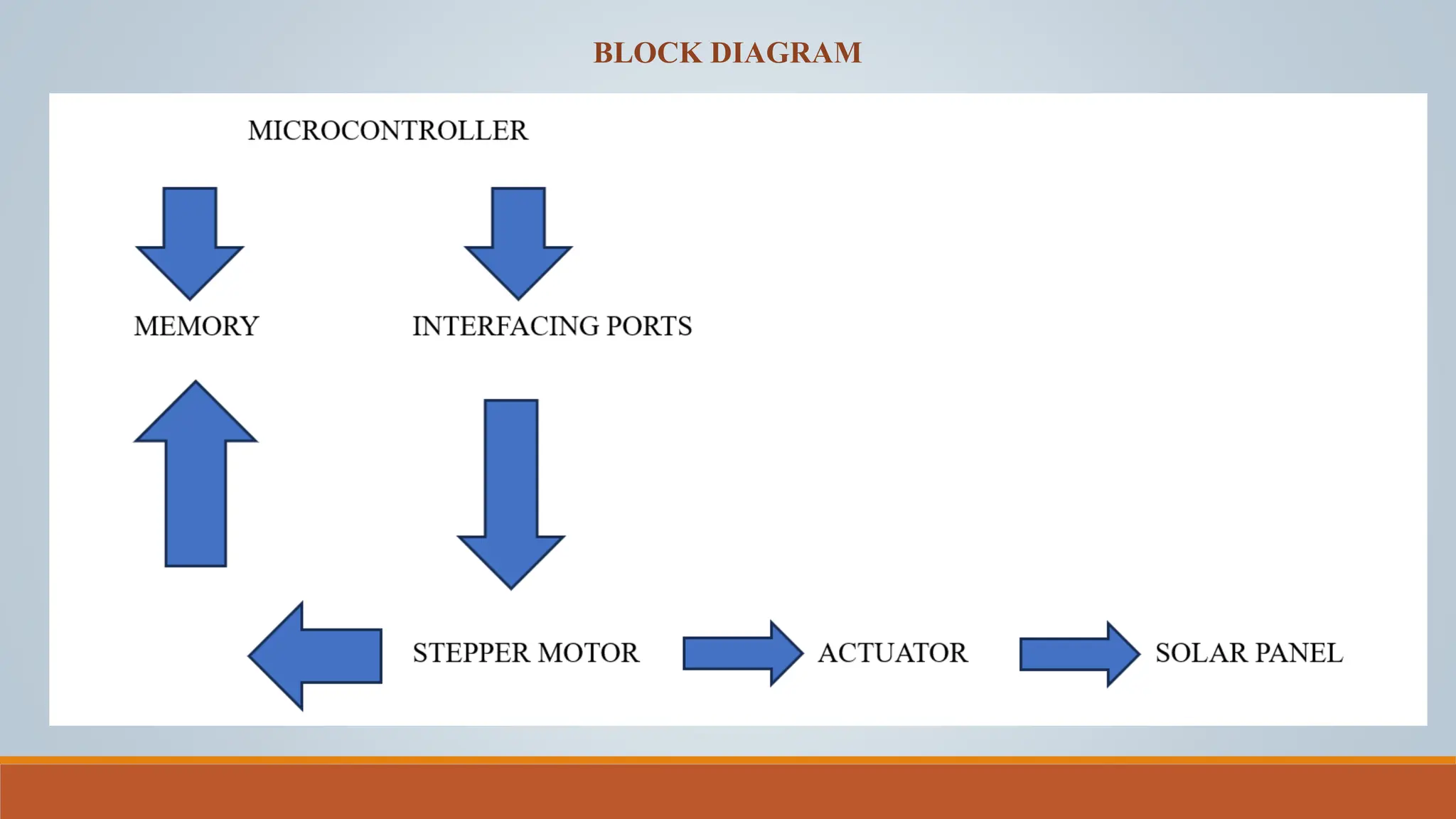
BLOCK DIAGRAM
Basic components
▪ The Solar Panel (1)
▪ Stepper Motor (2)
▪ Actuator (3)
▪ Microcontroller (4)
▪ A Display Unit (Optional) (5)
▪ Interfacing Cables (6)
(1) (2) (3)
(4) (5) (6)
COMPONENTS
S0LAR PANEL
▪It’s made up of a number of solar cells connected in series
internally to convert solar energy to electricity.
▪Photo voltaic effect produces a change in electrical
characteristics when light is incident upon it.
STEPPER MOTOR
▪ It’s an electromechanical device that converts digital pulse
inputs to incremental shaft rotation.
▪Used for precision positioning control applications.
▪ It is controlled by a series of electromagnetic coils.
COMPONENTS
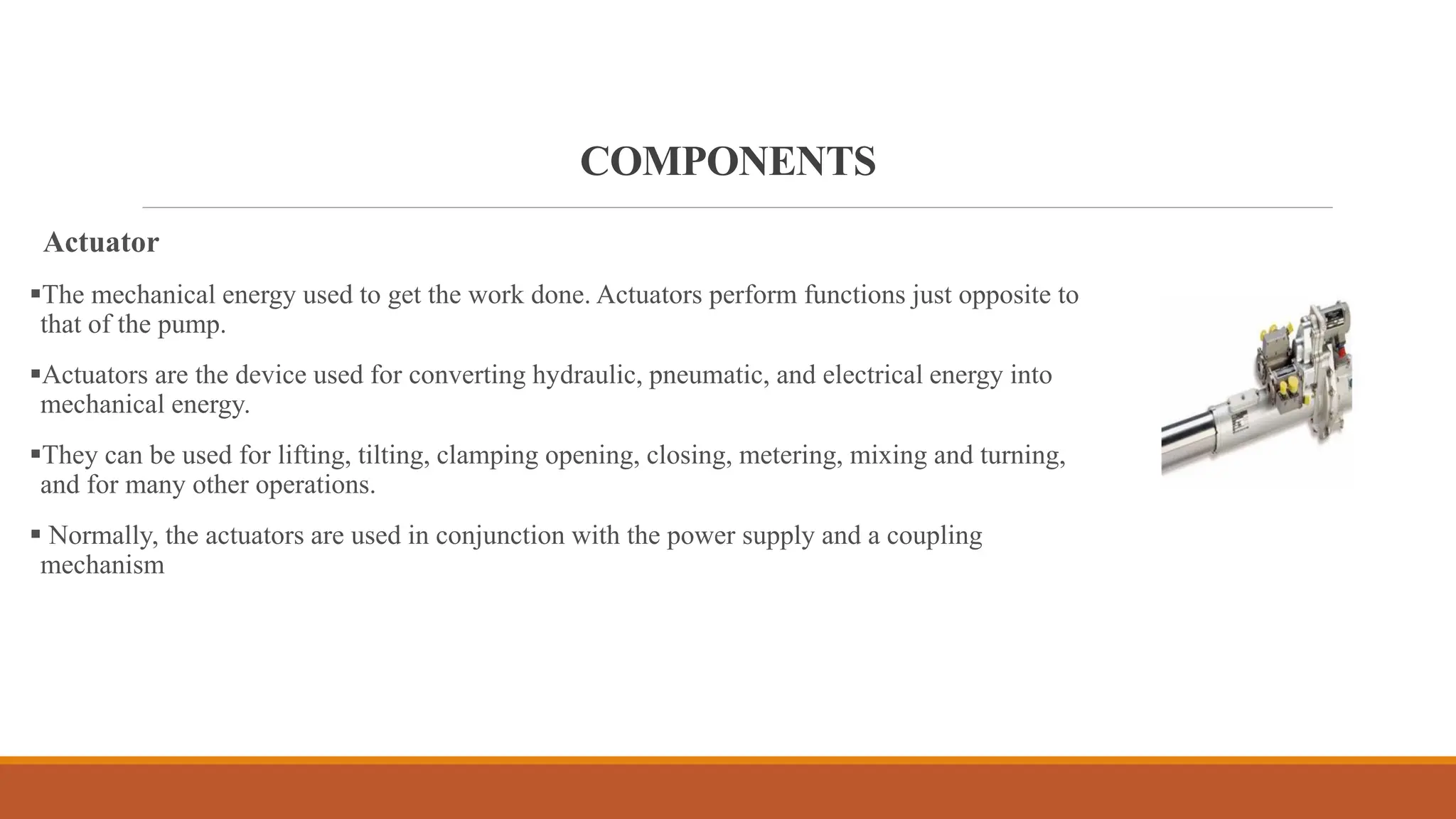
Actuator
▪The mechanical energy used to get the work done. Actuators perform functions just opposite to
that of the pump.
▪Actuators are the device used for converting hydraulic, pneumatic, and electrical energy into
mechanical energy.
▪They can be used for lifting, tilting, clamping opening, closing, metering, mixing and turning,
and for many other operations.
▪ Normally, the actuators are used in conjunction with the power supply and a coupling
mechanism
COMPONENTS
MICROCONTROLLER
▪ A microcontroller is an integrated circuit (IC) that can be
programmed to perform a set of functions to control a
collection of electronic devices.
▪ A self-contained system in which a processor, support,
memory, and input/output (I/O) are all contained in a single
package.
DISPLAY UNIT
▪A display unit, in the context of computing and electronics,
refers to the hardware component that visually presents
information generated by a computer or other electronic
devices.
▪ It's the screen you look at when using a computer, smartphone,
tablet, television, or any other electronic device with a visual
interface.
▪ Auto-tracking control system comprises PLC, sensors, signal processing units, PV cells,
electromagnetic and mechanical motion control modules, and power supply systems.
▪ Panel detects the sunlight strength to sensors.
▪ The sensor’s output is given to the PLC which compares it and produces an equivalent output to rotate
the motor and align the panel in the sun’s direction.
WORKING PRINCIPLE
Conditions For Maximum Output
▪ The difference between the incident ray and the reflected ray should be equal to zero, i.e. the rays should
be perpendicular to the panel.
▪ The altitude is directly proportional to the efficiency of the system up to a certain limit.
▪ A very clear sky and clean atmosphere contributes a bit more to the efficiency of the system.
COMPARISON OF SOLAR ENERGY
▪ The invention of the Solar Tracking System helps us improve the performance of PV solar systems
simply.
▪ Used relative method of sunlight strength.
▪ We have established a model of an automatic tracking system to keep vertical contact between solar
panels and sunlight.
▪ Improved the utilization rate of solar energy and efficiency of photovoltaic power
generation systems.
CONCLUSION
▪ Solar Tracking System (openai.com)
▪ Solar tracker - Wikipedia
▪ M Izham, A Mohamad, Hicham Mhamdi, Nawfal A Mohammad Amin, A review of automatic solar tracking
systems, Journal of Physics Conference Series 2051(1):012010, October 2021
▪ Automatic Solar Tracker System. Nikesh.D.Watane, Rakesh.A.Dafde International Journal of Scientific &
Engineering Research, Volume 4, Issue 6, June-2013 ISSN 2229-5518
REFERENCES
THANK YOU

Automatic solar tracking system ppt.pdf

  • 1.
    J.B. Institute ofEngineering & Technology (UGC AUTONOMOUS) (Accredited by NBA & NAAC, Approved by AICTE, Permanently Affiliated to JNTUH) Bhaskar Nagar, Yenkapally, Moinabad Mandal, R.R. District, Telangana, India-500075 A SEMINAR ON AUTOMATIC SOLAR TRACKING SYSTEM PRESENTED BY S.SAI GANESH (21675A0219) EEE-B
  • 2.
    CONTENTS ▪ Introduction ▪ Whatis Solar Tracker? ▪ Types of Solar Trackers ▪ Block Diagram ▪ Components ▪ Working Principle ▪ Conditions For Maximum Output ▪ Comparison of Solar Energy ▪ Conclusion ▪ References
  • 3.
    INTRODUCTION ▪ Renewable energysolutions are becoming popular. ▪ Maximizing output from solar systems increases efficiency. ▪ Presently solar panels are of fixed type which lowers the efficiency. ▪ Maintaining vertical direction between light and panel maximizes efficiency. ▪ Solar tracking system has 35% higher generating power than fixed. ▪ Solar tracking system based on PLC can adjust automatically the orientation of the panel.
  • 4.
    What is SolarTracker? A Solar tracker is a device used for orienting a solar photovoltaic panel or lens towards the sun by using the solar or light sensors connected with the machine (ex: stepper motor, servo motor, gas-filled piston).
  • 5.
    TYPES OF SOLARTRACKERS Single axis trackers ▪ Single-axis solar trackers can either have a horizontal or a vertical axle.
  • 6.
    Dual Axis Trackers ▪Double-axis solar trackers have both a horizontal and vertical axis. ▪ It can track the Sun's apparent motion exactly anywhere in the world.
  • 7.
  • 8.
    Basic components ▪ TheSolar Panel (1) ▪ Stepper Motor (2) ▪ Actuator (3) ▪ Microcontroller (4) ▪ A Display Unit (Optional) (5) ▪ Interfacing Cables (6) (1) (2) (3) (4) (5) (6)
  • 9.
    COMPONENTS S0LAR PANEL ▪It’s madeup of a number of solar cells connected in series internally to convert solar energy to electricity. ▪Photo voltaic effect produces a change in electrical characteristics when light is incident upon it. STEPPER MOTOR ▪ It’s an electromechanical device that converts digital pulse inputs to incremental shaft rotation. ▪Used for precision positioning control applications. ▪ It is controlled by a series of electromagnetic coils.
  • 10.
    COMPONENTS Actuator ▪The mechanical energyused to get the work done. Actuators perform functions just opposite to that of the pump. ▪Actuators are the device used for converting hydraulic, pneumatic, and electrical energy into mechanical energy. ▪They can be used for lifting, tilting, clamping opening, closing, metering, mixing and turning, and for many other operations. ▪ Normally, the actuators are used in conjunction with the power supply and a coupling mechanism
  • 11.
    COMPONENTS MICROCONTROLLER ▪ A microcontrolleris an integrated circuit (IC) that can be programmed to perform a set of functions to control a collection of electronic devices. ▪ A self-contained system in which a processor, support, memory, and input/output (I/O) are all contained in a single package. DISPLAY UNIT ▪A display unit, in the context of computing and electronics, refers to the hardware component that visually presents information generated by a computer or other electronic devices. ▪ It's the screen you look at when using a computer, smartphone, tablet, television, or any other electronic device with a visual interface.
  • 12.
    ▪ Auto-tracking controlsystem comprises PLC, sensors, signal processing units, PV cells, electromagnetic and mechanical motion control modules, and power supply systems. ▪ Panel detects the sunlight strength to sensors. ▪ The sensor’s output is given to the PLC which compares it and produces an equivalent output to rotate the motor and align the panel in the sun’s direction. WORKING PRINCIPLE
  • 13.
    Conditions For MaximumOutput ▪ The difference between the incident ray and the reflected ray should be equal to zero, i.e. the rays should be perpendicular to the panel. ▪ The altitude is directly proportional to the efficiency of the system up to a certain limit. ▪ A very clear sky and clean atmosphere contributes a bit more to the efficiency of the system.
  • 14.
  • 15.
    ▪ The inventionof the Solar Tracking System helps us improve the performance of PV solar systems simply. ▪ Used relative method of sunlight strength. ▪ We have established a model of an automatic tracking system to keep vertical contact between solar panels and sunlight. ▪ Improved the utilization rate of solar energy and efficiency of photovoltaic power generation systems. CONCLUSION
  • 16.
    ▪ Solar TrackingSystem (openai.com) ▪ Solar tracker - Wikipedia ▪ M Izham, A Mohamad, Hicham Mhamdi, Nawfal A Mohammad Amin, A review of automatic solar tracking systems, Journal of Physics Conference Series 2051(1):012010, October 2021 ▪ Automatic Solar Tracker System. Nikesh.D.Watane, Rakesh.A.Dafde International Journal of Scientific & Engineering Research, Volume 4, Issue 6, June-2013 ISSN 2229-5518 REFERENCES
  • 17.