Journal of Soft Computing in Civil Engineering 6-3 (2022) 01-17
How to cite this article: Padsumbiya M, Brahmbhatt V, Thakkar SP. Automatic crack detection using convolutional neural
network. J Soft Comput Civ Eng 2022;6(3):01–17. https://doi.org/10.22115/scce.2022.325596.1397
2588-2872/ © 2022 The Authors. Published by Pouyan Press.
This is an open access article under the CC BY license (http://creativecommons.org/licenses/by/4.0/).
Contents lists available at SCCE
Journal of Soft Computing in Civil Engineering
Journal homepage: www.jsoftcivil.com
Automatic Crack Detection Using Convolutional Neural Network
Mihir Padsumbiya1*
, Vedant Brahmbhatt1
, Sonal P. Thakkar2
1. B Tech, Department of Civil Engineering, Institute of Technology, Nirma University, Ahmedabad, Gujarat, India
2. Associate Professor, Department of Civil Engineering, Institute of Technology, Nirma University, Ahmedabad,
Gujarat, India
Corresponding author: sonal.thakkar@nirmauni.ac.in
https://doi.org/10.22115/SCCE.2022.325596.1397
ARTICLE INFO ABSTRACT
Article history:
Received: 19 January 2022
Revised: 20 June 2022
Accepted: 09 July 2022
Manual inspection of cracks on concrete surfaces requires
wholesome knowledge and depends entirely on the expertise
and capabilities of the inspector. This study proposes the use of
a simple Convolutional Neural Network (CNN) for automatic
crack detection. A comparative approach for Automated Crack
Detection is presented between Feed-Forward Fully Connected
Neural Networks and CNN, focusing on the primary
hyperparameters affecting the accuracy of both systems. An
inclination towards CNN is concluded due to its simplicity and
computational efficiency. For the purpose of this study, the
input data is extracted from an open-source platform. In the
second step, the images are pre-processed for obtaining low-
pixel density images with the aim to get better accuracy at lower
computer power. The CNN proposed uses Max Pooling and
appropriate optimization techniques. The model is trained to
detect and segregate cracked and non-cracked concrete surfaces
through input images. The proposed model predicts and labels
images with cracks on concrete surfaces and images with no
cracks using pixel-level information. The final accuracy
achieved is 97.8% by the proposed CNN model. The proposed
model is a novel approach to detecting cracks on low pixel
density images of concrete surfaces for its economic and
processing efficiency and thus eliminates the need for high-cost
digital image capturing devices. This study signifies and
confirms the impact of Artificial Intelligence in the Civil
Engineering field where using simple techniques like a simple
four-layered Neural Network is capable of carrying automatic
inspection of cracks which can be further developed for other
applications.
Keywords:
Deep learning;
Computer vision;
Maintenance and rehabilitation;
Artificial neural network.
2 M. Padsumbiya et al./ Journal of Soft Computing in Civil Engineering 6-3 (2022) 01-17
1. Introduction
The maintenance of any building is followed by a set plan of timely inspections and maintenance
work to increase the life span of the building. A building undergoes deterioration due to multiple
external and internal factors. Cracks are an important aspect of any structure as they provide a
visual signal to the distress of that structure. Hence, inspecting and evaluating cracks is one of
the most important steps to predicting the life span of any structure [1]. However, manual
inspection leads to reliability and accessibility issues, heavy reliance on inspectors leading to
manual errors compounded with financial issues [2].
To avoid the cons of manual inspection, advanced technologies can be used for automatic crack
detection and the academic community has been fairly excited about this. Barrias et al., proposed
crack measuring systems using fiber optic sensors by implanting IoT based sensors for the
surface under scrutiny [3]. Feng et al., proposed the route of using a laser scanning system that
generates a high-density 3D point cloud for better accuracy in crack detection [4]. Yan et al.
proposes the use of a novel sensing skin that identifies change in strain over a surface and detects
cracks [5]. Similarly, Downey et al. further proposed a Monte Carlo method for using high value
resistors in resistor mesh model to detect the electrical output from self-sensing material [6]. Kim
et al. proposes the use of images from a combination of RGB-D and high-resolution digital
cameras in a sensor fusion algorithm [7]. Cho et al. proposes the use of image processing
algorithms on octree data from Terrestrial laser scanning [8].
The robustness of Machine learning techniques enables its use to address different Civil
Engineering problems. Farhangi.et al. uses Artificial Neural Networks for better accuracy in
estimating the first yield point displacement and post-yield stiffness ratio in shape memory alloy
equipped bar hysteric dampers [9]. Khaleghi et al. uses a novel Multi-pier method to determine
the behavior of Perforated unreinforced masonry walls. The results of Multi-pier method are
used for predictive analysis of Perforated unreinforced masonry walls using various Machine
learning techniques [10]. Chen. et al. proposes the use of multi-source sensor information to
form fused RGB-thermal images for pavement damage detection using the pre-trained Efficient
Net B4 model. The results of the model provide high accuracy even with complex pavement
conditions [11].
Advancements in deep learning techniques and the currently used cumbersome rehabilitation and
maintenance techniques call for applying deep learning techniques in Civil engineering. Deep
learning is a branch of machine learning with applications in image classification, natural
language processing [12]. Image classification can be convenient in crack detection as computer
efficiency and advanced algorithmic tools can be leveraged to understand low-level patterns in
cracked concrete surfaces. With its immensely optimized structure and more minor
computational needs, deep learning, not to forget the accuracy, gives it an upper hand over other
machine learning techniques when it comes to image classification [2].
Using vision-based approaches to provide a solution to automatic crack detection is under lot of
consideration by many researchers around the world. O’Byrne et al. proposes the use of
segmentation techniques and texture analysis for detecting damage detection in structures [13] .
M. Padsumbiya et al./ Journal of Soft Computing in Civil Engineering 6-3 (2022) 01-17 3
Kalfarisi et al. proposes the use of Deep Learning techniques with a 3D mesh model for
segmentation and detection of cracks [14]. Li et al. proposes a novel Fully Convolutional Neural
network which in steps measure the features of cracks [15]. Gao et al. prove the effectiveness of
deep Transfer learning based models for structural damage recognition [16]. Fang et al. proposed
the use of a hybrid model by combining a Faster Region-Based Convolutional Neural Network
for crack patch detection, a Convolutional Neural Network for crack orientation recognition, and
a Bayesian algorithm [17] . Sattar et al. compares Edge Detectors and Deep Convolutional
Neural Networks for image-based crack detection and concludes that convolutional neural
networks perform much better both in terms of accuracy and efficiency [18].
In this paper, the problem of crack detection is addressed with the use of a Convolutional Neural
Network scaled down to work on 128x128x3 px images for better efficiency. The model is
proposed to detect cracks and automatically classify images of concrete surfaces with/without
cracks. It is crucial to understand the underlying concepts of deep learning and what happens
under the hood of any neural network. A comprehensive explanation of the same is given to build
both an intuitional understanding and mathematical understanding of neural networks for the
convenience of any reader not equipped with the proper understanding of deep learning
techniques. Finally, the procedure and results of the experimental work are presented. The
differing pixel values of grayscale cracked area of the image and background of the image allows
segmentation and detection of cracks in an image. The results of the model are promising and are
fully viable for practical uses.
2. Research significance
Researchers around the world have come up with significantly accurate solutions to Automatic
crack detection by using Deep Learning techniques. This enables high efficiency and less costs
for structural damage detection when compared to other techniques both Automatic and Manual.
However, the solutions are extremely complex. Moreover, the architecture of any neural network
is such that as the network becomes larger and complex, the number of parameters increase
drastically, further plummeting crack detection speeds [19]. This study proposes the use of a
simple 4 layered convolutional neural network enabled to detect cracks from a 128*128*3
image. This increases efficiency and eliminates the need for high-end costly devices to capture
complex digital data for training the model and significantly improves prediction speeds.
3. Literature review
3.1 Deep learning
Deep learning takes on many different applications in fields ranging from biomedical to
astronomy to different engineering domains. The availability of large amounts of data and faster
algorithms, not to mention the development of efficient computational technology, has made
using deep learning techniques in artificial intelligence even more successful. Computer vision
remains one of the best most popular, and many people worldwide are interested in learning
more about it. However, computer vision being analogical with the human visual cortex was first
4 M. Padsumbiya et al./ Journal of Soft Computing in Civil Engineering 6-3 (2022) 01-17
thought of in the 1940s. Back then, it was called cybernetics, the main goal being the
computation of a linear function. In the 1980s, it was named connectionism, and
backpropagation was introduced by Rumelhart et al. in 1986 [20,21]. However, unlike today, the
idea of backpropagation was not utilized for all layers of the neural network. With the work of
Hinton et al. in 2006, it was renamed Deep Learning [22]. Hinton et al. solved the problem of the
unfeasibility of neural networks by developing the idea of pre-training and fine-tuning. Since
then, the availability of large data sets, better computational power, efficient algorithms, and
better cleaner data Deep Learning has proved to be the most sought-after technique for computer
vision areas [23–25]. The availability of better graphics, GPUs, and open-source frameworks
making the execution of models easier, has further motivated Deep Learning techniques.
Different Deep Learning techniques- Deep Belief Networks, Convolutional Neural Networks,
Recurrent Neural Networks, Feed-Forward, Fully Connected Neural Networks- are better suited
for different applications.
3.2 Mathematical understanding
Forward propagation is the first real sub-task of a deep learning model where the input is passed
through the convoluted layers to learn features, and learned features are passed through feed-
forward fully connected layer/s to compute loss. The main goal of forwarding propagation is to
get an output using the input features in such a way as to minimize the cost (difference between
output labels and predicted labels) by tweaking the hyperparameters that lead to an optimized set
of weights and bias vectors [26]. The overall idea is then to learn the weights and biases over a
series of iterations. In mathematical terms, the goal is to predict the output of function y = f (x,
𝜽�), where y is the output label, x is the input data, and 𝜽� are parameters whose values are
learned. There can be multiple layers executing the same process where the output of the
preceding layer acts as the input. When multi-layered, it is called a network. Each layer in any
such network has its function and parameters. In the case of a Convoluted layer, these weights
and biases form a kernel. Convoluted layers are best at detecting features. Usually, the
convoluted layers precede the feed-forward, fully connected layers. At every convoluted layer,
the kernel with randomly initialized weights and chosen dimensions is operated over the first
data instance. The kernel undergoes matrix multiplication over the input matrix pixel by pixel
according to stride value. The output of each instance of matrix multiplication is stored in the
output matrix. Subsequently, the output matrix is passed through an activation function and a
pooling function, if any. This follows all convoluted layers where the output from the preceding
layer acts as input for any subsequent layer. The dimensions of the output matrix from any
convoluted layer can be derived using:
𝑛[𝐿]
= ((𝑛[𝐿−1]
+ 2𝑝 − 𝑓)/𝑠) + 1 (1)
Where n[L]
is the dimensions of data for the current layer, n[L-1]
is the dimensions of data for the
previous layer, p is the padding value implied on the previous layer, f is the dimensions of
kernel/filter applied on the previous layer, s is the stride value implied on the previous layer. It is
important to note that the output value of dimensions from the above formula before any pooling
is applied on the previous layer. If pooling is applied, the dimensions are further reduced. The
M. Padsumbiya et al./ Journal of Soft Computing in Civil Engineering 6-3 (2022) 01-17 5
last convoluted layer is succeeded by a flattening layer where the matrix is flattened to pre-
process the data for a fully connected layer.
At a fully connected layer, the basic mathematical calculation is a multiplication of input features
with weights layer by layer and the addition of biases. The result is passed through an activation
function, the result being promoted as inputs for the next layer.
𝑍[1]
=
(
𝑊1
1
𝑊2
1
𝑊1
2
𝑊2
2
𝑊3
1
⋯ 𝑊4
1
𝑊3
2
⋯ 𝑊4
2
𝑊1
3
𝑊2
3
𝑊1
4
𝑊2
4
𝑊3
3
⋯ 𝑊4
3
𝑊3
4
⋯ 𝑊4
4
)
(
𝑋1
𝑋2
𝑋3
𝑋4
⋮
⋮
𝑋 )
�+�(
𝑏1
𝑏2
𝑏3
𝑏4
) (2)
A[1]
= σ (
Z[1]1
Z[1]2
Z[1]3
) = (
A[1]1
A[1]2
A[1]3
) (3)
At the output layer, the activation function gives predictions. These predictions are then
compared to true labels, and the competency is checked using a loss function which can be
defined as L (Y, Ŷ), where Y depicts the predictions and Ŷ depicts true labels. The losses are
decreased through consecutive backpropagation operations, each of which modifies the
hyperparameters to lower the losses. This can be achieved by finding Cost Function gradients
with respect to weights and biases at each layer. This is the entire process of a convolutional
neural network in a nutshell and an overview of how it performs.
3.3 Recent work
Extensive research for use of Deep Learning models for crack detection has provided promising
results in the recent past. Guo X.Hu et al. [27] discuss the use of YOLOv5 series pre-trained
models for pavement crack detection on an image dataset captured using a high-end digital
camera, and reach a promising 88.1% accuracy, although on 2978 x 3978 pixel images. Pang-jo
Chun et al. [28] proposes the use of Light Gradient Boosting Machine model for automatic crack
detection and compare the results with pix2pix-based approach. The study generates crack
features using pixel values and geometric shapes and achieves an accuracy of 99.7%, whilst
being a complex procedure. Yang Yu et al. [29] critiques the accuracy and computational cost of
automatic crack detection techniques currently used. They propose a vision-based crack
detection method using Deep Learning and the Enhanced Chicken Swarm algorithm. Diane
Andrushia A et al. [30] propose a Deep Learning model for crack detection on concrete surfaces
exposed to elevated temperatures. The proposed method performs pixel wise classification using
a complex U-Net architecture with a encoder and decoder framework. Abdellah Chehri et al. [31]
presents an IoT and Deep Learning based solution for automatic crack detection on Concrete
Bridge Structures. Weijian Zhao et al. [32] proposes a combination of YOLOv5 model and crack
feature pyramid network (Crack-FPN) for reduced computational cost and feature extraction.
Munawar, H.S et al. [33] conduct a review on 30 different crack detection models proposed in
6 M. Padsumbiya et al./ Journal of Soft Computing in Civil Engineering 6-3 (2022) 01-17
the past decade. The study advocates for the consideration of computational costs, resource
consumption, and applicability in real-time scenarios. This study addresses these factors in the
proposed crack detection model.
In this paper, a combination of convoluted layers and feed-forward neural layers is used for
image classification. With a motive to achieve better results and computational efficiency,
appropriate optimization techniques have been used. The simplistic architecture of the model,
making it robust and providing more scope for further changes to accommodate further aims,
makes the model one of a kind. Also, this paper is written to accommodate a reader with lesser or
no knowledge of deep learning models, explaining what happens under the hood. In all, a model
has two sub-tasks- forward propagation and backward propagation. The sub-tasks are linked so
that forward-propagation generates a prediction, which is then compared to the true value using a
loss function. The difference in the true value and prediction loss is used by backward
propagation to tweak the parameters to reduce this difference. Specifically, the convoluted layers
detect and learn the features.
4. Methods
Crack detection in the current scenario for most parts of the world is a tedious job and is often
prone to human errors. It is inherently time-consuming. A neural network model is being
proposed here to automate the task of crack detection. The proposed model has an accuracy of
97.8%.
The proposed model uses a total of 40,000 images of concrete surfaces extracted from an open-
source platform [34]. The data is created and uploaded by Çağlar Fırat Özgenel. Many thanks to
Çağlar Fırat Özgenel for contributing such refined images. The dataset contains 20,000 images
with cracks and 20,000 images with no cracks over the concrete surface. The cracks present in
the images are of varied form, shape, and nature, so diversity is taken care of. The images are
generated from 458 high-resolution images of 4032*3024 pixels with the method Zhang et al.
[25]. High-resolution images have variance in surface finish and illumination conditions, making
the model applicable to robust conditions. The shape of each instance of data is 227*227*3 with
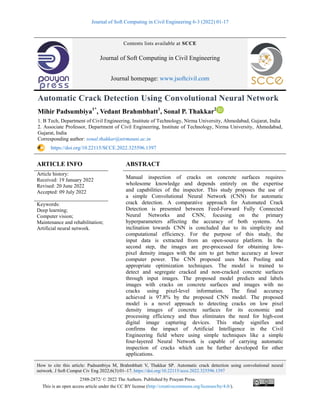
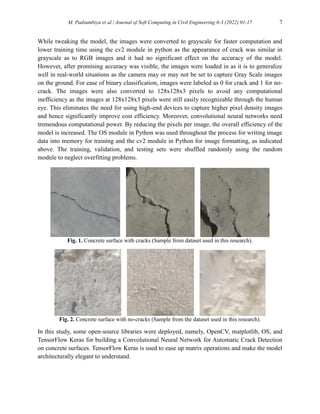
RGB channels. Fig. 1 and fig. 2 illustrates sample images used for training the model. A total of
32400 images were randomly chosen for training the model, 3600 images were randomly chosen
for validation purposes and 4000 images were separated for testing the model. Because the size
and diversity in the training set and testing set are enough for the model to give satisfactory
results, no data augmentation in random rotation or flipping is applied. An equilibrium in the
distribution of all training, validation, and testing sets was maintained to ensure that a similar
number of images labeled crack and non-crack is present to avoid bias. 16200, 1800, and 2000
images of crack and non-crack concrete surfaces are set in training, validation, and testing sets,
respectively. It was also ensured that no image was repeated in training, validation, or testing
sets.
M. Padsumbiya et al./ Journal of Soft Computing in Civil Engineering 6-3 (2022) 01-17 7
While tweaking the model, the images were converted to grayscale for faster computation and
lower training time using the cv2 module in python as the appearance of crack was similar in
grayscale as to RGB images and it had no significant effect on the accuracy of the model.
However, after promising accuracy was visible, the images were loaded in as it is to generalize
well in real-world situations as the camera may or may not be set to capture Gray Scale images
on the ground. For ease of binary classification, images were labeled as 0 for crack and 1 for no-
crack. The images were also converted to 128x128x3 pixels to avoid any computational
inefficiency as the images at 128x128x3 pixels were still easily recognizable through the human
eye. This eliminates the need for using high-end devices to capture higher pixel density images
and hence significantly improve cost efficiency. Moreover, convolutional neural networks need
tremendous computational power. By reducing the pixels per image, the overall efficiency of the
model is increased. The OS module in Python was used throughout the process for writing image
data into memory for training and the cv2 module in Python for image formatting, as indicated
above. The training, validation, and testing sets were shuffled randomly using the random
module to neglect overfitting problems.
Fig. 1. Concrete surface with cracks (Sample from dataset used in this research).
Fig. 2. Concrete surface with no-cracks (Sample from the dataset used in this research).
In this study, some open-source libraries were deployed, namely, OpenCV, matplotlib, OS, and
TensorFlow Keras for building a Convolutional Neural Network for Automatic Crack Detection
on concrete surfaces. TensorFlow Keras is used to ease up matrix operations and make the model
architecturally elegant to understand.
8 M. Padsumbiya et al./ Journal of Soft Computing in Civil Engineering 6-3 (2022) 01-17
The model has a simplistic architecture with four layers, two each convolutional (feature
detector) and feed-forward fully connected layers. A sequential model is used as the model layers
are stacked one after the other, and the number of input and output tensors for each layer is
precisely one. The pixel values for all instances of data are normalized before feeding into the
model. Max pooling is applied at the first layer(Convoluted). The first layer has a stride value of
one, and no padding is applied to the layer. With a kernel size of 3*3, the output shape is
126*126*128, and the number of parameters learned is 3584 parameters. The activation function
applied is RELU, as the RELU function is computationally inexpensive, converges faster than
other activation functions, and does not saturate at higher positive inputs. Moreover, RELU
function is most sought after for convolutional neural networks. The pooling layer used is MAX
Pooling of shape 4x4 as, max pooling is used when we need to detect prominent pixels from an
array of pixels as the pixels containing the crack are mostly inclined to B channel and hence can
be easily detected when compared to the surrounding pixels. The output data from the first
pooling layer is of shape 31x31x128.
At the second convoluted layer, with the kernel size 3*3, stride value one, and no padding, the
output shape is 29*29*128, with a total of 147584 parameters. The activation function RELU is
used again. Finally, the A-MAX pooling layer is applied with output shape 7*7*128.
The output arrays of the second convoluted layers are then flattened to pre-process the data for
feed-forward, fully connected layers. The output shape after flattening the data is 6272*1. At the
first feed-forward fully connected layer, 128 neurons are stacked, learning 802944 parameters.
Regularization is applied with coefficients equal to 1 for kernel and bias regularization to avoid
overfitting and reduce variance. The activation function applied is RELU. At the output layer, the
activation function applied is SIGMOID, as it is a binary classification problem. The loss
function applied is binary cross-entropy. Binary cross entropy can be understood as a
combination of SIGMOID and cross-entropy loss. Binary cross-entropy is optimum here for
several reasons. First and the foremost being that the predictions are in the form of probabilities
for the class being 1 (No Crack), and hence, if the probability is high, the loss should be lower,
while if the probability is low, the loss should be higher and to compute this mathematically a
negative of log suits well here. Moreover, it is independent for each class, and hence the loss
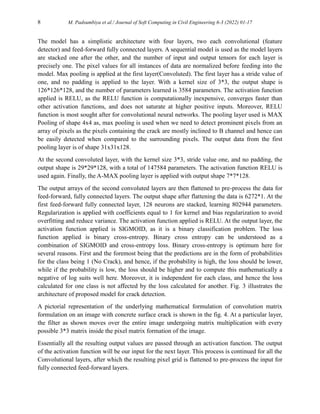
calculated for one class is not affected by the loss calculated for another. Fig. 3 illustrates the
architecture of proposed model for crack detection.
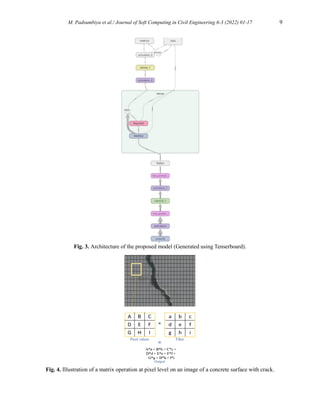
A pictorial representation of the underlying mathematical formulation of convolution matrix
formulation on an image with concrete surface crack is shown in the fig. 4. At a particular layer,
the filter as shown moves over the entire image undergoing matrix multiplication with every
possible 3*3 matrix inside the pixel matrix formation of the image.
Essentially all the resulting output values are passed through an activation function. The output
of the activation function will be our input for the next layer. This process is continued for all the
Convolutional layers, after which the resulting pixel grid is flattened to pre-process the input for
fully connected feed-forward layers.
M. Padsumbiya et al./ Journal of Soft Computing in Civil Engineering 6-3 (2022) 01-17 9
Fig. 3. Architecture of the proposed model (Generated using Tenserboard).
Fig. 4. Illustration of a matrix operation at pixel level on an image of a concrete surface with crack.
10 M. Padsumbiya et al./ Journal of Soft Computing in Civil Engineering 6-3 (2022) 01-17
The first of feed-forward fully connected layers is regularized. This was done to prevent
overfitting. During the testing of different model parameter values, there was a high variance
problem without regularization. The accuracy for the training set was about 99% which is more
than satisfactory, but the accuracy for the testing set was only 91%. The problem of high
variance, therefore, mandated the use of regularization. The regularization coefficient is set to a
default value of 0.01 both for kernel regularization and bias regularization.
The model's mathematical aim is to learn the CNN layers' filters and the weights of the feed-
forward fully connected layers so that the projected output is as close to the true label as feasible
for as many images as possible. For this goal to be achieved, the system iteratively performs
forward propagation and backward propagation and adjusts these filters and weights.
Every instance of data from the training set is processed through the network to learn the best
parameters and reduce the loss.
This process of learning the parameters is reiterated five times. Each iteration is known as an
epoch, and so the model is trained for five epochs. Initially, the model was trained for ten epochs,
but it was observed that the model tended to overfit the training set for simple pattern recognition
and binary classification problem.
A total of 5 epochs with a batch size of 16 data points is optimum to avoid both overfitting and
underfitting. From the system’s perspective, the end goal is to learn the underlying patterns of
image pixel while matching it to true labels and applying the learned knowledge to predict
outputs for the validation set and testing set. This occurs because of sudden change in pixel
information as the convolution window travels from non-cracked region of the surface to cracked
region where the pixels have lower values due to darker gray-scale regions while the surrounding
pixels have higher values due to higher density of RGB colors. Hence, by identifying the
combinations of non-cracked regions and cracked regions in terms of pixel values the parameters
of filter are adjusted in such a way that on provision of an unknown image the matrix operation
between filter and pixels of the image yields approximately similar results. Furthermore, when
the image contains a crack, the segmentation algorithm works to detect pixels inside the image
below a threshold value. This is because as mentioned earlier, the pixel values in cracked region
of the surface have lower density of RGB colors as it is majorly gray-scale and darker. Hence,
the lower valued pixels of cracks are detected easily.
As the amount of data points available is huge, Adam optimizer with default parameters set by
Keras (learning rate= 0.001, beta_1 = 0.9, beta_2 = 0.999, epsilon= 1e-8, decay= 0.0) is used for
optimizing the model. Moreover, to avoid noise in data, if any, and to take advantage of both
AdaGrad and RMSProp extensions of stochastic gradient descent, Adam is the best choice here.
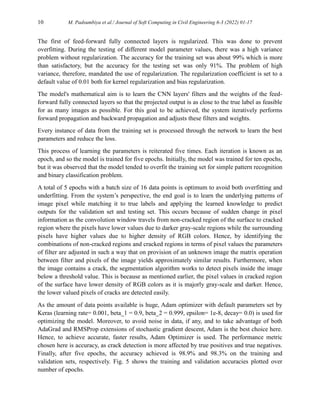
Hence, to achieve accurate, faster results, Adam Optimizer is used. The performance metric
chosen here is accuracy, as crack detection is more affected by true positives and true negatives.
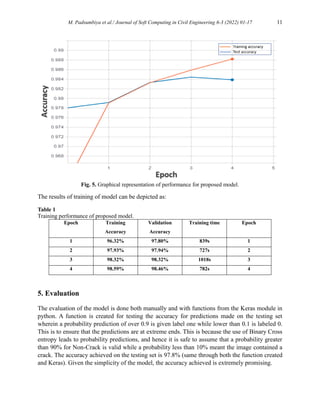
Finally, after five epochs, the accuracy achieved is 98.9% and 98.3% on the training and
validation sets, respectively. Fig. 5 shows the training and validation accuracies plotted over
number of epochs.
M. Padsumbiya et al./ Journal of Soft Computing in Civil Engineering 6-3 (2022) 01-17 11
Fig. 5. Graphical representation of performance for proposed model.
The results of training of model can be depicted as:
Table 1
Training performance of proposed model.
Epoch Training
Accuracy
Validation
Accuracy
Training time Epoch
1 96.32% 97.80% 839s 1
2 97.93% 97.94% 727s 2
3 98.32% 98.32% 1018s 3
4 98.59% 98.46% 782s 4
5. Evaluation
The evaluation of the model is done both manually and with functions from the Keras module in
python. A function is created for testing the accuracy for predictions made on the testing set
wherein a probability prediction of over 0.9 is given label one while lower than 0.1 is labeled 0.
This is to ensure that the predictions are at extreme ends. This is because the use of Binary Cross
entropy leads to probability predictions, and hence it is safe to assume that a probability greater
than 90% for Non-Crack is valid while a probability less than 10% meant the image contained a
crack. The accuracy achieved on the testing set is 97.8% (same through both the function created
and Keras). Given the simplicity of the model, the accuracy achieved is extremely promising.
12 M. Padsumbiya et al./ Journal of Soft Computing in Civil Engineering 6-3 (2022) 01-17
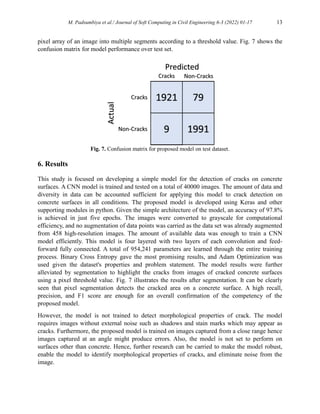
It is imperative to study the confusion matrix for the problem of crack detection. A function in
python is created for this purpose to calculate the elements of the confusion matrix. The test data
set consists of 4000 images, 2000 images with cracks, and 2000 images with no cracks; 88 are
falsely labeled while 3912 are labeled correctly. Out of 3912 images correctly predicted, 1921
images are with cracks, while 1991 images are without cracks. Out of 2000 images with cracks,
1921 images are correctly predicted as cracks, and out of 2000 images with no cracks, 1991 are
correctly predicted as non-cracks. While 79 images from 2000 images with cracks are falsely
predicted as non-cracks, and nine images from 2000 images with no cracks are falsely predicted
as cracks.
Analyzing the false predictions, it is concluded that the low pixel density of the images creates
an anomaly as lesser information is being given to the model for training. More precisely, the
model is being able to correctly predict settling cracks, heaving cracks, and expansion cracks,
mainly because of their obvious ‘crack-like’ size and dimensions and cavity produced on the
surface. However, low lighting and non-visibility of cracks clearly due to the smaller width of
the crack itself or instances where the color of concrete is darker leads to errors, and the model
fails to detect the underlying patterns and knowledge specifically for plastic shrinkage cracks and
cracks caused by premature drying.
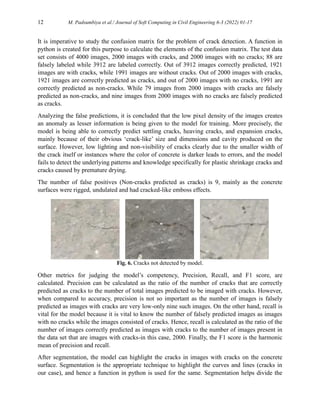
The number of false positives (Non-cracks predicted as cracks) is 9, mainly as the concrete
surfaces were rigged, undulated and had cracked-like emboss effects.
Fig. 6. Cracks not detected by model.
Other metrics for judging the model’s competency, Precision, Recall, and F1 score, are
calculated. Precision can be calculated as the ratio of the number of cracks that are correctly
predicted as cracks to the number of total images predicted to be imaged with cracks. However,
when compared to accuracy, precision is not so important as the number of images is falsely
predicted as images with cracks are very low-only nine such images. On the other hand, recall is
vital for the model because it is vital to know the number of falsely predicted images as images
with no cracks while the images consisted of cracks. Hence, recall is calculated as the ratio of the
number of images correctly predicted as images with cracks to the number of images present in
the data set that are images with cracks-in this case, 2000. Finally, the F1 score is the harmonic
mean of precision and recall.
After segmentation, the model can highlight the cracks in images with cracks on the concrete
surface. Segmentation is the appropriate technique to highlight the curves and lines (cracks in
our case), and hence a function in python is used for the same. Segmentation helps divide the
M. Padsumbiya et al./ Journal of Soft Computing in Civil Engineering 6-3 (2022) 01-17 13
pixel array of an image into multiple segments according to a threshold value. Fig. 7 shows the
confusion matrix for model performance over test set.
Fig. 7. Confusion matrix for proposed model on test dataset.
6. Results
This study is focused on developing a simple model for the detection of cracks on concrete
surfaces. A CNN model is trained and tested on a total of 40000 images. The amount of data and
diversity in data can be accounted sufficient for applying this model to crack detection on
concrete surfaces in all conditions. The proposed model is developed using Keras and other
supporting modules in python. Given the simple architecture of the model, an accuracy of 97.8%
is achieved in just five epochs. The images were converted to grayscale for computational
efficiency, and no augmentation of data points was carried as the data set was already augmented
from 458 high-resolution images. The amount of available data was enough to train a CNN
model efficiently. This model is four layered with two layers of each convolution and feed-
forward fully connected. A total of 954,241 parameters are learned through the entire training
process. Binary Cross Entropy gave the most promising results, and Adam Optimization was
used given the dataset's properties and problem statement. The model results were further
alleviated by segmentation to highlight the cracks from images of cracked concrete surfaces
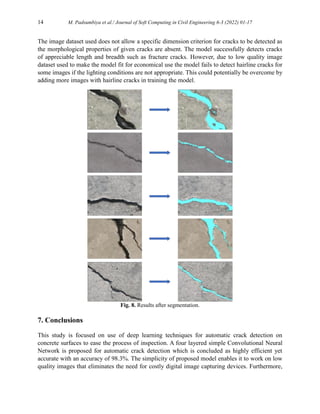
using a pixel threshold value. Fig. 7 illustrates the results after segmentation. It can be clearly
seen that pixel segmentation detects the cracked area on a concrete surface. A high recall,
precision, and F1 score are enough for an overall confirmation of the competency of the
proposed model.
However, the model is not trained to detect morphological properties of crack. The model
requires images without external noise such as shadows and stain marks which may appear as
cracks. Furthermore, the proposed model is trained on images captured from a close range hence
images captured at an angle might produce errors. Also, the model is not set to perform on
surfaces other than concrete. Hence, further research can be carried to make the model robust,
enable the model to identify morphological properties of cracks, and eliminate noise from the
image.
14 M. Padsumbiya et al./ Journal of Soft Computing in Civil Engineering 6-3 (2022) 01-17
The image dataset used does not allow a specific dimension criterion for cracks to be detected as
the morphological properties of given cracks are absent. The model successfully detects cracks
of appreciable length and breadth such as fracture cracks. However, due to low quality image
dataset used to make the model fit for economical use the model fails to detect hairline cracks for
some images if the lighting conditions are not appropriate. This could potentially be overcome by
adding more images with hairline cracks in training the model.
Fig. 8. Results after segmentation.
7. Conclusions
This study is focused on use of deep learning techniques for automatic crack detection on
concrete surfaces to ease the process of inspection. A four layered simple Convolutional Neural
Network is proposed for automatic crack detection which is concluded as highly efficient yet
accurate with an accuracy of 98.3%. The simplicity of proposed model enables it to work on low
quality images that eliminates the need for costly digital image capturing devices. Furthermore,
M. Padsumbiya et al./ Journal of Soft Computing in Civil Engineering 6-3 (2022) 01-17 15
the model is able to successfully segment cracks which are mostly major cracks with visible
dimensions such as settling cracks, heaving cracks, and expansion cracks. However, the model
struggles to detect minor cracks such as plastic shrinkage cracks and cracks caused by premature
drying. Hence, the proposed model can be used for quick initial inspection to detect major cracks
on concrete surfaces.
8. Future trends
A convolutional neural network model is proposed in this project for automatic crack detection
on concrete surfaces. The simplicity of this model can be leveraged for use in real-time for the
automatic assessment of structural damage. The model struggles to detect minor cracks due to
external factors which can potentially be eliminated by training the model on more data.
Furthermore, various techniques can be equipped to detect the morphological and physical
properties of cracks, and predict the urgency for repairs. Future scope of this study will be
focused on enabling the model for, detecting different types of surface distresses and use on all
types of surfaces.
Funding
This research received no external funding.
Conflicts of interest
The authors declare no conflict of interest.
References
[1] Avendaño J. Identification and quantification of concrete cracks using image analysis and machine
learning. KTH VETENSKAP OCH KONST, 2020.
[2] O’ Mahony N, Campbell S, Carvalho A, Harapanahalli S, Velasco Hernandez G, Krpalkova L, et
al. Deep Learning vs. Traditional Computer Vision. n.d.
[3] Barrias A, Casas JR, Villalba S. Embedded distributed optical fiber sensors in reinforced concrete
structures - A case study. Sensors (Switzerland) 2018;18. https://doi.org/10.3390/s18040980.
[4] Feng H, Member S, Li W, Luo Z, Chen Y, Member S, et al. GCN-Based Pavement Crack
Detection Using Mobile LiDAR Point Clouds. n.d.
[5] Yan J, Downey A, Cancelli A, Laflamme S, Chen A, Li J, et al. Concrete crack detection and
monitoring using a capacitive dense sensor array. Sensors (Switzerland) 2019;19.
https://doi.org/10.3390/s19081843.
[6] Downey A, D’Alessandro A, Ubertini F, Laflamme S. Automated crack detection in conductive
smart-concrete structures using a resistor mesh model. Meas Sci Technol 2018;29.
https://doi.org/10.1088/1361-6501/aa9fb8.
[7] Kim H, Lee S, Ahn E, Shin M, Sim SH. Crack identification method for concrete structures
considering angle of view using RGB-D camera-based sensor fusion. Struct Heal Monit
2021;20:500–12. https://doi.org/10.1177/1475921720934758.
16 M. Padsumbiya et al./ Journal of Soft Computing in Civil Engineering 6-3 (2022) 01-17
[8] Cho S, Park S, Cha G, Oh T. Development of Image Processing for Crack Detection on Concrete
Structures through Terrestrial Laser Scanning Associated with the Octree Structure. Appl Sci
2018;8. https://doi.org/10.3390/app8122373.
[9] Farhangi V, Jahangir H, Rezazadeh Eidgahee D, Karimipour A, Javan SAN, Hasani H, et al.
Behaviour Investigation of SMA-Equipped Bar Hysteretic Dampers Using Machine Learning
Techniques. Appl Sci 2021;11:10057. https://doi.org/10.3390/app112110057.
[10] Khaleghi M, Salimi J, Farhangi V, Moradi MJ, Karakouzian M. Evaluating the behaviour of
centrally perforated unreinforced masonry walls: Applications of numerical analysis, machine
learning, and stochastic methods. Ain Shams Eng J 2022;13.
https://doi.org/10.1016/j.asej.2021.10.026.
[11] Chen C, Chandra S, Han Y, Seo H. Deep learning-based thermal image analysis for pavement
defect detection and classification considering complex pavement conditions. Remote Sens
2022;14. https://doi.org/10.3390/rs14010106.
[12] Sarker IH. Deep Learning: A Comprehensive Overview on Techniques, Taxonomy, Applications
and Research Directions. SN Comput Sci 2021;2. https://doi.org/10.1007/s42979-021-00815-1.
[13] Byrne MO, Schoefs F, Gosh B, Pakrashi V, Analysis T, Damage B, et al. Texture Analysis Based
Damage Detection of Ageing Infrastructural Elements. Comput Civ Infrastruct Eng Wiley
2013;28:162–77.
[14] Kalfarisi R, Wu ZY, Soh K. Crack Detection and Segmentation Using Deep Learning with 3D
Reality Mesh Model for Quantitative Assessment and Integrated Visualization. J Comput Civ Eng
2020;34:04020010. https://doi.org/10.1061/(asce)cp.1943-5487.0000890.
[15] Li S, Zhao X, Zhou G. Automatic pixel-level multiple damage detection of concrete structure using
fully convolutional network. Comput Civ Infrastruct Eng 2019;34:616–34.
https://doi.org/10.1111/mice.12433.
[16] Gao YQ, Li KB, Mosalam KM, Gunay S. Deep residual network with transfer learning for image-
based structural damage recognition. 11th Natl. Conf. Earthq. Eng. 2018, NCEE 2018 Integr. Sci.
Eng. Policy, vol. 11, 2018, p. 6971–81.
[17] Fang F, Li L, Gu Y, Zhu H, Lim JH. A novel hybrid approach for crack detection. Pattern Recognit
2020;107. https://doi.org/10.1016/j.patcog.2020.107474.
[18] Dorafshan S, Thomas RJ, Maguire M. Comparison of Deep Convolutional Neural Networks and
Edge Detectors for Image-Based Crack Detection in Concrete. n.d.
[19] Qiao W, Liu Q, Wu X, Ma B, Li G. Automatic pixel-level pavement crack recognition using a deep
feature aggregation segmentation network with a scse attention mechanism module. Sensors
2021;21. https://doi.org/10.3390/s21092902.
[20] Flood I, Kartam N. Neural Networks in Civil Engineering. I: Principles and Understanding. J
Comput Civ Eng 1994;8:131–48. https://doi.org/10.1061/(ASCE)0887-3801(1994)8:2(131).
[21] Flood I, Kartam N. NEURAL NETWORKS IN CIVIL ENGINEERING. II: SYSTEMS AND
APPLICATION. J Comput Civ Eng 1994;8:149–62.
[22] Hinton G, Osindero S, Teh Y-W. A Fast Learning Algorithm for Deep Belief Nets Geoffrey.
Neural Comput 2006;1:1527–54. https://doi.org/10.7763/ijesd.2010.v1.67.
[23] Park S, Bang S, Kim H, Kim H. Patch-Based Crack Detection in Black Box Images Using
Convolutional Neural Networks. J Comput Civ Eng 2019;33:04019017.
https://doi.org/10.1061/(asce)cp.1943-5487.0000831.
[24] Hsieh Y-A, Tsai YJ. Machine Learning for Crack Detection: Review and Model Performance
Comparison. J Comput Civ Eng 2020;34:04020038. https://doi.org/10.1061/(asce)cp.1943-
5487.0000918.
M. Padsumbiya et al./ Journal of Soft Computing in Civil Engineering 6-3 (2022) 01-17 17
[25] Zhang L, Yang F, Daniel Zhang Y, Zhu YJ. Road crack detection using deep convolutional neural
network. 2016 IEEE Int. Conf. Image Process., IEEE; 2016, p. 3708–12.
https://doi.org/10.1109/ICIP.2016.7533052.
[26] Hirasawa K, Ohbayashi M, Koga M, Harada M. Forward propagation universal learning network.
IEEE Int Conf Neural Networks - Conf Proc 1996;1:353–8.
https://doi.org/10.1109/icnn.1996.548917.
[27] Hu GX, Hu BL, Yang Z, Huang L, Li P. Pavement Crack Detection Method Based on Deep
Learning Models. Wirel Commun Mob Comput 2021;2021:1–13.
https://doi.org/10.1155/2021/5573590.
[28] Chun P, Izumi S, Yamane T. Automatic detection method of cracks from concrete surface imagery
using two‐step light gradient boosting machine. Comput Civ Infrastruct Eng 2021;36:61–72.
https://doi.org/10.1111/mice.12564.
[29] Yu Y, Rashidi M, Samali B, Mohammadi M, Nguyen TN, Zhou X. Crack detection of concrete
structures using deep convolutional neural networks optimized by enhanced chicken swarm
algorithm. Struct Heal Monit 2022:147592172110535.
https://doi.org/10.1177/14759217211053546.
[30] Andrushia A D, N A, Lubloy E, G PA. Deep learning based thermal crack detection on structural
concrete exposed to elevated temperature. Adv Struct Eng 2021;24:1896–909.
https://doi.org/10.1177/1369433220986637.
[31] Chehri A, Saeidi A. IoT and Deep Learning Solutions for an Automated Crack Detection for the
Inspection of Concrete Bridge Structures, 2021, p. 110–9. https://doi.org/10.1007/978-981-16-
3264-8_11.
[32] Zhao W, Liu Y, Zhang J, Shao Y, Shu J. Automatic pixel‐level crack detection and evaluation of
concrete structures using deep learning. Struct Control Heal Monit 2022;29.
https://doi.org/10.1002/stc.2981.
[33] Munawar HS, Hammad AWA, Haddad A, Soares CAP, Waller ST. Image-Based Crack Detection
Methods: A Review. Infrastructures 2021;6:115. https://doi.org/10.3390/infrastructures6080115.
[34] Özgenel F, Gönenç Sorguç A. Performance comparison of pretrained convolutional neural
networks on crack detection in buildings. ISARC 2018 - 35th Int. Symp. Autom. Robot. Constr.
Int. AEC/FM Hackathon Futur. Build. Things, International Association for Automation and
Robotics in Construction I.A.A.R.C); 2018. https://doi.org/10.22260/isarc2018/0094.

Automatic Crack Detection Using Convolutional Neural Network

  • 1.
    Journal of SoftComputing in Civil Engineering 6-3 (2022) 01-17 How to cite this article: Padsumbiya M, Brahmbhatt V, Thakkar SP. Automatic crack detection using convolutional neural network. J Soft Comput Civ Eng 2022;6(3):01–17. https://doi.org/10.22115/scce.2022.325596.1397 2588-2872/ © 2022 The Authors. Published by Pouyan Press. This is an open access article under the CC BY license (http://creativecommons.org/licenses/by/4.0/). Contents lists available at SCCE Journal of Soft Computing in Civil Engineering Journal homepage: www.jsoftcivil.com Automatic Crack Detection Using Convolutional Neural Network Mihir Padsumbiya1* , Vedant Brahmbhatt1 , Sonal P. Thakkar2 1. B Tech, Department of Civil Engineering, Institute of Technology, Nirma University, Ahmedabad, Gujarat, India 2. Associate Professor, Department of Civil Engineering, Institute of Technology, Nirma University, Ahmedabad, Gujarat, India Corresponding author: sonal.thakkar@nirmauni.ac.in https://doi.org/10.22115/SCCE.2022.325596.1397 ARTICLE INFO ABSTRACT Article history: Received: 19 January 2022 Revised: 20 June 2022 Accepted: 09 July 2022 Manual inspection of cracks on concrete surfaces requires wholesome knowledge and depends entirely on the expertise and capabilities of the inspector. This study proposes the use of a simple Convolutional Neural Network (CNN) for automatic crack detection. A comparative approach for Automated Crack Detection is presented between Feed-Forward Fully Connected Neural Networks and CNN, focusing on the primary hyperparameters affecting the accuracy of both systems. An inclination towards CNN is concluded due to its simplicity and computational efficiency. For the purpose of this study, the input data is extracted from an open-source platform. In the second step, the images are pre-processed for obtaining low- pixel density images with the aim to get better accuracy at lower computer power. The CNN proposed uses Max Pooling and appropriate optimization techniques. The model is trained to detect and segregate cracked and non-cracked concrete surfaces through input images. The proposed model predicts and labels images with cracks on concrete surfaces and images with no cracks using pixel-level information. The final accuracy achieved is 97.8% by the proposed CNN model. The proposed model is a novel approach to detecting cracks on low pixel density images of concrete surfaces for its economic and processing efficiency and thus eliminates the need for high-cost digital image capturing devices. This study signifies and confirms the impact of Artificial Intelligence in the Civil Engineering field where using simple techniques like a simple four-layered Neural Network is capable of carrying automatic inspection of cracks which can be further developed for other applications. Keywords: Deep learning; Computer vision; Maintenance and rehabilitation; Artificial neural network.
  • 2.
    2 M. Padsumbiyaet al./ Journal of Soft Computing in Civil Engineering 6-3 (2022) 01-17 1. Introduction The maintenance of any building is followed by a set plan of timely inspections and maintenance work to increase the life span of the building. A building undergoes deterioration due to multiple external and internal factors. Cracks are an important aspect of any structure as they provide a visual signal to the distress of that structure. Hence, inspecting and evaluating cracks is one of the most important steps to predicting the life span of any structure [1]. However, manual inspection leads to reliability and accessibility issues, heavy reliance on inspectors leading to manual errors compounded with financial issues [2]. To avoid the cons of manual inspection, advanced technologies can be used for automatic crack detection and the academic community has been fairly excited about this. Barrias et al., proposed crack measuring systems using fiber optic sensors by implanting IoT based sensors for the surface under scrutiny [3]. Feng et al., proposed the route of using a laser scanning system that generates a high-density 3D point cloud for better accuracy in crack detection [4]. Yan et al. proposes the use of a novel sensing skin that identifies change in strain over a surface and detects cracks [5]. Similarly, Downey et al. further proposed a Monte Carlo method for using high value resistors in resistor mesh model to detect the electrical output from self-sensing material [6]. Kim et al. proposes the use of images from a combination of RGB-D and high-resolution digital cameras in a sensor fusion algorithm [7]. Cho et al. proposes the use of image processing algorithms on octree data from Terrestrial laser scanning [8]. The robustness of Machine learning techniques enables its use to address different Civil Engineering problems. Farhangi.et al. uses Artificial Neural Networks for better accuracy in estimating the first yield point displacement and post-yield stiffness ratio in shape memory alloy equipped bar hysteric dampers [9]. Khaleghi et al. uses a novel Multi-pier method to determine the behavior of Perforated unreinforced masonry walls. The results of Multi-pier method are used for predictive analysis of Perforated unreinforced masonry walls using various Machine learning techniques [10]. Chen. et al. proposes the use of multi-source sensor information to form fused RGB-thermal images for pavement damage detection using the pre-trained Efficient Net B4 model. The results of the model provide high accuracy even with complex pavement conditions [11]. Advancements in deep learning techniques and the currently used cumbersome rehabilitation and maintenance techniques call for applying deep learning techniques in Civil engineering. Deep learning is a branch of machine learning with applications in image classification, natural language processing [12]. Image classification can be convenient in crack detection as computer efficiency and advanced algorithmic tools can be leveraged to understand low-level patterns in cracked concrete surfaces. With its immensely optimized structure and more minor computational needs, deep learning, not to forget the accuracy, gives it an upper hand over other machine learning techniques when it comes to image classification [2]. Using vision-based approaches to provide a solution to automatic crack detection is under lot of consideration by many researchers around the world. O’Byrne et al. proposes the use of segmentation techniques and texture analysis for detecting damage detection in structures [13] .
  • 3.
    M. Padsumbiya etal./ Journal of Soft Computing in Civil Engineering 6-3 (2022) 01-17 3 Kalfarisi et al. proposes the use of Deep Learning techniques with a 3D mesh model for segmentation and detection of cracks [14]. Li et al. proposes a novel Fully Convolutional Neural network which in steps measure the features of cracks [15]. Gao et al. prove the effectiveness of deep Transfer learning based models for structural damage recognition [16]. Fang et al. proposed the use of a hybrid model by combining a Faster Region-Based Convolutional Neural Network for crack patch detection, a Convolutional Neural Network for crack orientation recognition, and a Bayesian algorithm [17] . Sattar et al. compares Edge Detectors and Deep Convolutional Neural Networks for image-based crack detection and concludes that convolutional neural networks perform much better both in terms of accuracy and efficiency [18]. In this paper, the problem of crack detection is addressed with the use of a Convolutional Neural Network scaled down to work on 128x128x3 px images for better efficiency. The model is proposed to detect cracks and automatically classify images of concrete surfaces with/without cracks. It is crucial to understand the underlying concepts of deep learning and what happens under the hood of any neural network. A comprehensive explanation of the same is given to build both an intuitional understanding and mathematical understanding of neural networks for the convenience of any reader not equipped with the proper understanding of deep learning techniques. Finally, the procedure and results of the experimental work are presented. The differing pixel values of grayscale cracked area of the image and background of the image allows segmentation and detection of cracks in an image. The results of the model are promising and are fully viable for practical uses. 2. Research significance Researchers around the world have come up with significantly accurate solutions to Automatic crack detection by using Deep Learning techniques. This enables high efficiency and less costs for structural damage detection when compared to other techniques both Automatic and Manual. However, the solutions are extremely complex. Moreover, the architecture of any neural network is such that as the network becomes larger and complex, the number of parameters increase drastically, further plummeting crack detection speeds [19]. This study proposes the use of a simple 4 layered convolutional neural network enabled to detect cracks from a 128*128*3 image. This increases efficiency and eliminates the need for high-end costly devices to capture complex digital data for training the model and significantly improves prediction speeds. 3. Literature review 3.1 Deep learning Deep learning takes on many different applications in fields ranging from biomedical to astronomy to different engineering domains. The availability of large amounts of data and faster algorithms, not to mention the development of efficient computational technology, has made using deep learning techniques in artificial intelligence even more successful. Computer vision remains one of the best most popular, and many people worldwide are interested in learning more about it. However, computer vision being analogical with the human visual cortex was first
  • 4.
    4 M. Padsumbiyaet al./ Journal of Soft Computing in Civil Engineering 6-3 (2022) 01-17 thought of in the 1940s. Back then, it was called cybernetics, the main goal being the computation of a linear function. In the 1980s, it was named connectionism, and backpropagation was introduced by Rumelhart et al. in 1986 [20,21]. However, unlike today, the idea of backpropagation was not utilized for all layers of the neural network. With the work of Hinton et al. in 2006, it was renamed Deep Learning [22]. Hinton et al. solved the problem of the unfeasibility of neural networks by developing the idea of pre-training and fine-tuning. Since then, the availability of large data sets, better computational power, efficient algorithms, and better cleaner data Deep Learning has proved to be the most sought-after technique for computer vision areas [23–25]. The availability of better graphics, GPUs, and open-source frameworks making the execution of models easier, has further motivated Deep Learning techniques. Different Deep Learning techniques- Deep Belief Networks, Convolutional Neural Networks, Recurrent Neural Networks, Feed-Forward, Fully Connected Neural Networks- are better suited for different applications. 3.2 Mathematical understanding Forward propagation is the first real sub-task of a deep learning model where the input is passed through the convoluted layers to learn features, and learned features are passed through feed- forward fully connected layer/s to compute loss. The main goal of forwarding propagation is to get an output using the input features in such a way as to minimize the cost (difference between output labels and predicted labels) by tweaking the hyperparameters that lead to an optimized set of weights and bias vectors [26]. The overall idea is then to learn the weights and biases over a series of iterations. In mathematical terms, the goal is to predict the output of function y = f (x, 𝜽�), where y is the output label, x is the input data, and 𝜽� are parameters whose values are learned. There can be multiple layers executing the same process where the output of the preceding layer acts as the input. When multi-layered, it is called a network. Each layer in any such network has its function and parameters. In the case of a Convoluted layer, these weights and biases form a kernel. Convoluted layers are best at detecting features. Usually, the convoluted layers precede the feed-forward, fully connected layers. At every convoluted layer, the kernel with randomly initialized weights and chosen dimensions is operated over the first data instance. The kernel undergoes matrix multiplication over the input matrix pixel by pixel according to stride value. The output of each instance of matrix multiplication is stored in the output matrix. Subsequently, the output matrix is passed through an activation function and a pooling function, if any. This follows all convoluted layers where the output from the preceding layer acts as input for any subsequent layer. The dimensions of the output matrix from any convoluted layer can be derived using: 𝑛[𝐿] = ((𝑛[𝐿−1] + 2𝑝 − 𝑓)/𝑠) + 1 (1) Where n[L] is the dimensions of data for the current layer, n[L-1] is the dimensions of data for the previous layer, p is the padding value implied on the previous layer, f is the dimensions of kernel/filter applied on the previous layer, s is the stride value implied on the previous layer. It is important to note that the output value of dimensions from the above formula before any pooling is applied on the previous layer. If pooling is applied, the dimensions are further reduced. The
  • 5.
    M. Padsumbiya etal./ Journal of Soft Computing in Civil Engineering 6-3 (2022) 01-17 5 last convoluted layer is succeeded by a flattening layer where the matrix is flattened to pre- process the data for a fully connected layer. At a fully connected layer, the basic mathematical calculation is a multiplication of input features with weights layer by layer and the addition of biases. The result is passed through an activation function, the result being promoted as inputs for the next layer. 𝑍[1] = ( 𝑊1 1 𝑊2 1 𝑊1 2 𝑊2 2 𝑊3 1 ⋯ 𝑊4 1 𝑊3 2 ⋯ 𝑊4 2 𝑊1 3 𝑊2 3 𝑊1 4 𝑊2 4 𝑊3 3 ⋯ 𝑊4 3 𝑊3 4 ⋯ 𝑊4 4 ) ( 𝑋1 𝑋2 𝑋3 𝑋4 ⋮ ⋮ 𝑋 ) �+�( 𝑏1 𝑏2 𝑏3 𝑏4 ) (2) A[1] = σ ( Z[1]1 Z[1]2 Z[1]3 ) = ( A[1]1 A[1]2 A[1]3 ) (3) At the output layer, the activation function gives predictions. These predictions are then compared to true labels, and the competency is checked using a loss function which can be defined as L (Y, Ŷ), where Y depicts the predictions and Ŷ depicts true labels. The losses are decreased through consecutive backpropagation operations, each of which modifies the hyperparameters to lower the losses. This can be achieved by finding Cost Function gradients with respect to weights and biases at each layer. This is the entire process of a convolutional neural network in a nutshell and an overview of how it performs. 3.3 Recent work Extensive research for use of Deep Learning models for crack detection has provided promising results in the recent past. Guo X.Hu et al. [27] discuss the use of YOLOv5 series pre-trained models for pavement crack detection on an image dataset captured using a high-end digital camera, and reach a promising 88.1% accuracy, although on 2978 x 3978 pixel images. Pang-jo Chun et al. [28] proposes the use of Light Gradient Boosting Machine model for automatic crack detection and compare the results with pix2pix-based approach. The study generates crack features using pixel values and geometric shapes and achieves an accuracy of 99.7%, whilst being a complex procedure. Yang Yu et al. [29] critiques the accuracy and computational cost of automatic crack detection techniques currently used. They propose a vision-based crack detection method using Deep Learning and the Enhanced Chicken Swarm algorithm. Diane Andrushia A et al. [30] propose a Deep Learning model for crack detection on concrete surfaces exposed to elevated temperatures. The proposed method performs pixel wise classification using a complex U-Net architecture with a encoder and decoder framework. Abdellah Chehri et al. [31] presents an IoT and Deep Learning based solution for automatic crack detection on Concrete Bridge Structures. Weijian Zhao et al. [32] proposes a combination of YOLOv5 model and crack feature pyramid network (Crack-FPN) for reduced computational cost and feature extraction. Munawar, H.S et al. [33] conduct a review on 30 different crack detection models proposed in
  • 6.
    6 M. Padsumbiyaet al./ Journal of Soft Computing in Civil Engineering 6-3 (2022) 01-17 the past decade. The study advocates for the consideration of computational costs, resource consumption, and applicability in real-time scenarios. This study addresses these factors in the proposed crack detection model. In this paper, a combination of convoluted layers and feed-forward neural layers is used for image classification. With a motive to achieve better results and computational efficiency, appropriate optimization techniques have been used. The simplistic architecture of the model, making it robust and providing more scope for further changes to accommodate further aims, makes the model one of a kind. Also, this paper is written to accommodate a reader with lesser or no knowledge of deep learning models, explaining what happens under the hood. In all, a model has two sub-tasks- forward propagation and backward propagation. The sub-tasks are linked so that forward-propagation generates a prediction, which is then compared to the true value using a loss function. The difference in the true value and prediction loss is used by backward propagation to tweak the parameters to reduce this difference. Specifically, the convoluted layers detect and learn the features. 4. Methods Crack detection in the current scenario for most parts of the world is a tedious job and is often prone to human errors. It is inherently time-consuming. A neural network model is being proposed here to automate the task of crack detection. The proposed model has an accuracy of 97.8%. The proposed model uses a total of 40,000 images of concrete surfaces extracted from an open- source platform [34]. The data is created and uploaded by Çağlar Fırat Özgenel. Many thanks to Çağlar Fırat Özgenel for contributing such refined images. The dataset contains 20,000 images with cracks and 20,000 images with no cracks over the concrete surface. The cracks present in the images are of varied form, shape, and nature, so diversity is taken care of. The images are generated from 458 high-resolution images of 4032*3024 pixels with the method Zhang et al. [25]. High-resolution images have variance in surface finish and illumination conditions, making the model applicable to robust conditions. The shape of each instance of data is 227*227*3 with RGB channels. Fig. 1 and fig. 2 illustrates sample images used for training the model. A total of 32400 images were randomly chosen for training the model, 3600 images were randomly chosen for validation purposes and 4000 images were separated for testing the model. Because the size and diversity in the training set and testing set are enough for the model to give satisfactory results, no data augmentation in random rotation or flipping is applied. An equilibrium in the distribution of all training, validation, and testing sets was maintained to ensure that a similar number of images labeled crack and non-crack is present to avoid bias. 16200, 1800, and 2000 images of crack and non-crack concrete surfaces are set in training, validation, and testing sets, respectively. It was also ensured that no image was repeated in training, validation, or testing sets.
  • 7.
    M. Padsumbiya etal./ Journal of Soft Computing in Civil Engineering 6-3 (2022) 01-17 7 While tweaking the model, the images were converted to grayscale for faster computation and lower training time using the cv2 module in python as the appearance of crack was similar in grayscale as to RGB images and it had no significant effect on the accuracy of the model. However, after promising accuracy was visible, the images were loaded in as it is to generalize well in real-world situations as the camera may or may not be set to capture Gray Scale images on the ground. For ease of binary classification, images were labeled as 0 for crack and 1 for no- crack. The images were also converted to 128x128x3 pixels to avoid any computational inefficiency as the images at 128x128x3 pixels were still easily recognizable through the human eye. This eliminates the need for using high-end devices to capture higher pixel density images and hence significantly improve cost efficiency. Moreover, convolutional neural networks need tremendous computational power. By reducing the pixels per image, the overall efficiency of the model is increased. The OS module in Python was used throughout the process for writing image data into memory for training and the cv2 module in Python for image formatting, as indicated above. The training, validation, and testing sets were shuffled randomly using the random module to neglect overfitting problems. Fig. 1. Concrete surface with cracks (Sample from dataset used in this research). Fig. 2. Concrete surface with no-cracks (Sample from the dataset used in this research). In this study, some open-source libraries were deployed, namely, OpenCV, matplotlib, OS, and TensorFlow Keras for building a Convolutional Neural Network for Automatic Crack Detection on concrete surfaces. TensorFlow Keras is used to ease up matrix operations and make the model architecturally elegant to understand.
  • 8.
    8 M. Padsumbiyaet al./ Journal of Soft Computing in Civil Engineering 6-3 (2022) 01-17 The model has a simplistic architecture with four layers, two each convolutional (feature detector) and feed-forward fully connected layers. A sequential model is used as the model layers are stacked one after the other, and the number of input and output tensors for each layer is precisely one. The pixel values for all instances of data are normalized before feeding into the model. Max pooling is applied at the first layer(Convoluted). The first layer has a stride value of one, and no padding is applied to the layer. With a kernel size of 3*3, the output shape is 126*126*128, and the number of parameters learned is 3584 parameters. The activation function applied is RELU, as the RELU function is computationally inexpensive, converges faster than other activation functions, and does not saturate at higher positive inputs. Moreover, RELU function is most sought after for convolutional neural networks. The pooling layer used is MAX Pooling of shape 4x4 as, max pooling is used when we need to detect prominent pixels from an array of pixels as the pixels containing the crack are mostly inclined to B channel and hence can be easily detected when compared to the surrounding pixels. The output data from the first pooling layer is of shape 31x31x128. At the second convoluted layer, with the kernel size 3*3, stride value one, and no padding, the output shape is 29*29*128, with a total of 147584 parameters. The activation function RELU is used again. Finally, the A-MAX pooling layer is applied with output shape 7*7*128. The output arrays of the second convoluted layers are then flattened to pre-process the data for feed-forward, fully connected layers. The output shape after flattening the data is 6272*1. At the first feed-forward fully connected layer, 128 neurons are stacked, learning 802944 parameters. Regularization is applied with coefficients equal to 1 for kernel and bias regularization to avoid overfitting and reduce variance. The activation function applied is RELU. At the output layer, the activation function applied is SIGMOID, as it is a binary classification problem. The loss function applied is binary cross-entropy. Binary cross entropy can be understood as a combination of SIGMOID and cross-entropy loss. Binary cross-entropy is optimum here for several reasons. First and the foremost being that the predictions are in the form of probabilities for the class being 1 (No Crack), and hence, if the probability is high, the loss should be lower, while if the probability is low, the loss should be higher and to compute this mathematically a negative of log suits well here. Moreover, it is independent for each class, and hence the loss calculated for one class is not affected by the loss calculated for another. Fig. 3 illustrates the architecture of proposed model for crack detection. A pictorial representation of the underlying mathematical formulation of convolution matrix formulation on an image with concrete surface crack is shown in the fig. 4. At a particular layer, the filter as shown moves over the entire image undergoing matrix multiplication with every possible 3*3 matrix inside the pixel matrix formation of the image. Essentially all the resulting output values are passed through an activation function. The output of the activation function will be our input for the next layer. This process is continued for all the Convolutional layers, after which the resulting pixel grid is flattened to pre-process the input for fully connected feed-forward layers.
  • 9.
    M. Padsumbiya etal./ Journal of Soft Computing in Civil Engineering 6-3 (2022) 01-17 9 Fig. 3. Architecture of the proposed model (Generated using Tenserboard). Fig. 4. Illustration of a matrix operation at pixel level on an image of a concrete surface with crack.
  • 10.
    10 M. Padsumbiyaet al./ Journal of Soft Computing in Civil Engineering 6-3 (2022) 01-17 The first of feed-forward fully connected layers is regularized. This was done to prevent overfitting. During the testing of different model parameter values, there was a high variance problem without regularization. The accuracy for the training set was about 99% which is more than satisfactory, but the accuracy for the testing set was only 91%. The problem of high variance, therefore, mandated the use of regularization. The regularization coefficient is set to a default value of 0.01 both for kernel regularization and bias regularization. The model's mathematical aim is to learn the CNN layers' filters and the weights of the feed- forward fully connected layers so that the projected output is as close to the true label as feasible for as many images as possible. For this goal to be achieved, the system iteratively performs forward propagation and backward propagation and adjusts these filters and weights. Every instance of data from the training set is processed through the network to learn the best parameters and reduce the loss. This process of learning the parameters is reiterated five times. Each iteration is known as an epoch, and so the model is trained for five epochs. Initially, the model was trained for ten epochs, but it was observed that the model tended to overfit the training set for simple pattern recognition and binary classification problem. A total of 5 epochs with a batch size of 16 data points is optimum to avoid both overfitting and underfitting. From the system’s perspective, the end goal is to learn the underlying patterns of image pixel while matching it to true labels and applying the learned knowledge to predict outputs for the validation set and testing set. This occurs because of sudden change in pixel information as the convolution window travels from non-cracked region of the surface to cracked region where the pixels have lower values due to darker gray-scale regions while the surrounding pixels have higher values due to higher density of RGB colors. Hence, by identifying the combinations of non-cracked regions and cracked regions in terms of pixel values the parameters of filter are adjusted in such a way that on provision of an unknown image the matrix operation between filter and pixels of the image yields approximately similar results. Furthermore, when the image contains a crack, the segmentation algorithm works to detect pixels inside the image below a threshold value. This is because as mentioned earlier, the pixel values in cracked region of the surface have lower density of RGB colors as it is majorly gray-scale and darker. Hence, the lower valued pixels of cracks are detected easily. As the amount of data points available is huge, Adam optimizer with default parameters set by Keras (learning rate= 0.001, beta_1 = 0.9, beta_2 = 0.999, epsilon= 1e-8, decay= 0.0) is used for optimizing the model. Moreover, to avoid noise in data, if any, and to take advantage of both AdaGrad and RMSProp extensions of stochastic gradient descent, Adam is the best choice here. Hence, to achieve accurate, faster results, Adam Optimizer is used. The performance metric chosen here is accuracy, as crack detection is more affected by true positives and true negatives. Finally, after five epochs, the accuracy achieved is 98.9% and 98.3% on the training and validation sets, respectively. Fig. 5 shows the training and validation accuracies plotted over number of epochs.
  • 11.
    M. Padsumbiya etal./ Journal of Soft Computing in Civil Engineering 6-3 (2022) 01-17 11 Fig. 5. Graphical representation of performance for proposed model. The results of training of model can be depicted as: Table 1 Training performance of proposed model. Epoch Training Accuracy Validation Accuracy Training time Epoch 1 96.32% 97.80% 839s 1 2 97.93% 97.94% 727s 2 3 98.32% 98.32% 1018s 3 4 98.59% 98.46% 782s 4 5. Evaluation The evaluation of the model is done both manually and with functions from the Keras module in python. A function is created for testing the accuracy for predictions made on the testing set wherein a probability prediction of over 0.9 is given label one while lower than 0.1 is labeled 0. This is to ensure that the predictions are at extreme ends. This is because the use of Binary Cross entropy leads to probability predictions, and hence it is safe to assume that a probability greater than 90% for Non-Crack is valid while a probability less than 10% meant the image contained a crack. The accuracy achieved on the testing set is 97.8% (same through both the function created and Keras). Given the simplicity of the model, the accuracy achieved is extremely promising.
  • 12.
    12 M. Padsumbiyaet al./ Journal of Soft Computing in Civil Engineering 6-3 (2022) 01-17 It is imperative to study the confusion matrix for the problem of crack detection. A function in python is created for this purpose to calculate the elements of the confusion matrix. The test data set consists of 4000 images, 2000 images with cracks, and 2000 images with no cracks; 88 are falsely labeled while 3912 are labeled correctly. Out of 3912 images correctly predicted, 1921 images are with cracks, while 1991 images are without cracks. Out of 2000 images with cracks, 1921 images are correctly predicted as cracks, and out of 2000 images with no cracks, 1991 are correctly predicted as non-cracks. While 79 images from 2000 images with cracks are falsely predicted as non-cracks, and nine images from 2000 images with no cracks are falsely predicted as cracks. Analyzing the false predictions, it is concluded that the low pixel density of the images creates an anomaly as lesser information is being given to the model for training. More precisely, the model is being able to correctly predict settling cracks, heaving cracks, and expansion cracks, mainly because of their obvious ‘crack-like’ size and dimensions and cavity produced on the surface. However, low lighting and non-visibility of cracks clearly due to the smaller width of the crack itself or instances where the color of concrete is darker leads to errors, and the model fails to detect the underlying patterns and knowledge specifically for plastic shrinkage cracks and cracks caused by premature drying. The number of false positives (Non-cracks predicted as cracks) is 9, mainly as the concrete surfaces were rigged, undulated and had cracked-like emboss effects. Fig. 6. Cracks not detected by model. Other metrics for judging the model’s competency, Precision, Recall, and F1 score, are calculated. Precision can be calculated as the ratio of the number of cracks that are correctly predicted as cracks to the number of total images predicted to be imaged with cracks. However, when compared to accuracy, precision is not so important as the number of images is falsely predicted as images with cracks are very low-only nine such images. On the other hand, recall is vital for the model because it is vital to know the number of falsely predicted images as images with no cracks while the images consisted of cracks. Hence, recall is calculated as the ratio of the number of images correctly predicted as images with cracks to the number of images present in the data set that are images with cracks-in this case, 2000. Finally, the F1 score is the harmonic mean of precision and recall. After segmentation, the model can highlight the cracks in images with cracks on the concrete surface. Segmentation is the appropriate technique to highlight the curves and lines (cracks in our case), and hence a function in python is used for the same. Segmentation helps divide the
  • 13.
    M. Padsumbiya etal./ Journal of Soft Computing in Civil Engineering 6-3 (2022) 01-17 13 pixel array of an image into multiple segments according to a threshold value. Fig. 7 shows the confusion matrix for model performance over test set. Fig. 7. Confusion matrix for proposed model on test dataset. 6. Results This study is focused on developing a simple model for the detection of cracks on concrete surfaces. A CNN model is trained and tested on a total of 40000 images. The amount of data and diversity in data can be accounted sufficient for applying this model to crack detection on concrete surfaces in all conditions. The proposed model is developed using Keras and other supporting modules in python. Given the simple architecture of the model, an accuracy of 97.8% is achieved in just five epochs. The images were converted to grayscale for computational efficiency, and no augmentation of data points was carried as the data set was already augmented from 458 high-resolution images. The amount of available data was enough to train a CNN model efficiently. This model is four layered with two layers of each convolution and feed- forward fully connected. A total of 954,241 parameters are learned through the entire training process. Binary Cross Entropy gave the most promising results, and Adam Optimization was used given the dataset's properties and problem statement. The model results were further alleviated by segmentation to highlight the cracks from images of cracked concrete surfaces using a pixel threshold value. Fig. 7 illustrates the results after segmentation. It can be clearly seen that pixel segmentation detects the cracked area on a concrete surface. A high recall, precision, and F1 score are enough for an overall confirmation of the competency of the proposed model. However, the model is not trained to detect morphological properties of crack. The model requires images without external noise such as shadows and stain marks which may appear as cracks. Furthermore, the proposed model is trained on images captured from a close range hence images captured at an angle might produce errors. Also, the model is not set to perform on surfaces other than concrete. Hence, further research can be carried to make the model robust, enable the model to identify morphological properties of cracks, and eliminate noise from the image.
  • 14.
    14 M. Padsumbiyaet al./ Journal of Soft Computing in Civil Engineering 6-3 (2022) 01-17 The image dataset used does not allow a specific dimension criterion for cracks to be detected as the morphological properties of given cracks are absent. The model successfully detects cracks of appreciable length and breadth such as fracture cracks. However, due to low quality image dataset used to make the model fit for economical use the model fails to detect hairline cracks for some images if the lighting conditions are not appropriate. This could potentially be overcome by adding more images with hairline cracks in training the model. Fig. 8. Results after segmentation. 7. Conclusions This study is focused on use of deep learning techniques for automatic crack detection on concrete surfaces to ease the process of inspection. A four layered simple Convolutional Neural Network is proposed for automatic crack detection which is concluded as highly efficient yet accurate with an accuracy of 98.3%. The simplicity of proposed model enables it to work on low quality images that eliminates the need for costly digital image capturing devices. Furthermore,
  • 15.
    M. Padsumbiya etal./ Journal of Soft Computing in Civil Engineering 6-3 (2022) 01-17 15 the model is able to successfully segment cracks which are mostly major cracks with visible dimensions such as settling cracks, heaving cracks, and expansion cracks. However, the model struggles to detect minor cracks such as plastic shrinkage cracks and cracks caused by premature drying. Hence, the proposed model can be used for quick initial inspection to detect major cracks on concrete surfaces. 8. Future trends A convolutional neural network model is proposed in this project for automatic crack detection on concrete surfaces. The simplicity of this model can be leveraged for use in real-time for the automatic assessment of structural damage. The model struggles to detect minor cracks due to external factors which can potentially be eliminated by training the model on more data. Furthermore, various techniques can be equipped to detect the morphological and physical properties of cracks, and predict the urgency for repairs. Future scope of this study will be focused on enabling the model for, detecting different types of surface distresses and use on all types of surfaces. Funding This research received no external funding. Conflicts of interest The authors declare no conflict of interest. References [1] Avendaño J. Identification and quantification of concrete cracks using image analysis and machine learning. KTH VETENSKAP OCH KONST, 2020. [2] O’ Mahony N, Campbell S, Carvalho A, Harapanahalli S, Velasco Hernandez G, Krpalkova L, et al. Deep Learning vs. Traditional Computer Vision. n.d. [3] Barrias A, Casas JR, Villalba S. Embedded distributed optical fiber sensors in reinforced concrete structures - A case study. Sensors (Switzerland) 2018;18. https://doi.org/10.3390/s18040980. [4] Feng H, Member S, Li W, Luo Z, Chen Y, Member S, et al. GCN-Based Pavement Crack Detection Using Mobile LiDAR Point Clouds. n.d. [5] Yan J, Downey A, Cancelli A, Laflamme S, Chen A, Li J, et al. Concrete crack detection and monitoring using a capacitive dense sensor array. Sensors (Switzerland) 2019;19. https://doi.org/10.3390/s19081843. [6] Downey A, D’Alessandro A, Ubertini F, Laflamme S. Automated crack detection in conductive smart-concrete structures using a resistor mesh model. Meas Sci Technol 2018;29. https://doi.org/10.1088/1361-6501/aa9fb8. [7] Kim H, Lee S, Ahn E, Shin M, Sim SH. Crack identification method for concrete structures considering angle of view using RGB-D camera-based sensor fusion. Struct Heal Monit 2021;20:500–12. https://doi.org/10.1177/1475921720934758.
  • 16.
    16 M. Padsumbiyaet al./ Journal of Soft Computing in Civil Engineering 6-3 (2022) 01-17 [8] Cho S, Park S, Cha G, Oh T. Development of Image Processing for Crack Detection on Concrete Structures through Terrestrial Laser Scanning Associated with the Octree Structure. Appl Sci 2018;8. https://doi.org/10.3390/app8122373. [9] Farhangi V, Jahangir H, Rezazadeh Eidgahee D, Karimipour A, Javan SAN, Hasani H, et al. Behaviour Investigation of SMA-Equipped Bar Hysteretic Dampers Using Machine Learning Techniques. Appl Sci 2021;11:10057. https://doi.org/10.3390/app112110057. [10] Khaleghi M, Salimi J, Farhangi V, Moradi MJ, Karakouzian M. Evaluating the behaviour of centrally perforated unreinforced masonry walls: Applications of numerical analysis, machine learning, and stochastic methods. Ain Shams Eng J 2022;13. https://doi.org/10.1016/j.asej.2021.10.026. [11] Chen C, Chandra S, Han Y, Seo H. Deep learning-based thermal image analysis for pavement defect detection and classification considering complex pavement conditions. Remote Sens 2022;14. https://doi.org/10.3390/rs14010106. [12] Sarker IH. Deep Learning: A Comprehensive Overview on Techniques, Taxonomy, Applications and Research Directions. SN Comput Sci 2021;2. https://doi.org/10.1007/s42979-021-00815-1. [13] Byrne MO, Schoefs F, Gosh B, Pakrashi V, Analysis T, Damage B, et al. Texture Analysis Based Damage Detection of Ageing Infrastructural Elements. Comput Civ Infrastruct Eng Wiley 2013;28:162–77. [14] Kalfarisi R, Wu ZY, Soh K. Crack Detection and Segmentation Using Deep Learning with 3D Reality Mesh Model for Quantitative Assessment and Integrated Visualization. J Comput Civ Eng 2020;34:04020010. https://doi.org/10.1061/(asce)cp.1943-5487.0000890. [15] Li S, Zhao X, Zhou G. Automatic pixel-level multiple damage detection of concrete structure using fully convolutional network. Comput Civ Infrastruct Eng 2019;34:616–34. https://doi.org/10.1111/mice.12433. [16] Gao YQ, Li KB, Mosalam KM, Gunay S. Deep residual network with transfer learning for image- based structural damage recognition. 11th Natl. Conf. Earthq. Eng. 2018, NCEE 2018 Integr. Sci. Eng. Policy, vol. 11, 2018, p. 6971–81. [17] Fang F, Li L, Gu Y, Zhu H, Lim JH. A novel hybrid approach for crack detection. Pattern Recognit 2020;107. https://doi.org/10.1016/j.patcog.2020.107474. [18] Dorafshan S, Thomas RJ, Maguire M. Comparison of Deep Convolutional Neural Networks and Edge Detectors for Image-Based Crack Detection in Concrete. n.d. [19] Qiao W, Liu Q, Wu X, Ma B, Li G. Automatic pixel-level pavement crack recognition using a deep feature aggregation segmentation network with a scse attention mechanism module. Sensors 2021;21. https://doi.org/10.3390/s21092902. [20] Flood I, Kartam N. Neural Networks in Civil Engineering. I: Principles and Understanding. J Comput Civ Eng 1994;8:131–48. https://doi.org/10.1061/(ASCE)0887-3801(1994)8:2(131). [21] Flood I, Kartam N. NEURAL NETWORKS IN CIVIL ENGINEERING. II: SYSTEMS AND APPLICATION. J Comput Civ Eng 1994;8:149–62. [22] Hinton G, Osindero S, Teh Y-W. A Fast Learning Algorithm for Deep Belief Nets Geoffrey. Neural Comput 2006;1:1527–54. https://doi.org/10.7763/ijesd.2010.v1.67. [23] Park S, Bang S, Kim H, Kim H. Patch-Based Crack Detection in Black Box Images Using Convolutional Neural Networks. J Comput Civ Eng 2019;33:04019017. https://doi.org/10.1061/(asce)cp.1943-5487.0000831. [24] Hsieh Y-A, Tsai YJ. Machine Learning for Crack Detection: Review and Model Performance Comparison. J Comput Civ Eng 2020;34:04020038. https://doi.org/10.1061/(asce)cp.1943- 5487.0000918.
  • 17.
    M. Padsumbiya etal./ Journal of Soft Computing in Civil Engineering 6-3 (2022) 01-17 17 [25] Zhang L, Yang F, Daniel Zhang Y, Zhu YJ. Road crack detection using deep convolutional neural network. 2016 IEEE Int. Conf. Image Process., IEEE; 2016, p. 3708–12. https://doi.org/10.1109/ICIP.2016.7533052. [26] Hirasawa K, Ohbayashi M, Koga M, Harada M. Forward propagation universal learning network. IEEE Int Conf Neural Networks - Conf Proc 1996;1:353–8. https://doi.org/10.1109/icnn.1996.548917. [27] Hu GX, Hu BL, Yang Z, Huang L, Li P. Pavement Crack Detection Method Based on Deep Learning Models. Wirel Commun Mob Comput 2021;2021:1–13. https://doi.org/10.1155/2021/5573590. [28] Chun P, Izumi S, Yamane T. Automatic detection method of cracks from concrete surface imagery using two‐step light gradient boosting machine. Comput Civ Infrastruct Eng 2021;36:61–72. https://doi.org/10.1111/mice.12564. [29] Yu Y, Rashidi M, Samali B, Mohammadi M, Nguyen TN, Zhou X. Crack detection of concrete structures using deep convolutional neural networks optimized by enhanced chicken swarm algorithm. Struct Heal Monit 2022:147592172110535. https://doi.org/10.1177/14759217211053546. [30] Andrushia A D, N A, Lubloy E, G PA. Deep learning based thermal crack detection on structural concrete exposed to elevated temperature. Adv Struct Eng 2021;24:1896–909. https://doi.org/10.1177/1369433220986637. [31] Chehri A, Saeidi A. IoT and Deep Learning Solutions for an Automated Crack Detection for the Inspection of Concrete Bridge Structures, 2021, p. 110–9. https://doi.org/10.1007/978-981-16- 3264-8_11. [32] Zhao W, Liu Y, Zhang J, Shao Y, Shu J. Automatic pixel‐level crack detection and evaluation of concrete structures using deep learning. Struct Control Heal Monit 2022;29. https://doi.org/10.1002/stc.2981. [33] Munawar HS, Hammad AWA, Haddad A, Soares CAP, Waller ST. Image-Based Crack Detection Methods: A Review. Infrastructures 2021;6:115. https://doi.org/10.3390/infrastructures6080115. [34] Özgenel F, Gönenç Sorguç A. Performance comparison of pretrained convolutional neural networks on crack detection in buildings. ISARC 2018 - 35th Int. Symp. Autom. Robot. Constr. Int. AEC/FM Hackathon Futur. Build. Things, International Association for Automation and Robotics in Construction I.A.A.R.C); 2018. https://doi.org/10.22260/isarc2018/0094.