The document proposes an algorithm for automated live migration of virtual machines to improve efficiency. It aims to address the bin packing problem where virtual machines are packed into physical machines. The proposed first-fit algorithm is implemented in OpenStack and aims to minimize the number of physical machines used and reduce migration time compared to best-fit. The algorithm detects underload and overload of virtual machines to trigger migrations between physical machines for dynamic consolidation. Evaluation shows the first-fit algorithm reduces migration time but further optimization is needed.
![Algorithm for Automated Live Migration of Virtual Machines
Atchukatla Suhail, Chatlapalle Akhila, Iqbal Nayyar
School of Engineering
Blekinge Institute of Technology
Karlskrona, Sweden
{maat16, sich16, naiq15}@student.bth.se
Wlodek J. Kulesza
School of Engineering
Blekinge Institute of Technology
Karlskrona, Sweden
wka@bth.se
Abstract—Nowadays data centers are rapidly expanding, as
a result it create problems in accommodation of an increasing
number of Virtual and Physical machines. There is a need of
dynamic consolidation of Virtual machines, consequently Live
migration has become a key factor behind the management
activities of cloud computing system to achieve the goals of non-
breaking services. A common problem during resource allocation
of VM is Bin Packing which limits the efficiency of virtual
machines. We have proposed and implemented an algorithm
named First-Fit in OpenStack environment that helps to achieve
the solution in less migration time. This algorithm will also
determines underload and overload of a virtual machine.
Keywords—Bin Packing, Live migration, Memory management
I. INTRODUCTION
Over the past few years, cloud computing has become
a major part in IT industry, as it provides a prototype of
enabling ubiquitous and on-demand access to a shared pool
of configurable computing resources like servers, storage,
applications and services.To optimize resource allocation IaaS-
cloud providers install virtual machines (VM) on physical
machines (PM), this is possible due to the flexibility of virtual
machines (VM) [1].
OpenStack platform provides efficient and dynamic man-
agement of virtual resources with great flexibility and comfort.
It controls large pools of compute, storage and networking
resources throughout a data center which are managed through
the OpenStack API [2].
Cloud computing providers promise to provide availability,
performance and other metrics according to the service level
agreements (SLA) with the customer. There is a trade-off be-
tween migrating VMs and diminishing the number of physical
machines to host VMs. Most cloud computing providers use
dynamic consolidation approach in a data centers to minimize
usage of physical resources.
II. SURVEY OF RELATED WORKS
In the paper by Shingo Takeda and Toshinori Takemura [3],
VM consolidation method for power saving in data centers
is presented that relies on the bin packing First-Fit heuristic.
The papers by Tiago C Ferreto, Marco AS Netto, Rodrigo N
Calheiros [4], deals with the LP formulation and heuristics
to control VM migration. In paper by Dong Jiankang, Wang
Hongbo, Li Yangyang [5], they proposed a method for opti-
mizing both Physical Machine resources and CPU utilization
at the same time in IaaS cloud but still there is a need for a
optimal solution.
III. PROBLEM STATEMENT AND MAIN CONTRIBUTION
Over-provisioning of computing resources in the cloud data
centers is a common phenomena. So there is a need to
optimize the resource allocation. Dynamic consolidation of
virtual machines, enabled by live migration, is a successful
approach to diminish the energy consumption. It is the ability
to move a running virtual machine from one physical hosts to
another with almost no downtime and minimum disturbance
for the user [6].
Our objective is to improve the efficiency of VMs by
avoiding resource allocation issue which can be demonstrated
as the Bin-packing problem, where Physical Machine (PM)is
a bin and each Virtual Machine (VM) is an item to be packed.
Our proposed First-Fit algorithm in OpenStack platform
minimizes the number of PMs to host VMs and finds the
solution in less migration time compared to the classical Best-
Fit algorithm. The goal of this algorithm is to pack these
items(VMs) into the smallest possible number of bins(PMs)
upon underload request or overload request by PMs. The
Load Balance algorithm will determine the underload and the
overload of a PMs, so that VM can be migrated from one PM
to another PM when they become overloaded or underloaded.
IV. PROBLEM SOLUTION
The main focus of this paper is to improve the VMs
efficiency by limiting Bin packing problem. Migration time,
CPU consumption and Memory resources are of great concern
when a VM migrates from one PM to another PM [7] .
Following are the three parts in solving the proposed problem.
A. Integration with OpenStack
To enable live migration in OpenStack, it is required to
setup shared storage and correspondingly configure OpenStack
components like (Nova, Ceilometer etc). The OpenStack archi-
tecture for the proposed system can be divided into following
three main parts:
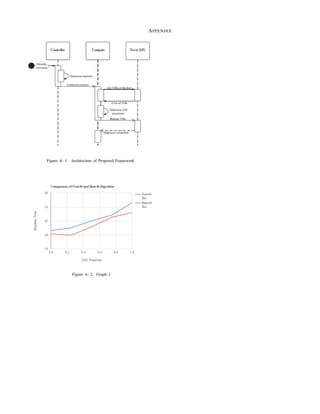
1) Controller component is deployed on the controller
host which take decisions like virtual machine
migration,mapping of the virtual machine as shown
in Figure A-1. in Appendix.](https://image.slidesharecdn.com/tc06atchukatlachatlapalleiqbalpapervr3-161121201523/85/Automated-LiveMigration-of-VMs-1-320.jpg)
![Algorithm for Automated Live Migration of Virtual Machines
Atchukatla Suhail, Chatlapalle Akhila, Iqbal Nayyar
School of Engineering
Blekinge Institute of Technology
Karlskrona, Sweden
{maat16, sich16, naiq15}@student.bth.se
Wlodek J. Kulesza
School of Engineering
Blekinge Institute of Technology
Karlskrona, Sweden
wka@bth.se
Abstract—Nowadays data centers are rapidly expanding, as
a result it create problems in accommodation of an increasing
number of Virtual and Physical machines. There is a need of
dynamic consolidation of Virtual machines, consequently Live
migration has become a key factor behind the management
activities of cloud computing system to achieve the goals of non-
breaking services. A common problem during resource allocation
of VM is Bin Packing which limits the efficiency of virtual
machines. We have proposed and implemented an algorithm
named First-Fit in OpenStack environment that helps to achieve
the solution in less migration time. This algorithm will also
determines underload and overload of a virtual machine.
Keywords—Bin Packing, Live migration, Memory management
I. INTRODUCTION
Over the past few years, cloud computing has become
a major part in IT industry, as it provides a prototype of
enabling ubiquitous and on-demand access to a shared pool
of configurable computing resources like servers, storage,
applications and services.To optimize resource allocation IaaS-
cloud providers install virtual machines (VM) on physical
machines (PM), this is possible due to the flexibility of virtual
machines (VM) [1].
OpenStack platform provides efficient and dynamic man-
agement of virtual resources with great flexibility and comfort.
It controls large pools of compute, storage and networking
resources throughout a data center which are managed through
the OpenStack API [2].
Cloud computing providers promise to provide availability,
performance and other metrics according to the service level
agreements (SLA) with the customer. There is a trade-off be-
tween migrating VMs and diminishing the number of physical
machines to host VMs. Most cloud computing providers use
dynamic consolidation approach in a data centers to minimize
usage of physical resources.
II. SURVEY OF RELATED WORKS
In the paper by Shingo Takeda and Toshinori Takemura [3],
VM consolidation method for power saving in data centers
is presented that relies on the bin packing First-Fit heuristic.
The papers by Tiago C Ferreto, Marco AS Netto, Rodrigo N
Calheiros [4], deals with the LP formulation and heuristics
to control VM migration. In paper by Dong Jiankang, Wang
Hongbo, Li Yangyang [5], they proposed a method for opti-
mizing both Physical Machine resources and CPU utilization
at the same time in IaaS cloud but still there is a need for a
optimal solution.
III. PROBLEM STATEMENT AND MAIN CONTRIBUTION
Over-provisioning of computing resources in the cloud data
centers is a common phenomena. So there is a need to
optimize the resource allocation. Dynamic consolidation of
virtual machines, enabled by live migration, is a successful
approach to diminish the energy consumption. It is the ability
to move a running virtual machine from one physical hosts to
another with almost no downtime and minimum disturbance
for the user [6].
Our objective is to improve the efficiency of VMs by
avoiding resource allocation issue which can be demonstrated
as the Bin-packing problem, where Physical Machine (PM)is
a bin and each Virtual Machine (VM) is an item to be packed.
Our proposed First-Fit algorithm in OpenStack platform
minimizes the number of PMs to host VMs and finds the
solution in less migration time compared to the classical Best-
Fit algorithm. The goal of this algorithm is to pack these
items(VMs) into the smallest possible number of bins(PMs)
upon underload request or overload request by PMs. The
Load Balance algorithm will determine the underload and the
overload of a PMs, so that VM can be migrated from one PM
to another PM when they become overloaded or underloaded.
IV. PROBLEM SOLUTION
The main focus of this paper is to improve the VMs
efficiency by limiting Bin packing problem. Migration time,
CPU consumption and Memory resources are of great concern
when a VM migrates from one PM to another PM [7] .
Following are the three parts in solving the proposed problem.
A. Integration with OpenStack
To enable live migration in OpenStack, it is required to
setup shared storage and correspondingly configure OpenStack
components like (Nova, Ceilometer etc). The OpenStack archi-
tecture for the proposed system can be divided into following
three main parts:
1) Controller component is deployed on the controller
host which take decisions like virtual machine
migration,mapping of the virtual machine as shown
in Figure A-1. in Appendix.](https://image.slidesharecdn.com/tc06atchukatlachatlapalleiqbalpapervr3-161121201523/75/Automated-LiveMigration-of-VMs-1-2048.jpg)
![2) Compute component is deployed on the compute host
which takes a decision on overload and underload of the
virtual machine.
3) Nova API component is deployed on every computer host
present in the OpenStack environment. This is mainly
responsible for collecting the different parameters from a
virtual machine and forward it to compute and controller.
B. Algorithm Implementation
Following algorithms are proposed to solve the problem of
dynamic consolidation of virtual machines in an OpenStack
environment.
Fig. 1. Load Balance Algorithm
Fig. 2. First Fit Algorithm
Algorithm used for detection of load (Overload and Under-
load) of the virtual machine is shown in Fig. 1. This algorithm
calculates the average of the i latest CPU utilization of the
virtual machine and compares that with threshold values that
are set in Ceilometer. If CPU utilization is greater than the
threshold value then virtual machine is in Overload condition.
Otherwise, it will be on Underload condition.
C. Performance Evaluation
The CPU load generator reads the configuration file which
is provided in controller host and starts generating CPU
utilization for virtual machine each time frame. The results
of comparison of First-Fit algorithm with Best-Fit Algorithm
are shown in Figure A-2. in Appendix. Unfortunately, there is
a hardware issue (nodes did not have enough RAM as data
centers) keeping the framework from exploiting dynamic VM
consolidation to minimize energy consumption.
V. CONCLUSION
In this model of dynamic VM consolidation, the problem
can be subdivided into four problems namely underload detec-
tion, overload detection, VM selection and VM placement.In
VM placement algorithm we are using a First Fit algorithm
instead of the Best fit Algorithm. Our simulation result shows
that this method is not so effective.In future work, we estimate
that by using Probability distribution and random process for
selecting Bins can minimize the migration time [8].
REFERENCES
[1] Mattias Forsman, Andreas Glad, Lars Lundberg, et al.
“Algorithms for automated live migration of virtual ma-
chines”. In: Journal of Systems and Software 101 (2015),
pp. 110–126.
[2] Software OpenStack Open Source Cloud Computing
Software. URL: https://www.openstack.org/software/.
[3] Shingo Takeda and Toshinori Takemura. “A rank-based
vm consolidation method for power saving in data-
centers”. In: Information and Media Technologies 5.3
(2010), pp. 994–1002.
[4] Akshat Verma, Puneet Ahuja, and Anindya Neogi.
“pMapper: power and migration cost aware
application placement in virtualized systems”. In:
ACM/IFIP/USENIX International Conference on
Distributed Systems Platforms and Open Distributed
Processing. Springer. 2008, pp. 243–264.
[5] Tiago C Ferreto, Marco AS Netto, Rodrigo N Calheiros,
et al. “Server consolidation with migration control for
virtualized data centers”. In: Future Generation Com-
puter Systems 27.8 (2011), pp. 1027–1034.
[6] Dong Jiankang, Wang Hongbo, Li Yangyang, et al. “Vir-
tual machine scheduling for improving energy efficiency
in IaaS cloud”. In: China Communications 11.3 (2014),
pp. 1–12.
[7] Rajwinder Singh, KS Kahlon, and Sarabjit Singh. “Com-
parative Study of Virtual Machine Migration Techniques
and Challenges in Post Copy Live Virtual Machine
Migration”. In: International Journal of Science and
Research 5.3 (2016), pp. 117–121.
[8] Miti S Bhat, Deepthi G Nair, Devyani Bansal, et al.
“Data structure based performance evaluation of emerg-
ing technologiesA comparison of Scala, Ruby, Groovy,
and Python”. In: 2012 CSI Sixth International Confer-
ence on Software Engineering (CONSEG). 2012.](https://image.slidesharecdn.com/tc06atchukatlachatlapalleiqbalpapervr3-161121201523/85/Automated-LiveMigration-of-VMs-2-320.jpg)