What does an “automated” marine
container terminal look like in 2016?
Straddle carriers and RTGs can be
automated but these are rarely used as
the backbone for an automated terminal
due to lack of density or poor performance
from a rubber tyred interface compared
with steel wheels running on a steel rail.
Cantilever RMGs running parallel to the
quay are a viable option in places with
cheap labour (horizontal transport is still
manual) or that have a lot of transshipment
or have street trucks that frequently pull
multiple trailers (and can’t back into an ASC
buffer effectively). Container warehouses
or terminals based on overhead structures
may also be a viable option for very high
density situations, but for most people
an automated terminal implies the use of
automated stacking cranes (ASCs).
ASCs are portal frame RMGs that load
from the end of the stack. After picking a
container from the end, the ASC gantries
with the container to or from the desired
storage position in the container yard (CY).
These ASC storage blocks are typically
arranged perpendicular to the quay, but
this is not an absolute requirement. The
powerful advantage of ASCs over other
terminal options is physical separation of
gate and vessel traffic, which allows use of
automated transport from the quay to the
container yard.
THE ASC TERMINAL
The first ASC terminal was built in
Rotterdam in the early 1990s and at this
point there are approximately two dozen
ASC terminals in the world. Container
handling hardware and software makers
are very familiar with them, and they
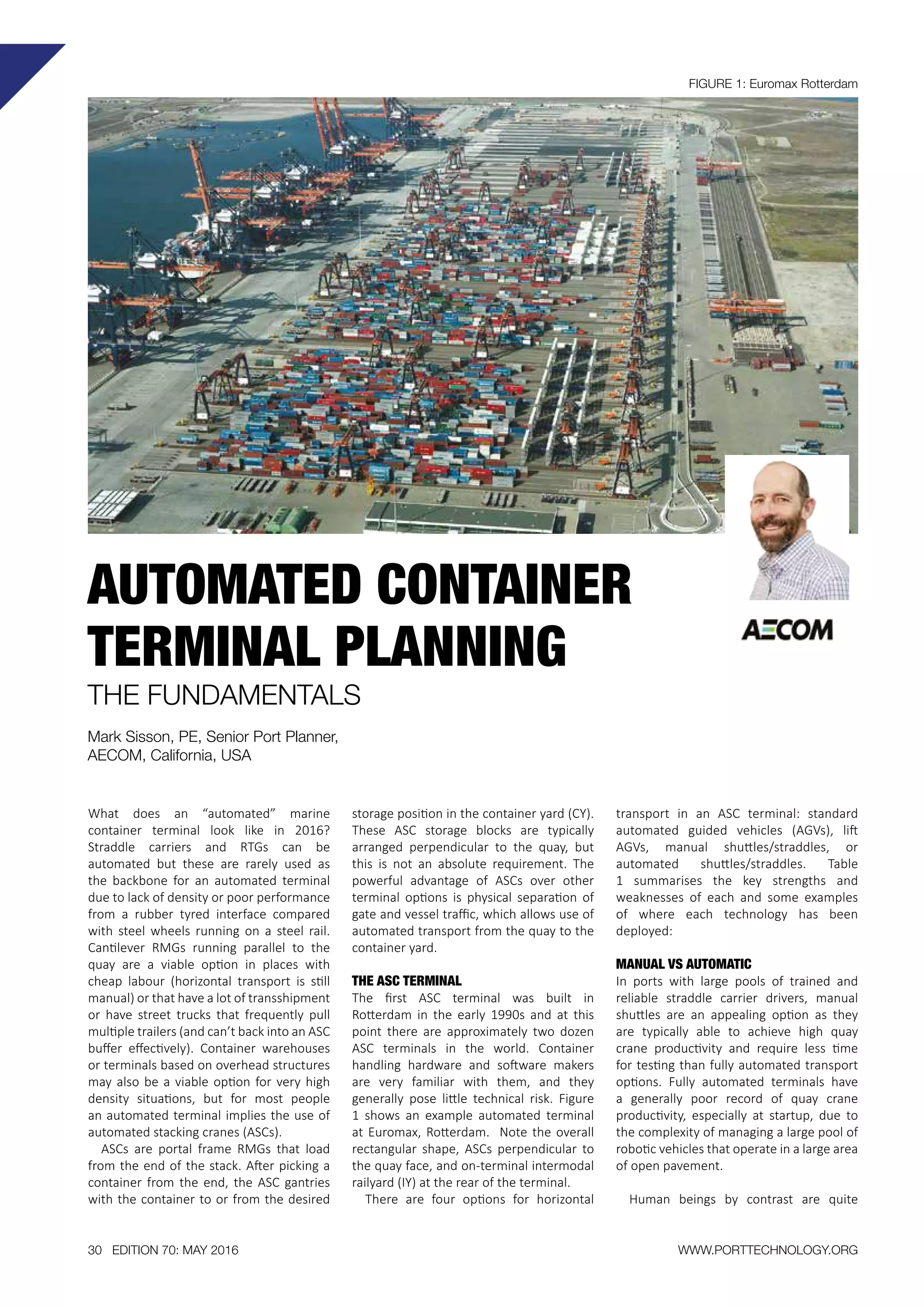
generally pose little technical risk. Figure
1 shows an example automated terminal
at Euromax, Rotterdam. Note the overall
rectangular shape, ASCs perpendicular to
the quay face, and on-terminal intermodal
railyard (IY) at the rear of the terminal.
There are four options for horizontal
transport in an ASC terminal: standard
automated guided vehicles (AGVs), lift
AGVs, manual shuttles/straddles, or
automated shuttles/straddles. Table
1 summarises the key strengths and
weaknesses of each and some examples
of where each technology has been
deployed:
MANUAL VS AUTOMATIC
In ports with large pools of trained and
reliable straddle carrier drivers, manual
shuttles are an appealing option as they
are typically able to achieve high quay
crane productivity and require less time
for testing than fully automated transport
options. Fully automated terminals have
a generally poor record of quay crane
productivity, especially at startup, due to
the complexity of managing a large pool of
robotic vehicles that operate in a large area
of open pavement.
Human beings by contrast are quite
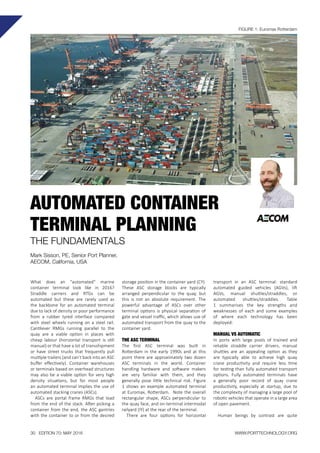
AUTOMATED CONTAINER
TERMINAL PLANNING
THE FUNDAMENTALS
Mark Sisson, PE, Senior Port Planner,
AECOM, California, USA
FIGURE 1: Euromax Rotterdam
30 EDITION 70: MAY 2016 WWW.PORTTECHNOLOGY.ORG
good at driving vehicles and improvising
their way through complicated situations
(there is a reason that driverless cars that
are effective in the real world are still
some way off). This performance gap may
shrink over time as hardware and software
vendors gain more experience, and as
firms outside the industry, such as Tesla
and Google, continue to invest in robotic
vehicle technology.
TERMINAL LAYOUT
Terminals that are non-rectangular in
shape can see a great deal of benefit in
the use of strads as opposed to shuttles
or AGVs in order to maximise the storage
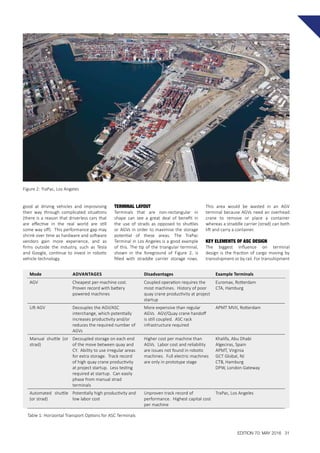
potential of these areas. The TraPac
Terminal in Los Angeles is a good example
of this. The tip of the triangular terminal,
shown in the foreground of Figure 2, is
filled with straddle carrier storage rows.
This area would be wasted in an AGV
terminal because AGVs need an overhead
crane to remove or place a container
whereas a straddle carrier (strad) can both
lift and carry a container.
KEY ELEMENTS OF ASC DESIGN
The biggest influence on terminal
design is the fraction of cargo moving by
transshipment or by rail. For transshipment
Mode ADVANTAGES Disadvantages Example Terminals
AGV Cheapest per-machine cost.
Proven record with battery
powered machines
Coupled operation requires the
most machines. History of poor
quay crane productivity at project
startup
Euromax, Rotterdam
CTA, Hamburg
Lift AGV Decouples the AGV/ASC
interchange, which potentially
increases productivity and/or
reduces the required number of
AGVs
More expensive than regular
AGVs. AGV/Quay crane handoff
is still coupled. ASC rack
infrastructure required
APMT MVII, Rotterdam
Manual shuttle (or
strad)
Decoupled storage on each end
of the move between quay and
CY. Ability to use irregular areas
for extra storage. Track record
of high quay crane productivity
at project startup. Less testing
required at startup. Can easily
phase from manual strad
terminals
Higher cost per machine than
AGVs. Labor cost and reliability
are issues not found in robotic
machines. Full electric machines
are only in prototype stage
Khalifa, Abu Dhabi
Algeciras, Spain
APMT, Virginia
GCT Global, NJ
CTB, Hamburg
DPW, London Gateway
Automated shuttle
(or strad)
Potentially high productivity and
low labor cost
Unproven track record of
performance. Highest capital cost
per machine
TraPac, Los Angeles
Table 1: Horizontal Transport Options for ASC Terminals
Figure 2: TraPac, Los Angeles
EDITION 70: MAY 2016 31
terminals, it may be worth studying
alternatives with ASC rows running parallel
to the quay as opposed to perpendicular.
This allows both ends of the stack to be
used effectively for transshipment. Using
the traditional perpendicular alignment
of ASCs in a transshipment terminal can
also work (it was done in Algeciras, for
example) but it leaves the landside ASC
crane underutilised and may generate an
excessive amount of rehandling moves
to properly utilise all of the terminal’s
container storage. Transshipment terminals
may benefit from an oversized waterside
block of storage served by cantilever RMGs
to maximise accessibility to the most useful
storage location on the terminal.
Most traditional “fully automated”
terminals like Euromax or CTA Hamburg
use a completely manual tractor move to
transfer a container from the ASCs to the
on-terminal intermodal railyard (IY). This
may be fine for terminals with 10% of cargo
moving via rail, but some terminals on the
West Coast of North America move over
50% of vessel cargo via rail, and may be
more motivated to explore options to allow
automated vehicles to move containers
between the CY and IY.
Physical separation of manned and
automated equipment is one of the
fundamental principles of automated
terminal design, so terminals that want to
connect the CY and IY with robots have two
options:
1.	 Restrict gate trucks to a limited area of
the terminal and allow at-grade access
for robots in the remainder. This is
the strategy employed by TraPac in Los
Angeles. The tip of the triangle in the
foreground of Figure 2 is an area for
robots only
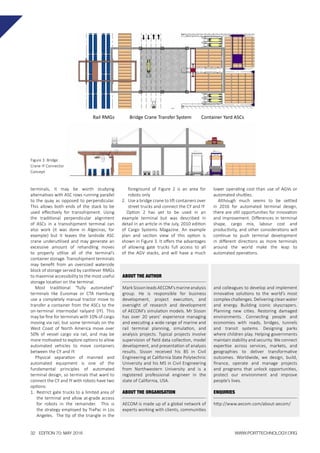
2.	 Use a bridge crane to lift containers over
street trucks and connect the CY and IY
Option 2 has yet to be used in an
example terminal but was described in
detail in an article in the July, 2010 edition
of Cargo Systems Magazine. An example
plan and section view of this option is
shown in Figure 3. It offers the advantages
of allowing gate trucks full access to all
of the AGV stacks, and will have a much
lower operating cost than use of AGVs or
automated shuttles.
Although much seems to be settled
in 2016 for automated terminal design,
there are still opportunities for innovation
and improvement. Differences in terminal
shape, cargo mix, labour cost and
productivity, and other considerations will
continue to push terminal development
in different directions as more terminals
around the world make the leap to
automated operations.
Rail RMGs Bridge Crane Transfer System Container Yard ASCs
ABOUT THE AUTHOR
MarkSissonleadsAECOM’smarineanalysis
group. He is responsible for business
development, project execution, and
oversight of research and development
of AECOM’s simulation models. Mr Sisson
has over 20 years’ experience managing
and executing a wide range of marine and
rail terminal planning, simulation, and
analysis projects. Typical projects involve
supervision of field data collection, model
development, and presentation of analysis
results. Sisson received his BS in Civil
Engineering at California State Polytechnic
University and his MS in Civil Engineering
from Northwestern University and is a
registered professional engineer in the
state of California, USA.
ABOUT THE ORGANISATION
AECOM is made up of a global network of
experts working with clients, communities
and colleagues to develop and implement
innovative solutions to the world’s most
complex challenges. Delivering clean water
and energy. Building iconic skyscrapers.
Planning new cities. Restoring damaged
environments. Connecting people and
economies with roads, bridges, tunnels
and transit systems. Designing parks
where children play. Helping governments
maintain stability and security. We connect
expertise across services, markets, and
geographies to deliver transformative
outcomes. Worldwide, we design, build,
finance, operate and manage projects
and programs that unlock opportunities,
protect our environment and improve
people’s lives.
ENQUIRIES
http://www.aecom.com/about-aecom/
Figure 3: Bridge
Crane IY Connector
Concept
32 EDITION 70: MAY 2016 WWW.PORTTECHNOLOGY.ORG

Automated Container Terminal Planning

  • 1.
    What does an“automated” marine container terminal look like in 2016? Straddle carriers and RTGs can be automated but these are rarely used as the backbone for an automated terminal due to lack of density or poor performance from a rubber tyred interface compared with steel wheels running on a steel rail. Cantilever RMGs running parallel to the quay are a viable option in places with cheap labour (horizontal transport is still manual) or that have a lot of transshipment or have street trucks that frequently pull multiple trailers (and can’t back into an ASC buffer effectively). Container warehouses or terminals based on overhead structures may also be a viable option for very high density situations, but for most people an automated terminal implies the use of automated stacking cranes (ASCs). ASCs are portal frame RMGs that load from the end of the stack. After picking a container from the end, the ASC gantries with the container to or from the desired storage position in the container yard (CY). These ASC storage blocks are typically arranged perpendicular to the quay, but this is not an absolute requirement. The powerful advantage of ASCs over other terminal options is physical separation of gate and vessel traffic, which allows use of automated transport from the quay to the container yard. THE ASC TERMINAL The first ASC terminal was built in Rotterdam in the early 1990s and at this point there are approximately two dozen ASC terminals in the world. Container handling hardware and software makers are very familiar with them, and they generally pose little technical risk. Figure 1 shows an example automated terminal at Euromax, Rotterdam. Note the overall rectangular shape, ASCs perpendicular to the quay face, and on-terminal intermodal railyard (IY) at the rear of the terminal. There are four options for horizontal transport in an ASC terminal: standard automated guided vehicles (AGVs), lift AGVs, manual shuttles/straddles, or automated shuttles/straddles. Table 1 summarises the key strengths and weaknesses of each and some examples of where each technology has been deployed: MANUAL VS AUTOMATIC In ports with large pools of trained and reliable straddle carrier drivers, manual shuttles are an appealing option as they are typically able to achieve high quay crane productivity and require less time for testing than fully automated transport options. Fully automated terminals have a generally poor record of quay crane productivity, especially at startup, due to the complexity of managing a large pool of robotic vehicles that operate in a large area of open pavement. Human beings by contrast are quite AUTOMATED CONTAINER TERMINAL PLANNING THE FUNDAMENTALS Mark Sisson, PE, Senior Port Planner, AECOM, California, USA FIGURE 1: Euromax Rotterdam 30 EDITION 70: MAY 2016 WWW.PORTTECHNOLOGY.ORG
  • 2.
    good at drivingvehicles and improvising their way through complicated situations (there is a reason that driverless cars that are effective in the real world are still some way off). This performance gap may shrink over time as hardware and software vendors gain more experience, and as firms outside the industry, such as Tesla and Google, continue to invest in robotic vehicle technology. TERMINAL LAYOUT Terminals that are non-rectangular in shape can see a great deal of benefit in the use of strads as opposed to shuttles or AGVs in order to maximise the storage potential of these areas. The TraPac Terminal in Los Angeles is a good example of this. The tip of the triangular terminal, shown in the foreground of Figure 2, is filled with straddle carrier storage rows. This area would be wasted in an AGV terminal because AGVs need an overhead crane to remove or place a container whereas a straddle carrier (strad) can both lift and carry a container. KEY ELEMENTS OF ASC DESIGN The biggest influence on terminal design is the fraction of cargo moving by transshipment or by rail. For transshipment Mode ADVANTAGES Disadvantages Example Terminals AGV Cheapest per-machine cost. Proven record with battery powered machines Coupled operation requires the most machines. History of poor quay crane productivity at project startup Euromax, Rotterdam CTA, Hamburg Lift AGV Decouples the AGV/ASC interchange, which potentially increases productivity and/or reduces the required number of AGVs More expensive than regular AGVs. AGV/Quay crane handoff is still coupled. ASC rack infrastructure required APMT MVII, Rotterdam Manual shuttle (or strad) Decoupled storage on each end of the move between quay and CY. Ability to use irregular areas for extra storage. Track record of high quay crane productivity at project startup. Less testing required at startup. Can easily phase from manual strad terminals Higher cost per machine than AGVs. Labor cost and reliability are issues not found in robotic machines. Full electric machines are only in prototype stage Khalifa, Abu Dhabi Algeciras, Spain APMT, Virginia GCT Global, NJ CTB, Hamburg DPW, London Gateway Automated shuttle (or strad) Potentially high productivity and low labor cost Unproven track record of performance. Highest capital cost per machine TraPac, Los Angeles Table 1: Horizontal Transport Options for ASC Terminals Figure 2: TraPac, Los Angeles EDITION 70: MAY 2016 31
  • 3.
    terminals, it maybe worth studying alternatives with ASC rows running parallel to the quay as opposed to perpendicular. This allows both ends of the stack to be used effectively for transshipment. Using the traditional perpendicular alignment of ASCs in a transshipment terminal can also work (it was done in Algeciras, for example) but it leaves the landside ASC crane underutilised and may generate an excessive amount of rehandling moves to properly utilise all of the terminal’s container storage. Transshipment terminals may benefit from an oversized waterside block of storage served by cantilever RMGs to maximise accessibility to the most useful storage location on the terminal. Most traditional “fully automated” terminals like Euromax or CTA Hamburg use a completely manual tractor move to transfer a container from the ASCs to the on-terminal intermodal railyard (IY). This may be fine for terminals with 10% of cargo moving via rail, but some terminals on the West Coast of North America move over 50% of vessel cargo via rail, and may be more motivated to explore options to allow automated vehicles to move containers between the CY and IY. Physical separation of manned and automated equipment is one of the fundamental principles of automated terminal design, so terminals that want to connect the CY and IY with robots have two options: 1. Restrict gate trucks to a limited area of the terminal and allow at-grade access for robots in the remainder. This is the strategy employed by TraPac in Los Angeles. The tip of the triangle in the foreground of Figure 2 is an area for robots only 2. Use a bridge crane to lift containers over street trucks and connect the CY and IY Option 2 has yet to be used in an example terminal but was described in detail in an article in the July, 2010 edition of Cargo Systems Magazine. An example plan and section view of this option is shown in Figure 3. It offers the advantages of allowing gate trucks full access to all of the AGV stacks, and will have a much lower operating cost than use of AGVs or automated shuttles. Although much seems to be settled in 2016 for automated terminal design, there are still opportunities for innovation and improvement. Differences in terminal shape, cargo mix, labour cost and productivity, and other considerations will continue to push terminal development in different directions as more terminals around the world make the leap to automated operations. Rail RMGs Bridge Crane Transfer System Container Yard ASCs ABOUT THE AUTHOR MarkSissonleadsAECOM’smarineanalysis group. He is responsible for business development, project execution, and oversight of research and development of AECOM’s simulation models. Mr Sisson has over 20 years’ experience managing and executing a wide range of marine and rail terminal planning, simulation, and analysis projects. Typical projects involve supervision of field data collection, model development, and presentation of analysis results. Sisson received his BS in Civil Engineering at California State Polytechnic University and his MS in Civil Engineering from Northwestern University and is a registered professional engineer in the state of California, USA. ABOUT THE ORGANISATION AECOM is made up of a global network of experts working with clients, communities and colleagues to develop and implement innovative solutions to the world’s most complex challenges. Delivering clean water and energy. Building iconic skyscrapers. Planning new cities. Restoring damaged environments. Connecting people and economies with roads, bridges, tunnels and transit systems. Designing parks where children play. Helping governments maintain stability and security. We connect expertise across services, markets, and geographies to deliver transformative outcomes. Worldwide, we design, build, finance, operate and manage projects and programs that unlock opportunities, protect our environment and improve people’s lives. ENQUIRIES http://www.aecom.com/about-aecom/ Figure 3: Bridge Crane IY Connector Concept 32 EDITION 70: MAY 2016 WWW.PORTTECHNOLOGY.ORG