Automata and complexity Theory
Chapter 1
Introduction
Definitions
• Symbol – An atomic unit, such as a digit, character,
lower-case letter, etc. Sometimes a word. [Formal
language does not deal with the “meaning” of the
symbols.]
• Alphabet – A finite set of symbols, usually denoted by
Σ.
Σ = {0, 1} Σ = {0, a, 4} Σ = {a, b, c, d}
• String – A finite length sequence of symbols,
Alphabets and strings
• A common way to talk about words, number, pairs of words,
etc. is by representing them as strings
• To define strings, we start with an alphabet
• Examples
An alphabet is a finite set of symbols.
S1 = {a, b, c, d, …, z}: the set of letters in English
S2 = {0, 1, …, 9}: the set of (base 10) digits
S3 = {a, b, …, z, #}: the set of letters plus the
special symbol #
S4 = {(, )}: the set of open and closed brackets
Strings
• The empty string will be denoted by e (epsilon)
• Examples
A string over alphabet S is a finite sequence
of symbols in S.
abfbz is a string over S1 = {a, b, c, d, …, z}
9021 is a string over S2 = {0, 1, …, 9}
ab#bc is a string over S3 = {a, b, …, z, #}
))()(() is a string over S4 = {(, )}
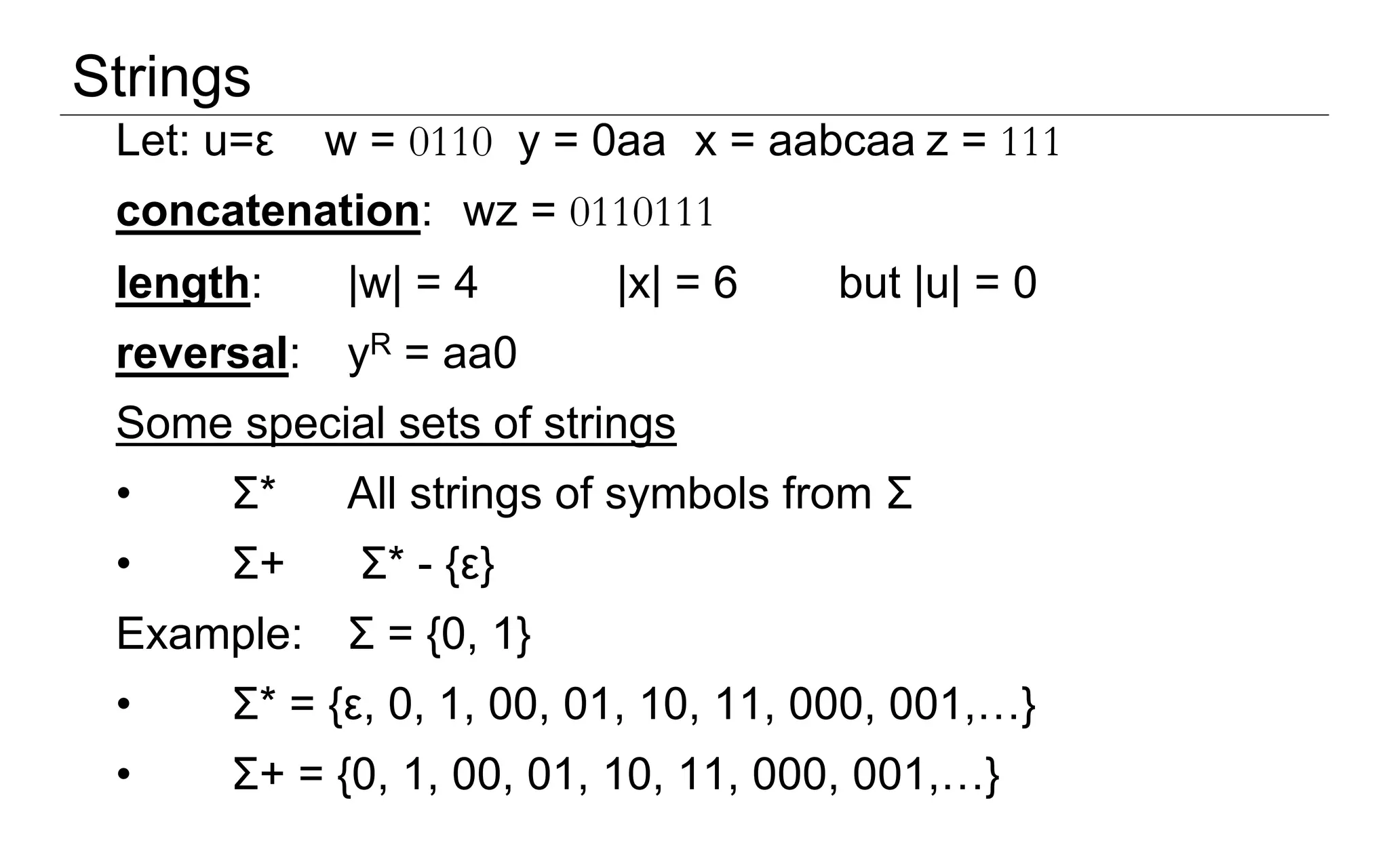
Let: u=ε w = 0110 y = 0aa x = aabcaa z = 111
concatenation: wz = 0110111
length: |w| = 4 |x| = 6 but |u| = 0
reversal: yR = aa0
Some special sets of strings
• Σ* All strings of symbols from Σ
• Σ+ Σ* - {ε}
Example: Σ = {0, 1}
• Σ* = {ε, 0, 1, 00, 01, 10, 11, 000, 001,…}
• Σ+ = {0, 1, 00, 01, 10, 11, 000, 001,…}
Strings
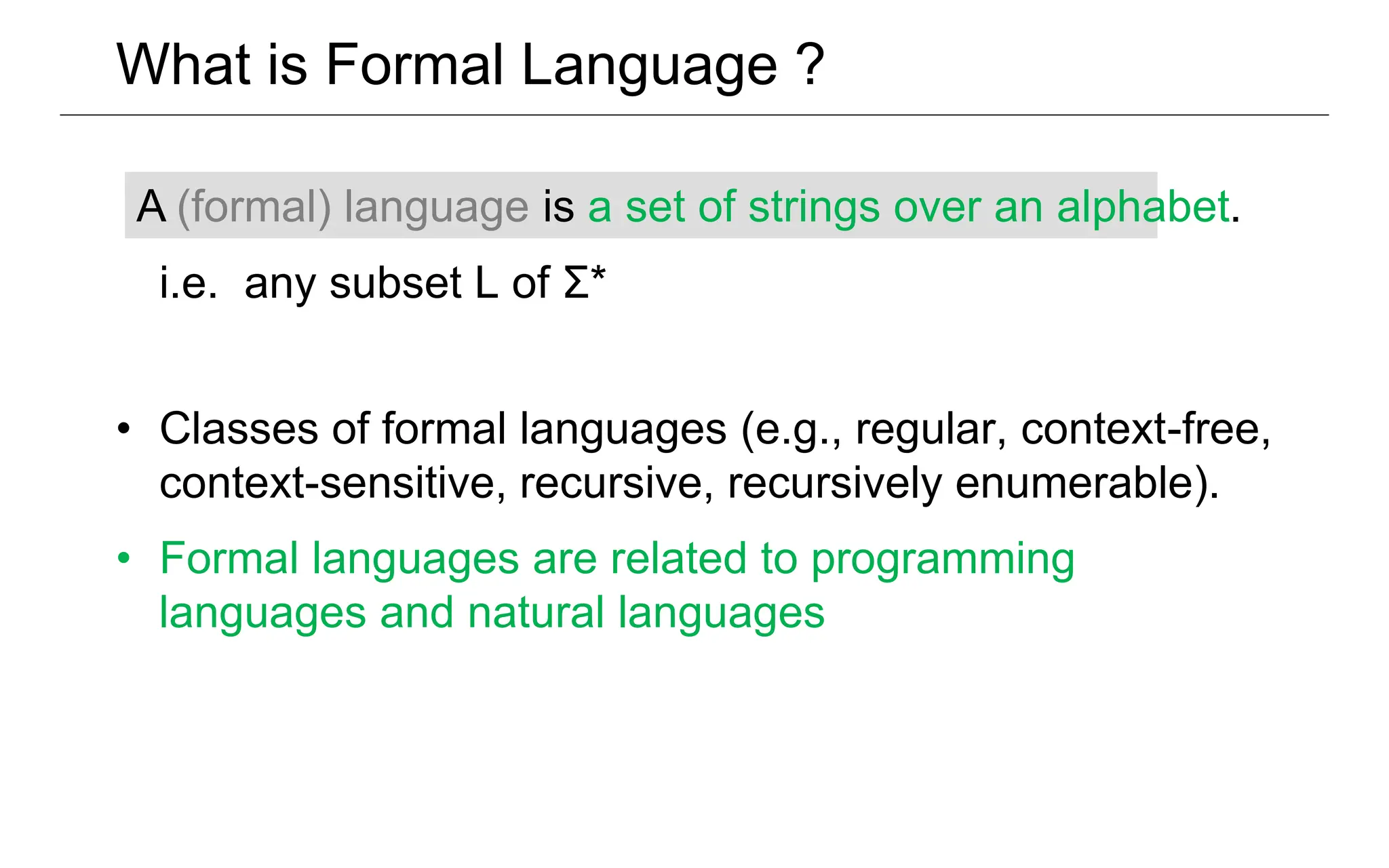
What is Formal Language ?
i.e. any subset L of Σ*
• Classes of formal languages (e.g., regular, context-free,
context-sensitive, recursive, recursively enumerable).
• Formal languages are related to programming
languages and natural languages
A (formal) language is a set of strings over an alphabet.
Formal Language Examples:
Σ = {0, 1}
L = {x | x is in Σ* and x contains an even number of
0’s}
Σ = {0, 1, 2,…, 9, .}
L = {x | x is in Σ* and x forms a finite length real
number}
= {0, 1.5, 9.326,…}
Σ = {a, b, c,…, z, A, B,…, Z}
L = {x | x is in Σ* and x is a CPP reserved word}
Formal Language Examples:
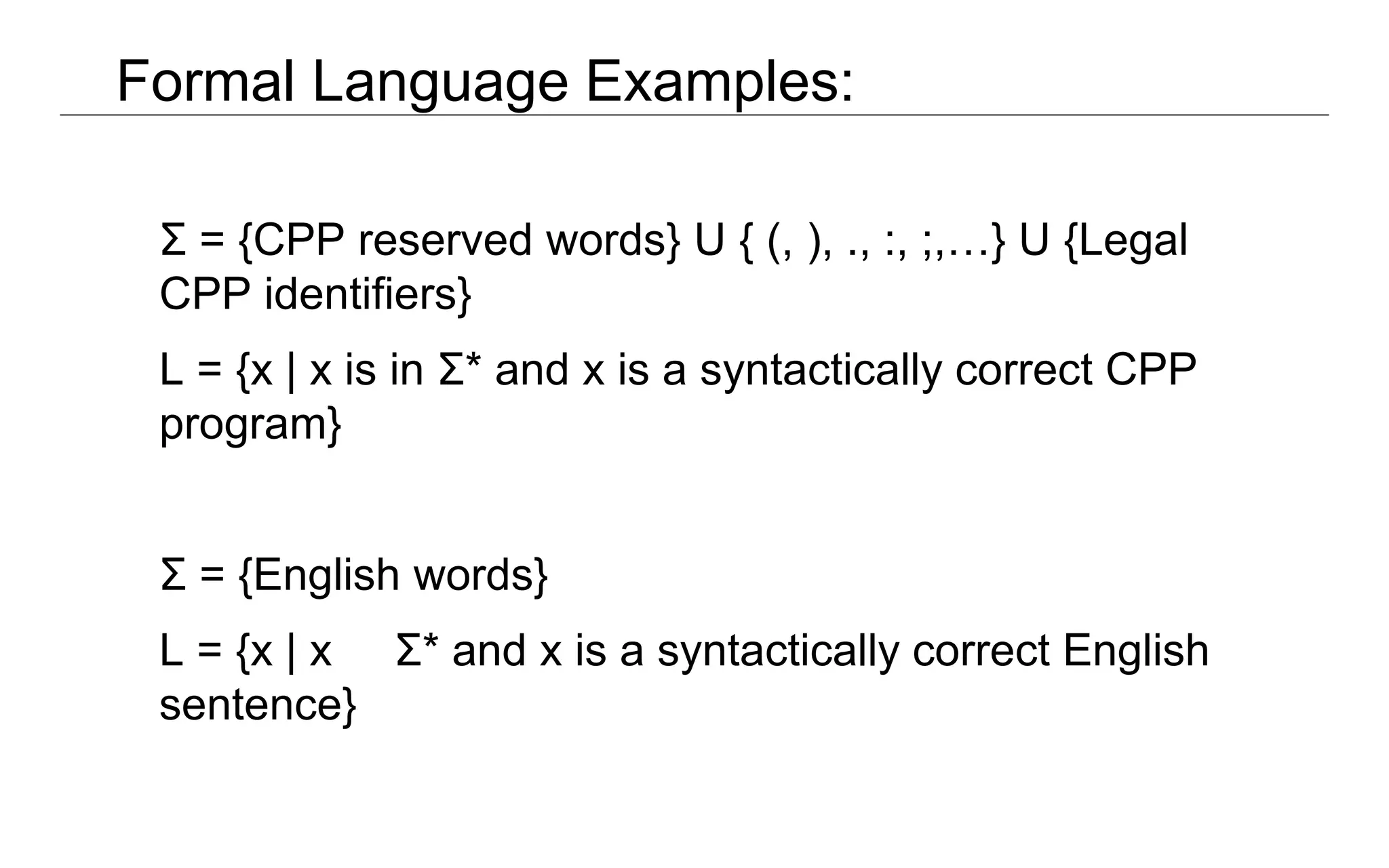
Σ = {CPP reserved words} U { (, ), ., :, ;,…} U {Legal
CPP identifiers}
L = {x | x is in Σ* and x is a syntactically correct CPP
program}
Σ = {English words}
L = {x | x Σ* and x is a syntactically correct English
sentence}
What is automata theory ?
• Automata theory is the study of abstract computational
devices
• Abstract devices are (simplified) models of real
computations
• Computations happen everywhere: On your laptop, on your
cell phone, in nature, …
• Why do we need abstract models?
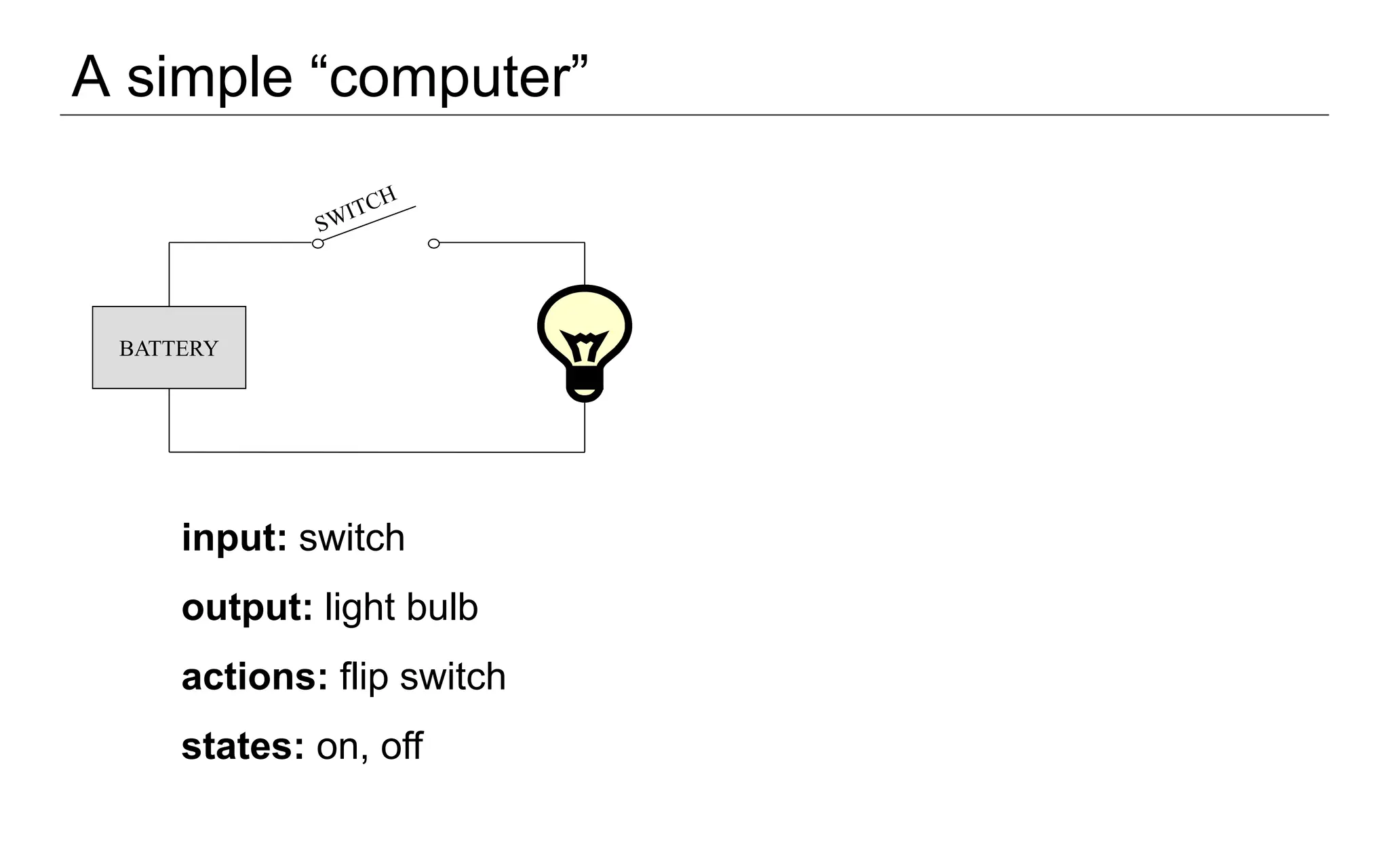
A simple “computer”
BATTERY
input: switch
output: light bulb
actions: flip switch
states: on, off
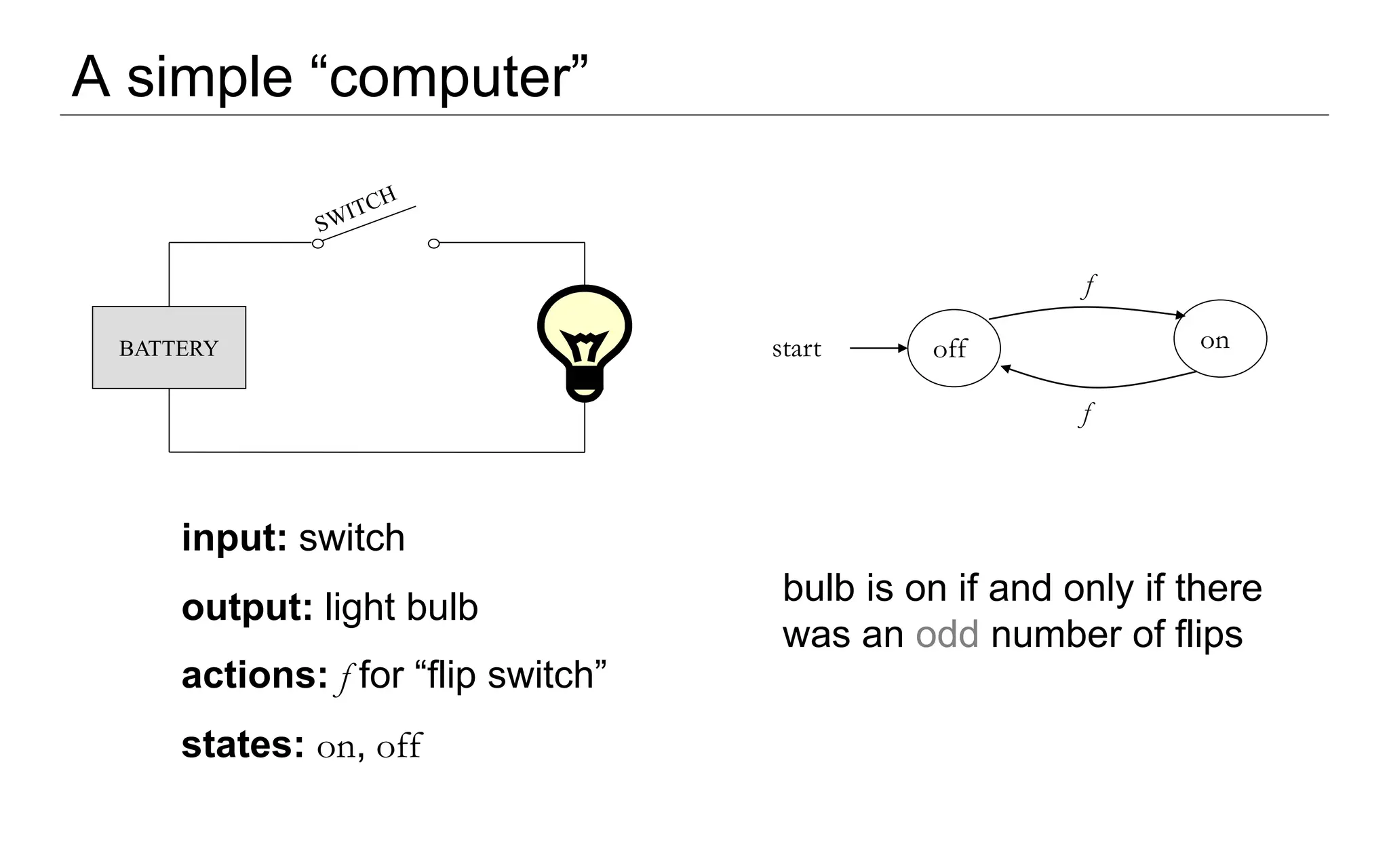
A simple “computer”
BATTERY off on
start
f
f
input: switch
output: light bulb
actions: f for “flip switch”
states: on, off
bulb is on if and only if there
was an odd number of flips
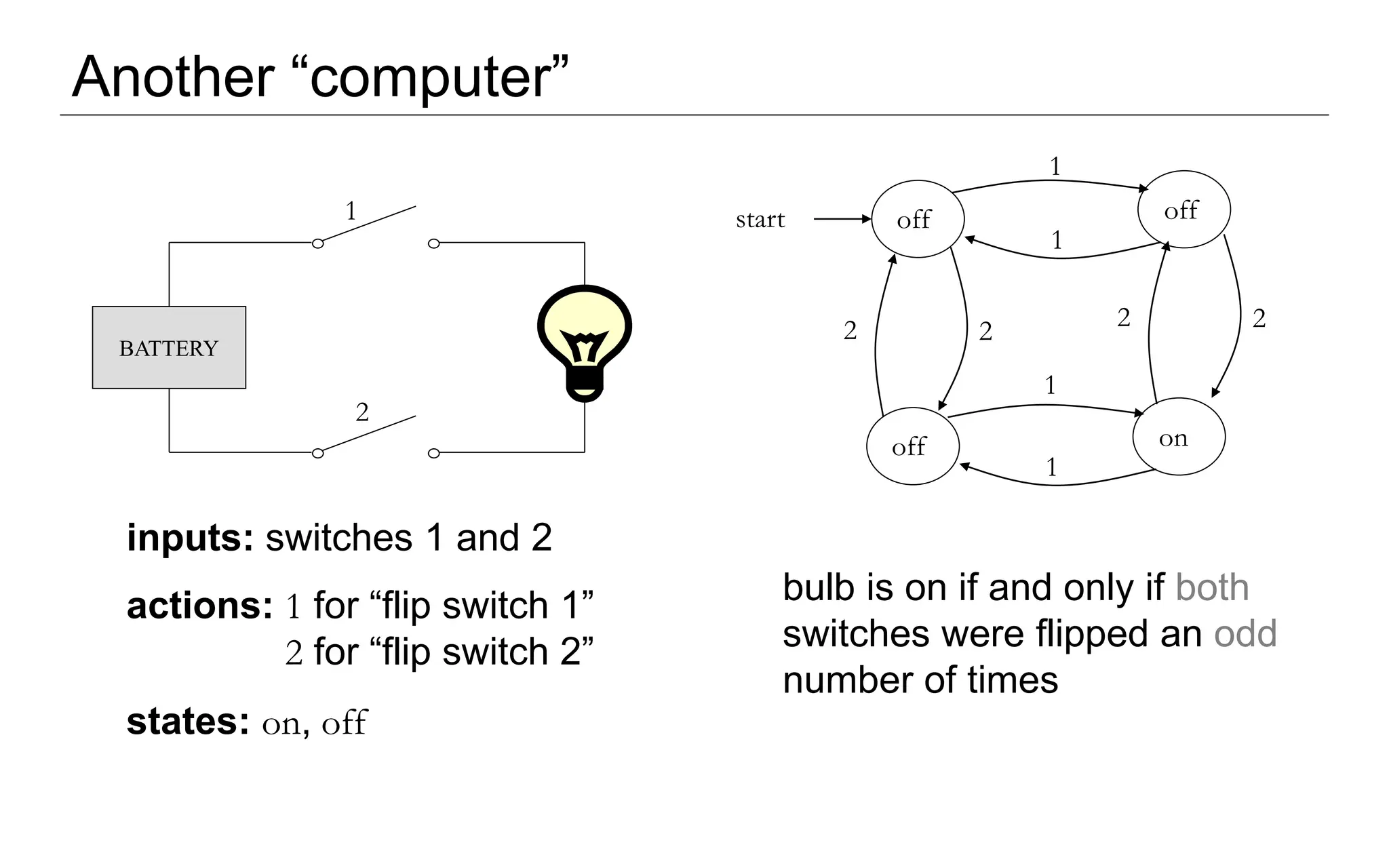
Another “computer”
BATTERY
off off
start
1
inputs: switches 1 and 2
actions: 1 for “flip switch 1”
actions: 2 for “flip switch 2”
states: on, off
bulb is on if and only if both
switches were flipped an odd
number of times
1
2
1
off on
1
1
2 2 2 2
Another Example
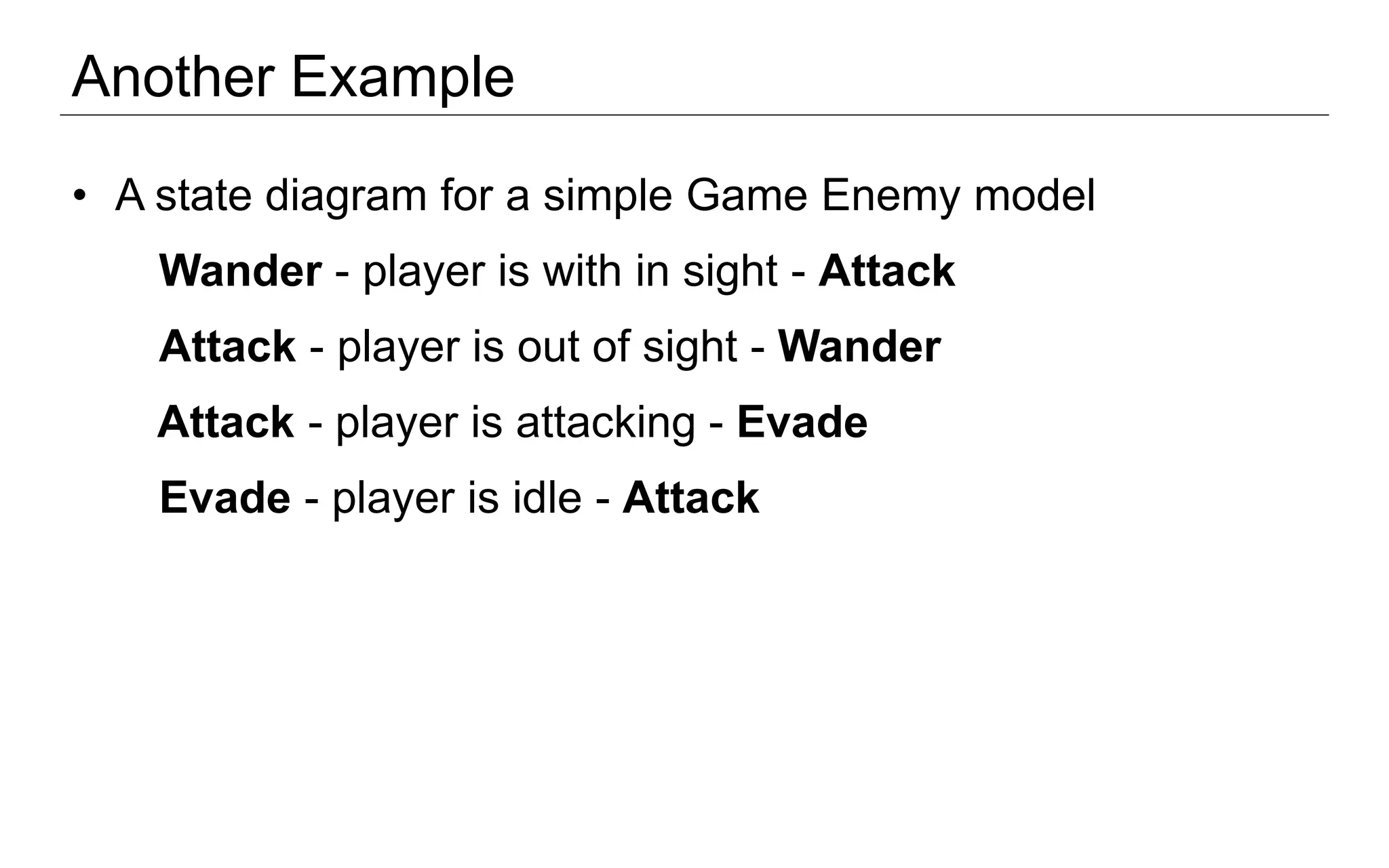
• A state diagram for a simple Game Enemy model
Wander - player is with in sight - Attack
Attack - player is out of sight - Wander
Attack - player is attacking - Evade
Evade - player is idle - Attack
Different kinds of automata
• This was only some examples of a computational device,
and there are others
• We will look at different devices, and look at the following
questions:
– What can a given type of device compute, and what are its
limitations?
– Is one type of device more powerful than another?
Some devices we will see
finite automata Devices with a finite amount of memory.
Used to model “small” computers.
push-down automata Devices with infinite memory that can be
accessed in a restricted way.
Used to model parsers, etc.
Turing Machines Devices with infinite memory.
Used to model any computer.
Preliminaries of automata theory
• How do we formalize the question
• First, we need a formal way of describing the problems that
we are interested in solving
Can device A solve problem B?
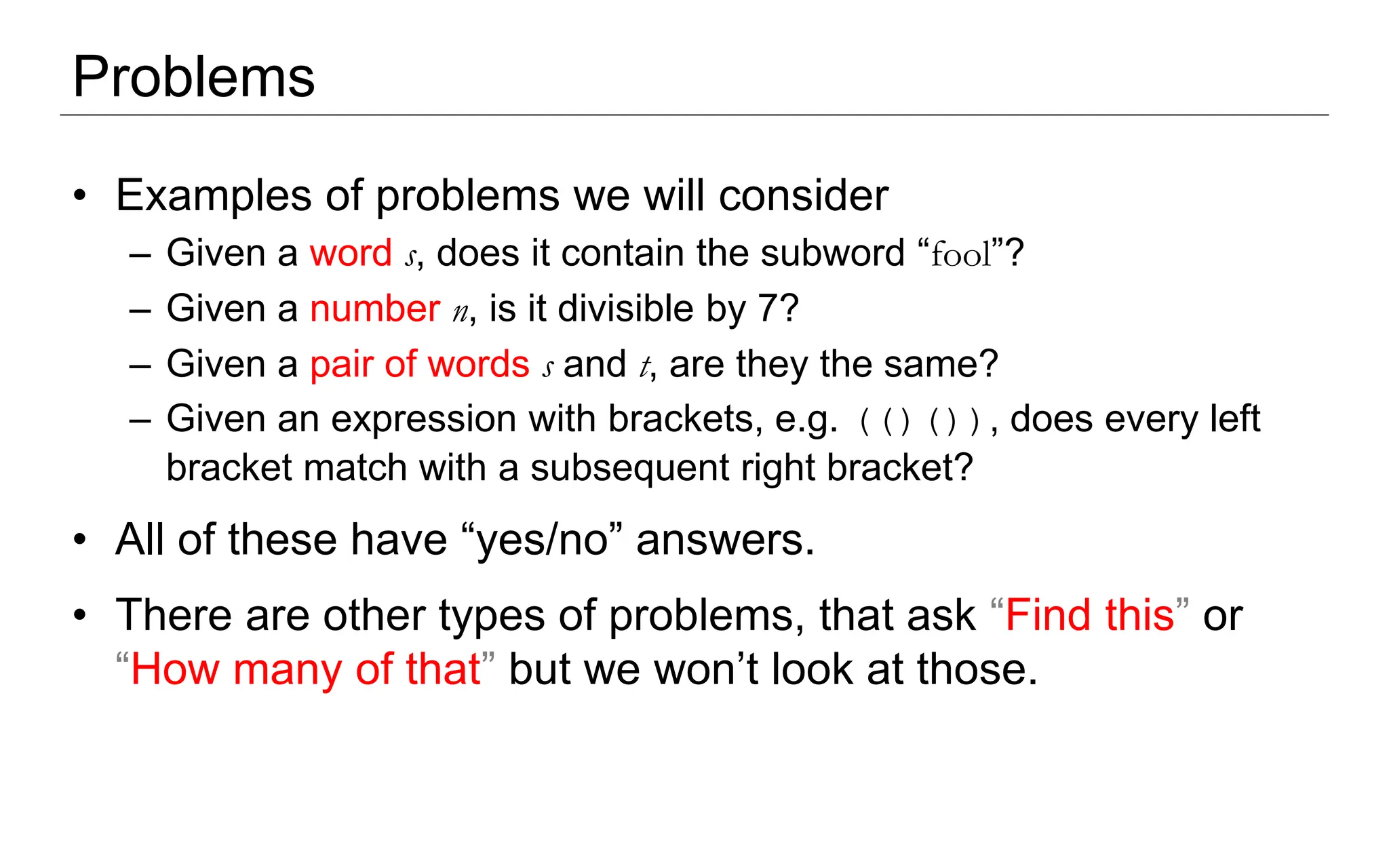
Problems
• Examples of problems we will consider
– Given a word s, does it contain the subword “fool”?
– Given a number n, is it divisible by 7?
– Given a pair of words s and t, are they the same?
– Given an expression with brackets, e.g. (()()), does every left
bracket match with a subsequent right bracket?
• All of these have “yes/no” answers.
• There are other types of problems, that ask “Find this” or
“How many of that” but we won’t look at those.
Reading Assignment
• Mathematical Preliminaries
– sets,
– relations,
– functions,
– sequences,
– graphs,
– trees.

01.ppt

  • 1.
  • 2.
  • 3.
    Definitions • Symbol –An atomic unit, such as a digit, character, lower-case letter, etc. Sometimes a word. [Formal language does not deal with the “meaning” of the symbols.] • Alphabet – A finite set of symbols, usually denoted by Σ. Σ = {0, 1} Σ = {0, a, 4} Σ = {a, b, c, d} • String – A finite length sequence of symbols,
  • 4.
    Alphabets and strings •A common way to talk about words, number, pairs of words, etc. is by representing them as strings • To define strings, we start with an alphabet • Examples An alphabet is a finite set of symbols. S1 = {a, b, c, d, …, z}: the set of letters in English S2 = {0, 1, …, 9}: the set of (base 10) digits S3 = {a, b, …, z, #}: the set of letters plus the special symbol # S4 = {(, )}: the set of open and closed brackets
  • 5.
    Strings • The emptystring will be denoted by e (epsilon) • Examples A string over alphabet S is a finite sequence of symbols in S. abfbz is a string over S1 = {a, b, c, d, …, z} 9021 is a string over S2 = {0, 1, …, 9} ab#bc is a string over S3 = {a, b, …, z, #} ))()(() is a string over S4 = {(, )}
  • 6.
    Let: u=ε w= 0110 y = 0aa x = aabcaa z = 111 concatenation: wz = 0110111 length: |w| = 4 |x| = 6 but |u| = 0 reversal: yR = aa0 Some special sets of strings • Σ* All strings of symbols from Σ • Σ+ Σ* - {ε} Example: Σ = {0, 1} • Σ* = {ε, 0, 1, 00, 01, 10, 11, 000, 001,…} • Σ+ = {0, 1, 00, 01, 10, 11, 000, 001,…} Strings
  • 7.
    What is FormalLanguage ? i.e. any subset L of Σ* • Classes of formal languages (e.g., regular, context-free, context-sensitive, recursive, recursively enumerable). • Formal languages are related to programming languages and natural languages A (formal) language is a set of strings over an alphabet.
  • 8.
    Formal Language Examples: Σ= {0, 1} L = {x | x is in Σ* and x contains an even number of 0’s} Σ = {0, 1, 2,…, 9, .} L = {x | x is in Σ* and x forms a finite length real number} = {0, 1.5, 9.326,…} Σ = {a, b, c,…, z, A, B,…, Z} L = {x | x is in Σ* and x is a CPP reserved word}
  • 9.
    Formal Language Examples: Σ= {CPP reserved words} U { (, ), ., :, ;,…} U {Legal CPP identifiers} L = {x | x is in Σ* and x is a syntactically correct CPP program} Σ = {English words} L = {x | x Σ* and x is a syntactically correct English sentence}
  • 10.
    What is automatatheory ? • Automata theory is the study of abstract computational devices • Abstract devices are (simplified) models of real computations • Computations happen everywhere: On your laptop, on your cell phone, in nature, … • Why do we need abstract models?
  • 11.
    A simple “computer” BATTERY input:switch output: light bulb actions: flip switch states: on, off
  • 12.
    A simple “computer” BATTERYoff on start f f input: switch output: light bulb actions: f for “flip switch” states: on, off bulb is on if and only if there was an odd number of flips
  • 13.
    Another “computer” BATTERY off off start 1 inputs:switches 1 and 2 actions: 1 for “flip switch 1” actions: 2 for “flip switch 2” states: on, off bulb is on if and only if both switches were flipped an odd number of times 1 2 1 off on 1 1 2 2 2 2
  • 14.
    Another Example • Astate diagram for a simple Game Enemy model Wander - player is with in sight - Attack Attack - player is out of sight - Wander Attack - player is attacking - Evade Evade - player is idle - Attack
  • 15.
    Different kinds ofautomata • This was only some examples of a computational device, and there are others • We will look at different devices, and look at the following questions: – What can a given type of device compute, and what are its limitations? – Is one type of device more powerful than another?
  • 16.
    Some devices wewill see finite automata Devices with a finite amount of memory. Used to model “small” computers. push-down automata Devices with infinite memory that can be accessed in a restricted way. Used to model parsers, etc. Turing Machines Devices with infinite memory. Used to model any computer.
  • 17.
    Preliminaries of automatatheory • How do we formalize the question • First, we need a formal way of describing the problems that we are interested in solving Can device A solve problem B?
  • 18.
    Problems • Examples ofproblems we will consider – Given a word s, does it contain the subword “fool”? – Given a number n, is it divisible by 7? – Given a pair of words s and t, are they the same? – Given an expression with brackets, e.g. (()()), does every left bracket match with a subsequent right bracket? • All of these have “yes/no” answers. • There are other types of problems, that ask “Find this” or “How many of that” but we won’t look at those.
  • 19.
    Reading Assignment • MathematicalPreliminaries – sets, – relations, – functions, – sequences, – graphs, – trees.