Autoimmunity
“n. of, relating to, or caused by
autoantibodies or lymphocytes that attack
molecules, cells, or tissues of the organism
producing them.”
(from Webster’s Online)
The Study of Autoimmunity
• Molecular Mechanisms of Autoimmunity
• Animal Models for Autoimmune
Dysfunction
• Treatments for Autoimmune Diseases
• Gender Differences in Autoimmunity
• Three Common Autoimmune Diseases
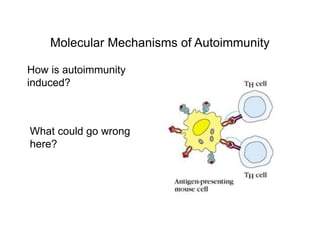
Molecular Mechanisms of Autoimmunity
What could go wrong
here?
How is autoimmunity
induced?
Molecular Mechanisms of Autoimmunity
• Cross-reactivity (Molecular and Viral Mimicry)
Viral and nonviral peptides can mimic self-peptides and
induce autoimmunity
Example: papilloma virus (HPV) and insulin receptor
Molecular Mechanisms of Autoimmunity
• Release of Sequestered Antigen
Antibodies in blood can attack Myelin Basic Protein if
Blood-Brain barrier is breached.
Molecular Mechanisms of Autoimmunity
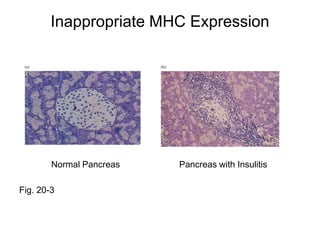
• Inappropriate MHC expression
Type I Diabetes: Pancreatic β cells express abnormally
high levels of MHC I and MHC II (?)
MHC II – APC only! This may hypersensitize TH cells to β
cell peptides.
Inappropriate MHC Expression
Normal Pancreas Pancreas with Insulitis
Fig. 20-3
Molecular Mechanisms of Autoimmunity
• Polyclonal B Cell Activation by Viruses and
Bacteria
If B cells reactive to self-peptides are activated,
autoimmunity can occur.
Example: Epstein-Barr Virus, which is the cause of
infectious mononucleosis.
Putting it all together…the big picture
• Autoimmunity can be caused by immunological, genetic,
viral, drug-induced, and hormonal factors.
• There are 4 immunological mechanisms of
autoimmunity.
• All mechanisms cause abnormal B or T cell activation.
• Centrality of the Ternary Complex
• Most instances of autoimmune diseases occur with
multiple mechanisms, which makes treatment difficult.
Autoimmunity in Animals is
Spontaneous or Induced
• Spontaneous: Autoimmunity develops
spontaneously in some inbred strains of
animals
• Induced: Autoimmunity develops after
being induced by certain experimental
manipulation
Induced Autoimmunity in Animals
• Autoimmune dysfunctions that are similar
to human autoimmune disease can be
induced into animals
Treatment of Autoimmune
Diseases
I. Current Therapies
II. - aimed at reducing symptoms by
providing non-specific suppression of the
immune system
II. Experimental Therapeutic Approaches
- try to induce specific immunity
I. Current Therapies
• Immunosuppressive drugs
- corticosteroids, azathioprine
- slows the proliferation of lymphocytes
• Cyclosporin A
- blocks signal transduction mediated by the TCR
(inhibits only antigen-activated T cells while sparing
non-activated ones)
• Thymectomy
- removal of thymus from patients with myasthenia
gravis
• Plasmapheresis
- removes antigen-antibody complexes for a short-
term reduction in symptoms
II. Experimental Therapeutic
Approaches
• T-cell Vaccination
- autoimmune T-cell clones elicit regulator T-cells
that are specific for the TCR on the autoimmune T-
cells
- results in suppression of the autoimmune cells
• Peptide Blockade of MHC molecules
- a synthetic peptide is used to bind in place of the
regular peptide on the MHC
- induces a state of clonal anergy in the autoimmune
T-cells
(Experimental Therapies continued)
• Monoclonal-Antibody Treatment
- monoclonal antibody against the IL-2 receptor
blocks activated TH-cells
- blockage of preferred TCRs with monoclonal
antibodies
- monoclonal antibody against an MHC molecule
that is associated with autoimmunity while sparing
the others
• Oral antigens
- tend to induce tolerance
- still in early clinical trials
Sex-based Differences in
Autoimmunity
• Differences can be traced to sex hormones
- hormones circulate throughout the body and alter
immune response by influencing gene expression
- (in general) estrogen can trigger autoimmunity and
testosterone can protect against it
• Difference in immune response
- ♀ produce a higher titer of antibodies and mount
more vigorous immune responses than ♂
- ♀ have a slightly higher cortisol secretion than ♂
- ♀ have higher levels or CD4+ T-cells and serum
IgM
Sex-based Differences
• Estrogen
- causes autoimmunity (generally)
- stimulates prolactin secretion (helps regulate
immune response)
- stimulates the gene for CRH (corticotropin-
releasing hormone) that promotes cortisol secretion
- causes more TH1-dominated immune responses
(promotes inflammation)
• Testosterone
- can cause autoimmunity or protect against it
Rheumatoid Arthritis (RA)
• Cause (s) and Demographics
• Molecular Mechanism
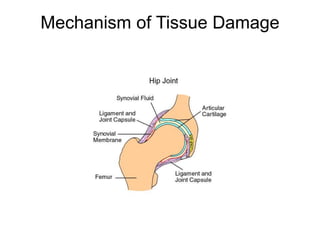
• Mechanism of Tissue Damage
• Treatment Options
Cause and Demographics
• Cause is unknown!
• Affects 1-2% of worldwide population
• Patients are 75% Women, between 40-60
years of age
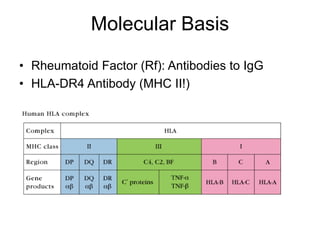
Molecular Basis
• Rheumatoid Factor (Rf): Antibodies to IgG
• HLA-DR4 Antibody (MHC II!)
Mechanism of Tissue Damage
Treatment Options
• NSAIDs
• Cox-2 Inhibitors
• Methotrexate
• Herbal Remedies
– Glucosamine
– Chondroitin
Autoimmune Anemias
• Pernicious Anemia
What is it?
- deficiency in vitamin B12
What causes it?
- auto-antibodies to intrinsic factor
What happens?
- B12 remains in the stomach and is excreted
Treatment
- treated with injections of B12
• Hemolytic Anemia
- results from monoclonal antibodies to normal
RBC constituents
- antibodies coat the erythrocytes, causing clumping,
lysis, and premature clearance by the spleen
- can be induced by an “offending” agent (parasite,
drug, or toxin) that adheres to the RBC
- Drug-induced Hemolytic Anemia- drug binds
to RBC’s and causes them to become
antigenic
- antibodies that develop from the drug
recognize these cells and they are
lysed

autoimmunity immunology .ppt

  • 1.
    Autoimmunity “n. of, relatingto, or caused by autoantibodies or lymphocytes that attack molecules, cells, or tissues of the organism producing them.” (from Webster’s Online)
  • 2.
    The Study ofAutoimmunity • Molecular Mechanisms of Autoimmunity • Animal Models for Autoimmune Dysfunction • Treatments for Autoimmune Diseases • Gender Differences in Autoimmunity • Three Common Autoimmune Diseases
  • 3.
    Molecular Mechanisms ofAutoimmunity What could go wrong here? How is autoimmunity induced?
  • 4.
    Molecular Mechanisms ofAutoimmunity • Cross-reactivity (Molecular and Viral Mimicry) Viral and nonviral peptides can mimic self-peptides and induce autoimmunity Example: papilloma virus (HPV) and insulin receptor
  • 5.
    Molecular Mechanisms ofAutoimmunity • Release of Sequestered Antigen Antibodies in blood can attack Myelin Basic Protein if Blood-Brain barrier is breached.
  • 6.
    Molecular Mechanisms ofAutoimmunity • Inappropriate MHC expression Type I Diabetes: Pancreatic β cells express abnormally high levels of MHC I and MHC II (?) MHC II – APC only! This may hypersensitize TH cells to β cell peptides.
  • 7.
    Inappropriate MHC Expression NormalPancreas Pancreas with Insulitis Fig. 20-3
  • 8.
    Molecular Mechanisms ofAutoimmunity • Polyclonal B Cell Activation by Viruses and Bacteria If B cells reactive to self-peptides are activated, autoimmunity can occur. Example: Epstein-Barr Virus, which is the cause of infectious mononucleosis.
  • 9.
    Putting it alltogether…the big picture • Autoimmunity can be caused by immunological, genetic, viral, drug-induced, and hormonal factors. • There are 4 immunological mechanisms of autoimmunity. • All mechanisms cause abnormal B or T cell activation. • Centrality of the Ternary Complex • Most instances of autoimmune diseases occur with multiple mechanisms, which makes treatment difficult.
  • 10.
    Autoimmunity in Animalsis Spontaneous or Induced • Spontaneous: Autoimmunity develops spontaneously in some inbred strains of animals • Induced: Autoimmunity develops after being induced by certain experimental manipulation
  • 11.
    Induced Autoimmunity inAnimals • Autoimmune dysfunctions that are similar to human autoimmune disease can be induced into animals
  • 12.
    Treatment of Autoimmune Diseases I.Current Therapies II. - aimed at reducing symptoms by providing non-specific suppression of the immune system II. Experimental Therapeutic Approaches - try to induce specific immunity
  • 13.
    I. Current Therapies •Immunosuppressive drugs - corticosteroids, azathioprine - slows the proliferation of lymphocytes • Cyclosporin A - blocks signal transduction mediated by the TCR (inhibits only antigen-activated T cells while sparing non-activated ones) • Thymectomy - removal of thymus from patients with myasthenia gravis • Plasmapheresis - removes antigen-antibody complexes for a short- term reduction in symptoms
  • 14.
    II. Experimental Therapeutic Approaches •T-cell Vaccination - autoimmune T-cell clones elicit regulator T-cells that are specific for the TCR on the autoimmune T- cells - results in suppression of the autoimmune cells • Peptide Blockade of MHC molecules - a synthetic peptide is used to bind in place of the regular peptide on the MHC - induces a state of clonal anergy in the autoimmune T-cells
  • 15.
    (Experimental Therapies continued) •Monoclonal-Antibody Treatment - monoclonal antibody against the IL-2 receptor blocks activated TH-cells - blockage of preferred TCRs with monoclonal antibodies - monoclonal antibody against an MHC molecule that is associated with autoimmunity while sparing the others • Oral antigens - tend to induce tolerance - still in early clinical trials
  • 16.
    Sex-based Differences in Autoimmunity •Differences can be traced to sex hormones - hormones circulate throughout the body and alter immune response by influencing gene expression - (in general) estrogen can trigger autoimmunity and testosterone can protect against it • Difference in immune response - ♀ produce a higher titer of antibodies and mount more vigorous immune responses than ♂ - ♀ have a slightly higher cortisol secretion than ♂ - ♀ have higher levels or CD4+ T-cells and serum IgM
  • 17.
    Sex-based Differences • Estrogen -causes autoimmunity (generally) - stimulates prolactin secretion (helps regulate immune response) - stimulates the gene for CRH (corticotropin- releasing hormone) that promotes cortisol secretion - causes more TH1-dominated immune responses (promotes inflammation) • Testosterone - can cause autoimmunity or protect against it
  • 18.
    Rheumatoid Arthritis (RA) •Cause (s) and Demographics • Molecular Mechanism • Mechanism of Tissue Damage • Treatment Options
  • 19.
    Cause and Demographics •Cause is unknown! • Affects 1-2% of worldwide population • Patients are 75% Women, between 40-60 years of age
  • 20.
    Molecular Basis • RheumatoidFactor (Rf): Antibodies to IgG • HLA-DR4 Antibody (MHC II!)
  • 21.
  • 22.
    Treatment Options • NSAIDs •Cox-2 Inhibitors • Methotrexate • Herbal Remedies – Glucosamine – Chondroitin
  • 23.
    Autoimmune Anemias • PerniciousAnemia What is it? - deficiency in vitamin B12 What causes it? - auto-antibodies to intrinsic factor What happens? - B12 remains in the stomach and is excreted Treatment - treated with injections of B12
  • 24.
    • Hemolytic Anemia -results from monoclonal antibodies to normal RBC constituents - antibodies coat the erythrocytes, causing clumping, lysis, and premature clearance by the spleen - can be induced by an “offending” agent (parasite, drug, or toxin) that adheres to the RBC - Drug-induced Hemolytic Anemia- drug binds to RBC’s and causes them to become antigenic - antibodies that develop from the drug recognize these cells and they are lysed