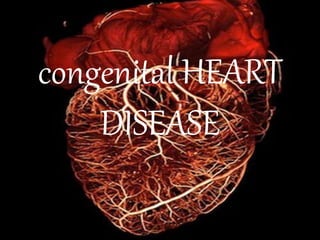
congenital HEART
DISEASE
CONGENITAL HEART
DISEASE
A Congenital Heart Disease(CHD), also
known as a congenital heart anomaly
or congenital heart defect, is a problem in
the structure of the heart that is present at
birth. Congenital heart disease is one of the
most common types of birth defects,
affecting up to 9 in every 1,000 babies
born.
CLASSIFICATION
According to arterial oxygen saturation
congenital heart diseases are classified into
two main categories:
Acyanotic CHD- Normal arterial oxygen
saturation
Cyanotic CHD- Reduced arterial oxygen
saturated
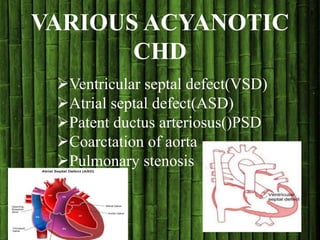
VARIOUS ACYANOTIC
CHD
Ventricular septal defect(VSD)
Atrial septal defect(ASD)
Patent ductus arteriosus()PSD
Coarctation of aorta
Pulmonary stenosis
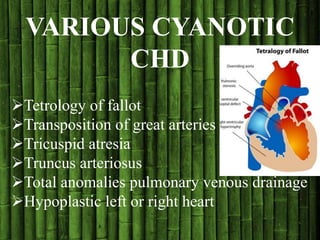
VARIOUS CYANOTIC
CHD
Tetrology of fallot
Transposition of great arteries
Tricuspid atresia
Truncus arteriosus
Total anomalies pulmonary venous drainage
Hypoplastic left or right heart
FACTORS CONTRIBUTING TO
CHD
85 to 90% of cases, there is no identifiable
cause for the heart defect. Generally
considered to be caused by the multifactorial
inheritance.
Factors are usually both genetic and
environmental, where a combination of genes
from both parents.
Maternal factors.
SYMPTOMS
Poor feeding
Low birth weight
Dizziness
Excessive sweating
Swelling in the hands,
Ankles or feet
TREATMENT
This is depend on the type of the C.H.D.
No treatment (observation and
reassurance)
Surgical treatment (palliative or curative).
Cardiac transplant or lung heart transplant
Medical treatment (antifailure,
antiarythmaic etc.,)
Artificial heart valves
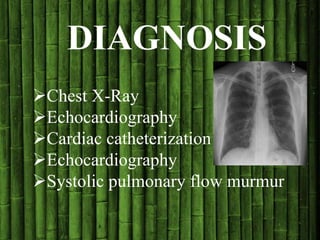
Chest X-Ray
Echocardiography
Cardiac catheterization
Echocardiography
Systolic pulmonary flow murmur
DIAGNOSIS
Avoid pregnancy above age of 38
year.
Avoid smoking.
Avoid alcohol.
Avoid exposure to radiation.
Avoid drugs intake before medical
consultation.
Vaccination of all childbearing
women for rubella.
PREVENTIVE MEASURES
THANK YOU

Austin Cardio & Cardiovascular Case Reports

  • 1.
  • 2.
    CONGENITAL HEART DISEASE A CongenitalHeart Disease(CHD), also known as a congenital heart anomaly or congenital heart defect, is a problem in the structure of the heart that is present at birth. Congenital heart disease is one of the most common types of birth defects, affecting up to 9 in every 1,000 babies born.
  • 4.
    CLASSIFICATION According to arterialoxygen saturation congenital heart diseases are classified into two main categories: Acyanotic CHD- Normal arterial oxygen saturation Cyanotic CHD- Reduced arterial oxygen saturated
  • 5.
    VARIOUS ACYANOTIC CHD Ventricular septaldefect(VSD) Atrial septal defect(ASD) Patent ductus arteriosus()PSD Coarctation of aorta Pulmonary stenosis
  • 6.
    VARIOUS CYANOTIC CHD Tetrology offallot Transposition of great arteries Tricuspid atresia Truncus arteriosus Total anomalies pulmonary venous drainage Hypoplastic left or right heart
  • 7.
    FACTORS CONTRIBUTING TO CHD 85to 90% of cases, there is no identifiable cause for the heart defect. Generally considered to be caused by the multifactorial inheritance. Factors are usually both genetic and environmental, where a combination of genes from both parents. Maternal factors.
  • 8.
    SYMPTOMS Poor feeding Low birthweight Dizziness Excessive sweating Swelling in the hands, Ankles or feet
  • 9.
    TREATMENT This is dependon the type of the C.H.D. No treatment (observation and reassurance) Surgical treatment (palliative or curative). Cardiac transplant or lung heart transplant Medical treatment (antifailure, antiarythmaic etc.,) Artificial heart valves
  • 10.
  • 11.
    Avoid pregnancy aboveage of 38 year. Avoid smoking. Avoid alcohol. Avoid exposure to radiation. Avoid drugs intake before medical consultation. Vaccination of all childbearing women for rubella. PREVENTIVE MEASURES
  • 12.