Geoengineering Cost Analysis

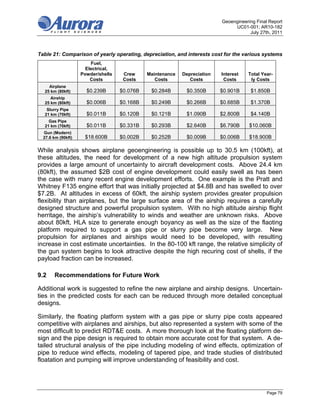
               Final Report

        Prepared Under Contract to
         The University Of Calgary


   Contract Number: __UC01-001______


  Aurora Report Number: ____AR10-182__
                July 27, 2011


                  Prepared by
                Justin McClellan
    James Sisco, Brandon Suarez, Greg Keogh
       Aurora Flight Sciences Corporation
             1 Broadway, 12th Floor
       Cambridge, Massachusetts 02142

               www.aurora.aero
Geoengineering Final Report
                                                                                                     UC01-001; AR10-182
                                                                                                            July 27th, 2011


Executive Summary ..................................................................................... 3 
1  Introduction ........................................................................................... 6 
      1.1  What is Geoengineering? ................................................................................ 6 
      1.2  Introduction to This Study................................................................................ 6 
      1.3  Chemistry Considerations Affecting Dispersal ................................................ 7 
2     Geoengineering Concept of Operations ................................................ 8 
3     Basis for Cost Models ......................................................................... 10 
      3.1  RAND DAPCA IV Cost Estimating Relationships .......................................... 10 
      3.2  Assumptions and Cost Inputs........................................................................ 17 
      3.3  Comparable operating airlines ...................................................................... 19 
4     Overview of Aircraft Design and Selection .......................................... 21 
      4.1  Altitude Capability: Aerodynamics ................................................................. 21 
      4.2  Altitude Capability: Propulsion....................................................................... 22 
5     Analysis of Existing Aircraft and Results ............................................. 33 
      5.1    Assumptions specific to analysis of existing aircraft ...................................... 33 
      5.2    Choice of Platforms ....................................................................................... 34 
      5.3    Cost Estimates .............................................................................................. 35 
      5.4    Modifications to Existing Aircraft ................................................................... 37 
      5.5    Conclusions................................................................................................... 40 
6     New Aircraft Design ............................................................................ 43 
      6.1    New Aircraft Assumptions ............................................................................. 45 
      6.2    Uncertainty Analysis ...................................................................................... 45 
      6.3    Cost Estimates .............................................................................................. 46 
      6.4    Conclusions................................................................................................... 48 
7     Airships ............................................................................................... 50 
      7.1  Airship Design Considerations and Assumptions .......................................... 50 
      7.2  Cost Estimates .............................................................................................. 54 
      7.3  Conclusions................................................................................................... 56 
8     Non-Aircraft Systems .......................................................................... 62 
      8.1  Rocket Powered Glider ................................................................................. 62 
      8.2  Guns ............................................................................................................. 64 
      8.3  Floating Platform with Slurry Pipe / Gas Pipe................................................ 68 
9     Conclusions......................................................................................... 75 
      9.1  Comparison of All Systems ........................................................................... 75 
      9.2  Recommendations for Future Work .............................................................. 79 
10  Appendix ............................................................................................. 80 
      10.1  Basing Options .............................................................................................. 80 
      10.2  HLA Sizing Equations ................................................................................... 80 
      10.3  HLA Architecture Comparisons ..................................................................... 82 
      10.4  Existing HLA Hangars ................................................................................... 85 


                                                                                                                         Page 2
Geoengineering Final Report
                                                                                               UC01-001; AR10-182
                                                                                                      July 27th, 2011

Executive Summary
Geoengineering has been defined as: “the deliberate large-scale manipulation of the
planetary environment to counteract anthropogenic climate change.1” As Lord Rees,
chair of The Royal Society, wrote in the forward to the Society's 2009 report on geoen-
gineering,
          "The continuing rise in the atmospheric concentration of greenhouse gases, mainly caused by the burning of
          fossil fuels, is driving changes in the Earth’s climate. The long-term consequences will be exceedingly
          threatening, especially if nations continue ‘business as usual’ in the coming decades. Most nations now rec-
          ognize the need to shift to a low-carbon economy, and nothing should divert us from the main priority of re-
          ducing global greenhouse gas emissions. But if such reductions achieve too little, too late, there will surely
          be pressure to consider a ‘plan B’—to seek ways to counteract the climatic effects of greenhouse gas emis-
          sions by ‘geoengineering’ … Far more detailed study would be needed before any method could even be
          seriously considered for deployment on the requisite international scale. Moreover, it is already clear than
          none offers a ‘silver bullet’, and that some options are far more problematic than others.2".

Geoengineering may be a means to create a time buffer against catastrophic climate
change while long-term emissions reduction actions take effect. One approach is to
disperse particulates at high altitude to reduce the effective solar flux entering the at-
mosphere. Sulfur compounds have been proposed, similar to the compounds emitted
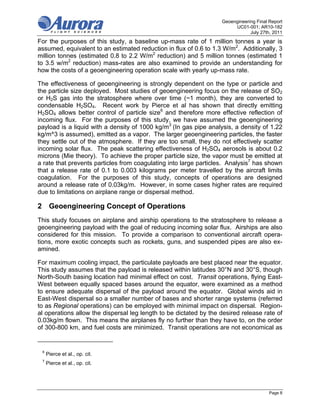
during volcanic eruptions that have been found to cool surface temperatures. As shown
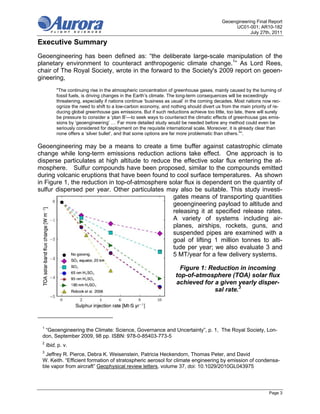
in Figure 1, the reduction in top-of-atmosphere solar flux is dependent on the quantity of
sulfur dispersed per year. Other particulates may also be suitable. This study investi-
                                                 gates means of transporting quantities
                                                 geoengineering payload to altitude and
                                                 releasing it at specified release rates.
                                                 A variety of systems including air-
                                                 planes, airships, rockets, guns, and
                                                 suspended pipes are examined with a
                                                 goal of lifting 1 million tonnes to alti-
                                                 tude per year; we also evaluate 3 and
                                                 5 MT/year for a few delivery systems.

                                                                      Figure 1: Reduction in incoming
                                                                    top-of-atmosphere (TOA) solar flux
                                                                    achieved for a given yearly disper-
                                                                                  sal rate.3


 1
  “Geoengineering the Climate: Science, Governance and Uncertainty”, p. 1, The Royal Society, Lon-
 don, September 2009, 98 pp. ISBN: 978-0-85403-773-5
 2
     Ibid, p. v.
 3
  Jeffrey R. Pierce, Debra K. Weisenstein, Patricia Heckendorn, Thomas Peter, and David
 W. Keith. “Efficient formation of stratospheric aerosol for climate engineering by emission of condensa-
 ble vapor from aircraft” Geophysical review letters, volume 37, doi: 10.1029/2010GL043975


                                                                                                                 Page 3
Geoengineering Final Report
                                                                                  UC01-001; AR10-182
                                                                                         July 27th, 2011
Existing aircraft are evaluated based on cost of acquisition and operations. An in-depth
new aircraft design study and cost analysis was conducted to determine the cost of de-
veloping and operating a dedicated geoengineering airplane type. Similarly, an airship
design study and cost analysis was conducted. Finally a survey of non-aircraft systems
was conducted to determine how their costs compare to aircraft and airships.

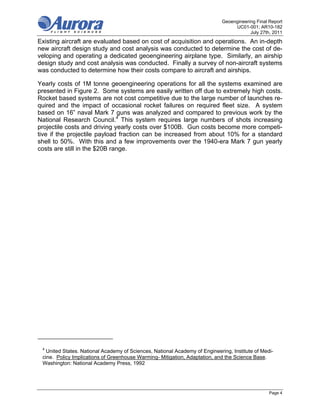
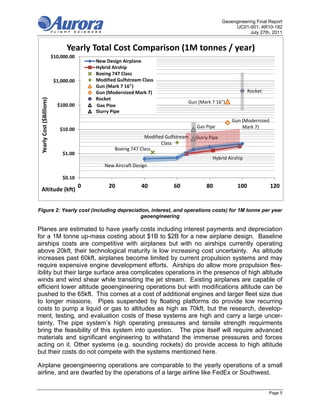
Yearly costs of 1M tonne geoengineering operations for all the systems examined are
presented in Figure 2. Some systems are easily written off due to extremely high costs.
Rocket based systems are not cost competitive due to the large number of launches re-
quired and the impact of occasional rocket failures on required fleet size. A system
based on 16” naval Mark 7 guns was analyzed and compared to previous work by the
National Research Council.4 This system requires large numbers of shots increasing
projectile costs and driving yearly costs over $100B. Gun costs become more competi-
tive if the projectile payload fraction can be increased from about 10% for a standard
shell to 50%. With this and a few improvements over the 1940-era Mark 7 gun yearly
costs are still in the $20B range.


 4
   United States. National Academy of Sciences, National Academy of Engineering, Institute of Medi-
 cine. Policy Implications of Greenhouse Warming- Mitigation, Adaptation, and the Science Base.
 Washington: National Academy Press, 1992


                                                                                                  Page 4
Geoengineering Final Report
                                                                                                            UC01-001; AR10-182
                                                                                                                   July 27th, 2011


                                  Yearly Total Cost Comparison (1M tonnes / year)
                            $10,000.00
                                             New Design Airplane
                                             Hybrid Airship
                                             Boeing 747 Class
                             $1,000.00       Modified Gulfstream Class
                                             Gun (Mark 7 16")
                                             Gun (Modernized Mark 7)                                               Rocket
 Yearly Cost ($Billions) 


                                             Rocket
                                                                                     Gun (Mark 7 16")
                              $100.00        Chimney
                                             Gas Pipe
                                             Slurry Pipe
                                                                                                           Gun (Modernized 
                                                                                         Gas Pipe              Mark 7)
                               $10.00
                                                                  Modified Gulfstream    Slurry Pipe
                                                                         Class
                                                     Boeing 747 Class
                                $1.00
                                                                                                 Hybrid Airship
                                                New Aircraft Design

                                $0.10
                                         0        20            40             60             80             100            120
 Altitude (kft)


Figure 2: Yearly cost (including depreciation, interest, and operations costs) for 1M tonne per year
                                          geoengineering

Planes are estimated to have yearly costs including interest payments and depreciation
for a 1M tonne up-mass costing about $1B to $2B for a new airplane design. Baseline
airships costs are competitive with airplanes but with no airships currently operating
above 20kft, their technological maturity is low increasing cost uncertainty. As altitude
increases past 60kft, airplanes become limited by current propulsion systems and may
require expensive engine development efforts. Airships do allow more propulsion flex-
ibility but their large surface area complicates operations in the presence of high altitude
winds and wind shear while transiting the jet stream. Existing airplanes are capable of
efficient lower altitude geoengineering operations but with modifications altitude can be
pushed to the 65kft. This comes at a cost of additional engines and larger fleet size due
to longer missions. Pipes suspended by floating platforms do provide low recurring
costs to pump a liquid or gas to altitudes as high as 70kft, but the research, develop-
ment, testing, and evaluation costs of these systems are high and carry a large uncer-
tainty. The pipe system’s high operating pressures and tensile strength requirments
bring the feasibility of this system into question. The pipe itself will require advanced
materials and significant engineering to withstand the immense pressures and forces
acting on it. Other systems (e.g. sounding rockets) do provide access to high altitude
but their costs do not compete with the systems mentioned here.

Airplane geoengineering operations are comparable to the yearly operations of a small
airline, and are dwarfed by the operations of a large airline like FedEx or Southwest.


                                                                                                                            Page 5
Geoengineering Final Report
                                                                              UC01-001; AR10-182
                                                                                     July 27th, 2011

1 Introduction

1.1    What is Geoengineering?

Geoengineering may provide a means to create a time buffer against catastrophic cli-
mate change while long-term emissions reduction actions take effect. One approach is
to disperse sulfur compounds at high altitude to reduce the effective solar flux entering
the atmosphere. This report will evaluate the means of delivering sufficient mass of this
or similar material to affect climate change on a global scale.

1.2    Introduction to This Study

The goal of this study is to use engineering design and cost analysis to determine the
feasibility and cost of a delivering material to the stratosphere for solar radiation man-
agement (SRM). This study does not examine effectiveness or risks of injecting material
into the stratosphere for SRM. Its goal is simply to compare a range of delivery systems
on a single cost basis.

Key assumptions:

Parameter                   Value                   Rational
Mass per year               1 Million tonnes        The rough order of magnitude needed for pla-
                                                    netary scale SRM. Values of 3M, and 5M also
                                                    considered for some systems.
Altitude range              40 to 100 kft           SRM is generally thought to be most effective
                                                    in this altitude range, with current models
                                                    showing increased effectiveness above 60 kft.
Payload cost                Not considered
Payload density             1 kg/L                  Equivalent to water. Payload density sufficient-
                                                    ly large that payload volume can be ignored.
Payload dispersal rate      0.1 to 0.003 kg/m       Release rate per meter flown to obtain ideal
                                                    particle size. Goal of 0.03 kg/m.

The primary vehicles examined to lift particulate to stratospheric altitudes and disperse
them at a predetermined release rate are airplanes and airships; rockets and other non-
aircraft methods such as guns and suspended pipes are also surveyed.

Existing airplanes, modified airplanes, and clean sheet designs requiring development
and testing are examined. Fleet setup cost analysis looked at costs of starting up a
geoengineering operation by purchasing airplanes, designing and acquiring new air-
planes or airships, or constructing other systems. Operations cost analysis looked at
the fuel costs, electricity costs, personnel costs, maintenance costs of systems. Final-
ly, yearly costs combined operations with depreciation of the system’s initial costs as
well as financing charges over the 20-year system life.

1.2.1 Glossary

The following is a list of terms and their definitions used in the report:


                                                                                              Page 6
Geoengineering Final Report
                                                                                             UC01-001; AR10-182
                                                                                                    July 27th, 2011

        RDT&E                                   Research, Development, Testing & Evaluation


Fleet (Acquisition)        Cost to set up new aircraft fleet, including RDT&E and acquisition costs of aircraft.
       Cost                        Similarly, cost of developing and constructing non-aircraft systems.
Yearly Operations          Cost of operating aircraft fleet, including maintenance, fuel, personnel, spare parts
      Cost                             for 1 year. Similarly, cost operating non-aircraft systems.
 Yearly Total Cost             Combined cost of operations and depreciation of aircraft fleet or system over 20-
                                    year life as well as 10% interest charge for financing over 20 years.
Regional Dispersal             Aircraft concept of operations with dispersal taking place in a region close to the
     CONOP                                          aircraft base. Out and back flight path.
 Transit Dispersal             Aircraft concept of operations with dispersal taking place during long transit leg
     CONOP                                                     between bases.
     Hybrid Airship             An airship that (at some altitude) develops lift from aerodynamics in addition to
        (HLA)                                                       buoyancy


Altitudes are expressed in feet in accordance with International Civil Aviation Organiza-
tion standards. Altitudes for atmospheric chemistry are typically presented in kilometers
so where possible, both feet and kilometers are presented. A conversion table is pre-
sented below:

                           Thousands of Feet (kft):        40     60     70      80    100

                                    Kilometers:           12.2   18.2    21.3   24.4   30.5


1.3      Chemistry Considerations Affecting Dispersal

Atmospheric chemistry analysis as well
as observation of surface temperatures
after large volcanic eruptions has shown
that injection of sulfur compounds into
the stratosphere reduces incoming solar
flux. The mass of sulfur compounds re-
leased is directly proportional to the re-
duction in incoming flux achieved
(Figure 3). Current anthropogenic net
forcing is ~ 2 W/m2.

   Figure 3: Reduction in incoming top-of-
 atmosphere (TOA) solar flux achieved for a
        given yearly dispersal rate.5


 5
     Pierce et al., op. cit.


                                                                                                             Page 7
Geoengineering Final Report
                                                                        UC01-001; AR10-182
                                                                               July 27th, 2011
For the purposes of this study, a baseline up-mass rate of 1 million tonnes a year is
assumed, equivalent to an estimated reduction in flux of 0.6 to 1.3 W/m2. Additionally, 3
million tonnes (estimated 0.8 to 2.2 W/m2 reduction) and 5 million tonnes (estimated 1
to 3.5 w/m2 reduction) mass-rates are also examined to provide an understanding for
how the costs of a geoengineering operation scale with yearly up-mass rate.

The effectiveness of geoengineering is strongly dependent on the type or particle and
the particle size deployed. Most studies of geoengineering focus on the release of SO2
or H2S gas into the stratosphere where over time (~1 month), they are converted to
condensable H2SO4. Recent work by Pierce et al has shown that directly emitting
H2SO4 allows better control of particle size6 and therefore more effective reflection of
incoming flux. For the purposes of this study, we have assumed the geoengineering
payload is a liquid with a density of 1000 kg/m3 (In gas pipe analysis, a density of 1.22
kg/m^3 is assumed), emitted as a vapor. The larger geoengineering particles, the faster
they settle out of the atmosphere. If they are too small, they do not effectively scatter
incoming solar flux. The peak scattering effectiveness of H2SO4 aerosols is about 0.2
microns (Mie theory). To achieve the proper particle size, the vapor must be emitted at
a rate that prevents particles from coagulating into large particles. Analysis7 has shown
that a release rate of 0.1 to 0.003 kilograms per meter travelled by the aircraft limits
coagulation. For the purposes of this study, concepts of operations are designed
around a release rate of 0.03kg/m. However, in some cases higher rates are required
due to limitations on airplane range or dispersal method.

2 Geoengineering Concept of Operations
This study focuses on airplane and airship operations to the stratosphere to release a
geoengineering payload with the goal of reducing incoming solar flux. Airships are also
considered for this mission. To provide a comparison to conventional aircraft opera-
tions, more exotic concepts such as rockets, guns, and suspended pipes are also ex-
amined.

For maximum cooling impact, the particulate payloads are best placed near the equator.
This study assumes that the payload is released within latitudes 30°N and 30°S, though
North-South basing location had minimal effect on cost. Transit operations, flying East-
West between equally spaced bases around the equator, were examined as a method
to ensure adequate dispersal of the payload around the equator. Global winds aid in
East-West dispersal so a smaller number of bases and shorter range systems (referred
to as Regional operations) can be employed with minimal impact on dispersal. Region-
al operations allow the dispersal leg length to be dictated by the desired release rate of
0.03kg/m flown. This means the airplanes fly no further than they have to, on the order
of 300-800 km, and fuel costs are minimized. Transit operations are not economical as


 6
     Pierce et al., op. cit.
 7
     Pierce et al., op. cit.


                                                                                        Page 8
Geoengineering Final Report
                                                                                  UC01-001; AR10-182
                                                                                         July 27th, 2011
the leg length is dictated by the distance between bases (for 8-base operations, legs are
approximately 5,000 km) causing release rates to be low and fuel costs to be high. A
comparison of regional and transit operations utilizing Boeing 747s (at its service ceiling
of 45,000 feet) is as follows:

      Regional: 747s operating regionally from multiple bases
           o 14 airplanes, payload dispersed over 1,500 km cruise leg at a rate of
             0.036 kg/m flown
           o $0.8B for acquisition and $1B for one year of operations
           o 0.66M tonnes fuel burned per year

      Transit: 747s transiting from 8 bases
           o 24 airplanes, payload dispersed over 5,000 km cruise leg at a rate of
             0.012 kg/m flown
           o $1.4 B for acquisition and $2.8B for one year of operations
           o 1.6M tonnes fuel burned per year

      Transit: 747s transiting from 4 bases
           o 48 airplanes, payload dispersed over 11,000 km cruise leg at a rate of
             0.005 kg/m flown
           o $2.8B for acquisition and $4.5B for one year of operations
           o 3.24M tonnes fuel burned per year


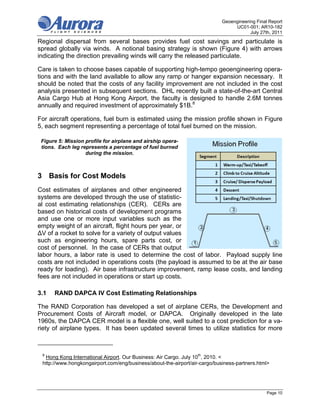
Figure 4: Notional basing strategy for a geoengineering effort. Existing civilian and military facili-
 ties in Palmdale, USA, Manta, Ecuador, and Perth, Australia are capable of supporting geoengi-
neering support facilities and operations. The prevailing winds, shown as arrows, serve to further
                      distribute the particulate around the equatorial region.


                                                                                                  Page 9
Geoengineering Final Report
                                                                                 UC01-001; AR10-182
                                                                                        July 27th, 2011
Regional dispersal from several bases provides fuel cost savings and particulate is
spread globally via winds. A notional basing strategy is shown (Figure 4) with arrows
indicating the direction prevailing winds will carry the released particulate.

Care is taken to choose bases capable of supporting high-tempo geoengineering opera-
tions and with the land available to allow any ramp or hanger expansion necessary. It
should be noted that the costs of any facility improvement are not included in the cost
analysis presented in subsequent sections. DHL recently built a state-of-the-art Central
Asia Cargo Hub at Hong Kong Airport, the faculty is designed to handle 2.6M tonnes
annually and required investment of approximately $1B.8

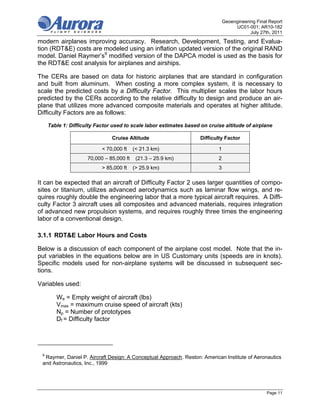
For aircraft operations, fuel burn is estimated using the mission profile shown in Figure
5, each segment representing a percentage of total fuel burned on the mission.

 Figure 5: Mission profile for airplane and airship opera-
 tions. Each leg represents a percentage of fuel burned
                   during the mission.


3 Basis for Cost Models
Cost estimates of airplanes and other engineered
systems are developed through the use of statistic-
al cost estimating relationships (CER). CERs are
based on historical costs of development programs
and use one or more input variables such as the
empty weight of an aircraft, flight hours per year, or
ΔV of a rocket to solve for a variety of output values
such as engineering hours, spare parts cost, or
cost of personnel. In the case of CERs that output
labor hours, a labor rate is used to determine the cost of labor. Payload supply line
costs are not included in operations costs (the payload is assumed to be at the air base
ready for loading). Air base infrastructure improvement, ramp lease costs, and landing
fees are not included in operations or start up costs.

3.1   RAND DAPCA IV Cost Estimating Relationships

The RAND Corporation has developed a set of airplane CERs, the Development and
Procurement Costs of Aircraft model, or DAPCA. Originally developed in the late
1960s, the DAPCA CER model is a flexible one, well suited to a cost prediction for a va-
riety of airplane types. It has been updated several times to utilize statistics for more


 8
  Hong Kong International Airport. Our Business: Air Cargo. July 10th, 2010. <
 http://www.hongkongairport.com/eng/business/about-the-airport/air-cargo/business-partners.html>


                                                                                                Page 10
Geoengineering Final Report
                                                                                    UC01-001; AR10-182
                                                                                           July 27th, 2011
modern airplanes improving accuracy. Research, Development, Testing, and Evalua-
tion (RDT&E) costs are modeled using an inflation updated version of the original RAND
model. Daniel Raymer’s9 modified version of the DAPCA model is used as the basis for
the RDT&E cost analysis for airplanes and airships.

The CERs are based on data for historic airplanes that are standard in configuration
and built from aluminum. When costing a more complex system, it is necessary to
scale the predicted costs by a Difficulty Factor. This multiplier scales the labor hours
predicted by the CERs according to the relative difficulty to design and produce an air-
plane that utilizes more advanced composite materials and operates at higher altitude.
Difficulty Factors are as follows:

     Table 1: Difficulty Factor used to scale labor estimates based on cruise altitude of airplane

                               Cruise Altitude                      Difficulty Factor

                           < 70,000 ft    (< 21.3 km)                      1
                     70,000 – 85,000 ft    (21.3 – 25.9 km)                2
                           > 85,000 ft    (> 25.9 km)                      3

It can be expected that an aircraft of Difficulty Factor 2 uses larger quantities of compo-
sites or titanium, utilizes advanced aerodynamics such as laminar flow wings, and re-
quires roughly double the engineering labor that a more typical aircraft requires. A Diffi-
culty Factor 3 aircraft uses all composites and advanced materials, requires integration
of advanced new propulsion systems, and requires roughly three times the engineering
labor of a conventional design.

3.1.1 RDT&E Labor Hours and Costs

Below is a discussion of each component of the airplane cost model. Note that the in-
put variables in the equations below are in US Customary units (speeds are in knots).
Specific models used for non-airplane systems will be discussed in subsequent sec-
tions.

Variables used:

        We = Empty weight of aircraft (lbs)
        Vmax = maximum cruise speed of aircraft (kts)
        Np = Number of prototypes
        Df = Difficulty factor


 9
  Raymer, Daniel P. Aircraft Design: A Conceptual Approach. Reston: American Institute of Aeronautics
 and Astronautics, Inc., 1999


                                                                                                   Page 11
Geoengineering Final Report
                                                                                                              UC01-001; AR10-182
                                                                                                                     July 27th, 2011

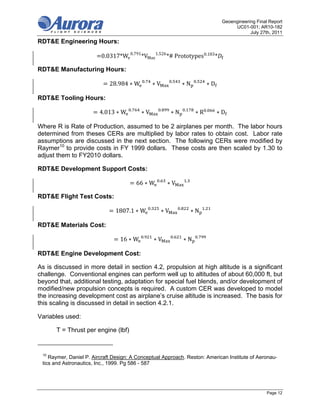
RDT&E Engineering Hours:

                         0.0317*We 0.791 *VMax 1.526 *#	Prototypes 0.183 *

RDT&E Manufacturing Hours:
                                                .                 .                    .
                             28.984 ∗ W                 ∗V                    ∗N                   ∗D

RDT&E Tooling Hours:
                                      .                      .                .                    .
                         4.013 ∗ W         ∗V                     ∗N                   ∗R               ∗D

Where R is Rate of Production, assumed to be 2 airplanes per month. The labor hours
determined from theses CERs are multiplied by labor rates to obtain cost. Labor rate
assumptions are discussed in the next section. The following CERs were modified by
Raymer10 to provide costs in FY 1999 dollars. These costs are then scaled by 1.30 to
adjust them to FY2010 dollars.

RDT&E Development Support Costs:
                                                         .                        .
                                          66 ∗ W                 ∗V

RDT&E Flight Test Costs:
                                                    .                     .                    .
                               1807.1 ∗ W                    ∗V                       ∗N

RDT&E Materials Cost:
                                            .                         .                    .
                                 16 ∗ W                 ∗V                    ∗N

RDT&E Engine Development Cost:

As is discussed in more detail in section 4.2, propulsion at high altitude is a significant
challenge. Conventional engines can perform well up to altitudes of about 60,000 ft, but
beyond that, additional testing, adaptation for special fuel blends, and/or development of
modified/new propulsion concepts is required. A custom CER was developed to model
the increasing development cost as airplane’s cruise altitude is increased. The basis for
this scaling is discussed in detail in section 4.2.1.

Variables used:

      T = Thrust per engine (lbf)


 10
    Raymer, Daniel P. Aircraft Design: A Conceptual Approach. Reston: American Institute of Aeronau-
 tics and Astronautics, Inc., 1999. Pg 586 - 587


                                                                                                                             Page 12
Geoengineering Final Report
                                                                                      UC01-001; AR10-182
                                                                                             July 27th, 2011
         Ne = Number of engines per aircraft
         Ti = Temperature at the turbine entrance (R)
         Mmax = Maximum Mach number of the aircraft

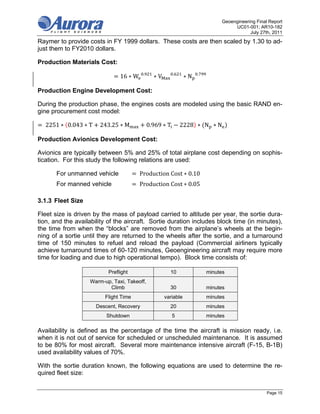
< 45,000 ft (13.7 km): Basic RAND engine procurement cost model11

             	 2251 ∗ 0.043 ∗ T        243.25 ∗ M           0.969 ∗ T      2228 ∗ N ∗ N

45,000 – 65,000 ft (13.7 – 19.8 km): Basic procurement model doubled to account for
recertification and testing of engine

            	2 ∗ 2251 ∗ 0.043 ∗ T        243.25 ∗ M           0.969 ∗ T      2228 ∗ N ∗ N

65,000 – 80,000 ft (19.8 – 24.4 km): Basic procurement model doubled, plus $1B for
modifications and adaptation to non-standard fuel

      	1,000,000,000     2 ∗ 2251 ∗ 0.043 ∗ T 243.25 ∗ M                   0.969 ∗ T      2228 ∗ N ∗
                                             Ne

> 80,000 ft (> 24.4 km): Basic procurement model doubled, plus $2B for new technology
development

      	2,000,000,000     2 ∗ 2251 ∗ 0.043 ∗ T 243.25 ∗ M                   0.969 ∗ T      2228 ∗ N ∗
                                             Ne

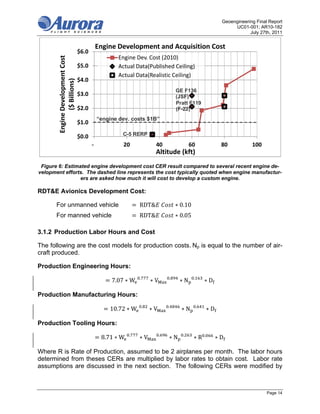
This yields an engine development cost function that varies strongly with altitude. The
results of this function are compared to several engine development efforts (Figure 6).
The cost function matches the historic development efforts well when the service ceil-
ings are adjusted to more realistic engine flame out altitude based on similar engine and
aircraft capabilities12.


 11
    Birkler, J. L., Garfinkle, J. B., and Marks, K. E., “Development and Production Cost Estimating Rela-
 tionships For Aircraft Turbine Engines,” Rand Corp., Report N-1882-AF, Santa Monica, CA, 1982
 12
   During a 1963 altitude record setting flight by Commander Leroy Heath and Lieutenant Larry Monroe,
 their A3J-1 Vigilante flamed out at 91,000 ft. During a 1975, record setting flight, lightened F-15 “Streak
 Eagle” flamed out at 98,000 ft. These flame out altitudes are reduced to 80,000 ft to allow a more sta-
 ble combustion in the burner.


                                                                                                     Page 13
Geoengineering Final Report
                                                                                                                   UC01-001; AR10-182
                                                                                                                          July 27th, 2011


                                              Engine Development and Acquisition Cost
                                   $6.0
        Engine Development Cost 
                                                     Engine Dev. Cost (2010)
                                   $5.0              Actual Data(Published Ceiling)
                                                     Actual Data(Realistic Ceiling)
                                   $4.0
               ($ Billions)

                                                                                   GE F136
                                   $3.0                                            (JSF)
                                                                                   Pratt F119
                                   $2.0                                            (F-22)
                                              “engine dev. costs $1B”
                                   $1.0

                                   $0.0                C-5 RERP

                                          ‐            20              40                 60                  80           100 
                                                                       Altitude (kft)
 Figure 6: Estimated engine development cost CER result compared to several recent engine de-
velopment efforts. The dashed line represents the cost typically quoted when engine manufactur-
                 ers are asked how much it will cost to develop a custom engine.

RDT&E Avionics Development Cost:

       For unmanned vehicle                                   	RDT& 	              ∗ 0.10
       For manned vehicle                                     	RDT& 	              ∗ 0.05

3.1.2 Production Labor Hours and Cost

The following are the cost models for production costs. Np is equal to the number of air-
craft produced.

Production Engineering Hours:
                                                              .                .            .
                                                   7.07 ∗ W           ∗V            ∗N              ∗D

Production Manufacturing Hours:
                                                                  .            .                .
                                                  10.72 ∗ W           ∗V             ∗N                 ∗D

Production Tooling Hours:
                                                          .                .          .             .
                                               8.71 ∗ W       ∗V               ∗N           ∗R               ∗D

Where R is Rate of Production, assumed to be 2 airplanes per month. The labor hours
determined from theses CERs are multiplied by labor rates to obtain cost. Labor rate
assumptions are discussed in the next section. The following CERs were modified by


                                                                                                                                  Page 14
Geoengineering Final Report
                                                                                    UC01-001; AR10-182
                                                                                           July 27th, 2011
Raymer to provide costs in FY 1999 dollars. These costs are then scaled by 1.30 to ad-
just them to FY2010 dollars.

Production Materials Cost:
                                          .               .          .
                               16 ∗ W           ∗V              ∗N

Production Engine Development Cost:

During the production phase, the engines costs are modeled using the basic RAND en-
gine procurement cost model:

  	2251 ∗ 0.043 ∗ T    243.25 ∗ M             0.969 ∗ T       2228 ∗ N ∗ N

Production Avionics Development Cost:

Avionics are typically between 5% and 25% of total airplane cost depending on sophis-
tication. For this study the following relations are used:

       For unmanned vehicle            	Production	Cost ∗ 0.10
       For manned vehicle              	Production	Cost ∗ 0.05

3.1.3 Fleet Size

Fleet size is driven by the mass of payload carried to altitude per year, the sortie dura-
tion, and the availability of the aircraft. Sortie duration includes block time (in minutes),
the time from when the “blocks” are removed from the airplane’s wheels at the begin-
ning of a sortie until they are returned to the wheels after the sortie, and a turnaround
time of 150 minutes to refuel and reload the payload (Commercial airliners typically
achieve turnaround times of 60-120 minutes, Geoengineering aircraft may require more
time for loading and due to high operational tempo). Block time consists of:

                          Preflight                    10                minutes
                   Warm-up, Taxi, Takeoff,
                          Climb                        30                minutes
                         Flight Time                 variable            minutes
                      Descent, Recovery                20                minutes
                          Shutdown                        5              minutes

Availability is defined as the percentage of the time the aircraft is mission ready, i.e.
when it is not out of service for scheduled or unscheduled maintenance. It is assumed
to be 80% for most aircraft. Several more maintenance intensive aircraft (F-15, B-1B)
used availability values of 70%.

With the sortie duration known, the following equations are used to determine the re-
quired fleet size:


                                                                                                   Page 15
Geoengineering Final Report
                                                                               UC01-001; AR10-182
                                                                                      July 27th, 2011
                                   	       	   	
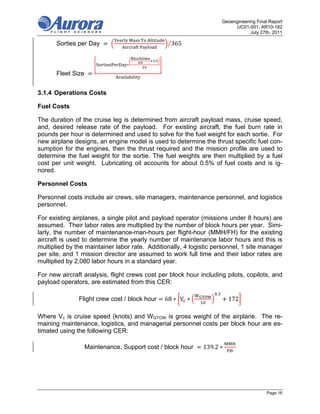
       Sorties per Day      	                          ⁄365
                                       	

                                                   .
                                  ∗

       Fleet Size


3.1.4 Operations Costs

Fuel Costs

The duration of the cruise leg is determined from aircraft payload mass, cruise speed,
and, desired release rate of the payload. For existing aircraft, the fuel burn rate in
pounds per hour is determined and used to solve for the fuel weight for each sortie. For
new airplane designs, an engine model is used to determine the thrust specific fuel con-
sumption for the engines, then the thrust required and the mission profile are used to
determine the fuel weight for the sortie. The fuel weights are then multiplied by a fuel
cost per unit weight. Lubricating oil accounts for about 0.5% of fuel costs and is ig-
nored.

Personnel Costs

Personnel costs include air crews, site managers, maintenance personnel, and logistics
personnel.

For existing airplanes, a single pilot and payload operator (missions under 8 hours) are
assumed. Their labor rates are multiplied by the number of block hours per year. Simi-
larly, the number of maintenance-man-hours per flight-hour (MMH/FH) for the existing
aircraft is used to determine the yearly number of maintenance labor hours and this is
multiplied by the maintainer labor rate. Additionally, 4 logistic personnel, 1 site manager
per site, and 1 mission director are assumed to work full time and their labor rates are
multiplied by 2,080 labor hours in a standard year.

For new aircraft analysis, flight crews cost per block hour including pilots, copilots, and
payload operators, are estimated from this CER:
                                                                      .
               Flight crew cost / block hour           68 ∗ V ∗             172

Where Vc is cruise speed (knots) and WGTOW is gross weight of the airplane. The re-
maining maintenance, logistics, and managerial personnel costs per block hour are es-
timated using the following CER:

                    Maintenance, Support cost / block hour        139.2 ∗


                                                                                              Page 16
Geoengineering Final Report
                                                                                 UC01-001; AR10-182
                                                                                        July 27th, 2011
MMH/FH is assumed to be 10 hours per flight hour (unless noted otherwise). The per
block hour labor costs are multiplied by the total number of block hours per year (Block
Time * Sorties per year).

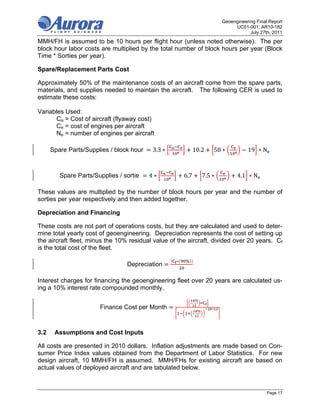
Spare/Replacement Parts Cost

Approximately 50% of the maintenance costs of an aircraft come from the spare parts,
materials, and supplies needed to maintain the aircraft. The following CER is used to
estimate these costs:

Variables Used:
       Ca = Cost of aircraft (flyaway cost)
       Ce = cost of engines per aircraft
       Ne = number of engines per aircraft

      Spare Parts/Supplies / block hour 	   3.3 ∗             10.2        58 ∗         19 ∗ N


         Spare Parts/Supplies / sortie      4∗          6.7        7.5 ∗          4.1 ∗ N

These values are multiplied by the number of block hours per year and the number of
sorties per year respectively and then added together.

Depreciation and Financing

These costs are not part of operations costs, but they are calculated and used to deter-
mine total yearly cost of geoengineering. Depreciation represents the cost of setting up
the aircraft fleet, minus the 10% residual value of the aircraft, divided over 20 years. Cf
is the total cost of the fleet.

                                                    ∗   %
                                  Depreciation

Interest charges for financing the geoengineering fleet over 20 years are calculated us-
ing a 10% interest rate compounded monthly.
                                                              %
                                                                  ∗
                        Finance Cost per Month                 %
                                                                      ∗


3.2    Assumptions and Cost Inputs

All costs are presented in 2010 dollars. Inflation adjustments are made based on Con-
sumer Price Index values obtained from the Department of Labor Statistics. For new
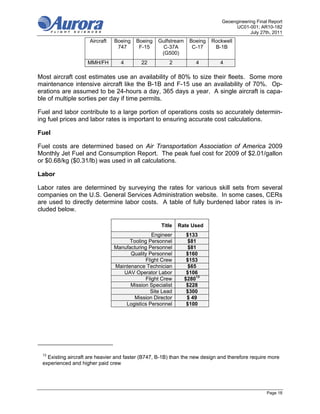
design aircraft, 10 MMH/FH is assumed. MMH/FHs for existing aircraft are based on
actual values of deployed aircraft and are tabulated below.


                                                                                                Page 17
Geoengineering Final Report
                                                                                   UC01-001; AR10-182
                                                                                          July 27th, 2011
                     Aircraft   Boeing   Boeing   Gulfstream     Boeing   Rockwell
                                 747      F-15     C-37A          C-17     B-1B
                                                   (G500)
                    MMH/FH        4        22          2           4         4

Most aircraft cost estimates use an availability of 80% to size their fleets. Some more
maintenance intensive aircraft like the B-1B and F-15 use an availability of 70%. Op-
erations are assumed to be 24-hours a day, 365 days a year. A single aircraft is capa-
ble of multiple sorties per day if time permits.

Fuel and labor contribute to a large portion of operations costs so accurately determin-
ing fuel prices and labor rates is important to ensuring accurate cost calculations.

Fuel

Fuel costs are determined based on Air Transportation Association of America 2009
Monthly Jet Fuel and Consumption Report. The peak fuel cost for 2009 of $2.01/gallon
or $0.68/kg ($0.31/lb) was used in all calculations.

Labor

Labor rates are determined by surveying the rates for various skill sets from several
companies on the U.S. General Services Administration website. In some cases, CERs
are used to directly determine labor costs. A table of fully burdened labor rates is in-
cluded below.

                                                    Title   Rate Used
                                               Engineer         $133
                                      Tooling Personnel         $81
                                Manufacturing Personnel         $81
                                      Quality Personnel         $160
                                            Flight Crew         $153
                                Maintenance Technician          $65
                                   UAV Operator Labor           $106
                                            Flight Crew        $28013
                                      Mission Specialist        $228
                                              Site Lead         $300
                                        Mission Director        $ 49
                                    Logistics Personnel         $100


 13
   Existing aircraft are heavier and faster (B747, B-1B) than the new design and therefore require more
 experienced and higher paid crew


                                                                                                  Page 18
Geoengineering Final Report
                                                                                         UC01-001; AR10-182
                                                                                                July 27th, 2011

3.3    Comparable operating airlines

To put the magnitude of 1M tonne geoengineering operations in perspective, FedEx’s
global lift capacity is 4.3M tonnes per year. The baseline geoengineering up-mass rate
of 1M tonnes is equivalent to 20-25 fully loaded 747-400F flights per day. Depending
on the payload capacity of the aircraft used, sorties per day can vary from 60 to 600.
While hundreds of sorties a day may seem like a lot, it should be noted that Atlanta’s
Hartsfield-Jackson International Airport handles 180-240 flights per hour.

Cost predictions are compared to multiple existing airlines and operators to ensure CER
predicted costs are reasonable. Publicly owned companies are chosen for comparison
as their annual reports contained detailed cost and operations information. No airline or
operator fulfils the exact geoengineering mission described here, so their operations
numbers are scaled to allow a direct comparison. In the case of existing aircraft the
scale factor is the total tonnage of cargo moved by the comparable operator divided by
the total tonnage moved for geoengineering operations. For the new aircraft analysis,
the short duration of the missions required a more sophisticated scaling method. Total
tonnage moved by the comparable operator is multiplied by the average stage length to
obtain tonne-kilometers per year. The typical geoengineering mission performed by the
new design airplane is 335 km in length, equating to a 335 million tonne-kilometers per
year. The ratio of the comparable operator’s tonne-kilometers per year to geoengineer-
ing’s tonne-kilometers per year is used to scale operations cost. Personnel costs for
passenger airlines are scaled by 2/3 to remove counter, reservations, and customer
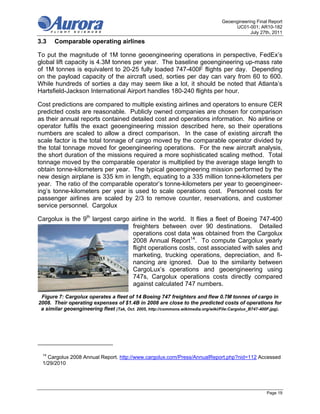
service personnel. Cargolux

Cargolux is the 9th largest cargo airline in the world. It flies a fleet of Boeing 747-400
                                  freighters between over 90 destinations. Detailed
                                  operations cost data was obtained from the Cargolux
                                  2008 Annual Report14. To compute Cargolux yearly
                                  flight operations costs, cost associated with sales and
                                  marketing, trucking operations, depreciation, and fi-
                                  nancing are ignored. Due to the similarity between
                                  CargoLux’s operations and geoengineering using
                                  747s, Cargolux operations costs directly compared
                                  against calculated 747 numbers.

 Figure 7: Cargolux operates a fleet of 14 Boeing 747 freighters and flew 0.7M tonnes of cargo in
2008. Their operating expenses of $1.4B in 2008 are close to the predicted costs of operations for
 a similar geoengineering fleet (Tak, Oct. 2005, http://commons.wikimedia.org/wiki/File:Cargolux_B747-400F.jpg).


 14
   Cargolux 2008 Annual Report. http://www.cargolux.com/Press/AnnualReport.php?nid=112 Accessed
 1/29/2010


                                                                                                         Page 19
Geoengineering Final Report
                                                                                              UC01-001; AR10-182
                                                                                                     July 27th, 2011


JetBlue Airlines

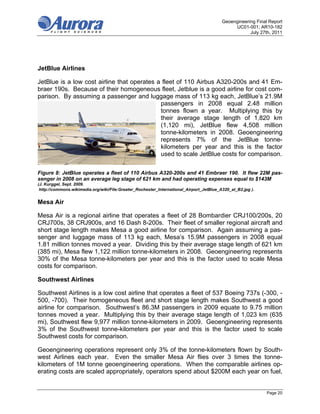
JetBlue is a low cost airline that operates a fleet of 110 Airbus A320-200s and 41 Em-
braer 190s. Because of their homogeneous fleet, Jetblue is a good airline for cost com-
parison. By assuming a passenger and luggage mass of 113 kg each, JetBlue’s 21.9M
                                             passengers in 2008 equal 2.48 million
                                             tonnes flown a year. Multiplying this by
                                             their average stage length of 1,820 km
                                             (1,120 mi), JetBlue flew 4,508 million
                                             tonne-kilometers in 2008. Geoengineering
                                             represents 7% of the JetBlue tonne-
                                             kilometers per year and this is the factor
                                             used to scale JetBlue costs for comparison.

Figure 8: JetBlue operates a fleet of 110 Airbus A320-200s and 41 Embraer 190. It flew 22M pas-
senger in 2008 on an average leg stage of 621 km and had operating expenses equal to $143M
(J. Kurggel, Sept. 2009.
 http://commons.wikimedia.org/wiki/File:Greater_Rochester_International_Airport_JetBlue_A320_at_B2.jpg ).


Mesa Air

Mesa Air is a regional airline that operates a fleet of 28 Bombardier CRJ100/200s, 20
CRJ700s, 38 CRJ900s, and 16 Dash 8-200s. Their fleet of smaller regional aircraft and
short stage length makes Mesa a good airline for comparison. Again assuming a pas-
senger and luggage mass of 113 kg each, Mesa’s 15.9M passengers in 2008 equal
1.81 million tonnes moved a year. Dividing this by their average stage length of 621 km
(385 mi), Mesa flew 1,122 million tonne-kilometers in 2008. Geoengineering represents
30% of the Mesa tonne-kilometers per year and this is the factor used to scale Mesa
costs for comparison.

Southwest Airlines

Southwest Airlines is a low cost airline that operates a fleet of 537 Boeing 737s (-300, -
500, -700). Their homogeneous fleet and short stage length makes Southwest a good
airline for comparison. Southwest’s 86.3M passengers in 2009 equate to 9.75 million
tonnes moved a year. Multiplying this by their average stage length of 1,023 km (635
mi), Southwest flew 9,977 million tonne-kilometers in 2009. Geoengineering represents
3% of the Southwest tonne-kilometers per year and this is the factor used to scale
Southwest costs for comparison.

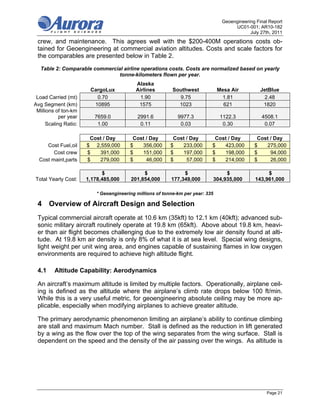
Geoengineering operations represent only 3% of the tonne-kilometers flown by South-
west Airlines each year. Even the smaller Mesa Air flies over 3 times the tonne-
kilometers of 1M tonne geoengineering operations. When the comparable airlines op-
erating costs are scaled appropriately, operators spend about $200M each year on fuel,


                                                                                                             Page 20
Geoengineering Final Report
                                                                                         UC01-001; AR10-182
                                                                                                July 27th, 2011
 crew, and maintenance. This agrees well with the $200-400M operations costs ob-
 tained for Geoengineering at commercial aviation altitudes. Costs and scale factors for
 the comparables are presented below in Table 2.

   Table 2: Comparable commercial airline operations costs. Costs are normalized based on yearly
                                tonne-kilometers flown per year.
                                            Alaska
                        CargoLux            Airlines        Southwest             Mesa Air           JetBlue
 Load Carried (mt)        0.70                1.90            9.75                 1.81               2.48
Avg Segment (km)         10895               1575             1023                  621               1820
 Millions of ton-km
            per year      7659.0            2991.6            9977.3               1122.3            4508.1
      Scaling Ratio:       1.00              0.11              0.03                 0.30              0.07

                        Cost / Day        Cost / Day        Cost / Day        Cost / Day           Cost / Day
     Cost Fuel,oil     $ 2,559,000       $   356,000       $   233,000       $   423,000          $   275,000
        Cost crew      $   391,000       $   151,000       $   197,000       $   198,000          $     94,000
  Cost maint,parts     $   279,000       $     46,000      $     57,000      $   214,000          $     26,000

                             $                 $                $                     $                $
Total Yearly Cost:     1,178,485,000      201,854,000      177,349,000           304,935,000      143,961,000

                           * Geoengineering millions of tonne-km per year: 335

 4 Overview of Aircraft Design and Selection
 Typical commercial aircraft operate at 10.6 km (35kft) to 12.1 km (40kft); advanced sub-
 sonic military aircraft routinely operate at 19.8 km (65kft). Above about 19.8 km, heavi-
 er than air flight becomes challenging due to the extremely low air density found at alti-
 tude. At 19.8 km air density is only 8% of what it is at sea level. Special wing designs,
 light weight per unit wing area, and engines capable of sustaining flames in low oxygen
 environments are required to achieve high altitude flight.

 4.1     Altitude Capability: Aerodynamics

 An aircraft’s maximum altitude is limited by multiple factors. Operationally, airplane ceil-
 ing is defined as the altitude where the airplane’s climb rate drops below 100 ft/min.
 While this is a very useful metric, for geoengineering absolute ceiling may be more ap-
 plicable, especially when modifying airplanes to achieve greater altitude.

 The primary aerodynamic phenomenon limiting an airplane’s ability to continue climbing
 are stall and maximum Mach number. Stall is defined as the reduction in lift generated
 by a wing as the flow over the top of the wing separates from the wing surface. Stall is
 dependent on the speed and the density of the air passing over the wings. As altitude is


                                                                                                        Page 21
Geoengineering Final Report
                                                                                               UC01-001; AR10-182
                                                                                                      July 27th, 2011
increased and the air gets thinner, the airplane must fly faster to generate enough lift to
counteract the force of gravity without stalling. In other words, the airplane’s minimum
speed (stall speed) increases with altitude as air density decreases. Maximum Mach15
number is the maximum speed the airplane can fly at without generating shock waves
as air flow curving around the wings and fuselage locally goes supersonic. If shocks
form, the airplane can become difficult or impossible to control and can be structurally
damaged.

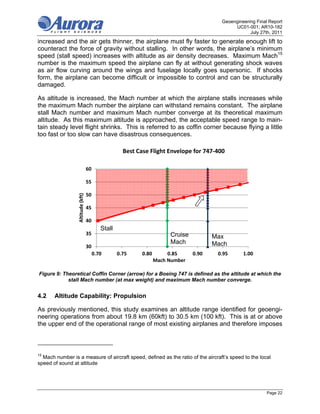
As altitude is increased, the Mach number at which the airplane stalls increases while
the maximum Mach number the airplane can withstand remains constant. The airplane
stall Mach number and maximum Mach number converge at its theoretical maximum
altitude. As this maximum altitude is approached, the acceptable speed range to main-
tain steady level flight shrinks. This is referred to as coffin corner because flying a little
too fast or too slow can have disastrous consequences.

                                                      Best Case Flight Envelope for 747‐400

                                   60

                                   55

                                   50
                  Altitude (kft)


                                   45

                                   40
                                            Stall
                                   35                                  Cruise           Max
                                                                       Mach             Mach
                                   30
                                        0.70        0.75     0.80      0.85     0.90     0.95      1.00 
                                                                  Mach Number

Figure 9: Theoretical Coffin Corner (arrow) for a Boeing 747 is defined as the altitude at which the
            stall Mach number (at max weight) and maximum Mach number converge.


4.2    Altitude Capability: Propulsion

As previously mentioned, this study examines an altitude range identified for geoengi-
neering operations from about 19.8 km (60kft) to 30.5 km (100 kft). This is at or above
the upper end of the operational range of most existing airplanes and therefore imposes


15
  Mach number is a measure of aircraft speed, defined as the ratio of the aircraft’s speed to the local
speed of sound at altitude


                                                                                                              Page 22
Geoengineering Final Report
                                                                                   UC01-001; AR10-182
                                                                                          July 27th, 2011
unique constraints upon the design and operation of the dispersal aircraft and its sub-
systems. In particular, propulsion system performance and operability are very strongly
influenced by its operational altitude. Due to the critical role the propulsion system
plays in aircraft performance, aircraft capability may be limited as a result. This subsec-
tion provides a qualitative (and in some cases quantitative) outline of the implications
and limitations of operation in this altitude range on propulsion system design and per-
formance.

4.2.1 Technology Categories

Aurora believes that aircraft propulsion system technology may be grouped in four cate-
gories based on maximum operational altitude: 1) up to 13.7 km (45 kft); 2) between
13.7 and 19.8 km (45 and 65 kft); 3) between 19.8 and 24.4 km (65 and 80 kft); 4)
above 24.4 km (80 kft). To extend a system’s maximum operational altitude from one
category into the next requires a step change in technology as well as cost. It should be
noted that these altitude limits represent rough estimates of technology transition points
and are meant to serve as guidelines rather than hard limits. A description of the base
technologies assumed for each of the four categories is contained below along with a
detailed analysis of thrust lapse with altitude for several “off-the-shelf” engines.

                               Kerosene Fuel 
                                   Tank

                                  Pump
                                                Combustion 
                                                 Chamber


                               Compressor                       High 
                                                              Pressure     Low 
       Engine                                                            Pressure      Nozzle
                      Fan
        Inlet                                                            Turbine
                                                              Turbine
                                                Generator/
                                                Accessories


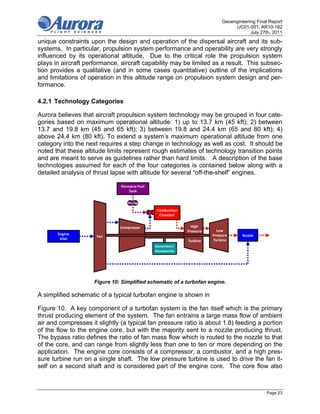
                     Figure 10: Simplified schematic of a turbofan engine.

A simplified schematic of a typical turbofan engine is shown in

Figure 10. A key component of a turbofan system is the fan itself which is the primary
thrust producing element of the system. The fan entrains a large mass flow of ambient
air and compresses it slightly (a typical fan pressure ratio is about 1.8) feeding a portion
of the flow to the engine core, but with the majority sent to a nozzle producing thrust.
The bypass ratio defines the ratio of fan mass flow which is routed to the nozzle to that
of the core, and can range from slightly less than one to ten or more depending on the
application. The engine core consists of a compressor, a combustor, and a high pres-
sure turbine run on a single shaft. The low pressure turbine is used to drive the fan it-
self on a second shaft and is considered part of the engine core. The core flow also


                                                                                                  Page 23
Geoengineering Final Report
                                                                                  UC01-001; AR10-182
                                                                                         July 27th, 2011
produces significant jet thrust. Most often the core and bypass flows are mixed in a sin-
gle nozzle, as shown in

Figure 10, but in some cases may be fed to separate nozzles.

Turbofan Propulsion System (up to 13.7 km, 45 kft)

An “off-the-shelf” turbofan propulsion system may be used to propel an aircraft intended
to operate at a maximum altitude of 45 kft or less. In terms of technology “off-the-shelf”
is meant to indicate that an existing turbofan engine would require little to no modifica-
tion to operate at these altitudes as most of these engines are designed to operate in
this range. These off-the-shelf engines most often run with kerosene-based jet fuels
such as Jet-A. Off the shelf engine development costs are minimal; costs simply in-
clude the cost of engines for the prototype aircraft. These costs are modeled using an
engine acquisition cost estimating relationship (CER) based on thrust, turbine inlet tem-
perature, and number of engines purchased.

Modified Turbofan Propulsion System (13.7 to 19.8 km, 45 to 65 kft)

The performance of many turbofan components, specifically the fan, compressor, and
combustor, are very sensitive to operational altitude and may ultimately limit the en-
gine’s operational ceiling. Fan and compressor pressure ratio and efficiency will de-
crease due to increased fluid dynamic losses as the pressure and Reynolds number
decreases. More specifically, flow separation at the blades and compressor instabili-
ties, such as surge, may become more prevalent. As combustor temperature and pres-
sure decreases it also becomes more difficult to maintain flame stability as chemical ki-
netics and vaporization rates slow significantly. As a result, the range of operating fuel-
to-air mixture ratios at which stable combustion may be achieved narrows, imposing lim-
its on engine throttleability and operating envelope.

To improve performance and extend the altitude ceiling above 45 kft to about 65 kft, ex-
isting turbofans may be modified through a combination of component development,
operational modification, and engine testing to characterize performance. For example,
the Rolls-Royce AE3007 engine, which is used on the Embraer 135/140/145 family of
aircraft, is modified (AE3007H) for high altitude operation up to 70 kft in the Global
Hawk unmanned aerial vehicle (UAV) primarily through the development of a modified
turbine section to increase flow capacity, and a modified Full-Authority Digital Engine
Control (FADEC) system.16 Testing of the modified engine showed that the engine is
capable of operating reliably up to 65 kft with constraints on throttle transients.16 This
example illustrates that it is combustion stability which most often dictates the altitude
limitations of a turbofan engine. Engine development costs in this category are modeled


 16
    Schelp, T. M., Corea, V. A., and Jeffries, J. K., “Development of the RQ-4A Global Hawk Propulsion
 System,” AIAA Paper 2003-4680, 39th AIAA/ASME/SAE/ASEE Joint Propulsion Conference and Exhi-
 bit, Huntsville, AL, 20-23 July, 2003.


                                                                                                 Page 24
Geoengineering Final Report
                                                                                  UC01-001; AR10-182
                                                                                         July 27th, 2011
by doubling the prototype aircraft engine acquisition CER cost to account for the addi-
tional testing and of the engine to verify its operating envelope and combustion stability.


Advanced Turbofan Propulsion System (19.8 to 24.4 km, 65 to 80 kft)

At about 65 kft the pressure in a modified turbofan combustor becomes too low to ade-
quately stabilize a kerosene-based flame. To extend operation to higher altitudes sup-
plemental fuels that provide high kinetic rates in low pressure air, such as pyrophorics
which ignite spontaneously in contact with oxygen, are needed to enhance flame stabili-
ty. Limited detail exists in the literature regarding the fuels used for this purpose and
the techniques by which they are introduced into the combustor, but it is believed that
such techniques are used on General Electric’s F118-GE-101 engine17 used in the U-2
aircraft, which has a stated altitude limit greater than 70 kft.18 Implementation of this
technique would require incorporation of tankage and a delivery system, FADEC modifi-
cation, advanced combustor development, and extensive test characterization. In addi-
tion, modifications to the fan, compressor, or turbine may be required to improve per-
formance at these high altitudes. For example, the fan used on the F118-GE-101 is
modified from the version used on its predecessor, the F110, for high altitude opera-
tion.17 Engine development costs in this category are assumed to be $1B plus double
the prototype engine acquisition CER cost. This accounts for cost of any R&D required
to modifying the engine as needed as well as extensive testing verifying the engines
operating envelope. Another consideration for operation at these altitudes is the ther-
mal stability of kerosene-based fuel. Alternative fuel blends may be required to prevent
freezing of the fuel and to maintain fuel stability as it pertains to engine cooling. The
F118-GE-101 runs on a special fuel, called Jet Propellant Thermally Stable (JPTS), to
combat these issues. As a result, fuel costs for operations in this over 65kft are doubled
to account for additional cost of JPTS-type fuels.

Alternative Propulsion System (above 24.4 km, 80 kft)

Above 80kft air density and oxygen concentrations become so low that even the ad-
vanced turbofan engines discussed above do not perform adequately. At these alti-
tudes alternative propulsion systems are required such as: a) rocket-based systems that
carry both fuel and oxidizer, which are burned in a combustion chamber and expanded
through a nozzle to produce jet thrust, b) a new turbofan system designed specifically
for high altitudes, i.e. fan, compressor, combustor, etc., and configuration to run on a
highly reactive alternative fuel, or c) a reciprocating engine system which burns a fuel
and oxidizer to drive a piston(s) which produces power to drive a propeller. In the case


 17
      General Electric F118, Jane’s Aero-Engines, Issue 22, 2007, pp. 593.
 18
   U.S. Air Force U-2S/TU-2S Factsheet, http://www.af.mil/information/factsheets/factsheet.asp?id=129,
 accessed April 27, 2010.


                                                                                                 Page 25
Geoengineering Final Report
                                                                                       UC01-001; AR10-182
                                                                                              July 27th, 2011
of the first two options these could be installed as a secondary propulsion system on the
aircraft and run only above 80 kft or so, while an advanced turbofan system could be
used to propel the vehicle from sea level up to this transitional altitude. Due to the low
air density levels at these high altitudes the inlet area required for a given thrust level at
high altitudes will provide significantly more air flow than is needed for the same thrust
at lower altitudes. Consequently, a smaller engine may be more appropriate for low alti-
tude operation. Aurora has been developing a propulsion concept called the Hydrazine
Decomposition Air Turbine (HDAT) to enable aircraft operation at these high altitudes.19
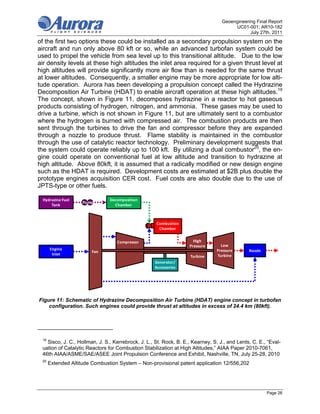
The concept, shown in Figure 11, decomposes hydrazine in a reactor to hot gaseous
products consisting of hydrogen, nitrogen, and ammonia. These gases may be used to
drive a turbine, which is not shown in Figure 11, but are ultimately sent to a combustor
where the hydrogen is burned with compressed air. The combustion products are then
sent through the turbines to drive the fan and compressor before they are expanded
through a nozzle to produce thrust. Flame stability is maintained in the combustor
through the use of catalytic reactor technology. Preliminary development suggests that
the system could operate reliably up to 100 kft. By utilizing a dual combustor20, the en-
gine could operate on conventional fuel at low altitude and transition to hydrazine at
high altitude. Above 80kft, it is assumed that a radically modified or new design engine
such as the HDAT is required. Development costs are estimated at $2B plus double the
prototype engines acquisition CER cost. Fuel costs are also double due to the use of
JPTS-type or other fuels.

 Hydrazine Fuel                Decomposition 
                    Pump
     Tank                        Chamber


                                                    Combustion 
                                                     Chamber


                                  Compressor                         High 
                                                                   Pressure       Low 
      Engine                                                                    Pressure      Nozzle
                        Fan
       Inlet                                                                    Turbine
                                                                    Turbine
                                                   Generator/
                                                   Accessories


Figure 11: Schematic of Hydrazine Decomposition Air Turbine (HDAT) engine concept in turbofan
    configuration. Such engines could provide thrust at altitudes in excess of 24.4 km (80kft).


 19
   Sisco, J. C., Hollman, J. S., Kerrebrock, J. L., St. Rock, B. E., Kearney, S. J., and Lents, C. E., “Eval-
 uation of Catalytic Reactors for Combustion Stabilization at High Altitudes,” AIAA Paper 2010-7061,
 46th AIAA/ASME/SAE/ASEE Joint Propulsion Conference and Exhibit, Nashville, TN, July 25-28, 2010
 20
      Extended Altitude Combustion System – Non-provisional patent application 12/556,202


                                                                                                       Page 26
Geoengineering Final Report
                                                                                 UC01-001; AR10-182
                                                                                        July 27th, 2011

4.2.2 Thrust Lapse

A typical turbofan engine maintains a fixed inlet area throughout its operational
envelope. For this reason, as altitude increases and air density decreases the mass
flow rate of air entering into the engine, and consequently its thrust, will decrease. This
phenomenon is well known and is commonly referred to as thrust lapse. Along with
general aircraft aerodynamic performance, thrust lapse is a primary contributor to defin-
ing the altitude limit of a particular aircraft. A turbofan thermodynamic model is used to
quantify the thrust lapse of several aircraft engines being considered as part of this
study and is used to guide aircraft analysis and design. To simplify the analysis engine
performance parameters found in the open literature are assumed to be constant
throughout the evaluated altitude range. As discussed above this is not the case, but
detailed engine performance numbers are not available.

Three engines are considered as part of this analysis: 1) the General Electric F118-GE-
101 used on the Lockheed U-2 ultra-high altitude surveillance aircraft, 2) the Rolls-
Royce BR725 turbofan which is planned for use in the Gulfstream G550/650 ultra-long
range business jet, 3) the Pratt & Whitney PW2040 used in the Boeing 757 civilian
transport and C-17 Globemaster III military transport planes, and 4) the Rolls-Royce
Trent 900 engine which is the lead engine for the Airbus A380 civilian transport aircraft.
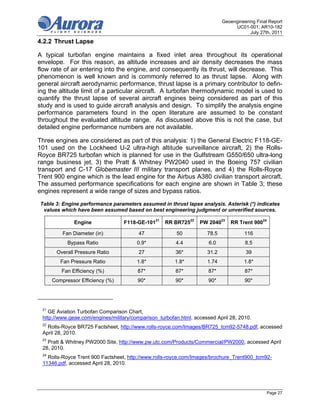
The assumed performance specifications for each engine are shown in Table 3; these
engines represent a wide range of sizes and bypass ratios.

Table 3: Engine performance parameters assumed in thrust lapse analysis. Asterisk (*) indicates
 values which have been assumed based on best engineering judgment or unverified sources.

              Engine              F118-GE-10121     RR BR72522    PW 204023    RR Trent 90024

          Fan Diameter (in)              47             50           78.5            116
            Bypass Ratio                0.9*            4.4           6.0             8.5
       Overall Pressure Ratio            27             36*          31.2             39
         Fan Pressure Ratio             1.8*            1.8*         1.74            1.8*
         Fan Efficiency (%)             87*             87*           87*             87*
      Compressor Efficiency (%)         90*             90*           90*             90*


 21
    GE Aviation Turbofan Comparison Chart,
 http://www.geae.com/engines/military/comparison_turbofan.html, accessed April 28, 2010.
 22
   Rolls-Royce BR725 Factsheet, http://www.rolls-royce.com/Images/BR725_tcm92-5748.pdf, accessed
 April 28, 2010.
 23
   Pratt & Whitney PW2000 Site, http://www.pw.utc.com/Products/Commercial/PW2000, accessed April
 28, 2010.
 24
   Rolls-Royce Trent 900 Factsheet, http://www.rolls-royce.com/Images/brochure_Trent900_tcm92-
 11346.pdf, accessed April 28, 2010.


                                                                                                Page 27
Geoengineering Final Report
                                                                                                   UC01-001; AR10-182
                                                                                                          July 27th, 2011

       Turbine Efficiency (%)                        88*                 88*          88*               88*
   Turbine Inlet Temperature (°F)                   2,200*             1,700*        2,200*           2,200*
     Sea Level Max Thrust (lbf)                     17,000             17,000        43,734           76,500
        Engine Weight (lbf)                         3,150              4,912*        7,160*           14,190

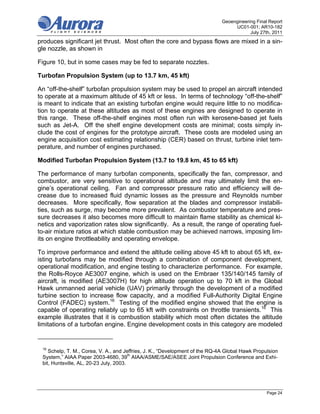
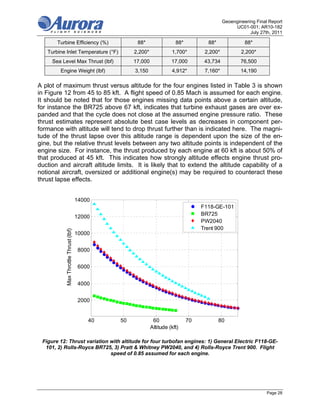
A plot of maximum thrust versus altitude for the four engines listed in Table 3 is shown
in Figure 12 from 45 to 85 kft. A flight speed of 0.85 Mach is assumed for each engine.
It should be noted that for those engines missing data points above a certain altitude,
for instance the BR725 above 67 kft, indicates that turbine exhaust gases are over ex-
panded and that the cycle does not close at the assumed engine pressure ratio. These
thrust estimates represent absolute best case levels as decreases in component per-
formance with altitude will tend to drop thrust further than is indicated here. The magni-
tude of the thrust lapse over this altitude range is dependent upon the size of the en-
gine, but the relative thrust levels between any two altitude points is independent of the
engine size. For instance, the thrust produced by each engine at 60 kft is about 50% of
that produced at 45 kft. This indicates how strongly altitude effects engine thrust pro-
duction and aircraft altitude limits. It is likely that to extend the altitude capability of a
notional aircraft, oversized or additional engine(s) may be required to counteract these
thrust lapse effects.


                                      14000
                                                                                    F118-GE-101
                                                                                    BR725
                                      12000
                                                                                    PW2040
                                                                                    Trent 900
          Max Throttle Thrust (lbf)


                                      10000


                                       8000


                                       6000


                                       4000


                                       2000


                                          40   50             60               70           80
                                                             Altitude (kft)

 Figure 12: Thrust variation with altitude for four turbofan engines: 1) General Electric F118-GE-
  101, 2) Rolls-Royce BR725, 3) Pratt & Whitney PW2040, and 4) Rolls-Royce Trent 900. Flight
                             speed of 0.85 assumed for each engine.


                                                                                                                  Page 28
Geoengineering Final Report
                                                                                      UC01-001; AR10-182
                                                                                             July 27th, 2011

4.2.3 Sulfuric Acid Impact on Aircraft

If sulfuric acid is chosen as the particulate material, there is a high likelihood that the
through the process of dispersing sulfuric acid into the atmosphere that the dispersing
aircraft and its turbofan engines will be subjected to relatively high concentrations of sul-
furic acid vapor/aerosols. This could have negative effects on engine performance,
component lifetimes, and maintenance costs. A mostly qualitative summary of the po-
tential effects that sulfuric acid may have on aircraft and engine components is pre-
sented in what follows.

As a brief aside, it should be noted that a large amount of data concerning the effects of
volcanic ash on engine performance was compiled following the Mt. Pinatubo eruption
in 1991.25 Ash particles, which are essentially very small pieces of rock, are found to
degrade turbofan performance through: 1) abrasion of the forward facing surfaces such
as fan and compressor blades which in some cases altered blade flow significantly
enough to produce a surge instability in the compressor, and 2) deposition of molten
ash on fuel nozzles, nozzle guide vanes, or turbine blades following heating past melt-
ing in the combustor. This molten ash was found to cool and solidify on engine compo-
nents and in many cases blocked fuel nozzle flow and turbine blade cooling flow. In
some cases, this blockage triggered engine overheating and/or shutdown.

Specific studies targeting the effects of sulfuric acid on turbofan engines are rarer. A
1990 study details the effects of prolonged exposure to sulfuric acid on aircraft acrylic
windshields, which results in accelerated crazing of the acrylic.26 Aircraft exterior polyu-
rethane paint also tends to fade more rapidly when exposed to sulfuric acid.25 Sulfuric
acid vapor and aerosols are more benign than volcanic ash in terms of impact damage
to forward facing surfaces, but prolonged exposure of fan and compressor blades to sul-
furic acid may result in material degradation. Typically fan and compressor blades are
manufactured from titanium alloys although some modern fan designs incorporate com-
posite construction. Engine seals, wiring, and hoses may also be susceptible to dam-
age from prolonged exposure to sulfuric acid.

Sulfuric acid will be chemically transformed at the high temperatures present in a gas
turbine combustor likely producing sulfur oxides such as sulfur dioxide, SO2, and sulfur
trioxide, SO3. These sulfur oxides may be further altered at these high temperatures
and deposit on turbines blades in the form of sulfate minerals, such as gypsum or anhy-
drite. These effects have been observed in the longer term following volcanic eruptions


 25
   Casadevall, T. J., De los Reyes, P. J., and Schneider, D. J., “The 1991 Pinatubo Eruptions and Their
 Effects on Aircraft Operations,” Fire and Mud: Eruptions and Lahars of Mount Pinatubo, Philippines,
 Edited by Newhall, C. G., and Punongbayan, R. S., Philippine Institute of Volcanology and Seismology,
 Quezon City, Philippines and University of Washington Press, Seattle and London, 1996, pp 1126.
 26
   Bernard, A., and Rose, Jr., W. I., “The Injection of Sulfuric Acid Aerosols in the Stratosphere by the El
 Chichon Volcano and its Related Hazards to the International Air Traffic,” Natural Hazards, Vol. 3,
 1990, pp. 56-67.


                                                                                                     Page 29
Geoengineering Final Report
                                                                                    UC01-001; AR10-182
                                                                                           July 27th, 2011
after the volcanic ash has largely settled out of the atmosphere.25 It should also be
noted that most aviation fuels contain some sulfur content, which is regulated to less
than 0.3% by mass and is in practice often less than 0.07% by mass.27 This limit is in
place due to concerns over the effects of sulfur oxides on downstream engine compo-
nents, specifically turbine blades which are manufactured from nickel superalloys. An
oxide coating is typically applied over the base turbine blade material to protect it from
the high temperature, oxidizing environment present in the turbine. Sulfur and sulfur-
based molecules are known to attack these coatings leading to corrosion as the base
blade material is directly exposed to the turbine environment.

Ingestion of sulfuric acid into the engine will increase the amount of sulfur oxides pro-
duced by the combustor and subsequently increase the susceptibility of critical engine
components to sulfur related degradation. The established limit on aviation fuel sulfur
content (0.3% by mass) is used to facilitate a first cut estimate of the limit on sulfuric ac-
id ingestion by the engine. The total mass of sulfur exiting a notional combustor is esti-
mated assuming that jet fuel with 0.07% sulfur by mass is burned with ambient air con-
taining varying levels of sulfuric acid, H2SO4, in the parts per million range (volume %).
It is assumed that the fuel and air are mixed at a fuel-to-air mass ratio of 0.035, which is
typical for modern gas turbine systems. The total air flow to the engine is adjusted
based on the H2SO4 content assuming a fixed engine inlet area and flight speed. Re-
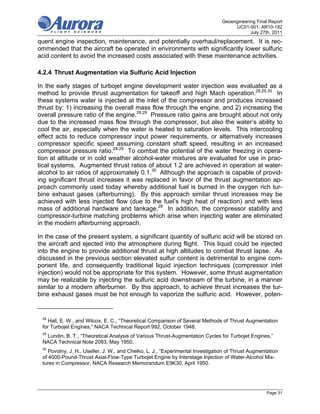
sults of the computation suggest that 0.3% by mass sulfur content is reached when at-
mospheric air contains approximately 70 ppm H2SO4, as shown in Table 4. Concentra-
tions expected at altitude during geoengineering operations are on the order of 0.01
ppm and pale in comparison to sulfate levels experienced by aircraft landing in polluted
regions such as Mexico City or Shanghai.

 Table 4: Variation in total sulfur mass exiting turbofan combustor with sulfuric acid levels in air.

                     Sulfuric Acid in Air (ppm)    Total Mass Sulfur/Mass Fuel (%)

                                  0                               0.07
                                 20                               0.14
                                 40                               0.20
                                 60                               0.27
                                 80                               0.33
                                 100                              0.40

This is an approximate estimate of allowable sulfuric acid ingestion limits. Prolonged
operation of the engine in environments exceeding this level will likely lead to accele-
rated deterioration of turbine blades and other components exposed to the combustor
exhaust gases. In addition, operation as these levels will likely necessitate more fre-


 27
      CRC Report No. 635, “Handbook of Aviation Fuel Properties,” Third Edition, 2004.


                                                                                                   Page 30
Geoengineering Final Report
                                                                                     UC01-001; AR10-182
                                                                                            July 27th, 2011
quent engine inspection, maintenance, and potentially overhaul/replacement. It is rec-
ommended that the aircraft be operated in environments with significantly lower sulfuric
acid content to avoid the increased costs associated with these maintenance activities.

4.2.4 Thrust Augmentation via Sulfuric Acid Injection

In the early stages of turbojet engine development water injection was evaluated as a
method to provide thrust augmentation for takeoff and high Mach operation.28,29,30 In
these systems water is injected at the inlet of the compressor and produces increased
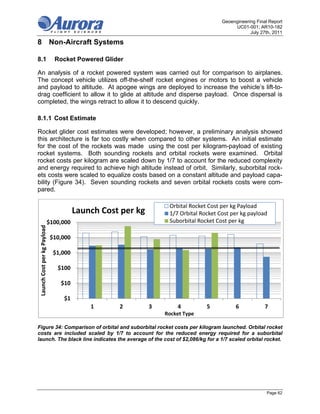
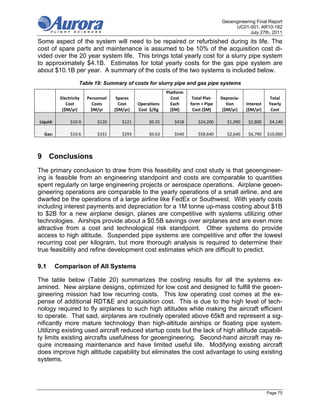
thrust by: 1) increasing the overall mass flow through the engine, and 2) increasing the
overall pressure ratio of the engine.28,29 Pressure ratio gains are brought about not only
due to the increased mass flow through the compressor, but also the water’s ability to
cool the air, especially when the water is heated to saturation levels. This intercooling
effect acts to reduce compressor input power requirements, or alternatively increases
compressor specific speed assuming constant shaft speed, resulting in an increased
compressor pressure ratio.28,29 To combat the potential of the water freezing in opera-
tion at altitude or in cold weather alcohol-water mixtures are evaluated for use in prac-
tical systems. Augmented thrust ratios of about 1.2 are achieved in operation at water-
alcohol to air ratios of approximately 0.1.30 Although the approach is capable of provid-
ing significant thrust increases it was replaced in favor of the thrust augmentation ap-
proach commonly used today whereby additional fuel is burned in the oxygen rich tur-
bine exhaust gases (afterburning). By this approach similar thrust increases may be
achieved with less injected flow (due to the fuel’s high heat of reaction) and with less
mass of additional hardware and tankage.28 In addition, the compressor stability and
compressor-turbine matching problems which arise when injecting water are eliminated
in the modern afterburning approach.

In the case of the present system, a significant quantity of sulfuric acid will be stored on
the aircraft and ejected into the atmosphere during flight. This liquid could be injected
into the engine to provide additional thrust at high altitudes to combat thrust lapse. As
discussed in the previous section elevated sulfur content is detrimental to engine com-
ponent life, and consequently traditional liquid injection techniques (compressor inlet
injection) would not be appropriate for this system. However, some thrust augmentation
may be realizable by injecting the sulfuric acid downstream of the turbine, in a manner
similar to a modern afterburner. By this approach, to achieve thrust increases the tur-
bine exhaust gases must be hot enough to vaporize the sulfuric acid. However, poten-


 28
   Hall, E. W., and Wilcox, E. C., “Theoretical Comparison of Several Methods of Thrust Augmentation
 for Turbojet Engines,” NACA Technical Report 992, October 1948.
 29
  Lundin, B. T., “Theoretical Analysis of Various Thrust-Augmentation Cycles for Turbojet Engines,”
 NACA Technical Note 2083, May 1950.
 30
    Povolny, J. H., Useller, J. W., and Chelko, L. J., “Experimental Investigation of Thrust Augmentation
 of 4000-Pound-Thrust Axial-Flow-Type Turbojet Engine by Interstage Injection of Water-Alcohol Mix-
 tures in Compressor, NACA Research Memorandum E9K30, April 1950.


                                                                                                    Page 31
Geoengineering Final Report
                                                                              UC01-001; AR10-182
                                                                                     July 27th, 2011
tial thrust increases provided by elevated nozzle mass flow will be counteracted by the
attendant decrease in total temperature associated with liquid vaporization and heating.

To evaluate potential thrust increases due to sulfuric acid injection the turbofan analysis
model was modified to analyze the effects of liquid injection downstream of the turbine.
A zero dimensional energy balance approach is employed whereby turbine exhaust gas
and injected sulfuric acid where assumed to mix completely in an arbitrarily large control
volume, i.e. neglecting fluid/energy transport times. The temperature of the gas mixture
exiting the control volume is evaluated based on fluid inlet enthalpies including sulfuric
acid heat of vaporization (511 kJ/kg) and fluid heat capacity data. Figure 13 shows the
thrust augmentation possible with sulfuric acid injection downstream of the turbine for a
PW2040 engine operating at 13.7 km (45 kft). At a sulfuric acid to air mass ratio of
0.086, or a sulfuric acid injection rate of 17 kg/s (37.5 lbm/s), a maximum thrust level of
about 35.5 kN (7,946 lbf) is achievable, which is about 1.08 times the engine’s base
thrust (32.8 kN; 7,370 lbf) at this altitude. At mass ratio greater than this the sulfuric ac-
id only partially vaporizes, and the thrust decreases from the maximum value as a re-
sult. It should be noted that the behavior of this plot is highly dependent upon the prop-
erties of the injected liquid, particularly its heat of vaporization. For instance, if the liquid
is assumed to be water (heat of vaporization = 2258 kJ/kg) the augmented thrust is ac-
tually lower than the base thrust for all injected mass flow levels. This is because the
drop in gas temperature which results from fully vaporizing the water detracts from the
benefit of added mass flow.

As previously mentioned the sulfuric acid release rate range being considered for this
study is between 0.003 and 0.1 kg/m. At 13.7 km (45 kft) and a flight Mach number of
0.85 that equates to a sulfuric acid injection mass flow rate range between about 0.73
and 24.9 kg/s. For the PW2040 engine the peak thrust achieved via sulfuric acid injec-
tion actually occurs at 17 kg/s per engine (or 0.07 kg/m release rate) which is just over
the specified range for a dual engine aircraft. Prior analysis suggests that between
12.2-15.2 km (40-50 kft) the thrust lapse associated with the PW2040 engine is about
4.3 kN/km (300 lbf/kft). Assuming that the engine is installed on a notional aircraft that
requires 32.8 kN (7,370 lbf) thrust for steady level flight at 13.7 km (45 kft), and that the
1.08 thrust augmentation ratio is constant with altitude this analysis suggests that sulfur-
ic acid injection could be used to maintain this thrust level up to 14.3 km (47 kft), there-
by extending the aircraft’s altitude capability by 610 m (2,000 ft).

While the sulfuric acid injection technique described above does provide some ex-
tended altitude capability, it does not appear to provide a substantial enough benefit to
warrant its implementation in a turbofan engine for that purpose. However, injection of
the sulfuric acid into the exhaust in this way may represent an efficient method by which
to disperse it into the atmosphere. This analysis suggests that even at the maximum
sulfuric acid release rate under consideration (24.9 kg/s) the thrust level produced by
the engine is not adversely affected (1.05 thrust ratio).


                                                                                             Page 32
Geoengineering Final Report
                                                                                                   UC01-001; AR10-182
                                                                                                          July 27th, 2011


                                               1.1

                                              1.09

                                              1.08


                Augmented/Base Thrust Ratio
                                              1.07

                                              1.06

                                              1.05

                                              1.04

                                              1.03

                                              1.02

                                              1.01

                                                1
                                                     0   0.05           0.1            0.15    0.2
                                                                H2SO4/Air Mass Ratio


Figure 13: Thrust augmentation possible with sulfuric acid injection aft of turbine for PW2040 en-
 gine operating a 13.7 km (45 kft). At H2SO4/Air mass ratios greater than 0.086 sulfuric acid does
                                         not fully vaporize.

5 Analysis of Existing Aircraft and Results

5.1   Assumptions specific to analysis of existing aircraft

Analysis of existing aircraft focused on estimating the cost of acquiring and operating
new or used aircraft. If fleet size represents a large portion of an aircraft’s total produc-
tion, new aircraft price is used to calculate acquisition costs; otherwise a survey of the
used market provided typical used acquisition costs. Costs of conversion of existing
aircraft for the geoengineering mission are estimated based on costs of converting pas-
senger aircraft to cargo aircraft. For modified versions of existing aircraft, costs of addi-
tional engines are included. A summary of acquisition and modification costs is in-
cluded in Table 5.


                                                                                                                  Page 33
Geoengineering Final Report
                                                                                                UC01-001; AR10-182
                                                                                                       July 27th, 2011
       Table 5: Acquisition and modification costs used in analysis of existing aircraft costs.

                                           Gulfstream      Gulfstream      Gulfstream
                Boeing         Boeing                                                        Boeing        Rockwell
                                             C-37A           C-37A           C-37A
                747-400         F-15                                                          C-17           B-1B
                                             (Used)          (New)         (Modified)

  FY10
                              $50,000,00   $22,750,00      $59,900,00      $54,900,00      $240,000,00    $300,000,00
Acquisition   $28,000,000
                                   0            0               0               0               0              0
  Cost:
                                                                           $5M credit
                                            1997 G-V
              1999 B747-                                     New Air-      for selling
  Notes:                      Estimated     with 5672                                       New cost       New cost
                 40031                                     frame Cost       OEM en-
                                           total time32
                                                                             gines.
   FY10
                                           $10,000,00      $10,000,00      $20,000,00
Modifica-     $30,459,000     $5,000,000                                                   $50,320,000    $10,000,000
                                                0               0               0
tion Cost:
               USAF Civil                                                    New En-
                                           Tank instal-    Tank instal-
                Reserve                                                    gines. Tank
                                            lation, dis-    lation, dis-
               Fleet pas-                                                  installation,                   $10M For
                               Custom        pensers,        pensers,                      Four $11.3M
              senger jet to                                                dispensers,                    integration
                              drop tanks      possible        possible                     engines plus
  Notes:       cargo con-                                                     possible                     of tanks,
                               with dis-     fuel tank       fuel tank                      $5M for in-
                version                                                      fuel tank                     sprayers,
                                penser       modifica-       modifica-                       tegration.
              cost(convert                                                   modifica-                        etc.
                                           tion to carry   tion to carry
                ed from                                                    tion to carry
                                              payload         payload
               1983 $) 33                                                     payload


It should be noted that used aircraft will require more maintenance than a new aircraft.
As the aircraft ages, the maintenance burden will increase until the aircraft’s usable life
has been reached or the economics of keeping the aircraft in service are no longer via-
ble. For this reason, used aircraft may need more frequent replacement than new air-
craft placing upward pressure on yearly total costs.

5.2     Choice of Platforms

To limit scope to a manageable number of platforms, five airplane types are down se-
lected and a single aircraft from each type was analyzed in detail. These types allow
cost estimates to be extended to a large number of airplanes. For example, while a
Gulfstream G550/650 is used to analyze large business jet costs in detail, the cost


  31
     1999 Boeing 747-400 Aircraft for sale on http://www.aviatorsale.com :
  http://www.aviatorsale.com/aix6882/
  32
     1997 Gulfstream G-V for sale on http://www.aviatorsale.com:
  http://www.aviatorsale.com/aix7303/
  33
     Determining the Boeing 747 Conversion Costs for the Civil Reserve Air Fleet Enhancement Program
  http://oai.dtic.mil/oai/oai?verb=getRecord&metadataPrefix=html&identifier=ADA134446 Accessed
  1/15/2010.


                                                                                                               Page 34
Geoengineering Final Report
                                                                                UC01-001; AR10-182
                                                                                       July 27th, 2011
numbers are also representative of most aircraft in this class such as the Dassault Fal-
con 900 or Bombardier Global 5000.

Type              Representative   Properties               Availability
                  Airplane


Large Cargo       Boeing 747       • Large cargo capacity   Dozens available
Aircraft          (-200)           • Long range             used, approx. 600
                                   • Efficient              built


High Perfor-      Boeing C-17      • Large cargo capacity   Available new
mance Airlifter                    • Short range            while production
                                   • High lift wing         line remains open


Supersonic        Rockwell B-1B    • Large cargo capacity   Probably not
Bomber                             • Long range             available, 100 built
                                   • High altitude          (Russian Tu-160
                                   • Sensitive technology   Blackjacks may be
                                                            available, 35 built)


Business Jet      Gulfstream       • Large cargo capacity   Available used
                  G550/650           OR fuel capacity       and new, approx.
                  (C-37A)          • Well suited to high    190 built
                                     altitude


High Perfor-      MacDonnell       • Large Payload          Questionable
mance Zoom        Douglas F-15     • Fast time-to-climb     availability, ap-
Climber                            • High Altitude          prox. 1200 built.
                                   • High maintenance       Numerous similar
                                     and fuel costs         in storage


5.3    Cost Estimates

5.3.1 Large Cargo Type

Large passenger and cargo transport airplanes are well suited to geoengineering due to
their size and affordability but provide limited usefulness due to a lack of high-altitude
capability. Regional operations allow the Boeing 747 to operate from 1 or more bases
and carry a large payload of 128,000 kg (less than max capacity to allow for better per-
formance at max altitude) per sortie, requiring 47 sorties per day from the fleet. At a re-
lease rate of 0.03 kg/m flown, mission lengths are short enough to allow a fleet of 14
747s to execute the 47 sorties a day. By limiting leg length to the 1,600 km required to


                                                                                               Page 35
Geoengineering Final Report
                                                                          UC01-001; AR10-182
                                                                                 July 27th, 2011
hit the preferred dispersal rate, fuel burn is kept to 0.016 kg/m per aircraft. Altitude is
limited to 13.7 km (45kft). Costs are as follows:

           Aircraft Acquisition Cost: $0.8 Billion FY10 USD
           Yearly Operations cost: $1.0 Billion FY10 USD
           Yearly Total Cost (including depreciation and interest): $1.1 Billion FY10
            USD

5.3.2 High Performance Airlifter Type

The high performance airlifter type in stock configuration is similar to the large cargo
type, so it is only analyzed with modifications to extend its maximum altitude. Details
are discussed in section 5.4.2.

5.3.3 Supersonic Dispersal (Supersonic Bomber Type)

Supersonic high altitude bombers are examined for completeness, though there are
significant challenges associated with employing this type of aircraft for geoengineering.
While their high speed makes them ideal for transit CONOPs and they have large payl-
oads, issues include creating sonic booms over land, appearing as an aggressor when
entering airspace, and the expense and sensitivity of their technology.

The Rockwell B-1B has an altitude capability in excess of 18.3 km (60kft). When oper-
ating from 4 bases and flying transit legs between the bases, payload is 60,000 kg. A
fleet of 28 aircraft are required, conducting 45 sorties a day. Release rates, driven
down by the leg length between bases, are 0.01 kg/m flown. Fuel burn is 0.0025 kg/m
flown. The availability of this type of aircraft is questionable. While 100 B-1s were built;
it is not likely the US Government would sell them. Russian Tu-160 may be available
for purchase, or potentially either aircraft could be put back into limited production. With
no second hand market, the new aircraft cost is used for acquisition cost estimates.
Costs are high:

           New Aircraft Acquisition Cost: $8.7 Billion FY10 USD
           Yearly Operations cost: $3.6 Billion FY10 USD
           Yearly Total Cost (including depreciation and interest): $4.7 Billion FY10
            USD

5.3.4 Business Jet Type

Business jets are designed for higher altitude flight above commercial aircraft traffic but
are expensive to purchase and operate. Their large fuel capacity for long range flight
allows them to carry large volumes of geoengineering payload when flying short dura-
tion missions. The Gulfstream G550/650 can operate regionally from 1 or more bases
and carry 16,300 kg of payload per sortie, requiring 168 sorties per day. At a release
rate of 0.04 kg/m flown, mission duration is short requiring a fleet of 66 aircraft. Busi-


                                                                                         Page 36
Geoengineering Final Report
                                                                          UC01-001; AR10-182
                                                                                 July 27th, 2011
ness jets are efficient, fuel burn is 0.0014 kg/m flown. Altitude is limited to 15.5 km
(51kft). Costs are as follows:

           New Aircraft Acquisition Cost: $2.1 Billion FY10 USD
           Yearly Operations cost: $2.1 Billion FY10 USD
           Yearly Total Cost (including depreciation and interest): $2.4 Billion FY10
            USD

5.3.5 High performance Zoom Climber Type

Large numbers of small, high-performance interceptor aircraft have been built and are in
service around the world. Many U.S. aircraft are in storage at Davis-Montham Air Force
Base but the availability and flight-readiness of these airframes is unknown. Still, with
many older aircraft being sold to other nations and new aircraft constantly coming online
to replace old ones, the availability of aircraft such as the F-15, F-4, F-111, and F-14s is
good. The Boeing F-15 has an altitude capability estimated at 25.9 km (85k ft) in a
zoom climb. Carrying a payload of 4,000 kg and minimal fuel load to reduce weight,
671 sorties per day are required. Due to the high performance of this aircraft type the
entire sortie takes only 23 minutes requiring a fleet of 133 aircraft. At altitude, a 3
minute supersonic cruise leg allows the F-15 to deploy the particulate at a rate of 0.037
kg/m flown. Climb performance requires the use of afterburners so fuel burn is 0.025
kg/m flown. Cost of a used high performance interceptor is difficult to determine, a val-
ue of $55M per aircraft is used in cost calculations. These aircraft are also maintenance
intensive. Costs are as follows:

           Used Aircraft Acquisition Cost: $7 Billion FY10 USD
           Yearly Operations cost: $7.6 Billion FY10 USD
           Yearly Total Cost (including dep. and int.): $8.4 Billion FY10 USD

5.4   Modifications to Existing Aircraft

                                                           Figure 14: Mach number capability
                                                           for the Gulfstream G550/650. The
                                                          typical cruise condition of Mach 0.8
                                                            at 40,000 ft is shown by the blue
                                                            circle. Aerodynamically, altitude
                                                              can be increased to 60,000 ft.

                                                          As discussed in section 4.2,
                                                          propulsion for high altitude air-
                                                          craft is a challenge. While most
                                                          aircraft surveyed have aerody-
                                                          namic capability for additional
                                                          altitude, thrust lapse of their
                                                          engines limits the thrust availa-


                                                                                         Page 37
Geoengineering Final Report
                                                                                        UC01-001; AR10-182
                                                                                               July 27th, 2011
ble to them at higher altitudes preventing them from flying higher.

5.4.1 BizJet Class

The Gulfstream G550/650 is
designed for fast flight, close
to the speed of sound, at al-
titudes of up to 15.5 km
(51kft). As shown in Figure
14 the G550/650s coffin
corner is at about 19.8 km
(65kft). Operating at this alti-
tude requires the aircraft to
fly at a high lift coefficient to
generate enough lift to sus-
tain altitude. This causes
the aircraft to be less effi-
cient due to increased in-
duced drag requiring more
thrust.

  Figure 15: The Gulfstream G550/650’s two Rolls-Royce BR725 engines produce the 2,500 lb of
 thrust each required to maintain speed at 40,000 ft. When altitude is increased to 60,000 ft over
 3,100 lb thrust is required to maintain speed (the aircraft is less efficient aerodynamically at this
         altitude). The BR725s produce only 1,000 lb thrust at 60,000 due to thrust lapse.

The thrust available from the G550/650’s Rolls-Royce BR725 engines at 12.1 km (40kft)
is about 20% of the sea level thrust of the engines. As altitude is increased thrust laps
reduces the available thrust from the BR725s to <10% of the sea level thrust (Figure
15). Thus significantly larger or more powerful engines are required. Table 6 illustrates
the propulsion requirements at several operating points.
                            Table 6: Gulfstream G550/650 re-engining comparison


                                 Gulfstream                     Gulfstream              Extended Altitude
                             Initial Cruise (41kft)         Final Cruise (51kft)             (60kft)

      Lift Coefficient               0.44                           0.47                        1.25
     Drag Coefficient                0.024                          0.026                       0.08
            L/D                      18.4                           18.4                         14
   Thrust Required (lb)              4,800                          3,200                       6200
   Available Thrust (lb)             5,000                          3,400                       2000

A large high bypass ratio turbo fan engine is one possible choice for re-engining of the
G550/650 (see Table 7). The efficiency of a high bypass engine, such as the Pratt &
Whitney PW2040 used on the C-17 and Boeing 757) makes it desirable from a fuel burn


                                                                                                       Page 38
Geoengineering Final Report
                                                                            UC01-001; AR10-182
                                                                                   July 27th, 2011
stand point, but its large diameter and weight make the feasibility of this option ques-
tionable. It is more desirable to choose a low bypass engine that exhibits less thrust
lapse with altitude. A survey of potential engines was conducted and no low bypass
engines produced enough thrust at altitude without the use of an afterburner. While the
selected Pratt & Whitney F100 is similar in weight to the original BR725, the high fuel
consumption of the afterburning engine reduces payload of the G550/650.

              Table 7: Potential re-engining options for the Gulfstream G550/650


The G550/650 fitted with F100 engines can deliver 13,600 kg of payload to 18.2 km
(60kft). A total of 43 aircraft are required to operate 200 sorties per day. A release rate
of 0.034 kg/m flown is achieved while fuel burn is 0.004 kg/m flown, almost 4 times that
of the original G550/650. Costs, including cost of new engines, are as follows:

           New Aircraft Acquisition Cost: $3.2 Billion FY10 USD
           Yearly Operations cost: $2.5 Billion FY10 USD
           Yearly Total Cost (including depreciation and interest): $2.7 Billion FY10

5.4.2 High Performance Airlifter Type

Military airlifters appear to be promising geoengineering aircraft due to their large cargo
capacity and high lift aerodynamics designed to allow them to takeoff from short run-


                                                                                           Page 39
Geoengineering Final Report
                                                                           UC01-001; AR10-182
                                                                                  July 27th, 2011
ways. Analysis of the Boeing C-17 showed that altitude capability is limited by engine
thrust (


Figure 16) which drops by 50% as altitude is increased from 13.7 km (45kft) to 18.2 km
(60kft).


                                                          Figure 16: The Boeing C-17 requires
                                                           about 7,500 lb of thrust from each
                                                           engine at cruise. When increasing
                                                          altitude (along black dashed line) to
                                                          60,000 ft, thrust available from each
                                                           PW2040 engine drops to 3,500 lbs
                                                           (blue circle). A doubling of availa-
                                                           ble thrust (green circle) is required
                                                             to maintain altitude at 60,000 ft.

                                                        Adding four more engines, no-
                                                        tionally PW2040s or a lower by-
                                                        pass engine, provides the C-17
                                                        with enough thrust to achieve an
                                                        altitude of 18.2 km (60kft). Op-
erating regionally on short duration missions, payload is 45,000 kg requiring 60 sorties
per day performed by a fleet of 24 aircraft. The short range of the C-17 combined with
the additional fuel consumption of the 8-engine drives release rates to 0.06 kg/m flown,
while fuel burn is 0.025 kg/m flown. Costs, including acquisition and integration costs of
additional engines are:

           New Aircraft Acquisition Cost: $7.0 B
           Yearly Operations cost: $2.8 Billion
           Yearly Total Cost (including depreciation and interest): $3.6 Billion FY10

5.5   Conclusions

Existing Systems are optimized to transport a payload quickly and efficiency over a long
distance. They are not optimized for high altitude flight and therefore are poorly suited
to the geoengineering mission. Operating existing aircraft at their ceiling, or beyond
with expensive modifications, requires lightly loading them driving fleet size up. The
small zoom climber type does have high altitude capability, but its size drives fleet size
well over 100 aircraft and their fuel consumption makes operations costs the highest of
all airplane options examined. Supersonic bomber aircraft provides the payload and
altitude capability required for geoengineering but the feasibility of acquiring and operat-
ing them is questionable and costs are high.


                                                                                          Page 40
Geoengineering Final Report
                                                                                                                             UC01-001; AR10-182
                                                                                                                                    July 27th, 2011
Costs grow rapidly as altitude is increased. The yearly cost (including operations, de-
preciation, and interest) of regional CONOPs increases by $0.85B for every 1.5 km
(5,000 ft) increase in altitude (Figure 17). This means moving from the 12.1 km (40kft)
operating altitude of most commercial airliners, to 19.8 km (65kft) represents an in-
crease in yearly cost of $4.25B.

                                                            Yearly Total Cost vs Altitude (Existing Systems)
                                                 $12
                                                 $10
               Yearly Total Cost  ($ Billions)


                                                                                                            F-15

                                                  $8                                                          y = 0.17x ‐ 6.3
                                                             y = 0.0055x + 5.10
                                                                                 C-37A (Mod.)
                                                  $6            C-37A
                                                                747                        B-1B
                                                  $4                                  C-17(Mod.)
                                                             C-37A                   C-37A (Mod.)
                                                  $2                                                Transit Distribution
                                                                 747                                Regional Distribution
                                                  $0
                                                       40         50            60           70        80          90         100
                                                                                        Altitude (kft)

Figure 17: Plot of yearly total cost (operations, depreciation, and interest) for the existing aircraft
                                         systems examined.

A summary of all the existing systems examined is included below in Table 8:

        Table 8: Summary of Fleet, Operations, and Yearly costs for all existing systems

                                                                                 Development                         Yearly Total
                                                                                 and Acquisi-                       Cost (Includ-
                                                                     Altitude     tion Costs         Total Ops      ing Dep. and          Disper-
          Description                                                  (kft)         ($B)            Cost ($B)          Int.)              sion

     Boeing 747-400 Class                                               45               $0.82         $1.00               $1.13         Regional
    Gulfstream C-37A Class                                              45               $2.16         $2.15               $2.50         Regional
   Modified Gulfstream C-37A                                            60               $3.23         $2.37               $2.89         Regional
     Modified Boeing C-17                                               60               $6.97         $2.79               $3.91         Regional

       Boeing F-15 Class                                                85               $7.32         $7.60               $8.77         Regional
         747-400 Class                                                  45               $2.81         $4.49               $4.94          Transit
    Gulfstream C-37A Class                                              45               $8.39         $4.28               $5.63          Transit
   Modified Gulfstream C-37A
             Class                                                      60               $7.77         $4.71               $5.96          Transit
         Rockwell B-1B                                                  65               $8.68         $3.68               $5.07          Transit

The cost breakdown for the various systems varied depending on the type. For most
types, personnel costs dominated operations costs. The high maintenance zoom


                                                                                                                                            Page 41
Geoengineering Final Report
                                                                                  UC01-001; AR10-182
                                                                                         July 27th, 2011
climber support personnel costs are almost 50% of operations costs. The large cargo
transports high gross weight drives flight crew costs up, accounting for 35% of opera-
tions costs. The high fly-away cost of the Gulfstream G550/650 drives up the price of
spare parts, causing them to account for 30% of operations costs. The breakdown of
costs for each system is included below in Table 9.

           Table 9: Breakdown of yearly operations an, depreciation, and itnerest costs

                                                                    Total
                                                           Flight   Yearly                    Yearly Total
                              Support     Fuel    Spares   Crew      Ops      Depreciation   Cost (Includ-
                             Personnel    Costs    Cost    Costs     Cost     and Interest   ing Dep. and
       Description           Costs ($B)    ($B)    ($B)     ($B)     ($B)      Cost ($B)       Int.) ($B)
  Boeing 747-400 Class,
         Regional              $0.19      $0.40   $0.28    $0.18    $1.00        $0.13           $1.13
 Gulfstream C-37A Class,
         Regional              $0.56      $0.19   $0.73    $0.95    $2.15        $0.35           $2.50
Modified Gulfstream C-37A,
         Regional              $0.21      $0.10   $0.80    $1.04    $2.37        $0.52           $2.89
  Modified Boeing C-17,
         Regional              $0.34      $0.91   $1.38    $0.23    $2.79        $1.12           $3.91
   Boeing F-15 Class,
         Regional              $4.57      $1.07   $1.04    $1.66    $7.60        $1.18           $8.77
      747-400 Class,
          Transit              $0.79      $2.16   $1.41    $0.18    $4.49        $0.45           $4.94
 Gulfstream C-37A Class,
          Transit              $1.14      $0.54   $1.91    $0.96    $4.28        $1.35           $5.63
Modified Gulfstream C-37A
       Class, Transit          $0.44      $0.27   $2.10    $1.06    $4.71        $1.25           $5.96
      Rockwell B-1B,
          Transit              $0.43      $0.37   $2.75    $0.17    $3.68        $1.40           $5.07

Existing aircraft offer a cost-effective way to begin a geoengineering campaign for mi-
nimal upfront costs, but there are trade-offs to employing used aircraft. The aging air-
craft require increasing maintenance, driving up operations costs the longer they remain
in service. It is unlikely a used aircraft will be safe and economical to operate for a 20-
year geoengineering effort. The cost impact of more frequent aircraft replacement is
shown in Figure 18 below.


                                                                                                 Page 42
Geoengineering Final Report
                                                                                                 UC01-001; AR10-182
                                                                                                        July 27th, 2011

                                        B747 Total Yearly Cost (Including Depreciation, 
                                                           Interest)
                                      $3.00
                                      $2.50


                 Total Yearly Cost 
                                      $2.00


                    ($Billions)
                                      $1.50
                                      $1.00
                                      $0.50
                                      $0.00
                                              0         5        10       15           20   25
                                                  Years between aircraft replacement

Figure 18: Used aircraft may have diminished useful life remaining. The impact of more frequent
                    aircraft replacement on total yearly cost is shown above.

6 New Aircraft Design
The analysis of new aircraft designs for the geoengineering mission was an in depth
look at what design would be the most affordable for geoengineering operations. Typi-
cally an aircraft is designed for a particular mission, and is optimized for a primary oper-
ating point, such as cruise for a commercial transport. Dozens of aircraft design para-
meters are fine tuned to optimize the aircraft for the mission. These translate to an infi-
nite spectrum of aircraft designs for a given operating point, each with specific RDT&E,
acquisition, and operations costs. These design parameters are interdependent and
must be carefully balanced to obtain a design that closes and fulfils the mission.

To examine the design spectrum for geoengineering, Aurora Flight Sciences utilized an
in-house aircraft design and sizing code originally developed to look at high efficiency
transport aircraft. This code was integrated with the CERs presented in section 3.1 and
driven by a parametric analysis software package called iSight (Figure 19).


                                                                                                                Page 43
Geoengineering Final Report
                                                                                UC01-001; AR10-182
                                                                                       July 27th, 2011


 Figure 19: iSight Optimizer design, including a top level Altitude Loop with a nested Design Of
Experiments block (DOE) to vary aircraft input parameters. The specific mission, based on payl-
oad and release rate is determined by a Matlab Range Definition script which feeds the mission
 profile into an Aircraft Optimizer. The optimizer fine tunes the aircraft to find a closed design,
                     then passes inputs to an Excel based Cost Analysis tool.

A top level loop in iSight steps through 6 altitudes, calling a Design of Experiment
(DOE) that steps through 32 combinations of airplane payload, propulsion type, and
number of engines. The range of each input is included below (Table 10).


                       Table 10: Exploration variable inputs to iSight DOE

                  Exploration Variable           Lower Limit          Upper Limit
                        Altitude                   40,000 ft           100,000 ft
                        Payload                   10,000 kg            100,000 kg
                   Number of Engines                   2                     8
                   Propulsion System               Propeller            Turbofan

A Matlab script is used to determine the mission profile for each set of inputs. Cruise
altitude dictated time-to-climb and time-to-descend. Payload mass dictated range
based on the requirement to release payload at 0.03 kg/m flown. With the mission de-
fined, the aircraft optimizer utilized a genetic algorithm to design a spectrum of aircraft
for each combination of inputs. A total of 1,200 designs are examined for each altitude
and combination of inputs. Parameters including wingspan, wing aspect-ratio, wing


                                                                                               Page 44
Geoengineering Final Report
                                                                                   UC01-001; AR10-182
                                                                                          July 27th, 2011
thickness, wing sweep, thrust-to-weight ratio, fuel fraction, payload fraction, cruise
speed are varied. This translates to a design space of over 230,400 individual aircraft
designs (6x32x1200). This analysis was run for 3 yearly up-masses, 1M tonnes, 3M
tonnes, and 5M tonnes. Designs that violated the range requirements or lacked the
excess power to climb to altitude in a reasonable amount of time are discarded. A total
of over 300 airplane configurations successfully closed and completed the mission at
various altitudes for varying costs. These airplane configurations are then ranked by
cost.

6.1   New Aircraft Assumptions

The analysis of new aircraft platforms assumed a 20-year aircraft design life, consisting
of approximately 7,000 flight hours per year or about 2,000 cycles. This is comparable
to a Boeing 737 with a design life of about 150,000 hours and 75,000 cycles. Aircraft
designs are optimized by depreciating acquisition costs over this 20-year life.

6.2   Uncertainty Analysis

An uncertainty analysis was performed on aircraft costs estimates. The following
ranges of uncertainty are established for the inputs to the CERs. These uncertainties
are based on engineering judgment and historic trends for aircraft cost prediction in the
conceptual design phase.

      Table 11: Acquisition/RDT&E uncertainties (top) and operations uncertainties (bottom)

                             Uncertainty in CER Inputs (Acquisition)

                                    Wempty                  +/-         10%

                                  Vmax (fps)                +/-          20

                                     Mmax                   +/-         0.05

                          Turbine Inlet Temp (deg R)        +/-         100

                                  Thrust (lb)               +/-         1000

                              Number Produced               +/-         10%


                             Uncertainty in CER Inputs (Operations)
                                Block Time (min)                  +/-         40
                                 Takeoff Weight                   +/-     10%
                                  Fuel Cost ($)                   +/-     0.06
                               Block Radius (Nmi)                 +/-     305
                               Flight Speed (knots)               +/-         12
                               Block Speed (knots)                +/-         12


                                                                                                  Page 45
Geoengineering Final Report
                                                                           UC01-001; AR10-182
                                                                                  July 27th, 2011

                                  MMH/FM                      +/-    50%


6.3   Cost Estimates

Airplane RDT&E and acquisition costs as well and upper and lower uncertainty bounds
are shown in the following plots (Figure 20) for 1M, 3M, and 5M tonnes. The optimized
aircraft design is similar to that of a Gulfstream G200, so that aircraft was used to com-
pare acquisition costs. It is apparent that engine costs above 19.8 km (65kft) increase
RDT&E and acquisition costs significantly.


Figure 20: New-design airplane RDT&E and Acquisition cost estimates for 1M, 3M, and 5M tonnes
       per year up-mass. The upper and lower uncertainty bounds shown with fine lines.

Operations costs are plotted Figure 21 for 1M, 3M, and 5M tonnes along with upper and
lower uncertainty bounds. As expected, operations costs grow rapidly above 19.8 km
(65kft) altitude. This is due to the use of more expensive, exotic fuels at high altitude as
well as larger fleets due to the longer missions extended due to slower cruise speeds
and longer climb legs. Operations costs are compared to several airlines, with costs
scaled by yearly tonne-kilometers flown.


                                                                                          Page 46
Geoengineering Final Report
                                                                              UC01-001; AR10-182
                                                                                     July 27th, 2011


  Figure 21: Yearly operations costs for 1M, 3M, and 5M tonnes yearly up-mass. Costs are com-
pared against FY08 or FY09 operating expenses for several airlines. Expenses are scaled by year-
ly tonne-kilometers flown. Personnel costs for comparables are scaled by 2/3 to account for flight
                       attendant, booking, and customer service personnel.


                                                                                             Page 47
Geoengineering Final Report
                                                                                            UC01-001; AR10-182
                                                                                                   July 27th, 2011
Combining depreciation and interest for the RDT&E and acquisition costs with yearly
operations cost, a yearly total cost can be determined. This yearly cost is plotted vs.
altitude in Figure 22. Uncertainty is included as are the second lowest cost airplane
designs. There is a noticable increase in cost above 19.8 km (65kft) due to the increase
in engine development costs and fuel costs.

                                              Lowest and 2nd Lowest Yearly Cost
                                          (Including Ops, Depreciation, and Interest)
         10.0
 Cost ($ Billions)


                     1.0

                                                                             Lowest Yearly Cost - 5MT
                                                                             2nd Lowest Yearly Cost - 5 MT
                                                                             Lowest Yearly Cost - 3 MT
                                                                             2nd Lowest early Cost - 3 MT
                                                                             Lowest Yearly Cost - 1 MT
                                                                             2nd Lowest Yearly Cost - 1 MT
                     0.1
                           40        50           60           70             80             90              100
                                                            Altitude (kft)

Figure 22: New-design yearly cost including depreciation, interests (both over 20-years), and year-
 ly operations costs. Lowest cost design is plotted with uncertainty, with second lowest cost de-
                                sign shown with open symbols.


6.4                        Conclusions

As expected, both operations and acquisition costs are minimized by flying smaller, ligh-
ter planes. For almost all altitudes, and yearly up-masses, a 10,000 kg payload size is
the most affordable. This is logical as a larger payload vehicle requires a larger air
frame utilizing more materials; requires more powerful engines which are more costly;
and requires a more highly trained crew that is paid more. The only missions that bene-
fit from a larger payload mass is low altitude operations at 18.2km and 21.3km (60kft,
70kft) when yearly mass is 5M tonnes. In these 2 cases, due to the large fleet required
for 5M tonnes per year, a 40,000 kg payload is more cost effective. At higher altitude,
the large wing span required to lift the larger aircraft as well as the propulsion require-
ments drove payload mass down to 10,000 kg.


                                                                                                           Page 48
Geoengineering Final Report
                                                                                     UC01-001; AR10-182
                                                                                            July 27th, 2011


 Figure 23: New design airplane
optimized wing span vs. altitude.
As expected, wing span increases
 with altitude due to decreasing
      atmospheric density.

As expected, airplane wing
span increased with altitude
due to the reduction in air den-
sity with altitude. A plot of air-
plane wing span vs. dispersal
altitude is included in Figure
23. The optimized aircraft have cruise lift coefficients of 0.6 to 1.1. Due to the slow
cruise speed, wing sweep is between 10° and 20°. Not surprisingly at lower altitudes,
the geoengineering airplane optimizes out to be very similar to a business jet, but with
less wing sweep due to slower cruise speed and lower price due to the lack of executive
interior furnishings.

                                          Geoengineering Aircraft                Gulfstream G250
                                             (15.2 km / 50 kft)              (13.7 km / 45 kft ceiling)
           Gross Weight (kg)                        14,000                            16,000
            Wing Span (m)                              20                               17.7
             Wing Sweep                               10°                               28°
      Civil Purchase Cost34 (each)                   $16M                             $21.5M


At higher altitudes, the optimized geoengineering aircraft begins to resemble other high
altitude aircraft. At about 20 km (65kft) the wing span is about 35 meters, comparable
to the 32m wing span of the Lockheed U-2 designed to fly at over 20 km.

The optimized designs favor 2 engines over greater numbers as engines are a large
contributor to RDT&E and acquisition costs as well as spare parts costs. At 30.5 km
(100kft) the effect of thrust lapse if great, driving the number of engines required to 4.

Fleet size is heavily dependent on altitude as well as yearly up-mass. As altitude is in-
creased, aircraft are pushed to the limit to generate adequate thrust to attain cruise alti-
tude. Time to climb increases dramatically. Similarly, as coffin corner shrinks the ac-
ceptable speed range for the aircraft, they must fly slower to avoid formation of shocks.
These two factors drive mission time from just over an hour at 12.2 km (40kft) to over 3
hours at 30.5 km (100kft). Longer missions reduce the number of sorties each aircraft


 34
   Civil Purchase Cost refers to the cost a single aircraft including cost of production and production
 tools as well as RDT&E costs.


                                                                                                    Page 49
Geoengineering Final Report
                                                                               UC01-001; AR10-182
                                                                                      July 27th, 2011
can perform driving up fleet
size. Figure 24 shows the trend
in fleet size with altitude for a
variety of yearly up-masses.


 Figure 24: Fleet size as a function
   of altitude for 1M, 3M and 5M
           tonnes per year.


7 Airships

7.1   Airship Design Considerations and Assumptions

Airships provide an attractive solution to the mission of payload delivery because of
their large payload capacity and long endurance potential. The idea of using airships for
heavy payload missions resurfaces from time to time as technology develops and eco-
nomic shocks cause a reexamination of current modes. For over 100 years, Lighter
Than Air (LTA) vehicles have provided persistent mission capability for operations
where speed was not a driver. LTA’s, or blimps, are used in low altitude tourist opera-
tions in several locations around the world and are regularly employed as camera plat-
forms over sporting events where their persistence and fuel efficiency is unmatched by
rotary or fixed wing systems. In recent years the concept of Hybrid Lift Airships (HLA)
has emerged as a way to reduce vehicle size and improve ground handling. HLA’s gen-
erate the majority of their lift from buoyant forces like conventional LTA’s but generate a
small percentage dynamically due to aerodynamic forces like a conventional airplane.
This affords HLAs the opportunity to be net heavy on the ground making operations
simpler and safer.

The HLA technology shows promise for geoengineering operations, but the technology
is still in its infancy. Several companies, such as Northrop Grumman and Lockheed
Martin, have developed technology demonstrators that are intended to prove the theory
of HLA design with goals of operating them at 65,000 ft or higher. However, current de-
velopment programs focus on much lower altitudes. A recent U.S. Army contract will
provide Northrop Grumman with up to $517 million for development of a football field-
sized HLA capable of operating at 20,000 ft.35


 35
    “Long Endurance Multi-Intelligence Vehicle (LEMV) Agreement Signed.” Jun 17, 2010. Online Post-
 ing. Www.Army.Mil. Oct 25, 2010 <http://www.army.mil/-news/2010/06/17/41024-long-endurance-multi-
 intelligence-vehicle-lemv-agreement-signed/>


                                                                                              Page 50
Geoengineering Final Report
                                                                                     UC01-001; AR10-182
                                                                                            July 27th, 2011
The Lockheed Martin P-791 prototype, developed with $100M in funding from the U.S.
Department of Defense and significant investment from Lockheed, generates as much
as 20 percent of its lift from dynamic forces
(known as percent heaviness) (Figure 25).
Despite several flights proving the technology,
Lockheed has not flown the P-791 at high alti-
tude and, with its cruise speed of 20 kts, it
most likely lacks the power required to over-
come high altitude winds. Significant develop-
ment is still required to increase the speed (to
navigate winds aloft), payload capacity, and
altitude capability of HLAs.

Figure 25: Lockheed Martin’s HLA technology demonstrator that made its first flight in 200636Hy-
                                     brid Airship Design

LTA design has many established and understood design practices but HLA design
presents new and previously unexplored challenges. For this study, many design con-
siderations are taken from “Conceptual Design of a Hybrid Lift Airship for Intra-regional
Flexible Access Transport”37.

Key Assumptions

            A turboprop engine model is used for propulsion analysis. Costs of develop-
             ing or modifying engines are computed using a modified version of the engine
             CER presented in section 3.1
            The Hull material and construction are sophisticated enough to handle a posi-
             tive pressure differential without deformation.
            Ballonets that can take 50% of the volume of the HLA with only 1% He loss
             per flight

7.1.1 HLA Model

A Matlab model is used to design and simulate individual airships. The diagram of this
model can be seen in Figure 26. The model is used to analyze airships going to 15, 20,
25 and 30 kilometers maximum altitude with 0, 10 and 20 percent heaviness.


 36
      Lockheed Martin flight test video: http://www.youtube.com/watch?v=wUkCyXCqUx8
 37
    Agte, J., Gan, T., Kunzi, F., March, A., Sato, S., Suarez, B., Yutko, B., “Conceptual Design of a Hybr-
 id Lift Airship for Intra-regional Flexible Access Transport,” AIAA Paper 2010-1391, 48th AIAA Aero-
 space Sciences Meeting, Orlando, FL, 4-7 January, 2010.


                                                                                                    Page 51
Geoengineering Final Report
                                                                          UC01-001; AR10-182
                                                                                 July 27th, 2011


          Figure 26: Matlab model used to optimize HLA size and simulate missions


Vehicle Sizing

Without high fidelity aerodynamic modeling, sizing a novel vehicle of this size remains
uncertain. For the purposes of this study, a very simple design is considered and kept
constant across vehicles. A volume of helium is calculated based on percent heaviness
and the amount of helium needed to lift the vehicle at maximum altitude, the remaining
equations can be seen in appendix 10.2. Figure 27 shows the conceptual design of an
intra-regional HLA transport that could carry 45 metric tons across the continental US.
The model used the idea of connecting hulls to widen the vehicle and thus increase its
aerodynamic performance.


                                                                                         Page 52
Geoengineering Final Report
                                                                              UC01-001; AR10-182
                                                                                     July 27th, 2011

                         50 m
                         163 ft


                                                                                           35 m
                                                                                          116 ft


   88 m
  290 ft


 Figure 27: Conceptual design of a HLA that could carry 45 metric tonnes in intra-regional cargo
                                          transport.

Aerodynamic Forces

This study uses a low fidelity aerodynamic model based on basic principle and engi-
neering estimates. As a result, many forces are allowed to vary to achieve steady level
flight and are then evaluated in a post process step to ensure validity.

Buoyancy Management

One open issue surrounding a HLA’s with enormous lifting capability is recovering the
vehicle after it has released its payload. In a conventional airship, ballonets are used to
maintain equilibrium pressure across the hull surface so that by controlling the flow of
air into the ballonets, net buoyancy can be controlled. The vehicles in this study are not
only carrying more payload than traditional airships but are operating at a much higher
altitude. To support this extreme change in buoyancy, a concept of pressurized ballo-
nets and hull is used in this model. This is similar to the design of prototype HLA’s flying
today including the Lockheed P-791. Figure 28 shows a sketch of this concept. This
represents an area of ongoing research in the airship community but may be the only
feasible way to lift heavy payloads to high altitudes. Several aerospace primes are
studying HLAs for use as high altitude, long endurance, intelligence platforms.


                                                                                             Page 53
Geoengineering Final Report
                                                                                UC01-001; AR10-182
                                                                                       July 27th, 2011


 Figure 28: By expanding ballonets inside of the hull, the net buoyancy of the vehicle changes to
 manage lift. This requires the pressurization of the hull and the compression of air in the ballo-
                                               nets.


7.2        Cost Estimates

7.2.1 HLA Specific Modifications

Cost models associated with military aircraft must be modified to account for the in-
creased size and payload capacity and the decreased cruise speeds of HLAs. The
same RAND DAPCA CERs are used as a baseline for HLA costing but several changes
are made. Refer to section 3 for the baseline costing model. The propulsion system de-
velopment cost CER presented in section 3.1 is also modified for use in analyzing air-
ships. Changes are as follows:

RDT&E/Acquisition Costs:

      1) The difficulty factor is substituted with a design factor equal to 0.935. This design
         factor captures the reality that with an increase in altitude, the complexity of a
         HLA does not increase like an aircraft but only the amount of Helium it must carry
         and thus its size.
      2) Only one prototype HLA shall be built and it will be given to the operational fleet
         once testing is complete. This is most likely a necessity given the effort that
         would be needed to build such a large vehicle.
      3) The flight speed term used in the engineering and production labor terms is re-
         moved. This reflects the inherent difference between military aircraft, which grow
         in cost as flight speed is increased and airships, which are designed to fly slow.
      4) An avionics cost of 1% of non-recurring cost is assumed.
      5) Fly away cost includes all RDT&E and production split between the fleet.

Operations Costs:

      1)         Operations will require 1% helium volume replenishment after every mis-
                 sion. This is due to leaks or inefficiencies in internal gas handling. For
                 20km (65 kft) altitude airships, yearly Helium replenishment equates to


                                                                                               Page 54
Geoengineering Final Report
                                                                                                                UC01-001; AR10-182
                                                                                                                       July 27th, 2011
               about 70% of 2008 U.S. production38. Helium is assumed to cost $2,000
               per kilogram39 to account for the additional cost of producing such large
               quantities.
      2) 2 operators, 2 managers, 1 operation engineer, and 2 maintenance personnel
         are assumed to be present for every flight hour.

The small global airship fleet made finding costs of comparable systems difficult.
Smaller blimps such as the Zeppelin NT carry only 1-2 tonnes of payload to 10,000 ft (3
km). Translating this airship type to geoengineering, a fleet of over 200 airships is re-
quired costing $1.8B. Larger airships have not been produced since before World War
II. The USS Akron’s cost adjusted for inflation is approximately $70M but its large payl-
oad allows a fleet of only 40 ships to fly to 26,000 ft (8 km) for a cost of just under $3B.
These two comparables, though for lower altitude vehicles, line up well with the cost es-
timates generated using the CERs (Figure 29).

                                                   Comparison of Blimp/HLA Cost Comparables
                                                  $8
             Fleet Development and Acquisition 


                                                  $7
                                                  $6
                                                  $5                                                New Design 
                                                                                                      HLAs
                                                  $4
                         Cost ($B)


                                                  $3
                                                                     USS Acron
                                                  $2
                                                           Zepplin NT 
                                                  $1
                                                  $0
                                                       0     20          40        60          80        100       120
                                                                              Altitude (kft)


  Figure 29: Comparision of fleet development and Acquisition costs for new design HLAs and
                                       comparable blimps


 38
   “Mineral Commodity Summaries: Helium.” 2009. Online Posting. U.S. Geological Survey Minerals
 Resources Program. <http://minerals.usgs.gov/minerals/pubs/commodity/helium/mcs-2009-heliu.pdf>
 Accessed 9/10/2010.
 39
   This value represents the cost of helium in a post Strategic Helium Reserve market where demand
 for helium for geoengineering operations has increased costs.


                                                                                                                               Page 55
Geoengineering Final Report
                                                                                      UC01-001; AR10-182
                                                                                             July 27th, 2011

7.2.2 Uncertainty Analysis

As with aircraft, uncertainty analysis is performed to determine cost estimates sensitivity
to changes in key design variables. Table 12 shows the input variables and their varia-
tion, which are slightly different from the aircraft analysis due to the nature of the mod-
els.

 Table 12: Uncertainty Analysis varied key design variables to determine maximum and minimum
                                               cost

                                             Variable            Variance

                                            HLA Mass              +/- 10%
                                            Engine Tt4           +/- 100 K
                                         Max Engine Trust         +/- 10%
                                          Mission Time           +/- 40 min
                                           Cost of Fuel           +/- 10%
                                    Fuel Mass per Mission         +/- 10%


This analysis produced maximum and minimum costs for the top ranking architecture at
each altitude. It is apparent that the most uncertain aspect of the cost estimates, similar
to airplane cost estimates, is the engine RDT&E cost. To take this into account, an addi-
tional propulsion uncertainty is added onto the total non-recurring cost calculation as
shown in Table 13. This uncertainty grows noticeably with altitude, but to a lesser de-
gree than in airplane cost estimates which use a similar engine cost model but has larg-
er propulsion cost uncertainty due to the limitations of integrating propulsion onto an
airplane. This is due to the extra flexibility the airship allows. It is relatively simple to
add an additional engine or gear box and larger propeller to the airship without impact-
ing its payload significantly.

Table 13: Additional uncertainty due to specialized engine development needed to perform at high
                                            altitudes.

      <65,000 [ft]         65,000 [ft]                    80,000 [ft]               100,000 [ft]
      No change      +/- 10% of Engine RDT&E     +/- 20% of Engine RDT&E      +/- 30% of Engine RDT&E


7.3      Conclusions

7.3.1 HLA and Campaign Optimization

While the model used in this study provided an effective design and evaluation tool, it is
not a suitable optimization tool to find robust optima as is done in the new aircraft analy-
sis presented in Section 5. Cases are chosen for evaluation based on previous studies
and an estimated concept of operations, but the computational power was not available
to actively search for these parameters in the design space. As a result, there is no


                                                                                                     Page 56
Geoengineering Final Report
                                                                                   UC01-001; AR10-182
                                                                                          July 27th, 2011
guarantee that an optimal solution was found but there is confidence in its general con-
clusions and demonstrated trends. The general trends are threefold

   1) The designs tended to heavier payloads that take advantage of the buoyancy of
      the HLA.
   2) Lower altitudes require smaller vehicles that can carry more payload, driven by
      the ratio of Helium density to atmospheric density at cruise altitude. This results
      in significantly simpler operations and manufacturing. The large size of airships
      for higher altitude is still an operational hurdle.
   3) Cruise speed is constrained below 100 knots due to the large frontal area asso-
      ciated with HLA’s. The slower cruise speed resulted in longer missions and a
      slower operations tempo.

There is also a clear advantage to modern HLA’s at high altitudes where the volume of
helium needed for buoyant flight in a traditional airship (LTA) becomes very large. The
cost of systems at different altitudes also depends heavily on what altitude they are op-
timized for. Thus, the optimal solution at a given altitude will not perform well at other
altitudes. The plots in the appendix 10.3 show the comparison between the optimal so-
lutions and the LTA solutions.

7.3.2 Operational Constraints Considered

As with any vehicle, operations will place constraints on the design. For the subsequent
analysis, the HLA’s are constrained by existing hangers located in the US with the no-
tional idea that similar facilities could be built around the world if needed. These facilities
are shown in Table 14.

 Table 14: Existing hangars on in the US constrain airships to 200x65x35 [m] or 650x210x110 [ft]

                          Location        Length [ft]   Width [ft]   Height [ft]

                         Akron, OH           1175          325          200

                      Moffett Field, CA      1170          231          124

                       Weeksville, NC        1000          220          160

                       Lakehurst, NJ         1000          220          160


7.3.3 Development and Acquisition Costs

Estimated costs of developing and acquiring the HLA fleet are shown in Figure 30. Each
architecture has a different number of HLA’s in the fleet but overall costs are compara-
ble.


                                                                                                  Page 57
Geoengineering Final Report
                                                                                                        UC01-001; AR10-182
                                                                                                               July 27th, 2011


                                                             Development and Acquisition Costs
                                                        10

                                                        9     Best Constrained Solution
        Development and Acquisition Cost [$ Billions]


                                                        8     Second Constrained Solution
                                                              Maximum Uncertainity
                                                        7     Minimum Uncertainity
                                                        6

                                                        5

                                                        4

                                                        3

                                                        2

                                                        1

                                                        0
Altitude [kft] 40                                               50         60         70    80       90          100
Altitude (km) 12.2                                             15.2       18.3       21.3   24.4    27.4          30.5


  Figure 30: The total cost of the fleet in millions of dollars. Development and acquisition costs
     increase with altitude ranging from $2.8 Billion to $7.5 Billion although fleet sizes vary.


7.3.4 Yearly Operations Cost

Operations costs for each year include the entire fleet for a year fuel, personnel, helium
replacement, and maintenance. As with the other cost models in this study, HLA costs
do not include facilities or infrastructure. This is partly compensated by constraining the
vehicles to fit within existing hangars. It should be noted that here are some non-trivial
operational issues such as severe weather that may impact operations costs.


                                                                                                                         Page 58
Geoengineering Final Report
                                                                                                            UC01-001; AR10-182
                                                                                                                   July 27th, 2011


                                                                  Yearly Operations Costs
                                         1.00
                                                         Best Constrained Solution
                                         0.90
                                                         Second Constrained Solution
                                         0.80

                                         0.70
        Yearly Operations [$ Billions]


                                         0.60

                                         0.50

                                         0.40

                                         0.30

                                         0.20

                                         0.10

                                         0.00
Altitude [kft]                                  40         50           60         70           80           90           100
Altitude (km)                                   12.2       15.2         18.3         21.3       24.4        27.4          30.5


                                         Figure 31: Yearly operations costs for airship geoengineering operations.

Figure 31 shows the fleet operating cost per year. The constrained solution shows a
drastic increase in cost past 24.3 km (80kft) due to the large size and weight of the
higher altitude HLA’s. Air is simply very thin above 24.4 km, about 3.5% of the density
at sea level, requiring large HLAs with small payload fractions. This drives up the fleet
size and the number of sorties per year increasing fuel costs, personnel costs, and
maintenance costs.

7.3.5 Total Yearly Costs

Yearly total costs were computed in the same manner as described for aircraft. Total
yearly costs include cost of operations, interest payments for 20-year financing, and de-
preciation over 20 years.


                                                                                                                           Page 59
Geoengineering Final Report
                                                                                                             UC01-001; AR10-182
                                                                                                                    July 27th, 2011

                                                                          Total Yearly Costs 
                                                          (Including Operations, Depreciations, and Interest)
                                               2.5
                                                              Best Constrained Solution
                                                              Second Constrained Solution
                                               2.0
              Total Yearly Cost [$ Billions]


                                               1.5


                                               1.0


                                               0.5


                                               0.0
 Altitude [kft]                                      40          50         60            70     80            90          100
 Altitude (km)                                   12.2           15.2        18.3          21.3   24.4         27.4         30.5


    Figure 32: Yearly cost of operation including fleet operation and financial considerations.

Lower fuel costs and the smaller fleet size are likely to allow airships to beat airplane
operating costs. Above 24.4 km (80kft) the air becomes too thin for airships to be a log-
ical choice. The quantities of helium required increases while payload capacity shrinks,
driving airship costs up.

Airships provide a low cost method to transport large quantities of payload, but signifi-
cant development is required mature the HLA concept and move it to the high altitude
required for geoengineering. While the CERs developed for airships provide a good es-
timate of cost, current HLA development efforts are higher than these estimates and re-
flect the immaturity of this technology.

The end goal of these recent HLA development efforts is a 65,000 ft capable airship, so
that altitude is used for comparison purposes. It is important to note that current HLA
prototypes have not exceeded 20,000 ft (6 km) and that even proposed prototypes are
being design for 20,000 ft demonstration. The Northrop Grumman HLA development
effort with up to $500M to produce up to three HLAs capable of carrying an estimated
1,500 kg provides a per ship cost of $166M. This provides one upper bound for geoen-
gineering airships fleet costs of $45B. The Lockheed P-791 HLA prototype, with an es-
timated 1,000 kg payload, was developed for over $100M providing a second HLA fleet


                                                                                                                            Page 60
Geoengineering Final Report
                                                                                                                          UC01-001; AR10-182
                                                                                                                                 July 27th, 2011
cost upper estimate of $40B. These maximum theoretical airship costs bring the maxi-
mum total yearly cost for airships up to the $8B-10B range.

                                                                 Upper Bound on HLA Cost Estimates
            Fleet Development and Acquisition Cost    $100

                                                                                                   Northrop HLA
                                                                                                   Lockheed P‐791


                                                       $10
                            ($B)


                                                                      USS Acron                          New Design 
                                                             Zepplin NT                                    HLAs

                                                       $1
                                                             0        20          40        60          80          100       120
                                                                                       Altitude (kft)


Figure 33: Comparision of fleet development and Acquisition costs for new design HLAs including
        recent HLA development efforts which provide an upper bound to cost estimates.

Airships offer less propulsion development risk than airplanes due to their large size and
large payload fraction. For example, imagine during the development of the geoengi-
neering aircraft presented in section 6, that drag is higher than initially estimated. Addi-
tional thrust is needed so the 10,000 kg payload would need to be reduced to allow ad-
dition of an additional 1,500 kg engine. This represents a 15% reduction in payload,
and will increase fuel consumption requiring an additional reduction in payload. A simi-
lar drag increase on the airship, requiring an additional 1,500 kg engine, will only reduce
the airship’s 40,000 kg payload by 3.7% minimally impacting the fleet size and sortie
rate.

The majority of the airship’s technical risk comes from extending the technology to high
altitude. As the air gets thinner, the airship must increase in size to generate adequate
buoyancy and lift in less dense air. This pushes the structural design to the limit. The
presence of high altitude winds increases the propulsion requirements on the HLA and
transitioning through wind currents such as the jet stream may expose the vehicle to
large wind shear, further increasing structural requirements.


                                                                                                                                         Page 61
Geoengineering Final Report
                                                                                        UC01-001; AR10-182
                                                                                               July 27th, 2011

8 Non-Aircraft Systems

8.1                            Rocket Powered Glider

An analysis of a rocket powered system was carried out for comparison to airplanes.
The concept vehicle utilizes off-the-shelf rocket engines or motors to boost a vehicle
and payload to altitude. At apogee wings are deployed to increase the vehicle’s lift-to-
drag coefficient to allow it to glide at altitude and disperse payload. Once dispersal is
completed, the wings retract to allow it to descend quickly.

8.1.1 Cost Estimate

Rocket glider cost estimates were developed; however, a preliminary analysis showed
this architecture is far too costly when compared to other systems. An initial estimate
for the cost of the rockets was made using the cost per kilogram-payload of existing
rocket systems. Both sounding rockets and orbital rockets were examined. Orbital
rocket costs per kilogram are scaled down by 1/7 to account for the reduced complexity
and energy required to achieve high altitude instead of orbit. Similarly, suborbital rock-
ets costs were scaled to equalize costs based on a constant altitude and payload capa-
bility (Figure 34). Seven sounding rockets and seven orbital rockets costs were com-
pared.

                                                               Orbital Rocket Cost per kg Payload
                                     Launch Cost per kg        1/7 Orbital Rocket Cost per kg payload
                          $100,000                             Suborbital Rocket Cost per kg
 Launch Cost per kg Payload


                              $10,000 

                               $1,000 

                                $100 

                                  $10 

                                   $1 
                                          1       2       3       4          5           6            7
                                                              Rocket Type

Figure 34: Comparison of orbital and suborbital rocket costs per kilogram launched. Orbital rocket
costs are included scaled by 1/7 to account for the reduced energy required for a suborbital
launch. The black line indicates the average of the cost of $2,086/kg for a 1/7 scaled orbital rocket.


                                                                                                       Page 62
Geoengineering Final Report
                                                                                                    UC01-001; AR10-182
                                                                                                           July 27th, 2011
The average cost computed from the 1/7 orbital rocket cost is $2,086 / kg-payload. This
is in line with several published values that price a suborbital rocket launch at about
$2,000 / kg-payload40. Based on this, our notional 5,000 kg-payload rocket-glider has a
fly-away cost of $10M each. At this rate, launching 1M tonnes a year to altitude requires
200,000 vehicles a year and would cost $2,000B per year. It is important to note that
these values assume a signal use rocket.

Due to the high acquisition cost of rockets, refurbishing and reusing them is cost effec-
tive. Assuming a 1 month turnaround time, reusing the rockets reduces the required
fleet to 16,000 bringing total yearly costs down from $2,000B per year to $390B per
year. If 10 full time technicians are required to refurbish each rocket, an army of
160,000 technicians is required costing $30B in labor each year.

Rocket motors and engines produce extremely large amounts of energy through con-
trolled combustion of highly volatile chemicals. For this reason, a typical rocket has a
failure rate of several percent. The top 10 most utilized rockets have a failure rate of
7%, with 1,973 launches between them.41 The Delta 2 rocket has a realized failure rate
of 1.35% with 93 consecutive successful launches, the most of any orbital rocket. Be-
cause the chemical propellants and oxidizers are carried with the rocket, payload frac-
tions are small and a large number of launches would be required to achieve geoengi-
neering up-masses. With a 5,000 kg payload, 200,000 launches a year would be re-
quired. If rockets can be refueled and refurbished in 1 month, each rocket can fly 12
sorties a year. If no failures occur, a fleet of about 16,000 vehicles is required. If a fail-
ure rate of 5% is assumed (note, this is equivalent to retiring a rocket after 20 success-
ful launches), a staggering 10,000 rockets will be lost or retired per year. Replacing
these rockets dominates acquisition costs requiring a total fleet size of over 216,000
rockets with almost all lost or retired.

If no failures are assumed, a lower bound on cost of $60B per year is obtained, domi-
nated by labor. Each rocket must fly 240 sorties over a 20-year campaign.

Similarly a lower bound on rocket fly-away cost was determined by averaging only the
lowest 50th percentile of orbital and suborbital rocket costs. This yields a cost of
$285/kg-payload42 or $3.5M each for the notional 5,000 kg-payload rocket43, bringing
yearly costs down to $340B for single use rockets. Refurbishing and reusing these low-
er costs rockets further reduces costs. If failures can be limited to 1% total yearly costs


40
     Mains, Richard. “Commercial SubOrbital Science: A Game-Changer for Micro-g R&D.” Commercial Space Gateway. May 4th, 2009.
      http://www.commercialspacegateway.com/item/19040-commercial-suborbital-science-a-game-changer-for (May 26th, 2010)
41
   Kyle, Ed. “2010 Space Launch Report.” Space Launch Report. December 29th 2010.
     < http://www.spacelaunchreport.com/log2010.html> Accessed July 14th 2011)
42
    SpaceX is targeting the long sought $2200/kg-payload price for their planned 50,000 kg-payload Falcon 9 Heavy
     rocket. When scaled by 1/7, this equates to $314/kg-payload and is in agreement with the lower 50th percentile
     figure. Currently the SpaceX Falcon 1e costs about $10,000 kg-payload or $1430/kg-payload.
     Morring, Frank, “Musk Sees Market for Falcon 9 Heavy.” Aviation Week, Aug. 7 2011
43
   It should be noted that the 286 kg Black Brant suborbital rocket costs an estimated $2M.


                                                                                                                      Page 63
Geoengineering Final Report
                                                                                     UC01-001; AR10-182
                                                                                            July 27th, 2011
for rockets reach $50B and are still more than an order of magnitude greater than costs
for airplanes.

Based on these initial estimates, rockets are not competitive from a cost standpoint.

8.2       Guns

Conventional guns as well as more advanced gun designs were examined. Matlab
models originally developed to model rocket launch and ballistic coast were easily
adapted to guns and used to verify projectile apogee height.

                                  Table 15: Gun System Analysis Inputs

                                         Item                       Value44,45,46

                                   Shell Mass (kg)                      862
                               Payload Per Shell (kg)                    70
                           Gun powder Mass per shot (kg)                297
                                 Powder Cost per kg                     $22
                                Muzzle Velocity (m/s)                   760
                               Cost per New Barrel ($)              $7,500,000
                                     Cost of Shell                    $3,000
                           Full Time Personnel Per Barrel                2
                                      Fire Rate                       2 / min
                               Shots Per Barrel Lining                 1500
                               Cost Of Barrel Relining               $335,000
                       Barrel availability due to relining, main-      50%
                                        tenance

The basis for this analysis is the 16” Iowa class Mark 7 naval gun. While there are new
gun technologies under development that utilize electromagnetics, the 16” naval guns
represent a mature, deployable technology with almost a century or heritage. Inputs to
gun calculations are show in Table 15 with all costs in 2010 dollars.


44
     http://www.ussnewjersey.com/hist_sts.htm
45
  United States. National Academy of Sciences, National Academy of Engineering, Institute of Medicine.
Policy Implications of Greenhouse Warming- Mitigation, Adaptation, and the Science Base. Washington:
National Academy Press, 1992
46
     http://www.navweaps.com/Weapons/WNUS_16-50_mk7.htm


                                                                                                    Page 64
Geoengineering Final Report
                                                                          UC01-001; AR10-182
                                                                                 July 27th, 2011
These inputs differ from previous work on guns for geoengineering by the National
Academy45. The National Academy study assumes a payload fraction of 50%. At that
high a payload fraction, the projectile shell may not be strong enough to withstand the
acceleration experienced during firing. Based on muzzle velocity and barrel length, the
shells experience about 2000 g acceleration. Peak g-loads may be significantly higher
considering a 155mm Howitzer shell requires 15,000 g hardened electronics. At 15,000
g, the steel at the base of the standard shell experiences a compressive force of 1,400
                                    MPa, close to the yield strength of steel. Additionally,
                                    particulate density is lower than steel density so high
                                    payload fractions may lighten the projectile limiting
                                    its range and altitude. The National Academy as-
                                    sumed a cost of $2 trillion to set up a 400 barrel gun
                                    system, this seems very high and differs dramatically
                                    from the $7.5M per-barrel acquisition cost used in
                                    this analysis. The National Academy also used a
                                    higher value for the cost of barrel replace-
                                    ment/relining, this drove their solution to much lower
                                    firing rates and many more guns. Their analysis
                                    used a fire rate of every 12 minutes while this analy-
                                    sis uses a shot every 2 minutes. The Academy as-
                                    sumed operations 250 days a year equivalent to an
                                    availability of 68%. Finally, the Academy assumed
                                    10 personnel for each gun while this study assumed
                                    more automation and employed only 2 people per
                                    gun.

                                      The guns have no trouble launching a projectile to
                                      altitudes between 23 km (75 kft) to 27 km (89 kft)
                                      when firing at an angle of 85 degrees with a muzzle
                                      velocity between 760 m/s and 820 m/s. That said,
                                      altitude capability is strongly dependent on shell
 Figure 35: A 16"/50 Mark 13 projec- momentum and drag coefficient (Cd). A trade study
tile weighing in at 862 kg. By design was performed to determine how weight and aerody-
 it carries a 70 kg payload. Note the namics impact altitude capability. Results are in-
   greater than 8 cm thick casing to  cluded in Figure 36.
 withstand g-loads of firing and in-
          crease weight.
                                 Analysis is conducted assuming 1M, 3M, and 5M
(http://www.navweaps.com/Weapons/WNUS_
           16-50 mk7 pics.htm )  tonnes up-mass per year. Costs predicted for a gun
system are heavily dependent on projectile payload fraction. With the 70 kg explosive
payload replaced with geoengineering material the shells have a payload fraction of on-
ly 8%. This means to achieve 1M tonnes up-mass per year, 14,000,000 shots must be
fired each year. A payload fraction of 50% was also analyzed to serve as a lower
bound for cost.


                                                                                         Page 65
Geoengineering Final Report
                                                                                    UC01-001; AR10-182
                                                                                           July 27th, 2011
Figure 36: The 16” naval shell
show as black circle, achieves 22
km (72kft) altitude with a muzzle
velocity of 760 m/s, mass of 862
kg, and Cd of 0.26. Lightening the
shell   reduces    altitude  while
streamlining it increases altitude
capability.


The barrel linings need to be
replaced after approximately
every 1,500 shots47 (about 48
hours of firing). If it is assumed
that the barrels are removed
for relining elsewhere and a
fresh barrel is installed, we can
assume this process takes an estimated 3 hours. Thus each gun is then available 93%
of the time. Availability was reduced to 50% to take into account maintenance on load-
ing mechanisms and other components. Crew costs are rather conservative, as the fir-
ing process can be automated. Labor is assumed to be 1 operator and 1 maintenance
technician 24-hours a day for each barrel and 1 manager for 8 hours per day for each
set of 10 barrels. The cost of setting up the guns and associated breach loading sys-
tems, projectile conveyors, and gun mounts is $7.5M per barrel.

8.2.1 Cost Estimate

The gun based system was the cheapest to develop and acquire. This is due to the ma-
turity of the technology involved, having been used on battleships for approximately 70
years. A gun system would require a large number of barrels with automated loading
systems and barrel lining replacement systems. A rate of $7.5M per barrel was as-
sumed for the construction of the gun loading and control systems. The largest ex-
pense associated with operating the guns is cost of projectiles. This is due to the 10%
payload faction of a conventional 16” projectile. Even though each projectile is relatively
cheap at $3000 each, with 14M projectiles needed each year, costs are exorbitant. The
recurring cost per kilogram to 21.3 km (100kft) altitude is $140. It should be noted that
the cost per shot of $9,500 within the same order of magnitude as the National Acade-
my value of about $15,000 per shot (adjusted for inflation) shown in Table 16.

Table 16: Costs estimates for geoengineering gun system. Numbers based on Mark 7 U.S. Naval
guns with a 10% payload fraction. Previous estimates by the National Academy of Sciences (ad-
            justed for inflation) are included for comparison (50% payload fraction).


 47
   Originally the linings lasted only 290-350 shots, but with the use of modern linings on powder bags,
 gaseous erosion was significantly reduced. (http://www.navweaps.com/Weapons/WNUS_16-
 50_mk7.htm)


                                                                                                   Page 66
Geoengineering Final Report
                                                                                      UC01-001; AR10-182
                                                                                             July 27th, 2011


             Shots per    Number    Number       Shell    Powder    Barrel     Cost      Deprecia-    Total
               year       of Guns    of Bar-     Cost      Cost     Reline      Per       tion Per    Yearly
                                    rels Re-      Per       Per      Cost     Shot ($)      Year       Cost
                                     placed      Year      Year      Per
                                    Per year                         Year

   1M        14,000,000    110        9,520      $43B      $93B     $3.2B     $9,770      $0.06B      $140B
Tonnes/ yr
   3M        43,000,000    330       28,570      $128B    $280B     $9.6B     $9,770      $0.18B      $419B
Tonnes/yr
   5M        71,000,000    545       47,600      $215B    $466B     $16.0B    $9,770      $0.30B      $700B
Tonnes/yr
 Natl. Ac.
   5M
Tonnes/yr    10,000,000    400        8000       $113B    $13.6B    $11.3B    $14,090      $45B       $185B48


These numbers are based on a gun system developed in 1939. To attempt to model a
more advanced gun system several modifications are made to the original Mark 7 gun
model (Table 17). Payload fraction is increased to 50% (431 kg per shot) to take into
account stronger, denser materials used in the projectile. This is in line with National
Academy payload assumptions. The projectile cost is reduced to $1,500 to account for
more automated manufacturing processes. Finally, barrel wear is increased to require
relining every 3,000 shots to account for the use of advanced materials.

Table 17: Costs estimates for modernized geoengineering gun system. Numbers based on Mark 7
 U.S. Naval guns but with barrel linings lasting twice as long, 50% payload fraction, and projectile
cost halved. Previous estimates by National Academy are included for comparison (50% payload
                                               fraction).

             Shots per    Number     Number       Shell   Powder     Barrel      Cost     Deprecia-     Total
               year       of Guns   of Barrels    Cost     Cost      Reline      Per       tion Per     Yearly
                                    Replaced       Per      Per       Cost       Shot        Year        Cost
                                    Per Year      Year     Year       Per
                                                                      Year

   1M        2,300,000      18         775       $3.5B     $15.1B    $0.26B     $8,160     $0.009B      $19B
Tonnes/ yr
   3M        7,000,000      53        2,320      $10.5B    $45.5B    $0.78B     $8,160     $0.03B       $57B
Tonnes/yr
   5M        12,000,000     90        3,870      $17.5B    $75.8B    $1.3B      $8,160     $0.05B       $95B
Tonnes/yr
                                                                                                                48
 Natl. Ac.   10,000,000     400       8000       $113B     $13.6B    $11.3B    $14,090      $45B       $185B


  48
    To maintain an equal comparison, only 45% of the $2T acquisition cost for the National Academy
  system is depreciated to obtain total yearly cost. An inflation adjustment of 1.51 was used to escalate
  National Academy 1992 dollars to 2010 dollars.


                                                                                                      Page 67
Geoengineering Final Report
                                                                                      UC01-001; AR10-182
                                                                                             July 27th, 2011
   5M
Tonnes/yr


Even with these improvements, the cost per shot is reduced by only $1,500. This
represents a cost of $19 per kilogram to 21.3 km (100kft). The improved system with a
50% projectile payload fraction has yearly costs of about 50% less that the values cal-
culated by the National Academy using a 50% payload fraction. Differences in shell
cost account for about half of this discrepancy. The remainder can be attributed to the
higher acquisition cost of the gun system in the National Academy analysis adding ap-
proximately $45B in depreciation per year.

8.2.2 Conclusions

While costs calculated here and those from the National Academy are comparable, the
gun system is too expensive to be competitive with airplanes and airships. For this sys-
tem to be competitive, cost per kilogram must be reduced significantly by reducing pro-
jectile cost or increasing projectile payload to reduce number of shots required. That
said, the benefit of 30.4 km (100kft) capability may justify the higher cost of the gun sys-
tem.

8.3     Floating Platform with Slurry Pipe / Gas Pipe

Analysis was conducted on systems utilizing a lighter-than-air platform to support a
pipe49,50. For simplicity a single monolithic floatation platform to support the pipe and a
single pump at the base are modeled. This allows prediction of the platform and pipe
system RDT&E costs using the airship cost model. Systems carrying a liquid slurry so-
lution (density of 1000 kg/m3, equal to water), and a gas (density of 1.22 kg/m3, equal to
atmospheric density at sea level) are examined. It should be noted that the gas system
is not a chimney, as buoyancy is not being used to propel the gas. Altitude is limited to
21.3 km (70kft) to limit the size of the floatation structures.

8.3.1 Feasibility and Design

It is important to note that these systems are purely theoretical and push the limits of
today’s materials and technologies. Analysis was conducted to determine approximate
costs for comparison purposes but uncertainty is very large and true development costs
are extremely difficult to predict. Deploying these systems may require significant ad-
vancements in fluid mechanics, aerodynamics, and material science.


 49
      Intellectual Ventures Lab. The Stratospheric Shield. Bellevue, WA: Intellectual Ventures, 2009
 50
   Jason Blackstock, D.S. Battisti, Ken Caldeira, D.M. Eardley, J.I. Katz, David W. Keith, A.A.N. Patri-
 nos, D.P. Scharg, Robert H. Socolow, and S.E. Koonin. Climate engineering responses to climate
 emergencies. Technical report, Novim, July 2009


                                                                                                       Page 68
Geoengineering Final Report
                                                                           UC01-001; AR10-182
                                                                                  July 27th, 2011
These systems trade two primary design drivers. First, the diameter of the fluid pipe
dictates the weight of the column of fluid in the pipe and the weight of the pipe itself,
driving the quantity of helium required to provide buoyancy and therefore the size of the
floating platform. Second, the diameter of the pipe dictates how fast the flow must tra-
vel to meet the yearly up-mass rate, dictating the pressure needed to drive the fluid to
altitude while overcoming friction in the pipe. These drivers compete: for a small plat-
form a thin pipe is desirable but thin pipes require fast flows, have higher frictional
losses, and require excessive pressures. A large pipe and platform allows slow moving
flow, but at some size the feasibility of building a floatation platform becomes question-
able.

To determine the feasibility of building a pipe system, a pipe diameter trade was per-
formed to balance the two primary design drivers. A floatation platform of less than 300
m in diameter (as represented by a helium sphere) is desired. This platform size is sig-
nificantly larger in volume than the largest airship built to date, the USS Akron, but com-
parable in linear dimension. For example, a typical NASA scientific balloon expands to
140 m at high altitude. Given advances in modern CAD/CAM and material technology
this size seems like a feasible size for a platform. A maximum feasible pipe pressure of
about 3,000 Atm (303 MPa; 44,000 psi) is also determined based on the hoop stress in
the pipes. While a pipe with thicker walls could withstand greater pressure, the weight
of the pipe causes the platform to grow far beyond the 300 m limit. In the following
plots, the region of the design space within this realm of technology is approximately
shown by the green shading.

The pipe has to resist several stresses making its design a challenge. There is a hoop
stress on the pipe from the pressure of the fluid inside it. There is a tensile stress on
the pipe due to its weight and the weight of the fluid. Additionally, the pipe and the float-
ing platform must be able to resist atmospheric winds. Sections of the pipe and poten-
tially the floating platform itself may be exposed to winds of up to 120 kts. This will put
large shear and additional tensile stress on the pipe increasing its required strength.
Distributed flotation along the pipe’s length reduces the tensile stress on the pipe but
will exacerbate wind shear. Adding pumps distributed along its length would reduce
pressure and loads as well. Additional trade studies are required to determine the ben-
efits and disadvantages to distributed floatation and pumping. Details about the pipe
stress and strength are discussed in more detail in the following sections.


                                                                                          Page 69
Geoengineering Final Report
                                                                             UC01-001; AR10-182
                                                                                    July 27th, 2011

8.3.2 Liquid Slurry Pipe


Figure 37: Pipe diameter trade between platform diameter (diameter of helium sphere) vs. pump
pressure required to pump liquid to 21.3 km (70kft). The design space of reasonable (300 m plat-
 forms, 3,000 Atm pipe pressure) is shown in green. System cost can be reduced by minimizing
pressure and platform size. Pressures can be maintained close to 2,000 atmospheres without re-
                          quiring a platform beyond reasonable limits.

Figure 37 shows the trade between the pressures required to pump a fluid to 21.3 km
(70kft), overcoming friction and gravity, versus the size of the floating platform required
to support the pipe and column of fluid. The pipe is assumed to be a 70% carbon fiber
matrix composite with a 10 mm wall thickness and a density of 1600 kg/m3, though pipe
sections will need to be connected via a flexible coupling to allow movement.

For the liquid slurry system to be viable, between 10 and 100 pipe/platforms are re-
quired. At 34 pipe/platforms, the pressure required to pump the fluid is 2,200 Atm with a
platform diameter of 301 m. Pipe diameter is 0.04 m. This represents a good balance
between pressure, platform size, and number of pipe/platforms while being a low cost
solution balancing RDT&E costs limiting pressures to reduce pump electricity costs.

A lengthwise maximum strength for a 70% carbon fiber matrix composite is 1.5 GPa.
Assuming roughly half the fibers run lengthwise to resist the tensile strength and half
run circumferentially to resist the hoop stress, the actual strength of the pipe is 750


                                                                                            Page 70
Geoengineering Final Report
                                                                                   UC01-001; AR10-182
                                                                                          July 27th, 2011
MPa. These values include no margin for safety or for carbon fiber allowables51. The
maximum pressure near the base of the pipe creates a hoop stress in the pipe of 894
MPa. The weight of the pipe and the fluid is 1,150 kN causing 732 MPa tensile stress in
the pipe. There is an additional stress on the pipe due to wind that has not been calcu-
lated here. It is important to note that the hoop stress is reduced with height so the pipe
could be tailored to have more hoop strength near the base and less at altitude, lighten-
ing the whole structure. In summary, the slurry pipe concept does not violate physics or
material science, but will require innovative engineering to achieve a feasible design
with appropriate allowable and safety margin.


 Figure 38: Pipe diameter trade between platform diameter (helium sphere diameter) required to
support pipe carrying air to 21.3 km (70,000 ft) vs. pump pressure required at base to move the air.
  The design space of reasonable (300m platforms, 3000 Atm pipe pressure) is shown in green.
Pressures required to move the gases can be reduced as low as 100 Atm without requiring an ex-
                                  cessively large flotation platform.


 51
    Allowables are material specifications with a certain probability of meeting or exceeding a specific
 value. For example, the 1.5 GPa strength given here is a 50% allowable. This means 50% of the
 structure will have a higher strength and 50% will have a lower strength. To ensure a safe design, a
 95% or 99% allowable should be used which is typically ½ to 1/3 the value of the ideal 50% value. For
 the pipe case this means only the strongest 50% of the pipe sections produced will be used (increasing
 price) or the strength property used to design the pipe should be reduced to the 95% or 99% allowable.


                                                                                                  Page 71
Geoengineering Final Report
                                                                                     UC01-001; AR10-182
                                                                                            July 27th, 2011
                                              Gas Pipe

Figure 38 shows the pipe diameter trade between the pressures required to pump a gas
to 21.3 km (70kft) versus the size of the floating platform required to support the column
of gas. The pipe is assumed to be a 5 mm wall thickness 70% carbon fiber reinforced
composite. The primary differences between the gas pipe and the liquid slurry pipe are
the non-uniform density and the lower viscosity of the gas. The gas pipe carries a com-
pressible gas so the density of the column of gas is not uniform. The gas near the bot-
tom of the pipe is pressurized as it pushes the column of gas upwards against the force
of gravity and friction.

The gas system requires between 10 and 100 pipe/platforms. Pressures are significant-
ly reduced over the slurry system due to reduced density and viscosity of the gas, but
the larger pipe diameters required to move the low density gas cause the pipe weight to
be double that of a comparable liquid system even with half the wall thickness required
to resist pressure. The gas system optimizes to about 90 systems with 0.21 m diameter
pipes. This requires a platform of 330 m in diameter, only 10% larger than the limit of
300 m. Pressures at the base of the system are 156 Atm.

The 70% carbon fiber matrix composite pipe has a maximum strength of 1,500 MPa.
This translates to 750 MPa in the lengthwise and circumferential direction (neglecting
allowable and safety margin) when plies are aligned at 90° to each other to carry the
orthogonal loads. The maximum pressure near the base of the pipe creates a hoop
stress in the pipe of 666 MPa. The weight of the pipe and the fluid is 1,525 kN causing
450 MPa tensile stress in the pipe. These values indicate the system is feasible but has
little margin for safety or for carbon fiber allowables. Again, note that the hoop stress is
reduced with height so the pipe could be tailored to have more hoop strength near the
base and less at altitude, lightening the whole structure. In summary, the gas pipe con-
cept does not violate physics or material science, but will require innovative engineering
to achieve a feasible design. Properties for the gas pipe and the slurry pipe system are
tabulated below (Table 18).

                   Table 18: Properties of Slurry Pipe and Gas Pipe systems

                                                       Liquid Slurry         Gas Pipe 
                                 Wall Thickness (m)              0.010             0.005 
                                  Pipe Diameter (m)              0.040             0.210 
                                 Area of Pipe (m^2)            0.0016             0.0034  
                    Tensile Force due to weight (N)         1,151,000          1,525,000  
                   Platform Size (dia He sphere, m)                300                330  
                  Tensile Stress @ Max weight (Pa)        732,572,000        451,586,000  
                                  Max Pressure (Pa)       223,694,000         15,870,000  
                                Max Pressure (Atm)               2,200                160  
                  Hoop Stress @ Max pressure (Pa)         894,777,000        666,534,000  
                                                                                           
                   Ultimate Strength (CF 70%) (Pa)      1,500,000,000      1,500,000,000  


                                                                                                    Page 72
Geoengineering Final Report
                                                                                UC01-001; AR10-182
                                                                                       July 27th, 2011


8.3.3 Cost Estimate

The development costs of a pipe strong enough to constrain the floating platform in the
presence of high altitude winds as well as
resist the extremely high pressure exerted           Platform Cost (Airship CER) [M$]
on the pipe are difficult to predict. With
carbon fiber prices on the order of $22 per $500
kilogram and the pipe containing up to $400
114,000 kg of carbon, the material costs
for the pipe are $2.5M. Development of $300
more advanced materials, engineering and $200
development of the pipes themselves, and
testing costs are harder to predict for such $100                       Platform Cost ($M, each)
a unique pipe application and easily ex-       $0
ceed $1B and may reach perhaps $20B.              0.0      100.0    200.0       300.0        400.0
A value of $10B is used for cost estimates.             Diameter of Helium Sphere (m)

 Figure 39: Cost of floatation platform based on airship CER presented in section 7.2.1. Points in-
  dicate an airship cost determined with the airship CER. The curve fit was used for cost of the
                                         floating platforms.

The costs associated with building a 10 or 100 dirigibles 300 m diameter are easier to
estimate so that will be the focus of the pipe/platform cost calculations. Utilizing the air-
ship CERs (Figure 39), a 300 m (0.014 km^3) floatation platform costs approximately
$415M. This cost seems reasonable due to the complexity of piping, pumps, and high
pressure equipment. Additionally the floatation platform may make use of propulsion to
counter the effects of winds aloft. Considering the similarity between the floating plat-
form and a deep water oil drilling rig, both support miles-long pipe systems while pump-
ing high pressure drilling fluids and processing high pressure (up to 2,000 Atm) oil and
                                gas, the drilling rig cost seems to be a good upper bound
                                for platform cost. At 106x70m the Cajun Express deep
                                water oil drilling rig pictured in Figure 40 rents out at
                                about $500,000 per day and has a cost of about $600M.
                                This is in good agreement with the values predicted by
                                the CER.

                                       Figure 40: The Cajun Express deep water drilling rig. At
                                  106x70m and with up to 10.6 km (35kft) of pipe down to a pocket
                                     of high pressure oil and natural gas, these off shore rigs are
                                    analogous to a floating geoengineering platform (Transocean
                                  image, http://www.deepwater.com/fw/main/Cajun-Express-52C17.html).

                                  The liquid slurry system requires 34 platforms and slurry
                                  pipes to reduce pressures and platform buoyancy re-
                                  quirements enough for the system to be feasible. With a


                                                                                               Page 73
Geoengineering Final Report
                                                                           UC01-001; AR10-182
                                                                                  July 27th, 2011
platform of 301 m in diameter, each pipe/platform has a $418M acquisition cost. Adding
$10B for pipe development brings initial costs to $24.2B.

A 90 platform gas pipe systems requires a floatation platform of 330 m in diameter cost-
ing $540M each, combined with $10B for pipe development, RDT&E and acquisition
cost are $58.6B.

Assuming some automation, a crew of 2 full time engineers and 2 full time maintenance
technicians run each platform. Two additional technicians supplement each crew for 8
hours each day and there are 2 managers per 10 platforms overseeing operations (1
manager for the single platform case. Total personnel costs were estimated at $3.5M
per year per platform plus management costs. This equates to $120M in yearly per-
sonnel costs for the 34 slurry pipes and $330M in personnel costs for the 90 gas pipes.
Required pump power is determined by adding the power required to overcome friction
to the power required to overcome the weight of the fluid. First the pressure to over-
come viscous frictional losses in the pipe is converted to a head height (in meters). Us-
ing the pump power formula below, a friction power is determined. This is added to the
power required to overcome the weight of the fluid, derived from the same pump power
formula but using the 21.3 km (70kft) height of the fluid column.

                                	    	        	               /   ∗


                                         m        kg          m
                                    V         ρ          G	       H	 m
                                         hr       m           s
                       	
               Power       kW                                             ∗e
                                                  3.6 ∗ 10


Where:
             P = pressure at base of column
             Ρ = density of the fluid
             G = acceleration due to gravity
             V = Volumetric flow rate
             H = head height
             e = pump efficiency

Assuming a standard pump efficiency of 60%, each liquid slurry pipe requires 330 kW to
run. Over a year, this equates to 2,890 GW-h for each slurry platform. Industrial elec-
tricity rates in the US range from $0.05 to $0.18 per kW-h, assuming the median rate of
$0.11 per kW-h, each slurry pipe’s pumps costs $0.318M to run for one year. With 34
pipes required to move 1M tonnes per year, total electricity costs are about $10.8M.

Each gas pipe requires 110 kW to run. Over a year, this equates to 963 GW-h for each
pipe/platform. Assuming a median electricity rate of $0.11 per kW-h, each pipe’s pumps
costs $0.106M to run, or $9.5M for the set of 90.


                                                                                          Page 74
Geoengineering Final Report
                                                                                                      UC01-001; AR10-182
                                                                                                             July 27th, 2011
Some aspect of the system will need to be repaired or refurbished during its life. The
cost of spare parts and maintenance is assumed to be 10% of the acquisition cost di-
vided over the 20 year system life. This brings total yearly cost for a slurry pipe system
to approximately $4.1B. Estimates for total yearly costs for the gas pipe system are
about $10.1B per year. A summary of the costs of the two systems is included below.

                            Table 19: Summary of costs for slurry pipe and gas pipe systems
                                                                      Platform 
                 Electricity    Personnel     Spares                    Cost       Total Plat‐   Deprecia‐                Total 
                    Cost          Costs        Cost     Operations      Each      form + Pipe       tion      Interest    Yearly 
                  ($M/yr)        $M/yr       ($M/yr)    Cost  $/Kg      ($M)       Cost ($M)      ($M/yr)     ($M/yr)      Cost 

     Liquid:           $10.9         $120       $121         $0.25        $418       $24,200        $1,090     $2,800      $4,140 

       Gas:            $10.6         $331       $293         $0.63        $540       $58,640        $2,640     $6,790  $10,060 


9 Conclusions
The primary conclusion to draw from this feasibility and cost study is that geoengineer-
ing is feasible from an engineering standpoint and costs are comparable to quantities
spent regularly on large engineering projects or aerospace operations. Airplane geoen-
gineering operations are comparable to the yearly operations of a small airline, and are
dwarfed be the operations of a large airline like FedEx or Southwest. With yearly costs
including interest payments and depreciation for a 1M tonne up-mass costing about $1B
to $2B for a new airplane design, planes are competitive with systems utilizing other
technologies. Airships provide about a $0.5B savings over airplanes and are even more
attractive from a cost and technological risk standpoint. Other systems do provide
access to high altitude. Suspended pipe systems are competitive and offer the lowest
recurring cost per kilogram, but more thorough analysis is required to determine their
true feasibility and refine development cost estimates which are difficult to predict.

9.1             Comparison of All Systems

The table below (Table 20) summarizes the costing results for all the systems ex-
amined. New airplane designs, optimized for low cost and designed to fulfill the geoen-
gineering mission had low recurring costs. This low operating cost comes at the ex-
pense of additional RDT&E and acquisition cost. This is due to the high level of tech-
nology required to fly airplanes to such high altitudes while making the aircraft efficient
to operate. That said, airplanes are routinely operated above 65kft and represent a sig-
nificantly more mature technology than high-altitude airships or floating pipe system.
Utilizing existing used aircraft reduced startup costs but the lack of high altitude capabili-
ty limits existing aircrafts usefulness for geoengineering. Second-hand aircraft may re-
quire increasing maintenance and have limited useful life. Modifying existing aircraft
does improve high altitude capability but eliminates the cost advantage to using existing
systems.


                                                                                                                          Page 75
Geoengineering Final Report
                                                                                              UC01-001; AR10-182
                                                                                                     July 27th, 2011
          Table 20: Summary of all systems examined. 1M tonnes per year, all costs in FY10 dollars. 
                                                                         Recurring Cost per         Yearly Total Cost
                                  Alti-      Alti-     RDT&E and                  Kg               Including deprecia-
                                  tude      tude       Acquisition      (Less RDT&E, Acqui-          tion and Interest
      System Type                  (kft)    (km)       Costs ($B)           sition Costs)                  ($B)
   Boeing 747 Class                 45       13.7           $0.820                      $1.00                    $1.130
Modified Gulfstream Class           60       18.3           $3.230                      $2.15                    $2.890
  New Design Airplane               40       12.2           $2.010                      $0.30                    $0.610
  New Design Airplane               60       18.3           $2.070                      $0.35                    $0.670
  New Design Airplane               70       21.3           $5.580                      $0.56                    $1.460
  New Design Airplane               80       24.4           $7.780                      $0.60                    $1.850
  New Design Airplane              100       30.5          $11.400                      $0.75                    $2.570
   Gun (Mark 7 16")                 91       27.7           $0.340                    $137.00                  $136.760
Gun (Modernized Mark 7)             91       27.7           $0.550                     $18.90                   $18.900
      Hybrid Airship                66       20.0           $4.000                      $0.35                    $0.990
      Hybrid Airship                82       25.0           $5.900                      $0.40                    $1.370
      Hybrid Airship                98       30.0           $7.500                      $0.80                    $2.030
         Rocket                    100       30.5       $2,300.000                   $263.0052                 $390.000
  Floating Slurry Pipe              70       21.3          $24.200                      $0.25                    $4.140
   Floating Gas Pipe                70       21.3          $58.640                      $0.63                   $10.060

   Gun systems, simialar to the 16” Naval guns of the Iowa class battleship provide the
   solution with the lowest initial investment due to technological maturity. The large
   number of shots required to lift 1M, 3M, or 5M tonnes of mass drives up the cost of
   projectiles and barrel relining making guns a costly system. Even doubling projectile
   payload, halving projectile cost, and increasing barrel resilience, gun recuring costs
   were orders of magnitude more than other systems. For guns to be competitive,
   projectile costs must be reduced significantly or projectile payload must be increased
   without affecting projectile height capability.

   Slurry pipes and gas pipes supported by floating platforms may be prommising
   solutions, but the technical challenges associated with them require a more detailed
   look to identify required technological advancements and develop maturation plans to
   for those technologies. Developing and producing large floating paltforms on the order
   of 300 m in diameter with 14x106 m3 of helium to support the pipe is within the realm of
   possibility but at a high cost approaching $0.5B each. The pipe system’s high operating
   pressures and tensile strength requirments bring the feasibility of this system into
   question. The pipe itself will require advanced materials and significant engineering to
   withstand the immense pressures and forces acting on it. Once developed, the minimal
   electricity and personnel costs allowed the pipe systems to achieved the lowest
   recurring cost per kilogram of all systems examined. At under $0.20 per kilogram, the


     52
          This value is for reusable rockets with a 5% failure rate (equivalent to retiring rocket after 20 uses).


                                                                                                              Page 76
Geoengineering Final Report
                                                                                                           UC01-001; AR10-182
                                                                                                                  July 27th, 2011
pipe systems have the cheapest operating costs on a per-kilogram basis. Assuming the
pipes and platforms do not need extensive maintenance or replacement the yearly
opperating costs remain low. This makes pipes the most promising system for long
duration geoengineering operations. After ample time for development, pipe systems
may replace lower risk airplanes or airships once their service life has been expended.

Figure 41 provides a comparsion of all the systems yearly costs (including depreciation,
interest, and operation). The high altitude capability of guns and rockets comes at an
extreamly high cost. The large cost associated with developing high altitude airship and
airplane systems is dwarfed by the costs of other non-aircraft high altitude systems.
Even with generous uncertainties on the new aircraft and airship systems(shown as
shaded regions), the costs of rockets and guns dwarf the cost of aircraft systems.
Airships manage to beat out aircraft at high altitude due to their significant advantage in
fuel burn and slightly lower development and acquisiton costs. While airplanes provide
flexability, having low costs at all altitudes, airships are better suited to large payload,
high altitude operations. Gas and slurry pipes may provide a cost competitve solution if
low end estimates are accurate but, with considerably higher tehcnological risk, their
RDT&E and acquisition cost posses large uncertainties and may exceed $20B even if
they prove technically feasible.


                                 Yearly Total Cost Comparison (1M tonnes / year)
                           $10,000.00
                                            New Design Airplane
                                            Hybrid Airship
                                            Boeing 747 Class
                            $1,000.00       Modified Gulfstream Class
                                            Gun (Mark 7 16")
                                            Gun (Modernized Mark 7)                                               Rocket
                                            Rocket
 Yearly Cost ($Billions)


                                                                                    Gun (Mark 7 16")
                             $100.00        Chimney
                                             Gas Pipe
                                            Slurry Pipe
                                                                                                          Gun (Modernized 
                                                                                        Gas Pipe              Mark 7)
                              $10.00
                                                                 Modified Gulfstream    Slurry Pipe
                                                                        Class
                                                    Boeing 747 Class
                               $1.00
                                                                                                Hybrid Airship
                                               New Aircraft Design

                               $0.10
                                        0        20            40             60             80             100             120
 Altitude (kft)
  Altitude (km) 0                                6.0          12.2           18.3           24.4             30.5           36.5

Figure 41: Comparison of yearly costs for various geoengineering systems. Shaded regions show
                                 uncertainty in cost estimates.


                                                                                                                           Page 77
Geoengineering Final Report
                                                                                                                 UC01-001; AR10-182
                                                                                                                        July 27th, 2011
Figure 42 provides a comparison of the recuring costs per kilogram to transport that
kilogram to altitude. Depreciation and interest costs are negelected. The slurry and gas
pipe systems are cheap to operate due to their low personnel costs. Actual maintence
costs for the pipe systems are difficult to predict and may increase these operating
costs significantly. With opperations costs below $1 / kg, the airplane and airship are
systems that are affordable to operate at all altitudes. Even expensive airplane systems
such as modified buisiness jets come in at only $2 / kg to altitude. This is compared to
over $10 to $100 / kg for guns.


                                            Operations Cost Per Kilogram Comparison
                                $1,000.00
                                                New Design Airplane
                                                Hybrid Airship
                                                                                                                       Rocket
 Operations Cost per kilogram


                                                Boeing 747 Class
                                                                                                                 Gun (Mark 7 16")
                                 $100.00        Modified Gulfstream Class
                                                Gun (Mark 7 16")
                                                Gun (Modernized Mark 7)
                                                Rocket                                                           Gun (Modernized 
                                  $10.00        Chimney
                                                Gas Pipe                                                             Mark 7)
                                                Slurry Pipe
                                                             Modified BizJet Class

                                   $1.00              Boeing 747 Class                    Gas Pipe


                                               New Design Airplane                                       Hybrid Airship
                                                                                               Slurry Pipe
                                   $0.10
 Altitude (kft) 0                                   20               40              60               80           100              120
   Altitude (km) 0                                 6.0           12.2           18.3                 24.4          30.5          36.5

           Figure 42: Recurring cost per kilogram for each system. This recurring cost per kilogram only
           considers operations costs and does not include depreciation and interest costs. Uncertainty
                                              shown by shaded areas.

When comparing the cost breakdown for the various systems one can see what drives
the cost for each (Table 21). The airship is able to achieve lower total yearly costs over
airplanes due to significantly less fuel burn. Even with the long duration missions
increasing crew costs, the fuel savings accounts for half of the difference in cost
between the two systems. The reduced development and acquisition cost of the
airships serves to reduce depreciation and interest costs accounting for the remaining
advanatge airhsips have in yearly cost. The pipe systems costs are dominated by the
interest and depreciation costs since that system is inexpensive to operate. This is
even more noticable on the slurry pipe system requiring 100 pipes and platforms.
Clearly a small escalation in development cost of those systems will have a large impact
on their anuual cost. The gun system’s cost is driven primarily by the cost of the shells.
The low payload fraction of the shells and the need for over 2 million shots means a
small increase in shell cost will drive annual costs up significantly.


                                                                                                                                Page 78
Geoengineering Final Report
                                                                                UC01-001; AR10-182
                                                                                       July 27th, 2011


Table 21: Comparison of yearly operating, depreciation, and interests cost for the various systems
                        Fuel,
                      Electrical,
                    Powder/shells    Crew     Maintenance   Depreciation   Interest   Total Year-
                        Costs        Costs       Costs         Costs        Costs      ly Costs
    Airplane
  25 km (80kft)       $0.239B       $0.076B    $0.284B       $0.350B       $0.901B     $1.850B
     Airship
  25 km (80kft)       $0.006B       $0.168B    $0.249B       $0.266B       $0.685B     $1.370B
   Slurry Pipe
  21 km (70kft)       $0.011B       $0.120B    $0.121B       $1.090B       $2.800B     $4.140B
    Gas Pipe
  21 km (70kft)       $0.011B       $0.331B    $0.293B       $2.640B       $6.790B     $10.060B
  Gun (Modern)
  27.6 km (90kft)    $18.600B       $0.002B    $0.252B       $0.009B       $0.006B     $18.900B

While analysis shows airplane geoengineering is possible up to 30.5 km (100kft), at
these altitudes, the need for development of a new high altitude propulsion system
provides a large amount of uncertainty to aircraft development costs. Above 24.4 km
(80kft), the assumed $2B cost of engine development could easily swell as has been
the case with many recent engine development efforts. One example is the Pratt and
Whitney F135 engine effort that was initially projected at $4.8B and has swelled to over
$7.2B. At altitudes in excess of 60kft, the airship system provides greater propulsion
flexibility than airplanes, but the large surface area of the airship requires a carefully
designed structure and powerful propulsion system. With no high altitude airship flight
herritage, the airship’s vulnerability to winds and weather are unknown risks. Above
about 80kft, HLA size to generate enough boyancy as well as the size of the flaoting
platform required to support a gas pipe or slurry pipe become very large. New
propulsion for airplanes and airships would need to be developed, with resulting
increase in cost estimate uncertainties. In the 80-100 kft range, the relative simplicity of
the gun system begins to look attractive despite the high recuring cost of shells, if the
payload fraction can be increased.

9.2    Recommendations for Future Work

Additional work is suggested to refine the new airplane and airship designs. Uncertain-
ties in the predicted costs for each can be reduced through more detailed conceptual
designs.

Similarly, the floating platform system with a gas pipe or slurry pipe costs appeared
competitive with airplanes and airships, but also represented a system with some of the
most difficult to predict RDT&E costs. A more thorough look at the floating platform de-
sign and the pipe design is required to obtain more accurate cost for that system. A de-
tailed structural analysis of the pipe including modeling of wind effects, optimization of
pipe to reduce wind effects, modeling of tapered pipe, and trade studies of distributed
floatation and pumping will improve understanding of feasibility and cost.


                                                                                               Page 79
Geoengineering Final Report
                                                                             UC01-001; AR10-182
                                                                                    July 27th, 2011

10 Appendix

10.1 Basing Options

Figure 43 shows 11 potential basing locations. A survey of satellite photos for the vari-
ous locations allowed verification that these sites have ample space for any required
infrastructure improvement to accommodate a large geoengineering fleet.


                        Figure 43: Map of potential basing locations.


10.2 HLA Sizing Equations


                                                                                            Page 80
Geoengineering Final Report
                                                                                                         UC01-001; AR10-182
                                                                                                                July 27th, 2011

                                                                                    π
                                           2πL	         	   2πL 	– 4 20                    S
                                                                                    6
                              	rad                                     π                         	 m	
                                                                  40
                                                                       6
                                                                                                         1
       																								Width	     	2 ∗ rad	 m , Height	               	2 ∗ rad m , FA	          	 πrad m 		
                                                                                                         2


                                                                                                 vol
                       For	percent	heavines                  10%: qs           40 m , S              m
                                                                                                 qs

                                                                                                     π
                    4πL        2theta ∗ L           	       4πL        2theta ∗ L           	4 40      ∗      S
                                                                                                     6
      rad	                                                             π                                          	 m	
                                                                  80
                                                                       6

                                                                       theta
             								Width	       	4rad	        	rad 1        cos                   m , Height	         	2rad	 m 	
                                                                         2

                                                                                theta
                                  								FA	     	π ∗ rad          rad ∗                  m 	
                                                                                  2


                                                                                                 vol
                       For	precent	heaviness                 20%: qs           60	 m , S             m
                                                                                                 qs

                       6πL       4theta ∗ L             	    6πL           4theta ∗ l           	4 10π ∗     S
        rad	                                                                                                      m	
                                                                  20π

                                                                            theta
      								Width	      	6 ∗ rad	        	2 ∗ rad ∗ 1           cos                    m , Height	       	2 ∗ rad	 m 	
                                                                              2

                                                3                                       theta
                            								FA	     	     π ∗ rad           2 ∗ rad ∗                    m 	
                                                2                                         2

Margins were then added to these sizes to account for crew and/or avionics, payload,
and fuel. This results in a final HLA volume shown in the equation below

           Total	Volume	                1.1 ∗ Vol           Vol            	1.2 ∗ Vol               	1.1 ∗ Vol    	


                                                                                                                         Page 81
Geoengineering Final Report
                                                                       UC01-001; AR10-182
                                                                              July 27th, 2011

10.3 HLA Architecture Comparisons

The following plots compare all potential airship solutions examined for geoengineering.
They are included to show how constraining the airship size effected airship cost num-
bers.

10.3.1 Yearly Financed Fleet Operations

Yearly cost includes operations, finance charges, and depreciation. Unconstrained so-
lutions larger than existing hanger facilities are shown.


                                                                                      Page 82
Geoengineering Final Report
                                                                        UC01-001; AR10-182
                                                                               July 27th, 2011

10.3.2 Capital Cost of Fleet

Fleet RDT&E and acquisition costs including solutions larger than existing hanger facili-
ties.


                                                                                       Page 83
Geoengineering Final Report
                                                                        UC01-001; AR10-182
                                                                               July 27th, 2011

10.3.3 Operations Costs

Operations costs for all airships, including unconstrained solutions larger than existing
hanger facilities.


                                                                                       Page 84
Geoengineering Final Report
                                                                                           UC01-001; AR10-182
                                                                                                  July 27th, 2011

10.4 Existing HLA Hangars

Due to their buoyancy, airships are typically stored and serviced in large hangars afford-
ing them protection from severe weather. Several large airship hangars are still in ser-
vice (for other uses). The airship solutions presented in section 7 are constrained by
these hangar sizes.

Hangar #1 at NASA Ames Research Center


                  Left: http://www.nasa.gov/centers/ames/multimedia/images/2008/macon_12.html

             Right: http://www.nasa.gov/centers/ames/images/content/74046main_mACD99-0136-23.jpg


Hangars #2 and #3 at Naval Air Warfare Center in Lakehurst, NJ


                                         Hangar No. Two Dimensions


                   Exterior Length (Maximum)                          614 Feet

                   Exterior Width (Maximum)                           217 Feet

                   Exterior Height (Maximum)                          118 Feet


                                                                                                          Page 85
Geoengineering Final Report
                                                                                    UC01-001; AR10-182
                                                                                           July 27th, 2011

                       Interior Length, Floor                       604 Feet

                       Interior Width, Floor                        155 Feet

                        Clear Door Height                           90 Feet

                        Clear Door Width                            156 Feet

                        Hangar Floor Area                    93,620 Sq. Feet


                                      Hangar No. Three Dimensions


                    Exterior Length (Maximum)                       414 Feet

                    Exterior Width (Maximum)                        217 Feet

                    Exterior Height (Maximum)                       118 Feet

                       Interior Length, Floor                       404 Feet

                       Interior Width, Floor                        155 Feet

                        Clear Door Height                           90 Feet

                        Clear Door Width                            156 Feet

                        Hangar Floor Area                    62,650 Sq. Feet


Courtesy: http://www.nlhs.com/hangars.htm


                                                                                                   Page 86
Geoengineering Final Report
     UC01-001; AR10-182
            July 27th, 2011


                    Page 87

Aurora georeport

  • 1.
    Geoengineering Cost Analysis Final Report Prepared Under Contract to The University Of Calgary Contract Number: __UC01-001______ Aurora Report Number: ____AR10-182__ July 27, 2011 Prepared by Justin McClellan James Sisco, Brandon Suarez, Greg Keogh Aurora Flight Sciences Corporation 1 Broadway, 12th Floor Cambridge, Massachusetts 02142 www.aurora.aero
  • 2.
    Geoengineering Final Report UC01-001; AR10-182 July 27th, 2011 Executive Summary ..................................................................................... 3  1  Introduction ........................................................................................... 6  1.1  What is Geoengineering? ................................................................................ 6  1.2  Introduction to This Study................................................................................ 6  1.3  Chemistry Considerations Affecting Dispersal ................................................ 7  2  Geoengineering Concept of Operations ................................................ 8  3  Basis for Cost Models ......................................................................... 10  3.1  RAND DAPCA IV Cost Estimating Relationships .......................................... 10  3.2  Assumptions and Cost Inputs........................................................................ 17  3.3  Comparable operating airlines ...................................................................... 19  4  Overview of Aircraft Design and Selection .......................................... 21  4.1  Altitude Capability: Aerodynamics ................................................................. 21  4.2  Altitude Capability: Propulsion....................................................................... 22  5  Analysis of Existing Aircraft and Results ............................................. 33  5.1  Assumptions specific to analysis of existing aircraft ...................................... 33  5.2  Choice of Platforms ....................................................................................... 34  5.3  Cost Estimates .............................................................................................. 35  5.4  Modifications to Existing Aircraft ................................................................... 37  5.5  Conclusions................................................................................................... 40  6  New Aircraft Design ............................................................................ 43  6.1  New Aircraft Assumptions ............................................................................. 45  6.2  Uncertainty Analysis ...................................................................................... 45  6.3  Cost Estimates .............................................................................................. 46  6.4  Conclusions................................................................................................... 48  7  Airships ............................................................................................... 50  7.1  Airship Design Considerations and Assumptions .......................................... 50  7.2  Cost Estimates .............................................................................................. 54  7.3  Conclusions................................................................................................... 56  8  Non-Aircraft Systems .......................................................................... 62  8.1  Rocket Powered Glider ................................................................................. 62  8.2  Guns ............................................................................................................. 64  8.3  Floating Platform with Slurry Pipe / Gas Pipe................................................ 68  9  Conclusions......................................................................................... 75  9.1  Comparison of All Systems ........................................................................... 75  9.2  Recommendations for Future Work .............................................................. 79  10  Appendix ............................................................................................. 80  10.1  Basing Options .............................................................................................. 80  10.2  HLA Sizing Equations ................................................................................... 80  10.3  HLA Architecture Comparisons ..................................................................... 82  10.4  Existing HLA Hangars ................................................................................... 85  Page 2
  • 3.
    Geoengineering Final Report UC01-001; AR10-182 July 27th, 2011 Executive Summary Geoengineering has been defined as: “the deliberate large-scale manipulation of the planetary environment to counteract anthropogenic climate change.1” As Lord Rees, chair of The Royal Society, wrote in the forward to the Society's 2009 report on geoen- gineering, "The continuing rise in the atmospheric concentration of greenhouse gases, mainly caused by the burning of fossil fuels, is driving changes in the Earth’s climate. The long-term consequences will be exceedingly threatening, especially if nations continue ‘business as usual’ in the coming decades. Most nations now rec- ognize the need to shift to a low-carbon economy, and nothing should divert us from the main priority of re- ducing global greenhouse gas emissions. But if such reductions achieve too little, too late, there will surely be pressure to consider a ‘plan B’—to seek ways to counteract the climatic effects of greenhouse gas emis- sions by ‘geoengineering’ … Far more detailed study would be needed before any method could even be seriously considered for deployment on the requisite international scale. Moreover, it is already clear than none offers a ‘silver bullet’, and that some options are far more problematic than others.2". Geoengineering may be a means to create a time buffer against catastrophic climate change while long-term emissions reduction actions take effect. One approach is to disperse particulates at high altitude to reduce the effective solar flux entering the at- mosphere. Sulfur compounds have been proposed, similar to the compounds emitted during volcanic eruptions that have been found to cool surface temperatures. As shown in Figure 1, the reduction in top-of-atmosphere solar flux is dependent on the quantity of sulfur dispersed per year. Other particulates may also be suitable. This study investi- gates means of transporting quantities geoengineering payload to altitude and releasing it at specified release rates. A variety of systems including air- planes, airships, rockets, guns, and suspended pipes are examined with a goal of lifting 1 million tonnes to alti- tude per year; we also evaluate 3 and 5 MT/year for a few delivery systems. Figure 1: Reduction in incoming top-of-atmosphere (TOA) solar flux achieved for a given yearly disper- sal rate.3 1 “Geoengineering the Climate: Science, Governance and Uncertainty”, p. 1, The Royal Society, Lon- don, September 2009, 98 pp. ISBN: 978-0-85403-773-5 2 Ibid, p. v. 3 Jeffrey R. Pierce, Debra K. Weisenstein, Patricia Heckendorn, Thomas Peter, and David W. Keith. “Efficient formation of stratospheric aerosol for climate engineering by emission of condensa- ble vapor from aircraft” Geophysical review letters, volume 37, doi: 10.1029/2010GL043975 Page 3
  • 4.
    Geoengineering Final Report UC01-001; AR10-182 July 27th, 2011 Existing aircraft are evaluated based on cost of acquisition and operations. An in-depth new aircraft design study and cost analysis was conducted to determine the cost of de- veloping and operating a dedicated geoengineering airplane type. Similarly, an airship design study and cost analysis was conducted. Finally a survey of non-aircraft systems was conducted to determine how their costs compare to aircraft and airships. Yearly costs of 1M tonne geoengineering operations for all the systems examined are presented in Figure 2. Some systems are easily written off due to extremely high costs. Rocket based systems are not cost competitive due to the large number of launches re- quired and the impact of occasional rocket failures on required fleet size. A system based on 16” naval Mark 7 guns was analyzed and compared to previous work by the National Research Council.4 This system requires large numbers of shots increasing projectile costs and driving yearly costs over $100B. Gun costs become more competi- tive if the projectile payload fraction can be increased from about 10% for a standard shell to 50%. With this and a few improvements over the 1940-era Mark 7 gun yearly costs are still in the $20B range. 4 United States. National Academy of Sciences, National Academy of Engineering, Institute of Medi- cine. Policy Implications of Greenhouse Warming- Mitigation, Adaptation, and the Science Base. Washington: National Academy Press, 1992 Page 4
  • 5.
    Geoengineering Final Report UC01-001; AR10-182 July 27th, 2011 Yearly Total Cost Comparison (1M tonnes / year) $10,000.00 New Design Airplane Hybrid Airship Boeing 747 Class $1,000.00 Modified Gulfstream Class Gun (Mark 7 16") Gun (Modernized Mark 7) Rocket Yearly Cost ($Billions)  Rocket Gun (Mark 7 16") $100.00 Chimney Gas Pipe Slurry Pipe Gun (Modernized  Gas Pipe Mark 7) $10.00 Modified Gulfstream  Slurry Pipe Class Boeing 747 Class $1.00 Hybrid Airship New Aircraft Design $0.10 0 20 40 60 80 100 120 Altitude (kft) Figure 2: Yearly cost (including depreciation, interest, and operations costs) for 1M tonne per year geoengineering Planes are estimated to have yearly costs including interest payments and depreciation for a 1M tonne up-mass costing about $1B to $2B for a new airplane design. Baseline airships costs are competitive with airplanes but with no airships currently operating above 20kft, their technological maturity is low increasing cost uncertainty. As altitude increases past 60kft, airplanes become limited by current propulsion systems and may require expensive engine development efforts. Airships do allow more propulsion flex- ibility but their large surface area complicates operations in the presence of high altitude winds and wind shear while transiting the jet stream. Existing airplanes are capable of efficient lower altitude geoengineering operations but with modifications altitude can be pushed to the 65kft. This comes at a cost of additional engines and larger fleet size due to longer missions. Pipes suspended by floating platforms do provide low recurring costs to pump a liquid or gas to altitudes as high as 70kft, but the research, develop- ment, testing, and evaluation costs of these systems are high and carry a large uncer- tainty. The pipe system’s high operating pressures and tensile strength requirments bring the feasibility of this system into question. The pipe itself will require advanced materials and significant engineering to withstand the immense pressures and forces acting on it. Other systems (e.g. sounding rockets) do provide access to high altitude but their costs do not compete with the systems mentioned here. Airplane geoengineering operations are comparable to the yearly operations of a small airline, and are dwarfed by the operations of a large airline like FedEx or Southwest. Page 5
  • 6.
    Geoengineering Final Report UC01-001; AR10-182 July 27th, 2011 1 Introduction 1.1 What is Geoengineering? Geoengineering may provide a means to create a time buffer against catastrophic cli- mate change while long-term emissions reduction actions take effect. One approach is to disperse sulfur compounds at high altitude to reduce the effective solar flux entering the atmosphere. This report will evaluate the means of delivering sufficient mass of this or similar material to affect climate change on a global scale. 1.2 Introduction to This Study The goal of this study is to use engineering design and cost analysis to determine the feasibility and cost of a delivering material to the stratosphere for solar radiation man- agement (SRM). This study does not examine effectiveness or risks of injecting material into the stratosphere for SRM. Its goal is simply to compare a range of delivery systems on a single cost basis. Key assumptions: Parameter Value Rational Mass per year 1 Million tonnes The rough order of magnitude needed for pla- netary scale SRM. Values of 3M, and 5M also considered for some systems. Altitude range 40 to 100 kft SRM is generally thought to be most effective in this altitude range, with current models showing increased effectiveness above 60 kft. Payload cost Not considered Payload density 1 kg/L Equivalent to water. Payload density sufficient- ly large that payload volume can be ignored. Payload dispersal rate 0.1 to 0.003 kg/m Release rate per meter flown to obtain ideal particle size. Goal of 0.03 kg/m. The primary vehicles examined to lift particulate to stratospheric altitudes and disperse them at a predetermined release rate are airplanes and airships; rockets and other non- aircraft methods such as guns and suspended pipes are also surveyed. Existing airplanes, modified airplanes, and clean sheet designs requiring development and testing are examined. Fleet setup cost analysis looked at costs of starting up a geoengineering operation by purchasing airplanes, designing and acquiring new air- planes or airships, or constructing other systems. Operations cost analysis looked at the fuel costs, electricity costs, personnel costs, maintenance costs of systems. Final- ly, yearly costs combined operations with depreciation of the system’s initial costs as well as financing charges over the 20-year system life. 1.2.1 Glossary The following is a list of terms and their definitions used in the report: Page 6
  • 7.
    Geoengineering Final Report UC01-001; AR10-182 July 27th, 2011 RDT&E Research, Development, Testing & Evaluation Fleet (Acquisition) Cost to set up new aircraft fleet, including RDT&E and acquisition costs of aircraft. Cost Similarly, cost of developing and constructing non-aircraft systems. Yearly Operations Cost of operating aircraft fleet, including maintenance, fuel, personnel, spare parts Cost for 1 year. Similarly, cost operating non-aircraft systems. Yearly Total Cost Combined cost of operations and depreciation of aircraft fleet or system over 20- year life as well as 10% interest charge for financing over 20 years. Regional Dispersal Aircraft concept of operations with dispersal taking place in a region close to the CONOP aircraft base. Out and back flight path. Transit Dispersal Aircraft concept of operations with dispersal taking place during long transit leg CONOP between bases. Hybrid Airship An airship that (at some altitude) develops lift from aerodynamics in addition to (HLA) buoyancy Altitudes are expressed in feet in accordance with International Civil Aviation Organiza- tion standards. Altitudes for atmospheric chemistry are typically presented in kilometers so where possible, both feet and kilometers are presented. A conversion table is pre- sented below: Thousands of Feet (kft): 40 60 70 80 100 Kilometers: 12.2 18.2 21.3 24.4 30.5 1.3 Chemistry Considerations Affecting Dispersal Atmospheric chemistry analysis as well as observation of surface temperatures after large volcanic eruptions has shown that injection of sulfur compounds into the stratosphere reduces incoming solar flux. The mass of sulfur compounds re- leased is directly proportional to the re- duction in incoming flux achieved (Figure 3). Current anthropogenic net forcing is ~ 2 W/m2. Figure 3: Reduction in incoming top-of- atmosphere (TOA) solar flux achieved for a given yearly dispersal rate.5 5 Pierce et al., op. cit. Page 7
  • 8.
    Geoengineering Final Report UC01-001; AR10-182 July 27th, 2011 For the purposes of this study, a baseline up-mass rate of 1 million tonnes a year is assumed, equivalent to an estimated reduction in flux of 0.6 to 1.3 W/m2. Additionally, 3 million tonnes (estimated 0.8 to 2.2 W/m2 reduction) and 5 million tonnes (estimated 1 to 3.5 w/m2 reduction) mass-rates are also examined to provide an understanding for how the costs of a geoengineering operation scale with yearly up-mass rate. The effectiveness of geoengineering is strongly dependent on the type or particle and the particle size deployed. Most studies of geoengineering focus on the release of SO2 or H2S gas into the stratosphere where over time (~1 month), they are converted to condensable H2SO4. Recent work by Pierce et al has shown that directly emitting H2SO4 allows better control of particle size6 and therefore more effective reflection of incoming flux. For the purposes of this study, we have assumed the geoengineering payload is a liquid with a density of 1000 kg/m3 (In gas pipe analysis, a density of 1.22 kg/m^3 is assumed), emitted as a vapor. The larger geoengineering particles, the faster they settle out of the atmosphere. If they are too small, they do not effectively scatter incoming solar flux. The peak scattering effectiveness of H2SO4 aerosols is about 0.2 microns (Mie theory). To achieve the proper particle size, the vapor must be emitted at a rate that prevents particles from coagulating into large particles. Analysis7 has shown that a release rate of 0.1 to 0.003 kilograms per meter travelled by the aircraft limits coagulation. For the purposes of this study, concepts of operations are designed around a release rate of 0.03kg/m. However, in some cases higher rates are required due to limitations on airplane range or dispersal method. 2 Geoengineering Concept of Operations This study focuses on airplane and airship operations to the stratosphere to release a geoengineering payload with the goal of reducing incoming solar flux. Airships are also considered for this mission. To provide a comparison to conventional aircraft opera- tions, more exotic concepts such as rockets, guns, and suspended pipes are also ex- amined. For maximum cooling impact, the particulate payloads are best placed near the equator. This study assumes that the payload is released within latitudes 30°N and 30°S, though North-South basing location had minimal effect on cost. Transit operations, flying East- West between equally spaced bases around the equator, were examined as a method to ensure adequate dispersal of the payload around the equator. Global winds aid in East-West dispersal so a smaller number of bases and shorter range systems (referred to as Regional operations) can be employed with minimal impact on dispersal. Region- al operations allow the dispersal leg length to be dictated by the desired release rate of 0.03kg/m flown. This means the airplanes fly no further than they have to, on the order of 300-800 km, and fuel costs are minimized. Transit operations are not economical as 6 Pierce et al., op. cit. 7 Pierce et al., op. cit. Page 8
  • 9.
    Geoengineering Final Report UC01-001; AR10-182 July 27th, 2011 the leg length is dictated by the distance between bases (for 8-base operations, legs are approximately 5,000 km) causing release rates to be low and fuel costs to be high. A comparison of regional and transit operations utilizing Boeing 747s (at its service ceiling of 45,000 feet) is as follows:  Regional: 747s operating regionally from multiple bases o 14 airplanes, payload dispersed over 1,500 km cruise leg at a rate of 0.036 kg/m flown o $0.8B for acquisition and $1B for one year of operations o 0.66M tonnes fuel burned per year  Transit: 747s transiting from 8 bases o 24 airplanes, payload dispersed over 5,000 km cruise leg at a rate of 0.012 kg/m flown o $1.4 B for acquisition and $2.8B for one year of operations o 1.6M tonnes fuel burned per year  Transit: 747s transiting from 4 bases o 48 airplanes, payload dispersed over 11,000 km cruise leg at a rate of 0.005 kg/m flown o $2.8B for acquisition and $4.5B for one year of operations o 3.24M tonnes fuel burned per year Figure 4: Notional basing strategy for a geoengineering effort. Existing civilian and military facili- ties in Palmdale, USA, Manta, Ecuador, and Perth, Australia are capable of supporting geoengi- neering support facilities and operations. The prevailing winds, shown as arrows, serve to further distribute the particulate around the equatorial region. Page 9
  • 10.
    Geoengineering Final Report UC01-001; AR10-182 July 27th, 2011 Regional dispersal from several bases provides fuel cost savings and particulate is spread globally via winds. A notional basing strategy is shown (Figure 4) with arrows indicating the direction prevailing winds will carry the released particulate. Care is taken to choose bases capable of supporting high-tempo geoengineering opera- tions and with the land available to allow any ramp or hanger expansion necessary. It should be noted that the costs of any facility improvement are not included in the cost analysis presented in subsequent sections. DHL recently built a state-of-the-art Central Asia Cargo Hub at Hong Kong Airport, the faculty is designed to handle 2.6M tonnes annually and required investment of approximately $1B.8 For aircraft operations, fuel burn is estimated using the mission profile shown in Figure 5, each segment representing a percentage of total fuel burned on the mission. Figure 5: Mission profile for airplane and airship opera- tions. Each leg represents a percentage of fuel burned during the mission. 3 Basis for Cost Models Cost estimates of airplanes and other engineered systems are developed through the use of statistic- al cost estimating relationships (CER). CERs are based on historical costs of development programs and use one or more input variables such as the empty weight of an aircraft, flight hours per year, or ΔV of a rocket to solve for a variety of output values such as engineering hours, spare parts cost, or cost of personnel. In the case of CERs that output labor hours, a labor rate is used to determine the cost of labor. Payload supply line costs are not included in operations costs (the payload is assumed to be at the air base ready for loading). Air base infrastructure improvement, ramp lease costs, and landing fees are not included in operations or start up costs. 3.1 RAND DAPCA IV Cost Estimating Relationships The RAND Corporation has developed a set of airplane CERs, the Development and Procurement Costs of Aircraft model, or DAPCA. Originally developed in the late 1960s, the DAPCA CER model is a flexible one, well suited to a cost prediction for a va- riety of airplane types. It has been updated several times to utilize statistics for more 8 Hong Kong International Airport. Our Business: Air Cargo. July 10th, 2010. < http://www.hongkongairport.com/eng/business/about-the-airport/air-cargo/business-partners.html> Page 10
  • 11.
    Geoengineering Final Report UC01-001; AR10-182 July 27th, 2011 modern airplanes improving accuracy. Research, Development, Testing, and Evalua- tion (RDT&E) costs are modeled using an inflation updated version of the original RAND model. Daniel Raymer’s9 modified version of the DAPCA model is used as the basis for the RDT&E cost analysis for airplanes and airships. The CERs are based on data for historic airplanes that are standard in configuration and built from aluminum. When costing a more complex system, it is necessary to scale the predicted costs by a Difficulty Factor. This multiplier scales the labor hours predicted by the CERs according to the relative difficulty to design and produce an air- plane that utilizes more advanced composite materials and operates at higher altitude. Difficulty Factors are as follows: Table 1: Difficulty Factor used to scale labor estimates based on cruise altitude of airplane Cruise Altitude Difficulty Factor < 70,000 ft (< 21.3 km) 1 70,000 – 85,000 ft (21.3 – 25.9 km) 2 > 85,000 ft (> 25.9 km) 3 It can be expected that an aircraft of Difficulty Factor 2 uses larger quantities of compo- sites or titanium, utilizes advanced aerodynamics such as laminar flow wings, and re- quires roughly double the engineering labor that a more typical aircraft requires. A Diffi- culty Factor 3 aircraft uses all composites and advanced materials, requires integration of advanced new propulsion systems, and requires roughly three times the engineering labor of a conventional design. 3.1.1 RDT&E Labor Hours and Costs Below is a discussion of each component of the airplane cost model. Note that the in- put variables in the equations below are in US Customary units (speeds are in knots). Specific models used for non-airplane systems will be discussed in subsequent sec- tions. Variables used: We = Empty weight of aircraft (lbs) Vmax = maximum cruise speed of aircraft (kts) Np = Number of prototypes Df = Difficulty factor 9 Raymer, Daniel P. Aircraft Design: A Conceptual Approach. Reston: American Institute of Aeronautics and Astronautics, Inc., 1999 Page 11
  • 12.
    Geoengineering Final Report UC01-001; AR10-182 July 27th, 2011 RDT&E Engineering Hours: 0.0317*We 0.791 *VMax 1.526 *# Prototypes 0.183 * RDT&E Manufacturing Hours: . . . 28.984 ∗ W ∗V ∗N ∗D RDT&E Tooling Hours: . . . . 4.013 ∗ W ∗V ∗N ∗R ∗D Where R is Rate of Production, assumed to be 2 airplanes per month. The labor hours determined from theses CERs are multiplied by labor rates to obtain cost. Labor rate assumptions are discussed in the next section. The following CERs were modified by Raymer10 to provide costs in FY 1999 dollars. These costs are then scaled by 1.30 to adjust them to FY2010 dollars. RDT&E Development Support Costs: . . 66 ∗ W ∗V RDT&E Flight Test Costs: . . . 1807.1 ∗ W ∗V ∗N RDT&E Materials Cost: . . . 16 ∗ W ∗V ∗N RDT&E Engine Development Cost: As is discussed in more detail in section 4.2, propulsion at high altitude is a significant challenge. Conventional engines can perform well up to altitudes of about 60,000 ft, but beyond that, additional testing, adaptation for special fuel blends, and/or development of modified/new propulsion concepts is required. A custom CER was developed to model the increasing development cost as airplane’s cruise altitude is increased. The basis for this scaling is discussed in detail in section 4.2.1. Variables used: T = Thrust per engine (lbf) 10 Raymer, Daniel P. Aircraft Design: A Conceptual Approach. Reston: American Institute of Aeronau- tics and Astronautics, Inc., 1999. Pg 586 - 587 Page 12
  • 13.
    Geoengineering Final Report UC01-001; AR10-182 July 27th, 2011 Ne = Number of engines per aircraft Ti = Temperature at the turbine entrance (R) Mmax = Maximum Mach number of the aircraft < 45,000 ft (13.7 km): Basic RAND engine procurement cost model11 2251 ∗ 0.043 ∗ T 243.25 ∗ M 0.969 ∗ T 2228 ∗ N ∗ N 45,000 – 65,000 ft (13.7 – 19.8 km): Basic procurement model doubled to account for recertification and testing of engine 2 ∗ 2251 ∗ 0.043 ∗ T 243.25 ∗ M 0.969 ∗ T 2228 ∗ N ∗ N 65,000 – 80,000 ft (19.8 – 24.4 km): Basic procurement model doubled, plus $1B for modifications and adaptation to non-standard fuel 1,000,000,000 2 ∗ 2251 ∗ 0.043 ∗ T 243.25 ∗ M 0.969 ∗ T 2228 ∗ N ∗ Ne > 80,000 ft (> 24.4 km): Basic procurement model doubled, plus $2B for new technology development 2,000,000,000 2 ∗ 2251 ∗ 0.043 ∗ T 243.25 ∗ M 0.969 ∗ T 2228 ∗ N ∗ Ne This yields an engine development cost function that varies strongly with altitude. The results of this function are compared to several engine development efforts (Figure 6). The cost function matches the historic development efforts well when the service ceil- ings are adjusted to more realistic engine flame out altitude based on similar engine and aircraft capabilities12. 11 Birkler, J. L., Garfinkle, J. B., and Marks, K. E., “Development and Production Cost Estimating Rela- tionships For Aircraft Turbine Engines,” Rand Corp., Report N-1882-AF, Santa Monica, CA, 1982 12 During a 1963 altitude record setting flight by Commander Leroy Heath and Lieutenant Larry Monroe, their A3J-1 Vigilante flamed out at 91,000 ft. During a 1975, record setting flight, lightened F-15 “Streak Eagle” flamed out at 98,000 ft. These flame out altitudes are reduced to 80,000 ft to allow a more sta- ble combustion in the burner. Page 13
  • 14.
    Geoengineering Final Report UC01-001; AR10-182 July 27th, 2011 Engine Development and Acquisition Cost $6.0 Engine Development Cost  Engine Dev. Cost (2010) $5.0 Actual Data(Published Ceiling) Actual Data(Realistic Ceiling) $4.0 ($ Billions) GE F136 $3.0 (JSF) Pratt F119 $2.0 (F-22) “engine dev. costs $1B” $1.0 $0.0 C-5 RERP ‐ 20  40  60  80  100  Altitude (kft) Figure 6: Estimated engine development cost CER result compared to several recent engine de- velopment efforts. The dashed line represents the cost typically quoted when engine manufactur- ers are asked how much it will cost to develop a custom engine. RDT&E Avionics Development Cost: For unmanned vehicle RDT& ∗ 0.10 For manned vehicle RDT& ∗ 0.05 3.1.2 Production Labor Hours and Cost The following are the cost models for production costs. Np is equal to the number of air- craft produced. Production Engineering Hours: . . . 7.07 ∗ W ∗V ∗N ∗D Production Manufacturing Hours: . . . 10.72 ∗ W ∗V ∗N ∗D Production Tooling Hours: . . . . 8.71 ∗ W ∗V ∗N ∗R ∗D Where R is Rate of Production, assumed to be 2 airplanes per month. The labor hours determined from theses CERs are multiplied by labor rates to obtain cost. Labor rate assumptions are discussed in the next section. The following CERs were modified by Page 14
  • 15.
    Geoengineering Final Report UC01-001; AR10-182 July 27th, 2011 Raymer to provide costs in FY 1999 dollars. These costs are then scaled by 1.30 to ad- just them to FY2010 dollars. Production Materials Cost: . . . 16 ∗ W ∗V ∗N Production Engine Development Cost: During the production phase, the engines costs are modeled using the basic RAND en- gine procurement cost model: 2251 ∗ 0.043 ∗ T 243.25 ∗ M 0.969 ∗ T 2228 ∗ N ∗ N Production Avionics Development Cost: Avionics are typically between 5% and 25% of total airplane cost depending on sophis- tication. For this study the following relations are used: For unmanned vehicle Production Cost ∗ 0.10 For manned vehicle Production Cost ∗ 0.05 3.1.3 Fleet Size Fleet size is driven by the mass of payload carried to altitude per year, the sortie dura- tion, and the availability of the aircraft. Sortie duration includes block time (in minutes), the time from when the “blocks” are removed from the airplane’s wheels at the begin- ning of a sortie until they are returned to the wheels after the sortie, and a turnaround time of 150 minutes to refuel and reload the payload (Commercial airliners typically achieve turnaround times of 60-120 minutes, Geoengineering aircraft may require more time for loading and due to high operational tempo). Block time consists of: Preflight 10 minutes Warm-up, Taxi, Takeoff, Climb 30 minutes Flight Time variable minutes Descent, Recovery 20 minutes Shutdown 5 minutes Availability is defined as the percentage of the time the aircraft is mission ready, i.e. when it is not out of service for scheduled or unscheduled maintenance. It is assumed to be 80% for most aircraft. Several more maintenance intensive aircraft (F-15, B-1B) used availability values of 70%. With the sortie duration known, the following equations are used to determine the re- quired fleet size: Page 15
  • 16.
    Geoengineering Final Report UC01-001; AR10-182 July 27th, 2011 Sorties per Day ⁄365 . ∗ Fleet Size 3.1.4 Operations Costs Fuel Costs The duration of the cruise leg is determined from aircraft payload mass, cruise speed, and, desired release rate of the payload. For existing aircraft, the fuel burn rate in pounds per hour is determined and used to solve for the fuel weight for each sortie. For new airplane designs, an engine model is used to determine the thrust specific fuel con- sumption for the engines, then the thrust required and the mission profile are used to determine the fuel weight for the sortie. The fuel weights are then multiplied by a fuel cost per unit weight. Lubricating oil accounts for about 0.5% of fuel costs and is ig- nored. Personnel Costs Personnel costs include air crews, site managers, maintenance personnel, and logistics personnel. For existing airplanes, a single pilot and payload operator (missions under 8 hours) are assumed. Their labor rates are multiplied by the number of block hours per year. Simi- larly, the number of maintenance-man-hours per flight-hour (MMH/FH) for the existing aircraft is used to determine the yearly number of maintenance labor hours and this is multiplied by the maintainer labor rate. Additionally, 4 logistic personnel, 1 site manager per site, and 1 mission director are assumed to work full time and their labor rates are multiplied by 2,080 labor hours in a standard year. For new aircraft analysis, flight crews cost per block hour including pilots, copilots, and payload operators, are estimated from this CER: . Flight crew cost / block hour 68 ∗ V ∗ 172 Where Vc is cruise speed (knots) and WGTOW is gross weight of the airplane. The re- maining maintenance, logistics, and managerial personnel costs per block hour are es- timated using the following CER: Maintenance, Support cost / block hour 139.2 ∗ Page 16
  • 17.
    Geoengineering Final Report UC01-001; AR10-182 July 27th, 2011 MMH/FH is assumed to be 10 hours per flight hour (unless noted otherwise). The per block hour labor costs are multiplied by the total number of block hours per year (Block Time * Sorties per year). Spare/Replacement Parts Cost Approximately 50% of the maintenance costs of an aircraft come from the spare parts, materials, and supplies needed to maintain the aircraft. The following CER is used to estimate these costs: Variables Used: Ca = Cost of aircraft (flyaway cost) Ce = cost of engines per aircraft Ne = number of engines per aircraft Spare Parts/Supplies / block hour 3.3 ∗ 10.2 58 ∗ 19 ∗ N Spare Parts/Supplies / sortie 4∗ 6.7 7.5 ∗ 4.1 ∗ N These values are multiplied by the number of block hours per year and the number of sorties per year respectively and then added together. Depreciation and Financing These costs are not part of operations costs, but they are calculated and used to deter- mine total yearly cost of geoengineering. Depreciation represents the cost of setting up the aircraft fleet, minus the 10% residual value of the aircraft, divided over 20 years. Cf is the total cost of the fleet. ∗ % Depreciation Interest charges for financing the geoengineering fleet over 20 years are calculated us- ing a 10% interest rate compounded monthly. % ∗ Finance Cost per Month % ∗ 3.2 Assumptions and Cost Inputs All costs are presented in 2010 dollars. Inflation adjustments are made based on Con- sumer Price Index values obtained from the Department of Labor Statistics. For new design aircraft, 10 MMH/FH is assumed. MMH/FHs for existing aircraft are based on actual values of deployed aircraft and are tabulated below. Page 17
  • 18.
    Geoengineering Final Report UC01-001; AR10-182 July 27th, 2011 Aircraft Boeing Boeing Gulfstream Boeing Rockwell 747 F-15 C-37A C-17 B-1B (G500) MMH/FH 4 22 2 4 4 Most aircraft cost estimates use an availability of 80% to size their fleets. Some more maintenance intensive aircraft like the B-1B and F-15 use an availability of 70%. Op- erations are assumed to be 24-hours a day, 365 days a year. A single aircraft is capa- ble of multiple sorties per day if time permits. Fuel and labor contribute to a large portion of operations costs so accurately determin- ing fuel prices and labor rates is important to ensuring accurate cost calculations. Fuel Fuel costs are determined based on Air Transportation Association of America 2009 Monthly Jet Fuel and Consumption Report. The peak fuel cost for 2009 of $2.01/gallon or $0.68/kg ($0.31/lb) was used in all calculations. Labor Labor rates are determined by surveying the rates for various skill sets from several companies on the U.S. General Services Administration website. In some cases, CERs are used to directly determine labor costs. A table of fully burdened labor rates is in- cluded below. Title Rate Used Engineer $133 Tooling Personnel $81 Manufacturing Personnel $81 Quality Personnel $160 Flight Crew $153 Maintenance Technician $65 UAV Operator Labor $106 Flight Crew $28013 Mission Specialist $228 Site Lead $300 Mission Director $ 49 Logistics Personnel $100 13 Existing aircraft are heavier and faster (B747, B-1B) than the new design and therefore require more experienced and higher paid crew Page 18
  • 19.
    Geoengineering Final Report UC01-001; AR10-182 July 27th, 2011 3.3 Comparable operating airlines To put the magnitude of 1M tonne geoengineering operations in perspective, FedEx’s global lift capacity is 4.3M tonnes per year. The baseline geoengineering up-mass rate of 1M tonnes is equivalent to 20-25 fully loaded 747-400F flights per day. Depending on the payload capacity of the aircraft used, sorties per day can vary from 60 to 600. While hundreds of sorties a day may seem like a lot, it should be noted that Atlanta’s Hartsfield-Jackson International Airport handles 180-240 flights per hour. Cost predictions are compared to multiple existing airlines and operators to ensure CER predicted costs are reasonable. Publicly owned companies are chosen for comparison as their annual reports contained detailed cost and operations information. No airline or operator fulfils the exact geoengineering mission described here, so their operations numbers are scaled to allow a direct comparison. In the case of existing aircraft the scale factor is the total tonnage of cargo moved by the comparable operator divided by the total tonnage moved for geoengineering operations. For the new aircraft analysis, the short duration of the missions required a more sophisticated scaling method. Total tonnage moved by the comparable operator is multiplied by the average stage length to obtain tonne-kilometers per year. The typical geoengineering mission performed by the new design airplane is 335 km in length, equating to a 335 million tonne-kilometers per year. The ratio of the comparable operator’s tonne-kilometers per year to geoengineer- ing’s tonne-kilometers per year is used to scale operations cost. Personnel costs for passenger airlines are scaled by 2/3 to remove counter, reservations, and customer service personnel. Cargolux Cargolux is the 9th largest cargo airline in the world. It flies a fleet of Boeing 747-400 freighters between over 90 destinations. Detailed operations cost data was obtained from the Cargolux 2008 Annual Report14. To compute Cargolux yearly flight operations costs, cost associated with sales and marketing, trucking operations, depreciation, and fi- nancing are ignored. Due to the similarity between CargoLux’s operations and geoengineering using 747s, Cargolux operations costs directly compared against calculated 747 numbers. Figure 7: Cargolux operates a fleet of 14 Boeing 747 freighters and flew 0.7M tonnes of cargo in 2008. Their operating expenses of $1.4B in 2008 are close to the predicted costs of operations for a similar geoengineering fleet (Tak, Oct. 2005, http://commons.wikimedia.org/wiki/File:Cargolux_B747-400F.jpg). 14 Cargolux 2008 Annual Report. http://www.cargolux.com/Press/AnnualReport.php?nid=112 Accessed 1/29/2010 Page 19
  • 20.
    Geoengineering Final Report UC01-001; AR10-182 July 27th, 2011 JetBlue Airlines JetBlue is a low cost airline that operates a fleet of 110 Airbus A320-200s and 41 Em- braer 190s. Because of their homogeneous fleet, Jetblue is a good airline for cost com- parison. By assuming a passenger and luggage mass of 113 kg each, JetBlue’s 21.9M passengers in 2008 equal 2.48 million tonnes flown a year. Multiplying this by their average stage length of 1,820 km (1,120 mi), JetBlue flew 4,508 million tonne-kilometers in 2008. Geoengineering represents 7% of the JetBlue tonne- kilometers per year and this is the factor used to scale JetBlue costs for comparison. Figure 8: JetBlue operates a fleet of 110 Airbus A320-200s and 41 Embraer 190. It flew 22M pas- senger in 2008 on an average leg stage of 621 km and had operating expenses equal to $143M (J. Kurggel, Sept. 2009. http://commons.wikimedia.org/wiki/File:Greater_Rochester_International_Airport_JetBlue_A320_at_B2.jpg ). Mesa Air Mesa Air is a regional airline that operates a fleet of 28 Bombardier CRJ100/200s, 20 CRJ700s, 38 CRJ900s, and 16 Dash 8-200s. Their fleet of smaller regional aircraft and short stage length makes Mesa a good airline for comparison. Again assuming a pas- senger and luggage mass of 113 kg each, Mesa’s 15.9M passengers in 2008 equal 1.81 million tonnes moved a year. Dividing this by their average stage length of 621 km (385 mi), Mesa flew 1,122 million tonne-kilometers in 2008. Geoengineering represents 30% of the Mesa tonne-kilometers per year and this is the factor used to scale Mesa costs for comparison. Southwest Airlines Southwest Airlines is a low cost airline that operates a fleet of 537 Boeing 737s (-300, - 500, -700). Their homogeneous fleet and short stage length makes Southwest a good airline for comparison. Southwest’s 86.3M passengers in 2009 equate to 9.75 million tonnes moved a year. Multiplying this by their average stage length of 1,023 km (635 mi), Southwest flew 9,977 million tonne-kilometers in 2009. Geoengineering represents 3% of the Southwest tonne-kilometers per year and this is the factor used to scale Southwest costs for comparison. Geoengineering operations represent only 3% of the tonne-kilometers flown by South- west Airlines each year. Even the smaller Mesa Air flies over 3 times the tonne- kilometers of 1M tonne geoengineering operations. When the comparable airlines op- erating costs are scaled appropriately, operators spend about $200M each year on fuel, Page 20
  • 21.
    Geoengineering Final Report UC01-001; AR10-182 July 27th, 2011 crew, and maintenance. This agrees well with the $200-400M operations costs ob- tained for Geoengineering at commercial aviation altitudes. Costs and scale factors for the comparables are presented below in Table 2. Table 2: Comparable commercial airline operations costs. Costs are normalized based on yearly tonne-kilometers flown per year. Alaska CargoLux Airlines Southwest Mesa Air JetBlue Load Carried (mt) 0.70 1.90 9.75 1.81 2.48 Avg Segment (km) 10895 1575 1023 621 1820 Millions of ton-km per year 7659.0 2991.6 9977.3 1122.3 4508.1 Scaling Ratio: 1.00 0.11 0.03 0.30 0.07 Cost / Day Cost / Day Cost / Day Cost / Day Cost / Day Cost Fuel,oil $ 2,559,000 $ 356,000 $ 233,000 $ 423,000 $ 275,000 Cost crew $ 391,000 $ 151,000 $ 197,000 $ 198,000 $ 94,000 Cost maint,parts $ 279,000 $ 46,000 $ 57,000 $ 214,000 $ 26,000 $ $ $ $ $ Total Yearly Cost: 1,178,485,000 201,854,000 177,349,000 304,935,000 143,961,000 * Geoengineering millions of tonne-km per year: 335 4 Overview of Aircraft Design and Selection Typical commercial aircraft operate at 10.6 km (35kft) to 12.1 km (40kft); advanced sub- sonic military aircraft routinely operate at 19.8 km (65kft). Above about 19.8 km, heavi- er than air flight becomes challenging due to the extremely low air density found at alti- tude. At 19.8 km air density is only 8% of what it is at sea level. Special wing designs, light weight per unit wing area, and engines capable of sustaining flames in low oxygen environments are required to achieve high altitude flight. 4.1 Altitude Capability: Aerodynamics An aircraft’s maximum altitude is limited by multiple factors. Operationally, airplane ceil- ing is defined as the altitude where the airplane’s climb rate drops below 100 ft/min. While this is a very useful metric, for geoengineering absolute ceiling may be more ap- plicable, especially when modifying airplanes to achieve greater altitude. The primary aerodynamic phenomenon limiting an airplane’s ability to continue climbing are stall and maximum Mach number. Stall is defined as the reduction in lift generated by a wing as the flow over the top of the wing separates from the wing surface. Stall is dependent on the speed and the density of the air passing over the wings. As altitude is Page 21
  • 22.
    Geoengineering Final Report UC01-001; AR10-182 July 27th, 2011 increased and the air gets thinner, the airplane must fly faster to generate enough lift to counteract the force of gravity without stalling. In other words, the airplane’s minimum speed (stall speed) increases with altitude as air density decreases. Maximum Mach15 number is the maximum speed the airplane can fly at without generating shock waves as air flow curving around the wings and fuselage locally goes supersonic. If shocks form, the airplane can become difficult or impossible to control and can be structurally damaged. As altitude is increased, the Mach number at which the airplane stalls increases while the maximum Mach number the airplane can withstand remains constant. The airplane stall Mach number and maximum Mach number converge at its theoretical maximum altitude. As this maximum altitude is approached, the acceptable speed range to main- tain steady level flight shrinks. This is referred to as coffin corner because flying a little too fast or too slow can have disastrous consequences. Best Case Flight Envelope for 747‐400 60 55 50 Altitude (kft) 45 40 Stall 35 Cruise Max Mach Mach 30 0.70  0.75  0.80  0.85  0.90  0.95  1.00  Mach Number Figure 9: Theoretical Coffin Corner (arrow) for a Boeing 747 is defined as the altitude at which the stall Mach number (at max weight) and maximum Mach number converge. 4.2 Altitude Capability: Propulsion As previously mentioned, this study examines an altitude range identified for geoengi- neering operations from about 19.8 km (60kft) to 30.5 km (100 kft). This is at or above the upper end of the operational range of most existing airplanes and therefore imposes 15 Mach number is a measure of aircraft speed, defined as the ratio of the aircraft’s speed to the local speed of sound at altitude Page 22
  • 23.
    Geoengineering Final Report UC01-001; AR10-182 July 27th, 2011 unique constraints upon the design and operation of the dispersal aircraft and its sub- systems. In particular, propulsion system performance and operability are very strongly influenced by its operational altitude. Due to the critical role the propulsion system plays in aircraft performance, aircraft capability may be limited as a result. This subsec- tion provides a qualitative (and in some cases quantitative) outline of the implications and limitations of operation in this altitude range on propulsion system design and per- formance. 4.2.1 Technology Categories Aurora believes that aircraft propulsion system technology may be grouped in four cate- gories based on maximum operational altitude: 1) up to 13.7 km (45 kft); 2) between 13.7 and 19.8 km (45 and 65 kft); 3) between 19.8 and 24.4 km (65 and 80 kft); 4) above 24.4 km (80 kft). To extend a system’s maximum operational altitude from one category into the next requires a step change in technology as well as cost. It should be noted that these altitude limits represent rough estimates of technology transition points and are meant to serve as guidelines rather than hard limits. A description of the base technologies assumed for each of the four categories is contained below along with a detailed analysis of thrust lapse with altitude for several “off-the-shelf” engines. Kerosene Fuel  Tank Pump Combustion  Chamber Compressor High  Pressure Low  Engine Pressure  Nozzle Fan Inlet Turbine Turbine Generator/ Accessories Figure 10: Simplified schematic of a turbofan engine. A simplified schematic of a typical turbofan engine is shown in Figure 10. A key component of a turbofan system is the fan itself which is the primary thrust producing element of the system. The fan entrains a large mass flow of ambient air and compresses it slightly (a typical fan pressure ratio is about 1.8) feeding a portion of the flow to the engine core, but with the majority sent to a nozzle producing thrust. The bypass ratio defines the ratio of fan mass flow which is routed to the nozzle to that of the core, and can range from slightly less than one to ten or more depending on the application. The engine core consists of a compressor, a combustor, and a high pres- sure turbine run on a single shaft. The low pressure turbine is used to drive the fan it- self on a second shaft and is considered part of the engine core. The core flow also Page 23
  • 24.
    Geoengineering Final Report UC01-001; AR10-182 July 27th, 2011 produces significant jet thrust. Most often the core and bypass flows are mixed in a sin- gle nozzle, as shown in Figure 10, but in some cases may be fed to separate nozzles. Turbofan Propulsion System (up to 13.7 km, 45 kft) An “off-the-shelf” turbofan propulsion system may be used to propel an aircraft intended to operate at a maximum altitude of 45 kft or less. In terms of technology “off-the-shelf” is meant to indicate that an existing turbofan engine would require little to no modifica- tion to operate at these altitudes as most of these engines are designed to operate in this range. These off-the-shelf engines most often run with kerosene-based jet fuels such as Jet-A. Off the shelf engine development costs are minimal; costs simply in- clude the cost of engines for the prototype aircraft. These costs are modeled using an engine acquisition cost estimating relationship (CER) based on thrust, turbine inlet tem- perature, and number of engines purchased. Modified Turbofan Propulsion System (13.7 to 19.8 km, 45 to 65 kft) The performance of many turbofan components, specifically the fan, compressor, and combustor, are very sensitive to operational altitude and may ultimately limit the en- gine’s operational ceiling. Fan and compressor pressure ratio and efficiency will de- crease due to increased fluid dynamic losses as the pressure and Reynolds number decreases. More specifically, flow separation at the blades and compressor instabili- ties, such as surge, may become more prevalent. As combustor temperature and pres- sure decreases it also becomes more difficult to maintain flame stability as chemical ki- netics and vaporization rates slow significantly. As a result, the range of operating fuel- to-air mixture ratios at which stable combustion may be achieved narrows, imposing lim- its on engine throttleability and operating envelope. To improve performance and extend the altitude ceiling above 45 kft to about 65 kft, ex- isting turbofans may be modified through a combination of component development, operational modification, and engine testing to characterize performance. For example, the Rolls-Royce AE3007 engine, which is used on the Embraer 135/140/145 family of aircraft, is modified (AE3007H) for high altitude operation up to 70 kft in the Global Hawk unmanned aerial vehicle (UAV) primarily through the development of a modified turbine section to increase flow capacity, and a modified Full-Authority Digital Engine Control (FADEC) system.16 Testing of the modified engine showed that the engine is capable of operating reliably up to 65 kft with constraints on throttle transients.16 This example illustrates that it is combustion stability which most often dictates the altitude limitations of a turbofan engine. Engine development costs in this category are modeled 16 Schelp, T. M., Corea, V. A., and Jeffries, J. K., “Development of the RQ-4A Global Hawk Propulsion System,” AIAA Paper 2003-4680, 39th AIAA/ASME/SAE/ASEE Joint Propulsion Conference and Exhi- bit, Huntsville, AL, 20-23 July, 2003. Page 24
  • 25.
    Geoengineering Final Report UC01-001; AR10-182 July 27th, 2011 by doubling the prototype aircraft engine acquisition CER cost to account for the addi- tional testing and of the engine to verify its operating envelope and combustion stability. Advanced Turbofan Propulsion System (19.8 to 24.4 km, 65 to 80 kft) At about 65 kft the pressure in a modified turbofan combustor becomes too low to ade- quately stabilize a kerosene-based flame. To extend operation to higher altitudes sup- plemental fuels that provide high kinetic rates in low pressure air, such as pyrophorics which ignite spontaneously in contact with oxygen, are needed to enhance flame stabili- ty. Limited detail exists in the literature regarding the fuels used for this purpose and the techniques by which they are introduced into the combustor, but it is believed that such techniques are used on General Electric’s F118-GE-101 engine17 used in the U-2 aircraft, which has a stated altitude limit greater than 70 kft.18 Implementation of this technique would require incorporation of tankage and a delivery system, FADEC modifi- cation, advanced combustor development, and extensive test characterization. In addi- tion, modifications to the fan, compressor, or turbine may be required to improve per- formance at these high altitudes. For example, the fan used on the F118-GE-101 is modified from the version used on its predecessor, the F110, for high altitude opera- tion.17 Engine development costs in this category are assumed to be $1B plus double the prototype engine acquisition CER cost. This accounts for cost of any R&D required to modifying the engine as needed as well as extensive testing verifying the engines operating envelope. Another consideration for operation at these altitudes is the ther- mal stability of kerosene-based fuel. Alternative fuel blends may be required to prevent freezing of the fuel and to maintain fuel stability as it pertains to engine cooling. The F118-GE-101 runs on a special fuel, called Jet Propellant Thermally Stable (JPTS), to combat these issues. As a result, fuel costs for operations in this over 65kft are doubled to account for additional cost of JPTS-type fuels. Alternative Propulsion System (above 24.4 km, 80 kft) Above 80kft air density and oxygen concentrations become so low that even the ad- vanced turbofan engines discussed above do not perform adequately. At these alti- tudes alternative propulsion systems are required such as: a) rocket-based systems that carry both fuel and oxidizer, which are burned in a combustion chamber and expanded through a nozzle to produce jet thrust, b) a new turbofan system designed specifically for high altitudes, i.e. fan, compressor, combustor, etc., and configuration to run on a highly reactive alternative fuel, or c) a reciprocating engine system which burns a fuel and oxidizer to drive a piston(s) which produces power to drive a propeller. In the case 17 General Electric F118, Jane’s Aero-Engines, Issue 22, 2007, pp. 593. 18 U.S. Air Force U-2S/TU-2S Factsheet, http://www.af.mil/information/factsheets/factsheet.asp?id=129, accessed April 27, 2010. Page 25
  • 26.
    Geoengineering Final Report UC01-001; AR10-182 July 27th, 2011 of the first two options these could be installed as a secondary propulsion system on the aircraft and run only above 80 kft or so, while an advanced turbofan system could be used to propel the vehicle from sea level up to this transitional altitude. Due to the low air density levels at these high altitudes the inlet area required for a given thrust level at high altitudes will provide significantly more air flow than is needed for the same thrust at lower altitudes. Consequently, a smaller engine may be more appropriate for low alti- tude operation. Aurora has been developing a propulsion concept called the Hydrazine Decomposition Air Turbine (HDAT) to enable aircraft operation at these high altitudes.19 The concept, shown in Figure 11, decomposes hydrazine in a reactor to hot gaseous products consisting of hydrogen, nitrogen, and ammonia. These gases may be used to drive a turbine, which is not shown in Figure 11, but are ultimately sent to a combustor where the hydrogen is burned with compressed air. The combustion products are then sent through the turbines to drive the fan and compressor before they are expanded through a nozzle to produce thrust. Flame stability is maintained in the combustor through the use of catalytic reactor technology. Preliminary development suggests that the system could operate reliably up to 100 kft. By utilizing a dual combustor20, the en- gine could operate on conventional fuel at low altitude and transition to hydrazine at high altitude. Above 80kft, it is assumed that a radically modified or new design engine such as the HDAT is required. Development costs are estimated at $2B plus double the prototype engines acquisition CER cost. Fuel costs are also double due to the use of JPTS-type or other fuels. Hydrazine Fuel  Decomposition  Pump Tank Chamber Combustion  Chamber Compressor High  Pressure Low  Engine Pressure  Nozzle Fan Inlet Turbine Turbine Generator/ Accessories Figure 11: Schematic of Hydrazine Decomposition Air Turbine (HDAT) engine concept in turbofan configuration. Such engines could provide thrust at altitudes in excess of 24.4 km (80kft). 19 Sisco, J. C., Hollman, J. S., Kerrebrock, J. L., St. Rock, B. E., Kearney, S. J., and Lents, C. E., “Eval- uation of Catalytic Reactors for Combustion Stabilization at High Altitudes,” AIAA Paper 2010-7061, 46th AIAA/ASME/SAE/ASEE Joint Propulsion Conference and Exhibit, Nashville, TN, July 25-28, 2010 20 Extended Altitude Combustion System – Non-provisional patent application 12/556,202 Page 26
  • 27.
    Geoengineering Final Report UC01-001; AR10-182 July 27th, 2011 4.2.2 Thrust Lapse A typical turbofan engine maintains a fixed inlet area throughout its operational envelope. For this reason, as altitude increases and air density decreases the mass flow rate of air entering into the engine, and consequently its thrust, will decrease. This phenomenon is well known and is commonly referred to as thrust lapse. Along with general aircraft aerodynamic performance, thrust lapse is a primary contributor to defin- ing the altitude limit of a particular aircraft. A turbofan thermodynamic model is used to quantify the thrust lapse of several aircraft engines being considered as part of this study and is used to guide aircraft analysis and design. To simplify the analysis engine performance parameters found in the open literature are assumed to be constant throughout the evaluated altitude range. As discussed above this is not the case, but detailed engine performance numbers are not available. Three engines are considered as part of this analysis: 1) the General Electric F118-GE- 101 used on the Lockheed U-2 ultra-high altitude surveillance aircraft, 2) the Rolls- Royce BR725 turbofan which is planned for use in the Gulfstream G550/650 ultra-long range business jet, 3) the Pratt & Whitney PW2040 used in the Boeing 757 civilian transport and C-17 Globemaster III military transport planes, and 4) the Rolls-Royce Trent 900 engine which is the lead engine for the Airbus A380 civilian transport aircraft. The assumed performance specifications for each engine are shown in Table 3; these engines represent a wide range of sizes and bypass ratios. Table 3: Engine performance parameters assumed in thrust lapse analysis. Asterisk (*) indicates values which have been assumed based on best engineering judgment or unverified sources. Engine F118-GE-10121 RR BR72522 PW 204023 RR Trent 90024 Fan Diameter (in) 47 50 78.5 116 Bypass Ratio 0.9* 4.4 6.0 8.5 Overall Pressure Ratio 27 36* 31.2 39 Fan Pressure Ratio 1.8* 1.8* 1.74 1.8* Fan Efficiency (%) 87* 87* 87* 87* Compressor Efficiency (%) 90* 90* 90* 90* 21 GE Aviation Turbofan Comparison Chart, http://www.geae.com/engines/military/comparison_turbofan.html, accessed April 28, 2010. 22 Rolls-Royce BR725 Factsheet, http://www.rolls-royce.com/Images/BR725_tcm92-5748.pdf, accessed April 28, 2010. 23 Pratt & Whitney PW2000 Site, http://www.pw.utc.com/Products/Commercial/PW2000, accessed April 28, 2010. 24 Rolls-Royce Trent 900 Factsheet, http://www.rolls-royce.com/Images/brochure_Trent900_tcm92- 11346.pdf, accessed April 28, 2010. Page 27
  • 28.
    Geoengineering Final Report UC01-001; AR10-182 July 27th, 2011 Turbine Efficiency (%) 88* 88* 88* 88* Turbine Inlet Temperature (°F) 2,200* 1,700* 2,200* 2,200* Sea Level Max Thrust (lbf) 17,000 17,000 43,734 76,500 Engine Weight (lbf) 3,150 4,912* 7,160* 14,190 A plot of maximum thrust versus altitude for the four engines listed in Table 3 is shown in Figure 12 from 45 to 85 kft. A flight speed of 0.85 Mach is assumed for each engine. It should be noted that for those engines missing data points above a certain altitude, for instance the BR725 above 67 kft, indicates that turbine exhaust gases are over ex- panded and that the cycle does not close at the assumed engine pressure ratio. These thrust estimates represent absolute best case levels as decreases in component per- formance with altitude will tend to drop thrust further than is indicated here. The magni- tude of the thrust lapse over this altitude range is dependent upon the size of the en- gine, but the relative thrust levels between any two altitude points is independent of the engine size. For instance, the thrust produced by each engine at 60 kft is about 50% of that produced at 45 kft. This indicates how strongly altitude effects engine thrust pro- duction and aircraft altitude limits. It is likely that to extend the altitude capability of a notional aircraft, oversized or additional engine(s) may be required to counteract these thrust lapse effects. 14000 F118-GE-101 BR725 12000 PW2040 Trent 900 Max Throttle Thrust (lbf) 10000 8000 6000 4000 2000 40 50 60 70 80 Altitude (kft) Figure 12: Thrust variation with altitude for four turbofan engines: 1) General Electric F118-GE- 101, 2) Rolls-Royce BR725, 3) Pratt & Whitney PW2040, and 4) Rolls-Royce Trent 900. Flight speed of 0.85 assumed for each engine. Page 28
  • 29.
    Geoengineering Final Report UC01-001; AR10-182 July 27th, 2011 4.2.3 Sulfuric Acid Impact on Aircraft If sulfuric acid is chosen as the particulate material, there is a high likelihood that the through the process of dispersing sulfuric acid into the atmosphere that the dispersing aircraft and its turbofan engines will be subjected to relatively high concentrations of sul- furic acid vapor/aerosols. This could have negative effects on engine performance, component lifetimes, and maintenance costs. A mostly qualitative summary of the po- tential effects that sulfuric acid may have on aircraft and engine components is pre- sented in what follows. As a brief aside, it should be noted that a large amount of data concerning the effects of volcanic ash on engine performance was compiled following the Mt. Pinatubo eruption in 1991.25 Ash particles, which are essentially very small pieces of rock, are found to degrade turbofan performance through: 1) abrasion of the forward facing surfaces such as fan and compressor blades which in some cases altered blade flow significantly enough to produce a surge instability in the compressor, and 2) deposition of molten ash on fuel nozzles, nozzle guide vanes, or turbine blades following heating past melt- ing in the combustor. This molten ash was found to cool and solidify on engine compo- nents and in many cases blocked fuel nozzle flow and turbine blade cooling flow. In some cases, this blockage triggered engine overheating and/or shutdown. Specific studies targeting the effects of sulfuric acid on turbofan engines are rarer. A 1990 study details the effects of prolonged exposure to sulfuric acid on aircraft acrylic windshields, which results in accelerated crazing of the acrylic.26 Aircraft exterior polyu- rethane paint also tends to fade more rapidly when exposed to sulfuric acid.25 Sulfuric acid vapor and aerosols are more benign than volcanic ash in terms of impact damage to forward facing surfaces, but prolonged exposure of fan and compressor blades to sul- furic acid may result in material degradation. Typically fan and compressor blades are manufactured from titanium alloys although some modern fan designs incorporate com- posite construction. Engine seals, wiring, and hoses may also be susceptible to dam- age from prolonged exposure to sulfuric acid. Sulfuric acid will be chemically transformed at the high temperatures present in a gas turbine combustor likely producing sulfur oxides such as sulfur dioxide, SO2, and sulfur trioxide, SO3. These sulfur oxides may be further altered at these high temperatures and deposit on turbines blades in the form of sulfate minerals, such as gypsum or anhy- drite. These effects have been observed in the longer term following volcanic eruptions 25 Casadevall, T. J., De los Reyes, P. J., and Schneider, D. J., “The 1991 Pinatubo Eruptions and Their Effects on Aircraft Operations,” Fire and Mud: Eruptions and Lahars of Mount Pinatubo, Philippines, Edited by Newhall, C. G., and Punongbayan, R. S., Philippine Institute of Volcanology and Seismology, Quezon City, Philippines and University of Washington Press, Seattle and London, 1996, pp 1126. 26 Bernard, A., and Rose, Jr., W. I., “The Injection of Sulfuric Acid Aerosols in the Stratosphere by the El Chichon Volcano and its Related Hazards to the International Air Traffic,” Natural Hazards, Vol. 3, 1990, pp. 56-67. Page 29
  • 30.
    Geoengineering Final Report UC01-001; AR10-182 July 27th, 2011 after the volcanic ash has largely settled out of the atmosphere.25 It should also be noted that most aviation fuels contain some sulfur content, which is regulated to less than 0.3% by mass and is in practice often less than 0.07% by mass.27 This limit is in place due to concerns over the effects of sulfur oxides on downstream engine compo- nents, specifically turbine blades which are manufactured from nickel superalloys. An oxide coating is typically applied over the base turbine blade material to protect it from the high temperature, oxidizing environment present in the turbine. Sulfur and sulfur- based molecules are known to attack these coatings leading to corrosion as the base blade material is directly exposed to the turbine environment. Ingestion of sulfuric acid into the engine will increase the amount of sulfur oxides pro- duced by the combustor and subsequently increase the susceptibility of critical engine components to sulfur related degradation. The established limit on aviation fuel sulfur content (0.3% by mass) is used to facilitate a first cut estimate of the limit on sulfuric ac- id ingestion by the engine. The total mass of sulfur exiting a notional combustor is esti- mated assuming that jet fuel with 0.07% sulfur by mass is burned with ambient air con- taining varying levels of sulfuric acid, H2SO4, in the parts per million range (volume %). It is assumed that the fuel and air are mixed at a fuel-to-air mass ratio of 0.035, which is typical for modern gas turbine systems. The total air flow to the engine is adjusted based on the H2SO4 content assuming a fixed engine inlet area and flight speed. Re- sults of the computation suggest that 0.3% by mass sulfur content is reached when at- mospheric air contains approximately 70 ppm H2SO4, as shown in Table 4. Concentra- tions expected at altitude during geoengineering operations are on the order of 0.01 ppm and pale in comparison to sulfate levels experienced by aircraft landing in polluted regions such as Mexico City or Shanghai. Table 4: Variation in total sulfur mass exiting turbofan combustor with sulfuric acid levels in air. Sulfuric Acid in Air (ppm) Total Mass Sulfur/Mass Fuel (%) 0 0.07 20 0.14 40 0.20 60 0.27 80 0.33 100 0.40 This is an approximate estimate of allowable sulfuric acid ingestion limits. Prolonged operation of the engine in environments exceeding this level will likely lead to accele- rated deterioration of turbine blades and other components exposed to the combustor exhaust gases. In addition, operation as these levels will likely necessitate more fre- 27 CRC Report No. 635, “Handbook of Aviation Fuel Properties,” Third Edition, 2004. Page 30
  • 31.
    Geoengineering Final Report UC01-001; AR10-182 July 27th, 2011 quent engine inspection, maintenance, and potentially overhaul/replacement. It is rec- ommended that the aircraft be operated in environments with significantly lower sulfuric acid content to avoid the increased costs associated with these maintenance activities. 4.2.4 Thrust Augmentation via Sulfuric Acid Injection In the early stages of turbojet engine development water injection was evaluated as a method to provide thrust augmentation for takeoff and high Mach operation.28,29,30 In these systems water is injected at the inlet of the compressor and produces increased thrust by: 1) increasing the overall mass flow through the engine, and 2) increasing the overall pressure ratio of the engine.28,29 Pressure ratio gains are brought about not only due to the increased mass flow through the compressor, but also the water’s ability to cool the air, especially when the water is heated to saturation levels. This intercooling effect acts to reduce compressor input power requirements, or alternatively increases compressor specific speed assuming constant shaft speed, resulting in an increased compressor pressure ratio.28,29 To combat the potential of the water freezing in opera- tion at altitude or in cold weather alcohol-water mixtures are evaluated for use in prac- tical systems. Augmented thrust ratios of about 1.2 are achieved in operation at water- alcohol to air ratios of approximately 0.1.30 Although the approach is capable of provid- ing significant thrust increases it was replaced in favor of the thrust augmentation ap- proach commonly used today whereby additional fuel is burned in the oxygen rich tur- bine exhaust gases (afterburning). By this approach similar thrust increases may be achieved with less injected flow (due to the fuel’s high heat of reaction) and with less mass of additional hardware and tankage.28 In addition, the compressor stability and compressor-turbine matching problems which arise when injecting water are eliminated in the modern afterburning approach. In the case of the present system, a significant quantity of sulfuric acid will be stored on the aircraft and ejected into the atmosphere during flight. This liquid could be injected into the engine to provide additional thrust at high altitudes to combat thrust lapse. As discussed in the previous section elevated sulfur content is detrimental to engine com- ponent life, and consequently traditional liquid injection techniques (compressor inlet injection) would not be appropriate for this system. However, some thrust augmentation may be realizable by injecting the sulfuric acid downstream of the turbine, in a manner similar to a modern afterburner. By this approach, to achieve thrust increases the tur- bine exhaust gases must be hot enough to vaporize the sulfuric acid. However, poten- 28 Hall, E. W., and Wilcox, E. C., “Theoretical Comparison of Several Methods of Thrust Augmentation for Turbojet Engines,” NACA Technical Report 992, October 1948. 29 Lundin, B. T., “Theoretical Analysis of Various Thrust-Augmentation Cycles for Turbojet Engines,” NACA Technical Note 2083, May 1950. 30 Povolny, J. H., Useller, J. W., and Chelko, L. J., “Experimental Investigation of Thrust Augmentation of 4000-Pound-Thrust Axial-Flow-Type Turbojet Engine by Interstage Injection of Water-Alcohol Mix- tures in Compressor, NACA Research Memorandum E9K30, April 1950. Page 31
  • 32.
    Geoengineering Final Report UC01-001; AR10-182 July 27th, 2011 tial thrust increases provided by elevated nozzle mass flow will be counteracted by the attendant decrease in total temperature associated with liquid vaporization and heating. To evaluate potential thrust increases due to sulfuric acid injection the turbofan analysis model was modified to analyze the effects of liquid injection downstream of the turbine. A zero dimensional energy balance approach is employed whereby turbine exhaust gas and injected sulfuric acid where assumed to mix completely in an arbitrarily large control volume, i.e. neglecting fluid/energy transport times. The temperature of the gas mixture exiting the control volume is evaluated based on fluid inlet enthalpies including sulfuric acid heat of vaporization (511 kJ/kg) and fluid heat capacity data. Figure 13 shows the thrust augmentation possible with sulfuric acid injection downstream of the turbine for a PW2040 engine operating at 13.7 km (45 kft). At a sulfuric acid to air mass ratio of 0.086, or a sulfuric acid injection rate of 17 kg/s (37.5 lbm/s), a maximum thrust level of about 35.5 kN (7,946 lbf) is achievable, which is about 1.08 times the engine’s base thrust (32.8 kN; 7,370 lbf) at this altitude. At mass ratio greater than this the sulfuric ac- id only partially vaporizes, and the thrust decreases from the maximum value as a re- sult. It should be noted that the behavior of this plot is highly dependent upon the prop- erties of the injected liquid, particularly its heat of vaporization. For instance, if the liquid is assumed to be water (heat of vaporization = 2258 kJ/kg) the augmented thrust is ac- tually lower than the base thrust for all injected mass flow levels. This is because the drop in gas temperature which results from fully vaporizing the water detracts from the benefit of added mass flow. As previously mentioned the sulfuric acid release rate range being considered for this study is between 0.003 and 0.1 kg/m. At 13.7 km (45 kft) and a flight Mach number of 0.85 that equates to a sulfuric acid injection mass flow rate range between about 0.73 and 24.9 kg/s. For the PW2040 engine the peak thrust achieved via sulfuric acid injec- tion actually occurs at 17 kg/s per engine (or 0.07 kg/m release rate) which is just over the specified range for a dual engine aircraft. Prior analysis suggests that between 12.2-15.2 km (40-50 kft) the thrust lapse associated with the PW2040 engine is about 4.3 kN/km (300 lbf/kft). Assuming that the engine is installed on a notional aircraft that requires 32.8 kN (7,370 lbf) thrust for steady level flight at 13.7 km (45 kft), and that the 1.08 thrust augmentation ratio is constant with altitude this analysis suggests that sulfur- ic acid injection could be used to maintain this thrust level up to 14.3 km (47 kft), there- by extending the aircraft’s altitude capability by 610 m (2,000 ft). While the sulfuric acid injection technique described above does provide some ex- tended altitude capability, it does not appear to provide a substantial enough benefit to warrant its implementation in a turbofan engine for that purpose. However, injection of the sulfuric acid into the exhaust in this way may represent an efficient method by which to disperse it into the atmosphere. This analysis suggests that even at the maximum sulfuric acid release rate under consideration (24.9 kg/s) the thrust level produced by the engine is not adversely affected (1.05 thrust ratio). Page 32
  • 33.
    Geoengineering Final Report UC01-001; AR10-182 July 27th, 2011 1.1 1.09 1.08 Augmented/Base Thrust Ratio 1.07 1.06 1.05 1.04 1.03 1.02 1.01 1 0 0.05 0.1 0.15 0.2 H2SO4/Air Mass Ratio Figure 13: Thrust augmentation possible with sulfuric acid injection aft of turbine for PW2040 en- gine operating a 13.7 km (45 kft). At H2SO4/Air mass ratios greater than 0.086 sulfuric acid does not fully vaporize. 5 Analysis of Existing Aircraft and Results 5.1 Assumptions specific to analysis of existing aircraft Analysis of existing aircraft focused on estimating the cost of acquiring and operating new or used aircraft. If fleet size represents a large portion of an aircraft’s total produc- tion, new aircraft price is used to calculate acquisition costs; otherwise a survey of the used market provided typical used acquisition costs. Costs of conversion of existing aircraft for the geoengineering mission are estimated based on costs of converting pas- senger aircraft to cargo aircraft. For modified versions of existing aircraft, costs of addi- tional engines are included. A summary of acquisition and modification costs is in- cluded in Table 5. Page 33
  • 34.
    Geoengineering Final Report UC01-001; AR10-182 July 27th, 2011 Table 5: Acquisition and modification costs used in analysis of existing aircraft costs. Gulfstream Gulfstream Gulfstream Boeing Boeing Boeing Rockwell C-37A C-37A C-37A 747-400 F-15 C-17 B-1B (Used) (New) (Modified) FY10 $50,000,00 $22,750,00 $59,900,00 $54,900,00 $240,000,00 $300,000,00 Acquisition $28,000,000 0 0 0 0 0 0 Cost: $5M credit 1997 G-V 1999 B747- New Air- for selling Notes: Estimated with 5672 New cost New cost 40031 frame Cost OEM en- total time32 gines. FY10 $10,000,00 $10,000,00 $20,000,00 Modifica- $30,459,000 $5,000,000 $50,320,000 $10,000,000 0 0 0 tion Cost: USAF Civil New En- Tank instal- Tank instal- Reserve gines. Tank lation, dis- lation, dis- Fleet pas- installation, $10M For Custom pensers, pensers, Four $11.3M senger jet to dispensers, integration drop tanks possible possible engines plus Notes: cargo con- possible of tanks, with dis- fuel tank fuel tank $5M for in- version fuel tank sprayers, penser modifica- modifica- tegration. cost(convert modifica- etc. tion to carry tion to carry ed from tion to carry payload payload 1983 $) 33 payload It should be noted that used aircraft will require more maintenance than a new aircraft. As the aircraft ages, the maintenance burden will increase until the aircraft’s usable life has been reached or the economics of keeping the aircraft in service are no longer via- ble. For this reason, used aircraft may need more frequent replacement than new air- craft placing upward pressure on yearly total costs. 5.2 Choice of Platforms To limit scope to a manageable number of platforms, five airplane types are down se- lected and a single aircraft from each type was analyzed in detail. These types allow cost estimates to be extended to a large number of airplanes. For example, while a Gulfstream G550/650 is used to analyze large business jet costs in detail, the cost 31 1999 Boeing 747-400 Aircraft for sale on http://www.aviatorsale.com : http://www.aviatorsale.com/aix6882/ 32 1997 Gulfstream G-V for sale on http://www.aviatorsale.com: http://www.aviatorsale.com/aix7303/ 33 Determining the Boeing 747 Conversion Costs for the Civil Reserve Air Fleet Enhancement Program http://oai.dtic.mil/oai/oai?verb=getRecord&metadataPrefix=html&identifier=ADA134446 Accessed 1/15/2010. Page 34
  • 35.
    Geoengineering Final Report UC01-001; AR10-182 July 27th, 2011 numbers are also representative of most aircraft in this class such as the Dassault Fal- con 900 or Bombardier Global 5000. Type Representative Properties Availability Airplane Large Cargo Boeing 747 • Large cargo capacity Dozens available Aircraft (-200) • Long range used, approx. 600 • Efficient built High Perfor- Boeing C-17 • Large cargo capacity Available new mance Airlifter • Short range while production • High lift wing line remains open Supersonic Rockwell B-1B • Large cargo capacity Probably not Bomber • Long range available, 100 built • High altitude (Russian Tu-160 • Sensitive technology Blackjacks may be available, 35 built) Business Jet Gulfstream • Large cargo capacity Available used G550/650 OR fuel capacity and new, approx. (C-37A) • Well suited to high 190 built altitude High Perfor- MacDonnell • Large Payload Questionable mance Zoom Douglas F-15 • Fast time-to-climb availability, ap- Climber • High Altitude prox. 1200 built. • High maintenance Numerous similar and fuel costs in storage 5.3 Cost Estimates 5.3.1 Large Cargo Type Large passenger and cargo transport airplanes are well suited to geoengineering due to their size and affordability but provide limited usefulness due to a lack of high-altitude capability. Regional operations allow the Boeing 747 to operate from 1 or more bases and carry a large payload of 128,000 kg (less than max capacity to allow for better per- formance at max altitude) per sortie, requiring 47 sorties per day from the fleet. At a re- lease rate of 0.03 kg/m flown, mission lengths are short enough to allow a fleet of 14 747s to execute the 47 sorties a day. By limiting leg length to the 1,600 km required to Page 35
  • 36.
    Geoengineering Final Report UC01-001; AR10-182 July 27th, 2011 hit the preferred dispersal rate, fuel burn is kept to 0.016 kg/m per aircraft. Altitude is limited to 13.7 km (45kft). Costs are as follows:  Aircraft Acquisition Cost: $0.8 Billion FY10 USD  Yearly Operations cost: $1.0 Billion FY10 USD  Yearly Total Cost (including depreciation and interest): $1.1 Billion FY10 USD 5.3.2 High Performance Airlifter Type The high performance airlifter type in stock configuration is similar to the large cargo type, so it is only analyzed with modifications to extend its maximum altitude. Details are discussed in section 5.4.2. 5.3.3 Supersonic Dispersal (Supersonic Bomber Type) Supersonic high altitude bombers are examined for completeness, though there are significant challenges associated with employing this type of aircraft for geoengineering. While their high speed makes them ideal for transit CONOPs and they have large payl- oads, issues include creating sonic booms over land, appearing as an aggressor when entering airspace, and the expense and sensitivity of their technology. The Rockwell B-1B has an altitude capability in excess of 18.3 km (60kft). When oper- ating from 4 bases and flying transit legs between the bases, payload is 60,000 kg. A fleet of 28 aircraft are required, conducting 45 sorties a day. Release rates, driven down by the leg length between bases, are 0.01 kg/m flown. Fuel burn is 0.0025 kg/m flown. The availability of this type of aircraft is questionable. While 100 B-1s were built; it is not likely the US Government would sell them. Russian Tu-160 may be available for purchase, or potentially either aircraft could be put back into limited production. With no second hand market, the new aircraft cost is used for acquisition cost estimates. Costs are high:  New Aircraft Acquisition Cost: $8.7 Billion FY10 USD  Yearly Operations cost: $3.6 Billion FY10 USD  Yearly Total Cost (including depreciation and interest): $4.7 Billion FY10 USD 5.3.4 Business Jet Type Business jets are designed for higher altitude flight above commercial aircraft traffic but are expensive to purchase and operate. Their large fuel capacity for long range flight allows them to carry large volumes of geoengineering payload when flying short dura- tion missions. The Gulfstream G550/650 can operate regionally from 1 or more bases and carry 16,300 kg of payload per sortie, requiring 168 sorties per day. At a release rate of 0.04 kg/m flown, mission duration is short requiring a fleet of 66 aircraft. Busi- Page 36
  • 37.
    Geoengineering Final Report UC01-001; AR10-182 July 27th, 2011 ness jets are efficient, fuel burn is 0.0014 kg/m flown. Altitude is limited to 15.5 km (51kft). Costs are as follows:  New Aircraft Acquisition Cost: $2.1 Billion FY10 USD  Yearly Operations cost: $2.1 Billion FY10 USD  Yearly Total Cost (including depreciation and interest): $2.4 Billion FY10 USD 5.3.5 High performance Zoom Climber Type Large numbers of small, high-performance interceptor aircraft have been built and are in service around the world. Many U.S. aircraft are in storage at Davis-Montham Air Force Base but the availability and flight-readiness of these airframes is unknown. Still, with many older aircraft being sold to other nations and new aircraft constantly coming online to replace old ones, the availability of aircraft such as the F-15, F-4, F-111, and F-14s is good. The Boeing F-15 has an altitude capability estimated at 25.9 km (85k ft) in a zoom climb. Carrying a payload of 4,000 kg and minimal fuel load to reduce weight, 671 sorties per day are required. Due to the high performance of this aircraft type the entire sortie takes only 23 minutes requiring a fleet of 133 aircraft. At altitude, a 3 minute supersonic cruise leg allows the F-15 to deploy the particulate at a rate of 0.037 kg/m flown. Climb performance requires the use of afterburners so fuel burn is 0.025 kg/m flown. Cost of a used high performance interceptor is difficult to determine, a val- ue of $55M per aircraft is used in cost calculations. These aircraft are also maintenance intensive. Costs are as follows:  Used Aircraft Acquisition Cost: $7 Billion FY10 USD  Yearly Operations cost: $7.6 Billion FY10 USD  Yearly Total Cost (including dep. and int.): $8.4 Billion FY10 USD 5.4 Modifications to Existing Aircraft Figure 14: Mach number capability for the Gulfstream G550/650. The typical cruise condition of Mach 0.8 at 40,000 ft is shown by the blue circle. Aerodynamically, altitude can be increased to 60,000 ft. As discussed in section 4.2, propulsion for high altitude air- craft is a challenge. While most aircraft surveyed have aerody- namic capability for additional altitude, thrust lapse of their engines limits the thrust availa- Page 37
  • 38.
    Geoengineering Final Report UC01-001; AR10-182 July 27th, 2011 ble to them at higher altitudes preventing them from flying higher. 5.4.1 BizJet Class The Gulfstream G550/650 is designed for fast flight, close to the speed of sound, at al- titudes of up to 15.5 km (51kft). As shown in Figure 14 the G550/650s coffin corner is at about 19.8 km (65kft). Operating at this alti- tude requires the aircraft to fly at a high lift coefficient to generate enough lift to sus- tain altitude. This causes the aircraft to be less effi- cient due to increased in- duced drag requiring more thrust. Figure 15: The Gulfstream G550/650’s two Rolls-Royce BR725 engines produce the 2,500 lb of thrust each required to maintain speed at 40,000 ft. When altitude is increased to 60,000 ft over 3,100 lb thrust is required to maintain speed (the aircraft is less efficient aerodynamically at this altitude). The BR725s produce only 1,000 lb thrust at 60,000 due to thrust lapse. The thrust available from the G550/650’s Rolls-Royce BR725 engines at 12.1 km (40kft) is about 20% of the sea level thrust of the engines. As altitude is increased thrust laps reduces the available thrust from the BR725s to <10% of the sea level thrust (Figure 15). Thus significantly larger or more powerful engines are required. Table 6 illustrates the propulsion requirements at several operating points. Table 6: Gulfstream G550/650 re-engining comparison Gulfstream Gulfstream Extended Altitude Initial Cruise (41kft) Final Cruise (51kft) (60kft) Lift Coefficient 0.44 0.47 1.25 Drag Coefficient 0.024 0.026 0.08 L/D 18.4 18.4 14 Thrust Required (lb) 4,800 3,200 6200 Available Thrust (lb) 5,000 3,400 2000 A large high bypass ratio turbo fan engine is one possible choice for re-engining of the G550/650 (see Table 7). The efficiency of a high bypass engine, such as the Pratt & Whitney PW2040 used on the C-17 and Boeing 757) makes it desirable from a fuel burn Page 38
  • 39.
    Geoengineering Final Report UC01-001; AR10-182 July 27th, 2011 stand point, but its large diameter and weight make the feasibility of this option ques- tionable. It is more desirable to choose a low bypass engine that exhibits less thrust lapse with altitude. A survey of potential engines was conducted and no low bypass engines produced enough thrust at altitude without the use of an afterburner. While the selected Pratt & Whitney F100 is similar in weight to the original BR725, the high fuel consumption of the afterburning engine reduces payload of the G550/650. Table 7: Potential re-engining options for the Gulfstream G550/650 The G550/650 fitted with F100 engines can deliver 13,600 kg of payload to 18.2 km (60kft). A total of 43 aircraft are required to operate 200 sorties per day. A release rate of 0.034 kg/m flown is achieved while fuel burn is 0.004 kg/m flown, almost 4 times that of the original G550/650. Costs, including cost of new engines, are as follows:  New Aircraft Acquisition Cost: $3.2 Billion FY10 USD  Yearly Operations cost: $2.5 Billion FY10 USD  Yearly Total Cost (including depreciation and interest): $2.7 Billion FY10 5.4.2 High Performance Airlifter Type Military airlifters appear to be promising geoengineering aircraft due to their large cargo capacity and high lift aerodynamics designed to allow them to takeoff from short run- Page 39
  • 40.
    Geoengineering Final Report UC01-001; AR10-182 July 27th, 2011 ways. Analysis of the Boeing C-17 showed that altitude capability is limited by engine thrust ( Figure 16) which drops by 50% as altitude is increased from 13.7 km (45kft) to 18.2 km (60kft). Figure 16: The Boeing C-17 requires about 7,500 lb of thrust from each engine at cruise. When increasing altitude (along black dashed line) to 60,000 ft, thrust available from each PW2040 engine drops to 3,500 lbs (blue circle). A doubling of availa- ble thrust (green circle) is required to maintain altitude at 60,000 ft. Adding four more engines, no- tionally PW2040s or a lower by- pass engine, provides the C-17 with enough thrust to achieve an altitude of 18.2 km (60kft). Op- erating regionally on short duration missions, payload is 45,000 kg requiring 60 sorties per day performed by a fleet of 24 aircraft. The short range of the C-17 combined with the additional fuel consumption of the 8-engine drives release rates to 0.06 kg/m flown, while fuel burn is 0.025 kg/m flown. Costs, including acquisition and integration costs of additional engines are:  New Aircraft Acquisition Cost: $7.0 B  Yearly Operations cost: $2.8 Billion  Yearly Total Cost (including depreciation and interest): $3.6 Billion FY10 5.5 Conclusions Existing Systems are optimized to transport a payload quickly and efficiency over a long distance. They are not optimized for high altitude flight and therefore are poorly suited to the geoengineering mission. Operating existing aircraft at their ceiling, or beyond with expensive modifications, requires lightly loading them driving fleet size up. The small zoom climber type does have high altitude capability, but its size drives fleet size well over 100 aircraft and their fuel consumption makes operations costs the highest of all airplane options examined. Supersonic bomber aircraft provides the payload and altitude capability required for geoengineering but the feasibility of acquiring and operat- ing them is questionable and costs are high. Page 40
  • 41.
    Geoengineering Final Report UC01-001; AR10-182 July 27th, 2011 Costs grow rapidly as altitude is increased. The yearly cost (including operations, de- preciation, and interest) of regional CONOPs increases by $0.85B for every 1.5 km (5,000 ft) increase in altitude (Figure 17). This means moving from the 12.1 km (40kft) operating altitude of most commercial airliners, to 19.8 km (65kft) represents an in- crease in yearly cost of $4.25B. Yearly Total Cost vs Altitude (Existing Systems) $12 $10 Yearly Total Cost  ($ Billions) F-15 $8 y = 0.17x ‐ 6.3 y = 0.0055x + 5.10 C-37A (Mod.) $6 C-37A 747 B-1B $4 C-17(Mod.) C-37A C-37A (Mod.) $2 Transit Distribution 747 Regional Distribution $0 40 50 60 70 80 90 100 Altitude (kft) Figure 17: Plot of yearly total cost (operations, depreciation, and interest) for the existing aircraft systems examined. A summary of all the existing systems examined is included below in Table 8: Table 8: Summary of Fleet, Operations, and Yearly costs for all existing systems Development Yearly Total and Acquisi- Cost (Includ- Altitude tion Costs Total Ops ing Dep. and Disper- Description (kft) ($B) Cost ($B) Int.) sion Boeing 747-400 Class 45 $0.82 $1.00 $1.13 Regional Gulfstream C-37A Class 45 $2.16 $2.15 $2.50 Regional Modified Gulfstream C-37A 60 $3.23 $2.37 $2.89 Regional Modified Boeing C-17 60 $6.97 $2.79 $3.91 Regional Boeing F-15 Class 85 $7.32 $7.60 $8.77 Regional 747-400 Class 45 $2.81 $4.49 $4.94 Transit Gulfstream C-37A Class 45 $8.39 $4.28 $5.63 Transit Modified Gulfstream C-37A Class 60 $7.77 $4.71 $5.96 Transit Rockwell B-1B 65 $8.68 $3.68 $5.07 Transit The cost breakdown for the various systems varied depending on the type. For most types, personnel costs dominated operations costs. The high maintenance zoom Page 41
  • 42.
    Geoengineering Final Report UC01-001; AR10-182 July 27th, 2011 climber support personnel costs are almost 50% of operations costs. The large cargo transports high gross weight drives flight crew costs up, accounting for 35% of opera- tions costs. The high fly-away cost of the Gulfstream G550/650 drives up the price of spare parts, causing them to account for 30% of operations costs. The breakdown of costs for each system is included below in Table 9. Table 9: Breakdown of yearly operations an, depreciation, and itnerest costs Total Flight Yearly Yearly Total Support Fuel Spares Crew Ops Depreciation Cost (Includ- Personnel Costs Cost Costs Cost and Interest ing Dep. and Description Costs ($B) ($B) ($B) ($B) ($B) Cost ($B) Int.) ($B) Boeing 747-400 Class, Regional $0.19 $0.40 $0.28 $0.18 $1.00 $0.13 $1.13 Gulfstream C-37A Class, Regional $0.56 $0.19 $0.73 $0.95 $2.15 $0.35 $2.50 Modified Gulfstream C-37A, Regional $0.21 $0.10 $0.80 $1.04 $2.37 $0.52 $2.89 Modified Boeing C-17, Regional $0.34 $0.91 $1.38 $0.23 $2.79 $1.12 $3.91 Boeing F-15 Class, Regional $4.57 $1.07 $1.04 $1.66 $7.60 $1.18 $8.77 747-400 Class, Transit $0.79 $2.16 $1.41 $0.18 $4.49 $0.45 $4.94 Gulfstream C-37A Class, Transit $1.14 $0.54 $1.91 $0.96 $4.28 $1.35 $5.63 Modified Gulfstream C-37A Class, Transit $0.44 $0.27 $2.10 $1.06 $4.71 $1.25 $5.96 Rockwell B-1B, Transit $0.43 $0.37 $2.75 $0.17 $3.68 $1.40 $5.07 Existing aircraft offer a cost-effective way to begin a geoengineering campaign for mi- nimal upfront costs, but there are trade-offs to employing used aircraft. The aging air- craft require increasing maintenance, driving up operations costs the longer they remain in service. It is unlikely a used aircraft will be safe and economical to operate for a 20- year geoengineering effort. The cost impact of more frequent aircraft replacement is shown in Figure 18 below. Page 42
  • 43.
    Geoengineering Final Report UC01-001; AR10-182 July 27th, 2011 B747 Total Yearly Cost (Including Depreciation,  Interest) $3.00 $2.50 Total Yearly Cost  $2.00 ($Billions) $1.50 $1.00 $0.50 $0.00 0 5 10 15 20 25 Years between aircraft replacement Figure 18: Used aircraft may have diminished useful life remaining. The impact of more frequent aircraft replacement on total yearly cost is shown above. 6 New Aircraft Design The analysis of new aircraft designs for the geoengineering mission was an in depth look at what design would be the most affordable for geoengineering operations. Typi- cally an aircraft is designed for a particular mission, and is optimized for a primary oper- ating point, such as cruise for a commercial transport. Dozens of aircraft design para- meters are fine tuned to optimize the aircraft for the mission. These translate to an infi- nite spectrum of aircraft designs for a given operating point, each with specific RDT&E, acquisition, and operations costs. These design parameters are interdependent and must be carefully balanced to obtain a design that closes and fulfils the mission. To examine the design spectrum for geoengineering, Aurora Flight Sciences utilized an in-house aircraft design and sizing code originally developed to look at high efficiency transport aircraft. This code was integrated with the CERs presented in section 3.1 and driven by a parametric analysis software package called iSight (Figure 19). Page 43
  • 44.
    Geoengineering Final Report UC01-001; AR10-182 July 27th, 2011 Figure 19: iSight Optimizer design, including a top level Altitude Loop with a nested Design Of Experiments block (DOE) to vary aircraft input parameters. The specific mission, based on payl- oad and release rate is determined by a Matlab Range Definition script which feeds the mission profile into an Aircraft Optimizer. The optimizer fine tunes the aircraft to find a closed design, then passes inputs to an Excel based Cost Analysis tool. A top level loop in iSight steps through 6 altitudes, calling a Design of Experiment (DOE) that steps through 32 combinations of airplane payload, propulsion type, and number of engines. The range of each input is included below (Table 10). Table 10: Exploration variable inputs to iSight DOE Exploration Variable Lower Limit Upper Limit Altitude 40,000 ft 100,000 ft Payload 10,000 kg 100,000 kg Number of Engines 2 8 Propulsion System Propeller Turbofan A Matlab script is used to determine the mission profile for each set of inputs. Cruise altitude dictated time-to-climb and time-to-descend. Payload mass dictated range based on the requirement to release payload at 0.03 kg/m flown. With the mission de- fined, the aircraft optimizer utilized a genetic algorithm to design a spectrum of aircraft for each combination of inputs. A total of 1,200 designs are examined for each altitude and combination of inputs. Parameters including wingspan, wing aspect-ratio, wing Page 44
  • 45.
    Geoengineering Final Report UC01-001; AR10-182 July 27th, 2011 thickness, wing sweep, thrust-to-weight ratio, fuel fraction, payload fraction, cruise speed are varied. This translates to a design space of over 230,400 individual aircraft designs (6x32x1200). This analysis was run for 3 yearly up-masses, 1M tonnes, 3M tonnes, and 5M tonnes. Designs that violated the range requirements or lacked the excess power to climb to altitude in a reasonable amount of time are discarded. A total of over 300 airplane configurations successfully closed and completed the mission at various altitudes for varying costs. These airplane configurations are then ranked by cost. 6.1 New Aircraft Assumptions The analysis of new aircraft platforms assumed a 20-year aircraft design life, consisting of approximately 7,000 flight hours per year or about 2,000 cycles. This is comparable to a Boeing 737 with a design life of about 150,000 hours and 75,000 cycles. Aircraft designs are optimized by depreciating acquisition costs over this 20-year life. 6.2 Uncertainty Analysis An uncertainty analysis was performed on aircraft costs estimates. The following ranges of uncertainty are established for the inputs to the CERs. These uncertainties are based on engineering judgment and historic trends for aircraft cost prediction in the conceptual design phase. Table 11: Acquisition/RDT&E uncertainties (top) and operations uncertainties (bottom) Uncertainty in CER Inputs (Acquisition) Wempty +/- 10% Vmax (fps) +/- 20 Mmax +/- 0.05 Turbine Inlet Temp (deg R) +/- 100 Thrust (lb) +/- 1000 Number Produced +/- 10% Uncertainty in CER Inputs (Operations) Block Time (min) +/- 40 Takeoff Weight +/- 10% Fuel Cost ($) +/- 0.06 Block Radius (Nmi) +/- 305 Flight Speed (knots) +/- 12 Block Speed (knots) +/- 12 Page 45
  • 46.
    Geoengineering Final Report UC01-001; AR10-182 July 27th, 2011 MMH/FM +/- 50% 6.3 Cost Estimates Airplane RDT&E and acquisition costs as well and upper and lower uncertainty bounds are shown in the following plots (Figure 20) for 1M, 3M, and 5M tonnes. The optimized aircraft design is similar to that of a Gulfstream G200, so that aircraft was used to com- pare acquisition costs. It is apparent that engine costs above 19.8 km (65kft) increase RDT&E and acquisition costs significantly. Figure 20: New-design airplane RDT&E and Acquisition cost estimates for 1M, 3M, and 5M tonnes per year up-mass. The upper and lower uncertainty bounds shown with fine lines. Operations costs are plotted Figure 21 for 1M, 3M, and 5M tonnes along with upper and lower uncertainty bounds. As expected, operations costs grow rapidly above 19.8 km (65kft) altitude. This is due to the use of more expensive, exotic fuels at high altitude as well as larger fleets due to the longer missions extended due to slower cruise speeds and longer climb legs. Operations costs are compared to several airlines, with costs scaled by yearly tonne-kilometers flown. Page 46
  • 47.
    Geoengineering Final Report UC01-001; AR10-182 July 27th, 2011 Figure 21: Yearly operations costs for 1M, 3M, and 5M tonnes yearly up-mass. Costs are com- pared against FY08 or FY09 operating expenses for several airlines. Expenses are scaled by year- ly tonne-kilometers flown. Personnel costs for comparables are scaled by 2/3 to account for flight attendant, booking, and customer service personnel. Page 47
  • 48.
    Geoengineering Final Report UC01-001; AR10-182 July 27th, 2011 Combining depreciation and interest for the RDT&E and acquisition costs with yearly operations cost, a yearly total cost can be determined. This yearly cost is plotted vs. altitude in Figure 22. Uncertainty is included as are the second lowest cost airplane designs. There is a noticable increase in cost above 19.8 km (65kft) due to the increase in engine development costs and fuel costs. Lowest and 2nd Lowest Yearly Cost (Including Ops, Depreciation, and Interest) 10.0 Cost ($ Billions) 1.0 Lowest Yearly Cost - 5MT 2nd Lowest Yearly Cost - 5 MT Lowest Yearly Cost - 3 MT 2nd Lowest early Cost - 3 MT Lowest Yearly Cost - 1 MT 2nd Lowest Yearly Cost - 1 MT 0.1 40 50 60 70 80 90 100 Altitude (kft) Figure 22: New-design yearly cost including depreciation, interests (both over 20-years), and year- ly operations costs. Lowest cost design is plotted with uncertainty, with second lowest cost de- sign shown with open symbols. 6.4 Conclusions As expected, both operations and acquisition costs are minimized by flying smaller, ligh- ter planes. For almost all altitudes, and yearly up-masses, a 10,000 kg payload size is the most affordable. This is logical as a larger payload vehicle requires a larger air frame utilizing more materials; requires more powerful engines which are more costly; and requires a more highly trained crew that is paid more. The only missions that bene- fit from a larger payload mass is low altitude operations at 18.2km and 21.3km (60kft, 70kft) when yearly mass is 5M tonnes. In these 2 cases, due to the large fleet required for 5M tonnes per year, a 40,000 kg payload is more cost effective. At higher altitude, the large wing span required to lift the larger aircraft as well as the propulsion require- ments drove payload mass down to 10,000 kg. Page 48
  • 49.
    Geoengineering Final Report UC01-001; AR10-182 July 27th, 2011 Figure 23: New design airplane optimized wing span vs. altitude. As expected, wing span increases with altitude due to decreasing atmospheric density. As expected, airplane wing span increased with altitude due to the reduction in air den- sity with altitude. A plot of air- plane wing span vs. dispersal altitude is included in Figure 23. The optimized aircraft have cruise lift coefficients of 0.6 to 1.1. Due to the slow cruise speed, wing sweep is between 10° and 20°. Not surprisingly at lower altitudes, the geoengineering airplane optimizes out to be very similar to a business jet, but with less wing sweep due to slower cruise speed and lower price due to the lack of executive interior furnishings. Geoengineering Aircraft Gulfstream G250 (15.2 km / 50 kft) (13.7 km / 45 kft ceiling) Gross Weight (kg) 14,000 16,000 Wing Span (m) 20 17.7 Wing Sweep 10° 28° Civil Purchase Cost34 (each) $16M $21.5M At higher altitudes, the optimized geoengineering aircraft begins to resemble other high altitude aircraft. At about 20 km (65kft) the wing span is about 35 meters, comparable to the 32m wing span of the Lockheed U-2 designed to fly at over 20 km. The optimized designs favor 2 engines over greater numbers as engines are a large contributor to RDT&E and acquisition costs as well as spare parts costs. At 30.5 km (100kft) the effect of thrust lapse if great, driving the number of engines required to 4. Fleet size is heavily dependent on altitude as well as yearly up-mass. As altitude is in- creased, aircraft are pushed to the limit to generate adequate thrust to attain cruise alti- tude. Time to climb increases dramatically. Similarly, as coffin corner shrinks the ac- ceptable speed range for the aircraft, they must fly slower to avoid formation of shocks. These two factors drive mission time from just over an hour at 12.2 km (40kft) to over 3 hours at 30.5 km (100kft). Longer missions reduce the number of sorties each aircraft 34 Civil Purchase Cost refers to the cost a single aircraft including cost of production and production tools as well as RDT&E costs. Page 49
  • 50.
    Geoengineering Final Report UC01-001; AR10-182 July 27th, 2011 can perform driving up fleet size. Figure 24 shows the trend in fleet size with altitude for a variety of yearly up-masses. Figure 24: Fleet size as a function of altitude for 1M, 3M and 5M tonnes per year. 7 Airships 7.1 Airship Design Considerations and Assumptions Airships provide an attractive solution to the mission of payload delivery because of their large payload capacity and long endurance potential. The idea of using airships for heavy payload missions resurfaces from time to time as technology develops and eco- nomic shocks cause a reexamination of current modes. For over 100 years, Lighter Than Air (LTA) vehicles have provided persistent mission capability for operations where speed was not a driver. LTA’s, or blimps, are used in low altitude tourist opera- tions in several locations around the world and are regularly employed as camera plat- forms over sporting events where their persistence and fuel efficiency is unmatched by rotary or fixed wing systems. In recent years the concept of Hybrid Lift Airships (HLA) has emerged as a way to reduce vehicle size and improve ground handling. HLA’s gen- erate the majority of their lift from buoyant forces like conventional LTA’s but generate a small percentage dynamically due to aerodynamic forces like a conventional airplane. This affords HLAs the opportunity to be net heavy on the ground making operations simpler and safer. The HLA technology shows promise for geoengineering operations, but the technology is still in its infancy. Several companies, such as Northrop Grumman and Lockheed Martin, have developed technology demonstrators that are intended to prove the theory of HLA design with goals of operating them at 65,000 ft or higher. However, current de- velopment programs focus on much lower altitudes. A recent U.S. Army contract will provide Northrop Grumman with up to $517 million for development of a football field- sized HLA capable of operating at 20,000 ft.35 35 “Long Endurance Multi-Intelligence Vehicle (LEMV) Agreement Signed.” Jun 17, 2010. Online Post- ing. Www.Army.Mil. Oct 25, 2010 <http://www.army.mil/-news/2010/06/17/41024-long-endurance-multi- intelligence-vehicle-lemv-agreement-signed/> Page 50
  • 51.
    Geoengineering Final Report UC01-001; AR10-182 July 27th, 2011 The Lockheed Martin P-791 prototype, developed with $100M in funding from the U.S. Department of Defense and significant investment from Lockheed, generates as much as 20 percent of its lift from dynamic forces (known as percent heaviness) (Figure 25). Despite several flights proving the technology, Lockheed has not flown the P-791 at high alti- tude and, with its cruise speed of 20 kts, it most likely lacks the power required to over- come high altitude winds. Significant develop- ment is still required to increase the speed (to navigate winds aloft), payload capacity, and altitude capability of HLAs. Figure 25: Lockheed Martin’s HLA technology demonstrator that made its first flight in 200636Hy- brid Airship Design LTA design has many established and understood design practices but HLA design presents new and previously unexplored challenges. For this study, many design con- siderations are taken from “Conceptual Design of a Hybrid Lift Airship for Intra-regional Flexible Access Transport”37. Key Assumptions  A turboprop engine model is used for propulsion analysis. Costs of develop- ing or modifying engines are computed using a modified version of the engine CER presented in section 3.1  The Hull material and construction are sophisticated enough to handle a posi- tive pressure differential without deformation.  Ballonets that can take 50% of the volume of the HLA with only 1% He loss per flight 7.1.1 HLA Model A Matlab model is used to design and simulate individual airships. The diagram of this model can be seen in Figure 26. The model is used to analyze airships going to 15, 20, 25 and 30 kilometers maximum altitude with 0, 10 and 20 percent heaviness. 36 Lockheed Martin flight test video: http://www.youtube.com/watch?v=wUkCyXCqUx8 37 Agte, J., Gan, T., Kunzi, F., March, A., Sato, S., Suarez, B., Yutko, B., “Conceptual Design of a Hybr- id Lift Airship for Intra-regional Flexible Access Transport,” AIAA Paper 2010-1391, 48th AIAA Aero- space Sciences Meeting, Orlando, FL, 4-7 January, 2010. Page 51
  • 52.
    Geoengineering Final Report UC01-001; AR10-182 July 27th, 2011 Figure 26: Matlab model used to optimize HLA size and simulate missions Vehicle Sizing Without high fidelity aerodynamic modeling, sizing a novel vehicle of this size remains uncertain. For the purposes of this study, a very simple design is considered and kept constant across vehicles. A volume of helium is calculated based on percent heaviness and the amount of helium needed to lift the vehicle at maximum altitude, the remaining equations can be seen in appendix 10.2. Figure 27 shows the conceptual design of an intra-regional HLA transport that could carry 45 metric tons across the continental US. The model used the idea of connecting hulls to widen the vehicle and thus increase its aerodynamic performance. Page 52
  • 53.
    Geoengineering Final Report UC01-001; AR10-182 July 27th, 2011 50 m 163 ft 35 m 116 ft 88 m 290 ft Figure 27: Conceptual design of a HLA that could carry 45 metric tonnes in intra-regional cargo transport. Aerodynamic Forces This study uses a low fidelity aerodynamic model based on basic principle and engi- neering estimates. As a result, many forces are allowed to vary to achieve steady level flight and are then evaluated in a post process step to ensure validity. Buoyancy Management One open issue surrounding a HLA’s with enormous lifting capability is recovering the vehicle after it has released its payload. In a conventional airship, ballonets are used to maintain equilibrium pressure across the hull surface so that by controlling the flow of air into the ballonets, net buoyancy can be controlled. The vehicles in this study are not only carrying more payload than traditional airships but are operating at a much higher altitude. To support this extreme change in buoyancy, a concept of pressurized ballo- nets and hull is used in this model. This is similar to the design of prototype HLA’s flying today including the Lockheed P-791. Figure 28 shows a sketch of this concept. This represents an area of ongoing research in the airship community but may be the only feasible way to lift heavy payloads to high altitudes. Several aerospace primes are studying HLAs for use as high altitude, long endurance, intelligence platforms. Page 53
  • 54.
    Geoengineering Final Report UC01-001; AR10-182 July 27th, 2011 Figure 28: By expanding ballonets inside of the hull, the net buoyancy of the vehicle changes to manage lift. This requires the pressurization of the hull and the compression of air in the ballo- nets. 7.2 Cost Estimates 7.2.1 HLA Specific Modifications Cost models associated with military aircraft must be modified to account for the in- creased size and payload capacity and the decreased cruise speeds of HLAs. The same RAND DAPCA CERs are used as a baseline for HLA costing but several changes are made. Refer to section 3 for the baseline costing model. The propulsion system de- velopment cost CER presented in section 3.1 is also modified for use in analyzing air- ships. Changes are as follows: RDT&E/Acquisition Costs: 1) The difficulty factor is substituted with a design factor equal to 0.935. This design factor captures the reality that with an increase in altitude, the complexity of a HLA does not increase like an aircraft but only the amount of Helium it must carry and thus its size. 2) Only one prototype HLA shall be built and it will be given to the operational fleet once testing is complete. This is most likely a necessity given the effort that would be needed to build such a large vehicle. 3) The flight speed term used in the engineering and production labor terms is re- moved. This reflects the inherent difference between military aircraft, which grow in cost as flight speed is increased and airships, which are designed to fly slow. 4) An avionics cost of 1% of non-recurring cost is assumed. 5) Fly away cost includes all RDT&E and production split between the fleet. Operations Costs: 1) Operations will require 1% helium volume replenishment after every mis- sion. This is due to leaks or inefficiencies in internal gas handling. For 20km (65 kft) altitude airships, yearly Helium replenishment equates to Page 54
  • 55.
    Geoengineering Final Report UC01-001; AR10-182 July 27th, 2011 about 70% of 2008 U.S. production38. Helium is assumed to cost $2,000 per kilogram39 to account for the additional cost of producing such large quantities. 2) 2 operators, 2 managers, 1 operation engineer, and 2 maintenance personnel are assumed to be present for every flight hour. The small global airship fleet made finding costs of comparable systems difficult. Smaller blimps such as the Zeppelin NT carry only 1-2 tonnes of payload to 10,000 ft (3 km). Translating this airship type to geoengineering, a fleet of over 200 airships is re- quired costing $1.8B. Larger airships have not been produced since before World War II. The USS Akron’s cost adjusted for inflation is approximately $70M but its large payl- oad allows a fleet of only 40 ships to fly to 26,000 ft (8 km) for a cost of just under $3B. These two comparables, though for lower altitude vehicles, line up well with the cost es- timates generated using the CERs (Figure 29). Comparison of Blimp/HLA Cost Comparables $8 Fleet Development and Acquisition  $7 $6 $5 New Design  HLAs $4 Cost ($B) $3 USS Acron $2 Zepplin NT  $1 $0 0 20 40 60 80 100 120 Altitude (kft) Figure 29: Comparision of fleet development and Acquisition costs for new design HLAs and comparable blimps 38 “Mineral Commodity Summaries: Helium.” 2009. Online Posting. U.S. Geological Survey Minerals Resources Program. <http://minerals.usgs.gov/minerals/pubs/commodity/helium/mcs-2009-heliu.pdf> Accessed 9/10/2010. 39 This value represents the cost of helium in a post Strategic Helium Reserve market where demand for helium for geoengineering operations has increased costs. Page 55
  • 56.
    Geoengineering Final Report UC01-001; AR10-182 July 27th, 2011 7.2.2 Uncertainty Analysis As with aircraft, uncertainty analysis is performed to determine cost estimates sensitivity to changes in key design variables. Table 12 shows the input variables and their varia- tion, which are slightly different from the aircraft analysis due to the nature of the mod- els. Table 12: Uncertainty Analysis varied key design variables to determine maximum and minimum cost Variable Variance HLA Mass +/- 10% Engine Tt4 +/- 100 K Max Engine Trust +/- 10% Mission Time +/- 40 min Cost of Fuel +/- 10% Fuel Mass per Mission +/- 10% This analysis produced maximum and minimum costs for the top ranking architecture at each altitude. It is apparent that the most uncertain aspect of the cost estimates, similar to airplane cost estimates, is the engine RDT&E cost. To take this into account, an addi- tional propulsion uncertainty is added onto the total non-recurring cost calculation as shown in Table 13. This uncertainty grows noticeably with altitude, but to a lesser de- gree than in airplane cost estimates which use a similar engine cost model but has larg- er propulsion cost uncertainty due to the limitations of integrating propulsion onto an airplane. This is due to the extra flexibility the airship allows. It is relatively simple to add an additional engine or gear box and larger propeller to the airship without impact- ing its payload significantly. Table 13: Additional uncertainty due to specialized engine development needed to perform at high altitudes. <65,000 [ft] 65,000 [ft] 80,000 [ft] 100,000 [ft] No change +/- 10% of Engine RDT&E +/- 20% of Engine RDT&E +/- 30% of Engine RDT&E 7.3 Conclusions 7.3.1 HLA and Campaign Optimization While the model used in this study provided an effective design and evaluation tool, it is not a suitable optimization tool to find robust optima as is done in the new aircraft analy- sis presented in Section 5. Cases are chosen for evaluation based on previous studies and an estimated concept of operations, but the computational power was not available to actively search for these parameters in the design space. As a result, there is no Page 56
  • 57.
    Geoengineering Final Report UC01-001; AR10-182 July 27th, 2011 guarantee that an optimal solution was found but there is confidence in its general con- clusions and demonstrated trends. The general trends are threefold 1) The designs tended to heavier payloads that take advantage of the buoyancy of the HLA. 2) Lower altitudes require smaller vehicles that can carry more payload, driven by the ratio of Helium density to atmospheric density at cruise altitude. This results in significantly simpler operations and manufacturing. The large size of airships for higher altitude is still an operational hurdle. 3) Cruise speed is constrained below 100 knots due to the large frontal area asso- ciated with HLA’s. The slower cruise speed resulted in longer missions and a slower operations tempo. There is also a clear advantage to modern HLA’s at high altitudes where the volume of helium needed for buoyant flight in a traditional airship (LTA) becomes very large. The cost of systems at different altitudes also depends heavily on what altitude they are op- timized for. Thus, the optimal solution at a given altitude will not perform well at other altitudes. The plots in the appendix 10.3 show the comparison between the optimal so- lutions and the LTA solutions. 7.3.2 Operational Constraints Considered As with any vehicle, operations will place constraints on the design. For the subsequent analysis, the HLA’s are constrained by existing hangers located in the US with the no- tional idea that similar facilities could be built around the world if needed. These facilities are shown in Table 14. Table 14: Existing hangars on in the US constrain airships to 200x65x35 [m] or 650x210x110 [ft] Location Length [ft] Width [ft] Height [ft] Akron, OH 1175 325 200 Moffett Field, CA 1170 231 124 Weeksville, NC 1000 220 160 Lakehurst, NJ 1000 220 160 7.3.3 Development and Acquisition Costs Estimated costs of developing and acquiring the HLA fleet are shown in Figure 30. Each architecture has a different number of HLA’s in the fleet but overall costs are compara- ble. Page 57
  • 58.
    Geoengineering Final Report UC01-001; AR10-182 July 27th, 2011 Development and Acquisition Costs 10 9 Best Constrained Solution Development and Acquisition Cost [$ Billions] 8 Second Constrained Solution Maximum Uncertainity 7 Minimum Uncertainity 6 5 4 3 2 1 0 Altitude [kft] 40 50 60 70 80 90 100 Altitude (km) 12.2 15.2 18.3 21.3 24.4 27.4 30.5 Figure 30: The total cost of the fleet in millions of dollars. Development and acquisition costs increase with altitude ranging from $2.8 Billion to $7.5 Billion although fleet sizes vary. 7.3.4 Yearly Operations Cost Operations costs for each year include the entire fleet for a year fuel, personnel, helium replacement, and maintenance. As with the other cost models in this study, HLA costs do not include facilities or infrastructure. This is partly compensated by constraining the vehicles to fit within existing hangars. It should be noted that here are some non-trivial operational issues such as severe weather that may impact operations costs. Page 58
  • 59.
    Geoengineering Final Report UC01-001; AR10-182 July 27th, 2011 Yearly Operations Costs 1.00 Best Constrained Solution 0.90 Second Constrained Solution 0.80 0.70 Yearly Operations [$ Billions] 0.60 0.50 0.40 0.30 0.20 0.10 0.00 Altitude [kft] 40 50 60 70 80 90 100 Altitude (km) 12.2 15.2 18.3 21.3 24.4 27.4 30.5 Figure 31: Yearly operations costs for airship geoengineering operations. Figure 31 shows the fleet operating cost per year. The constrained solution shows a drastic increase in cost past 24.3 km (80kft) due to the large size and weight of the higher altitude HLA’s. Air is simply very thin above 24.4 km, about 3.5% of the density at sea level, requiring large HLAs with small payload fractions. This drives up the fleet size and the number of sorties per year increasing fuel costs, personnel costs, and maintenance costs. 7.3.5 Total Yearly Costs Yearly total costs were computed in the same manner as described for aircraft. Total yearly costs include cost of operations, interest payments for 20-year financing, and de- preciation over 20 years. Page 59
  • 60.
    Geoengineering Final Report UC01-001; AR10-182 July 27th, 2011 Total Yearly Costs  (Including Operations, Depreciations, and Interest) 2.5 Best Constrained Solution Second Constrained Solution 2.0 Total Yearly Cost [$ Billions] 1.5 1.0 0.5 0.0 Altitude [kft] 40 50 60 70 80 90 100 Altitude (km) 12.2 15.2 18.3 21.3 24.4 27.4 30.5 Figure 32: Yearly cost of operation including fleet operation and financial considerations. Lower fuel costs and the smaller fleet size are likely to allow airships to beat airplane operating costs. Above 24.4 km (80kft) the air becomes too thin for airships to be a log- ical choice. The quantities of helium required increases while payload capacity shrinks, driving airship costs up. Airships provide a low cost method to transport large quantities of payload, but signifi- cant development is required mature the HLA concept and move it to the high altitude required for geoengineering. While the CERs developed for airships provide a good es- timate of cost, current HLA development efforts are higher than these estimates and re- flect the immaturity of this technology. The end goal of these recent HLA development efforts is a 65,000 ft capable airship, so that altitude is used for comparison purposes. It is important to note that current HLA prototypes have not exceeded 20,000 ft (6 km) and that even proposed prototypes are being design for 20,000 ft demonstration. The Northrop Grumman HLA development effort with up to $500M to produce up to three HLAs capable of carrying an estimated 1,500 kg provides a per ship cost of $166M. This provides one upper bound for geoen- gineering airships fleet costs of $45B. The Lockheed P-791 HLA prototype, with an es- timated 1,000 kg payload, was developed for over $100M providing a second HLA fleet Page 60
  • 61.
    Geoengineering Final Report UC01-001; AR10-182 July 27th, 2011 cost upper estimate of $40B. These maximum theoretical airship costs bring the maxi- mum total yearly cost for airships up to the $8B-10B range. Upper Bound on HLA Cost Estimates Fleet Development and Acquisition Cost  $100 Northrop HLA Lockheed P‐791 $10 ($B) USS Acron New Design  Zepplin NT  HLAs $1 0 20 40 60 80 100 120 Altitude (kft) Figure 33: Comparision of fleet development and Acquisition costs for new design HLAs including recent HLA development efforts which provide an upper bound to cost estimates. Airships offer less propulsion development risk than airplanes due to their large size and large payload fraction. For example, imagine during the development of the geoengi- neering aircraft presented in section 6, that drag is higher than initially estimated. Addi- tional thrust is needed so the 10,000 kg payload would need to be reduced to allow ad- dition of an additional 1,500 kg engine. This represents a 15% reduction in payload, and will increase fuel consumption requiring an additional reduction in payload. A simi- lar drag increase on the airship, requiring an additional 1,500 kg engine, will only reduce the airship’s 40,000 kg payload by 3.7% minimally impacting the fleet size and sortie rate. The majority of the airship’s technical risk comes from extending the technology to high altitude. As the air gets thinner, the airship must increase in size to generate adequate buoyancy and lift in less dense air. This pushes the structural design to the limit. The presence of high altitude winds increases the propulsion requirements on the HLA and transitioning through wind currents such as the jet stream may expose the vehicle to large wind shear, further increasing structural requirements. Page 61
  • 62.
    Geoengineering Final Report UC01-001; AR10-182 July 27th, 2011 8 Non-Aircraft Systems 8.1 Rocket Powered Glider An analysis of a rocket powered system was carried out for comparison to airplanes. The concept vehicle utilizes off-the-shelf rocket engines or motors to boost a vehicle and payload to altitude. At apogee wings are deployed to increase the vehicle’s lift-to- drag coefficient to allow it to glide at altitude and disperse payload. Once dispersal is completed, the wings retract to allow it to descend quickly. 8.1.1 Cost Estimate Rocket glider cost estimates were developed; however, a preliminary analysis showed this architecture is far too costly when compared to other systems. An initial estimate for the cost of the rockets was made using the cost per kilogram-payload of existing rocket systems. Both sounding rockets and orbital rockets were examined. Orbital rocket costs per kilogram are scaled down by 1/7 to account for the reduced complexity and energy required to achieve high altitude instead of orbit. Similarly, suborbital rock- ets costs were scaled to equalize costs based on a constant altitude and payload capa- bility (Figure 34). Seven sounding rockets and seven orbital rockets costs were com- pared. Orbital Rocket Cost per kg Payload Launch Cost per kg 1/7 Orbital Rocket Cost per kg payload $100,000  Suborbital Rocket Cost per kg Launch Cost per kg Payload $10,000  $1,000  $100  $10  $1  1 2 3 4 5 6 7 Rocket Type Figure 34: Comparison of orbital and suborbital rocket costs per kilogram launched. Orbital rocket costs are included scaled by 1/7 to account for the reduced energy required for a suborbital launch. The black line indicates the average of the cost of $2,086/kg for a 1/7 scaled orbital rocket. Page 62
  • 63.
    Geoengineering Final Report UC01-001; AR10-182 July 27th, 2011 The average cost computed from the 1/7 orbital rocket cost is $2,086 / kg-payload. This is in line with several published values that price a suborbital rocket launch at about $2,000 / kg-payload40. Based on this, our notional 5,000 kg-payload rocket-glider has a fly-away cost of $10M each. At this rate, launching 1M tonnes a year to altitude requires 200,000 vehicles a year and would cost $2,000B per year. It is important to note that these values assume a signal use rocket. Due to the high acquisition cost of rockets, refurbishing and reusing them is cost effec- tive. Assuming a 1 month turnaround time, reusing the rockets reduces the required fleet to 16,000 bringing total yearly costs down from $2,000B per year to $390B per year. If 10 full time technicians are required to refurbish each rocket, an army of 160,000 technicians is required costing $30B in labor each year. Rocket motors and engines produce extremely large amounts of energy through con- trolled combustion of highly volatile chemicals. For this reason, a typical rocket has a failure rate of several percent. The top 10 most utilized rockets have a failure rate of 7%, with 1,973 launches between them.41 The Delta 2 rocket has a realized failure rate of 1.35% with 93 consecutive successful launches, the most of any orbital rocket. Be- cause the chemical propellants and oxidizers are carried with the rocket, payload frac- tions are small and a large number of launches would be required to achieve geoengi- neering up-masses. With a 5,000 kg payload, 200,000 launches a year would be re- quired. If rockets can be refueled and refurbished in 1 month, each rocket can fly 12 sorties a year. If no failures occur, a fleet of about 16,000 vehicles is required. If a fail- ure rate of 5% is assumed (note, this is equivalent to retiring a rocket after 20 success- ful launches), a staggering 10,000 rockets will be lost or retired per year. Replacing these rockets dominates acquisition costs requiring a total fleet size of over 216,000 rockets with almost all lost or retired. If no failures are assumed, a lower bound on cost of $60B per year is obtained, domi- nated by labor. Each rocket must fly 240 sorties over a 20-year campaign. Similarly a lower bound on rocket fly-away cost was determined by averaging only the lowest 50th percentile of orbital and suborbital rocket costs. This yields a cost of $285/kg-payload42 or $3.5M each for the notional 5,000 kg-payload rocket43, bringing yearly costs down to $340B for single use rockets. Refurbishing and reusing these low- er costs rockets further reduces costs. If failures can be limited to 1% total yearly costs 40 Mains, Richard. “Commercial SubOrbital Science: A Game-Changer for Micro-g R&D.” Commercial Space Gateway. May 4th, 2009. http://www.commercialspacegateway.com/item/19040-commercial-suborbital-science-a-game-changer-for (May 26th, 2010) 41 Kyle, Ed. “2010 Space Launch Report.” Space Launch Report. December 29th 2010. < http://www.spacelaunchreport.com/log2010.html> Accessed July 14th 2011) 42 SpaceX is targeting the long sought $2200/kg-payload price for their planned 50,000 kg-payload Falcon 9 Heavy rocket. When scaled by 1/7, this equates to $314/kg-payload and is in agreement with the lower 50th percentile figure. Currently the SpaceX Falcon 1e costs about $10,000 kg-payload or $1430/kg-payload. Morring, Frank, “Musk Sees Market for Falcon 9 Heavy.” Aviation Week, Aug. 7 2011 43 It should be noted that the 286 kg Black Brant suborbital rocket costs an estimated $2M. Page 63
  • 64.
    Geoengineering Final Report UC01-001; AR10-182 July 27th, 2011 for rockets reach $50B and are still more than an order of magnitude greater than costs for airplanes. Based on these initial estimates, rockets are not competitive from a cost standpoint. 8.2 Guns Conventional guns as well as more advanced gun designs were examined. Matlab models originally developed to model rocket launch and ballistic coast were easily adapted to guns and used to verify projectile apogee height. Table 15: Gun System Analysis Inputs Item Value44,45,46 Shell Mass (kg) 862 Payload Per Shell (kg) 70 Gun powder Mass per shot (kg) 297 Powder Cost per kg $22 Muzzle Velocity (m/s) 760 Cost per New Barrel ($) $7,500,000 Cost of Shell $3,000 Full Time Personnel Per Barrel 2 Fire Rate 2 / min Shots Per Barrel Lining 1500 Cost Of Barrel Relining $335,000 Barrel availability due to relining, main- 50% tenance The basis for this analysis is the 16” Iowa class Mark 7 naval gun. While there are new gun technologies under development that utilize electromagnetics, the 16” naval guns represent a mature, deployable technology with almost a century or heritage. Inputs to gun calculations are show in Table 15 with all costs in 2010 dollars. 44 http://www.ussnewjersey.com/hist_sts.htm 45 United States. National Academy of Sciences, National Academy of Engineering, Institute of Medicine. Policy Implications of Greenhouse Warming- Mitigation, Adaptation, and the Science Base. Washington: National Academy Press, 1992 46 http://www.navweaps.com/Weapons/WNUS_16-50_mk7.htm Page 64
  • 65.
    Geoengineering Final Report UC01-001; AR10-182 July 27th, 2011 These inputs differ from previous work on guns for geoengineering by the National Academy45. The National Academy study assumes a payload fraction of 50%. At that high a payload fraction, the projectile shell may not be strong enough to withstand the acceleration experienced during firing. Based on muzzle velocity and barrel length, the shells experience about 2000 g acceleration. Peak g-loads may be significantly higher considering a 155mm Howitzer shell requires 15,000 g hardened electronics. At 15,000 g, the steel at the base of the standard shell experiences a compressive force of 1,400 MPa, close to the yield strength of steel. Additionally, particulate density is lower than steel density so high payload fractions may lighten the projectile limiting its range and altitude. The National Academy as- sumed a cost of $2 trillion to set up a 400 barrel gun system, this seems very high and differs dramatically from the $7.5M per-barrel acquisition cost used in this analysis. The National Academy also used a higher value for the cost of barrel replace- ment/relining, this drove their solution to much lower firing rates and many more guns. Their analysis used a fire rate of every 12 minutes while this analy- sis uses a shot every 2 minutes. The Academy as- sumed operations 250 days a year equivalent to an availability of 68%. Finally, the Academy assumed 10 personnel for each gun while this study assumed more automation and employed only 2 people per gun. The guns have no trouble launching a projectile to altitudes between 23 km (75 kft) to 27 km (89 kft) when firing at an angle of 85 degrees with a muzzle velocity between 760 m/s and 820 m/s. That said, altitude capability is strongly dependent on shell Figure 35: A 16"/50 Mark 13 projec- momentum and drag coefficient (Cd). A trade study tile weighing in at 862 kg. By design was performed to determine how weight and aerody- it carries a 70 kg payload. Note the namics impact altitude capability. Results are in- greater than 8 cm thick casing to cluded in Figure 36. withstand g-loads of firing and in- crease weight. Analysis is conducted assuming 1M, 3M, and 5M (http://www.navweaps.com/Weapons/WNUS_ 16-50 mk7 pics.htm ) tonnes up-mass per year. Costs predicted for a gun system are heavily dependent on projectile payload fraction. With the 70 kg explosive payload replaced with geoengineering material the shells have a payload fraction of on- ly 8%. This means to achieve 1M tonnes up-mass per year, 14,000,000 shots must be fired each year. A payload fraction of 50% was also analyzed to serve as a lower bound for cost. Page 65
  • 66.
    Geoengineering Final Report UC01-001; AR10-182 July 27th, 2011 Figure 36: The 16” naval shell show as black circle, achieves 22 km (72kft) altitude with a muzzle velocity of 760 m/s, mass of 862 kg, and Cd of 0.26. Lightening the shell reduces altitude while streamlining it increases altitude capability. The barrel linings need to be replaced after approximately every 1,500 shots47 (about 48 hours of firing). If it is assumed that the barrels are removed for relining elsewhere and a fresh barrel is installed, we can assume this process takes an estimated 3 hours. Thus each gun is then available 93% of the time. Availability was reduced to 50% to take into account maintenance on load- ing mechanisms and other components. Crew costs are rather conservative, as the fir- ing process can be automated. Labor is assumed to be 1 operator and 1 maintenance technician 24-hours a day for each barrel and 1 manager for 8 hours per day for each set of 10 barrels. The cost of setting up the guns and associated breach loading sys- tems, projectile conveyors, and gun mounts is $7.5M per barrel. 8.2.1 Cost Estimate The gun based system was the cheapest to develop and acquire. This is due to the ma- turity of the technology involved, having been used on battleships for approximately 70 years. A gun system would require a large number of barrels with automated loading systems and barrel lining replacement systems. A rate of $7.5M per barrel was as- sumed for the construction of the gun loading and control systems. The largest ex- pense associated with operating the guns is cost of projectiles. This is due to the 10% payload faction of a conventional 16” projectile. Even though each projectile is relatively cheap at $3000 each, with 14M projectiles needed each year, costs are exorbitant. The recurring cost per kilogram to 21.3 km (100kft) altitude is $140. It should be noted that the cost per shot of $9,500 within the same order of magnitude as the National Acade- my value of about $15,000 per shot (adjusted for inflation) shown in Table 16. Table 16: Costs estimates for geoengineering gun system. Numbers based on Mark 7 U.S. Naval guns with a 10% payload fraction. Previous estimates by the National Academy of Sciences (ad- justed for inflation) are included for comparison (50% payload fraction). 47 Originally the linings lasted only 290-350 shots, but with the use of modern linings on powder bags, gaseous erosion was significantly reduced. (http://www.navweaps.com/Weapons/WNUS_16- 50_mk7.htm) Page 66
  • 67.
    Geoengineering Final Report UC01-001; AR10-182 July 27th, 2011 Shots per Number Number Shell Powder Barrel Cost Deprecia- Total year of Guns of Bar- Cost Cost Reline Per tion Per Yearly rels Re- Per Per Cost Shot ($) Year Cost placed Year Year Per Per year Year 1M 14,000,000 110 9,520 $43B $93B $3.2B $9,770 $0.06B $140B Tonnes/ yr 3M 43,000,000 330 28,570 $128B $280B $9.6B $9,770 $0.18B $419B Tonnes/yr 5M 71,000,000 545 47,600 $215B $466B $16.0B $9,770 $0.30B $700B Tonnes/yr Natl. Ac. 5M Tonnes/yr 10,000,000 400 8000 $113B $13.6B $11.3B $14,090 $45B $185B48 These numbers are based on a gun system developed in 1939. To attempt to model a more advanced gun system several modifications are made to the original Mark 7 gun model (Table 17). Payload fraction is increased to 50% (431 kg per shot) to take into account stronger, denser materials used in the projectile. This is in line with National Academy payload assumptions. The projectile cost is reduced to $1,500 to account for more automated manufacturing processes. Finally, barrel wear is increased to require relining every 3,000 shots to account for the use of advanced materials. Table 17: Costs estimates for modernized geoengineering gun system. Numbers based on Mark 7 U.S. Naval guns but with barrel linings lasting twice as long, 50% payload fraction, and projectile cost halved. Previous estimates by National Academy are included for comparison (50% payload fraction). Shots per Number Number Shell Powder Barrel Cost Deprecia- Total year of Guns of Barrels Cost Cost Reline Per tion Per Yearly Replaced Per Per Cost Shot Year Cost Per Year Year Year Per Year 1M 2,300,000 18 775 $3.5B $15.1B $0.26B $8,160 $0.009B $19B Tonnes/ yr 3M 7,000,000 53 2,320 $10.5B $45.5B $0.78B $8,160 $0.03B $57B Tonnes/yr 5M 12,000,000 90 3,870 $17.5B $75.8B $1.3B $8,160 $0.05B $95B Tonnes/yr 48 Natl. Ac. 10,000,000 400 8000 $113B $13.6B $11.3B $14,090 $45B $185B 48 To maintain an equal comparison, only 45% of the $2T acquisition cost for the National Academy system is depreciated to obtain total yearly cost. An inflation adjustment of 1.51 was used to escalate National Academy 1992 dollars to 2010 dollars. Page 67
  • 68.
    Geoengineering Final Report UC01-001; AR10-182 July 27th, 2011 5M Tonnes/yr Even with these improvements, the cost per shot is reduced by only $1,500. This represents a cost of $19 per kilogram to 21.3 km (100kft). The improved system with a 50% projectile payload fraction has yearly costs of about 50% less that the values cal- culated by the National Academy using a 50% payload fraction. Differences in shell cost account for about half of this discrepancy. The remainder can be attributed to the higher acquisition cost of the gun system in the National Academy analysis adding ap- proximately $45B in depreciation per year. 8.2.2 Conclusions While costs calculated here and those from the National Academy are comparable, the gun system is too expensive to be competitive with airplanes and airships. For this sys- tem to be competitive, cost per kilogram must be reduced significantly by reducing pro- jectile cost or increasing projectile payload to reduce number of shots required. That said, the benefit of 30.4 km (100kft) capability may justify the higher cost of the gun sys- tem. 8.3 Floating Platform with Slurry Pipe / Gas Pipe Analysis was conducted on systems utilizing a lighter-than-air platform to support a pipe49,50. For simplicity a single monolithic floatation platform to support the pipe and a single pump at the base are modeled. This allows prediction of the platform and pipe system RDT&E costs using the airship cost model. Systems carrying a liquid slurry so- lution (density of 1000 kg/m3, equal to water), and a gas (density of 1.22 kg/m3, equal to atmospheric density at sea level) are examined. It should be noted that the gas system is not a chimney, as buoyancy is not being used to propel the gas. Altitude is limited to 21.3 km (70kft) to limit the size of the floatation structures. 8.3.1 Feasibility and Design It is important to note that these systems are purely theoretical and push the limits of today’s materials and technologies. Analysis was conducted to determine approximate costs for comparison purposes but uncertainty is very large and true development costs are extremely difficult to predict. Deploying these systems may require significant ad- vancements in fluid mechanics, aerodynamics, and material science. 49 Intellectual Ventures Lab. The Stratospheric Shield. Bellevue, WA: Intellectual Ventures, 2009 50 Jason Blackstock, D.S. Battisti, Ken Caldeira, D.M. Eardley, J.I. Katz, David W. Keith, A.A.N. Patri- nos, D.P. Scharg, Robert H. Socolow, and S.E. Koonin. Climate engineering responses to climate emergencies. Technical report, Novim, July 2009 Page 68
  • 69.
    Geoengineering Final Report UC01-001; AR10-182 July 27th, 2011 These systems trade two primary design drivers. First, the diameter of the fluid pipe dictates the weight of the column of fluid in the pipe and the weight of the pipe itself, driving the quantity of helium required to provide buoyancy and therefore the size of the floating platform. Second, the diameter of the pipe dictates how fast the flow must tra- vel to meet the yearly up-mass rate, dictating the pressure needed to drive the fluid to altitude while overcoming friction in the pipe. These drivers compete: for a small plat- form a thin pipe is desirable but thin pipes require fast flows, have higher frictional losses, and require excessive pressures. A large pipe and platform allows slow moving flow, but at some size the feasibility of building a floatation platform becomes question- able. To determine the feasibility of building a pipe system, a pipe diameter trade was per- formed to balance the two primary design drivers. A floatation platform of less than 300 m in diameter (as represented by a helium sphere) is desired. This platform size is sig- nificantly larger in volume than the largest airship built to date, the USS Akron, but com- parable in linear dimension. For example, a typical NASA scientific balloon expands to 140 m at high altitude. Given advances in modern CAD/CAM and material technology this size seems like a feasible size for a platform. A maximum feasible pipe pressure of about 3,000 Atm (303 MPa; 44,000 psi) is also determined based on the hoop stress in the pipes. While a pipe with thicker walls could withstand greater pressure, the weight of the pipe causes the platform to grow far beyond the 300 m limit. In the following plots, the region of the design space within this realm of technology is approximately shown by the green shading. The pipe has to resist several stresses making its design a challenge. There is a hoop stress on the pipe from the pressure of the fluid inside it. There is a tensile stress on the pipe due to its weight and the weight of the fluid. Additionally, the pipe and the float- ing platform must be able to resist atmospheric winds. Sections of the pipe and poten- tially the floating platform itself may be exposed to winds of up to 120 kts. This will put large shear and additional tensile stress on the pipe increasing its required strength. Distributed flotation along the pipe’s length reduces the tensile stress on the pipe but will exacerbate wind shear. Adding pumps distributed along its length would reduce pressure and loads as well. Additional trade studies are required to determine the ben- efits and disadvantages to distributed floatation and pumping. Details about the pipe stress and strength are discussed in more detail in the following sections. Page 69
  • 70.
    Geoengineering Final Report UC01-001; AR10-182 July 27th, 2011 8.3.2 Liquid Slurry Pipe Figure 37: Pipe diameter trade between platform diameter (diameter of helium sphere) vs. pump pressure required to pump liquid to 21.3 km (70kft). The design space of reasonable (300 m plat- forms, 3,000 Atm pipe pressure) is shown in green. System cost can be reduced by minimizing pressure and platform size. Pressures can be maintained close to 2,000 atmospheres without re- quiring a platform beyond reasonable limits. Figure 37 shows the trade between the pressures required to pump a fluid to 21.3 km (70kft), overcoming friction and gravity, versus the size of the floating platform required to support the pipe and column of fluid. The pipe is assumed to be a 70% carbon fiber matrix composite with a 10 mm wall thickness and a density of 1600 kg/m3, though pipe sections will need to be connected via a flexible coupling to allow movement. For the liquid slurry system to be viable, between 10 and 100 pipe/platforms are re- quired. At 34 pipe/platforms, the pressure required to pump the fluid is 2,200 Atm with a platform diameter of 301 m. Pipe diameter is 0.04 m. This represents a good balance between pressure, platform size, and number of pipe/platforms while being a low cost solution balancing RDT&E costs limiting pressures to reduce pump electricity costs. A lengthwise maximum strength for a 70% carbon fiber matrix composite is 1.5 GPa. Assuming roughly half the fibers run lengthwise to resist the tensile strength and half run circumferentially to resist the hoop stress, the actual strength of the pipe is 750 Page 70
  • 71.
    Geoengineering Final Report UC01-001; AR10-182 July 27th, 2011 MPa. These values include no margin for safety or for carbon fiber allowables51. The maximum pressure near the base of the pipe creates a hoop stress in the pipe of 894 MPa. The weight of the pipe and the fluid is 1,150 kN causing 732 MPa tensile stress in the pipe. There is an additional stress on the pipe due to wind that has not been calcu- lated here. It is important to note that the hoop stress is reduced with height so the pipe could be tailored to have more hoop strength near the base and less at altitude, lighten- ing the whole structure. In summary, the slurry pipe concept does not violate physics or material science, but will require innovative engineering to achieve a feasible design with appropriate allowable and safety margin. Figure 38: Pipe diameter trade between platform diameter (helium sphere diameter) required to support pipe carrying air to 21.3 km (70,000 ft) vs. pump pressure required at base to move the air. The design space of reasonable (300m platforms, 3000 Atm pipe pressure) is shown in green. Pressures required to move the gases can be reduced as low as 100 Atm without requiring an ex- cessively large flotation platform. 51 Allowables are material specifications with a certain probability of meeting or exceeding a specific value. For example, the 1.5 GPa strength given here is a 50% allowable. This means 50% of the structure will have a higher strength and 50% will have a lower strength. To ensure a safe design, a 95% or 99% allowable should be used which is typically ½ to 1/3 the value of the ideal 50% value. For the pipe case this means only the strongest 50% of the pipe sections produced will be used (increasing price) or the strength property used to design the pipe should be reduced to the 95% or 99% allowable. Page 71
  • 72.
    Geoengineering Final Report UC01-001; AR10-182 July 27th, 2011 Gas Pipe Figure 38 shows the pipe diameter trade between the pressures required to pump a gas to 21.3 km (70kft) versus the size of the floating platform required to support the column of gas. The pipe is assumed to be a 5 mm wall thickness 70% carbon fiber reinforced composite. The primary differences between the gas pipe and the liquid slurry pipe are the non-uniform density and the lower viscosity of the gas. The gas pipe carries a com- pressible gas so the density of the column of gas is not uniform. The gas near the bot- tom of the pipe is pressurized as it pushes the column of gas upwards against the force of gravity and friction. The gas system requires between 10 and 100 pipe/platforms. Pressures are significant- ly reduced over the slurry system due to reduced density and viscosity of the gas, but the larger pipe diameters required to move the low density gas cause the pipe weight to be double that of a comparable liquid system even with half the wall thickness required to resist pressure. The gas system optimizes to about 90 systems with 0.21 m diameter pipes. This requires a platform of 330 m in diameter, only 10% larger than the limit of 300 m. Pressures at the base of the system are 156 Atm. The 70% carbon fiber matrix composite pipe has a maximum strength of 1,500 MPa. This translates to 750 MPa in the lengthwise and circumferential direction (neglecting allowable and safety margin) when plies are aligned at 90° to each other to carry the orthogonal loads. The maximum pressure near the base of the pipe creates a hoop stress in the pipe of 666 MPa. The weight of the pipe and the fluid is 1,525 kN causing 450 MPa tensile stress in the pipe. These values indicate the system is feasible but has little margin for safety or for carbon fiber allowables. Again, note that the hoop stress is reduced with height so the pipe could be tailored to have more hoop strength near the base and less at altitude, lightening the whole structure. In summary, the gas pipe con- cept does not violate physics or material science, but will require innovative engineering to achieve a feasible design. Properties for the gas pipe and the slurry pipe system are tabulated below (Table 18). Table 18: Properties of Slurry Pipe and Gas Pipe systems    Liquid Slurry  Gas Pipe  Wall Thickness (m)  0.010  0.005  Pipe Diameter (m)  0.040  0.210  Area of Pipe (m^2)  0.0016  0.0034   Tensile Force due to weight (N)  1,151,000  1,525,000   Platform Size (dia He sphere, m)  300   330   Tensile Stress @ Max weight (Pa)  732,572,000  451,586,000   Max Pressure (Pa)  223,694,000  15,870,000   Max Pressure (Atm)  2,200  160   Hoop Stress @ Max pressure (Pa)  894,777,000  666,534,000            Ultimate Strength (CF 70%) (Pa)  1,500,000,000  1,500,000,000   Page 72
  • 73.
    Geoengineering Final Report UC01-001; AR10-182 July 27th, 2011 8.3.3 Cost Estimate The development costs of a pipe strong enough to constrain the floating platform in the presence of high altitude winds as well as resist the extremely high pressure exerted Platform Cost (Airship CER) [M$] on the pipe are difficult to predict. With carbon fiber prices on the order of $22 per $500 kilogram and the pipe containing up to $400 114,000 kg of carbon, the material costs for the pipe are $2.5M. Development of $300 more advanced materials, engineering and $200 development of the pipes themselves, and testing costs are harder to predict for such $100 Platform Cost ($M, each) a unique pipe application and easily ex- $0 ceed $1B and may reach perhaps $20B. 0.0 100.0 200.0 300.0 400.0 A value of $10B is used for cost estimates. Diameter of Helium Sphere (m) Figure 39: Cost of floatation platform based on airship CER presented in section 7.2.1. Points in- dicate an airship cost determined with the airship CER. The curve fit was used for cost of the floating platforms. The costs associated with building a 10 or 100 dirigibles 300 m diameter are easier to estimate so that will be the focus of the pipe/platform cost calculations. Utilizing the air- ship CERs (Figure 39), a 300 m (0.014 km^3) floatation platform costs approximately $415M. This cost seems reasonable due to the complexity of piping, pumps, and high pressure equipment. Additionally the floatation platform may make use of propulsion to counter the effects of winds aloft. Considering the similarity between the floating plat- form and a deep water oil drilling rig, both support miles-long pipe systems while pump- ing high pressure drilling fluids and processing high pressure (up to 2,000 Atm) oil and gas, the drilling rig cost seems to be a good upper bound for platform cost. At 106x70m the Cajun Express deep water oil drilling rig pictured in Figure 40 rents out at about $500,000 per day and has a cost of about $600M. This is in good agreement with the values predicted by the CER. Figure 40: The Cajun Express deep water drilling rig. At 106x70m and with up to 10.6 km (35kft) of pipe down to a pocket of high pressure oil and natural gas, these off shore rigs are analogous to a floating geoengineering platform (Transocean image, http://www.deepwater.com/fw/main/Cajun-Express-52C17.html). The liquid slurry system requires 34 platforms and slurry pipes to reduce pressures and platform buoyancy re- quirements enough for the system to be feasible. With a Page 73
  • 74.
    Geoengineering Final Report UC01-001; AR10-182 July 27th, 2011 platform of 301 m in diameter, each pipe/platform has a $418M acquisition cost. Adding $10B for pipe development brings initial costs to $24.2B. A 90 platform gas pipe systems requires a floatation platform of 330 m in diameter cost- ing $540M each, combined with $10B for pipe development, RDT&E and acquisition cost are $58.6B. Assuming some automation, a crew of 2 full time engineers and 2 full time maintenance technicians run each platform. Two additional technicians supplement each crew for 8 hours each day and there are 2 managers per 10 platforms overseeing operations (1 manager for the single platform case. Total personnel costs were estimated at $3.5M per year per platform plus management costs. This equates to $120M in yearly per- sonnel costs for the 34 slurry pipes and $330M in personnel costs for the 90 gas pipes. Required pump power is determined by adding the power required to overcome friction to the power required to overcome the weight of the fluid. First the pressure to over- come viscous frictional losses in the pipe is converted to a head height (in meters). Us- ing the pump power formula below, a friction power is determined. This is added to the power required to overcome the weight of the fluid, derived from the same pump power formula but using the 21.3 km (70kft) height of the fluid column. / ∗ m kg m V ρ G H m hr m s Power kW ∗e 3.6 ∗ 10 Where: P = pressure at base of column Ρ = density of the fluid G = acceleration due to gravity V = Volumetric flow rate H = head height e = pump efficiency Assuming a standard pump efficiency of 60%, each liquid slurry pipe requires 330 kW to run. Over a year, this equates to 2,890 GW-h for each slurry platform. Industrial elec- tricity rates in the US range from $0.05 to $0.18 per kW-h, assuming the median rate of $0.11 per kW-h, each slurry pipe’s pumps costs $0.318M to run for one year. With 34 pipes required to move 1M tonnes per year, total electricity costs are about $10.8M. Each gas pipe requires 110 kW to run. Over a year, this equates to 963 GW-h for each pipe/platform. Assuming a median electricity rate of $0.11 per kW-h, each pipe’s pumps costs $0.106M to run, or $9.5M for the set of 90. Page 74
  • 75.
    Geoengineering Final Report UC01-001; AR10-182 July 27th, 2011 Some aspect of the system will need to be repaired or refurbished during its life. The cost of spare parts and maintenance is assumed to be 10% of the acquisition cost di- vided over the 20 year system life. This brings total yearly cost for a slurry pipe system to approximately $4.1B. Estimates for total yearly costs for the gas pipe system are about $10.1B per year. A summary of the costs of the two systems is included below. Table 19: Summary of costs for slurry pipe and gas pipe systems Platform  Electricity  Personnel  Spares  Cost  Total Plat‐ Deprecia‐ Total  Cost  Costs  Cost  Operations  Each  form + Pipe  tion  Interest  Yearly     ($M/yr)  $M/yr  ($M/yr)  Cost  $/Kg  ($M)  Cost ($M)  ($M/yr)  ($M/yr)  Cost  Liquid:  $10.9  $120  $121  $0.25  $418  $24,200  $1,090  $2,800  $4,140  Gas:  $10.6  $331  $293  $0.63  $540  $58,640  $2,640  $6,790  $10,060  9 Conclusions The primary conclusion to draw from this feasibility and cost study is that geoengineer- ing is feasible from an engineering standpoint and costs are comparable to quantities spent regularly on large engineering projects or aerospace operations. Airplane geoen- gineering operations are comparable to the yearly operations of a small airline, and are dwarfed be the operations of a large airline like FedEx or Southwest. With yearly costs including interest payments and depreciation for a 1M tonne up-mass costing about $1B to $2B for a new airplane design, planes are competitive with systems utilizing other technologies. Airships provide about a $0.5B savings over airplanes and are even more attractive from a cost and technological risk standpoint. Other systems do provide access to high altitude. Suspended pipe systems are competitive and offer the lowest recurring cost per kilogram, but more thorough analysis is required to determine their true feasibility and refine development cost estimates which are difficult to predict. 9.1 Comparison of All Systems The table below (Table 20) summarizes the costing results for all the systems ex- amined. New airplane designs, optimized for low cost and designed to fulfill the geoen- gineering mission had low recurring costs. This low operating cost comes at the ex- pense of additional RDT&E and acquisition cost. This is due to the high level of tech- nology required to fly airplanes to such high altitudes while making the aircraft efficient to operate. That said, airplanes are routinely operated above 65kft and represent a sig- nificantly more mature technology than high-altitude airships or floating pipe system. Utilizing existing used aircraft reduced startup costs but the lack of high altitude capabili- ty limits existing aircrafts usefulness for geoengineering. Second-hand aircraft may re- quire increasing maintenance and have limited useful life. Modifying existing aircraft does improve high altitude capability but eliminates the cost advantage to using existing systems. Page 75
  • 76.
    Geoengineering Final Report UC01-001; AR10-182 July 27th, 2011 Table 20: Summary of all systems examined. 1M tonnes per year, all costs in FY10 dollars.  Recurring Cost per Yearly Total Cost Alti- Alti- RDT&E and Kg Including deprecia- tude tude Acquisition (Less RDT&E, Acqui- tion and Interest System Type (kft) (km) Costs ($B) sition Costs) ($B) Boeing 747 Class 45 13.7 $0.820 $1.00 $1.130 Modified Gulfstream Class 60 18.3 $3.230 $2.15 $2.890 New Design Airplane 40 12.2 $2.010 $0.30 $0.610 New Design Airplane 60 18.3 $2.070 $0.35 $0.670 New Design Airplane 70 21.3 $5.580 $0.56 $1.460 New Design Airplane 80 24.4 $7.780 $0.60 $1.850 New Design Airplane 100 30.5 $11.400 $0.75 $2.570 Gun (Mark 7 16") 91 27.7 $0.340 $137.00 $136.760 Gun (Modernized Mark 7) 91 27.7 $0.550 $18.90 $18.900 Hybrid Airship 66 20.0 $4.000 $0.35 $0.990 Hybrid Airship 82 25.0 $5.900 $0.40 $1.370 Hybrid Airship 98 30.0 $7.500 $0.80 $2.030 Rocket 100 30.5 $2,300.000 $263.0052 $390.000 Floating Slurry Pipe 70 21.3 $24.200 $0.25 $4.140 Floating Gas Pipe 70 21.3 $58.640 $0.63 $10.060 Gun systems, simialar to the 16” Naval guns of the Iowa class battleship provide the solution with the lowest initial investment due to technological maturity. The large number of shots required to lift 1M, 3M, or 5M tonnes of mass drives up the cost of projectiles and barrel relining making guns a costly system. Even doubling projectile payload, halving projectile cost, and increasing barrel resilience, gun recuring costs were orders of magnitude more than other systems. For guns to be competitive, projectile costs must be reduced significantly or projectile payload must be increased without affecting projectile height capability. Slurry pipes and gas pipes supported by floating platforms may be prommising solutions, but the technical challenges associated with them require a more detailed look to identify required technological advancements and develop maturation plans to for those technologies. Developing and producing large floating paltforms on the order of 300 m in diameter with 14x106 m3 of helium to support the pipe is within the realm of possibility but at a high cost approaching $0.5B each. The pipe system’s high operating pressures and tensile strength requirments bring the feasibility of this system into question. The pipe itself will require advanced materials and significant engineering to withstand the immense pressures and forces acting on it. Once developed, the minimal electricity and personnel costs allowed the pipe systems to achieved the lowest recurring cost per kilogram of all systems examined. At under $0.20 per kilogram, the 52 This value is for reusable rockets with a 5% failure rate (equivalent to retiring rocket after 20 uses). Page 76
  • 77.
    Geoengineering Final Report UC01-001; AR10-182 July 27th, 2011 pipe systems have the cheapest operating costs on a per-kilogram basis. Assuming the pipes and platforms do not need extensive maintenance or replacement the yearly opperating costs remain low. This makes pipes the most promising system for long duration geoengineering operations. After ample time for development, pipe systems may replace lower risk airplanes or airships once their service life has been expended. Figure 41 provides a comparsion of all the systems yearly costs (including depreciation, interest, and operation). The high altitude capability of guns and rockets comes at an extreamly high cost. The large cost associated with developing high altitude airship and airplane systems is dwarfed by the costs of other non-aircraft high altitude systems. Even with generous uncertainties on the new aircraft and airship systems(shown as shaded regions), the costs of rockets and guns dwarf the cost of aircraft systems. Airships manage to beat out aircraft at high altitude due to their significant advantage in fuel burn and slightly lower development and acquisiton costs. While airplanes provide flexability, having low costs at all altitudes, airships are better suited to large payload, high altitude operations. Gas and slurry pipes may provide a cost competitve solution if low end estimates are accurate but, with considerably higher tehcnological risk, their RDT&E and acquisition cost posses large uncertainties and may exceed $20B even if they prove technically feasible. Yearly Total Cost Comparison (1M tonnes / year) $10,000.00 New Design Airplane Hybrid Airship Boeing 747 Class $1,000.00 Modified Gulfstream Class Gun (Mark 7 16") Gun (Modernized Mark 7) Rocket Rocket Yearly Cost ($Billions) Gun (Mark 7 16") $100.00 Chimney Gas Pipe Slurry Pipe Gun (Modernized  Gas Pipe Mark 7) $10.00 Modified Gulfstream  Slurry Pipe Class Boeing 747 Class $1.00 Hybrid Airship New Aircraft Design $0.10 0 20 40 60 80 100 120 Altitude (kft) Altitude (km) 0 6.0 12.2 18.3 24.4 30.5 36.5 Figure 41: Comparison of yearly costs for various geoengineering systems. Shaded regions show uncertainty in cost estimates. Page 77
  • 78.
    Geoengineering Final Report UC01-001; AR10-182 July 27th, 2011 Figure 42 provides a comparison of the recuring costs per kilogram to transport that kilogram to altitude. Depreciation and interest costs are negelected. The slurry and gas pipe systems are cheap to operate due to their low personnel costs. Actual maintence costs for the pipe systems are difficult to predict and may increase these operating costs significantly. With opperations costs below $1 / kg, the airplane and airship are systems that are affordable to operate at all altitudes. Even expensive airplane systems such as modified buisiness jets come in at only $2 / kg to altitude. This is compared to over $10 to $100 / kg for guns. Operations Cost Per Kilogram Comparison $1,000.00 New Design Airplane Hybrid Airship Rocket Operations Cost per kilogram Boeing 747 Class Gun (Mark 7 16") $100.00 Modified Gulfstream Class Gun (Mark 7 16") Gun (Modernized Mark 7) Rocket Gun (Modernized  $10.00 Chimney Gas Pipe Mark 7) Slurry Pipe Modified BizJet Class $1.00 Boeing 747 Class Gas Pipe New Design Airplane Hybrid Airship Slurry Pipe $0.10 Altitude (kft) 0 20 40 60 80 100 120 Altitude (km) 0 6.0 12.2 18.3 24.4 30.5 36.5 Figure 42: Recurring cost per kilogram for each system. This recurring cost per kilogram only considers operations costs and does not include depreciation and interest costs. Uncertainty shown by shaded areas. When comparing the cost breakdown for the various systems one can see what drives the cost for each (Table 21). The airship is able to achieve lower total yearly costs over airplanes due to significantly less fuel burn. Even with the long duration missions increasing crew costs, the fuel savings accounts for half of the difference in cost between the two systems. The reduced development and acquisition cost of the airships serves to reduce depreciation and interest costs accounting for the remaining advanatge airhsips have in yearly cost. The pipe systems costs are dominated by the interest and depreciation costs since that system is inexpensive to operate. This is even more noticable on the slurry pipe system requiring 100 pipes and platforms. Clearly a small escalation in development cost of those systems will have a large impact on their anuual cost. The gun system’s cost is driven primarily by the cost of the shells. The low payload fraction of the shells and the need for over 2 million shots means a small increase in shell cost will drive annual costs up significantly. Page 78
  • 79.
    Geoengineering Final Report UC01-001; AR10-182 July 27th, 2011 Table 21: Comparison of yearly operating, depreciation, and interests cost for the various systems Fuel, Electrical, Powder/shells Crew Maintenance Depreciation Interest Total Year- Costs Costs Costs Costs Costs ly Costs Airplane 25 km (80kft) $0.239B $0.076B $0.284B $0.350B $0.901B $1.850B Airship 25 km (80kft) $0.006B $0.168B $0.249B $0.266B $0.685B $1.370B Slurry Pipe 21 km (70kft) $0.011B $0.120B $0.121B $1.090B $2.800B $4.140B Gas Pipe 21 km (70kft) $0.011B $0.331B $0.293B $2.640B $6.790B $10.060B Gun (Modern) 27.6 km (90kft) $18.600B $0.002B $0.252B $0.009B $0.006B $18.900B While analysis shows airplane geoengineering is possible up to 30.5 km (100kft), at these altitudes, the need for development of a new high altitude propulsion system provides a large amount of uncertainty to aircraft development costs. Above 24.4 km (80kft), the assumed $2B cost of engine development could easily swell as has been the case with many recent engine development efforts. One example is the Pratt and Whitney F135 engine effort that was initially projected at $4.8B and has swelled to over $7.2B. At altitudes in excess of 60kft, the airship system provides greater propulsion flexibility than airplanes, but the large surface area of the airship requires a carefully designed structure and powerful propulsion system. With no high altitude airship flight herritage, the airship’s vulnerability to winds and weather are unknown risks. Above about 80kft, HLA size to generate enough boyancy as well as the size of the flaoting platform required to support a gas pipe or slurry pipe become very large. New propulsion for airplanes and airships would need to be developed, with resulting increase in cost estimate uncertainties. In the 80-100 kft range, the relative simplicity of the gun system begins to look attractive despite the high recuring cost of shells, if the payload fraction can be increased. 9.2 Recommendations for Future Work Additional work is suggested to refine the new airplane and airship designs. Uncertain- ties in the predicted costs for each can be reduced through more detailed conceptual designs. Similarly, the floating platform system with a gas pipe or slurry pipe costs appeared competitive with airplanes and airships, but also represented a system with some of the most difficult to predict RDT&E costs. A more thorough look at the floating platform de- sign and the pipe design is required to obtain more accurate cost for that system. A de- tailed structural analysis of the pipe including modeling of wind effects, optimization of pipe to reduce wind effects, modeling of tapered pipe, and trade studies of distributed floatation and pumping will improve understanding of feasibility and cost. Page 79
  • 80.
    Geoengineering Final Report UC01-001; AR10-182 July 27th, 2011 10 Appendix 10.1 Basing Options Figure 43 shows 11 potential basing locations. A survey of satellite photos for the vari- ous locations allowed verification that these sites have ample space for any required infrastructure improvement to accommodate a large geoengineering fleet. Figure 43: Map of potential basing locations. 10.2 HLA Sizing Equations Page 80
  • 81.
    Geoengineering Final Report UC01-001; AR10-182 July 27th, 2011 π 2πL 2πL – 4 20 S 6 rad π m 40 6 1 Width 2 ∗ rad m , Height 2 ∗ rad m , FA πrad m 2 vol For percent heavines 10%: qs 40 m , S m qs π 4πL 2theta ∗ L 4πL 2theta ∗ L 4 40 ∗ S 6 rad π m 80 6 theta Width 4rad rad 1 cos m , Height 2rad m 2 theta FA π ∗ rad rad ∗ m 2 vol For precent heaviness 20%: qs 60 m , S m qs 6πL 4theta ∗ L 6πL 4theta ∗ l 4 10π ∗ S rad m 20π theta Width 6 ∗ rad 2 ∗ rad ∗ 1 cos m , Height 2 ∗ rad m 2 3 theta FA π ∗ rad 2 ∗ rad ∗ m 2 2 Margins were then added to these sizes to account for crew and/or avionics, payload, and fuel. This results in a final HLA volume shown in the equation below Total Volume 1.1 ∗ Vol Vol 1.2 ∗ Vol 1.1 ∗ Vol Page 81
  • 82.
    Geoengineering Final Report UC01-001; AR10-182 July 27th, 2011 10.3 HLA Architecture Comparisons The following plots compare all potential airship solutions examined for geoengineering. They are included to show how constraining the airship size effected airship cost num- bers. 10.3.1 Yearly Financed Fleet Operations Yearly cost includes operations, finance charges, and depreciation. Unconstrained so- lutions larger than existing hanger facilities are shown. Page 82
  • 83.
    Geoengineering Final Report UC01-001; AR10-182 July 27th, 2011 10.3.2 Capital Cost of Fleet Fleet RDT&E and acquisition costs including solutions larger than existing hanger facili- ties. Page 83
  • 84.
    Geoengineering Final Report UC01-001; AR10-182 July 27th, 2011 10.3.3 Operations Costs Operations costs for all airships, including unconstrained solutions larger than existing hanger facilities. Page 84
  • 85.
    Geoengineering Final Report UC01-001; AR10-182 July 27th, 2011 10.4 Existing HLA Hangars Due to their buoyancy, airships are typically stored and serviced in large hangars afford- ing them protection from severe weather. Several large airship hangars are still in ser- vice (for other uses). The airship solutions presented in section 7 are constrained by these hangar sizes. Hangar #1 at NASA Ames Research Center Left: http://www.nasa.gov/centers/ames/multimedia/images/2008/macon_12.html Right: http://www.nasa.gov/centers/ames/images/content/74046main_mACD99-0136-23.jpg Hangars #2 and #3 at Naval Air Warfare Center in Lakehurst, NJ Hangar No. Two Dimensions Exterior Length (Maximum) 614 Feet Exterior Width (Maximum) 217 Feet Exterior Height (Maximum) 118 Feet Page 85
  • 86.
    Geoengineering Final Report UC01-001; AR10-182 July 27th, 2011 Interior Length, Floor 604 Feet Interior Width, Floor 155 Feet Clear Door Height 90 Feet Clear Door Width 156 Feet Hangar Floor Area 93,620 Sq. Feet Hangar No. Three Dimensions Exterior Length (Maximum) 414 Feet Exterior Width (Maximum) 217 Feet Exterior Height (Maximum) 118 Feet Interior Length, Floor 404 Feet Interior Width, Floor 155 Feet Clear Door Height 90 Feet Clear Door Width 156 Feet Hangar Floor Area 62,650 Sq. Feet Courtesy: http://www.nlhs.com/hangars.htm Page 86
  • 87.
    Geoengineering Final Report UC01-001; AR10-182 July 27th, 2011 Page 87