Staff
Organization of
State Forensic
Science
Laboratory (FSL)
Overview of the Organizational Structure
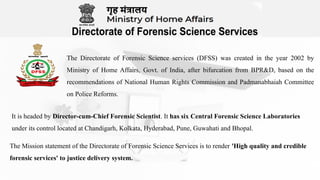
The Directorate of Forensic Science services (DFSS) was created in the year 2002 by
Ministry of Home Affairs, Govt. of India, after bifurcation from BPR&D, based on the
recommendations of National Human Rights Commission and Padmanabhaiah Committee
on Police Reforms.
It is headed by Director-cum-Chief Forensic Scientist. It has six Central Forensic Science Laboratories
under its control located at Chandigarh, Kolkata, Hyderabad, Pune, Guwahati and Bhopal.
The Mission statement of the Directorate of Forensic Science Services is to render 'High quality and credible
forensic services' to justice delivery system.
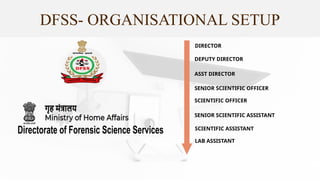
DIRECTOR
DEPUTY DIRECTOR
ASST DIRECTOR
SENIOR SCIENTIFIC OFFICER
SCIENTIFIC OFFICER
SENIOR SCIENTIFIC ASSISTANT
SCIENTIFIC ASSISTANT
LAB ASSISTANT
DFSS- ORGANISATIONAL SETUP
FSL- ORGANISATIONAL SETUP
OF LABORATORIES
-CENTRAL
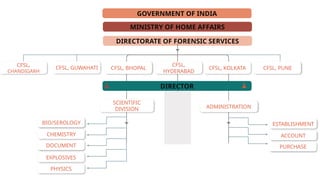
DIRECTORATE OF FORENSIC SERVICES
MINISTRY OF HOME AFFAIRS
GOVERNMENT OF INDIA
CFSL, GUWAHATI CFSL, PUNE
CFSL,
CHANDIGARH
SCIENTIFIC
DIVISION
BIO/SEROLOGY
CHEMISTRY
DOCUMENT
EXPLOSIVES
PHYSICS
ESTABLISHMENT
ACCOUNT
PURCHASE
ADMINISTRATION
DIRECTOR
CFSL, BHOPAL
CFSL,
HYDERABAD
CFSL, KOLKATA
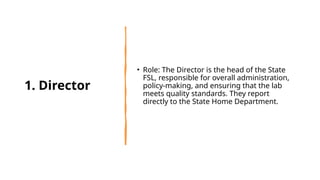
1. Director
• Role: The Director is the head of the State
FSL, responsible for overall administration,
policy-making, and ensuring that the lab
meets quality standards. They report
directly to the State Home Department.
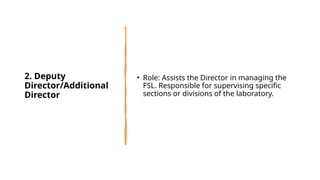
2. Deputy
Director/Additional
Director
• Role: Assists the Director in managing the
FSL. Responsible for supervising specific
sections or divisions of the laboratory.
Principal
Scientist
• Head of all scientific works.
3. Section
Heads/Division
Heads/
Asst.Director
/Joint Director
• Role: Each forensic division within the FSL is
headed by a senior forensic scientist or
Section Head. Divisions may include:
• - Biology Division
• - Chemistry Division
• - Physics Division
• - Ballistics Division
• - Toxicology Division
• - Serology Division
• - DNA Profiling Division
• - Questioned Documents Division
• - Cyber Forensics Division
• - Narcotics Division
4. Senior
Scientific
Officers
(SSOs)
• Role: SSOs are experienced forensic
scientists who manage the day-to-day
operations within their respective divisions,
mentor junior staff, and handle complex
cases.
5.
Scientific
Officers
(SOs)/ JSO
• Role: SOs conduct forensic analyses,
prepare reports, and may also testify as
expert witnesses in court. They work under
the supervision of the Section Heads.
6.
Assistant
Scientific
Officers
(ASOs) /
SSA /JSA
• Role: ASOs assist in forensic examinations,
carry out preliminary tests, and support the
work of the SOs and SSOs.
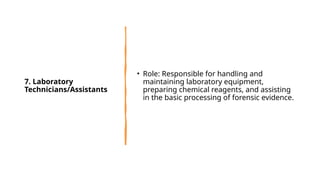
7. Laboratory
Technicians/Assistants
• Role: Responsible for handling and
maintaining laboratory equipment,
preparing chemical reagents, and assisting
in the basic processing of forensic evidence.
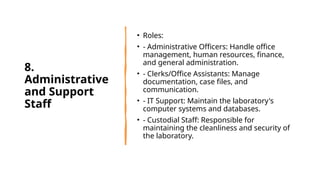
8.
Administrative
and Support
Staff
• Roles:
• - Administrative Officers: Handle office
management, human resources, finance,
and general administration.
• - Clerks/Office Assistants: Manage
documentation, case files, and
communication.
• - IT Support: Maintain the laboratory's
computer systems and databases.
• - Custodial Staff: Responsible for
maintaining the cleanliness and security of
the laboratory.
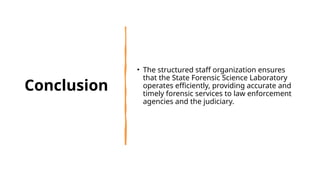
Conclusion
• The structured staff organization ensures
that the State Forensic Science Laboratory
operates efficiently, providing accurate and
timely forensic services to law enforcement
agencies and the judiciary.

admin structure of Forensic science labs.pptx

  • 1.
    Staff Organization of State Forensic Science Laboratory(FSL) Overview of the Organizational Structure
  • 2.
    The Directorate ofForensic Science services (DFSS) was created in the year 2002 by Ministry of Home Affairs, Govt. of India, after bifurcation from BPR&D, based on the recommendations of National Human Rights Commission and Padmanabhaiah Committee on Police Reforms. It is headed by Director-cum-Chief Forensic Scientist. It has six Central Forensic Science Laboratories under its control located at Chandigarh, Kolkata, Hyderabad, Pune, Guwahati and Bhopal. The Mission statement of the Directorate of Forensic Science Services is to render 'High quality and credible forensic services' to justice delivery system.
  • 3.
    DIRECTOR DEPUTY DIRECTOR ASST DIRECTOR SENIORSCIENTIFIC OFFICER SCIENTIFIC OFFICER SENIOR SCIENTIFIC ASSISTANT SCIENTIFIC ASSISTANT LAB ASSISTANT DFSS- ORGANISATIONAL SETUP
  • 5.
    FSL- ORGANISATIONAL SETUP OFLABORATORIES -CENTRAL
  • 6.
    DIRECTORATE OF FORENSICSERVICES MINISTRY OF HOME AFFAIRS GOVERNMENT OF INDIA CFSL, GUWAHATI CFSL, PUNE CFSL, CHANDIGARH SCIENTIFIC DIVISION BIO/SEROLOGY CHEMISTRY DOCUMENT EXPLOSIVES PHYSICS ESTABLISHMENT ACCOUNT PURCHASE ADMINISTRATION DIRECTOR CFSL, BHOPAL CFSL, HYDERABAD CFSL, KOLKATA
  • 7.
    1. Director • Role:The Director is the head of the State FSL, responsible for overall administration, policy-making, and ensuring that the lab meets quality standards. They report directly to the State Home Department.
  • 8.
    2. Deputy Director/Additional Director • Role:Assists the Director in managing the FSL. Responsible for supervising specific sections or divisions of the laboratory.
  • 9.
    Principal Scientist • Head ofall scientific works.
  • 10.
    3. Section Heads/Division Heads/ Asst.Director /Joint Director •Role: Each forensic division within the FSL is headed by a senior forensic scientist or Section Head. Divisions may include: • - Biology Division • - Chemistry Division • - Physics Division • - Ballistics Division • - Toxicology Division • - Serology Division • - DNA Profiling Division • - Questioned Documents Division • - Cyber Forensics Division • - Narcotics Division
  • 11.
    4. Senior Scientific Officers (SSOs) • Role:SSOs are experienced forensic scientists who manage the day-to-day operations within their respective divisions, mentor junior staff, and handle complex cases.
  • 12.
    5. Scientific Officers (SOs)/ JSO • Role:SOs conduct forensic analyses, prepare reports, and may also testify as expert witnesses in court. They work under the supervision of the Section Heads.
  • 13.
    6. Assistant Scientific Officers (ASOs) / SSA /JSA •Role: ASOs assist in forensic examinations, carry out preliminary tests, and support the work of the SOs and SSOs.
  • 14.
    7. Laboratory Technicians/Assistants • Role:Responsible for handling and maintaining laboratory equipment, preparing chemical reagents, and assisting in the basic processing of forensic evidence.
  • 15.
    8. Administrative and Support Staff • Roles: •- Administrative Officers: Handle office management, human resources, finance, and general administration. • - Clerks/Office Assistants: Manage documentation, case files, and communication. • - IT Support: Maintain the laboratory's computer systems and databases. • - Custodial Staff: Responsible for maintaining the cleanliness and security of the laboratory.
  • 16.
    Conclusion • The structuredstaff organization ensures that the State Forensic Science Laboratory operates efficiently, providing accurate and timely forensic services to law enforcement agencies and the judiciary.

Editor's Notes

  • #6 © Copyright PresentationGO.com – The free PowerPoint and Google Slides template library