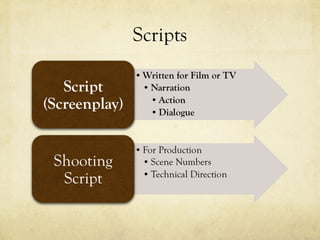
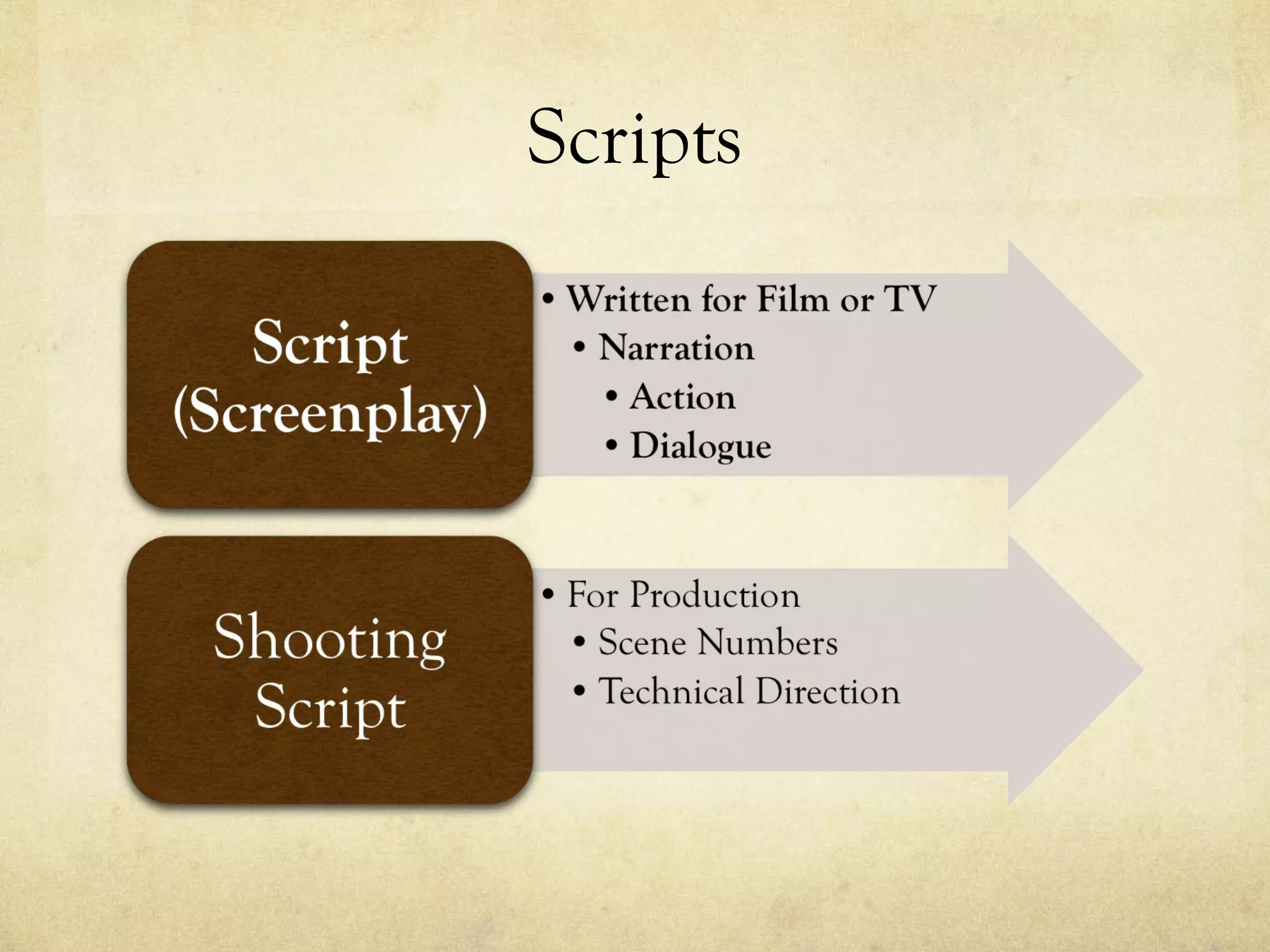
Scripts
Writing your Script
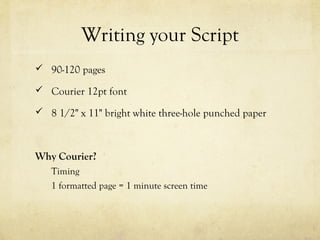
 90-120 pages
 Courier 12pt font
 8 1/2" x 11" bright white three-hole punched paper
Why Courier?
Timing
1 formatted page = 1 minute screen time
Writing your Script
A script can be an original piece, or based on a true story or
previously written piece, like a novel, stage play or
newspaper article.
At its heart, a script is a blueprint for the film it will one day
become…
The biggest mistake any new screenwriter can make is to submit a
script full of production language, including camera angles and
editing transitions
It's crucial to remember that film is primarily a visual
medium.
As a screenwriter, you must show what's happening in a story,
rather than tell.
Rules
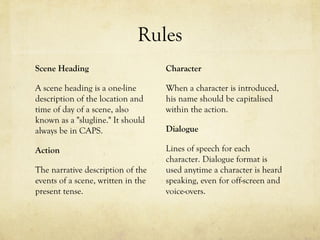
Scene Heading
A scene heading is a one-line
description of the location and
time of day of a scene, also
known as a "slugline." It should
always be in CAPS.
Action
The narrative description of the
events of a scene, written in the
present tense.
Character
When a character is introduced,
his name should be capitalised
within the action.
Dialogue
Lines of speech for each
character. Dialogue format is
used anytime a character is heard
speaking, even for off-screen and
voice-overs.
Writing your Script
The best way to learn to rules and style is to read scripts:
http://labs.triggerstreet.com/
http://www.simplyscripts.com/unpro.html
Library!!!
You can also take online lessons:
http://en.wikiversity.org/wiki/Lesson:Formatting_the_s
cript
A Lesson in Scriptwriting
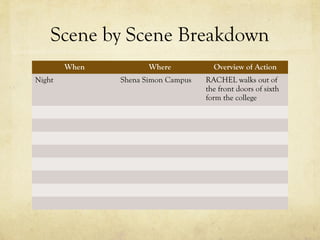
Scene by Scene Breakdown
When Where Overview of Action
Night Shena Simon Campus RACHEL walks out of
the front doors of sixth
form the college
Celtx
Download:https://www.celtx.
com/index.html
Video:http://youtu.be/C9x_
RvZl2go
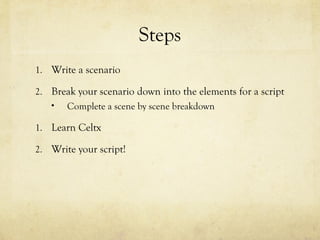
Steps
1. Write a scenario
2. Break your scenario down into the elements for a script
• Complete a scene by scene breakdown
1. Learn Celtx
2. Write your script!

Scripts

  • 1.
  • 2.
    Writing your Script 90-120 pages  Courier 12pt font  8 1/2" x 11" bright white three-hole punched paper Why Courier? Timing 1 formatted page = 1 minute screen time
  • 3.
    Writing your Script Ascript can be an original piece, or based on a true story or previously written piece, like a novel, stage play or newspaper article. At its heart, a script is a blueprint for the film it will one day become… The biggest mistake any new screenwriter can make is to submit a script full of production language, including camera angles and editing transitions It's crucial to remember that film is primarily a visual medium. As a screenwriter, you must show what's happening in a story, rather than tell.
  • 6.
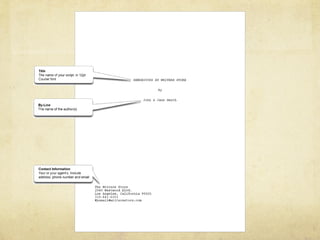
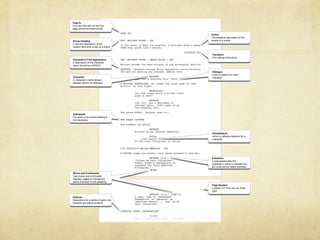
    Rules Scene Heading A sceneheading is a one-line description of the location and time of day of a scene, also known as a "slugline." It should always be in CAPS. Action The narrative description of the events of a scene, written in the present tense. Character When a character is introduced, his name should be capitalised within the action. Dialogue Lines of speech for each character. Dialogue format is used anytime a character is heard speaking, even for off-screen and voice-overs.
  • 7.
    Writing your Script Thebest way to learn to rules and style is to read scripts: http://labs.triggerstreet.com/ http://www.simplyscripts.com/unpro.html Library!!! You can also take online lessons: http://en.wikiversity.org/wiki/Lesson:Formatting_the_s cript
  • 8.
    A Lesson inScriptwriting
  • 9.
    Scene by SceneBreakdown When Where Overview of Action Night Shena Simon Campus RACHEL walks out of the front doors of sixth form the college
  • 10.
  • 11.
    Steps 1. Write ascenario 2. Break your scenario down into the elements for a script • Complete a scene by scene breakdown 1. Learn Celtx 2. Write your script!