Audience and
Representation
Users and gratification
 The users and gratification theory is About the audience interpreting
media rather than the media interpreting audiences. It suggests that
audiences aren’t passive and take an active role in interpreting and
integrating media in their everyday lives.
 The issue with users and gratification is that the audience can interpret the
media text in whatever way they wish. This means that the audience could
misinterpret a meaningful text. For instance a director could produce an
anti racist piece of media which could be misinterpreted by an audience as
racist and offensive.
My own coursework
 The users and gratification theory will allow my audiences to interpret my
documentary based on their own views and the activities of their day to day
life. In my documentary, I am trying to convey the strong or weak relationship
between an animal and a human and how culture can influence this
relationship for the better or for the worse. So my documentary is up to the
audience to decide what my overall message is after each episode and
therefore, fits closely with the users and gratification theory. (preferred
reading)
 However the users and gratification theory could have a negative impact on
my documentary as audiences could misinterpret my overall messages. Due to
my strong willed beliefs on animal cruelty and fighting against it, audiences
may see me as hypocritical as by filming cultural events using animals, I might
be accused of supporting the abuse or not focussing closely on the negative
affects animals have.
Herta Herzog
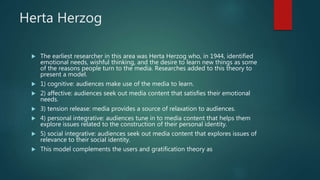
 The earliest researcher in this area was Herta Herzog who, in 1944, identified
emotional needs, wishful thinking, and the desire to learn new things as some
of the reasons people turn to the media. Researches added to this theory to
present a model.
 1) cognitive: audiences make use of the media to learn.
 2) affective: audiences seek out media content that satisfies their emotional
needs.
 3) tension release: media provides a source of relaxation to audiences.
 4) personal integrative: audiences tune in to media content that helps them
explore issues related to the construction of their personal identity.
 5) social integrative: audiences seek out media content that explores issues of
relevance to their social identity.
 This model complements the users and gratification theory as
Stuart Hall- Encoding/Decoding
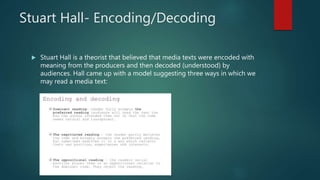
 Stuart Hall is a theorist that believed that media texts were encoded with
meaning from the producers and then decoded (understood) by
audiences. Hall came up with a model suggesting three ways in which we
may read a media text:
Albert Bandura- Media Affects
 The idea that the media can implant ideas in the mind of the audience
directly
 The idea that audiences acquire attitudes, emotional responses and new
styles of conduct through modelling
 The idea that media representations of transgressive behaviour, such as
violence or physical aggression, can lead audience members to imitate
those forms o behaviour.

Audience and representation 11

  • 1.
  • 2.
    Users and gratification The users and gratification theory is About the audience interpreting media rather than the media interpreting audiences. It suggests that audiences aren’t passive and take an active role in interpreting and integrating media in their everyday lives.  The issue with users and gratification is that the audience can interpret the media text in whatever way they wish. This means that the audience could misinterpret a meaningful text. For instance a director could produce an anti racist piece of media which could be misinterpreted by an audience as racist and offensive.
  • 3.
    My own coursework The users and gratification theory will allow my audiences to interpret my documentary based on their own views and the activities of their day to day life. In my documentary, I am trying to convey the strong or weak relationship between an animal and a human and how culture can influence this relationship for the better or for the worse. So my documentary is up to the audience to decide what my overall message is after each episode and therefore, fits closely with the users and gratification theory. (preferred reading)  However the users and gratification theory could have a negative impact on my documentary as audiences could misinterpret my overall messages. Due to my strong willed beliefs on animal cruelty and fighting against it, audiences may see me as hypocritical as by filming cultural events using animals, I might be accused of supporting the abuse or not focussing closely on the negative affects animals have.
  • 4.
    Herta Herzog  Theearliest researcher in this area was Herta Herzog who, in 1944, identified emotional needs, wishful thinking, and the desire to learn new things as some of the reasons people turn to the media. Researches added to this theory to present a model.  1) cognitive: audiences make use of the media to learn.  2) affective: audiences seek out media content that satisfies their emotional needs.  3) tension release: media provides a source of relaxation to audiences.  4) personal integrative: audiences tune in to media content that helps them explore issues related to the construction of their personal identity.  5) social integrative: audiences seek out media content that explores issues of relevance to their social identity.  This model complements the users and gratification theory as
  • 5.
    Stuart Hall- Encoding/Decoding Stuart Hall is a theorist that believed that media texts were encoded with meaning from the producers and then decoded (understood) by audiences. Hall came up with a model suggesting three ways in which we may read a media text:
  • 6.
    Albert Bandura- MediaAffects  The idea that the media can implant ideas in the mind of the audience directly  The idea that audiences acquire attitudes, emotional responses and new styles of conduct through modelling  The idea that media representations of transgressive behaviour, such as violence or physical aggression, can lead audience members to imitate those forms o behaviour.