A Publication of ATTRA—National Sustainable Agriculture Information Service • 1-800-346-9140 • www.attra.ncat.org
Contents
By Anne Fanatico
NCAT Agriculture
Specialist
Updated by
Lee Rinehart
NCAT Agriculture
Specialist
© 2009 NCAT
Raising Dairy Heifers
on Pasture
Introduction..................... 1
Custom heifer
raising ................................ 2
Costs of raising
heifers ................................ 2
Online resources............. 3
This publication discusses the costs and considerations in custom raising replacement dairy heifers on
pasture, and provides a list of additional online resources.
Introduction
Heifers are the foundation of a dairy enter-
prise and replacements represent a signifi-
cant investment. Information about raising
replacement heifers on pasture is becoming
more available as producers begin to adopt
grass-based systems to alleviate energy
costs associated with raising feed crops. For
general information on raising heifers, refer to
Cooperative Extension Service materials such
as Raising Dairy Replacements or Agricultural
Alternatives: Dairy Heifer Production, as refer-
enced in the Online resources section.
Traditionally, dairy farmers have raised their
own heifers, but custom raising of heifers is
now becoming an enterprise in its own right.
This can be an opportunity for supplemental
income or a farm’s main operation.
Raising cattle on pasture necessitates man-
agement decisions about grazing. Controlled
grazing or management-intensive rotational
grazing (MIG) of pastures can increase
animal production and maintain resilient,
diverse and nutritious pastures. Controlled
grazing involves grazing and then resting
several pastures in sequence. The rest periods
allow plants to recover before they are grazed
again. Although an intensive system has initial
costs of electric fencing and watering invest-
ments, as well as increased management, many
farmers report better profitability. Please refer
to the Related ATTRA Publications for
more information.
When planning a feed supplement program
for pastured heifers, first determine the type
and amount of forage the animal is eating,
and then consider the nutritive content of the
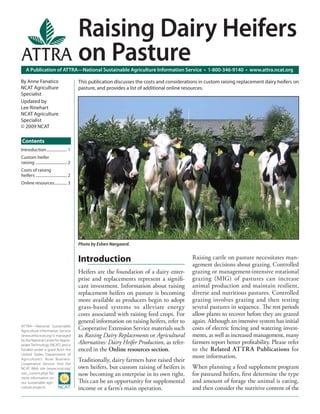
Photo by Esben Nørgaard.
ATTRA—National Sustainable
Agriculture Information Service
(www.attra.ncat.org) is managed
by the National Center for Appro-
priate Technology (NCAT) and is
funded under a grant from the
United States Department of
Agriculture’s Rural Business-
Cooperative Service. Visit the
NCAT Web site (www.ncat.org/
sarc_current.php) for
more information on
our sustainable agri-
culture projects.
Page 2 ATTRA Raising Dairy Heifers on Pasture
Related ATTRA
Publications
Nutrient Cycling
in Pastures
Paddock Design,
Fencing, and Water
Systems for Controlled
Grazing
Ruminant Nutrition
for Graziers
Pastures: Sustainable
Management
Cattle Production
Pasture, Rangeland,
and Grazing
Management
Dairy Production
on Pasture
Rotational Grazing
Dairy Resource List:
Organic and
Pasture-Based
Pasture, Rangeland,
and Grazing
Management
Grazing Contracts
for Livestock
forage. Most cool-season grass-legume pastures
provide more crude protein than is needed by
the animal. In this case, a small amount of
grain or bypass protein will stimulate gain.
Native warm-season grasses and some legumes,
such as birdsfoot trefoil, tend to be less soluble
in the rumen and have a higher bypass protein
availability. Producers can aim for the same
heifer growth rates on pasture that are possible
with confinement feeding of grain.
University of Minnesota researchers have
documented gains and costs of raising dairy
heifers in a feedlot versus raising them on
pasture. In their study, the feedlot heif-
ers had an average daily gain (ADG) of 2
pounds per head while the pasture heifers
had an ADG of 2.04, with a total cost per
head per day of $1.52 versus $0.95 respec-
tively. The study, Tale of Two Heifer-raising
Systems: Feedlot and management intensive
grazing go head to head by Margot Rudstrom,
is available online, and is referenced below in
the Online resources section.
Local and state Cooperative Extension Ser-
vice or Natural Resources Conservation
Service (NRCS) personnel may have infor-
mation on rotational grazing and grass
dairying and can help choose forage species
and varieties that work best for a producer
in a grazing program. In addition, The Stock-
man Grass Farmer is a magazine “dedicated
to profit from grassland agriculture” and
has many articles dealing with grazing and
sponsors workshops on grass management
and seasonal dairying. Refer to the section
called The Grass Farmer’s Bookshelf in every
issue of The Stockman Grass Farmer for use-
ful books about forages and forage manage-
ment. The magazine’s editor, Allan Nation,
recommends contract raising of heifers as a
high-value enterprise particularly well-suited
for small acreages.
Custom heifer raising
It is increasingly common for heifers to be
raised by contract on specialty farms. Hiring
out the raising of replacement heifers is advan-
tageous to a milk producer for at least two
reasons. First, it saves labor on the dairy farm
and second, it frees all the forage or other feed
to be utilized by milk-producing animals.
However, mingling heifers from several dif-
ferent farms is a concern for health reasons.
Custom raising of heifers is not recommended
as an enterprise for beginning farmers because
of the level of knowledge and experience needed
to manage young animals. Grazing expertise is
useful since pasture and grazing management
are key to enterprise sustainability and profit-
ability. Finding heifers to raise may be difficult
at first, but a good reputation and track record
will be assets in securing animals. Breeding
expertise may also be important depending on
contractual obligations.
Tom Wrchota in Wisconsin received a Sus-
tainable Agriculture Research and Edu-
cation (SARE) producer grant to custom
graze heifers and summarized his results
in a report called Developing Dairy Heifers
on Pasture. According to the SARE report,
“the most surprising aspect about the devel-
opment and successful implementation of
a seasonal custom heifer grazing program
was: the grant program started with very
modest amounts of capital, almost no expe-
rience and a limited cash/no debt strategy.”
The SARE report can be accessed online at
www.sare.org/reporting/report_viewer.asp?pn=
FNC93-040&ry=1995&rf=1.
Costs of raising heifers
The costs associated with a custom heifer
raising enterprise include labor, feed, facili-
ties and fencing and veterinary costs. Feed
costs and labor costs are usually the largest
costs to a custom grazier. High-quality pas-
ture and good grazing management can help
reduce these costs and ensure a profitable,
sustainable enterprise.
Accessing your local Natural Resources Conservation
Service (NRCS) and Cooperative Extension Service offices
NRCS and Extension phone numbers can be obtained in the federal
and county government sections, respectively, of your local telephone
directory. Also, you can access local NRCS and Extension directories on
the following Web sites:
Natural Resources Conservation Service
http://offices.sc.egov.usda.gov/locator/app?agency=nrcs
Cooperative Extension Service
www.csrees.usda.gov/Extension/index.html
Page 3ATTRAwww.attra.ncat.org
The Economics of Heifer Contracting, by
Robert Moore, Joseph Beiler and Gary
Schnitkey of The Ohio State University,
was developed to assist producers in esti-
mating costs and charging to cover costs
from a custom heifer raising enterprise, and
can be accessed online at http://ohioline.osu.
edu/as-fact/0006.html.
The use of pasture and grazing management to raise
dairy heifers is becoming more prominent in the indus-
try, and the following online resources will assist the
interested producer in planning and managing this
risky but often rewarding enterprise.
Anon. 2008. Labor Efficient Pasture Management.
Penn State Extension. Accessed June 2009. www.extension.
org/pages/Labor_Efficient_Pasture_Management
Beiler, Joseph. 2000. Dairy Heifer Contracting:
Motives, Forms, and Arrangements. The Ohio State
University Extension Fact Sheet AS-0005-00.
http://ohioline.osu.edu/as-fact/0005.html
Identifies important points a producer should consider when
examining heifer contracting. Three topics are discussed:
reasons for entering a contract, forms of contracting and the
arrangement between the producer and the grower.
Fischer, David B., Michael F. Hutjens and Edward N.
Ballard. 2005. Pasture-Based Feeding Programs for
Dairy Cattle. University of Illinois Extension. Accessed
June 2009. www.livestocktrail.uiuc.edu/dairynet/paper-
Display.cfm?ContentID=7160
Hedtcke, Janet and Josh Posner. Rotational Grazing
with Dairy Heifers on WICST: b. Animal Performance
Summary. Accessed June 2009. UW-Madison Center
for Integrated Agricultural Systems. www.cias.wisc.edu/
wicst/pubs/rotate_b.htm
James, Robert E. Nutrition of heifers while on pasture.
Dept. of Dairy Science, Virginia Tech. http://128.118.11.
160/dairynutrition/documents/jamespastheif.pdf
Mongeon, Mario, et al. 1998. Considerations for Custom
Raising Dairy Heifers. Ontario Ministry of Agriculture,
Food, and Rural Affairs. Accessed June 2009. www.
omafra.gov.on.ca/english/livestock/dairy/facts/98-059.htm
Moynihan, Meg (ed). 2006. Organic Production and
Custom Heifer Raising. From Dairy Your Way.
Minnesota Department of Agriculture. www.misa.umn.
edu/vd/publications/DYW_Chp5_Chp6.pdf
Roth, Sarah, Jud Heinrichs and Coleen Jones. 2008.
The Pennsylvania State University. Dairy Heifer
Contracting Fundamentals. www.extension.org/pages/
Dairy_Heifer_Contracting_Fundamentals
Outlines the advantages of using contracts and describes
the components that custom heifer growers may want to
include in their own contracts.
Rudstrom, Margot. 2002. Tale of Two Heifer-raising
Systems: Feedlot and management intensive grazing go
head to head. Dairy Initiative Newsletter. Vol. 11, No.
1. University of Minnesota. www.ansci.umn.edu/dairy/
dinews/11-1-heifer-raising.htm
Sanson, Ron, et al. 2002. Growing Dairy Heifers in
Southwest Iowa. Leopold Center for Sustainable Agri-
culture. Accessed June 2009. www.leopold.iastate.edu/
research/grants/2002/1999-11_Dairy_Heifer_Production_
%5B_Animal_Mngt_&_Forage_%5D.pdf
Based on the experiences of the limited number of coop-
erators in the project, this is a high-risk operation with
minimal financial returns to the farmer. Problems
encountered were the source and price of quality dairy
heifers in the spring, what type of arrangement the pro-
ducer could make to market the animals at the end of
the pasture growing season and the variability of pasture
production in southwest Iowa.
Stockman Grass Farmer Magazine
PO Box 2300
Ridgeland, MS 39158-9911
1-800-748-9808
www.stockmangrassfarmer.net/index.html
UMCE Pasture Management Home Study: an Online
Course. University of Maine Cooperative Extension.
www.umaine.edu/umext/pasture/index.htm
Web-based lessons on planning a grazing system, plant
species selection, fencing systems, weed management,
grazier’s arithmetic, managing for a year-long forage
supply and water systems.
University of Minnesota Dairy Extension Custom
Heifer Raising Contracts Page www.extension.umn.edu/
dairy/business/customheifer.htm
A page of links to custom heifer raising contract
resources, including contracting fundamentals, economics,
forms, heifer raising preferences and more.
Online resources
Page 4 ATTRA
Raising Dairy Heifers on Pasture
By Anne Fanatico
NCAT Agriculture Specialist
Updated by Lee Rinehart
NCAT Agriculture Specialist
© 2009 NCAT
Holly Michels, Editor
Amy Smith, Production
This publication is available on the Web at:
www.attra.ncat.org/attra-pub/dairyheifer.html
or
www.attra.ncat.org/attra-pub/PDF/dairyheifer.pdf
IP356
Slot 23
Version 010410

Raising Dairy Heifers on Pasture

  • 1.
    A Publication ofATTRA—National Sustainable Agriculture Information Service • 1-800-346-9140 • www.attra.ncat.org Contents By Anne Fanatico NCAT Agriculture Specialist Updated by Lee Rinehart NCAT Agriculture Specialist © 2009 NCAT Raising Dairy Heifers on Pasture Introduction..................... 1 Custom heifer raising ................................ 2 Costs of raising heifers ................................ 2 Online resources............. 3 This publication discusses the costs and considerations in custom raising replacement dairy heifers on pasture, and provides a list of additional online resources. Introduction Heifers are the foundation of a dairy enter- prise and replacements represent a signifi- cant investment. Information about raising replacement heifers on pasture is becoming more available as producers begin to adopt grass-based systems to alleviate energy costs associated with raising feed crops. For general information on raising heifers, refer to Cooperative Extension Service materials such as Raising Dairy Replacements or Agricultural Alternatives: Dairy Heifer Production, as refer- enced in the Online resources section. Traditionally, dairy farmers have raised their own heifers, but custom raising of heifers is now becoming an enterprise in its own right. This can be an opportunity for supplemental income or a farm’s main operation. Raising cattle on pasture necessitates man- agement decisions about grazing. Controlled grazing or management-intensive rotational grazing (MIG) of pastures can increase animal production and maintain resilient, diverse and nutritious pastures. Controlled grazing involves grazing and then resting several pastures in sequence. The rest periods allow plants to recover before they are grazed again. Although an intensive system has initial costs of electric fencing and watering invest- ments, as well as increased management, many farmers report better profitability. Please refer to the Related ATTRA Publications for more information. When planning a feed supplement program for pastured heifers, first determine the type and amount of forage the animal is eating, and then consider the nutritive content of the Photo by Esben Nørgaard. ATTRA—National Sustainable Agriculture Information Service (www.attra.ncat.org) is managed by the National Center for Appro- priate Technology (NCAT) and is funded under a grant from the United States Department of Agriculture’s Rural Business- Cooperative Service. Visit the NCAT Web site (www.ncat.org/ sarc_current.php) for more information on our sustainable agri- culture projects.
  • 2.
    Page 2 ATTRARaising Dairy Heifers on Pasture Related ATTRA Publications Nutrient Cycling in Pastures Paddock Design, Fencing, and Water Systems for Controlled Grazing Ruminant Nutrition for Graziers Pastures: Sustainable Management Cattle Production Pasture, Rangeland, and Grazing Management Dairy Production on Pasture Rotational Grazing Dairy Resource List: Organic and Pasture-Based Pasture, Rangeland, and Grazing Management Grazing Contracts for Livestock forage. Most cool-season grass-legume pastures provide more crude protein than is needed by the animal. In this case, a small amount of grain or bypass protein will stimulate gain. Native warm-season grasses and some legumes, such as birdsfoot trefoil, tend to be less soluble in the rumen and have a higher bypass protein availability. Producers can aim for the same heifer growth rates on pasture that are possible with confinement feeding of grain. University of Minnesota researchers have documented gains and costs of raising dairy heifers in a feedlot versus raising them on pasture. In their study, the feedlot heif- ers had an average daily gain (ADG) of 2 pounds per head while the pasture heifers had an ADG of 2.04, with a total cost per head per day of $1.52 versus $0.95 respec- tively. The study, Tale of Two Heifer-raising Systems: Feedlot and management intensive grazing go head to head by Margot Rudstrom, is available online, and is referenced below in the Online resources section. Local and state Cooperative Extension Ser- vice or Natural Resources Conservation Service (NRCS) personnel may have infor- mation on rotational grazing and grass dairying and can help choose forage species and varieties that work best for a producer in a grazing program. In addition, The Stock- man Grass Farmer is a magazine “dedicated to profit from grassland agriculture” and has many articles dealing with grazing and sponsors workshops on grass management and seasonal dairying. Refer to the section called The Grass Farmer’s Bookshelf in every issue of The Stockman Grass Farmer for use- ful books about forages and forage manage- ment. The magazine’s editor, Allan Nation, recommends contract raising of heifers as a high-value enterprise particularly well-suited for small acreages. Custom heifer raising It is increasingly common for heifers to be raised by contract on specialty farms. Hiring out the raising of replacement heifers is advan- tageous to a milk producer for at least two reasons. First, it saves labor on the dairy farm and second, it frees all the forage or other feed to be utilized by milk-producing animals. However, mingling heifers from several dif- ferent farms is a concern for health reasons. Custom raising of heifers is not recommended as an enterprise for beginning farmers because of the level of knowledge and experience needed to manage young animals. Grazing expertise is useful since pasture and grazing management are key to enterprise sustainability and profit- ability. Finding heifers to raise may be difficult at first, but a good reputation and track record will be assets in securing animals. Breeding expertise may also be important depending on contractual obligations. Tom Wrchota in Wisconsin received a Sus- tainable Agriculture Research and Edu- cation (SARE) producer grant to custom graze heifers and summarized his results in a report called Developing Dairy Heifers on Pasture. According to the SARE report, “the most surprising aspect about the devel- opment and successful implementation of a seasonal custom heifer grazing program was: the grant program started with very modest amounts of capital, almost no expe- rience and a limited cash/no debt strategy.” The SARE report can be accessed online at www.sare.org/reporting/report_viewer.asp?pn= FNC93-040&ry=1995&rf=1. Costs of raising heifers The costs associated with a custom heifer raising enterprise include labor, feed, facili- ties and fencing and veterinary costs. Feed costs and labor costs are usually the largest costs to a custom grazier. High-quality pas- ture and good grazing management can help reduce these costs and ensure a profitable, sustainable enterprise. Accessing your local Natural Resources Conservation Service (NRCS) and Cooperative Extension Service offices NRCS and Extension phone numbers can be obtained in the federal and county government sections, respectively, of your local telephone directory. Also, you can access local NRCS and Extension directories on the following Web sites: Natural Resources Conservation Service http://offices.sc.egov.usda.gov/locator/app?agency=nrcs Cooperative Extension Service www.csrees.usda.gov/Extension/index.html
  • 3.
    Page 3ATTRAwww.attra.ncat.org The Economicsof Heifer Contracting, by Robert Moore, Joseph Beiler and Gary Schnitkey of The Ohio State University, was developed to assist producers in esti- mating costs and charging to cover costs from a custom heifer raising enterprise, and can be accessed online at http://ohioline.osu. edu/as-fact/0006.html. The use of pasture and grazing management to raise dairy heifers is becoming more prominent in the indus- try, and the following online resources will assist the interested producer in planning and managing this risky but often rewarding enterprise. Anon. 2008. Labor Efficient Pasture Management. Penn State Extension. Accessed June 2009. www.extension. org/pages/Labor_Efficient_Pasture_Management Beiler, Joseph. 2000. Dairy Heifer Contracting: Motives, Forms, and Arrangements. The Ohio State University Extension Fact Sheet AS-0005-00. http://ohioline.osu.edu/as-fact/0005.html Identifies important points a producer should consider when examining heifer contracting. Three topics are discussed: reasons for entering a contract, forms of contracting and the arrangement between the producer and the grower. Fischer, David B., Michael F. Hutjens and Edward N. Ballard. 2005. Pasture-Based Feeding Programs for Dairy Cattle. University of Illinois Extension. Accessed June 2009. www.livestocktrail.uiuc.edu/dairynet/paper- Display.cfm?ContentID=7160 Hedtcke, Janet and Josh Posner. Rotational Grazing with Dairy Heifers on WICST: b. Animal Performance Summary. Accessed June 2009. UW-Madison Center for Integrated Agricultural Systems. www.cias.wisc.edu/ wicst/pubs/rotate_b.htm James, Robert E. Nutrition of heifers while on pasture. Dept. of Dairy Science, Virginia Tech. http://128.118.11. 160/dairynutrition/documents/jamespastheif.pdf Mongeon, Mario, et al. 1998. Considerations for Custom Raising Dairy Heifers. Ontario Ministry of Agriculture, Food, and Rural Affairs. Accessed June 2009. www. omafra.gov.on.ca/english/livestock/dairy/facts/98-059.htm Moynihan, Meg (ed). 2006. Organic Production and Custom Heifer Raising. From Dairy Your Way. Minnesota Department of Agriculture. www.misa.umn. edu/vd/publications/DYW_Chp5_Chp6.pdf Roth, Sarah, Jud Heinrichs and Coleen Jones. 2008. The Pennsylvania State University. Dairy Heifer Contracting Fundamentals. www.extension.org/pages/ Dairy_Heifer_Contracting_Fundamentals Outlines the advantages of using contracts and describes the components that custom heifer growers may want to include in their own contracts. Rudstrom, Margot. 2002. Tale of Two Heifer-raising Systems: Feedlot and management intensive grazing go head to head. Dairy Initiative Newsletter. Vol. 11, No. 1. University of Minnesota. www.ansci.umn.edu/dairy/ dinews/11-1-heifer-raising.htm Sanson, Ron, et al. 2002. Growing Dairy Heifers in Southwest Iowa. Leopold Center for Sustainable Agri- culture. Accessed June 2009. www.leopold.iastate.edu/ research/grants/2002/1999-11_Dairy_Heifer_Production_ %5B_Animal_Mngt_&_Forage_%5D.pdf Based on the experiences of the limited number of coop- erators in the project, this is a high-risk operation with minimal financial returns to the farmer. Problems encountered were the source and price of quality dairy heifers in the spring, what type of arrangement the pro- ducer could make to market the animals at the end of the pasture growing season and the variability of pasture production in southwest Iowa. Stockman Grass Farmer Magazine PO Box 2300 Ridgeland, MS 39158-9911 1-800-748-9808 www.stockmangrassfarmer.net/index.html UMCE Pasture Management Home Study: an Online Course. University of Maine Cooperative Extension. www.umaine.edu/umext/pasture/index.htm Web-based lessons on planning a grazing system, plant species selection, fencing systems, weed management, grazier’s arithmetic, managing for a year-long forage supply and water systems. University of Minnesota Dairy Extension Custom Heifer Raising Contracts Page www.extension.umn.edu/ dairy/business/customheifer.htm A page of links to custom heifer raising contract resources, including contracting fundamentals, economics, forms, heifer raising preferences and more. Online resources
  • 4.
    Page 4 ATTRA RaisingDairy Heifers on Pasture By Anne Fanatico NCAT Agriculture Specialist Updated by Lee Rinehart NCAT Agriculture Specialist © 2009 NCAT Holly Michels, Editor Amy Smith, Production This publication is available on the Web at: www.attra.ncat.org/attra-pub/dairyheifer.html or www.attra.ncat.org/attra-pub/PDF/dairyheifer.pdf IP356 Slot 23 Version 010410