Attribution theory( OB)
By Sitara Nazir
Attribution Theory
 Attribution is a term used in psychology which deals with how individual perceives the causes of
everyday experience as being either external or internal.
 People make sense of their surroundings on the basis of what they consider is the cause and
what is the effect of a phenomena.
 It suggests that individuals observe their own behaviour or experience, try to figure out what
caused it , and then (whether or not their conclusion is in fact correct) shape their future
behaviour accordingly.
 The purpose behind making attribution is to achieve cognitive control over ones environment by
explaining and understanding the causes behind behaviours and environmental occurrences.
 Making attribution gives order and predictability to our lives ; helps us to cope.
 imagine what it would be like if you felt that you had no control over the world.
This Photo by Unknown Author is licensed under CC BY
Internal attribution vs External attribution
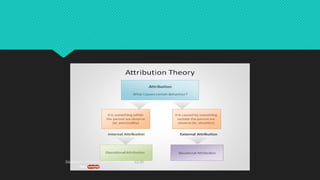
 INTERNAL ATTRIBUTION- internal attributions refer to the assumption that personal factors ,
such as an individuals abilities are the cause of an event or behaviour.
 EXTERNAL ATTRIBUTION- assigning the cause of the behaviour to external factors or
circumstances ,such as situational influences or environmental factor.
 Example _ in a performance appraisal, a person might claim that their performance was
either due to their own hard work(INTERNAL ATTRIBUTION) or was due to an external factor
such as luck or unforeseen circumstances.
 Example - if someone does well academically , than if a person with internal attribution
would attribute their success to intelligence or natural talent, and a person with external
attribution would attribute their success to an external factor such as luck or easy question
paper etc.
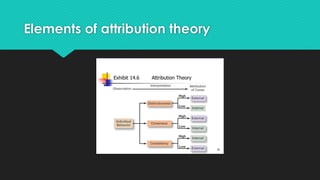
Elements of attribution theory
 Attribution theory is an approach used to explain how we judge people differently, based
on what meaning we attribute to a given behaviour .
 1. Distinctiveness- distinctiveness refers to whether an individual displays a behaviour in
many situations or whether it is particular to one situation.
 2.consensus- if everyone who is faced with similar situation in the same way, we can say
the behaviour shows consensus.
 3.consistency- the more consistent the behaviour, the more the observer is inclined to
attribute it to internal causes.
Attribution theory process
 There is a three- stage process underlying attribution:
 perception – observe, the person must perceive or observe the behaviour.
 Judgement – determine deliberateness. The person must believes that the behaviour was
intentionally performed.
 Attribute –The person must determine if he believes the other was forced to perform the
behaviour (in which case the cause is attributed to the situation ) or not (in which case
the cause is attributed to other person).
Fundamental attribution error
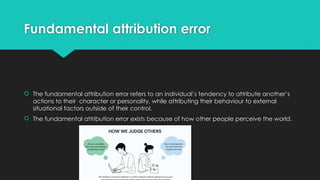
 The fundamental attribution error refers to an individual’s tendency to attribute another’s
actions to their character or personality, while attributing their behaviour to external
situational factors outside of their control.
 The fundamental attribution error exists because of how other people perceive the world.

ATTRIBUTION THEORY.pptx organisational behaviour

  • 1.
  • 2.
    Attribution Theory  Attributionis a term used in psychology which deals with how individual perceives the causes of everyday experience as being either external or internal.  People make sense of their surroundings on the basis of what they consider is the cause and what is the effect of a phenomena.  It suggests that individuals observe their own behaviour or experience, try to figure out what caused it , and then (whether or not their conclusion is in fact correct) shape their future behaviour accordingly.  The purpose behind making attribution is to achieve cognitive control over ones environment by explaining and understanding the causes behind behaviours and environmental occurrences.  Making attribution gives order and predictability to our lives ; helps us to cope.  imagine what it would be like if you felt that you had no control over the world.
  • 3.
    This Photo byUnknown Author is licensed under CC BY
  • 4.
    Internal attribution vsExternal attribution  INTERNAL ATTRIBUTION- internal attributions refer to the assumption that personal factors , such as an individuals abilities are the cause of an event or behaviour.  EXTERNAL ATTRIBUTION- assigning the cause of the behaviour to external factors or circumstances ,such as situational influences or environmental factor.  Example _ in a performance appraisal, a person might claim that their performance was either due to their own hard work(INTERNAL ATTRIBUTION) or was due to an external factor such as luck or unforeseen circumstances.  Example - if someone does well academically , than if a person with internal attribution would attribute their success to intelligence or natural talent, and a person with external attribution would attribute their success to an external factor such as luck or easy question paper etc.
  • 5.
  • 6.
    Elements of attributiontheory  Attribution theory is an approach used to explain how we judge people differently, based on what meaning we attribute to a given behaviour .  1. Distinctiveness- distinctiveness refers to whether an individual displays a behaviour in many situations or whether it is particular to one situation.  2.consensus- if everyone who is faced with similar situation in the same way, we can say the behaviour shows consensus.  3.consistency- the more consistent the behaviour, the more the observer is inclined to attribute it to internal causes.
  • 7.
    Attribution theory process There is a three- stage process underlying attribution:  perception – observe, the person must perceive or observe the behaviour.  Judgement – determine deliberateness. The person must believes that the behaviour was intentionally performed.  Attribute –The person must determine if he believes the other was forced to perform the behaviour (in which case the cause is attributed to the situation ) or not (in which case the cause is attributed to other person).
  • 8.
    Fundamental attribution error The fundamental attribution error refers to an individual’s tendency to attribute another’s actions to their character or personality, while attributing their behaviour to external situational factors outside of their control.  The fundamental attribution error exists because of how other people perceive the world.