Stainless Steel
Grade Datasheets
www.atlassteels.com.au
Copyright © Atlas Steels
Revised : August 2013
Atlas Steels
Technical Department
ATLAS STEELS  Stainless Steels Grade Datasheets
FOREWORD
This compilation of stainless steel Grade Datasheets has been produced by Atlas Steels Technical Department as
a companion to the Atlas Technical Handbook of Stainless Steels. Any suggestions for improvements, additions
or corrections would be very welcome; these should be directed to:
Technical Manager, Atlas Steels
Telephone +61 3 8383 9863, email peter.moore@atlassteels.com.au
Individual grade datasheets are available from the Atlas Steels website. Information from any Atlas
publication can be freely copied, but it is requested that the source be acknowledged.
Limitation of Liability
The information contained in these datasheets is not an exhaustive statement of all relevant information. It is a
general guide for customers to the products and services available from Atlas Steels and no representation is
made or warranty given in relation to this information or the products or processes it describes.
Published by Atlas Steels Technical Department
Copyright © Atlas Steels
www.atlassteels.com.au
Stainless Steel Datasheets
Revised November 2011 Page 1 of 1
www.atlassteels.com.au
Austenitic Stainless Steels
301, 301L, 301LN High strength for roll formed structural components
302HQ Low work hardening rate grade for cold heading fasteners
303, 303Se Free-machining bar grades
304, 304L, 304H Standard 18/8 grades
310, 310S, 310H High temperature resistant grades
316, 316L, 316H Improved resistance to pitting corrosion in chloride environments
321, 321H, 347 Stabilised grades for heavy section welding and high temperature applications
253MA (S30815) High temperature resistant grade
904L High resistance to general corrosion, pitting and stress corrosion cracking
Ferritic Stainless Steels
AtlasCR12 Utility steel resistant to wet abrasion and mild corrosion
AtlasCR12Ti Utility steel resistant to wet abrasion and mild corrosion – weld stabilised
409 Automotive exhaust grade – weld stabilised
430, 430F Resistant to mildly corrosive environments
F18S / 439 Resistant to mildly corrosive environments – weld stabilised
F20S A ferritic alternative to grade 304 / 304L – weld stabilised
F18MS / 444 A ferritic alternative to grade 316 / 316L – weld stabilised
Duplex Stainless Steels
2101 Lean duplex – economical alternative to 304 and 316
2304 Duplex alternative to grade 316
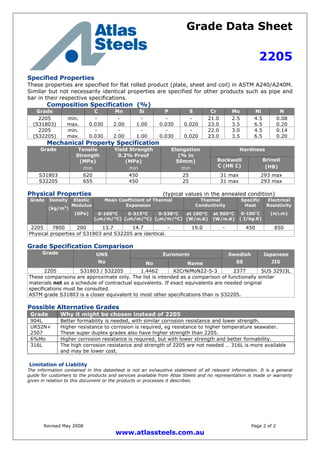
2205 Standard duplex stainless steel - high resistance to pitting and stress corrosion
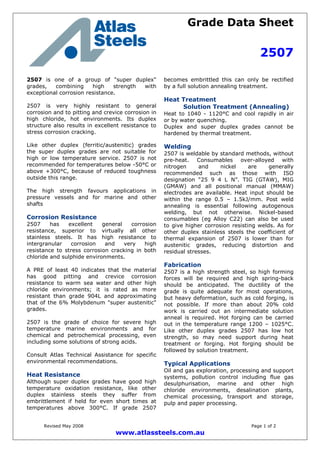
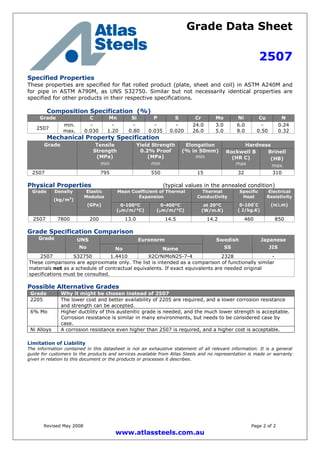
2507 Super duplex with very high resistance to pitting and stress corrosion
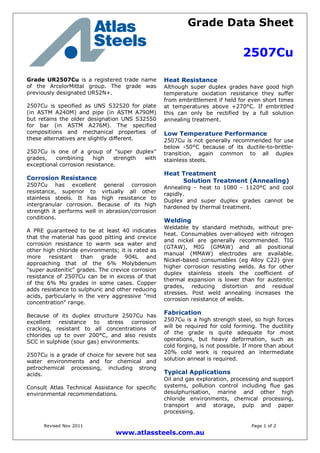
2507Cu Super duplex with very high resistance to pitting and stress corrosion
Martensitic Stainless Steels
410 Standard martensitic grade for low-duty hardened applications
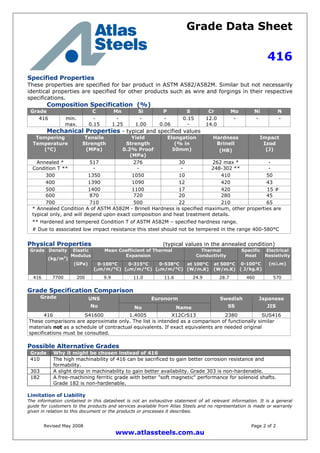
416 Free-machining bar grade
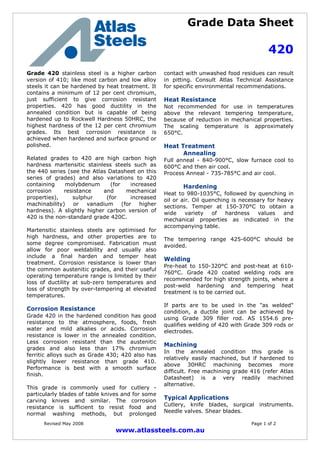
420 Higher hardness martensitic grade for cutlery, cutting tools and dies
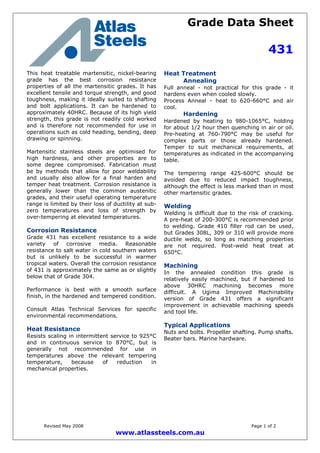
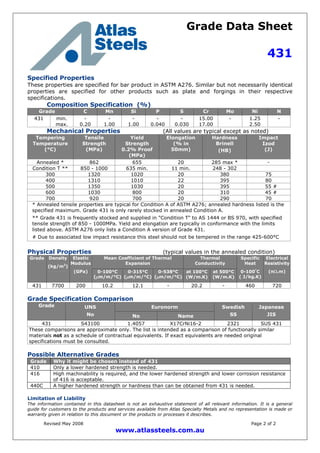
431 High hardness and toughness grade, primarily for shafting
440A, 440B, 440C Very high hardness grades used in cutting tools
Precipitation Hardening Stainless Steel
630 (17-4PH) High strength shafting grade
Note that some of these stainless steel grades are commonly referred to by designations that are registered
trademarks.
Limitation of Liability
The information contained in this datasheet is not an exhaustive statement of all relevant information. It is a general
guide for customers to the products and services available from Atlas Steels and no representation is made or warranty
given in relation to this document or the products or processes it describes.
Grade Data Sheet
301 301L 301LN
Revised May 2008 Page 1 of 2
www.atlassteels.com.au
Grade 301 is a high work-hardening rate
austenitic stainless steel. It can be supplied
with a tensile strength of up to over 1300 MPa
in strip and wire forms, to produce tempers in
the range of 1/16 Hard to Full Hard. The
controlled analysis of Grade 301 enables it to
retain sufficient ductility in conditions up to 1/2
Hard conditions to be roll or brake formed into
aircraft, architectural and particularly rail car
structural components. However, 3/4 to Full
Hard tempers should be used whenever high
wear resistance and spring features are
required in components of simple form designs.
Grade 301L with low carbon is preferred for
improved ductility or if heavy sections are to be
welded, and another variant 301LN has a
higher nitrogen content to compensate for the
lower carbon.
ASTM A666 covers all three variants, and some
are also included in Japanese specification JIS
G4305 and Euronorm EN 10088-2.
Corrosion Resistance
Corrosion resistance is similar to that of 304.
Good resistance in applications involving
external exposure to mildly corrosive
conditions at ambient temperatures.
Heat Resistance
Good oxidation resistance in intermittent
service to 840°C and in continuous service to
900°C, although not usually chosen for this
environment. Exposure to temperatures above
about 400°C will result in progressive removal
of work hardening effects; at approximately
800°C the strength will be similar to an
annealed 301. In creep applications a work
hardened grade 301 can even reduce to lower
strength than an annealed 301.
Heat Treatment
Solution Treatment (Annealing)
Heat to 1010-1120°C and cool rapidly. Use low
side of range for intermediate annealing. This
grade cannot be hardened by thermal
treatment.
Cold Working
Grade 301 and its low carbon variants are used
where a high strength stainless steel is
required. The grades work harden at the very
high rate of approximately 14MPa/%Ra (14MPa
increase in tensile strength for each 1%
reduction of area of cold work), resulting in
high achievable strengths from cold rolling and
from roll forming. The strain-hardened
austenite is at least partially transformed to
martensite by this work. Despite the high
strengths achieved there is still enough
residual ductility to enable significant cold
deformation. Although non-magnetic in the
annealed condition, when cold worked the
grades become strongly attracted to a magnet.
Welding
Good characteristics suited to all standard
methods. Grade 308L filler rod is
recommended. Welds in Grade 301 must be
annealed for maximum corrosion resistance;
this is not necessary in 301L or 301LN. Welding
and post weld annealing will both remove high
strength induced by prior cold rolling.
Spot welding is commonly used to assemble
cold rolled 301 components. The very small
heat affected zone associated with this rapid
welding technique results in little reduction of
overall component strength.
Typical Applications
Rail car structural components - often roll
formed, brake pressed or stretch formed to
profiles but also used flat. Airframe sections.
Highway trailer components. Automotive wheel
covers, wiper blade holders and clips. Toaster
springs, stove element clips. Screen frames,
curtain walls.
Grade Data Sheet
301 301L 301LN
Revised May 2008 Page 2 of 2
www.atlassteels.com.au
Specified Properties
The properties for Grade 301 are specified for flat rolled product (plate, sheet and coil) in ASTM
A666. Similar but not identical mechanical properties are specified in EN 10088.2 and JIS G4305
and in proprietary specifications.
Composition Specification (%)
Grade C Mn Si P S Cr Mo Ni N
301 min.
max.
-
0.15
-
2.0
-
1.0
-
0.045
-
0.030
16.0
18.0
- 6.0
8.0
-
0.10
301L min.
max.
-
0.03
-
2.0
-
1.0
-
0.045
-
0.030
16.0
18.0
- 6.0
8.0
-
0.20
301LN min.
max.
-
0.03
-
2.0
-
1.0
-
0.045
-
0.015
16.5
18.5
- 6.0
8.0
0.07
0.20
Mechanical Property Specification (Grade 301 – other values for 301L and 301LN)
Bend Test
(1.27 - 4.76mm thick)
Grade 301
Temper
ASTM A666
Tensile
Strength
(MPa)
min.
Yield Strength
0.2% Proof
(MPa)
min.
Elongation
(% in 50mm)
(thick.>0.76mm)
min.
Bend Angle
(°)
Factor
(Note 1)
Hardness
Rockwell
C
(Note 2)
Annealed 515 205 40 180 1
1/16 Hard 620 310 40 180 1
1/8 Hard 690 380 40 180 1
1/4 Hard 860 515 25 90 2 25 – 32
1/2 Hard 1035 760 18 90 2 32 – 37
3/4 Hard 1205 930 12 90 3 37 – 41
Full Hard 1275 965 9 90 5 41+
Notes 1. Bend test is around a diameter of the Bend Factor multiplied by the steel thickness.
2. Hardness values are typical industry standard – there are no specified limits.
Physical Properties (Grades 301, 301L and 301LN - typical values in the annealed condition)
Mean Coefficient of Thermal
Expansion
Thermal
Conductivity
Grade Density
(kg/m3
)
Elastic
Modulus
(GPa) 0-100°C
(m/m/°C)
0-315°C
(m/m/°C)
0-538°C
(m/m/°C)
at 100°C
(W/m.K)
at 500°C
(W/m.K)
Specific
Heat
0-100°C
( J/kg.K)
Electrical
Resistivity
(n.m)
All 7900 193 17.0 17.2 18.2 16.3 21.5 500 720
Grade Specification Comparison
EuronormGrade UNS
No No Name
Swedish
SS
Japanese
JIS
301 S30100 1.4319 X5CrNi17-7 - SUS 301
301L S30103 - - - SUS301L
301LN S30153 1.4318 X2CrNiN18-7 - -
These comparisons are approximate only. The list is intended as a comparison of functionally
similar materials not as a schedule of contractual equivalents. If exact equivalents are needed
original specifications must be consulted. Different comparisons apply to grades 301L and 301LN.
Possible Alternative Grades
Grade Why it might be chosen instead of 301 / 301L / 301LN
304 Better availability, lower cost; the lower work hardening rate of 304 is acceptable.
316 Higher corrosion resistance needed; the lower work hardening rate of 316 is acceptable
Limitation of Liability
The information contained in this datasheet is not an exhaustive statement of all relevant information. It is a general
guide for customers to the products and services available from Atlas Steels and no representation is made or warranty
given in relation to this document or the products or processes it describes.
Grade Data Sheet
302HQ
Revised May 2008 Page 1 of 2
www.atlassteels.com.au
Grade 302HQ is a specialised wire grade with
very wide usage for manufacture of stainless
steel fasteners. The inclusion of 3% copper in
the composition reduces the cold work
hardening rate substantially compared to
Grade 304. 302HQ is standard for manufacture
of self-tapping screws and light machine
screws; it is also used for some bolts, set
screws, rivets and specialised fasteners. It has
now totally replaced Grades 384 and 305 for
cold heading applications, copper being a lower
cost alternative to their high nickel contents.
The designation 302HQ is not standardised –
ASTM specifications list the grade as UNS
S30430, and alternative designations for the
same grade include "XM-7", "304Cu" and
"304HQ". The standard specification for
stainless steel fasteners, ISO 3506, includes
302HQ as an acceptable composition for
fastener grade “A2”; it is commonly produced
in strength grades A2-70 and A2-80.
The stable austenitic structure makes 302HQ
non-magnetic, even after substantial cold
work, and also results in excellent toughness,
even down to cryogenic temperatures.
Corrosion Resistance
Equal to or exceeding that of Grade 304.
Subject to pitting and crevice corrosion in
warm chloride environments, and to stress
corrosion cracking above about 50°C. 302HQ is
considered resistant to potable water with up
to about 200mg/L chlorides at ambient
temperatures, reducing to about 150mg/L at
60°C. Consult Atlas Technical Assistance for
specific environmental recommendations.
Heat Resistance
Good oxidation resistance in intermittent
service to 870°C and in continuous service to
925°C. Continuous use of Grade 302HQ in 425-
860°C range is usually safe (free of carbide
precipitation) as the grade has a very low
carbon content.
Heat Treatment
Solution Treatment (Annealing)
Heat to 1010-1120°C and cool rapidly. This
grade cannot be hardened by thermal
treatment.
Welding
Use Grade 308L rods or electrodes. Excellent
weldability by all standard fusion methods,
both with and without filler metals. Because of
its applications this grade is not often welded.
Exceptions are resistance butt welding to join
wires together during wire manufacture, and
when the grade is used to make stud welding
fasteners. 302HQ is not specifically listed in AS
1554.6.
Machining
302HQ is rarely machined, because of its form
and likely products. The grade always has very
low sulphur content as this aids formability, but
unfortunately this also reduces machinability.
Machining is certainly possible.
An Improved Machinability version of Grade
302HQ is produced, having a very high
machinability. This version has a slightly higher
sulphur content and is also calcium treated.
This Improved Machinability grade (referred to
as Ugima 4567) is available only to special
order, but should be considered as an option
where an “18/8” type grade needs to be both
heavily cold formed and extensively machined.
Cold Work Hardening
302HQ has the lowest work hardening rate of
any of the common austenitic stainless steels.
This results in a tensile strength increase of
approximately 8MPa/%Ra (8MPa increase in
tensile strength for each 1% reduction of area
of cold work - this data from wire drawing).
Even after substantial cold work this grade
remains essentially non-responsive to a
magnet.
For some high strength cold headed fasteners a
slightly higher work hardening rate will be
needed, so grade 304 or 304L (or the specialist
grade 304M) will need to be used instead of
302HQ; these have work hardening rates
varying between about 10 and 12.5MPa/%RA.
Typical Applications
All severe cold heading applications, including
self-tapping screws, roofing bolts, machine
screws, bolts, set screws, blind rivets.
Grade Data Sheet
302HQ
Revised May 2008 Page 2 of 2
www.atlassteels.com.au
Specified Properties
These properties are specified for grade S30430 wire in ASTM A493; wire is the only commonly
available form for this grade. Properties of finished fasteners are covered by other specifications,
such as ISO 3506-1 and 3506-3.
Composition Specification (%)
Grade C Mn Si P S Cr Mo Ni Cu
302HQ
min.
max.
-
0.03
-
2.00
-
1.00
-
0.045
-
0.030
17.0
19.0
- 8.0
10.0
3.0
4.0
Mechanical Property Specification
HardnessGrade Tensile
Strength
(MPa)
max.
Yield Strength
0.2% Proof
(MPa)
Elongation
(% in
50mm) Rockwell B
(HR B)
Brinell
(HB)
302HQ annealed 605 - - - -
302HQ lightly drawn 660 - - - -
Above values from ASTM A493 for diameters 2.5mm and above. Higher strengths can be produced by
heavy cold work - this may be required for certain applications, which should be discussed with Atlas
Technical Department.
Physical Properties (typical values in the annealed condition)
Mean Coefficient of Thermal
Expansion
Thermal
Conductivity
Grade Density
(kg/m3
)
Elastic
Modulus
(GPa) 0-100°C
(m/m/°C)
0-315°C
(m/m/°C)
0-538°C
(m/m/°C)
at 100°C
(W/m.K)
at 500°C
(W/m.K)
Specific
Heat
0-100°
C
( J/kg.K)
Electrical
Resistivity
(n.m)
302HQ 7900 193 17.2 17.8 18.8 16.3 21.5 500 720
Grade Specification Comparison
EuronormGrade UNS
No No Name
Swedish
SS
Japanese
JIS
302HQ S30430 1.4567 X3CrNiCu18-9-4 - SUS XM7
Possible Alternative Grades
Grade Why it might be chosen instead of 302HQ
304, 304L
or 304M
A higher work hardening rate can be tolerated - or is needed.
316L Higher resistance to pitting and crevice corrosion is required in chloride environments; the
higher work hardening rate of 316L is acceptable.
430 A lower cost is required, and the reduced corrosion resistance of 430 is acceptable.
Limitation of Liability
The information contained in this datasheet is not an exhaustive statement of all relevant information. It is a general
guide for customers to the products and services available from Atlas Steels and no representation is made or warranty
given in relation to this document or the products or processes it describes.
Grade Data Sheet
303
Revised May 2008 Page 1 of 2
www.atlassteels.com.au
Grade 303 represents the optimum in
machinability among the austenitic stainless
steels. It is primarily used when production
involves extensive machining in automatic
screw machines. Machinability Rating
(compared to B1212) is approximately 78%.
303 is also available as a "Ugima" Improved
Machinability grade, with machinability even
higher than that of the standard 303.
The sulphur addition which is responsible for
the improved machining and galling
characteristics of Grade 303 lowers its
corrosion resistance to below that of Grade
304. As for other austenitic grades the
structure gives 303 excellent toughness,
although the sulphur in 303 reduces its
toughness slightly.
Grade 303Se (UNS S30323) has a selenium
rather than sulphur addition, improving the hot
and cold forming characteristics over those of
303 and providing a smoother machined
surface finish. The machinability rate is also
slightly reduced compared to 303. Grade
303Se is not readily available in Australia.
Corrosion Resistance
Good resistance to mildly corrosive
atmospheres, but significantly less than Grade
304 due to the sulphur addition; the sulphide
inclusions act as pit initiation sites. Grade 303
should not be exposed to marine or other
similar environments, as these will result in
rapid pitting corrosion. Because the sulphide
inclusions in 303 are primarily aligned along
the rolling direction the corrosion resistance is
particularly reduced in cross-sections.
Grade 303, like other common austenitic
stainless steels, is subject to stress corrosion
cracking in chloride containing environments
above about 50°C.
Consult Atlas Technical Assistance for specific
environmental recommendations.
Heat Resistance
Good oxidation resistance in intermittent
service to 760°C and in continuous service to
870°C. Continuous use in the 425-860°C range
is not usually recommended due to carbide
precipitation - 303 usually does not have a low
carbon content so is susceptible to
sensitisation, which can lead to intergranular
corrosion.
Fabrication
As well as reducing the corrosion resistance,
the sulphur additions in 303 also result in poor
weldability and reduced formability compared
to Grade 304. Sharp bends should not be
attempted in 303. A practical compromise
alternative may be a 304 Ugima Improved
Machinability grade - this does not machine as
readily as 303, but does offer better formability
(as well as excellent weldability and
significantly better corrosion resistance).
Heat Treatment
Solution Treatment (Annealing)
Heat to 1010-1120°C and cool rapidly. This
grade cannot be hardened by thermal
treatment.
Welding
Not generally recommended but, if unavoidable
use Grade 308L or 309 electrodes. AS 1554.6
does not pre-qualify welding of 303. Welds
must be annealed for maximum corrosion
resistance, but even then poor mechanical and
corrosion properties will result.
Machining
A "Ugima" improved machinability version of
grade 303 is available in many bar products.
This machines significantly better even than
standard 303, giving very high machining rates
and lower tool wear in many operations.
For ultra-high machining rates there are also
available special grade variants such as Ugima
303UX. This includes copper to reduce the
work hardening rate, in addition to the usual
high sulphur and Improved Machinability steel
making practices.
Typical Applications
Nuts and bolts. Bushings. Shafts. Electrical
switchgear components. Gears. In general any
component that is heavily machined and where
the corrosion resistance and fabrication
properties of 303 are viable.
Grade Data Sheet
303
Revised May 2008 Page 2 of 2
www.atlassteels.com.au
Specified Properties
These properties are specified for long product (bar) in ASTM A582M. Similar but not necessarily
identical properties are specified for other products such as wire and forgings in their respective
specifications. Grade 303 is not produced in flat rolled products.
Composition Specification (%)
Grade C Mn Si P S Cr Mo Ni Se
303 min.
max.
-
0.15
-
2.00
-
1.00
-
0.20
0.15
-
17.0
19.0
- 8.0
10.0
-
303Se min.
max.
-
0.15
-
2.00
-
1.00
-
0.20
-
0.06
17.0
19.0
- 8.0
10.0
0.15
min
Mechanical Property Specification
HardnessGrade Tensile
Strength
(MPa)
Yield Strength
0.2% Proof
(MPa)
Elongation
(% in
50mm) Rockwell B
(HR B)
Brinell
(HB)
303 650 typical 300 typical 45 typical - 262 max
Note that ASTM A582 only specifies hardness – tensile properties included above are not guaranteed and
for information only. Drawn bars, generally up to 25.4mm diameter, will have higher strength values.
Proof (yield) stress values in particular will be significantly higher and the percentage elongation lower.
Physical Properties (typical values in the annealed condition)
Mean Coefficient of Thermal
Expansion
Thermal
Conductivity
Grade Density
(kg/m3
)
Elastic
Modulus
(GPa) 0-100°C
(m/m/°C)
0-315°C
(m/m/°C)
0-538°C
(m/m/°C)
at 100°C
(W/m.K)
at 500°C
(W/m.K)
Specific
Heat
0-100°C
( J/kg.K)
Electrical
Resistivity
(n.m)
303 7900 193 17.3 17.8 18.4 16.3 21.5 500 720
Grade Specification Comparison
EuronormGrade UNS
No No Name
Swedish
SS
Japanese
JIS
303 S30300 1.4305 X8CrNiS18-9 2346 SUS 303
303Se S30323 - - - SUS 303Se
Possible Alternative Grades
Grade Why it might be chosen instead of 303
303UX Ugima 303UX offers the highest machinability for long run repetition machining.
304 Better corrosion resistance, formability or weldability are needed, at the expense of lower
machinability. Consider 304 Ugima.
316 Higher resistance to pitting and crevice corrosion is required, in chloride environments. A lower
machinability can be accepted.
416 Even higher machinability than 303 is needed, and a lower corrosion resistance can be tolerated.
Or hardening by thermal treatment is required, while maintaining a high machinability.
Limitation of Liability
The information contained in this datasheet is not an exhaustive statement of all relevant information. It is a general
guide for customers to the products and services available from Atlas Steels and no representation is made or warranty
given in relation to this document or the products or processes it describes.
Grade Data Sheet
304 304L 304H
Revised Jan 2011 Page 1 of 2
www.atlassteels.com.au
Grade 304 is the standard “18/8” austenitic
stainless; it is the most versatile and most
widely used stainless steel, available in the
widest range of products, forms and finishes. It
has excellent forming and welding
characteristics.
Grade 304L, the low carbon version of 304,
does not require post-weld annealing and so is
extensively used in heavy gauge components
(about 5mm and over). Grade 304H with its
higher carbon content finds application at
elevated temperatures. The austenitic structure
also gives these grades excellent toughness,
even down to cryogenic temperatures.
Grade 304 can be severely deep drawn without
intermediate annealing, which has made this
grade dominant in the manufacture of drawn
stainless parts such as sinks, hollow-ware and
saucepans. For severe applications it is
common to use special “304DDQ” (Deep
Drawing Quality) variants.
Corrosion Resistance
Very good in a wide range of atmospheric
environments and many corrosive media.
Subject to pitting and crevice corrosion in
warm chloride environments, and to stress
corrosion cracking above about 60°C.
Considered resistant to pitting corrosion in
potable water with up to about 200mg/L
chlorides at ambient temperatures, reducing to
about 150mg/L at 60°C. Consult Atlas
Technical Assistance for specific environmental
recommendations.
There is usually no difference in corrosion
resistance between 304 and 304L.
Heat Resistance
Good oxidation resistance in intermittent
service to 870°C and in continuous service to
925°C. Continuous use of 304 in the 425-
860°C range is not recommended if
subsequent aqueous corrosion resistance is
important. Grade 304L is resistant to carbide
precipitation and can be heated into this
temperature range.
Grade 304H has higher strength at elevated
temperatures so is often used for structural
and pressure-containing applications at
temperatures above about 500°C and up to
about 800°C. 304H will become sensitised in
the temperature range of 425-860°C; this is
not a problem for high temperature
applications, but will result in reduced aqueous
corrosion resistance.
Heat Treatment
Solution Treatment (Annealing)
Heat to 1010-1120°C and cool rapidly. These
grades cannot be hardened by thermal
treatment.
Welding
Excellent weldability by all standard fusion
methods, both with and without filler metals.
AS 1554.6 pre-qualifies welding of 304 with
308, and 304L with 308L rods or electrodes (or
their high silicon equivalents). Heavy welded
sections in Grade 304 may require post-weld
annealing for maximum corrosion resistance.
This is not required for Grade 304L. Grade 321
may also be used as an alternative to 304 if
heavy section welding is required and post-
weld heat treatment is not possible.
Machining
A “Ugima” improved machinability version of
grade 304 is available in bar products. “Ugima”
machines significantly better than standard
304, giving higher machining rates and lower
tool wear in many operations.
“Dual Certification”
It is common for 304 and 304L to be stocked in
“Dual Certified” form, particularly in plate, pipe
and round bar. These items have chemical and
mechanical properties complying with both 304
and 304L specifications. Such dual certified
product may be unacceptable for high
temperature applications.
Typical Applications
Food processing, transport and storage
equipment, particularly in beer brewing, milk
processing and wine making. Kitchen benches,
sinks, troughs, equipment and appliances.
Architectural panelling, railings & trim.
Chemical containers, including for transport.
Heat Exchangers. Woven or welded screens.
Threaded fasteners. Springs.
Grade Data Sheet
304 304L 304H
Revised Jan 2011 Page 2 of 2
www.atlassteels.com.au
Specified Properties
These properties are specified for flat rolled product (plate, sheet and coil) in ASTM A240/A240M.
Similar but not necessarily identical properties are specified for other products such as pipe and
bar in their respective specifications. Minor changes to 304 and 304L composition limits were
made in 2006-7 to harmonise with similar grades specified in ISO and European standards.
Composition Specification (%)
Grade C Mn Si P S Cr Mo Ni N
304 min.
max.
-
0.07
-
2.0
-
0.75
-
0.045
-
0.030
17.5
19.5
- 8.0
10.5
-
0.10
304L min.
max.
-
0.030
-
2.0
-
0.75
-
0.045
-
0.030
17.5
19.5
- 8.0
12.0
-
0.10
304H min.
max.
0.04
0.10
-
2.0
-
0.75
-
0.045
-
0.030
18.0
20.0
- 8.0
10.5
-
Mechanical Property Specification (single values are minima except as noted)
HardnessGrade Tensile
Strength
(MPa)
min
Yield Strength
0.2% Proof
(MPa)
min
Elongation
(% in
50mm)
min
Rockwell
B (HR B)
max
Brinell
(HB)
max
304 515 205 40 92 201
304L 485 170 40 92 201
304H 515 205 40 92 201
304H also has a requirement for a grain size of ASTM No 7 or coarser.
Physical Properties (typical values in the annealed condition)
Mean Coefficient of Thermal
Expansion
Thermal
Conductivity
Grade Density
(kg/m3
)
Elastic
Modulus
(GPa) 0-100°C
(m/m/°C)
0-315°C
(m/m/°C)
0-538°C
(m/m/°C)
at 100°C
(W/m.K)
at 500°C
(W/m.K)
Specific
Heat
0-100°
C
( J/kg.K)
Electrical
Resistivity
(n.m)
304/L/H 7900 193 17.2 17.8 18.4 16.3 21.5 500 720
Grade Specification Comparison
EuronormGrade UNS
No No Name
Swedish
SS
Japanese
JIS
304 S30400 1.4301 X5CrNi18-10 2332 SUS 304
304L S30403 1.4307 X2CrNi18-9 2352 SUS 304L
304H S30409 1.4948 X6CrNi18-11 - -
These comparisons are approximate only. The list is intended as a comparison of functionally similar
materials not as a schedule of contractual equivalents. If exact equivalents are needed original
specifications must be consulted.
Possible Alternative Grades
Grade Why it might be chosen instead of 304
301/L A higher work hardening rate grade is required for roll formed or stretch formed components.
F20S Lower cost needed in thin gauge sheet and coil. Durinox F20S also has easier fabrication.
303 Higher machinability needed; lower corrosion resistance, formability & weldability are acceptable
316 Higher resistance to pitting and crevice corrosion is required, in chloride environments
253MA Better resistance high temperatures is needed. 253MA is optimised for temperatures to 1150°C.
430 A lower cost is required, and the reduced corrosion resistance and fabrication characteristics are
acceptable.
Limitation of Liability
The information contained in this datasheet is not an exhaustive statement of all relevant information. It is a general
guide for customers to the products and services available from Atlas Steels and no representation is made or warranty
given in relation to this document or the products or processes it describes.
Grade Data Sheet
310 310S 310H
Revised Jan 2011 Page 1 of 2
www.atlassteels.com.au
Grade 310 (UNS S31000) and its various sub-
grades combine excellent high temperature
properties with good ductility and weldability.
Grade 310H (UNS S31009) has a carbon
content restricted to exclude the lower end of
the 310 range, so is the grade of choice for
high temperature applications.
Grade 310S (UNS S31008) is used when the
application environment involves moist
corrodents in a temperature range lower than
that which is normally considered "high
temperature" service. The lower carbon
content of 310S does reduce its high
temperature strength compared to 310H.
Grade 310L is a series of proprietary grades,
generally with a 0.03% maximum carbon and
sometimes used for very specific corrosive
environments such as urea production.
Like other austenitic grades the 310 family
have excellent toughness, even down to
cryogenic temperatures, although other grades
are normally used in sub-zero environments.
Corrosion Resistance
The high chromium content - intended to
increase high temperature properties - also
gives these grades good aqueous corrosion
resistance. The PRE is approximately 25, and
sea water resistance about 22°C, similar to
that of Grade 316. In high temperature service
they exhibit good resistance to oxidising and
carburising atmospheres. Resist fuming nitric
acid at room temperature and fused nitrates up
to 425°C.
The high carbon contents of all except 310L do
make these grades susceptible to sensitisation
and hence intergranular corrosion after
elevated temperature exposure or welding.
310 is subject to stress corrosion cracking but
more resistant than Grades 304 or 316.
Consult Atlas Technical Assistance for specific
environmental recommendations.
Heat Resistance
310H has good resistance to oxidation in
intermittent service in air at temperatures up
to 1040°C and 1150°C in continuous service.
Good resistance to thermal fatigue and cyclic
heating. Widely used where sulphur dioxide gas
is encountered at elevated temperatures.
Continuous use in 425-860°C range not
recommended due to carbide precipitation, if
subsequent aqueous corrosion resistance is
needed, but it often performs well in
temperatures fluctuating above and below this
range. Prone to sigma phase embrittlement in
the temperature range 650 – 900°C.
Grade 310H is generally used at temperatures
starting from about 800 or 900°C - above the
temperatures at which 304H and 321 are
effective.
Heat Treatment
Solution Treatment (Annealing)
Heat to 1040-1150°C and cool rapidly for
maximum corrosion resistance. This treatment
is also recommended to restore ductility after
each 1000 hours of service above 650°C, due
to long term precipitation of brittle sigma
phase.
These grades cannot be hardened by thermal
treatment.
Welding
Good characteristics suited to all standard
methods. Grade 310S electrodes generally
recommended for fusion welding. AS 1554.6
pre-qualifies welding of 310 with Grade 310
rods or electrodes.
"Dual Certification"
310H and 310S are often produced in "Dual
Certified" form – mainly in plate and pipe.
These items have chemical and mechanical
properties complying with both 310H and 310S
specifications. Product complying with 310 only
or dual certified 310 and 310S may have a
carbon content below 0.04% which will not be
acceptable for some high temperature
applications.
Typical Applications
Furnace parts. Oil burner parts. Carburising
boxes. Heat Treatment baskets and jigs. Heat
exchangers. Welding filler wire and electrodes.
Grade Data Sheet
310 310S 310H
Revised Jan 2011 Page 2 of 2
www.atlassteels.com.au
Specified Properties
These properties are specified for flat rolled product (plate, sheet and coil) in ASTM A240/A240M
(310S and 310H) and ASTM A167 (310). Similar but not necessarily identical properties are
specified for other products such as pipe and bar in their respective specifications.
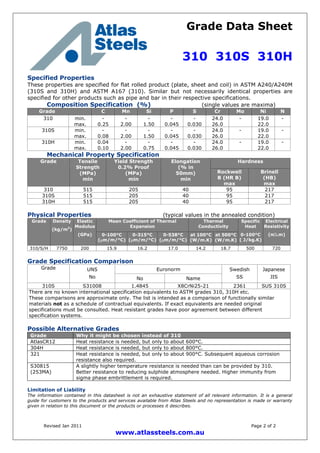
Composition Specification (%) (single values are maxima)
Grade C Mn Si P S Cr Mo Ni N
310 min.
max.
-
0.25
-
2.00
-
1.50
-
0.045
-
0.030
24.0
26.0
- 19.0
22.0
-
310S min.
max.
-
0.08
-
2.00
-
1.50
-
0.045
-
0.030
24.0
26.0
- 19.0
22.0
-
310H min.
max.
0.04
0.10
-
2.00
-
0.75
-
0.045
-
0.030
24.0
26.0
- 19.0
22.0
-
Mechanical Property Specification
HardnessGrade Tensile
Strength
(MPa)
min
Yield Strength
0.2% Proof
(MPa)
min
Elongation
(% in
50mm)
min
Rockwell
B (HR B)
max
Brinell
(HB)
max
310 515 205 40 95 217
310S 515 205 40 95 217
310H 515 205 40 95 217
Physical Properties (typical values in the annealed condition)
Mean Coefficient of Thermal
Expansion
Thermal
Conductivity
Grade Density
(kg/m3
)
Elastic
Modulus
(GPa) 0-100°C
(m/m/°C)
0-315°C
(m/m/°C)
0-538°C
(m/m/°C)
at 100°C
(W/m.K)
at 500°C
(W/m.K)
Specific
Heat
0-100°C
( J/kg.K)
Electrical
Resistivity
(n.m)
310/S/H 7750 200 15.9 16.2 17.0 14.2 18.7 500 720
Grade Specification Comparison
EuronormGrade UNS
No No Name
Swedish
SS
Japanese
JIS
310S S31008 1.4845 X8CrNi25-21 2361 SUS 310S
There are no known international specification equivalents to ASTM grades 310, 310H etc.
These comparisons are approximate only. The list is intended as a comparison of functionally similar
materials not as a schedule of contractual equivalents. If exact equivalents are needed original
specifications must be consulted. Heat resistant grades have poor agreement between different
specification systems.
Possible Alternative Grades
Grade Why it might be chosen instead of 310
AtlasCR12 Heat resistance is needed, but only to about 600°C.
304H Heat resistance is needed, but only to about 800°C.
321 Heat resistance is needed, but only to about 900°C. Subsequent aqueous corrosion
resistance also required.
S30815
(253MA)
A slightly higher temperature resistance is needed than can be provided by 310.
Better resistance to reducing sulphide atmosphere needed. Higher immunity from
sigma phase embrittlement is required.
Limitation of Liability
The information contained in this datasheet is not an exhaustive statement of all relevant information. It is a general
guide for customers to the products and services available from Atlas Steels and no representation is made or warranty
given in relation to this document or the products or processes it describes.
Grade Data Sheet
316 316L 316H
Revised Jan 2011 Page 1 of 2
www.atlassteels.com.au
Grade 316 is the standard molybdenum-bearing
austenitic grade, second stainless steel in
importance to 304. The molybdenum gives 316
better overall corrosion resistant properties
than Grade 304, particularly higher resistance
to pitting and crevice corrosion in chloride
environments. It is readily brake or roll formed,
welded, soldered and cut by both thermal and
mechanical methods. The austenitic structure
gives excellent toughness, even down to
cryogenic temperatures.
Grade 316L, the low carbon version of 316, is
highly resistant to sensitisation (grain boundary
carbide precipitation) and so is extensively used
in heavy gauge welded components (about
5mm and over). Grade 316H, with its higher
carbon content has some application at elevated
temperatures, as does stabilised grade 316Ti.
Nitrogen-strengthened versions also exist as
316N and 316LN. Only 316 and 316L are readily
available in Australian stock.
Corrosion Resistance
Excellent in a range of atmospheric
environments and many corrosive media -
generally more resistant than 304. Subject to
pitting and crevice corrosion in warm chloride
environments, and to stress corrosion cracking
above about 60°C. Considered resistant to
pitting corrosion in potable water with up to
about 1000mg/L chlorides at ambient
temperatures, reducing to about 300mg/L at
60°C.
316 is usually regarded as the standard “marine
grade” stainless steel, but it is not fully
resistant to sea water. In many marine
environments 316 does exhibit surface
corrosion, usually visible as brown staining. This
is particularly associated with crevices and
rough surface finish. Consult Atlas Technical
Assistance for specific environmental
recommendations.
There is usually no difference in corrosion
resistance between 316 and 316L.
Heat Resistance
Good oxidation resistance in intermittent
service to 870°C and in continuous service to
925°C. Continuous use of 316 in the 425-860°C
range is not recommended if subsequent
aqueous corrosion resistance is important.
Grade 316L is more resistant to carbide
precipitation and can be used in the above
temperature range. Grade 316H has higher
strength at elevated temperatures and is
sometimes used for structural and pressure-
containing applications at temperatures above
about 500°C, but the titanium stabilised grade
316Ti is often a more appropriate choice.
Heat Treatment
Solution Treatment (Annealing)
Heat to 1010-1120°C and cool rapidly. These
grades cannot be hardened by thermal
treatment.
Welding
Excellent weldability by all standard fusion
methods, both with and without filler metals. AS
1554.6 pre-qualifies welding of 316 with Grade
316 and 316L with Grade 316L rods or
electrodes (or their high silicon equivalents).
Heavy welded sections in Grade 316 require
post-weld annealing for maximum corrosion
resistance. This is not required for 316L. Grade
316Ti may also be used as an alternative to 316
for heavy section welding.
Machining
A “Ugima” improved machinability version of
grade 316 is available in round and hollow bar
products. Ugima machines significantly better
than standard 316 or 316L, giving higher
machining rates and lower tool wear in many
operations.
“Dual Certification”
It is common for 316 and 316L to be stocked in
“Dual Certified” form, particularly in plate, pipe
and round bar. These items have chemical and
mechanical properties complying with both 316
and 316L specifications. Such dual certified
product may be unacceptable for high
temperature applications.
Typical Applications
Food processing equipment. Laboratory
equipment. Architectural panelling, railings &
trim. Boat fittings. Chemical containers. Heat
exchangers. Screens for mining, quarrying &
water filtration. Threaded fasteners. Springs.
Grade Data Sheet
316 316L 316H
Revised Jan 2011 Page 2 of 2
www.atlassteels.com.au
Specified Properties
These properties are specified for flat rolled product (plate, sheet and coil) in ASTM A240/A240M.
Similar but not necessarily identical properties are specified for other products such as pipe and
bar in their respective specifications.
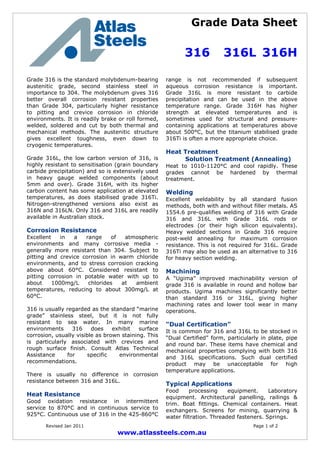
Composition Specification (%)
Grade C Mn Si P S Cr Mo Ni N
316 min.
max.
-
0.08
-
2.0
-
0.75
-
0.045
-
0.030
16.0
18.0
2.00
3.00
10.0
14.0
-
0.10
316L min.
max.
-
0.030
-
2.0
-
0.75
-
0.045
-
0.030
16.0
18.0
2.00
3.00
10.0
14.0
-
0.10
316H min.
max.
0.04
0.10
-
2.0
-
0.75
-
0.045
-
0.030
16.0
18.0
2.00
3.00
10.0
14.0
-
-
Mechanical Property Specification
HardnessGrade Tensile
Strength
(MPa)
min
Yield Strength
0.2% Proof
(MPa)
min
Elongation
(% in
50mm)
min
Rockwell B
(HR B)
max
Brinell
(HB)
max
316 515 205 40 95 217
316L 485 170 40 95 217
316H 515 205 40 95 217
316H also has a requirement for a grain size of ASTM No 7 or coarser.
Physical Properties (typical values in the annealed condition)
Mean Coefficient of Thermal
Expansion
Thermal
Conductivity
Grade Density
(kg/m3
)
Elastic
Modulus
(GPa) 0-100°C
(m/m/°C)
0-315°C
(m/m/°C)
0-538°C
(m/m/°C)
at 100°C
(W/m.K)
at 500°C
(W/m.K)
Specific
Heat
0-100°
C
( J/kg.K)
Electrical
Resistivity
(n.m)
316 &
316L/H
8000 193 15.9 16.2 17.5 16.3 21.5 500 740
Grade Specification Comparison
EuronormGrade UNS
No No Name
Swedish
SS
Japanese
JIS
316 S31600 1.4401 X5CrNiMo17-12-2 2347 SUS 316
316L S31603 1.4404 X2CrNiMo17-12-2 2348 SUS 316L
316H S31609 - - - -
These comparisons are approximate only. The list is intended as a comparison of functionally similar
materials not as a schedule of contractual equivalents. If exact equivalents are needed original
specifications must be consulted.
Possible Alternative Grades
Grade Why it might be chosen instead of 316
316Ti Better resistance to temperatures of around 600-900°C is needed.
316N Higher strength than standard 316.
317L Higher resistance to chlorides than 316L, but with similar resistance to stress corrosion
cracking.
F18MS / 444 Lower cost in thin gauge sheet and coil. F18MS (444) is a readily fabricated ferritic grade.
904L Much higher resistance to chlorides at elevated temperatures, with good formability
2205 Much higher resistance to chlorides at elevated temperatures, and higher strength.
Limitation of Liability
The information contained in this datasheet is not an exhaustive statement of all relevant information. It is a
general guide for customers to the products and services available from Atlas Steels and no representation is
made or warranty given in relation to this document or the products or processes it describes.
Grade Data Sheet
321
Revised May 2008 Page 1 of 2
www.atlassteels.com.au
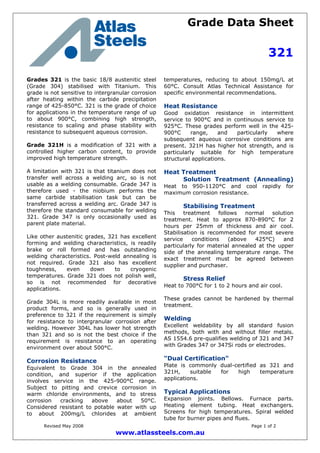
Grades 321 is the basic 18/8 austenitic steel
(Grade 304) stabilised with Titanium. This
grade is not sensitive to intergranular corrosion
after heating within the carbide precipitation
range of 425-850°C. 321 is the grade of choice
for applications in the temperature range of up
to about 900°C, combining high strength,
resistance to scaling and phase stability with
resistance to subsequent aqueous corrosion.
Grade 321H is a modification of 321 with a
controlled higher carbon content, to provide
improved high temperature strength.
A limitation with 321 is that titanium does not
transfer well across a welding arc, so is not
usable as a welding consumable. Grade 347 is
therefore used - the niobium performs the
same carbide stabilisation task but can be
transferred across a welding arc. Grade 347 is
therefore the standard consumable for welding
321. Grade 347 is only occasionally used as
parent plate material.
Like other austenitic grades, 321 has excellent
forming and welding characteristics, is readily
brake or roll formed and has outstanding
welding characteristics. Post-weld annealing is
not required. Grade 321 also has excellent
toughness, even down to cryogenic
temperatures. Grade 321 does not polish well,
so is not recommended for decorative
applications.
Grade 304L is more readily available in most
product forms, and so is generally used in
preference to 321 if the requirement is simply
for resistance to intergranular corrosion after
welding. However 304L has lower hot strength
than 321 and so is not the best choice if the
requirement is resistance to an operating
environment over about 500°C.
Corrosion Resistance
Equivalent to Grade 304 in the annealed
condition, and superior if the application
involves service in the 425-900°C range.
Subject to pitting and crevice corrosion in
warm chloride environments, and to stress
corrosion cracking above about 50°C.
Considered resistant to potable water with up
to about 200mg/L chlorides at ambient
temperatures, reducing to about 150mg/L at
60°C. Consult Atlas Technical Assistance for
specific environmental recommendations.
Heat Resistance
Good oxidation resistance in intermittent
service to 900°C and in continuous service to
925°C. These grades perform well in the 425-
900°C range, and particularly where
subsequent aqueous corrosive conditions are
present. 321H has higher hot strength, and is
particularly suitable for high temperature
structural applications.
Heat Treatment
Solution Treatment (Annealing)
Heat to 950-1120°C and cool rapidly for
maximum corrosion resistance.
Stabilising Treatment
This treatment follows normal solution
treatment. Heat to approx 870-890°C for 2
hours per 25mm of thickness and air cool.
Stabilisation is recommended for most severe
service conditions (above 425°C) and
particularly for material annealed at the upper
side of the annealing temperature range. The
exact treatment must be agreed between
supplier and purchaser.
Stress Relief
Heat to 700°C for 1 to 2 hours and air cool.
These grades cannot be hardened by thermal
treatment.
Welding
Excellent weldability by all standard fusion
methods, both with and without filler metals.
AS 1554.6 pre-qualifies welding of 321 and 347
with Grades 347 or 347Si rods or electrodes.
"Dual Certification"
Plate is commonly dual-certified as 321 and
321H, suitable for high temperature
applications.
Typical Applications
Expansion joints. Bellows. Furnace parts.
Heating element tubing. Heat exchangers.
Screens for high temperatures. Spiral welded
tube for burner pipes and flues.
Grade Data Sheet
321
Revised May 2008 Page 2 of 2
www.atlassteels.com.au
Specified Properties
These properties are specified for flat rolled product (plate, sheet and coil) in ASTM A240/A240M.
Similar but not necessarily identical properties are specified for other products such as pipe in
their respective specifications.
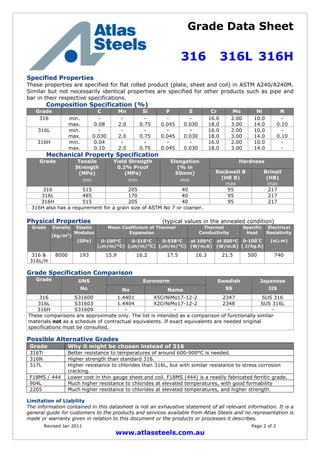
Composition Specification (%)
Grade C Mn Si P S Cr Mo Ni N Other
321 min.
max
-
0.08
-
2.00
-
0.75
-
0.045
-
0.030
17.0
19.0
- 9.0
12.0
-
0.10
Ti=5(C+N)
0.70
321H min.
max
0.04
0.10
-
2.00
-
0.75
-
0.045
-
0.030
17.0
19.0
- 9.0
12.0
- Ti=4(C+N)
0.70
347 min.
max
-
0.08
-
2.00
-
0.75
-
0.045
-
0.030
17.0
19.0
- 9.0
13.0
- Nb=10(C+N)
1.0
Mechanical Property Specification
HardnessGrade Tensile
Strength
(MPa)
min
Yield Strength
0.2% Proof
(MPa)
min
Elongation
(% in
50mm)
min
Rockwell
B (HR B)
max
Brinell
(HB)
max
321 515 205 40 95 217
321H 515 205 40 95 217
347 515 205 40 92 201
321H also has a requirement for a grain size of ASTM No 7 or coarser.
Physical Properties (typical values in the annealed condition)
Mean Coefficient of Thermal
Expansion
Thermal
Conductivity
Grade Density
(kg/m3
)
Elastic
Modulus
(GPa) 0-100°C
(m/m/°C)
0-315°C
(m/m/°C)
0-538°C
(m/m/°C)
at 100°C
(W/m.K)
at 500°C
(W/m.K)
Specific
Heat
0-100°C
( J/kg.K)
Electrical
Resistivity
(n.m)
321 7900 193 16.6 17.2 18.6 16.1 22.2 500 720
Grade Specification Comparison
EuronormGrade UNS
No No Name
Swedish
SS
Japanese
JIS
321 S32100 1.4541 X6CrNiTi18-10 2337 SUS 321
321H S32109 1.4878 X8CrNiTi18-10 - SUS 321H
347 S34700 1.4550 X6CrNiNb18-10 2338 SUS 347
These comparisons are approximate only. The list is intended as a comparison of functionally similar
materials not as a schedule of contractual equivalents. If exact equivalents are needed original
specifications must be consulted.
Possible Alternative Grades
Grade Why it might be chosen instead of 321
304L The requirement is for resistance to intergranular corrosion, not high temperature
strength
AtlasCR12 Only mild "high temperature" environment is present… up to about 450 – 600°C.
304H Only mild "high temperature" environment is present… up to about 600 – 800°C.
310 The operating temperature is up to about 1100°C - too high for 321 or 321H.
S30815
(253MA)
The operating temperature is up to about 1150°C- too high for 321 or 321H.
Limitation of Liability
The information contained in this datasheet is not an exhaustive statement of all relevant information. It is a general
guide for customers to the products and services available from Atlas Steels and no representation is made or warranty
given in relation to this document or the products or processes it describes.
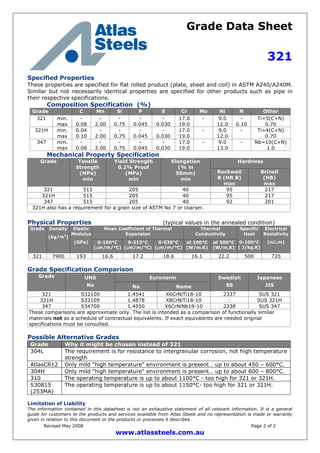
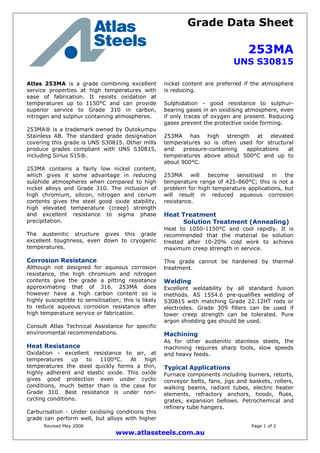
Grade Data Sheet
253MA
UNS S30815
Revised May 2008 Page 1 of 2
www.atlassteels.com.au
Atlas 253MA is a grade combining excellent
service properties at high temperatures with
ease of fabrication. It resists oxidation at
temperatures up to 1150°C and can provide
superior service to Grade 310 in carbon,
nitrogen and sulphur containing atmospheres.
253MA® is a trademark owned by Outokumpu
Stainless AB. The standard grade designation
covering this grade is UNS S30815. Other mills
produce grades compliant with UNS S30815,
including Sirius S15®.
253MA contains a fairly low nickel content,
which gives it some advantage in reducing
sulphide atmospheres when compared to high
nickel alloys and Grade 310. The inclusion of
high chromium, silicon, nitrogen and cerium
contents gives the steel good oxide stability,
high elevated temperature (creep) strength
and excellent resistance to sigma phase
precipitation.
The austenitic structure gives this grade
excellent toughness, even down to cryogenic
temperatures.
Corrosion Resistance
Although not designed for aqueous corrosion
resistance, the high chromium and nitrogen
contents give the grade a pitting resistance
approximating that of 316. 253MA does
however have a high carbon content so is
highly susceptible to sensitisation; this is likely
to reduce aqueous corrosion resistance after
high temperature service or fabrication.
Consult Atlas Technical Assistance for specific
environmental recommendations.
Heat Resistance
Oxidation - excellent resistance to air, at
temperatures up to 1100°C. At high
temperatures the steel quickly forms a thin,
highly adherent and elastic oxide. This oxide
gives good protection even under cyclic
conditions, much better than is the case for
Grade 310. Best resistance is under non-
cycling conditions.
Carburisation - Under oxidising conditions this
grade can perform well, but alloys with higher
nickel content are preferred if the atmosphere
is reducing.
Sulphidation - good resistance to sulphur-
bearing gases in an oxidising atmosphere, even
if only traces of oxygen are present. Reducing
gases prevent the protective oxide forming.
253MA has high strength at elevated
temperatures so is often used for structural
and pressure-containing applications at
temperatures above about 500°C and up to
about 900°C.
253MA will become sensitised in the
temperature range of 425-860°C; this is not a
problem for high temperature applications, but
will result in reduced aqueous corrosion
resistance.
Heat Treatment
Solution Treatment (Annealing)
Heat to 1050-1150°C and cool rapidly. It is
recommended that the material be solution
treated after 10-20% cold work to achieve
maximum creep strength in service.
This grade cannot be hardened by thermal
treatment.
Welding
Excellent weldability by all standard fusion
methods. AS 1554.6 pre-qualifies welding of
S30815 with matching Grade 22.12HT rods or
electrodes. Grade 309 fillers can be used if
lower creep strength can be tolerated. Pure
argon shielding gas should be used.
Machining
As for other austenitic stainless steels, the
machining requires sharp tools, slow speeds
and heavy feeds.
Typical Applications
Furnace components including burners, retorts,
conveyor belts, fans, jigs and baskets, rollers,
walking beams, radiant tubes, electric heater
elements, refractory anchors, hoods, flues,
grates, expansion bellows. Petrochemical and
refinery tube hangers.
Grade Data Sheet
253MA
UNS S30815
Revised May 2008 Page 2 of 2
www.atlassteels.com.au
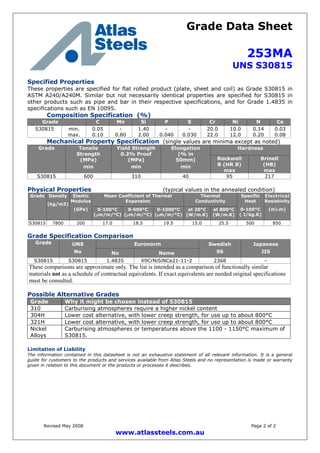
Specified Properties
These properties are specified for flat rolled product (plate, sheet and coil) as Grade S30815 in
ASTM A240/A240M. Similar but not necessarily identical properties are specified for S30815 in
other products such as pipe and bar in their respective specifications, and for Grade 1.4835 in
specifications such as EN 10095.
Composition Specification (%)
Grade C Mn Si P S Cr Ni N Ce
S30815 min.
max.
0.05
0.10
-
0.80
1.40
2.00
-
0.040
-
0.030
20.0
22.0
10.0
12.0
0.14
0.20
0.03
0.08
Mechanical Property Specification (single values are minima except as noted)
HardnessGrade Tensile
Strength
(MPa)
min
Yield Strength
0.2% Proof
(MPa)
min
Elongation
(% in
50mm)
min
Rockwell
B (HR B)
max
Brinell
(HB)
max
S30815 600 310 40 95 217
Physical Properties (typical values in the annealed condition)
Mean Coefficient of Thermal
Expansion
Thermal
Conductivity
Grade Density
(kg/m3)
Elastic
Modulus
(GPa) 0-100°C
(m/m/°C)
0-600°C
(m/m/°C)
0-1000°C
(m/m/°C)
at 20°C
(W/m.K)
at 800°C
(W/m.K)
Specific
Heat
0-100°C
( J/kg.K)
Electrical
Resistivity
(n.m)
S30815 7800 200 17.0 18.5 19.5 15.0 25.5 500 850
Grade Specification Comparison
EuronormGrade UNS
No No Name
Swedish
SS
Japanese
JIS
S30815 S30815 1.4835 X9CrNiSiNCe21-11-2 2368 -
These comparisons are approximate only. The list is intended as a comparison of functionally similar
materials not as a schedule of contractual equivalents. If exact equivalents are needed original specifications
must be consulted.
Possible Alternative Grades
Grade Why it might be chosen instead of S30815
310 Carburising atmospheres require a higher nickel content
304H Lower cost alternative, with lower creep strength, for use up to about 800°C
321H Lower cost alternative, with lower creep strength, for use up to about 800°C
Nickel
Alloys
Carburising atmospheres or temperatures above the 1100 - 1150°C maximum of
S30815.
Limitation of Liability
The information contained in this datasheet is not an exhaustive statement of all relevant information. It is a general
guide for customers to the products and services available from Atlas Steels and no representation is made or warranty
given in relation to this document or the products or processes it describes.
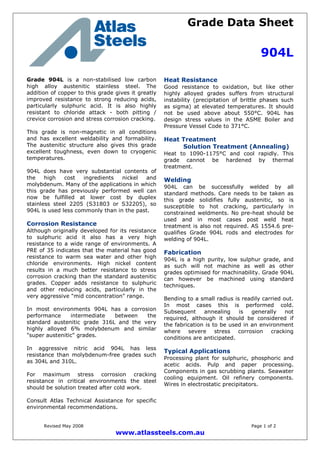
Grade Data Sheet
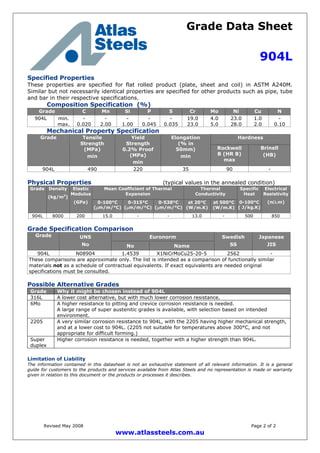
904L
Revised May 2008 Page 1 of 2
www.atlassteels.com.au
Grade 904L is a non-stabilised low carbon
high alloy austenitic stainless steel. The
addition of copper to this grade gives it greatly
improved resistance to strong reducing acids,
particularly sulphuric acid. It is also highly
resistant to chloride attack - both pitting /
crevice corrosion and stress corrosion cracking.
This grade is non-magnetic in all conditions
and has excellent weldability and formability.
The austenitic structure also gives this grade
excellent toughness, even down to cryogenic
temperatures.
904L does have very substantial contents of
the high cost ingredients nickel and
molybdenum. Many of the applications in which
this grade has previously performed well can
now be fulfilled at lower cost by duplex
stainless steel 2205 (S31803 or S32205), so
904L is used less commonly than in the past.
Corrosion Resistance
Although originally developed for its resistance
to sulphuric acid it also has a very high
resistance to a wide range of environments. A
PRE of 35 indicates that the material has good
resistance to warm sea water and other high
chloride environments. High nickel content
results in a much better resistance to stress
corrosion cracking than the standard austenitic
grades. Copper adds resistance to sulphuric
and other reducing acids, particularly in the
very aggressive "mid concentration" range.
In most environments 904L has a corrosion
performance intermediate between the
standard austenitic grade 316L and the very
highly alloyed 6% molybdenum and similar
"super austenitic" grades.
In aggressive nitric acid 904L has less
resistance than molybdenum-free grades such
as 304L and 310L.
For maximum stress corrosion cracking
resistance in critical environments the steel
should be solution treated after cold work.
Consult Atlas Technical Assistance for specific
environmental recommendations.
Heat Resistance
Good resistance to oxidation, but like other
highly alloyed grades suffers from structural
instability (precipitation of brittle phases such
as sigma) at elevated temperatures. It should
not be used above about 550°C. 904L has
design stress values in the ASME Boiler and
Pressure Vessel Code to 371°C.
Heat Treatment
Solution Treatment (Annealing)
Heat to 1090-1175°C and cool rapidly. This
grade cannot be hardened by thermal
treatment.
Welding
904L can be successfully welded by all
standard methods. Care needs to be taken as
this grade solidifies fully austenitic, so is
susceptible to hot cracking, particularly in
constrained weldments. No pre-heat should be
used and in most cases post weld heat
treatment is also not required. AS 1554.6 pre-
qualifies Grade 904L rods and electrodes for
welding of 904L.
Fabrication
904L is a high purity, low sulphur grade, and
as such will not machine as well as other
grades optimised for machinability. Grade 904L
can however be machined using standard
techniques.
Bending to a small radius is readily carried out.
In most cases this is performed cold.
Subsequent annealing is generally not
required, although it should be considered if
the fabrication is to be used in an environment
where severe stress corrosion cracking
conditions are anticipated.
Typical Applications
Processing plant for sulphuric, phosphoric and
acetic acids. Pulp and paper processing.
Components in gas scrubbing plants. Seawater
cooling equipment. Oil refinery components.
Wires in electrostatic precipitators.
Grade Data Sheet
904L
Revised May 2008 Page 2 of 2
www.atlassteels.com.au
Specified Properties
These properties are specified for flat rolled product (plate, sheet and coil) in ASTM A240M.
Similar but not necessarily identical properties are specified for other products such as pipe, tube
and bar in their respective specifications.
Composition Specification (%)
Grade C Mn Si P S Cr Mo Ni Cu N
904L min.
max.
-
0.020
-
2.00
-
1.00
-
0.045
-
0.035
19.0
23.0
4.0
5.0
23.0
28.0
1.0
2.0
-
0.10
Mechanical Property Specification
HardnessGrade Tensile
Strength
(MPa)
min
Yield
Strength
0.2% Proof
(MPa)
min
Elongation
(% in
50mm)
min
Rockwell
B (HR B)
max
Brinell
(HB)
904L 490 220 35 90 -
Physical Properties (typical values in the annealed condition)
Mean Coefficient of Thermal
Expansion
Thermal
Conductivity
Grade Density
(kg/m3
)
Elastic
Modulus
(GPa) 0-100°C
(m/m/°C)
0-315°C
(m/m/°C)
0-538°C
(m/m/°C)
at 20°C
(W/m.K)
at 500°C
(W/m.K)
Specific
Heat
0-100°C
( J/kg.K)
Electrical
Resistivity
(n.m)
904L 8000 200 15.0 - - 13.0 - 500 850
Grade Specification Comparison
EuronormGrade UNS
No No Name
Swedish
SS
Japanese
JIS
904L N08904 1.4539 X1NiCrMoCu25-20-5 2562 -
These comparisons are approximate only. The list is intended as a comparison of functionally similar
materials not as a schedule of contractual equivalents. If exact equivalents are needed original
specifications must be consulted.
Possible Alternative Grades
Grade Why it might be chosen instead of 904L
316L A lower cost alternative, but with much lower corrosion resistance.
6Mo A higher resistance to pitting and crevice corrosion resistance is needed.
A large range of super austenitic grades is available, with selection based on intended
environment.
2205 A very similar corrosion resistance to 904L, with the 2205 having higher mechanical strength,
and at a lower cost to 904L. (2205 not suitable for temperatures above 300°C, and not
appropriate for difficult forming.)
Super
duplex
Higher corrosion resistance is needed, together with a higher strength than 904L.
Limitation of Liability
The information contained in this datasheet is not an exhaustive statement of all relevant information. It is a general
guide for customers to the products and services available from Atlas Steels and no representation is made or warranty
given in relation to this document or the products or processes it describes.
Grade Data Sheet
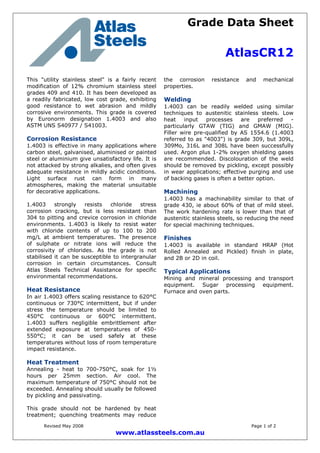
AtlasCR12
Revised May 2008 Page 1 of 2
www.atlassteels.com.au
This "utility stainless steel" is a fairly recent
modification of 12% chromium stainless steel
grades 409 and 410. It has been developed as
a readily fabricated, low cost grade, exhibiting
good resistance to wet abrasion and mildly
corrosive environments. This grade is covered
by Euronorm designation 1.4003 and also
ASTM UNS S40977 / S41003.
Corrosion Resistance
1.4003 is effective in many applications where
carbon steel, galvanised, aluminised or painted
steel or aluminium give unsatisfactory life. It is
not attacked by strong alkalies, and often gives
adequate resistance in mildly acidic conditions.
Light surface rust can form in many
atmospheres, making the material unsuitable
for decorative applications.
1.4003 strongly resists chloride stress
corrosion cracking, but is less resistant than
304 to pitting and crevice corrosion in chloride
environments. 1.4003 is likely to resist water
with chloride contents of up to 100 to 200
mg/L at ambient temperatures. The presence
of sulphate or nitrate ions will reduce the
corrosivity of chlorides. As the grade is not
stabilised it can be susceptible to intergranular
corrosion in certain circumstances. Consult
Atlas Steels Technical Assistance for specific
environmental recommendations.
Heat Resistance
In air 1.4003 offers scaling resistance to 620°C
continuous or 730°C intermittent, but if under
stress the temperature should be limited to
450°C continuous or 600°C intermittent.
1.4003 suffers negligible embrittlement after
extended exposure at temperatures of 450-
550°C; it can be used safely at these
temperatures without loss of room temperature
impact resistance.
Heat Treatment
Annealing - heat to 700-750°C, soak for 1½
hours per 25mm section. Air cool. The
maximum temperature of 750°C should not be
exceeded. Annealing should usually be followed
by pickling and passivating.
This grade should not be hardened by heat
treatment; quenching treatments may reduce
the corrosion resistance and mechanical
properties.
Welding
1.4003 can be readily welded using similar
techniques to austenitic stainless steels. Low
heat input processes are preferred -
particularly GTAW (TIG) and GMAW (MIG).
Filler wire pre-qualified by AS 1554.6 (1.4003
referred to as "4003") is grade 309, but 309L,
309Mo, 316L and 308L have been successfully
used. Argon plus 1-2% oxygen shielding gases
are recommended. Discolouration of the weld
should be removed by pickling, except possibly
in wear applications; effective purging and use
of backing gases is often a better option.
Machining
1.4003 has a machinability similar to that of
grade 430, ie about 60% of that of mild steel.
The work hardening rate is lower than that of
austenitic stainless steels, so reducing the need
for special machining techniques.
Finishes
1.4003 is available in standard HRAP (Hot
Rolled Annealed and Pickled) finish in plate,
and 2B or 2D in coil.
Typical Applications
Mining and mineral processing and transport
equipment. Sugar processing equipment.
Furnace and oven parts.
Grade Data Sheet
AtlasCR12
Revised May 2008 Page 2 of 2
www.atlassteels.com.au
Specified Properties
These properties are specified for flat rolled product (plate, sheet and coil) in Euronorm EN
10088.2 1.4003 and ASTM A240/A240M S40977 and S41003. Similar but not necessarily
identical properties apply for other products (1.4003 bar is covered by EN 10088-3), but this
grade is almost exclusively a flat rolled product.
Composition Specification (%)
Grade C Mn Si P S Cr Mo Ni N
1.4003
S40977
min.
max.
-
0.030
-
1.50
-
1.00
-
0.040
-
0.015
10.50
12.50
- 0.30
1.00
-
0.030
S41003 min.
max.
-
0.030
-
1.50
-
1.00
-
0.040
-
0.030
10.5
12.5
- -
1.50
-
0.030
Mechanical Property Specification
HardnessGrade Tensile
Strength
(MPa)
Yield Strength
0.2% Proof Stress
(MPa)
min
Elongation
(% in
50mm)
min
Rockwell
(HR)
max
Brinell
(HB)
max
1.4003 (1) 450 – 650 280 (long), 320
(trans)
20 - -
S40977 450 min 280 18 HR B88 180
S41003 455 min 275 18 HR C20 223
(1) Properties specified for cold rolled coil and hot rolled coil plate. Quarto plate has different values.
Physical Properties (typical values in the annealed condition)
Mean Coefficient of Thermal
Expansion
Thermal
Conductivity
Grade Density
(kg/m3
)
Elastic
Modulus
(GPa) 20-100°C
(m/m/°C)
20-300°C
(m/m/°C)
20-500°C
(m/m/°C)
at 100°C
(W/m.K)
Specific
Heat
0-100°C
( J/kg.K)
Electrical
Resistivity
(n.m)
1.4003 7700 220 10.4 11.2 11.9 25 430 600
Source: EN 10088-1
Grade Specification Comparison
EuronormGrade UNS
No No Name
Swedish
SS
Japanese
JIS
1.4003 S41003 or S40977 1.4003 X2CrNi12 - -
These comparisons are approximate only. The list is intended as a comparison of functionally similar
materials not as a schedule of contractual equivalents. If exact equivalents are needed original
specifications must be consulted.
Possible Alternative Grades
Grade Why it might be chosen instead of 1.4003
AtlasCR12Ti Improved resistance to sensitisation and intergranular corrosion is needed.
304 Better corrosion resistance and fabrication properties are required.
Galvanised
steel
A lower cost is required, and the reduced corrosion resistance and fabrication
characteristics of galvanised steel are acceptable.
Weathering
steel
A lower cost is required, and the reduced corrosion resistance and fabrication
characteristics of weathering steel are acceptable.
Limitation of Liability
The information contained in this datasheet is not an exhaustive statement of all relevant information. It is a general
guide for customers to the products and services available from Atlas Specialty Metals and no representation is made or
warranty given in relation to this document or the products or processes it describes.
Grade Data Sheet
AtlasCR12Ti
Revised May 2008 Page 1 of 2
www.atlassteels.com.au
This "utility stainless steel" is a proprietary
modification of Grade 409 12% chromium
stainless steel. It has been developed as a
readily fabricated, low cost grade, exhibiting
good resistance to wet abrasion and mildly
corrosive environments; the titanium stabilised
composition results in excellent resistance to
sensitisation in welding, particularly of thin
sections.
There are no national specifications or
international specifications covering this grade.
The designation "AtlasCR12Ti" is a registered
trade mark of Atlas Steels.
Corrosion Resistance
AtlasCR12Ti is effective in many applications
where carbon steel, galvanised, aluminised or
painted steel or aluminium give unsatisfactory
life. It is not attacked by strong alkalies, and
often gives adequate resistance in mildly acidic
conditions. Light surface rust can form in many
atmospheres, making the material unsuitable
for decorative applications.
AtlasCR12Ti strongly resists chloride stress
corrosion cracking, but is less resistant than
304 or 430 to pitting and crevice corrosion in
chloride environments. AtlasCR12Ti is likely to
resist pitting in water with chloride contents of
up to 100 to 200 mg/L at ambient
temperatures. The presence of sulphate or
nitrate ions will reduce the corrosivity of
chlorides. AtlasCR12Ti is titanium stabilised to
be more resistant to sensitisation and
intergranular corrosion compared to alternative
grades such as AtlasCR12 (1.4003). Consult
Atlas Technical Assistance for specific
environmental recommendations.
Heat Resistance
In air AtlasCR12Ti offers scaling resistance to
620°C continuous or 730°C intermittent, but if
under stress the temperature should be limited
to 450°C continuous or 600°C intermittent.
AtlasCR12Ti suffers negligible embrittlement
after extended exposure at temperatures of
450-550°C.
Heat Treatment
Annealing - heat to 700-750°C, soak
for 1½ hours per 25mm section. Air cool. The
maximum temperature of 750°C should not be
exceeded. Annealing should usually be followed
by pickling and passivating.
This grade should not be hardened by heat
treatment; quenching treatments may reduce
the corrosion resistance and mechanical
properties.
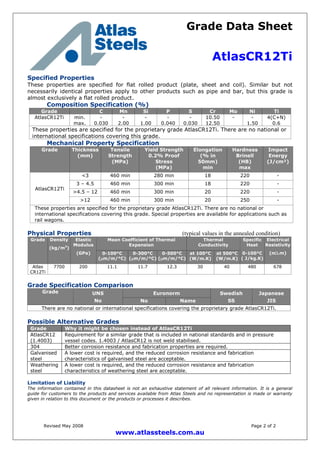
Welding
AtlasCR12Ti is resistant to the sensitisation and
intergranular corrosion that can occur in
welding of unstabilised stainless steels. It can
be welded using similar techniques to
austenitic stainless steels. Low heat input
processes are preferred - particularly GTAW
(TIG) and GMAW (MIG). Filler wire
recommended is grade 309L; this over-alloyed
grade is important for welding AtlasCR12Ti to
other steels, but 316L and 308L have also been
successfully used when welding AtlasCR12Ti to
itself. Heat inputs should be controlled to 0.5
to 1.5kJ/mm. Argon plus 1-2% oxygen
shielding gases are recommended.
Discolouration of the weld should be removed
by pickling, except possibly in wear
applications; effective purging and use of
backing gases is often a better option.
Standard stainless steel pickling pastes can
cause higher attack than they do on austenitic
grades; these should be used with caution.
Machining
AtlasCR12Ti has a machinability similar to that
of grade 430, ie about 60% of that of mild
steel. The work hardening rate is lower than
that of austenitic stainless steels, so reducing
the need for special machining techniques.
Finishes
AtlasCR12Ti is available in standard No1
(“HRAP” – Hot Rolled Annealed and Pickled)
finish in sheet, plate and coil down to 3mm
thickness, and as cold rolled 2B finish in lighter
gauges.
Typical Applications
Mining and mineral processing and transport
equipment. Rail wagons for coal and iron ore.
Sugar processing equipment. Furnace and oven
parts.
Grade Data Sheet
AtlasCR12Ti
Revised May 2008 Page 2 of 2
www.atlassteels.com.au
Specified Properties
These properties are specified for flat rolled product (plate, sheet and coil). Similar but not
necessarily identical properties apply to other products such as pipe and bar, but this grade is
almost exclusively a flat rolled product.
Composition Specification (%)
Grade C Mn Si P S Cr Mo Ni Ti
AtlasCR12Ti min.
max.
-
0.030
-
2.00
-
1.00
-
0.040
-
0.030
10.50
12.50
- -
1.50
4(C+N)
0.6
These properties are specified for the proprietary grade AtlasCR12Ti. There are no national or
international specifications covering this grade.
Mechanical Property Specification
Grade Thickness
(mm)
Tensile
Strength
(MPa)
Yield Strength
0.2% Proof
Stress
(MPa)
Elongation
(% in
50mm)
min
Hardness
Brinell
(HB)
max
Impact
Energy
(J/cm²)
<3 460 min 280 min 18 220 -
3 – 4.5 460 min 300 min 18 220 -
>4.5 – 12 460 min 300 min 20 220 -
AtlasCR12Ti
>12 460 min 300 min 20 250 -
These properties are specified for the proprietary grade AtlasCR12Ti. There are no national or
international specifications covering this grade. Special properties are available for applications such as
rail wagons.
Physical Properties (typical values in the annealed condition)
Mean Coefficient of Thermal
Expansion
Thermal
Conductivity
Grade Density
(kg/m3
)
Elastic
Modulus
(GPa) 0-100°C
(m/m/°C)
0-300°C
(m/m/°C)
0-500°C
(m/m/°C)
at 100°C
(W/m.K)
at 500°C
(W/m.K)
Specific
Heat
0-100°C
( J/kg.K)
Electrical
Resistivity
(n.m)
Atlas
CR12Ti
7700 200 11.1 11.7 12.3 30 40 480 678
Grade Specification Comparison
EuronormGrade UNS
No No Name
Swedish
SS
Japanese
JIS
There are no national or international specifications covering the proprietary grade AtlasCR12Ti.
Possible Alternative Grades
Grade Why it might be chosen instead of AtlasCR12Ti
AtlasCR12
(1.4003)
Requirement for a similar grade that is included in national standards and in pressure
vessel codes. 1.4003 / AtlasCR12 is not weld stabilised.
304 Better corrosion resistance and fabrication properties are required.
Galvanised
steel
A lower cost is required, and the reduced corrosion resistance and fabrication
characteristics of galvanised steel are acceptable.
Weathering
steel
A lower cost is required, and the reduced corrosion resistance and fabrication
characteristics of weathering steel are acceptable.
Limitation of Liability
The information contained in this datasheet is not an exhaustive statement of all relevant information. It is a general
guide for customers to the products and services available from Atlas Steels and no representation is made or warranty
given in relation to this document or the products or processes it describes.
Grade Data Sheet
409
Revised May 2008 Page 1 of 2
www.atlassteels.com.au
Grade 409 is a titanium-stabilised ferritic
stainless steel. Although regarded as a
general-purpose chromium stainless steel the
almost exclusive application for Grade 409 is
automotive exhaust systems. Its applications
are those where appearance is a secondary
consideration to mechanical properties and
corrosion resistance, particularly at high
temperatures, and where some weldability is
required.
The generic grade 409 has now been replaced
in some ASTM specifications (notably the flat
rolled specification ASTM A240M) by several
“sub-grades”, designated S40910, S40920 and
S40930. These have various degrees of
stabilisation with titanium, niobium or both
titanium and niobium. Any of these may be
certified as S40900 (Grade 409). By contrast
only standard Grade 409 is listed in ASTM
A268M covering tube.
Corrosion Resistance
Grade 409 resists atmospheric and exhaust gas
corrosion. A light surface rust will form in most
atmospheres; this rust retards further
corrosion but makes the surface undesirable
for decorative applications. The corrosion
resistance is about the same as that of
AtlasCR12 and the 12% chromium martensitic
grades such as 410, and inferior to the 17%
chromium grade 430.
Consult Atlas Technical Assistance for specific
environmental recommendations.
Heat Resistance
Generally 409 is classified as resistant to
scaling in intermittent service up to 815°C and
up to 675°C in continuous service, but these
temperatures are dependent upon the exact
service environment.
Heat Treatment
Annealing
Heat to 790-900°C and air cool. This grade
cannot be hardened by thermal treatment.
Welding
Readily welded but a pre-heat of 150-260°C is
recommended. Grade 409 or Grade 430
electrode or filler rods can be used, but AS
1554.6 pre-qualifies welding of 409 with Grade
309 rods or electrodes. These austenitic fillers
result in a more ductile weld.
Post-weld annealing at 760-815°C improves
weld ductility.
Post-weld annealing is not required when
welding thin sections. Automotive exhaust
tubing is typically welded without filler metal
(autogenously).
All welding must be carried out with minimum
heat input to reduce grain growth effects.
Typical Applications
Automotive exhaust systems, including
catalytic converters and mufflers
Grade Data Sheet
409
Revised May 2008 Page 2 of 2
www.atlassteels.com.au
Specified Properties
The properties for Grade 409 are specified for annealed tubing in ASTM A268M. Compositions of
other grades are for coil and sheet in ASTM A240M. Similar but not necessarily identical
properties are specified for other products in their respective specifications.
Composition Specification (%)
Grade C Mn Si P S Cr Ni N Ti Nb
409
S40900
min.
max.
-
0.08
-
1.00
-
1.00
-
0.045
-
0.030
10.5
11.7
-
0.50
6x%C
0.75
S40910 min.
max.
-
0.03
-
1.00
-
1.00
-
0.040
-
0.020
10.5
11.7
-
0.50
-
0.030
6x%C
0.50
-
0.17
S40920 min.
max.
-
0.03
-
1.00
-
1.00
-
0.040
-
0.020
10.5
11.7
-
0.50
-
0.030
0.15 & 8x(C+N)
0.50
-
0.10
S40930 min.
max.
-
0.03
-
1.00
-
1.00
-
0.040
-
0.020
10.5
11.7
-
0.50
-
0.030
Ti+Nb=(0.08+8)x(C+N)
0.75
Mechanical Property Specification
HardnessGrade Tensile
Strength
(MPa)
min
Yield Strength
0.2% Proof
(MPa)
min
Elongation
(% in
50mm)
min
Rockwell
B (HR B)
max
Brinell
(HB)
max
409 380 170 20 95 207
These same tensile, yield and elongation limits also apply to the other grades in ASTM A240M.
Hardness limits are 88HRB and 179HB maximum for these other grades in flat rolled product.
Physical Properties (typical values in the annealed condition)
Mean Coefficient of Thermal
Expansion
Thermal
Conductivity
Grade Density
(kg/m3
)
Elastic
Modulus
(GPa) 0-100°C
(m/m/°C)
0-315°C
(m/m/°C)
0-538°C
(m/m/°C)
at 100°C
(W/m.K)
at 500°C
(W/m.K)
Specific
Heat
0-100°C
( J/kg.K)
Electrical
Resistivity
(n.m)
409 7700 208 11.0 11.7 12.4 25.8 27.5 460 600
Grade Specification Comparison
EuronormGrade UNS
No No Name
Swedish
SS
Japanese
JIS
409 S40900 1.4512 X6CrTi12 / X2CrTi12 - SUH 409
There no known standardised international alternatives to the ASTM S40910, S40920 and S40930 grades.
These comparisons are approximate only. The list is intended as a comparison of functionally similar
materials not as a schedule of contractual equivalents. If exact equivalents are needed original
specifications must be consulted.
Possible Alternative Grades
Grade Why it might be chosen instead of 409
AtlasCR12 Similar corrosion resistance, better weldability and more readily available than 409,
particularly in heavy sections. (409 may have better drawability than AtlasCR12.)
304 Better corrosion resistance and heat resistance but at higher cost.
321 Higher heat resistance than 409 or 304.
Aluminised
steel
Lower cost than stainless steel grade 409, but also a lower resistance to exhaust gases.
Limitation of Liability
The information contained in this datasheet is not an exhaustive statement of all relevant information. It is a general
guide for customers to the products and services available from Atlas Steels and no representation is made or warranty
given in relation to this document or the products or processes it describes.
Grade Data Sheet
430
Revised May 2008 Page 1 of 2
www.atlassteels.com.au
Grade 430 is a ferritic, straight chromium,
non-hardenable grade, combining good
corrosion resistance and formability
characteristics with useful mechanical
properties. Its ability to resist nitric acid attack
permits its use in specific chemical applications
but automotive trim, indoor panelling such as
refrigeration cabinets and appliance
components are its largest fields of application.
This grade is only readily available in sheet and
coil (up to 1.2mm thick), most commonly in BA
or 2B finishes, or polished to No4. The BA
finish sheet has a quite bright, reflective
appearance.
Grade 430F is the free-machining version of
this grade, produced in bar form for high speed
machining in automatic screw machines.
Corrosion Resistance
Grade 430 has good resistance to a wide
variety of corrosive media including nitric acid
and some organic acids. It attains its maximum
corrosion resistance when in the highly
polished or buffed condition. Its resistance to
pitting and crevice corrosion resistance is a
little lower than that of Grade 304. It is not
usually recommended for Grade 430 to be
subjected to exterior exposure, but it performs
well in mild indoor environments. Stress
corrosion cracking resistance of Grade 430 is
very high, as it is for all ferritic grades.
Heat Resistance
Grade 430 Resists oxidation in intermittent
service up to 870°C and to 815°C in
continuous service. This grade may become
brittle at room temperature after prolonged
heating in the 400-600°C range. This effect
can be eliminated by annealing.
Heat Treatment
Solution Annealing
Heat to 815-845°C, hold for ½ hour per 25mm
of thickness, slow furnace cool to 600°C and
then quickly air cool. Slow cooling from 540-
400°C will cause embrittlement.
Sub-Critical anneal
Heat to 760-815°C and then air cool or water
quench.
This grade is not hardenable by thermal
treatment.
Note that 430 is likely to scale more heavily at
elevated temperatures than 304, and the scale
produced is more difficult to remove by
pickling.
Welding
If welding is necessary pre-heat at 150-200°C.
Embrittlement in the weld metal and heat
affected zone can be reduced by a post-weld
anneal at 790-815°C, but grain refinement will
not occur. Use Grade 430, 308L, 309 or 310
filler rod, depending upon application. AS
1554.6 pre-qualifies welding of Grade 430 with
Grade 309 filler rods and electrodes.
Machining
Grade 430 is easier to machine than the
standard austenitic grades such as 304, but
there is still a tendency for galling and pick-up
on the cutting tool. Bars that have been lightly
drawn are easier to machine than those in the
annealed condition, but Grade 430 is not
usually available in bar. Grade 430F, the free
machining version of 430, is very much easier
to machine.
Fabrication
The lower work hardening rate makes bending
and forming somewhat easier than for grade
304, but the lower ductility restricts very
severe operations. Wherever possible severe
bends should be made with the bend axis at
right angles to the rolling direction. Severe cold
heading of 430 wire is possible.
If very severe cold working is required it may
be necessary to carry out a sub-critical
intermediate anneal.
Typical Applications
Linings for dish washers and panels in other
domestic appliances. Refrigerator cabinet
panels. Automotive trim. Lashing wire. Element
supports. Stove trim rings. Fasteners. Chimney
liners.
Grade Data Sheet
430
Revised May 2008 Page 2 of 2
www.atlassteels.com.au
Specified Properties
These properties for 430 are specified for flat rolled product (plate, sheet and coil) in ASTM
A240/A240M. Properties of Grade 430F are specified for bar in ASTM A582. Similar but not
necessarily identical properties are specified for other products in their respective specifications.
Composition Specification (%)
Grade C Mn Si P S Cr Mo Ni N
430 min.
max.
-
0.12
-
1.00
-
1.00
-
0.040
-
0.030
16.0
18.0
- -
0.75
-
430F min.
max.
-
0.12
-
1.25
-
1.00
-
0.06
0.15
-
16.0
18.0
- - -
Mechanical Property Specification
HardnessGrade Tensile
Strength
(MPa)
min
Yield Strength
0.2% Proof
(MPa)
min
Elongation
(% in
50mm)
min
Rockwell
B (HR B)
max
Brinell
(HB)
max
430 450 205 22 89 183
430F 552 typical 379 typical 25 typical - 262
Physical Properties (typical values in the annealed condition)
Mean Coefficient of Thermal
Expansion
Thermal
Conductivity
Grade Density
(kg/m3
)
Elastic
Modulus
(GPa) 0-100°C
(m/m/°C)
0-315°C
(m/m/°C)
0-538°C
(m/m/°C)
at 100°C
(W/m.K)
at 500°C
(W/m.K)
Specific
Heat
0-100°C
( J/kg.K)
Electrical
Resistivity
(n.m)
430 7700 200 10.4 11.0 11.4 23.9 26.0 460 600
430F 7700 200 10.4 11.0 11.4 26.1 26.3 460 600
Grade Specification Comparison
EuronormGrade UNS
No No Name
Swedish
SS
Japanese
JIS
430 S43000 1.4016 X6Cr17 2320 SUS 430
430F S43020 1.4105 X6CrMoS17 2383 SUS 430F
These comparisons are approximate only. The list is intended as a comparison of functionally similar
materials not as a schedule of contractual equivalents. If exact equivalents are needed original
specifications must be consulted.
Possible Alternative Grades
Grade Why it might be chosen instead of 430
430F Higher machinability than 430 is needed in bar product, and reduced corrosion resistance
is acceptable.
Durinox
F20S
Better pitting resistance, formability and weldability is required in a ferritic stainless steel.
304 Higher corrosion resistance is needed, together with greatly improved ability to be welded
and cold formed.
316 Much better corrosion resistance is needed, together with greatly improved ability to be
welded and cold formed.
AtlasCR12 A lower corrosion resistance is acceptable in a cost-critical application.
Limitation of Liability
The information contained in this datasheet is not an exhaustive statement of all relevant information. It is a general
guide for customers to the products and services available from Atlas Steels and no representation is made or warranty
given in relation to this document or the products or processes it describes.
Grade Data Sheet
Durinox™ F18S
Revised July 2008 Page 1 of 2
www.atlassteels.com.au
Durinox F18S is a stabilised chromium ferritic
stainless steel, combining good corrosion
resistance with good formability and
weldability. Its corrosion resistance enables it
to replace grade 304 in less aggressive
applications. Like all ferritic steels it is readily
attracted to a magnet.
Durinox F18S is most commonly available in
tube, sheet or coil up to about 2mm thick.
Corrosion Resistance
Durinox F18S has resistance in a variety of
mildly corrosive media. It attains its maximum
corrosion resistance when in the highly
polished or buffed condition.
The resistance of grade F18S to pitting and
crevice corrosion in chloride environments is
between that of grades 430 and 304. Its PRE
value of about 18 is close to that of 304.
Chloride stress corrosion cracking (SCC)
resistance of Durinox F18S is very high, as it is
for all ferritic grades.
The resistance of Durinox F18S to acids is
generally lower than that of 304, but
performance varies for different acids, and
these should be considered on a case by case
basis.
Heat Resistance
Durinox F18S resists oxidation up to 980°C; it
is particularly resistant to intermittent service
conditions. It may become brittle at room
temperature after prolonged heating in the 400
– 500°C range; this effect can be corrected by
subsequent annealing. Niobium in F18S results
in very high creep strength that makes it a
good choice for critical auto exhaust system
components.
Heat Treatment
Annealing
Heat to 790 - 870°C, hold for only a few
minutes and then water quench or quickly air
cool. Slow cooling will cause embrittlement and
raise the ductile-to-brittle transition
temperature, so should be avoided. It is
important to not exceed 1000°C.
Durinox F18S is not hardenable by thermal
treatment.
Welding
Welding of Durinox F18S can be readily carried
out by all the common electric processes. As
F18S has very low carbon and nitrogen
contents and is stabilised by additions of
titanium and / or niobium it has good
resistance to sensitisation and hence
intergranular corrosion. Like most ferritic
grades it is subject to significant grain growth
in the heat affected zones of welds. Heat input
should therefore be kept to a minimum, and
welding of thicknesses over 2mm become more
difficult. Gas shielding of the arc, weld metal
and back side of the weld is important to
minimise air contact. Use Grade 308L (or
308LSi) filler rod, depending upon application.
Machining
F18S is easier to machine than the standard
austenitic grades such as 304, but the grade is
not commonly available as a bar.
Fabrication
Durinox F18S has a higher yield strength,
higher tensile strength and lower work
hardening rate compared to 304. Some
operations will therefore be easier and some
will require a little more force. The lower
ductility of F18S restricts some very severe
operations. It has quite good deep drawing
capability; close to that of 304, but it has
limited ability to stretch form. As these two
processes are often combined in a single
forming operation some changes to settings or
tooling compared to the austenitic grades may
be needed.
If very severe cold working is required it may
be necessary to carry out an intermediate
anneal.
Typical Applications
Chemical process equipment, heat exchanger
tubing – particularly in the sugar industry,
architectural panels and furniture for indoor
environments, trolleys, equipment for food
preparation service and display, refrigeration
cabinets, exhaust flues, fuel burners.
Grade Data Sheet
Durinox™ F18S
Revised July 2008 Page 2 of 2
www.atlassteels.com.au
Specified Properties
The composition and mechanical properties are specified for flat rolled product (plate, sheet and
coil) in ASTM A240/A240M, for grade UNS S43932. Durinox F18S is fully compliant with this
specification. Similar but not necessarily identical properties are specified for other products in
their respective specifications.
Chemical Composition (%)
Grade C Mn Si P S Cr Mo Ni N Ti+Nb
Durinox
F18S
-
0.030
-
1.00
-
1.00
-
0.040
-
0.030
17.0
19.0
- -
0.50
-
0.030
0.20+4(C+N)
0.75
Mechanical Properties
HardnessGrade Tensile
Strength
(MPa)
min
Yield
Strength
0.2% Proof
(MPa)
min
Elongation
(% in
50mm)
min
Rockwell B
(HR B)
max
Brinell
(HB)
max
Cold Bend
Transverse
direction
Bend radius = 1T
Durinox
F18S
415 205 22 89 183 180°
Physical Properties (typical values in the annealed condition)
Mean Coefficient of
Thermal Expansion
Thermal
Conductivity
Grade Density
(kg/m
3
)
Elastic
Modulus
(GPa) 0-100°C
(µm/m/°C)
0-400°C
(µm/m/°C)
at 100°C
(W/m.K)
Specific
Heat
0-100
°
C
( J/kg.K)
Electrical
Resistivity
(nΩ.m)
Durinox
F18S
7700 200 11.0 11.5 25 460 620
Grade Specification Comparison
EuronormGrade UNS No
No Name
Swedish
SS
Japanese
JIS
Durinox
F18S
S43932 1.4509 X2CrTiNb18 - -
These comparisons are approximate only. The list is intended as a comparison of functionally similar
materials not as a schedule of contractual equivalents. If exact equivalents are needed original
specifications must be consulted.
Possible Alternative Grades
Grade Why it might be chosen instead of Durinox F18S
304 Need the increased weldability, especially in heavy sections, or better stretch formability
of 304. 304 is also available in sections above the 2 to 3mm upper limit for Durinox
F18S, and a much wider range of products generally.
430 430 has corrosion resistance that is nearly as high as F18S, so may be appropriate in
indoor applications that are not welded.
F20S Durinox F20S could be used if the corrosion resistance of F18S was not quite adequate.
F20S is another low cost ferritic steel.
Limitation of Liability
The information contained in this datasheet is not an exhaustive statement of all relevant information. It is a general
guide for customers to the products and services available from Atlas Steels and no representation is made or warranty
given in relation to this document or the products or processes it describes.
Grade Data Sheet
Durinox™ F20S
Revised May 2008 Page 1 of 2
www.atlassteels.com.au
Atlas Durinox F20S is a stabilised 20%
chromium ferritic stainless steel, combining
good corrosion resistance with high formability
and weldability. This grade contains no nickel
and is an economical alternative to grade 304
in many applications. Like all ferritic steels it is
readily attracted to a magnet.
Durinox F20S is most commonly available in
sheet or coil up to about 2mm thick.
Corrosion Resistance
Durinox F20S has good resistance in a wide
variety of environments. The resistance of
Durinox F20S to pitting and crevice corrosion in
chloride environments is similar or superior to
that of grade 304. Its PRE value of about 20 is
above that of 304, confirmed by laboratory and
service exposure testing. In outdoor exposure
it performs similarly to 304. Chloride stress
corrosion cracking (SCC) resistance of Durinox
F20S is very high, as for all ferritic grades.
Its resistance to acids is generally slightly
lower than that of 304, but performance varies
for different acids.
Heat Resistance
Durinox F20S resists oxidation in intermittent
service up to 920°C and to 870°C in
continuous service but it may become brittle at
room temperature after prolonged heating in
the 400 – 500°C range. This effect can be
corrected by subsequent annealing.
Heat Treatment
Annealing
Heat to approximately 925°C, hold for only a
few minutes and then water quench or quickly
air cool. Slow cooling from 500-400°C will
cause embrittlement. F20S is not hardenable
by thermal treatment.
Welding
Welding of Durinox F20S can be readily carried
out by all the common electric processes. As
Durinox F20S has very low carbon and nitrogen
contents and is stabilised by additions of
titanium and / or niobium it has good
resistance to sensitisation and hence
intergranular corrosion. Like most ferritic
grades it is subject to significant grain growth
in the heat affected zones of welds. Heat input
should therefore be kept to a minimum, and
welding of thicknesses over 2mm become more
difficult. Welding sections above 3mm is
generally not recommended.
Gas shielding of the arc, weld metal and back
side of the weld is important to minimise air
contact. Shielding gases recommended for TIG
(GTAW) are Argon or Argon + Helium. For MIG
(GMAW) shielding is by Argon + 2% of Oxygen
or Argon + 2% Carbon Dioxide or Argon + 2%
CO2 + Helium. Use Grade 308L or 316L (or
316LSi) filler rod.
Machining
Durinox F20S is easier to machine than the
standard austenitic grades such as 304, but the
grade is not currently available as a bar.
Fabrication
Durinox F20S has a higher yield strength,
lower tensile strength and lower work
hardening rate compared to 304. Some
operations will therefore be easier and some
will require a little more force. Mechanical and
physical properties are very similar to those of
common carbon steels, so formability is also
very familiar for those fabricators with
experience in carbon steel.
The lower ductility of Durinox F20S restricts
some very severe operations. Durinox F20S
has very good drawing capability; exceeding
that of 304, but it has limited ability to stretch
form. As these two processes are often
combined in a single forming operation some
changes to settings or tooling compared to the
austenitic grades may be needed. Very severe
cold working may not be possible, or may only
be possible with an intermediate anneal.
Typical Applications
General sheet metal fabrication, bench tops,
catering equipment, equipment cabinets, flues,
process equipment, tank cladding.
Grade Data Sheet
Durinox™ F20S
Revised May 2008 Page 2 of 2
www.atlassteels.com.au
Specified Properties
Because Durinox F20S is a very new alloy its properties are not as yet included in any national or
international specifications. The following composition and mechanical properties are typical, not
specification limits.
Chemical Composition (%) (typical values)
Grade C Mn Si P S Cr N Ti+Nb
Durinox F20S 0.02 0.2 0.1 0.03 0.003 20 0.01 0.3
Note: Because of on-going product development some minor changes may be made to this composition.
Mechanical Properties
Grade Tensile
Strength
(MPa)
Yield
Strength
0.2% Proof
(MPa)
Elongation
(% in 50mm)
Hardness
Vickers HV
Durinox F20S 460 320 30 160
Note: Because of on-going product development some minor changes may be made to these properties.
Physical Properties (typical values in the annealed condition)
Mean Coefficient of
Thermal Expansion
Thermal
Conductivity
Grade Density
(kg/m
3
)
Elastic
Modulus
(GPa) 0-100°C
(µm/m/°C)
at 100°C
(W/m.K)
Specific
Heat
0-100
°
C
( J/kg.K)
Electrical
Resistivity
(nΩ.m)
Durinox 7750 205 10.5 23 440 600
Grade Specification Comparison
EuronormGrade UNS No
No Name
Swedish
SS
Japanese
JIS
Durinox
F20S
- - - - -
Note: no national or international specifications cover this grade as yet.
Possible Alternative Grades
Grade Why it might be chosen instead of Durinox F20S
F18S A lower cost than F20S is required and a slightly lower corrosion resistance can be tolerated.
Durinox F18S is less readily available than F20S.
304 Better ductility is required for severe forming. Better weldability in heavy sections is needed.
Product is required in thicknesses above those of F20S.
430 Lower cost is required, and reduced weldability, formability and corrosion resistance can be
tolerated.
444 Higher corrosion resistance is required, particularly in chloride environments.
Limitation of Liability
The information contained in this datasheet is not an exhaustive statement of all relevant information. It is a general
guide for customers to the products and services available from Atlas Steels and no representation is made or warranty
given in relation to this document or the products or processes it describes.
Grade Data Sheet
Durinox™ F18MS
Revised May 2008 Page 1 of 2
www.atlassteels.com.au
Durinox F18MS is a stabilised chromium-
molybdenum ferritic stainless steel, combining
very good corrosion resistance with good
formability and weldability. Its excellent
corrosion resistance enables it to replace grade
316 in many applications; domestic hot water
cylinders are its largest field of application. Like
all ferritic steels it is readily attracted to a
magnet.
Durinox F18MS is most commonly available in
sheet or coil up to about 2mm thick.
Corrosion Resistance
Durinox F18MS has good resistance in a wide
variety of corrosive media. It attains its
maximum corrosion resistance when in the
highly polished or buffed condition.
The resistance of grade F18MS to pitting and
crevice corrosion in chloride environments is
similar or superior to that of grade 316. Its PRE
value of about 25 is at least as high as that of
316. Chloride stress corrosion cracking (SCC)
resistance of Durinox F18MS is very high, as it
is for all ferritic grades.
The resistance of Durinox F18MS to acids is
generally lower than that of 316, but
performance varies for different acids, and
these should be considered on a case by case
basis.
Heat Resistance
Durinox F18MS resists oxidation in intermittent
service up to 920°C and to 870°C in
continuous service but it may become brittle at
room temperature after prolonged heating in
the 400 – 500°C range. This effect can be
corrected by subsequent annealing.
Heat Treatment
Annealing
Heat to approximately 925°C, hold for only a
few minutes and then water quench or quickly
air cool. Slow cooling from 500-400°C will
cause embrittlement.
Durinox F18MS is not hardenable by thermal
treatment.
Welding
Welding of Durinox F18MS can be readily
carried out by all the common electric
processes. As F18MS has very low carbon and
nitrogen contents and is stabilised by additions
of titanium and / or niobium it has good
resistance to sensitisation and hence
intergranular corrosion. Like most ferritic
grades it is subject to significant grain growth
in the heat affected zones of welds. Heat input
should therefore be kept to a minimum, and
welding of thicknesses over 2mm become more
difficult. Gas shielding of the arc, weld metal
and back side of the weld is important to
minimise air contact. Use Grade 316L (or
316LSi) filler rod, depending upon application.
AS 1554.6 pre-qualifies welding (listed as
Grade 444) with Grade 316L filler rods and
electrodes.
Machining
F18MS is easier to machine than the standard
austenitic grades such as 316, but the grade is
not commonly available as a bar.
Fabrication
Durinox F18MS has a higher yield strength,
higher tensile strength and lower work
hardening rate compared to 316. Some
operations will therefore be easier and some
will require a little more force. The lower
ductility of F18MS restricts some very severe
operations. It has quite good deep drawing
capability; close to that of 316, but it has
limited ability to stretch form. As these two
processes are often combined in a single
forming operation some changes to settings or
tooling compared to the austenitic grades may
be needed.
If very severe cold working is required it may
be necessary to carry out an intermediate
anneal.
Typical Applications
Hot water cylinders, heat exchanger tubing,
chemical process equipment, architectural
panels.
Grade Data Sheet
Durinox™ F18MS
Revised May 2008 Page 2 of 2
www.atlassteels.com.au
Specified Properties
The composition and mechanical properties are specified for flat rolled product (plate, sheet and
coil) in ASTM A240/A240M, for grade 444 (UNS S44400). Durinox F18MS is fully compliant with
this specification. Similar but not necessarily identical properties are specified for other products
in their respective specifications.
Chemical Composition (%)
Grade C Mn Si P S Cr Mo Ni N Ti+Nb
Durinox
F18MS
-
0.025
-
1.00
-
1.00
-
0.040
-
0.030
17.5
19.5
1.75
2.50
-
1.00
-
0.035
0.20+4(C+N)
0.80
Mechanical Properties
HardnessGrade Tensile
Strength
(MPa)
min
Yield
Strength
0.2% Proof
(MPa)
min
Elongation
(% in
50mm)
min
Rockwell B
(HR B)
max
Brinell
(HB)
max
Cold Bend
Transverse
direction
Bend radius = 1T
Durinox
F18MS
415 275 20 96 217 180°
Physical Properties (typical values in the annealed condition)
Mean Coefficient of
Thermal Expansion
Thermal
Conductivity
Grade Density
(kg/m
3
)
Elastic
Modulus
(GPa) 0-100°C
(µm/m/°C)
0-400°C
(µm/m/°C)
at 100°C
(W/m.K)
Specific
Heat
0-100
°
C
( J/kg.K)
Electrical
Resistivity
(nΩ.m)
Durinox
F18MS
7700 200 11.0 11.5 26.8 427 620
Grade Specification Comparison
EuronormGrade UNS No
No Name
Swedish
SS
Japanese
JIS
Durinox
F18MS
S44400 1.4521 X2CrMoTi18-2 2326 SUS 444
These comparisons are approximate only. The list is intended as a comparison of functionally similar
materials not as a schedule of contractual equivalents. If exact equivalents are needed original
specifications must be consulted.
Possible Alternative Grades
Grade Why it might be chosen instead of Durinox F18MS
316 Need the increased weldability, especially in heavy sections, or better stretch formability
of 316. 316 is also available in sections above the 2 to 3mm upper limit for Durinox
F18MS, and a wider range of products generally.
2304 2304 has better weldability in heavy sections, and higher strength that may alloy down-
gauging.
F20S Durinox F20S could be used if the corrosion resistance of F18MS was not needed.
Another low cost ferritic steel.
Limitation of Liability
The information contained in this datasheet is not an exhaustive statement of all relevant information. It is a general
guide for customers to the products and services available from Atlas Steels and no representation is made or warranty
given in relation to this document or the products or processes it describes.
Grade Data Sheet
2101
Revised November 2011 Page 1 of 2
www.atlassteels.com.au
LDX2101®
is a duplex (ferritic/austenitic)
stainless steel grade with a useful combination
of corrosion resistance and high strength.
Because it has almost no molybdenum and a
low nickel content the grade is an economical
alternative to 304 or 316 in some applications.
In 2101 nickel is largely replaced by
manganese and molybdenum’s corrosion
resistance role largely taken over by nitrogen.
Yield strength is about double that of the
standard austenitic grades 304 and 316.
LDX2101 was developed by Outokumpu as a
“lean duplex” grade; it has since been allocated
designations UNS S32101 and 1.4162 in the
American and European standards systems. It
also has ASME pressure vessel endorsement,
initially under Code Case 2418.
Corrosion Resistance
General corrosion resistance between Grades
304 and 316 in most environments. Good
resistance to localised corrosion including
intergranular, pitting and crevice corrosion; the
Pitting Resistance Equivalent (PRE) of 2101 is
26 – slightly higher than that of 316, but actual
pitting and crevice corrosion behaviour is
generally a between that of 304 and 316.
Grade 2101 is also resistant to chloride stress
corrosion cracking (SCC) at temperatures up to
over 100°C. It can perform well in
environments which cause premature failure of
austenitic grades.
Consult Atlas Technical Assistance for specific
environmental recommendations.
Heat Resistance
Although 2101 has good high temperature
oxidation resistance this grade, like other
duplex stainless steels, suffers from
embrittlement if held at temperatures above
300°C. If embrittled this can only be rectified
by a full solution annealing treatment. Duplex
stainless steels are almost never used above
300°C.
Low Temperature Performance
2101 is not generally recommended for use
below -50°C because of its ductile-to-brittle-
transition, again common to all duplex
stainless steels.
Heat Treatment
Solution treatment (annealing)
Heat to 1020-1080°C and cool rapidly. This
grade cannot be hardened by thermal
treatment, but does work harden.
Welding
Weldable by all standard electric methods.
Filler of 2209 rods or electrodes ensures that
deposited metal has the correctly balanced
duplex structure. Heat input should be kept low
(although this is less restrictive than for other
duplex grades) and no pre- or post-heat should
be used. Unlike other duplex grades welding of
2101 without filler metal may be possible.
The lower co-efficient of thermal expansion of
all duplex stainless steels compared with
austenitic grades reduces distortion and
associated stresses.
Machining
The high strength that makes 2101 useful in
many applications also reduces its
machinability, but overall it machines slightly
better than 316.
Fabrication
The high strength of 2101 also makes bending
and forming more difficult; these operations
will require larger capacity equipment than
would be required for austenitic stainless
steels. The ductility of 2101 is less than that of
an austenitic grade (but is not low when
compared to most other structural materials),
so severe forming operations, such as cold
heading, are not generally possible. If severe
cold working is required it is recommended
that intermediate annealing be carried out.
Typical Applications
Chemical processing, transport and storage. All
structural and pressure applications requiring
high strength and good corrosion resistance at
economical cost.
Grade Data Sheet
2101
Revised November 2011 Page 2 of 2
www.atlassteels.com.au
Specified Properties
These properties are specified for Grade 2101 (S32101) flat rolled product (plate over 5mm
thick) in ASTM A240/A240M. Similar but not necessarily identical properties are specified for
other products such as sheet, pipe and bar in their respective specifications.
Composition Specification (%)
Grade C Mn Si P S Cr Mo Ni Cu N
2101 min.
max.
-
0.040
4.00
6.00
-
1.00
-
0.040
-
0.030
21.0
22.0
0.10
0.80
1.35
1.70
0.10
0.80
0.20
0.25
Mechanical Property Specification
HardnessGrade Tensile
Strength
(MPa)
min
Yield Strength
0.2% Proof
(MPa)
min
Elongation
(% in
50mm)
min
Rockwell
C (HR C)
Brinell
(HB)
2101 650 450 30 - 290 max
Physical Properties (typical values in the annealed condition)
Mean Coefficient of Thermal
Expansion
Thermal
Conductivity
Grade Density
(kg/m3
)
Elastic
Modulus
(GPa) 0-100°C
(m/m/°C)
0-300°C
(m/m/°C)
0-538°C
(m/m/°C)
at 100°C
(W/m.K)
at 300°C
(W/m.K)
Specific
Heat
0-100°
C
( J/kg.K)
Electrical
Resistivity
at 20°C
(n.m)
2101 7800 200 13.0 14.0 - 16 18 530 800
Grade Specification Comparison
EuronormGrade UNS
No No Name
Swedish
SS
Japanese
JIS
2101 S32101 1.4162 - - -
These comparisons are approximate only. The list is intended as a comparison of functionally similar
materials not as a schedule of contractual equivalents. If exact equivalents are needed original
specifications must be consulted.
Possible Alternative Grades
Grade Why it might be chosen instead of 2304
304L Generally slightly lower pitting and crevice corrosion resistance than 2101 and lower strength,
but more easily cold formed and more readily available. 304 is non-magnetic.
316L Generally slightly higher pitting and crevice corrosion resistance than 2101, more easily cold
formed and more readily available, but lower strength. 316 is non-magnetic.
2205 Higher resistance to corrosion is required, eg resistance to higher temperature chloride
solutions. Grade 2205 is often more readily available than 2101.
F18MS /
444
Slightly higher pitting and crevice corrosion resistance than 2101, more easily cold formed
and lower cost. F18MS / 444 is only available in thin gauge sheet and coil.
2304 Slightly higher resistance to corrosion is required, eg resistance to higher temperature
chloride solutions. Grade 2304 is generally less readily available than 2101.
Limitation of Liability
The information contained in this datasheet is not an exhaustive statement of all relevant information. It is a general
guide for customers to the products and services available from Atlas Steels and no representation is made or warranty
given in relation to this document or the products or processes it describes.
Grade Data Sheet
2304
Revised May 2008 Page 1 of 2
www.atlassteels.com.au
2304 is a duplex (ferritic/austenitic) stainless
steel grade with a useful combination of
corrosion resistance and high strength.
Because it has almost no molybdenum the
grade is an economical alternative to 316 in
some applications.
2304 is not generally suitable for use at
temperatures above 300°C as it suffers from
precipitation of brittle micro-constituents, nor
below -50°C because of its ductile-to-brittle-
transition.
Corrosion Resistance
Good general corrosion resistance;
approximately the same as Grade 316 in most
environments. Good resistance to localised
corrosion including intergranular, pitting and
crevice corrosion; the Pitting Resistance
Equivalent (PRE) of 2304 is 26 – slightly higher
than that of 316 and this is confirmed by actual
pitting and crevice corrosion behaviour. It has
similar resistance to sea water as grade 316.
Grade 2304 is also resistant to chloride stress
corrosion cracking (SCC) at temperatures of up
to over 100°C. It will often perform well in
environments which cause premature failure of
austenitic grades.
Consult Atlas Technical Assistance for specific
environmental recommendations.
Heat Resistance
Although 2304 has good high temperature
oxidation resistance this grade, like other
duplex stainless steels, suffers from
embrittlement if held at temperatures above
300°C. 2304 resists this high temperature
embrittlement better than other duplex grades
but the effect will still occur after about 10
hours at elevated temperatures. If embrittled
this can only be rectified by a full solution
annealing treatment. Duplex stainless steels
are almost never used above 300°C.
Heat Treatment
Solution treatment (annealing)
Heat to 1020-1100°C and cool rapidly. This
grade cannot be hardened by thermal
treatment, but does work harden.
Welding
Weldable by all standard methods, but it
should not be welded without filler metal as
this may result in excessive ferrite. AS 1554.6
pre-qualifies welding of 2304 with 2209 rods or
electrodes to ensure that deposited metal has
the correctly balanced duplex structure.
Nitrogen added to the shielding gas will also
assist in ensuring adequate austenite in the
structure. Heat input must be kept low and no
pre- or post-heat should be used.
The lower co-efficient of thermal expansion of
all duplex stainless steels compared with
austenitic grades reduces distortion and
associated stresses.
Machining
The high strength that makes 2304 useful in
many applications also reduces its
machinability, but not as much as for duplex
grade 2205. Machinability of 2304 bars in some
operations is not as good as for 316 and in
other operations it is in fact better to machine.
Poor chip breaking can result in rough finishes
after some operations.
Fabrication
The high strength of 2304 also makes bending
and forming more difficult; these operations
will require larger capacity equipment than
would be required for austenitic stainless
steels. The ductility of 2304 is less than that of
an austenitic grade (but is not low when
compared to most other structural materials),
so severe forming operations, such as cold
heading, are not generally possible. If severe
cold working is required it is recommended
that intermediate annealing be carried out.
Typical Applications
Chemical processing, transport and storage. Oil
and gas exploration and processing equipment.
Marine and other high chloride environments.
Pulp & Paper digesters, liquor tanks and paper
machines.
Grade Data Sheet
2304
Revised May 2008 Page 2 of 2
www.atlassteels.com.au
Specified Properties
These properties are specified for Grade 2304 (S32304) flat rolled product (plate, sheet and coil)
in ASTM A240/A240M. Similar but not necessarily identical properties are specified for other
products such as pipe and bar in their respective specifications.
Composition Specification (%)
Grade C Mn Si P S Cr Mo Ni Cu N
2304 min.
max.
-
0.030
-
2.50
-
1.00
-
0.040
-
0.030
21.5
24.5
0.05
0.60
3.0
5.5
0.05
0.60
0.05
0.20
Mechanical Property Specification
HardnessGrade Tensile
Strength
(MPa)
min
Yield Strength
0.2% Proof
(MPa)
min
Elongation
(% in
50mm)
min
Rockwell
C (HR C)
Brinell
(HB)
2304 600 400 25 32 max 290 max
Physical Properties (typical values in the annealed condition)
Mean Coefficient of Thermal
Expansion
Thermal
Conductivity
Grade Density
(kg/m3
)
Elastic
Modulus
(GPa) 0-100°C
(m/m/°C)
0-400°C
(m/m/°C)
0-538°C
(m/m/°C)
at 100°C
(W/m.K)
at 300°C
(W/m.K)
Specific
Heat
0-100°
C
( J/kg.K)
Electrical
Resistivity
at 20°C
(n.m)
2304 7800 200 13.0 14.5 - 17 19 460 850
Grade Specification Comparison
EuronormGrade UNS
No No Name
Swedish
SS
Japanese
JIS
2304 S32304 1.4362 X2CrNiN23-4 2327 -
These comparisons are approximate only. The list is intended as a comparison of functionally similar
materials not as a schedule of contractual equivalents. If exact equivalents are needed original
specifications must be consulted.
Possible Alternative Grades
Grade Why it might be chosen instead of 2304
316L Approximately the same pitting and crevice corrosion resistance as 2304, more easily cold
formed and more readily available.
2205 Higher resistance to corrosion is required, eg resistance to higher temperature seawater.
Grade 2205 is also more readily available than 2304.
Durinox
F18MS
Approximately the same pitting and crevice corrosion resistance as 2304, more easily cold
formed and lower cost. Durinox F18MS is only available in thin gauge sheet and coil.
Limitation of Liability
The information contained in this datasheet is not an exhaustive statement of all relevant information. It is a general
guide for customers to the products and services available from Atlas Steels and no representation is made or warranty
given in relation to this document or the products or processes it describes.
Grade Data Sheet
2205
Revised May 2008 Page 1 of 2
www.atlassteels.com.au
2205 is the most widely used duplex
(ferritic/austenitic) stainless steel grade. It
finds applications due to both excellent
corrosion resistance and high strength.
The original S31803 composition has over the
years been refined by many steel suppliers,
and the resulting restricted composition range
was endorsed as UNS S32205 in 1996. S32205
gives better guaranteed corrosion resistance,
but much of the S31803 currently produced
also complies with S32205. It is recommended
that grade 2205 always be clarified as S31803
or S32205, but note that ASTM A240 defines
2205 as S32205.
2205 is not generally suitable for use at
temperatures above 300°C as it suffers from
precipitation of brittle micro-constituents, nor
below -50°C because of its ductile-to-brittle-
transition.
Corrosion Resistance
Excellent general corrosion resistance; superior
to Grade 316 in most environments. Excellent
resistance to localised corrosion including
intergranular, pitting and crevice corrosion; the
CPT of 2205 is generally at least 35°C. The
grade is also resistant to chloride stress
corrosion cracking (SCC) at temperatures of up
to about 150°C. Grade 2205 will often perform
well in environments which cause premature
failure of austenitic grades. It has better
resistance to sea water than grade 316.
Consult Atlas Technical Assistance for specific
environmental recommendations.
Heat Resistance
Although 2205 has good high temperature
oxidation resistance this grade, like other
duplex stainless steels, suffers from
embrittlement if held for even short times at
temperatures above 300°C. If embrittled this
can only be rectified by a full solution
annealing treatment. Duplex stainless steels
are almost never used above 300°C.
Heat Treatment
Solution treatment (annealing)
Heat to 1020-1100°C and cool rapidly. This
grade cannot be hardened by thermal
treatment, but does work harden.
Welding
Weldable by all standard methods, but should
not generally be welded without filler metal as
this may result in excessive ferrite. AS 1554.6
pre-qualifies welding of 2205 with 2209 rods or
electrodes to ensure that deposited metal has
the correctly balanced duplex structure.
Nitrogen added to the shielding gas will also
assist in ensuring adequate austenite in the
structure. Heat input must be kept low and no
pre- or post-heat should be used. The lower
co-efficient of thermal expansion of all duplex
stainless steels compared with austenitic
grades reduces distortion and associated
stresses.
Machining
The high strength that makes 2205 useful in
many applications also reduces its
machinability. Cutting speeds are
approximately 20% slower than for grade 304.
There is as yet no "Ugima" Improved
Machinability version of 2205.
Fabrication
The high strength of 2205 also makes bending
and forming more difficult; these operations
will require larger capacity equipment than
would be required for austenitic stainless
steels. The ductility of 2205 is less than that of
an austenitic grade (but is not low when
compared to most other structural materials),
so severe forming operations, such as cold
heading, are not generally possible. If severe
cold working is required it is recommended
that intermediate annealing be carried out.
Typical Applications
Chemical processing, transport and storage. Oil
and gas exploration and processing equipment.
Marine and other high chloride environments.
Pulp & Paper digesters, liquor tanks and paper
machines.
Grade Data Sheet
2205
Revised May 2008 Page 2 of 2
www.atlassteels.com.au
Specified Properties
These properties are specified for flat rolled product (plate, sheet and coil) in ASTM A240/A240M.
Similar but not necessarily identical properties are specified for other products such as pipe and
bar in their respective specifications.
Composition Specification (%)
Grade C Mn Si P S Cr Mo Ni N
2205
(S31803)
min.
max.
-
0.030
-
2.00
-
1.00
-
0.030
-
0.020
21.0
23.0
2.5
3.5
4.5
6.5
0.08
0.20
2205
(S32205)
min.
max.
-
0.030
-
2.00
-
1.00
-
0.030
-
0.020
22.0
23.0
3.0
3.5
4.5
6.5
0.14
0.20
Mechanical Property Specification
HardnessGrade Tensile
Strength
(MPa)
min
Yield Strength
0.2% Proof
(MPa)
min
Elongation
(% in
50mm)
min
Rockwell
C (HR C)
Brinell
(HB)
S31803 620 450 25 31 max 293 max
S32205 655 450 25 31 max 293 max
Physical Properties (typical values in the annealed condition)
Mean Coefficient of Thermal
Expansion
Thermal
Conductivity
Grade Density
(kg/m3
)
Elastic
Modulus
(GPa) 0-100°C
(m/m/°C)
0-315°C
(m/m/°C)
0-538°C
(m/m/°C)
at 100°C
(W/m.K)
at 500°C
(W/m.K)
Specific
Heat
0-100°
C
( J/kg.K)
Electrical
Resistivity
(n.m)
2205 7800 200 13.7 14.7 - 19.0 - 450 850
Physical properties of S31803 and S32205 are identical.
Grade Specification Comparison
EuronormGrade UNS
No No Name
Swedish
SS
Japanese
JIS
2205 S31803 / S32205 1.4462 X2CrNiMoN22-5-3 2377 SUS 329J3L
These comparisons are approximate only. The list is intended as a comparison of functionally similar
materials not as a schedule of contractual equivalents. If exact equivalents are needed original
specifications must be consulted.
ASTM grade S31803 is a closer equivalent to most other specifications than is S32205.
Possible Alternative Grades
Grade Why it might be chosen instead of 2205
904L Better formability is needed, with similar corrosion resistance and lower strength.
UR52N+
2507
Higher resistance to corrosion is required, eg resistance to higher temperature seawater.
These super duplex grades also have higher strength than 2205.
6%Mo Higher corrosion resistance is required, but with lower strength and better formability.
316L The high corrosion resistance and strength of 2205 are not needed … 316L is more available
and may be lower cost.
Limitation of Liability
The information contained in this datasheet is not an exhaustive statement of all relevant information. It is a general
guide for customers to the products and services available from Atlas Steels and no representation is made or warranty
given in relation to this document or the products or processes it describes.
Grade Data Sheet
2507
Revised May 2008 Page 1 of 2
www.atlassteels.com.au
2507 is one of a group of "super duplex"
grades, combining high strength with
exceptional corrosion resistance.
2507 is very highly resistant to general
corrosion and to pitting and crevice corrosion in
high chloride, hot environments. Its duplex
structure also results in excellent resistance to
stress corrosion cracking.
Like other duplex (ferritic/austenitic) grades
the super duplex grades are not suitable for
high or low temperature service. 2507 is not
recommended for temperatures below -50°C or
above +300°C, because of reduced toughness
outside this range.
The high strength favours applications in
pressure vessels and for marine and other
shafts
Corrosion Resistance
2507 has excellent general corrosion
resistance, superior to virtually all other
stainless steels. It has high resistance to
intergranular corrosion and very high
resistance to stress corrosion cracking in both
chloride and sulphide environments.
A PRE of least 40 indicates that the material
has good pitting and crevice corrosion
resistance to warm sea water and other high
chloride environments; it is rated as more
resistant than grade 904L and approximating
that of the 6% Molybdenum "super austenitic"
grades.
2507 is the grade of choice for severe high
temperature marine environments and for
chemical and petrochemical processing, even
including some solutions of strong acids.
Consult Atlas Technical Assistance for specific
environmental recommendations.
Heat Resistance
Although super duplex grades have good high
temperature oxidation resistance, like other
duplex stainless steels they suffer from
embrittlement if held for even short times at
temperatures above 300°C. If grade 2507
becomes embrittled this can only be rectified
by a full solution annealing treatment.
Heat Treatment
Solution Treatment (Annealing)
Heat to 1040 - 1120°C and cool rapidly in air
or by water quenching.
Duplex and super duplex grades cannot be
hardened by thermal treatment.
Welding
2507 is weldable by standard methods, without
pre-heat. Consumables over-alloyed with
nitrogen and nickel are generally
recommended such as those with ISO
designation “25 9 4 L N”. TIG (GTAW), MIG
(GMAW) and all positional manual (MMAW)
electrodes are available. Heat input should be
within the range 0.5 – 1.5kJ/mm. Post weld
annealing is essential following autogenous
welding, but not otherwise. Nickel-based
consumables (eg Alloy C22) can also be used
to give higher corrosion resisting welds. As for
other duplex stainless steels the coefficient of
thermal expansion of 2507 is lower than for
austenitic grades, reducing distortion and
residual stresses.
Fabrication
2507 is a high strength steel, so high forming
forces will be required and high spring-back
should be anticipated. The ductility of the
grade is quite adequate for most operations,
but heavy deformation, such as cold forging, is
not possible. If more than about 20% cold
work is carried out an intermediate solution
anneal is required. Hot forging can be carried
out in the temperature range 1200 – 1025°C.
Like other duplex grades 2507 has low hot
strength, so may need support during heat
treatment or forging. Hot forging should be
followed by solution treatment.
Typical Applications
Oil and gas exploration, processing and support
systems, pollution control including flue gas
desulphurisation, marine and other high
chloride environments, desalination plants,
chemical processing, transport and storage,
pulp and paper processing.
Grade Data Sheet
2507
Revised May 2008 Page 2 of 2
www.atlassteels.com.au
Specified Properties
These properties are specified for flat rolled product (plate, sheet and coil) in ASTM A240M and
for pipe in ASTM A790M, as UNS S32750. Similar but not necessarily identical properties are
specified for other products in their respective specifications.
Composition Specification (%)
Grade C Mn Si P S Cr Mo Ni Cu N
2507
min.
max.
-
0.030
-
1.20
-
0.80
-
0.035
-
0.020
24.0
26.0
3.0
5.0
6.0
8.0
-
0.50
0.24
0.32
Mechanical Property Specification
HardnessGrade Tensile
Strength
(MPa)
min
Yield Strength
0.2% Proof
(MPa)
min
Elongation
(% in 50mm)
min
Rockwell B
(HR C)
max
Brinell
(HB)
max
2507 795 550 15 32 310
Physical Properties (typical values in the annealed condition)
Mean Coefficient of Thermal
Expansion
Thermal
Conductivity
Grade Density
(kg/m3
)
Elastic
Modulus
(GPa) 0-100°C
(m/m/°C)
0-400°C
(m/m/°C)
at 20°C
(W/m.K)
Specific
Heat
0-100°
C
( J/kg.K)
Electrical
Resistivity
(n.m)
2507 7800 200 13.0 14.5 14.2 460 850
Grade Specification Comparison
EuronormGrade UNS
No No Name
Swedish
SS
Japanese
JIS
2507 S32750 1.4410 X2CrNiMoN25-7-4 2328 -
These comparisons are approximate only. The list is intended as a comparison of functionally similar
materials not as a schedule of contractual equivalents. If exact equivalents are needed original
specifications must be consulted.
Possible Alternative Grades
Grade Why it might be chosen instead of 2507
2205 The lower cost and better availability of 2205 are required, and a lower corrosion resistance
and strength can be accepted.
6% Mo Higher ductility of this austenitic grade is needed, and the much lower strength is acceptable.
Corrosion resistance is similar in many environments, but needs to be considered case by
case.
Ni Alloys A corrosion resistance even higher than 2507 is required, and a higher cost is acceptable.
Limitation of Liability
The information contained in this datasheet is not an exhaustive statement of all relevant information. It is a general
guide for customers to the products and services available from Atlas Steels and no representation is made or warranty
given in relation to this document or the products or processes it describes.
Grade Data Sheet
2507Cu
Revised Nov 2011 Page 1 of 2
www.atlassteels.com.au
Grade UR2507Cu is a registered trade name
of the ArcelorMittal group. The grade was
previously designated UR52N+.
2507Cu is specified as UNS S32520 for plate
(in ASTM A240M) and pipe (in ASTM A790M)
but retains the older designation UNS S32550
for bar (in ASTM A276M). The specified
compositions and mechanical properties of
these alternatives are slightly different.
2507Cu is one of a group of "super duplex"
grades, combining high strength with
exceptional corrosion resistance.
Corrosion Resistance
2507Cu has excellent general corrosion
resistance, superior to virtually all other
stainless steels. It has high resistance to
intergranular corrosion. Because of its high
strength it performs well in abrasion/corrosion
conditions.
A PRE guaranteed to be at least 40 indicates
that the material has good pitting and crevice
corrosion resistance to warm sea water and
other high chloride environments; it is rated as
more resistant than grade 904L and
approaching that of the 6% Molybdenum
"super austenitic" grades. The crevice corrosion
resistance of 2507Cu can be in excess of that
of the 6% Mo grades in some cases. Copper
adds resistance to sulphuric and other reducing
acids, particularly in the very aggressive "mid
concentration" range.
Because of its duplex structure 2507Cu has
excellent resistance to stress corrosion
cracking, resistant to all concentrations of
chlorides up to over 200°C, and also resists
SCC in sulphide (sour gas) environments.
2507Cu is a grade of choice for severe hot sea
water environments and for chemical and
petrochemical processing, including strong
acids.
Consult Atlas Technical Assistance for specific
environmental recommendations.
Heat Resistance
Although super duplex grades have good high
temperature oxidation resistance they suffer
from embrittlement if held for even short times
at temperatures above +270°C. If embrittled
this can only be rectified by a full solution
annealing treatment.
Low Temperature Performance
2507Cu is not generally recommended for use
below -50°C because of its ductile-to-brittle-
transition, again common to all duplex
stainless steels.
Heat Treatment
Solution Treatment (Annealing)
Annealing - heat to 1080 - 1120°C and cool
rapidly.
Duplex and super duplex grades cannot be
hardened by thermal treatment.
Welding
Weldable by standard methods, without pre-
heat. Consumables over-alloyed with nitrogen
and nickel are generally recommended. TIG
(GTAW), MIG (GMAW) and all positional
manual (MMAW) electrodes are available.
Nickel-based consumables (eg Alloy C22) give
higher corrosion resisting welds. As for other
duplex stainless steels the coefficient of
thermal expansion is lower than for austenitic
grades, reducing distortion and residual
stresses. Post weld annealing increases the
corrosion resistance of welds.
Fabrication
2507Cu is a high strength steel, so high forces
will be required for cold forming. The ductility
of the grade is quite adequate for most
operations, but heavy deformation, such as
cold forging, is not possible. If more than about
20% cold work is required an intermediate
solution anneal is required.
Typical Applications
Oil and gas exploration, processing and support
systems, pollution control including flue gas
desulphurisation, marine and other high
chloride environments, chemical processing,
transport and storage, pulp and paper
processing.
Grade Data Sheet
2507Cu
Revised Nov 2011 Page 2 of 2
www.atlassteels.com.au
Specified Properties
These properties are specified for flat rolled product (plate, sheet and coil) in ASTM A240M as
Grade S32520, for pipe in ASTM A790M (also as Grade S32520) and for bar in specification ASTM
A276, as Grade S32550, Condition A. Similar but not necessarily identical properties are
specified for other products in their respective specifications.
Composition Specification (%)
Grade & Spec. C Mn Si P S Cr Mo Ni Cu N
S32520
ASTM A240M
min.
max
-
0.030
-
1.50
-
0.80
-
0.035
-
0.020
24.0
26.0
3.0
4.0
5.5
8.0
0.5
2.0
0.20
0.35
S32520
ASTM A790M
min.
max
-
0.030
-
1.5
-
0.80
-
0.035
-
0.020
24.0
26.0
3.0
5.0
5.5
8.0
0.5
3.0
0.20
0.35
S32550
ASTM A276M
min.
max
-
0.040
-
1.50
-
1.0
-
0.040
-
0.030
24.0
27.0
2.9
3.9
4.5
6.5
1.5
2.5
0.10
0.25
Mechanical Property Specification
HardnessGrade
&
Specification
Tensile
Strength
(MPa)
min
Yield
Strength
0.2% Proof
(MPa)
min
Elongation
(% in
50mm)
min
Rockwell
C (HR C)
max
Brinell
(HB)
max
S32520 – A240M & A790M 770 550 25 - 310
S32550 – A276 Cond A 750 550 25 - 290
Physical Properties (typical values in the annealed condition)
Mean Coefficient of Thermal
Expansion
Thermal
Conductivity
Grade Density
(kg/m3
)
Elastic
Modulus
(GPa) 20-200°C
(m/m/°C)
20-300°C
(m/m/°C)
20-500°C
(m/m/°C)
at 20°C
(W/m.K)
at 200°C
(W/m.K)
Specific
Heat
20°C
( J/kg.K)
Electrical
Resistivity
(n.m)
2507Cu 7850 200 13.5 14.0 14.5 17 19 450 850
Grade Specification Comparison
EuronormGrade UNS
No No Name
Swedish
SS
Japanese
JIS
2507Cu S32520
S32550
1.4507 X2CrNiMoCuN25-6-3 - -
European 1.4507 is closer to S32520 than S32550, but is not exactly the same as either.
These comparisons are approximate only. The list is intended as a comparison of functionally similar
materials not as a schedule of contractual equivalents. If exact equivalents are needed original
specifications must be consulted.
Possible Alternative Grades
Grade Why it might be chosen instead of 2507Cu
2205 The lower cost and better availability of 2205 are required, and a lower corrosion
resistance and strength can be accepted.
6% Mo Higher ductility of this austenitic grade is needed, and the much lower strength is
acceptable. Corrosion resistance is similar in many environments, but needs to be
considered case by case.
Nickel
Alloys
A corrosion resistance even higher than 2507Cu is required, and a higher cost
structure is acceptable.
Limitation of Liability
The information contained in this datasheet is not an exhaustive statement of all relevant information. It is a general
guide for customers to the products and services available from Atlas Steels and no representation is made or warranty
given in relation to this document or the products or processes it describes.
Grade Data Sheet
410
Revised May 2008 Page 1 of 2
www.atlassteels.com.au
Grade 410 is the basic martensitic stainless
steel; like most non-stainless steels it can be
hardened by a "quench-and-temper" heat
treatment. It contains a minimum of 11.5 per
cent chromium, just sufficient to give corrosion
resistance properties. It achieves maximum
corrosion resistance when it has been
hardened and tempered and then polished.
Grade 410 is a general purpose grade often
supplied in the hardened, but still machinable
condition, for applications where high strength
and moderate heat and corrosion resistance
are required.
Martensitic stainless steels are optimised for
high hardness, and other properties are to
some degree compromised. Fabrication must
be by methods that allow for poor weldability
and usually the need for a final heat treatment.
Corrosion resistance of the martensitic grades
is lower than that of the common austenitic
grades, and their useful operating temperature
range is limited by their loss of ductility at sub-
zero temperatures and loss of strength by
over-tempering at elevated temperatures.
Grade 410 is usually a bar steel, most
commonly only available in Australia when
imported for a particular application.
Corrosion Resistance
410 resists dry atmosphere, fresh water, mild
alkalies and acids, food, steam and hot gases.
It must be hardened for maximum heat and
corrosion resistance. Performance is best with
a smooth surface finish. This grade has less
corrosion resistance than the austenitic grades
and also less than 17% chromium ferritic alloys
such as Grade 430.
Consult Atlas Technical Assistance for specific
environmental recommendations.
Heat Resistance
Good resistance to scaling up to approximately
650°C, but generally not recommended for use
in temperatures between 400 and 580°C,
because of the reduction in mechanical
properties.
Heat Treatment
Full Annealing
815-900°C, slow furnace cool to 600°C and
then air cool.
Process Annealing
650-760°C and air cool.
Hardening
Heat to 925-1010°C, followed by quenching in
oil or air. Oil quenching is necessary for heavy
sections. Temper, generally within the range
200-400°C, to obtain a variety of hardness
values and mechanical properties as indicated
in the accompanying table.
The tempering range 400-580°C should
generally be avoided.
Welding
Readily welded by all standard methods, but a
pre-heat of 150-260°C and post-weld
annealing treatment is required to reduce the
possibility of cracking. Use Grade 410 welding
rod if post hardening and tempering is
involved. If parts are to be used in the "as
welded" condition, a ductile joint can be
achieved by using Grade 309 filler rods.
AS 1554.6 pre-qualifies welding of 410 with
Grade 309 rods or electrodes.
Machining
In the annealed or highly tempered conditions
Grade 410 is relatively easily machined, but if
hardened to above 30HRC machining becomes
more difficult. Free machining Grade 416 (refer
to the Atlas Steels Datasheet) is a very readily
machined alternative, but with lower corrosion
resistance and mechanical properties.
Typical Applications
Bolts, nuts, screws, bushings. Pump and valve
parts and shafts. Steam and gas turbine parts.
Petroleum fractionating towers. Mine ladder
rungs.
Grade Data Sheet
410
Revised May 2008 Page 2 of 2
www.atlassteels.com.au
Specified Properties
These properties are specified for bar product in ASTM A276. Similar but not necessarily identical
properties are specified for other products such as plate, wire and forgings in their respective
specifications.
Composition Specification (%)
Grade C Mn Si P S Cr Mo Ni N
410 min.
max.
0.08
0.15
-
1.00
-
1.00
-
0.040
-
0.030
11.5
13.5
- - -
Mechanical Properties - typical and specified values
Tempering
Temperature
(°C)
Tensile
Strength
(MPa)
Yield Strength
0.2% Proof
(MPa)
Elongation
(% in
50mm)
Hardness
Brinell
(HB)
Impact
Charpy V
(J)
Annealed * 480 min 275 min 16 min - -
204 1310 1000 16 388 30
316 1240 960 14 325 36
427 1405 950 16 401 #
538 985 730 16 321 #
593 870 675 20 255 39
650 755 575 23 225 80
* Annealed properties are specified for Condition A of ASTM A276, for cold finished bar.
# Due to associated low impact resistance this steel should not be tempered in the range 425-600°C
Physical Properties (typical values in the annealed condition)
Mean Coefficient of Thermal
Expansion
Thermal
Conductivity
Grade Density
(kg/m3
)
Elastic
Modulus
(GPa) 0-100°C
(m/m/°C)
0-315°C
(m/m/°C)
0-538°C
(m/m/°C)
at 100°C
(W/m.K)
at 500°C
(W/m.K)
Specific
Heat
0-100°C
( J/kg.K)
Electrical
Resistivity
at 20°C
(n.m)
410 7700 200 9.9 11.4 11.6 24.9 28.7 460 570
Grade Specification Comparison
EuronormGrade UNS
No No Name
Swedish
SS
Japanese
JIS
410 S41000 1.4006 X12Cr13 2302 SUS410
These comparisons are approximate only. The list is intended as a comparison of functionally similar
materials not as a schedule of contractual equivalents. If exact equivalents are needed original
specifications must be consulted.
Possible Alternative Grades
Grade Why it might be chosen instead of 410
416 High machinability is required, and the lower corrosion resistance of 416 is acceptable.
AtlasCR12 A non-hardenable alternative with much better availability in flat products. Similar corrosion
resistance to 410.
420 A higher hardened strength or hardness than can be obtained from 410 is needed.
440C A higher hardened strength or hardness than can be obtained even from 420 is needed.
Limitation of Liability
The information contained in this datasheet is not an exhaustive statement of all relevant information. It is a general
guide for customers to the products and services available from Atlas Steels and no representation is made or warranty
given in relation to this document or the products or processes it describes.
Grade Data Sheet
416
Revised May 2008 Page 1 of 2
www.atlassteels.com.au
Grade 416 has the highest machinability of
any stainless steel, at about 85% of that of a
free-machining carbon steel. As for most other
free-machining steels the improvement in
machinability is achieved by addition of sulphur
which forms manganese sulphide inclusions;
this sulphur addition also lowers the corrosion
resistance, weldability and formability to below
that of its non-free machining equivalent Grade
410.
Grade 416 is sometimes used in the
unhardened or hardened and highly tempered
condition because of its low cost and ready
machinability.
Martensitic stainless steels are optimised for
high hardness, and other properties are to
some degree compromised. Fabrication must
be by methods that allow for poor weldability
and usually also allow for a final harden and
temper heat treatment. Corrosion resistance is
lower than the common austenitic grades, and
their useful operating temperature range is
limited by their loss of ductility at sub-zero
temperatures and loss of strength by over-
tempering at elevated temperatures.
Corrosion Resistance
Grade 416 has useful resistance to dry
atmospheres, fresh water and mild alkalies and
acids, but less resistant than the equivalent
non-free-machining grades. Less corrosion
resistant than the austenitic grades and also
less than 17% chromium ferritic alloys such as
Grade 430. High sulphur content free
machining grades such as 416 are totally
unsuitable for marine or other chloride
exposure.
Maximum corrosion resistance is achieved in
the hardened condition, with a smooth surface
finish.
Consult Atlas Technical Assistance for specific
environmental recommendations.
Heat Resistance
Fair resistance to scaling in intermittent service
up to 760°C and up to 675°C in continuous
service. Not recommended for use in
temperatures above the relevant tempering
temperature, if maintenance of mechanical
properties is important.
Heat Treatment
Full Annealing
Heat to 815-900°C for ½ hour per 25mm of
thickness. Cool at 30°C per hour maximum to
600°C and air cool.
Sub-Critical Annealing
Heat to 650-760°C and air cool.
Hardening
Hardened by heating to 925-1010°C,
quenching in oil, and tempering to suit the
mechanical requirements. See accompanying
table.
Note: The tempering range 400-580°C should
be avoided, due to poor ductility.
Welding
Grade 416 has poor weldability. If welding is
necessary ... use Grade 410 low hydrogen
electrodes. Pre-heat to 200-300°C. Follow
immediately with annealing or re-hardening, or
a stress relief at 650-675°C.
A better option if the weld is not required to be
hard is to use a Grade 309 austenitic stainless
steel filler rod.
Machining
Grade 416 offers exceptionally good
machinability, the highest of any of the
commonly available stainless steels. Best
machinability is in the sub-critical annealed
condition.
Typical Applications
Valve parts, pump shafts, automatic screw
machined parts, motor shafts and washing
machine components. Bolts, nuts, studs and
gears.
Grade Data Sheet
416
Revised May 2008 Page 2 of 2
www.atlassteels.com.au
Specified Properties
These properties are specified for bar product in ASTM A582/A582M. Similar but not necessarily
identical properties are specified for other products such as wire and forgings in their respective
specifications.
Composition Specification (%)
Grade C Mn Si P S Cr Mo Ni N
416 min.
max.
-
0.15
-
1.25
-
1.00
-
0.06
0.15
-
12.0
14.0
- - -
Mechanical Properties - typical and specified values
Tempering
Temperature
(°C)
Tensile
Strength
(MPa)
Yield
Strength
0.2% Proof
(MPa)
Elongation
(% in
50mm)
Hardness
Brinell
(HB)
Impact
Izod
(J)
Annealed * 517 276 30 262 max * -
Condition T ** - - - 248-302 ** -
300 1350 1050 10 410 50
400 1390 1090 12 420 43
500 1400 1100 17 420 15 #
600 870 720 20 280 45
700 710 500 22 210 65
* Annealed Condition A of ASTM A582M - Brinell Hardness is specified maximum, other properties are
typical only, and will depend upon exact composition and heat treatment details.
** Hardened and tempered Condition T of ASTM A582M – specified hardness range.
# Due to associated low impact resistance this steel should not be tempered in the range 400-580°C
Physical Properties (typical values in the annealed condition)
Mean Coefficient of Thermal
Expansion
Thermal
Conductivity
Grade Density
(kg/m3
)
Elastic
Modulus
(GPa) 0-100°C
(m/m/°C)
0-315°C
(m/m/°C)
0-538°C
(m/m/°C)
at 100°C
(W/m.K)
at 500°C
(W/m.K)
Specific
Heat
0-100°C
( J/kg.K)
Electrical
Resistivity
(n.m)
416 7700 200 9.9 11.0 11.6 24.9 28.7 460 570
Grade Specification Comparison
EuronormGrade UNS
No No Name
Swedish
SS
Japanese
JIS
416 S41600 1.4005 X12CrS13 2380 SUS416
These comparisons are approximate only. The list is intended as a comparison of functionally similar
materials not as a schedule of contractual equivalents. If exact equivalents are needed original
specifications must be consulted.
Possible Alternative Grades
Grade Why it might be chosen instead of 416
410 The high machinability of 416 can be sacrificed to gain better corrosion resistance and
formability.
303 A slight drop in machinability to gain better availability. Grade 303 is non-hardenable.
182 A free-machining ferritic grade with better "soft magnetic" performance for solenoid shafts.
Grade 182 is non-hardenable.
Limitation of Liability
The information contained in this datasheet is not an exhaustive statement of all relevant information. It is a general
guide for customers to the products and services available from Atlas Steels and no representation is made or warranty
given in relation to this document or the products or processes it describes.
Grade Data Sheet
420
Revised May 2008 Page 1 of 2
www.atlassteels.com.au
Grade 420 stainless steel is a higher carbon
version of 410; like most carbon and low alloy
steels it can be hardened by heat treatment. It
contains a minimum of 12 per cent chromium,
just sufficient to give corrosion resistant
properties. 420 has good ductility in the
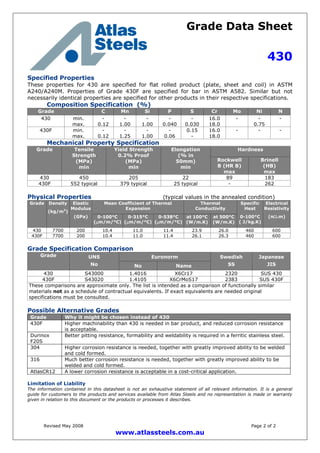
annealed condition but is capable of being
hardened up to Rockwell Hardness 50HRC, the
highest hardness of the 12 per cent chromium
grades. Its best corrosion resistance is
achieved when hardened and surface ground or
polished.
Related grades to 420 are high carbon high
hardness martensitic stainless steels such as
the 440 series (see the Atlas Datasheet on this
series of grades) and also variations to 420
containing molybdenum (for increased
corrosion resistance and mechanical
properties), sulphur (for increased
machinability) or vanadium (for higher
hardness). A slightly higher carbon version of
420 is the non-standard grade 420C.
Martensitic stainless steels are optimised for
high hardness, and other properties are to
some degree compromised. Fabrication must
allow for poor weldability and usually also
include a final harden and temper heat
treatment. Corrosion resistance is lower than
the common austenitic grades, and their useful
operating temperature range is limited by their
loss of ductility at sub-zero temperatures and
loss of strength by over-tempering at elevated
temperatures.
Corrosion Resistance
Grade 420 in the hardened condition has good
resistance to the atmosphere, foods, fresh
water and mild alkalies or acids. Corrosion
resistance is lower in the annealed condition.
Less corrosion resistant than the austenitic
grades and also less than 17% chromium
ferritic alloys such as Grade 430; 420 also has
slightly lower resistance than grade 410.
Performance is best with a smooth surface
finish.
This grade is commonly used for cutlery -
particularly blades of table knives and for some
carving knives and similar. The corrosion
resistance is sufficient to resist food and
normal washing methods, but prolonged
contact with unwashed food residues can result
in pitting. Consult Atlas Technical Assistance
for specific environmental recommendations.
Heat Resistance
Not recommended for use in temperatures
above the relevant tempering temperature,
because of reduction in mechanical properties.
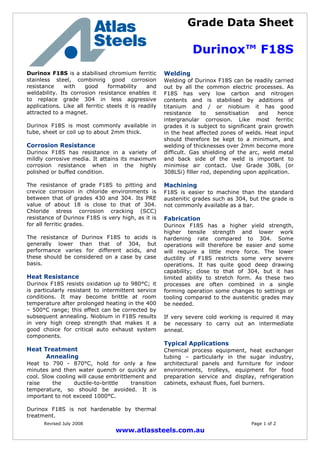
The scaling temperature is approximately
650°C.
Heat Treatment
Annealing
Full anneal - 840-900°C, slow furnace cool to
600°C and then air cool.
Process Anneal - 735-785°C and air cool.
Hardening
Heat to 980-1035°C, followed by quenching in
oil or air. Oil quenching is necessary for heavy
sections. Temper at 150-370°C to obtain a
wide variety of hardness values and
mechanical properties as indicated in the
accompanying table.
The tempering range 425-600°C should be
avoided.
Welding
Pre-heat to 150-320°C and post-heat at 610-
760°C. Grade 420 coated welding rods are
recommended for high strength joints, where a
post-weld hardening and tempering heat
treatment is to be carried out.
If parts are to be used in the "as welded"
condition, a ductile joint can be achieved by
using Grade 309 filler rod. AS 1554.6 pre-
qualifies welding of 420 with Grade 309 rods or
electrodes.
Machining
In the annealed condition this grade is
relatively easily machined, but if hardened to
above 30HRC machining becomes more
difficult. Free machining grade 416 (refer Atlas
Datasheet) is a very readily machined
alternative.
Typical Applications
Cutlery, knife blades, surgical instruments.
Needle valves. Shear blades.
Grade Data Sheet
420
Revised May 2008 Page 2 of 2
www.atlassteels.com.au
Specified Properties
These properties are specified for bar product in ASTM A276. Bar is the most commonly available
form of grade 420. Similar but not necessarily identical properties are specified for other
products such as plate and forgings in their respective specifications.
Composition Specification (%)
Grade C Mn Si P S Cr Mo Ni N
420 min.
max.
0.15
-
-
1.00
-
1.00
-
0.040
-
0.030
12.00
14.00
- - -
Mechanical Properties - typical values
Tempering
Temperature
(°C)
Tensile
Strength
(MPa)
Yield
Strength
0.2% Proof
(MPa)
Elongation
(% in
50mm)
Hardness
Brinell
(HB)
Impact
Charpy V
(J)
Annealed * 655 345 25 255 max * -
204 1600 1360 12 444 20
316 1580 1365 14 444 19
427 1620 1420 10 461 #
538 1305 1095 15 375 #
593 1035 810 18 302 22
650 895 680 20 262 42
* Annealed tensile properties are typical for Condition A; annealed hardness is the specified maximum
for cold finished Condition A bar, given in ASTM A276-06.
# Due to associated low impact resistance this steel should not be tempered in the range 425-600°C
Physical Properties (typical values in the annealed condition)
Mean Coefficient of Thermal
Expansion
Thermal
Conductivity
Grade Density
(kg/m3
)
Elastic
Modulus
(GPa) 0-100°C
(m/m/°C)
0-315°C
(m/m/°C)
at 100°C
(W/m.K)
at 500°C
(W/m.K)
Specific
Heat
0-100°
C
( J/kg.K)
Electrical
Resistivity
(n.m)
420 7700 200 10.3 10.8 24.9 - 460 550
Grade Specification Comparison
EuronormGrade UNS
No No Name
Swedish
SS
Japanese
JIS
420 S42000 1.4021 X20Cr13 2303 SUS 420J1
These comparisons are approximate only. The list is intended as a comparison of functionally similar
materials not as a schedule of contractual equivalents. If exact equivalents are needed original
specifications must be consulted.
Possible Alternative Grades
Grade Why it might be chosen instead of 420
410 Only a lower hardened strength is needed.
416 High machinability is required, and the lower hardened strength and lower corrosion
resistance of 416 is acceptable.
440C A higher hardened strength or hardness than can be obtained from 420 is needed.
"specials" Variations of 420 are available to special order. These offer higher hardness, corrosion
resistance and machinability for particular applications.
Limitation of Liability
The information contained in this datasheet is not an exhaustive statement of all relevant information. It is a general
guide for customers to the products and services available from Atlas Steels and no representation is made or warranty
given in relation to this document or the products or processes it describes.
Grade Data Sheet
431
Revised May 2008 Page 1 of 2
www.atlassteels.com.au
This heat treatable martensitic, nickel-bearing
grade has the best corrosion resistance
properties of all the martensitic grades. It has
excellent tensile and torque strength, and good
toughness, making it ideally suited to shafting
and bolt applications. It can be hardened to
approximately 40HRC. Because of its high yield
strength, this grade is not readily cold worked
and is therefore not recommended for use in
operations such as cold heading, bending, deep
drawing or spinning.
Martensitic stainless steels are optimised for
high hardness, and other properties are to
some degree compromised. Fabrication must
be by methods that allow for poor weldability
and usually also allow for a final harden and
temper heat treatment. Corrosion resistance is
generally lower than the common austenitic
grades, and their useful operating temperature
range is limited by their loss of ductility at sub-
zero temperatures and loss of strength by
over-tempering at elevated temperatures.
Corrosion Resistance
Grade 431 has excellent resistance to a wide
variety of corrosive media. Reasonable
resistance to salt water in cold southern waters
but is unlikely to be successful in warmer
tropical waters. Overall the corrosion resistance
of 431 is approximately the same as or slightly
below that of Grade 304.
Performance is best with a smooth surface
finish, in the hardened and tempered condition.
Consult Atlas Technical Services for specific
environmental recommendations.
Heat Resistance
Resists scaling in intermittent service to 925°C
and in continuous service to 870°C, but is
generally not recommended for use in
temperatures above the relevant tempering
temperature, because of reduction in
mechanical properties.
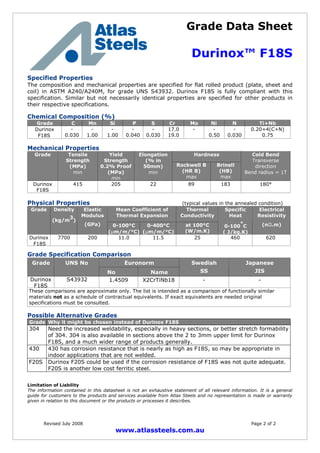
Heat Treatment
Annealing
Full anneal - not practical for this grade - it
hardens even when cooled slowly.
Process Anneal - heat to 620-660°C and air
cool.
Hardening
Hardened by heating to 980-1065°C, holding
for about 1/2 hour then quenching in air or oil.
Pre-heating at 760-790°C may be useful for
complex parts or those already hardened.
Temper to suit mechanical requirements, at
temperatures as indicated in the accompanying
table.
The tempering range 425-600°C should be
avoided due to reduced impact toughness,
although the effect is less marked than in most
other martensitic grades.
Welding
Welding is difficult due to the risk of cracking.
A pre-heat of 200-300°C is recommended prior
to welding. Grade 410 filler rod can be used,
but Grades 308L, 309 or 310 will provide more
ductile welds, so long as matching properties
are not required. Post-weld heat treat at
650°C.
Machining
In the annealed condition this grade is
relatively easily machined, but if hardened to
above 30HRC machining becomes more
difficult. A Ugima Improved Machinability
version of Grade 431 offers a significant
improvement in achievable machining speeds
and tool life.
Typical Applications
Nuts and bolts. Propeller shafting. Pump shafts.
Beater bars. Marine hardware.
Grade Data Sheet
431
Revised May 2008 Page 2 of 2
www.atlassteels.com.au
Specified Properties
These properties are specified for bar product in ASTM A276. Similar but not necessarily identical
properties are specified for other products such as plate and forgings in their respective
specifications.
Composition Specification (%)
Grade C Mn Si P S Cr Mo Ni N
431 min.
max.
-
0.20
-
1.00
-
1.00
-
0.040
-
0.030
15.00
17.00
- 1.25
2.50
-
Mechanical Properties (All values are typical except as noted)
Tempering
Temperature
(°C)
Tensile
Strength
(MPa)
Yield
Strength
0.2% Proof
(MPa)
Elongation
(% in
50mm)
Hardness
Brinell
(HB)
Impact
Izod
(J)
Annealed * 862 655 20 285 max * -
Condition T ** 850 - 1000 635 min. 11 min. 248 - 302
300 1320 1020 20 380 75
400 1310 1010 22 395 80
500 1350 1030 20 395 55 #
600 1030 800 20 310 45 #
700 920 700 20 290 70
* Annealed tensile properties are typical for Condition A of ASTM A276; annealed hardness listed is the
specified maximum. Grade 431 is only rarely stocked in annealed Condition A.
** Grade 431 is frequently stocked and supplied in "Condition T" to AS 1444 or BS 970, with specified
tensile strength of 850 - 1000MPa. Yield and elongation are typically in conformance with the limits
listed above. ASTM A276 only lists a Condition A version of Grade 431.
# Due to associated low impact resistance this steel should not be tempered in the range 425-600°C
Physical Properties (typical values in the annealed condition)
Mean Coefficient of Thermal
Expansion
Thermal
Conductivity
Grade Density
(kg/m3
)
Elastic
Modulus
(GPa) 0-100°C
(m/m/°C)
0-315°C
(m/m/°C)
0-538°C
(m/m/°C)
at 100°C
(W/m.K)
at 500°C
(W/m.K)
Specific
Heat
0-100°
C
( J/kg.K)
Electrical
Resistivity
(n.m)
431 7700 200 10.2 12.1 - 20.2 - 460 720
Grade Specification Comparison
EuronormGrade UNS
No No Name
Swedish
SS
Japanese
JIS
431 S43100 1.4057 X17CrNi16-2 2321 SUS 431
These comparisons are approximate only. The list is intended as a comparison of functionally similar
materials not as a schedule of contractual equivalents. If exact equivalents are needed original
specifications must be consulted.
Possible Alternative Grades
Grade Why it might be chosen instead of 431
410 Only a lower hardened strength is needed.
416 High machinability is required, and the lower hardened strength and lower corrosion resistance
of 416 is acceptable.
440C A higher hardened strength or hardness than can be obtained from 431 is needed.
Limitation of Liability
The information contained in this datasheet is not an exhaustive statement of all relevant information. It is a general
guide for customers to the products and services available from Atlas Specialty Metals and no representation is made or
warranty given in relation to this document or the products or processes it describes.
Grade Data Sheet
440C
Revised May 2008 Page 1 of 2
www.atlassteels.com.au
Grade 440C is capable of attaining, after heat
treatment, the highest strength, hardness
(Rockwell C 60) and wear resistance of all the
stainless alloys. Its very high carbon content of
1.0% is responsible for these characteristics,
which make 440C particularly suited to such
applications as ball bearings and valve parts.
Grades 440A and 440B are identical except
for slightly lower carbon contents (0.60 -
0.75% and 0.75 - 0.95% respectively); these
have lower attainable hardnesses but slightly
higher corrosion resistances. Although all three
versions of this grade are standard, in practice
440C is more available than the A or B
variants; none of these are regularly stocked in
Australia however.
A free-machining variant 440F (UNS S44020)
also exists, with the same high carbon content
as 440C. Again this grade is not readily
available in Australia.
Martensitic stainless steels are optimised for
high hardness, and other properties are to
some degree compromised. Fabrication must
be by methods that allow for poor weldability
and also allow for a final harden and temper
heat treatment. Corrosion resistance is
generally lower than the common austenitic
grades, and their useful operating temperature
range is limited by their loss of ductility at sub-
zero temperatures and loss of strength by
over-tempering at elevated temperatures.
Corrosion Resistance
Good resistance to the atmosphere, fresh
water, foods, alkalies and mild acids. Best
resistance in the hardened and tempered and
passivated condition. A smooth polished
surface also assists.
The corrosion resistance of Grade 440C is close
to that of grade 304 in many environments.
Consult Atlas Technical Assistance for specific
environmental recommendations.
Heat Resistance
Not recommended for use in temperatures
above the relevant tempering temperature,
because of reduction in mechanical properties
by over-tempering.
Heat Treatment
Annealing
Full anneal - 840-870°C, slow furnace cool to
about 600°C and then air cool.
Sub-critical Annealing - 735-760°C and slow
furnace cool.
Hardening
Heat to 1010-1065°C, followed by quenching in
warm oil or air. Oil quenching is necessary for
heavy sections. Immediately temper at 150-
370°C to obtain the hardness values and
mechanical properties as indicated in the
accompanying table.
Best corrosion resistance is when tempered
below 425°C. Tempering in the range 425-
565°C is to be avoided because of reduced
impact resistance and corrosion resistance.
Tempering in the range 600-675°C results in
lower hardness – the product becomes
machinable.
Maximum achievable hardnesses are
approximately HRC56 for Grade 440A, HRC58
for 440B and HRC60 for 440C.
Welding
Welding is seldom carried out because of the
grades’ high hardenability. If welding is
necessary pre-heat at 250°C and follow
welding with a full anneal. Grade 420 filler will
give a high hardness weld (although not as
high as the 440C), but 309 or 310 will produce
soft welds with higher ductility.
Machining
In the annealed condition this grade is
relatively easily machined; approximately the
same as for high speed steel. Chips are tough
and stringy so chip breakers are important. If
these grades are hardened machining becomes
more difficult and probably impossible.
Typical Applications
Rolling element bearings, valve seats, high
quality knife blades, surgical instruments and
chisels.
Grade Data Sheet
440C
Revised May 2008 Page 2 of 2
www.atlassteels.com.au
Specified Properties
These properties are specified for bar product in ASTM A276. Similar but not necessarily identical
properties are specified for other products such as wire and forgings in their respective
specifications. These grades are not normally available in flat rolled or fluids products.
Composition Specification (%)
Grade C Mn Si P S Cr Mo Ni N
440A min.
max.
0.65
0.75
-
1.00
-
1.00
-
0.040
-
0.030
16.00
18.00
-
0.75
- -
440B min.
max.
0.75
0.95
-
1.00
-
1.00
-
0.040
-
0.030
16.00
18.00
-
0.75
- -
440C min.
max.
0.95
1.20
-
1.00
-
1.00
-
0.040
-
0.030
16.00
18.00
-
0.75
- -
Mechanical Properties - 440C - typical and specified values
Tempering
Temperature
(°C)
Tensile
Strength
(MPa)
Yield Strength
0.2% Proof
(MPa)
Elongation
(% in
50mm)
Hardness
Rockwell
(HR C)
Impact
Charpy V
(J)
Annealed * 758 448 14 269HB max # -
204 2030 1900 4 59 9
260 1960 1830 4 57 9
316 1860 1740 4 56 9
371 1790 1660 4 56 9
* Annealed properties are typical for Grade 440C ASTM A276 annealed condition.
# Brinell Hardness is ASTM A276 specified maximum for annealed 440A, B and C, hot finished.
Physical Properties (typical values in the annealed condition)
Mean Coefficient of Thermal
Expansion
Thermal
Conductivity
Grade Density
(kg/m3
)
Elastic
Modulus
(GPa) 0-100°C
(m/m/°C)
0-200°C
(m/m/°C)
at 100°C
(W/m.K)
at 500°C
(W/m.K)
Specific
Heat
0-100°C
( J/kg.K)
Electrical
Resistivity
(n.m)
440A/B/C 7650 200 10.1 10.3 24.2 - 460 600
Grade Specification Comparison
EuronormGrade UNS
No No Name
Swedish
SS
Japanese
JIS
440A S44002 - - SUS 440A
440B S44003 1.4112 X90CrMoV18 SUS 440B
440C S44004 1.4125 X10⁵CrMo17 - SUS 440C
These comparisons are approximate only. The list is intended as a comparison of functionally similar
materials not as a schedule of contractual equivalents. If exact equivalents are needed original
specifications must be consulted.
Possible Alternative Grades
Grade Why it might be chosen instead of 440C
440A/B Slightly softer and more corrosion resistant grade needed
440F High machinability required, with same hardness and hardenability as 440C
420 Lower strength and hardness needed than any of the 440 grades
416 Higher machinability required, and the much lower hardness and strength is still adequate
Limitation of Liability
The information contained in this datasheet is not an exhaustive statement of all relevant information. It is a general
guide for customers to the products and services available from Atlas Steels and no representation is made or warranty
given in relation to this document or the products or processes it describes.
Grade Data Sheet
630 (17-4PH)
Revised January 2008 Page 1 of 2
www.atlassteels.com.au
Grade 630 martensitic precipitation hardening
stainless steel has a combination of high
hardness and strength after suitable heat
treatment. It also has similar corrosion and
heat resistance to Grade 304. The terms "Type
630" and "17-4PH" refer to the same grade.
The great benefit of this grade (and of other
precipitation hardening grades of stainless
steel) is that they are generally supplied in the
solution treated condition, in which they are
just machinable, and then can be age hardened
to achieve quite high strengths. This aging
treatment is so low in temperature that there is
no significant distortion. These grades are
therefore well suited to production of long
shafts, which require no re-straightening after
heat treatment.
Corrosion Resistance
Good resistance to a wide range of corrosive
environments; approaching that of Grade 304
stainless steel. Like 304, this grade is subject
to pitting and crevice corrosion in warm
chloride environments. Grade 630 has been
used for boat shafting for fresh water, and in
sea water with the addition of cathodic
protection.
Highly resistant to stress corrosion cracking if
aged at 550°C or higher. Higher aging
temperatures give better SCC resistance.
Grade 630 is resistant to sulphide stress
cracking (SSC) if highly aged; NACE MR0175
permits the use of 630 but only in a double age
hardened condition (refer to MR0175 and ASTM
A564M).
In solution treated Condition A the grade has
lower resistance to stress corrosion cracking,
and lower ductility compared to aged
conditions. It should not generally be used in
the solution treated condition, even if the
hardness is considered satisfactory.
Consult Atlas Technical Assistance for specific
environmental recommendations.
Heat Resistance
This grade has good oxidation resistance, but
to avoid reduction of its mechanical properties
and hardness it should not be used above its
age hardening temperature. Prolonger
exposure in the range 370-480°C should be
avoided if ambient temperature toughness is
critical.
Heat Treatment
Solution treatment (Condition A)
Heat at 1040°C for ½ hour and cool to 30°C
maximum in air. Oil quenching may be used for
small non-intricate sections.
Hardening (Aging)
After solution treatment a single low
temperature "age hardening" treatment is
employed to achieve required properties, as
below. This treatment results in no distortion
and only superficial discolouration. A slight
decrease in size (shrinkage) takes place during
the hardening; this is approximately 0.05% for
Condition H900 and 0.10% for H1150.
Typical mechanical properties achieved after
solution treating and then age hardening at the
indicated temperatures are as in the table in
the following page. The Condition is designated
by the age hardening temperature in °F
(Condition A is solution treated, ie not aged).
Welding
Grade 630 can be successfully welded by all
standard methods. Preheating is not necessary.
Properties comparable to those of the parent
metal may be achieved in the weld metal by
post-weld heat treatment. As for other high
strength steels precaution should be taken in
design and welding procedures to avoid
concentration of weldment stresses.
Machining
This steel is usually supplied in the solution
treated condition, in which it can be machined.
Machinability is similar to Grade 304.
Typical Applications
Gears, bolts and valve components. Plastic
moulding dies. High strength pump shafts and
boat propeller shafts. Engine components. In
general applications where some level of
corrosion resistance is needed in conjunction
with high strength or hardness.
Grade Data Sheet
630 (17-4PH)
Revised January 2008 Page 2 of 2
www.atlassteels.com.au
Specified Properties
These properties are specified for bar products in ASTM A564/A564M; round bar is the most
commonly available product form for this grade. Similar but not necessarily identical properties
are specified for other products such as plate and forgings in their respective specifications.
Composition Specification (%)
Grade C Mn Si P S Cr Ni Cu Nb+Ta
630 min.
max
-
0.07
-
1.00
-
1.00
-
0.040
-
0.030
15.0
17.5
3.0
5.0
3.0
5.0
0.15
0.45
Mechanical Property Specification
Hardening HardnessCondition
Temp
(°C)
Time
(h)
Tensile
Strength
(MPa)
Yield
Strength
0.2% Proof
(MPa)
Elongation
(% in
50mm) Rockwell C
(HR C)
Brinell
(HB)
A - - 1105 typ. 1000 typ. 15 typ. 38 max 363 max
H900 480 1 1310 1170 10 40 388
H925 495 4 1170 1070 10 38 375
H1025 550 4 1070 1000 12 35 331
H1075 580 4 1000 860 13 32 311
H1100 595 4 965 795 14 31 302
H1150 620 4 930 725 16 28 277
Single property values are minima except as noted as typical or maximum.
Values from ASTM A564M; these values apply only to certain size ranges. The specification should be
consulted for the complete details of these properties and of heat treatment procedures.
Solution treatment is at 1040°C followed by cooling as required.
Specialist double-aging treatments H1150M and H1150D are also possible – refer to ASTM A564M.
Physical Properties (typical values in the annealed condition)
Mean Coefficient of Thermal
Expansion
Thermal
Conductivity
Grade Density
(kg/m3
)
Elastic
Modulus
(GPa) 0-100°C
(m/m/°C)
0-315°C
(m/m/°C)
0-538°C
(m/m/°C)
at 100°C
(W/m.K)
at 500°C
(W/m.K)
Specific
Heat
0-100°
C
( J/kg.K)
Electrical
Resistivity
(n.m)
630 7750 196 10.8 11.6 - 18.4 22.7 460 800
Grade Specification Comparison
EuronormGrade UNS
No No Name
Swedish
SS
Japanese
JIS
630 S17400 1.4542 X5CrNiCuNb16-4 - SUS 630
These comparisons are approximate only. The list is intended as a comparison of functionally similar
materials not as a schedule of contractual equivalents. If exact equivalents are needed original
specifications must be consulted.
Possible Alternative Grades
Grade Why it might be chosen instead of 630 (17-4PH)
431 431 has higher toughness than 630. Better availability in some sizes.
416 Free machining martensitic stainless steel - better machinability. Lower cost but lower corrosion
resistance.
316 Higher corrosion resistance of 316 is needed, but with much lower strength than 630.
2205 Much better corrosion resistance than 630, with a lower strength (but not as low as 316).
Limitation of Liability
The information contained in this datasheet is not an exhaustive statement of all relevant information. It is a general
guide for customers to the products and services available from Atlas Steels and no representation is made or warranty
given in relation to this document or the products or processes it describes.

Atlas grade datasheet_-_all_datasheets_rev_aug_2013

  • 1.
    Stainless Steel Grade Datasheets www.atlassteels.com.au Copyright© Atlas Steels Revised : August 2013 Atlas Steels Technical Department
  • 2.
    ATLAS STEELS Stainless Steels Grade Datasheets FOREWORD This compilation of stainless steel Grade Datasheets has been produced by Atlas Steels Technical Department as a companion to the Atlas Technical Handbook of Stainless Steels. Any suggestions for improvements, additions or corrections would be very welcome; these should be directed to: Technical Manager, Atlas Steels Telephone +61 3 8383 9863, email peter.moore@atlassteels.com.au Individual grade datasheets are available from the Atlas Steels website. Information from any Atlas publication can be freely copied, but it is requested that the source be acknowledged. Limitation of Liability The information contained in these datasheets is not an exhaustive statement of all relevant information. It is a general guide for customers to the products and services available from Atlas Steels and no representation is made or warranty given in relation to this information or the products or processes it describes. Published by Atlas Steels Technical Department Copyright © Atlas Steels www.atlassteels.com.au
  • 3.
    Stainless Steel Datasheets RevisedNovember 2011 Page 1 of 1 www.atlassteels.com.au Austenitic Stainless Steels 301, 301L, 301LN High strength for roll formed structural components 302HQ Low work hardening rate grade for cold heading fasteners 303, 303Se Free-machining bar grades 304, 304L, 304H Standard 18/8 grades 310, 310S, 310H High temperature resistant grades 316, 316L, 316H Improved resistance to pitting corrosion in chloride environments 321, 321H, 347 Stabilised grades for heavy section welding and high temperature applications 253MA (S30815) High temperature resistant grade 904L High resistance to general corrosion, pitting and stress corrosion cracking Ferritic Stainless Steels AtlasCR12 Utility steel resistant to wet abrasion and mild corrosion AtlasCR12Ti Utility steel resistant to wet abrasion and mild corrosion – weld stabilised 409 Automotive exhaust grade – weld stabilised 430, 430F Resistant to mildly corrosive environments F18S / 439 Resistant to mildly corrosive environments – weld stabilised F20S A ferritic alternative to grade 304 / 304L – weld stabilised F18MS / 444 A ferritic alternative to grade 316 / 316L – weld stabilised Duplex Stainless Steels 2101 Lean duplex – economical alternative to 304 and 316 2304 Duplex alternative to grade 316 2205 Standard duplex stainless steel - high resistance to pitting and stress corrosion 2507 Super duplex with very high resistance to pitting and stress corrosion 2507Cu Super duplex with very high resistance to pitting and stress corrosion Martensitic Stainless Steels 410 Standard martensitic grade for low-duty hardened applications 416 Free-machining bar grade 420 Higher hardness martensitic grade for cutlery, cutting tools and dies 431 High hardness and toughness grade, primarily for shafting 440A, 440B, 440C Very high hardness grades used in cutting tools Precipitation Hardening Stainless Steel 630 (17-4PH) High strength shafting grade Note that some of these stainless steel grades are commonly referred to by designations that are registered trademarks. Limitation of Liability The information contained in this datasheet is not an exhaustive statement of all relevant information. It is a general guide for customers to the products and services available from Atlas Steels and no representation is made or warranty given in relation to this document or the products or processes it describes.
  • 4.
    Grade Data Sheet 301301L 301LN Revised May 2008 Page 1 of 2 www.atlassteels.com.au Grade 301 is a high work-hardening rate austenitic stainless steel. It can be supplied with a tensile strength of up to over 1300 MPa in strip and wire forms, to produce tempers in the range of 1/16 Hard to Full Hard. The controlled analysis of Grade 301 enables it to retain sufficient ductility in conditions up to 1/2 Hard conditions to be roll or brake formed into aircraft, architectural and particularly rail car structural components. However, 3/4 to Full Hard tempers should be used whenever high wear resistance and spring features are required in components of simple form designs. Grade 301L with low carbon is preferred for improved ductility or if heavy sections are to be welded, and another variant 301LN has a higher nitrogen content to compensate for the lower carbon. ASTM A666 covers all three variants, and some are also included in Japanese specification JIS G4305 and Euronorm EN 10088-2. Corrosion Resistance Corrosion resistance is similar to that of 304. Good resistance in applications involving external exposure to mildly corrosive conditions at ambient temperatures. Heat Resistance Good oxidation resistance in intermittent service to 840°C and in continuous service to 900°C, although not usually chosen for this environment. Exposure to temperatures above about 400°C will result in progressive removal of work hardening effects; at approximately 800°C the strength will be similar to an annealed 301. In creep applications a work hardened grade 301 can even reduce to lower strength than an annealed 301. Heat Treatment Solution Treatment (Annealing) Heat to 1010-1120°C and cool rapidly. Use low side of range for intermediate annealing. This grade cannot be hardened by thermal treatment. Cold Working Grade 301 and its low carbon variants are used where a high strength stainless steel is required. The grades work harden at the very high rate of approximately 14MPa/%Ra (14MPa increase in tensile strength for each 1% reduction of area of cold work), resulting in high achievable strengths from cold rolling and from roll forming. The strain-hardened austenite is at least partially transformed to martensite by this work. Despite the high strengths achieved there is still enough residual ductility to enable significant cold deformation. Although non-magnetic in the annealed condition, when cold worked the grades become strongly attracted to a magnet. Welding Good characteristics suited to all standard methods. Grade 308L filler rod is recommended. Welds in Grade 301 must be annealed for maximum corrosion resistance; this is not necessary in 301L or 301LN. Welding and post weld annealing will both remove high strength induced by prior cold rolling. Spot welding is commonly used to assemble cold rolled 301 components. The very small heat affected zone associated with this rapid welding technique results in little reduction of overall component strength. Typical Applications Rail car structural components - often roll formed, brake pressed or stretch formed to profiles but also used flat. Airframe sections. Highway trailer components. Automotive wheel covers, wiper blade holders and clips. Toaster springs, stove element clips. Screen frames, curtain walls.
  • 5.
    Grade Data Sheet 301301L 301LN Revised May 2008 Page 2 of 2 www.atlassteels.com.au Specified Properties The properties for Grade 301 are specified for flat rolled product (plate, sheet and coil) in ASTM A666. Similar but not identical mechanical properties are specified in EN 10088.2 and JIS G4305 and in proprietary specifications. Composition Specification (%) Grade C Mn Si P S Cr Mo Ni N 301 min. max. - 0.15 - 2.0 - 1.0 - 0.045 - 0.030 16.0 18.0 - 6.0 8.0 - 0.10 301L min. max. - 0.03 - 2.0 - 1.0 - 0.045 - 0.030 16.0 18.0 - 6.0 8.0 - 0.20 301LN min. max. - 0.03 - 2.0 - 1.0 - 0.045 - 0.015 16.5 18.5 - 6.0 8.0 0.07 0.20 Mechanical Property Specification (Grade 301 – other values for 301L and 301LN) Bend Test (1.27 - 4.76mm thick) Grade 301 Temper ASTM A666 Tensile Strength (MPa) min. Yield Strength 0.2% Proof (MPa) min. Elongation (% in 50mm) (thick.>0.76mm) min. Bend Angle (°) Factor (Note 1) Hardness Rockwell C (Note 2) Annealed 515 205 40 180 1 1/16 Hard 620 310 40 180 1 1/8 Hard 690 380 40 180 1 1/4 Hard 860 515 25 90 2 25 – 32 1/2 Hard 1035 760 18 90 2 32 – 37 3/4 Hard 1205 930 12 90 3 37 – 41 Full Hard 1275 965 9 90 5 41+ Notes 1. Bend test is around a diameter of the Bend Factor multiplied by the steel thickness. 2. Hardness values are typical industry standard – there are no specified limits. Physical Properties (Grades 301, 301L and 301LN - typical values in the annealed condition) Mean Coefficient of Thermal Expansion Thermal Conductivity Grade Density (kg/m3 ) Elastic Modulus (GPa) 0-100°C (m/m/°C) 0-315°C (m/m/°C) 0-538°C (m/m/°C) at 100°C (W/m.K) at 500°C (W/m.K) Specific Heat 0-100°C ( J/kg.K) Electrical Resistivity (n.m) All 7900 193 17.0 17.2 18.2 16.3 21.5 500 720 Grade Specification Comparison EuronormGrade UNS No No Name Swedish SS Japanese JIS 301 S30100 1.4319 X5CrNi17-7 - SUS 301 301L S30103 - - - SUS301L 301LN S30153 1.4318 X2CrNiN18-7 - - These comparisons are approximate only. The list is intended as a comparison of functionally similar materials not as a schedule of contractual equivalents. If exact equivalents are needed original specifications must be consulted. Different comparisons apply to grades 301L and 301LN. Possible Alternative Grades Grade Why it might be chosen instead of 301 / 301L / 301LN 304 Better availability, lower cost; the lower work hardening rate of 304 is acceptable. 316 Higher corrosion resistance needed; the lower work hardening rate of 316 is acceptable Limitation of Liability The information contained in this datasheet is not an exhaustive statement of all relevant information. It is a general guide for customers to the products and services available from Atlas Steels and no representation is made or warranty given in relation to this document or the products or processes it describes.
  • 6.
    Grade Data Sheet 302HQ RevisedMay 2008 Page 1 of 2 www.atlassteels.com.au Grade 302HQ is a specialised wire grade with very wide usage for manufacture of stainless steel fasteners. The inclusion of 3% copper in the composition reduces the cold work hardening rate substantially compared to Grade 304. 302HQ is standard for manufacture of self-tapping screws and light machine screws; it is also used for some bolts, set screws, rivets and specialised fasteners. It has now totally replaced Grades 384 and 305 for cold heading applications, copper being a lower cost alternative to their high nickel contents. The designation 302HQ is not standardised – ASTM specifications list the grade as UNS S30430, and alternative designations for the same grade include "XM-7", "304Cu" and "304HQ". The standard specification for stainless steel fasteners, ISO 3506, includes 302HQ as an acceptable composition for fastener grade “A2”; it is commonly produced in strength grades A2-70 and A2-80. The stable austenitic structure makes 302HQ non-magnetic, even after substantial cold work, and also results in excellent toughness, even down to cryogenic temperatures. Corrosion Resistance Equal to or exceeding that of Grade 304. Subject to pitting and crevice corrosion in warm chloride environments, and to stress corrosion cracking above about 50°C. 302HQ is considered resistant to potable water with up to about 200mg/L chlorides at ambient temperatures, reducing to about 150mg/L at 60°C. Consult Atlas Technical Assistance for specific environmental recommendations. Heat Resistance Good oxidation resistance in intermittent service to 870°C and in continuous service to 925°C. Continuous use of Grade 302HQ in 425- 860°C range is usually safe (free of carbide precipitation) as the grade has a very low carbon content. Heat Treatment Solution Treatment (Annealing) Heat to 1010-1120°C and cool rapidly. This grade cannot be hardened by thermal treatment. Welding Use Grade 308L rods or electrodes. Excellent weldability by all standard fusion methods, both with and without filler metals. Because of its applications this grade is not often welded. Exceptions are resistance butt welding to join wires together during wire manufacture, and when the grade is used to make stud welding fasteners. 302HQ is not specifically listed in AS 1554.6. Machining 302HQ is rarely machined, because of its form and likely products. The grade always has very low sulphur content as this aids formability, but unfortunately this also reduces machinability. Machining is certainly possible. An Improved Machinability version of Grade 302HQ is produced, having a very high machinability. This version has a slightly higher sulphur content and is also calcium treated. This Improved Machinability grade (referred to as Ugima 4567) is available only to special order, but should be considered as an option where an “18/8” type grade needs to be both heavily cold formed and extensively machined. Cold Work Hardening 302HQ has the lowest work hardening rate of any of the common austenitic stainless steels. This results in a tensile strength increase of approximately 8MPa/%Ra (8MPa increase in tensile strength for each 1% reduction of area of cold work - this data from wire drawing). Even after substantial cold work this grade remains essentially non-responsive to a magnet. For some high strength cold headed fasteners a slightly higher work hardening rate will be needed, so grade 304 or 304L (or the specialist grade 304M) will need to be used instead of 302HQ; these have work hardening rates varying between about 10 and 12.5MPa/%RA. Typical Applications All severe cold heading applications, including self-tapping screws, roofing bolts, machine screws, bolts, set screws, blind rivets.
  • 7.
    Grade Data Sheet 302HQ RevisedMay 2008 Page 2 of 2 www.atlassteels.com.au Specified Properties These properties are specified for grade S30430 wire in ASTM A493; wire is the only commonly available form for this grade. Properties of finished fasteners are covered by other specifications, such as ISO 3506-1 and 3506-3. Composition Specification (%) Grade C Mn Si P S Cr Mo Ni Cu 302HQ min. max. - 0.03 - 2.00 - 1.00 - 0.045 - 0.030 17.0 19.0 - 8.0 10.0 3.0 4.0 Mechanical Property Specification HardnessGrade Tensile Strength (MPa) max. Yield Strength 0.2% Proof (MPa) Elongation (% in 50mm) Rockwell B (HR B) Brinell (HB) 302HQ annealed 605 - - - - 302HQ lightly drawn 660 - - - - Above values from ASTM A493 for diameters 2.5mm and above. Higher strengths can be produced by heavy cold work - this may be required for certain applications, which should be discussed with Atlas Technical Department. Physical Properties (typical values in the annealed condition) Mean Coefficient of Thermal Expansion Thermal Conductivity Grade Density (kg/m3 ) Elastic Modulus (GPa) 0-100°C (m/m/°C) 0-315°C (m/m/°C) 0-538°C (m/m/°C) at 100°C (W/m.K) at 500°C (W/m.K) Specific Heat 0-100° C ( J/kg.K) Electrical Resistivity (n.m) 302HQ 7900 193 17.2 17.8 18.8 16.3 21.5 500 720 Grade Specification Comparison EuronormGrade UNS No No Name Swedish SS Japanese JIS 302HQ S30430 1.4567 X3CrNiCu18-9-4 - SUS XM7 Possible Alternative Grades Grade Why it might be chosen instead of 302HQ 304, 304L or 304M A higher work hardening rate can be tolerated - or is needed. 316L Higher resistance to pitting and crevice corrosion is required in chloride environments; the higher work hardening rate of 316L is acceptable. 430 A lower cost is required, and the reduced corrosion resistance of 430 is acceptable. Limitation of Liability The information contained in this datasheet is not an exhaustive statement of all relevant information. It is a general guide for customers to the products and services available from Atlas Steels and no representation is made or warranty given in relation to this document or the products or processes it describes.
  • 8.
    Grade Data Sheet 303 RevisedMay 2008 Page 1 of 2 www.atlassteels.com.au Grade 303 represents the optimum in machinability among the austenitic stainless steels. It is primarily used when production involves extensive machining in automatic screw machines. Machinability Rating (compared to B1212) is approximately 78%. 303 is also available as a "Ugima" Improved Machinability grade, with machinability even higher than that of the standard 303. The sulphur addition which is responsible for the improved machining and galling characteristics of Grade 303 lowers its corrosion resistance to below that of Grade 304. As for other austenitic grades the structure gives 303 excellent toughness, although the sulphur in 303 reduces its toughness slightly. Grade 303Se (UNS S30323) has a selenium rather than sulphur addition, improving the hot and cold forming characteristics over those of 303 and providing a smoother machined surface finish. The machinability rate is also slightly reduced compared to 303. Grade 303Se is not readily available in Australia. Corrosion Resistance Good resistance to mildly corrosive atmospheres, but significantly less than Grade 304 due to the sulphur addition; the sulphide inclusions act as pit initiation sites. Grade 303 should not be exposed to marine or other similar environments, as these will result in rapid pitting corrosion. Because the sulphide inclusions in 303 are primarily aligned along the rolling direction the corrosion resistance is particularly reduced in cross-sections. Grade 303, like other common austenitic stainless steels, is subject to stress corrosion cracking in chloride containing environments above about 50°C. Consult Atlas Technical Assistance for specific environmental recommendations. Heat Resistance Good oxidation resistance in intermittent service to 760°C and in continuous service to 870°C. Continuous use in the 425-860°C range is not usually recommended due to carbide precipitation - 303 usually does not have a low carbon content so is susceptible to sensitisation, which can lead to intergranular corrosion. Fabrication As well as reducing the corrosion resistance, the sulphur additions in 303 also result in poor weldability and reduced formability compared to Grade 304. Sharp bends should not be attempted in 303. A practical compromise alternative may be a 304 Ugima Improved Machinability grade - this does not machine as readily as 303, but does offer better formability (as well as excellent weldability and significantly better corrosion resistance). Heat Treatment Solution Treatment (Annealing) Heat to 1010-1120°C and cool rapidly. This grade cannot be hardened by thermal treatment. Welding Not generally recommended but, if unavoidable use Grade 308L or 309 electrodes. AS 1554.6 does not pre-qualify welding of 303. Welds must be annealed for maximum corrosion resistance, but even then poor mechanical and corrosion properties will result. Machining A "Ugima" improved machinability version of grade 303 is available in many bar products. This machines significantly better even than standard 303, giving very high machining rates and lower tool wear in many operations. For ultra-high machining rates there are also available special grade variants such as Ugima 303UX. This includes copper to reduce the work hardening rate, in addition to the usual high sulphur and Improved Machinability steel making practices. Typical Applications Nuts and bolts. Bushings. Shafts. Electrical switchgear components. Gears. In general any component that is heavily machined and where the corrosion resistance and fabrication properties of 303 are viable.
  • 9.
    Grade Data Sheet 303 RevisedMay 2008 Page 2 of 2 www.atlassteels.com.au Specified Properties These properties are specified for long product (bar) in ASTM A582M. Similar but not necessarily identical properties are specified for other products such as wire and forgings in their respective specifications. Grade 303 is not produced in flat rolled products. Composition Specification (%) Grade C Mn Si P S Cr Mo Ni Se 303 min. max. - 0.15 - 2.00 - 1.00 - 0.20 0.15 - 17.0 19.0 - 8.0 10.0 - 303Se min. max. - 0.15 - 2.00 - 1.00 - 0.20 - 0.06 17.0 19.0 - 8.0 10.0 0.15 min Mechanical Property Specification HardnessGrade Tensile Strength (MPa) Yield Strength 0.2% Proof (MPa) Elongation (% in 50mm) Rockwell B (HR B) Brinell (HB) 303 650 typical 300 typical 45 typical - 262 max Note that ASTM A582 only specifies hardness – tensile properties included above are not guaranteed and for information only. Drawn bars, generally up to 25.4mm diameter, will have higher strength values. Proof (yield) stress values in particular will be significantly higher and the percentage elongation lower. Physical Properties (typical values in the annealed condition) Mean Coefficient of Thermal Expansion Thermal Conductivity Grade Density (kg/m3 ) Elastic Modulus (GPa) 0-100°C (m/m/°C) 0-315°C (m/m/°C) 0-538°C (m/m/°C) at 100°C (W/m.K) at 500°C (W/m.K) Specific Heat 0-100°C ( J/kg.K) Electrical Resistivity (n.m) 303 7900 193 17.3 17.8 18.4 16.3 21.5 500 720 Grade Specification Comparison EuronormGrade UNS No No Name Swedish SS Japanese JIS 303 S30300 1.4305 X8CrNiS18-9 2346 SUS 303 303Se S30323 - - - SUS 303Se Possible Alternative Grades Grade Why it might be chosen instead of 303 303UX Ugima 303UX offers the highest machinability for long run repetition machining. 304 Better corrosion resistance, formability or weldability are needed, at the expense of lower machinability. Consider 304 Ugima. 316 Higher resistance to pitting and crevice corrosion is required, in chloride environments. A lower machinability can be accepted. 416 Even higher machinability than 303 is needed, and a lower corrosion resistance can be tolerated. Or hardening by thermal treatment is required, while maintaining a high machinability. Limitation of Liability The information contained in this datasheet is not an exhaustive statement of all relevant information. It is a general guide for customers to the products and services available from Atlas Steels and no representation is made or warranty given in relation to this document or the products or processes it describes.
  • 10.
    Grade Data Sheet 304304L 304H Revised Jan 2011 Page 1 of 2 www.atlassteels.com.au Grade 304 is the standard “18/8” austenitic stainless; it is the most versatile and most widely used stainless steel, available in the widest range of products, forms and finishes. It has excellent forming and welding characteristics. Grade 304L, the low carbon version of 304, does not require post-weld annealing and so is extensively used in heavy gauge components (about 5mm and over). Grade 304H with its higher carbon content finds application at elevated temperatures. The austenitic structure also gives these grades excellent toughness, even down to cryogenic temperatures. Grade 304 can be severely deep drawn without intermediate annealing, which has made this grade dominant in the manufacture of drawn stainless parts such as sinks, hollow-ware and saucepans. For severe applications it is common to use special “304DDQ” (Deep Drawing Quality) variants. Corrosion Resistance Very good in a wide range of atmospheric environments and many corrosive media. Subject to pitting and crevice corrosion in warm chloride environments, and to stress corrosion cracking above about 60°C. Considered resistant to pitting corrosion in potable water with up to about 200mg/L chlorides at ambient temperatures, reducing to about 150mg/L at 60°C. Consult Atlas Technical Assistance for specific environmental recommendations. There is usually no difference in corrosion resistance between 304 and 304L. Heat Resistance Good oxidation resistance in intermittent service to 870°C and in continuous service to 925°C. Continuous use of 304 in the 425- 860°C range is not recommended if subsequent aqueous corrosion resistance is important. Grade 304L is resistant to carbide precipitation and can be heated into this temperature range. Grade 304H has higher strength at elevated temperatures so is often used for structural and pressure-containing applications at temperatures above about 500°C and up to about 800°C. 304H will become sensitised in the temperature range of 425-860°C; this is not a problem for high temperature applications, but will result in reduced aqueous corrosion resistance. Heat Treatment Solution Treatment (Annealing) Heat to 1010-1120°C and cool rapidly. These grades cannot be hardened by thermal treatment. Welding Excellent weldability by all standard fusion methods, both with and without filler metals. AS 1554.6 pre-qualifies welding of 304 with 308, and 304L with 308L rods or electrodes (or their high silicon equivalents). Heavy welded sections in Grade 304 may require post-weld annealing for maximum corrosion resistance. This is not required for Grade 304L. Grade 321 may also be used as an alternative to 304 if heavy section welding is required and post- weld heat treatment is not possible. Machining A “Ugima” improved machinability version of grade 304 is available in bar products. “Ugima” machines significantly better than standard 304, giving higher machining rates and lower tool wear in many operations. “Dual Certification” It is common for 304 and 304L to be stocked in “Dual Certified” form, particularly in plate, pipe and round bar. These items have chemical and mechanical properties complying with both 304 and 304L specifications. Such dual certified product may be unacceptable for high temperature applications. Typical Applications Food processing, transport and storage equipment, particularly in beer brewing, milk processing and wine making. Kitchen benches, sinks, troughs, equipment and appliances. Architectural panelling, railings & trim. Chemical containers, including for transport. Heat Exchangers. Woven or welded screens. Threaded fasteners. Springs.
  • 11.
    Grade Data Sheet 304304L 304H Revised Jan 2011 Page 2 of 2 www.atlassteels.com.au Specified Properties These properties are specified for flat rolled product (plate, sheet and coil) in ASTM A240/A240M. Similar but not necessarily identical properties are specified for other products such as pipe and bar in their respective specifications. Minor changes to 304 and 304L composition limits were made in 2006-7 to harmonise with similar grades specified in ISO and European standards. Composition Specification (%) Grade C Mn Si P S Cr Mo Ni N 304 min. max. - 0.07 - 2.0 - 0.75 - 0.045 - 0.030 17.5 19.5 - 8.0 10.5 - 0.10 304L min. max. - 0.030 - 2.0 - 0.75 - 0.045 - 0.030 17.5 19.5 - 8.0 12.0 - 0.10 304H min. max. 0.04 0.10 - 2.0 - 0.75 - 0.045 - 0.030 18.0 20.0 - 8.0 10.5 - Mechanical Property Specification (single values are minima except as noted) HardnessGrade Tensile Strength (MPa) min Yield Strength 0.2% Proof (MPa) min Elongation (% in 50mm) min Rockwell B (HR B) max Brinell (HB) max 304 515 205 40 92 201 304L 485 170 40 92 201 304H 515 205 40 92 201 304H also has a requirement for a grain size of ASTM No 7 or coarser. Physical Properties (typical values in the annealed condition) Mean Coefficient of Thermal Expansion Thermal Conductivity Grade Density (kg/m3 ) Elastic Modulus (GPa) 0-100°C (m/m/°C) 0-315°C (m/m/°C) 0-538°C (m/m/°C) at 100°C (W/m.K) at 500°C (W/m.K) Specific Heat 0-100° C ( J/kg.K) Electrical Resistivity (n.m) 304/L/H 7900 193 17.2 17.8 18.4 16.3 21.5 500 720 Grade Specification Comparison EuronormGrade UNS No No Name Swedish SS Japanese JIS 304 S30400 1.4301 X5CrNi18-10 2332 SUS 304 304L S30403 1.4307 X2CrNi18-9 2352 SUS 304L 304H S30409 1.4948 X6CrNi18-11 - - These comparisons are approximate only. The list is intended as a comparison of functionally similar materials not as a schedule of contractual equivalents. If exact equivalents are needed original specifications must be consulted. Possible Alternative Grades Grade Why it might be chosen instead of 304 301/L A higher work hardening rate grade is required for roll formed or stretch formed components. F20S Lower cost needed in thin gauge sheet and coil. Durinox F20S also has easier fabrication. 303 Higher machinability needed; lower corrosion resistance, formability & weldability are acceptable 316 Higher resistance to pitting and crevice corrosion is required, in chloride environments 253MA Better resistance high temperatures is needed. 253MA is optimised for temperatures to 1150°C. 430 A lower cost is required, and the reduced corrosion resistance and fabrication characteristics are acceptable. Limitation of Liability The information contained in this datasheet is not an exhaustive statement of all relevant information. It is a general guide for customers to the products and services available from Atlas Steels and no representation is made or warranty given in relation to this document or the products or processes it describes.
  • 12.
    Grade Data Sheet 310310S 310H Revised Jan 2011 Page 1 of 2 www.atlassteels.com.au Grade 310 (UNS S31000) and its various sub- grades combine excellent high temperature properties with good ductility and weldability. Grade 310H (UNS S31009) has a carbon content restricted to exclude the lower end of the 310 range, so is the grade of choice for high temperature applications. Grade 310S (UNS S31008) is used when the application environment involves moist corrodents in a temperature range lower than that which is normally considered "high temperature" service. The lower carbon content of 310S does reduce its high temperature strength compared to 310H. Grade 310L is a series of proprietary grades, generally with a 0.03% maximum carbon and sometimes used for very specific corrosive environments such as urea production. Like other austenitic grades the 310 family have excellent toughness, even down to cryogenic temperatures, although other grades are normally used in sub-zero environments. Corrosion Resistance The high chromium content - intended to increase high temperature properties - also gives these grades good aqueous corrosion resistance. The PRE is approximately 25, and sea water resistance about 22°C, similar to that of Grade 316. In high temperature service they exhibit good resistance to oxidising and carburising atmospheres. Resist fuming nitric acid at room temperature and fused nitrates up to 425°C. The high carbon contents of all except 310L do make these grades susceptible to sensitisation and hence intergranular corrosion after elevated temperature exposure or welding. 310 is subject to stress corrosion cracking but more resistant than Grades 304 or 316. Consult Atlas Technical Assistance for specific environmental recommendations. Heat Resistance 310H has good resistance to oxidation in intermittent service in air at temperatures up to 1040°C and 1150°C in continuous service. Good resistance to thermal fatigue and cyclic heating. Widely used where sulphur dioxide gas is encountered at elevated temperatures. Continuous use in 425-860°C range not recommended due to carbide precipitation, if subsequent aqueous corrosion resistance is needed, but it often performs well in temperatures fluctuating above and below this range. Prone to sigma phase embrittlement in the temperature range 650 – 900°C. Grade 310H is generally used at temperatures starting from about 800 or 900°C - above the temperatures at which 304H and 321 are effective. Heat Treatment Solution Treatment (Annealing) Heat to 1040-1150°C and cool rapidly for maximum corrosion resistance. This treatment is also recommended to restore ductility after each 1000 hours of service above 650°C, due to long term precipitation of brittle sigma phase. These grades cannot be hardened by thermal treatment. Welding Good characteristics suited to all standard methods. Grade 310S electrodes generally recommended for fusion welding. AS 1554.6 pre-qualifies welding of 310 with Grade 310 rods or electrodes. "Dual Certification" 310H and 310S are often produced in "Dual Certified" form – mainly in plate and pipe. These items have chemical and mechanical properties complying with both 310H and 310S specifications. Product complying with 310 only or dual certified 310 and 310S may have a carbon content below 0.04% which will not be acceptable for some high temperature applications. Typical Applications Furnace parts. Oil burner parts. Carburising boxes. Heat Treatment baskets and jigs. Heat exchangers. Welding filler wire and electrodes.
  • 13.
    Grade Data Sheet 310310S 310H Revised Jan 2011 Page 2 of 2 www.atlassteels.com.au Specified Properties These properties are specified for flat rolled product (plate, sheet and coil) in ASTM A240/A240M (310S and 310H) and ASTM A167 (310). Similar but not necessarily identical properties are specified for other products such as pipe and bar in their respective specifications. Composition Specification (%) (single values are maxima) Grade C Mn Si P S Cr Mo Ni N 310 min. max. - 0.25 - 2.00 - 1.50 - 0.045 - 0.030 24.0 26.0 - 19.0 22.0 - 310S min. max. - 0.08 - 2.00 - 1.50 - 0.045 - 0.030 24.0 26.0 - 19.0 22.0 - 310H min. max. 0.04 0.10 - 2.00 - 0.75 - 0.045 - 0.030 24.0 26.0 - 19.0 22.0 - Mechanical Property Specification HardnessGrade Tensile Strength (MPa) min Yield Strength 0.2% Proof (MPa) min Elongation (% in 50mm) min Rockwell B (HR B) max Brinell (HB) max 310 515 205 40 95 217 310S 515 205 40 95 217 310H 515 205 40 95 217 Physical Properties (typical values in the annealed condition) Mean Coefficient of Thermal Expansion Thermal Conductivity Grade Density (kg/m3 ) Elastic Modulus (GPa) 0-100°C (m/m/°C) 0-315°C (m/m/°C) 0-538°C (m/m/°C) at 100°C (W/m.K) at 500°C (W/m.K) Specific Heat 0-100°C ( J/kg.K) Electrical Resistivity (n.m) 310/S/H 7750 200 15.9 16.2 17.0 14.2 18.7 500 720 Grade Specification Comparison EuronormGrade UNS No No Name Swedish SS Japanese JIS 310S S31008 1.4845 X8CrNi25-21 2361 SUS 310S There are no known international specification equivalents to ASTM grades 310, 310H etc. These comparisons are approximate only. The list is intended as a comparison of functionally similar materials not as a schedule of contractual equivalents. If exact equivalents are needed original specifications must be consulted. Heat resistant grades have poor agreement between different specification systems. Possible Alternative Grades Grade Why it might be chosen instead of 310 AtlasCR12 Heat resistance is needed, but only to about 600°C. 304H Heat resistance is needed, but only to about 800°C. 321 Heat resistance is needed, but only to about 900°C. Subsequent aqueous corrosion resistance also required. S30815 (253MA) A slightly higher temperature resistance is needed than can be provided by 310. Better resistance to reducing sulphide atmosphere needed. Higher immunity from sigma phase embrittlement is required. Limitation of Liability The information contained in this datasheet is not an exhaustive statement of all relevant information. It is a general guide for customers to the products and services available from Atlas Steels and no representation is made or warranty given in relation to this document or the products or processes it describes.
  • 14.
    Grade Data Sheet 316316L 316H Revised Jan 2011 Page 1 of 2 www.atlassteels.com.au Grade 316 is the standard molybdenum-bearing austenitic grade, second stainless steel in importance to 304. The molybdenum gives 316 better overall corrosion resistant properties than Grade 304, particularly higher resistance to pitting and crevice corrosion in chloride environments. It is readily brake or roll formed, welded, soldered and cut by both thermal and mechanical methods. The austenitic structure gives excellent toughness, even down to cryogenic temperatures. Grade 316L, the low carbon version of 316, is highly resistant to sensitisation (grain boundary carbide precipitation) and so is extensively used in heavy gauge welded components (about 5mm and over). Grade 316H, with its higher carbon content has some application at elevated temperatures, as does stabilised grade 316Ti. Nitrogen-strengthened versions also exist as 316N and 316LN. Only 316 and 316L are readily available in Australian stock. Corrosion Resistance Excellent in a range of atmospheric environments and many corrosive media - generally more resistant than 304. Subject to pitting and crevice corrosion in warm chloride environments, and to stress corrosion cracking above about 60°C. Considered resistant to pitting corrosion in potable water with up to about 1000mg/L chlorides at ambient temperatures, reducing to about 300mg/L at 60°C. 316 is usually regarded as the standard “marine grade” stainless steel, but it is not fully resistant to sea water. In many marine environments 316 does exhibit surface corrosion, usually visible as brown staining. This is particularly associated with crevices and rough surface finish. Consult Atlas Technical Assistance for specific environmental recommendations. There is usually no difference in corrosion resistance between 316 and 316L. Heat Resistance Good oxidation resistance in intermittent service to 870°C and in continuous service to 925°C. Continuous use of 316 in the 425-860°C range is not recommended if subsequent aqueous corrosion resistance is important. Grade 316L is more resistant to carbide precipitation and can be used in the above temperature range. Grade 316H has higher strength at elevated temperatures and is sometimes used for structural and pressure- containing applications at temperatures above about 500°C, but the titanium stabilised grade 316Ti is often a more appropriate choice. Heat Treatment Solution Treatment (Annealing) Heat to 1010-1120°C and cool rapidly. These grades cannot be hardened by thermal treatment. Welding Excellent weldability by all standard fusion methods, both with and without filler metals. AS 1554.6 pre-qualifies welding of 316 with Grade 316 and 316L with Grade 316L rods or electrodes (or their high silicon equivalents). Heavy welded sections in Grade 316 require post-weld annealing for maximum corrosion resistance. This is not required for 316L. Grade 316Ti may also be used as an alternative to 316 for heavy section welding. Machining A “Ugima” improved machinability version of grade 316 is available in round and hollow bar products. Ugima machines significantly better than standard 316 or 316L, giving higher machining rates and lower tool wear in many operations. “Dual Certification” It is common for 316 and 316L to be stocked in “Dual Certified” form, particularly in plate, pipe and round bar. These items have chemical and mechanical properties complying with both 316 and 316L specifications. Such dual certified product may be unacceptable for high temperature applications. Typical Applications Food processing equipment. Laboratory equipment. Architectural panelling, railings & trim. Boat fittings. Chemical containers. Heat exchangers. Screens for mining, quarrying & water filtration. Threaded fasteners. Springs.
  • 15.
    Grade Data Sheet 316316L 316H Revised Jan 2011 Page 2 of 2 www.atlassteels.com.au Specified Properties These properties are specified for flat rolled product (plate, sheet and coil) in ASTM A240/A240M. Similar but not necessarily identical properties are specified for other products such as pipe and bar in their respective specifications. Composition Specification (%) Grade C Mn Si P S Cr Mo Ni N 316 min. max. - 0.08 - 2.0 - 0.75 - 0.045 - 0.030 16.0 18.0 2.00 3.00 10.0 14.0 - 0.10 316L min. max. - 0.030 - 2.0 - 0.75 - 0.045 - 0.030 16.0 18.0 2.00 3.00 10.0 14.0 - 0.10 316H min. max. 0.04 0.10 - 2.0 - 0.75 - 0.045 - 0.030 16.0 18.0 2.00 3.00 10.0 14.0 - - Mechanical Property Specification HardnessGrade Tensile Strength (MPa) min Yield Strength 0.2% Proof (MPa) min Elongation (% in 50mm) min Rockwell B (HR B) max Brinell (HB) max 316 515 205 40 95 217 316L 485 170 40 95 217 316H 515 205 40 95 217 316H also has a requirement for a grain size of ASTM No 7 or coarser. Physical Properties (typical values in the annealed condition) Mean Coefficient of Thermal Expansion Thermal Conductivity Grade Density (kg/m3 ) Elastic Modulus (GPa) 0-100°C (m/m/°C) 0-315°C (m/m/°C) 0-538°C (m/m/°C) at 100°C (W/m.K) at 500°C (W/m.K) Specific Heat 0-100° C ( J/kg.K) Electrical Resistivity (n.m) 316 & 316L/H 8000 193 15.9 16.2 17.5 16.3 21.5 500 740 Grade Specification Comparison EuronormGrade UNS No No Name Swedish SS Japanese JIS 316 S31600 1.4401 X5CrNiMo17-12-2 2347 SUS 316 316L S31603 1.4404 X2CrNiMo17-12-2 2348 SUS 316L 316H S31609 - - - - These comparisons are approximate only. The list is intended as a comparison of functionally similar materials not as a schedule of contractual equivalents. If exact equivalents are needed original specifications must be consulted. Possible Alternative Grades Grade Why it might be chosen instead of 316 316Ti Better resistance to temperatures of around 600-900°C is needed. 316N Higher strength than standard 316. 317L Higher resistance to chlorides than 316L, but with similar resistance to stress corrosion cracking. F18MS / 444 Lower cost in thin gauge sheet and coil. F18MS (444) is a readily fabricated ferritic grade. 904L Much higher resistance to chlorides at elevated temperatures, with good formability 2205 Much higher resistance to chlorides at elevated temperatures, and higher strength. Limitation of Liability The information contained in this datasheet is not an exhaustive statement of all relevant information. It is a general guide for customers to the products and services available from Atlas Steels and no representation is made or warranty given in relation to this document or the products or processes it describes.
  • 16.
    Grade Data Sheet 321 RevisedMay 2008 Page 1 of 2 www.atlassteels.com.au Grades 321 is the basic 18/8 austenitic steel (Grade 304) stabilised with Titanium. This grade is not sensitive to intergranular corrosion after heating within the carbide precipitation range of 425-850°C. 321 is the grade of choice for applications in the temperature range of up to about 900°C, combining high strength, resistance to scaling and phase stability with resistance to subsequent aqueous corrosion. Grade 321H is a modification of 321 with a controlled higher carbon content, to provide improved high temperature strength. A limitation with 321 is that titanium does not transfer well across a welding arc, so is not usable as a welding consumable. Grade 347 is therefore used - the niobium performs the same carbide stabilisation task but can be transferred across a welding arc. Grade 347 is therefore the standard consumable for welding 321. Grade 347 is only occasionally used as parent plate material. Like other austenitic grades, 321 has excellent forming and welding characteristics, is readily brake or roll formed and has outstanding welding characteristics. Post-weld annealing is not required. Grade 321 also has excellent toughness, even down to cryogenic temperatures. Grade 321 does not polish well, so is not recommended for decorative applications. Grade 304L is more readily available in most product forms, and so is generally used in preference to 321 if the requirement is simply for resistance to intergranular corrosion after welding. However 304L has lower hot strength than 321 and so is not the best choice if the requirement is resistance to an operating environment over about 500°C. Corrosion Resistance Equivalent to Grade 304 in the annealed condition, and superior if the application involves service in the 425-900°C range. Subject to pitting and crevice corrosion in warm chloride environments, and to stress corrosion cracking above about 50°C. Considered resistant to potable water with up to about 200mg/L chlorides at ambient temperatures, reducing to about 150mg/L at 60°C. Consult Atlas Technical Assistance for specific environmental recommendations. Heat Resistance Good oxidation resistance in intermittent service to 900°C and in continuous service to 925°C. These grades perform well in the 425- 900°C range, and particularly where subsequent aqueous corrosive conditions are present. 321H has higher hot strength, and is particularly suitable for high temperature structural applications. Heat Treatment Solution Treatment (Annealing) Heat to 950-1120°C and cool rapidly for maximum corrosion resistance. Stabilising Treatment This treatment follows normal solution treatment. Heat to approx 870-890°C for 2 hours per 25mm of thickness and air cool. Stabilisation is recommended for most severe service conditions (above 425°C) and particularly for material annealed at the upper side of the annealing temperature range. The exact treatment must be agreed between supplier and purchaser. Stress Relief Heat to 700°C for 1 to 2 hours and air cool. These grades cannot be hardened by thermal treatment. Welding Excellent weldability by all standard fusion methods, both with and without filler metals. AS 1554.6 pre-qualifies welding of 321 and 347 with Grades 347 or 347Si rods or electrodes. "Dual Certification" Plate is commonly dual-certified as 321 and 321H, suitable for high temperature applications. Typical Applications Expansion joints. Bellows. Furnace parts. Heating element tubing. Heat exchangers. Screens for high temperatures. Spiral welded tube for burner pipes and flues.
  • 17.
    Grade Data Sheet 321 RevisedMay 2008 Page 2 of 2 www.atlassteels.com.au Specified Properties These properties are specified for flat rolled product (plate, sheet and coil) in ASTM A240/A240M. Similar but not necessarily identical properties are specified for other products such as pipe in their respective specifications. Composition Specification (%) Grade C Mn Si P S Cr Mo Ni N Other 321 min. max - 0.08 - 2.00 - 0.75 - 0.045 - 0.030 17.0 19.0 - 9.0 12.0 - 0.10 Ti=5(C+N) 0.70 321H min. max 0.04 0.10 - 2.00 - 0.75 - 0.045 - 0.030 17.0 19.0 - 9.0 12.0 - Ti=4(C+N) 0.70 347 min. max - 0.08 - 2.00 - 0.75 - 0.045 - 0.030 17.0 19.0 - 9.0 13.0 - Nb=10(C+N) 1.0 Mechanical Property Specification HardnessGrade Tensile Strength (MPa) min Yield Strength 0.2% Proof (MPa) min Elongation (% in 50mm) min Rockwell B (HR B) max Brinell (HB) max 321 515 205 40 95 217 321H 515 205 40 95 217 347 515 205 40 92 201 321H also has a requirement for a grain size of ASTM No 7 or coarser. Physical Properties (typical values in the annealed condition) Mean Coefficient of Thermal Expansion Thermal Conductivity Grade Density (kg/m3 ) Elastic Modulus (GPa) 0-100°C (m/m/°C) 0-315°C (m/m/°C) 0-538°C (m/m/°C) at 100°C (W/m.K) at 500°C (W/m.K) Specific Heat 0-100°C ( J/kg.K) Electrical Resistivity (n.m) 321 7900 193 16.6 17.2 18.6 16.1 22.2 500 720 Grade Specification Comparison EuronormGrade UNS No No Name Swedish SS Japanese JIS 321 S32100 1.4541 X6CrNiTi18-10 2337 SUS 321 321H S32109 1.4878 X8CrNiTi18-10 - SUS 321H 347 S34700 1.4550 X6CrNiNb18-10 2338 SUS 347 These comparisons are approximate only. The list is intended as a comparison of functionally similar materials not as a schedule of contractual equivalents. If exact equivalents are needed original specifications must be consulted. Possible Alternative Grades Grade Why it might be chosen instead of 321 304L The requirement is for resistance to intergranular corrosion, not high temperature strength AtlasCR12 Only mild "high temperature" environment is present… up to about 450 – 600°C. 304H Only mild "high temperature" environment is present… up to about 600 – 800°C. 310 The operating temperature is up to about 1100°C - too high for 321 or 321H. S30815 (253MA) The operating temperature is up to about 1150°C- too high for 321 or 321H. Limitation of Liability The information contained in this datasheet is not an exhaustive statement of all relevant information. It is a general guide for customers to the products and services available from Atlas Steels and no representation is made or warranty given in relation to this document or the products or processes it describes.
  • 18.
    Grade Data Sheet 253MA UNSS30815 Revised May 2008 Page 1 of 2 www.atlassteels.com.au Atlas 253MA is a grade combining excellent service properties at high temperatures with ease of fabrication. It resists oxidation at temperatures up to 1150°C and can provide superior service to Grade 310 in carbon, nitrogen and sulphur containing atmospheres. 253MA® is a trademark owned by Outokumpu Stainless AB. The standard grade designation covering this grade is UNS S30815. Other mills produce grades compliant with UNS S30815, including Sirius S15®. 253MA contains a fairly low nickel content, which gives it some advantage in reducing sulphide atmospheres when compared to high nickel alloys and Grade 310. The inclusion of high chromium, silicon, nitrogen and cerium contents gives the steel good oxide stability, high elevated temperature (creep) strength and excellent resistance to sigma phase precipitation. The austenitic structure gives this grade excellent toughness, even down to cryogenic temperatures. Corrosion Resistance Although not designed for aqueous corrosion resistance, the high chromium and nitrogen contents give the grade a pitting resistance approximating that of 316. 253MA does however have a high carbon content so is highly susceptible to sensitisation; this is likely to reduce aqueous corrosion resistance after high temperature service or fabrication. Consult Atlas Technical Assistance for specific environmental recommendations. Heat Resistance Oxidation - excellent resistance to air, at temperatures up to 1100°C. At high temperatures the steel quickly forms a thin, highly adherent and elastic oxide. This oxide gives good protection even under cyclic conditions, much better than is the case for Grade 310. Best resistance is under non- cycling conditions. Carburisation - Under oxidising conditions this grade can perform well, but alloys with higher nickel content are preferred if the atmosphere is reducing. Sulphidation - good resistance to sulphur- bearing gases in an oxidising atmosphere, even if only traces of oxygen are present. Reducing gases prevent the protective oxide forming. 253MA has high strength at elevated temperatures so is often used for structural and pressure-containing applications at temperatures above about 500°C and up to about 900°C. 253MA will become sensitised in the temperature range of 425-860°C; this is not a problem for high temperature applications, but will result in reduced aqueous corrosion resistance. Heat Treatment Solution Treatment (Annealing) Heat to 1050-1150°C and cool rapidly. It is recommended that the material be solution treated after 10-20% cold work to achieve maximum creep strength in service. This grade cannot be hardened by thermal treatment. Welding Excellent weldability by all standard fusion methods. AS 1554.6 pre-qualifies welding of S30815 with matching Grade 22.12HT rods or electrodes. Grade 309 fillers can be used if lower creep strength can be tolerated. Pure argon shielding gas should be used. Machining As for other austenitic stainless steels, the machining requires sharp tools, slow speeds and heavy feeds. Typical Applications Furnace components including burners, retorts, conveyor belts, fans, jigs and baskets, rollers, walking beams, radiant tubes, electric heater elements, refractory anchors, hoods, flues, grates, expansion bellows. Petrochemical and refinery tube hangers.
  • 19.
    Grade Data Sheet 253MA UNSS30815 Revised May 2008 Page 2 of 2 www.atlassteels.com.au Specified Properties These properties are specified for flat rolled product (plate, sheet and coil) as Grade S30815 in ASTM A240/A240M. Similar but not necessarily identical properties are specified for S30815 in other products such as pipe and bar in their respective specifications, and for Grade 1.4835 in specifications such as EN 10095. Composition Specification (%) Grade C Mn Si P S Cr Ni N Ce S30815 min. max. 0.05 0.10 - 0.80 1.40 2.00 - 0.040 - 0.030 20.0 22.0 10.0 12.0 0.14 0.20 0.03 0.08 Mechanical Property Specification (single values are minima except as noted) HardnessGrade Tensile Strength (MPa) min Yield Strength 0.2% Proof (MPa) min Elongation (% in 50mm) min Rockwell B (HR B) max Brinell (HB) max S30815 600 310 40 95 217 Physical Properties (typical values in the annealed condition) Mean Coefficient of Thermal Expansion Thermal Conductivity Grade Density (kg/m3) Elastic Modulus (GPa) 0-100°C (m/m/°C) 0-600°C (m/m/°C) 0-1000°C (m/m/°C) at 20°C (W/m.K) at 800°C (W/m.K) Specific Heat 0-100°C ( J/kg.K) Electrical Resistivity (n.m) S30815 7800 200 17.0 18.5 19.5 15.0 25.5 500 850 Grade Specification Comparison EuronormGrade UNS No No Name Swedish SS Japanese JIS S30815 S30815 1.4835 X9CrNiSiNCe21-11-2 2368 - These comparisons are approximate only. The list is intended as a comparison of functionally similar materials not as a schedule of contractual equivalents. If exact equivalents are needed original specifications must be consulted. Possible Alternative Grades Grade Why it might be chosen instead of S30815 310 Carburising atmospheres require a higher nickel content 304H Lower cost alternative, with lower creep strength, for use up to about 800°C 321H Lower cost alternative, with lower creep strength, for use up to about 800°C Nickel Alloys Carburising atmospheres or temperatures above the 1100 - 1150°C maximum of S30815. Limitation of Liability The information contained in this datasheet is not an exhaustive statement of all relevant information. It is a general guide for customers to the products and services available from Atlas Steels and no representation is made or warranty given in relation to this document or the products or processes it describes.
  • 20.
    Grade Data Sheet 904L RevisedMay 2008 Page 1 of 2 www.atlassteels.com.au Grade 904L is a non-stabilised low carbon high alloy austenitic stainless steel. The addition of copper to this grade gives it greatly improved resistance to strong reducing acids, particularly sulphuric acid. It is also highly resistant to chloride attack - both pitting / crevice corrosion and stress corrosion cracking. This grade is non-magnetic in all conditions and has excellent weldability and formability. The austenitic structure also gives this grade excellent toughness, even down to cryogenic temperatures. 904L does have very substantial contents of the high cost ingredients nickel and molybdenum. Many of the applications in which this grade has previously performed well can now be fulfilled at lower cost by duplex stainless steel 2205 (S31803 or S32205), so 904L is used less commonly than in the past. Corrosion Resistance Although originally developed for its resistance to sulphuric acid it also has a very high resistance to a wide range of environments. A PRE of 35 indicates that the material has good resistance to warm sea water and other high chloride environments. High nickel content results in a much better resistance to stress corrosion cracking than the standard austenitic grades. Copper adds resistance to sulphuric and other reducing acids, particularly in the very aggressive "mid concentration" range. In most environments 904L has a corrosion performance intermediate between the standard austenitic grade 316L and the very highly alloyed 6% molybdenum and similar "super austenitic" grades. In aggressive nitric acid 904L has less resistance than molybdenum-free grades such as 304L and 310L. For maximum stress corrosion cracking resistance in critical environments the steel should be solution treated after cold work. Consult Atlas Technical Assistance for specific environmental recommendations. Heat Resistance Good resistance to oxidation, but like other highly alloyed grades suffers from structural instability (precipitation of brittle phases such as sigma) at elevated temperatures. It should not be used above about 550°C. 904L has design stress values in the ASME Boiler and Pressure Vessel Code to 371°C. Heat Treatment Solution Treatment (Annealing) Heat to 1090-1175°C and cool rapidly. This grade cannot be hardened by thermal treatment. Welding 904L can be successfully welded by all standard methods. Care needs to be taken as this grade solidifies fully austenitic, so is susceptible to hot cracking, particularly in constrained weldments. No pre-heat should be used and in most cases post weld heat treatment is also not required. AS 1554.6 pre- qualifies Grade 904L rods and electrodes for welding of 904L. Fabrication 904L is a high purity, low sulphur grade, and as such will not machine as well as other grades optimised for machinability. Grade 904L can however be machined using standard techniques. Bending to a small radius is readily carried out. In most cases this is performed cold. Subsequent annealing is generally not required, although it should be considered if the fabrication is to be used in an environment where severe stress corrosion cracking conditions are anticipated. Typical Applications Processing plant for sulphuric, phosphoric and acetic acids. Pulp and paper processing. Components in gas scrubbing plants. Seawater cooling equipment. Oil refinery components. Wires in electrostatic precipitators.
  • 21.
    Grade Data Sheet 904L RevisedMay 2008 Page 2 of 2 www.atlassteels.com.au Specified Properties These properties are specified for flat rolled product (plate, sheet and coil) in ASTM A240M. Similar but not necessarily identical properties are specified for other products such as pipe, tube and bar in their respective specifications. Composition Specification (%) Grade C Mn Si P S Cr Mo Ni Cu N 904L min. max. - 0.020 - 2.00 - 1.00 - 0.045 - 0.035 19.0 23.0 4.0 5.0 23.0 28.0 1.0 2.0 - 0.10 Mechanical Property Specification HardnessGrade Tensile Strength (MPa) min Yield Strength 0.2% Proof (MPa) min Elongation (% in 50mm) min Rockwell B (HR B) max Brinell (HB) 904L 490 220 35 90 - Physical Properties (typical values in the annealed condition) Mean Coefficient of Thermal Expansion Thermal Conductivity Grade Density (kg/m3 ) Elastic Modulus (GPa) 0-100°C (m/m/°C) 0-315°C (m/m/°C) 0-538°C (m/m/°C) at 20°C (W/m.K) at 500°C (W/m.K) Specific Heat 0-100°C ( J/kg.K) Electrical Resistivity (n.m) 904L 8000 200 15.0 - - 13.0 - 500 850 Grade Specification Comparison EuronormGrade UNS No No Name Swedish SS Japanese JIS 904L N08904 1.4539 X1NiCrMoCu25-20-5 2562 - These comparisons are approximate only. The list is intended as a comparison of functionally similar materials not as a schedule of contractual equivalents. If exact equivalents are needed original specifications must be consulted. Possible Alternative Grades Grade Why it might be chosen instead of 904L 316L A lower cost alternative, but with much lower corrosion resistance. 6Mo A higher resistance to pitting and crevice corrosion resistance is needed. A large range of super austenitic grades is available, with selection based on intended environment. 2205 A very similar corrosion resistance to 904L, with the 2205 having higher mechanical strength, and at a lower cost to 904L. (2205 not suitable for temperatures above 300°C, and not appropriate for difficult forming.) Super duplex Higher corrosion resistance is needed, together with a higher strength than 904L. Limitation of Liability The information contained in this datasheet is not an exhaustive statement of all relevant information. It is a general guide for customers to the products and services available from Atlas Steels and no representation is made or warranty given in relation to this document or the products or processes it describes.
  • 22.
    Grade Data Sheet AtlasCR12 RevisedMay 2008 Page 1 of 2 www.atlassteels.com.au This "utility stainless steel" is a fairly recent modification of 12% chromium stainless steel grades 409 and 410. It has been developed as a readily fabricated, low cost grade, exhibiting good resistance to wet abrasion and mildly corrosive environments. This grade is covered by Euronorm designation 1.4003 and also ASTM UNS S40977 / S41003. Corrosion Resistance 1.4003 is effective in many applications where carbon steel, galvanised, aluminised or painted steel or aluminium give unsatisfactory life. It is not attacked by strong alkalies, and often gives adequate resistance in mildly acidic conditions. Light surface rust can form in many atmospheres, making the material unsuitable for decorative applications. 1.4003 strongly resists chloride stress corrosion cracking, but is less resistant than 304 to pitting and crevice corrosion in chloride environments. 1.4003 is likely to resist water with chloride contents of up to 100 to 200 mg/L at ambient temperatures. The presence of sulphate or nitrate ions will reduce the corrosivity of chlorides. As the grade is not stabilised it can be susceptible to intergranular corrosion in certain circumstances. Consult Atlas Steels Technical Assistance for specific environmental recommendations. Heat Resistance In air 1.4003 offers scaling resistance to 620°C continuous or 730°C intermittent, but if under stress the temperature should be limited to 450°C continuous or 600°C intermittent. 1.4003 suffers negligible embrittlement after extended exposure at temperatures of 450- 550°C; it can be used safely at these temperatures without loss of room temperature impact resistance. Heat Treatment Annealing - heat to 700-750°C, soak for 1½ hours per 25mm section. Air cool. The maximum temperature of 750°C should not be exceeded. Annealing should usually be followed by pickling and passivating. This grade should not be hardened by heat treatment; quenching treatments may reduce the corrosion resistance and mechanical properties. Welding 1.4003 can be readily welded using similar techniques to austenitic stainless steels. Low heat input processes are preferred - particularly GTAW (TIG) and GMAW (MIG). Filler wire pre-qualified by AS 1554.6 (1.4003 referred to as "4003") is grade 309, but 309L, 309Mo, 316L and 308L have been successfully used. Argon plus 1-2% oxygen shielding gases are recommended. Discolouration of the weld should be removed by pickling, except possibly in wear applications; effective purging and use of backing gases is often a better option. Machining 1.4003 has a machinability similar to that of grade 430, ie about 60% of that of mild steel. The work hardening rate is lower than that of austenitic stainless steels, so reducing the need for special machining techniques. Finishes 1.4003 is available in standard HRAP (Hot Rolled Annealed and Pickled) finish in plate, and 2B or 2D in coil. Typical Applications Mining and mineral processing and transport equipment. Sugar processing equipment. Furnace and oven parts.
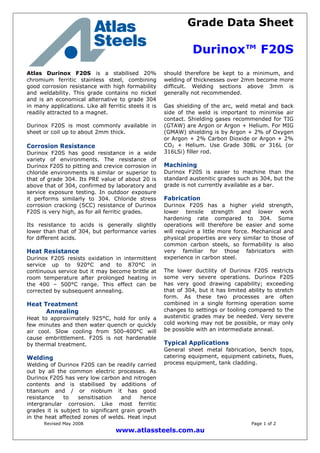
  • 23.
    Grade Data Sheet AtlasCR12 RevisedMay 2008 Page 2 of 2 www.atlassteels.com.au Specified Properties These properties are specified for flat rolled product (plate, sheet and coil) in Euronorm EN 10088.2 1.4003 and ASTM A240/A240M S40977 and S41003. Similar but not necessarily identical properties apply for other products (1.4003 bar is covered by EN 10088-3), but this grade is almost exclusively a flat rolled product. Composition Specification (%) Grade C Mn Si P S Cr Mo Ni N 1.4003 S40977 min. max. - 0.030 - 1.50 - 1.00 - 0.040 - 0.015 10.50 12.50 - 0.30 1.00 - 0.030 S41003 min. max. - 0.030 - 1.50 - 1.00 - 0.040 - 0.030 10.5 12.5 - - 1.50 - 0.030 Mechanical Property Specification HardnessGrade Tensile Strength (MPa) Yield Strength 0.2% Proof Stress (MPa) min Elongation (% in 50mm) min Rockwell (HR) max Brinell (HB) max 1.4003 (1) 450 – 650 280 (long), 320 (trans) 20 - - S40977 450 min 280 18 HR B88 180 S41003 455 min 275 18 HR C20 223 (1) Properties specified for cold rolled coil and hot rolled coil plate. Quarto plate has different values. Physical Properties (typical values in the annealed condition) Mean Coefficient of Thermal Expansion Thermal Conductivity Grade Density (kg/m3 ) Elastic Modulus (GPa) 20-100°C (m/m/°C) 20-300°C (m/m/°C) 20-500°C (m/m/°C) at 100°C (W/m.K) Specific Heat 0-100°C ( J/kg.K) Electrical Resistivity (n.m) 1.4003 7700 220 10.4 11.2 11.9 25 430 600 Source: EN 10088-1 Grade Specification Comparison EuronormGrade UNS No No Name Swedish SS Japanese JIS 1.4003 S41003 or S40977 1.4003 X2CrNi12 - - These comparisons are approximate only. The list is intended as a comparison of functionally similar materials not as a schedule of contractual equivalents. If exact equivalents are needed original specifications must be consulted. Possible Alternative Grades Grade Why it might be chosen instead of 1.4003 AtlasCR12Ti Improved resistance to sensitisation and intergranular corrosion is needed. 304 Better corrosion resistance and fabrication properties are required. Galvanised steel A lower cost is required, and the reduced corrosion resistance and fabrication characteristics of galvanised steel are acceptable. Weathering steel A lower cost is required, and the reduced corrosion resistance and fabrication characteristics of weathering steel are acceptable. Limitation of Liability The information contained in this datasheet is not an exhaustive statement of all relevant information. It is a general guide for customers to the products and services available from Atlas Specialty Metals and no representation is made or warranty given in relation to this document or the products or processes it describes.
  • 24.
    Grade Data Sheet AtlasCR12Ti RevisedMay 2008 Page 1 of 2 www.atlassteels.com.au This "utility stainless steel" is a proprietary modification of Grade 409 12% chromium stainless steel. It has been developed as a readily fabricated, low cost grade, exhibiting good resistance to wet abrasion and mildly corrosive environments; the titanium stabilised composition results in excellent resistance to sensitisation in welding, particularly of thin sections. There are no national specifications or international specifications covering this grade. The designation "AtlasCR12Ti" is a registered trade mark of Atlas Steels. Corrosion Resistance AtlasCR12Ti is effective in many applications where carbon steel, galvanised, aluminised or painted steel or aluminium give unsatisfactory life. It is not attacked by strong alkalies, and often gives adequate resistance in mildly acidic conditions. Light surface rust can form in many atmospheres, making the material unsuitable for decorative applications. AtlasCR12Ti strongly resists chloride stress corrosion cracking, but is less resistant than 304 or 430 to pitting and crevice corrosion in chloride environments. AtlasCR12Ti is likely to resist pitting in water with chloride contents of up to 100 to 200 mg/L at ambient temperatures. The presence of sulphate or nitrate ions will reduce the corrosivity of chlorides. AtlasCR12Ti is titanium stabilised to be more resistant to sensitisation and intergranular corrosion compared to alternative grades such as AtlasCR12 (1.4003). Consult Atlas Technical Assistance for specific environmental recommendations. Heat Resistance In air AtlasCR12Ti offers scaling resistance to 620°C continuous or 730°C intermittent, but if under stress the temperature should be limited to 450°C continuous or 600°C intermittent. AtlasCR12Ti suffers negligible embrittlement after extended exposure at temperatures of 450-550°C. Heat Treatment Annealing - heat to 700-750°C, soak for 1½ hours per 25mm section. Air cool. The maximum temperature of 750°C should not be exceeded. Annealing should usually be followed by pickling and passivating. This grade should not be hardened by heat treatment; quenching treatments may reduce the corrosion resistance and mechanical properties. Welding AtlasCR12Ti is resistant to the sensitisation and intergranular corrosion that can occur in welding of unstabilised stainless steels. It can be welded using similar techniques to austenitic stainless steels. Low heat input processes are preferred - particularly GTAW (TIG) and GMAW (MIG). Filler wire recommended is grade 309L; this over-alloyed grade is important for welding AtlasCR12Ti to other steels, but 316L and 308L have also been successfully used when welding AtlasCR12Ti to itself. Heat inputs should be controlled to 0.5 to 1.5kJ/mm. Argon plus 1-2% oxygen shielding gases are recommended. Discolouration of the weld should be removed by pickling, except possibly in wear applications; effective purging and use of backing gases is often a better option. Standard stainless steel pickling pastes can cause higher attack than they do on austenitic grades; these should be used with caution. Machining AtlasCR12Ti has a machinability similar to that of grade 430, ie about 60% of that of mild steel. The work hardening rate is lower than that of austenitic stainless steels, so reducing the need for special machining techniques. Finishes AtlasCR12Ti is available in standard No1 (“HRAP” – Hot Rolled Annealed and Pickled) finish in sheet, plate and coil down to 3mm thickness, and as cold rolled 2B finish in lighter gauges. Typical Applications Mining and mineral processing and transport equipment. Rail wagons for coal and iron ore. Sugar processing equipment. Furnace and oven parts.
  • 25.
    Grade Data Sheet AtlasCR12Ti RevisedMay 2008 Page 2 of 2 www.atlassteels.com.au Specified Properties These properties are specified for flat rolled product (plate, sheet and coil). Similar but not necessarily identical properties apply to other products such as pipe and bar, but this grade is almost exclusively a flat rolled product. Composition Specification (%) Grade C Mn Si P S Cr Mo Ni Ti AtlasCR12Ti min. max. - 0.030 - 2.00 - 1.00 - 0.040 - 0.030 10.50 12.50 - - 1.50 4(C+N) 0.6 These properties are specified for the proprietary grade AtlasCR12Ti. There are no national or international specifications covering this grade. Mechanical Property Specification Grade Thickness (mm) Tensile Strength (MPa) Yield Strength 0.2% Proof Stress (MPa) Elongation (% in 50mm) min Hardness Brinell (HB) max Impact Energy (J/cm²) <3 460 min 280 min 18 220 - 3 – 4.5 460 min 300 min 18 220 - >4.5 – 12 460 min 300 min 20 220 - AtlasCR12Ti >12 460 min 300 min 20 250 - These properties are specified for the proprietary grade AtlasCR12Ti. There are no national or international specifications covering this grade. Special properties are available for applications such as rail wagons. Physical Properties (typical values in the annealed condition) Mean Coefficient of Thermal Expansion Thermal Conductivity Grade Density (kg/m3 ) Elastic Modulus (GPa) 0-100°C (m/m/°C) 0-300°C (m/m/°C) 0-500°C (m/m/°C) at 100°C (W/m.K) at 500°C (W/m.K) Specific Heat 0-100°C ( J/kg.K) Electrical Resistivity (n.m) Atlas CR12Ti 7700 200 11.1 11.7 12.3 30 40 480 678 Grade Specification Comparison EuronormGrade UNS No No Name Swedish SS Japanese JIS There are no national or international specifications covering the proprietary grade AtlasCR12Ti. Possible Alternative Grades Grade Why it might be chosen instead of AtlasCR12Ti AtlasCR12 (1.4003) Requirement for a similar grade that is included in national standards and in pressure vessel codes. 1.4003 / AtlasCR12 is not weld stabilised. 304 Better corrosion resistance and fabrication properties are required. Galvanised steel A lower cost is required, and the reduced corrosion resistance and fabrication characteristics of galvanised steel are acceptable. Weathering steel A lower cost is required, and the reduced corrosion resistance and fabrication characteristics of weathering steel are acceptable. Limitation of Liability The information contained in this datasheet is not an exhaustive statement of all relevant information. It is a general guide for customers to the products and services available from Atlas Steels and no representation is made or warranty given in relation to this document or the products or processes it describes.
  • 26.
    Grade Data Sheet 409 RevisedMay 2008 Page 1 of 2 www.atlassteels.com.au Grade 409 is a titanium-stabilised ferritic stainless steel. Although regarded as a general-purpose chromium stainless steel the almost exclusive application for Grade 409 is automotive exhaust systems. Its applications are those where appearance is a secondary consideration to mechanical properties and corrosion resistance, particularly at high temperatures, and where some weldability is required. The generic grade 409 has now been replaced in some ASTM specifications (notably the flat rolled specification ASTM A240M) by several “sub-grades”, designated S40910, S40920 and S40930. These have various degrees of stabilisation with titanium, niobium or both titanium and niobium. Any of these may be certified as S40900 (Grade 409). By contrast only standard Grade 409 is listed in ASTM A268M covering tube. Corrosion Resistance Grade 409 resists atmospheric and exhaust gas corrosion. A light surface rust will form in most atmospheres; this rust retards further corrosion but makes the surface undesirable for decorative applications. The corrosion resistance is about the same as that of AtlasCR12 and the 12% chromium martensitic grades such as 410, and inferior to the 17% chromium grade 430. Consult Atlas Technical Assistance for specific environmental recommendations. Heat Resistance Generally 409 is classified as resistant to scaling in intermittent service up to 815°C and up to 675°C in continuous service, but these temperatures are dependent upon the exact service environment. Heat Treatment Annealing Heat to 790-900°C and air cool. This grade cannot be hardened by thermal treatment. Welding Readily welded but a pre-heat of 150-260°C is recommended. Grade 409 or Grade 430 electrode or filler rods can be used, but AS 1554.6 pre-qualifies welding of 409 with Grade 309 rods or electrodes. These austenitic fillers result in a more ductile weld. Post-weld annealing at 760-815°C improves weld ductility. Post-weld annealing is not required when welding thin sections. Automotive exhaust tubing is typically welded without filler metal (autogenously). All welding must be carried out with minimum heat input to reduce grain growth effects. Typical Applications Automotive exhaust systems, including catalytic converters and mufflers
  • 27.
    Grade Data Sheet 409 RevisedMay 2008 Page 2 of 2 www.atlassteels.com.au Specified Properties The properties for Grade 409 are specified for annealed tubing in ASTM A268M. Compositions of other grades are for coil and sheet in ASTM A240M. Similar but not necessarily identical properties are specified for other products in their respective specifications. Composition Specification (%) Grade C Mn Si P S Cr Ni N Ti Nb 409 S40900 min. max. - 0.08 - 1.00 - 1.00 - 0.045 - 0.030 10.5 11.7 - 0.50 6x%C 0.75 S40910 min. max. - 0.03 - 1.00 - 1.00 - 0.040 - 0.020 10.5 11.7 - 0.50 - 0.030 6x%C 0.50 - 0.17 S40920 min. max. - 0.03 - 1.00 - 1.00 - 0.040 - 0.020 10.5 11.7 - 0.50 - 0.030 0.15 & 8x(C+N) 0.50 - 0.10 S40930 min. max. - 0.03 - 1.00 - 1.00 - 0.040 - 0.020 10.5 11.7 - 0.50 - 0.030 Ti+Nb=(0.08+8)x(C+N) 0.75 Mechanical Property Specification HardnessGrade Tensile Strength (MPa) min Yield Strength 0.2% Proof (MPa) min Elongation (% in 50mm) min Rockwell B (HR B) max Brinell (HB) max 409 380 170 20 95 207 These same tensile, yield and elongation limits also apply to the other grades in ASTM A240M. Hardness limits are 88HRB and 179HB maximum for these other grades in flat rolled product. Physical Properties (typical values in the annealed condition) Mean Coefficient of Thermal Expansion Thermal Conductivity Grade Density (kg/m3 ) Elastic Modulus (GPa) 0-100°C (m/m/°C) 0-315°C (m/m/°C) 0-538°C (m/m/°C) at 100°C (W/m.K) at 500°C (W/m.K) Specific Heat 0-100°C ( J/kg.K) Electrical Resistivity (n.m) 409 7700 208 11.0 11.7 12.4 25.8 27.5 460 600 Grade Specification Comparison EuronormGrade UNS No No Name Swedish SS Japanese JIS 409 S40900 1.4512 X6CrTi12 / X2CrTi12 - SUH 409 There no known standardised international alternatives to the ASTM S40910, S40920 and S40930 grades. These comparisons are approximate only. The list is intended as a comparison of functionally similar materials not as a schedule of contractual equivalents. If exact equivalents are needed original specifications must be consulted. Possible Alternative Grades Grade Why it might be chosen instead of 409 AtlasCR12 Similar corrosion resistance, better weldability and more readily available than 409, particularly in heavy sections. (409 may have better drawability than AtlasCR12.) 304 Better corrosion resistance and heat resistance but at higher cost. 321 Higher heat resistance than 409 or 304. Aluminised steel Lower cost than stainless steel grade 409, but also a lower resistance to exhaust gases. Limitation of Liability The information contained in this datasheet is not an exhaustive statement of all relevant information. It is a general guide for customers to the products and services available from Atlas Steels and no representation is made or warranty given in relation to this document or the products or processes it describes.
  • 28.
    Grade Data Sheet 430 RevisedMay 2008 Page 1 of 2 www.atlassteels.com.au Grade 430 is a ferritic, straight chromium, non-hardenable grade, combining good corrosion resistance and formability characteristics with useful mechanical properties. Its ability to resist nitric acid attack permits its use in specific chemical applications but automotive trim, indoor panelling such as refrigeration cabinets and appliance components are its largest fields of application. This grade is only readily available in sheet and coil (up to 1.2mm thick), most commonly in BA or 2B finishes, or polished to No4. The BA finish sheet has a quite bright, reflective appearance. Grade 430F is the free-machining version of this grade, produced in bar form for high speed machining in automatic screw machines. Corrosion Resistance Grade 430 has good resistance to a wide variety of corrosive media including nitric acid and some organic acids. It attains its maximum corrosion resistance when in the highly polished or buffed condition. Its resistance to pitting and crevice corrosion resistance is a little lower than that of Grade 304. It is not usually recommended for Grade 430 to be subjected to exterior exposure, but it performs well in mild indoor environments. Stress corrosion cracking resistance of Grade 430 is very high, as it is for all ferritic grades. Heat Resistance Grade 430 Resists oxidation in intermittent service up to 870°C and to 815°C in continuous service. This grade may become brittle at room temperature after prolonged heating in the 400-600°C range. This effect can be eliminated by annealing. Heat Treatment Solution Annealing Heat to 815-845°C, hold for ½ hour per 25mm of thickness, slow furnace cool to 600°C and then quickly air cool. Slow cooling from 540- 400°C will cause embrittlement. Sub-Critical anneal Heat to 760-815°C and then air cool or water quench. This grade is not hardenable by thermal treatment. Note that 430 is likely to scale more heavily at elevated temperatures than 304, and the scale produced is more difficult to remove by pickling. Welding If welding is necessary pre-heat at 150-200°C. Embrittlement in the weld metal and heat affected zone can be reduced by a post-weld anneal at 790-815°C, but grain refinement will not occur. Use Grade 430, 308L, 309 or 310 filler rod, depending upon application. AS 1554.6 pre-qualifies welding of Grade 430 with Grade 309 filler rods and electrodes. Machining Grade 430 is easier to machine than the standard austenitic grades such as 304, but there is still a tendency for galling and pick-up on the cutting tool. Bars that have been lightly drawn are easier to machine than those in the annealed condition, but Grade 430 is not usually available in bar. Grade 430F, the free machining version of 430, is very much easier to machine. Fabrication The lower work hardening rate makes bending and forming somewhat easier than for grade 304, but the lower ductility restricts very severe operations. Wherever possible severe bends should be made with the bend axis at right angles to the rolling direction. Severe cold heading of 430 wire is possible. If very severe cold working is required it may be necessary to carry out a sub-critical intermediate anneal. Typical Applications Linings for dish washers and panels in other domestic appliances. Refrigerator cabinet panels. Automotive trim. Lashing wire. Element supports. Stove trim rings. Fasteners. Chimney liners.
  • 29.
    Grade Data Sheet 430 RevisedMay 2008 Page 2 of 2 www.atlassteels.com.au Specified Properties These properties for 430 are specified for flat rolled product (plate, sheet and coil) in ASTM A240/A240M. Properties of Grade 430F are specified for bar in ASTM A582. Similar but not necessarily identical properties are specified for other products in their respective specifications. Composition Specification (%) Grade C Mn Si P S Cr Mo Ni N 430 min. max. - 0.12 - 1.00 - 1.00 - 0.040 - 0.030 16.0 18.0 - - 0.75 - 430F min. max. - 0.12 - 1.25 - 1.00 - 0.06 0.15 - 16.0 18.0 - - - Mechanical Property Specification HardnessGrade Tensile Strength (MPa) min Yield Strength 0.2% Proof (MPa) min Elongation (% in 50mm) min Rockwell B (HR B) max Brinell (HB) max 430 450 205 22 89 183 430F 552 typical 379 typical 25 typical - 262 Physical Properties (typical values in the annealed condition) Mean Coefficient of Thermal Expansion Thermal Conductivity Grade Density (kg/m3 ) Elastic Modulus (GPa) 0-100°C (m/m/°C) 0-315°C (m/m/°C) 0-538°C (m/m/°C) at 100°C (W/m.K) at 500°C (W/m.K) Specific Heat 0-100°C ( J/kg.K) Electrical Resistivity (n.m) 430 7700 200 10.4 11.0 11.4 23.9 26.0 460 600 430F 7700 200 10.4 11.0 11.4 26.1 26.3 460 600 Grade Specification Comparison EuronormGrade UNS No No Name Swedish SS Japanese JIS 430 S43000 1.4016 X6Cr17 2320 SUS 430 430F S43020 1.4105 X6CrMoS17 2383 SUS 430F These comparisons are approximate only. The list is intended as a comparison of functionally similar materials not as a schedule of contractual equivalents. If exact equivalents are needed original specifications must be consulted. Possible Alternative Grades Grade Why it might be chosen instead of 430 430F Higher machinability than 430 is needed in bar product, and reduced corrosion resistance is acceptable. Durinox F20S Better pitting resistance, formability and weldability is required in a ferritic stainless steel. 304 Higher corrosion resistance is needed, together with greatly improved ability to be welded and cold formed. 316 Much better corrosion resistance is needed, together with greatly improved ability to be welded and cold formed. AtlasCR12 A lower corrosion resistance is acceptable in a cost-critical application. Limitation of Liability The information contained in this datasheet is not an exhaustive statement of all relevant information. It is a general guide for customers to the products and services available from Atlas Steels and no representation is made or warranty given in relation to this document or the products or processes it describes.
  • 30.
    Grade Data Sheet Durinox™F18S Revised July 2008 Page 1 of 2 www.atlassteels.com.au Durinox F18S is a stabilised chromium ferritic stainless steel, combining good corrosion resistance with good formability and weldability. Its corrosion resistance enables it to replace grade 304 in less aggressive applications. Like all ferritic steels it is readily attracted to a magnet. Durinox F18S is most commonly available in tube, sheet or coil up to about 2mm thick. Corrosion Resistance Durinox F18S has resistance in a variety of mildly corrosive media. It attains its maximum corrosion resistance when in the highly polished or buffed condition. The resistance of grade F18S to pitting and crevice corrosion in chloride environments is between that of grades 430 and 304. Its PRE value of about 18 is close to that of 304. Chloride stress corrosion cracking (SCC) resistance of Durinox F18S is very high, as it is for all ferritic grades. The resistance of Durinox F18S to acids is generally lower than that of 304, but performance varies for different acids, and these should be considered on a case by case basis. Heat Resistance Durinox F18S resists oxidation up to 980°C; it is particularly resistant to intermittent service conditions. It may become brittle at room temperature after prolonged heating in the 400 – 500°C range; this effect can be corrected by subsequent annealing. Niobium in F18S results in very high creep strength that makes it a good choice for critical auto exhaust system components. Heat Treatment Annealing Heat to 790 - 870°C, hold for only a few minutes and then water quench or quickly air cool. Slow cooling will cause embrittlement and raise the ductile-to-brittle transition temperature, so should be avoided. It is important to not exceed 1000°C. Durinox F18S is not hardenable by thermal treatment. Welding Welding of Durinox F18S can be readily carried out by all the common electric processes. As F18S has very low carbon and nitrogen contents and is stabilised by additions of titanium and / or niobium it has good resistance to sensitisation and hence intergranular corrosion. Like most ferritic grades it is subject to significant grain growth in the heat affected zones of welds. Heat input should therefore be kept to a minimum, and welding of thicknesses over 2mm become more difficult. Gas shielding of the arc, weld metal and back side of the weld is important to minimise air contact. Use Grade 308L (or 308LSi) filler rod, depending upon application. Machining F18S is easier to machine than the standard austenitic grades such as 304, but the grade is not commonly available as a bar. Fabrication Durinox F18S has a higher yield strength, higher tensile strength and lower work hardening rate compared to 304. Some operations will therefore be easier and some will require a little more force. The lower ductility of F18S restricts some very severe operations. It has quite good deep drawing capability; close to that of 304, but it has limited ability to stretch form. As these two processes are often combined in a single forming operation some changes to settings or tooling compared to the austenitic grades may be needed. If very severe cold working is required it may be necessary to carry out an intermediate anneal. Typical Applications Chemical process equipment, heat exchanger tubing – particularly in the sugar industry, architectural panels and furniture for indoor environments, trolleys, equipment for food preparation service and display, refrigeration cabinets, exhaust flues, fuel burners.
  • 31.
    Grade Data Sheet Durinox™F18S Revised July 2008 Page 2 of 2 www.atlassteels.com.au Specified Properties The composition and mechanical properties are specified for flat rolled product (plate, sheet and coil) in ASTM A240/A240M, for grade UNS S43932. Durinox F18S is fully compliant with this specification. Similar but not necessarily identical properties are specified for other products in their respective specifications. Chemical Composition (%) Grade C Mn Si P S Cr Mo Ni N Ti+Nb Durinox F18S - 0.030 - 1.00 - 1.00 - 0.040 - 0.030 17.0 19.0 - - 0.50 - 0.030 0.20+4(C+N) 0.75 Mechanical Properties HardnessGrade Tensile Strength (MPa) min Yield Strength 0.2% Proof (MPa) min Elongation (% in 50mm) min Rockwell B (HR B) max Brinell (HB) max Cold Bend Transverse direction Bend radius = 1T Durinox F18S 415 205 22 89 183 180° Physical Properties (typical values in the annealed condition) Mean Coefficient of Thermal Expansion Thermal Conductivity Grade Density (kg/m 3 ) Elastic Modulus (GPa) 0-100°C (µm/m/°C) 0-400°C (µm/m/°C) at 100°C (W/m.K) Specific Heat 0-100 ° C ( J/kg.K) Electrical Resistivity (nΩ.m) Durinox F18S 7700 200 11.0 11.5 25 460 620 Grade Specification Comparison EuronormGrade UNS No No Name Swedish SS Japanese JIS Durinox F18S S43932 1.4509 X2CrTiNb18 - - These comparisons are approximate only. The list is intended as a comparison of functionally similar materials not as a schedule of contractual equivalents. If exact equivalents are needed original specifications must be consulted. Possible Alternative Grades Grade Why it might be chosen instead of Durinox F18S 304 Need the increased weldability, especially in heavy sections, or better stretch formability of 304. 304 is also available in sections above the 2 to 3mm upper limit for Durinox F18S, and a much wider range of products generally. 430 430 has corrosion resistance that is nearly as high as F18S, so may be appropriate in indoor applications that are not welded. F20S Durinox F20S could be used if the corrosion resistance of F18S was not quite adequate. F20S is another low cost ferritic steel. Limitation of Liability The information contained in this datasheet is not an exhaustive statement of all relevant information. It is a general guide for customers to the products and services available from Atlas Steels and no representation is made or warranty given in relation to this document or the products or processes it describes.
  • 32.
    Grade Data Sheet Durinox™F20S Revised May 2008 Page 1 of 2 www.atlassteels.com.au Atlas Durinox F20S is a stabilised 20% chromium ferritic stainless steel, combining good corrosion resistance with high formability and weldability. This grade contains no nickel and is an economical alternative to grade 304 in many applications. Like all ferritic steels it is readily attracted to a magnet. Durinox F20S is most commonly available in sheet or coil up to about 2mm thick. Corrosion Resistance Durinox F20S has good resistance in a wide variety of environments. The resistance of Durinox F20S to pitting and crevice corrosion in chloride environments is similar or superior to that of grade 304. Its PRE value of about 20 is above that of 304, confirmed by laboratory and service exposure testing. In outdoor exposure it performs similarly to 304. Chloride stress corrosion cracking (SCC) resistance of Durinox F20S is very high, as for all ferritic grades. Its resistance to acids is generally slightly lower than that of 304, but performance varies for different acids. Heat Resistance Durinox F20S resists oxidation in intermittent service up to 920°C and to 870°C in continuous service but it may become brittle at room temperature after prolonged heating in the 400 – 500°C range. This effect can be corrected by subsequent annealing. Heat Treatment Annealing Heat to approximately 925°C, hold for only a few minutes and then water quench or quickly air cool. Slow cooling from 500-400°C will cause embrittlement. F20S is not hardenable by thermal treatment. Welding Welding of Durinox F20S can be readily carried out by all the common electric processes. As Durinox F20S has very low carbon and nitrogen contents and is stabilised by additions of titanium and / or niobium it has good resistance to sensitisation and hence intergranular corrosion. Like most ferritic grades it is subject to significant grain growth in the heat affected zones of welds. Heat input should therefore be kept to a minimum, and welding of thicknesses over 2mm become more difficult. Welding sections above 3mm is generally not recommended. Gas shielding of the arc, weld metal and back side of the weld is important to minimise air contact. Shielding gases recommended for TIG (GTAW) are Argon or Argon + Helium. For MIG (GMAW) shielding is by Argon + 2% of Oxygen or Argon + 2% Carbon Dioxide or Argon + 2% CO2 + Helium. Use Grade 308L or 316L (or 316LSi) filler rod. Machining Durinox F20S is easier to machine than the standard austenitic grades such as 304, but the grade is not currently available as a bar. Fabrication Durinox F20S has a higher yield strength, lower tensile strength and lower work hardening rate compared to 304. Some operations will therefore be easier and some will require a little more force. Mechanical and physical properties are very similar to those of common carbon steels, so formability is also very familiar for those fabricators with experience in carbon steel. The lower ductility of Durinox F20S restricts some very severe operations. Durinox F20S has very good drawing capability; exceeding that of 304, but it has limited ability to stretch form. As these two processes are often combined in a single forming operation some changes to settings or tooling compared to the austenitic grades may be needed. Very severe cold working may not be possible, or may only be possible with an intermediate anneal. Typical Applications General sheet metal fabrication, bench tops, catering equipment, equipment cabinets, flues, process equipment, tank cladding.
  • 33.
    Grade Data Sheet Durinox™F20S Revised May 2008 Page 2 of 2 www.atlassteels.com.au Specified Properties Because Durinox F20S is a very new alloy its properties are not as yet included in any national or international specifications. The following composition and mechanical properties are typical, not specification limits. Chemical Composition (%) (typical values) Grade C Mn Si P S Cr N Ti+Nb Durinox F20S 0.02 0.2 0.1 0.03 0.003 20 0.01 0.3 Note: Because of on-going product development some minor changes may be made to this composition. Mechanical Properties Grade Tensile Strength (MPa) Yield Strength 0.2% Proof (MPa) Elongation (% in 50mm) Hardness Vickers HV Durinox F20S 460 320 30 160 Note: Because of on-going product development some minor changes may be made to these properties. Physical Properties (typical values in the annealed condition) Mean Coefficient of Thermal Expansion Thermal Conductivity Grade Density (kg/m 3 ) Elastic Modulus (GPa) 0-100°C (µm/m/°C) at 100°C (W/m.K) Specific Heat 0-100 ° C ( J/kg.K) Electrical Resistivity (nΩ.m) Durinox 7750 205 10.5 23 440 600 Grade Specification Comparison EuronormGrade UNS No No Name Swedish SS Japanese JIS Durinox F20S - - - - - Note: no national or international specifications cover this grade as yet. Possible Alternative Grades Grade Why it might be chosen instead of Durinox F20S F18S A lower cost than F20S is required and a slightly lower corrosion resistance can be tolerated. Durinox F18S is less readily available than F20S. 304 Better ductility is required for severe forming. Better weldability in heavy sections is needed. Product is required in thicknesses above those of F20S. 430 Lower cost is required, and reduced weldability, formability and corrosion resistance can be tolerated. 444 Higher corrosion resistance is required, particularly in chloride environments. Limitation of Liability The information contained in this datasheet is not an exhaustive statement of all relevant information. It is a general guide for customers to the products and services available from Atlas Steels and no representation is made or warranty given in relation to this document or the products or processes it describes.
  • 34.
    Grade Data Sheet Durinox™F18MS Revised May 2008 Page 1 of 2 www.atlassteels.com.au Durinox F18MS is a stabilised chromium- molybdenum ferritic stainless steel, combining very good corrosion resistance with good formability and weldability. Its excellent corrosion resistance enables it to replace grade 316 in many applications; domestic hot water cylinders are its largest field of application. Like all ferritic steels it is readily attracted to a magnet. Durinox F18MS is most commonly available in sheet or coil up to about 2mm thick. Corrosion Resistance Durinox F18MS has good resistance in a wide variety of corrosive media. It attains its maximum corrosion resistance when in the highly polished or buffed condition. The resistance of grade F18MS to pitting and crevice corrosion in chloride environments is similar or superior to that of grade 316. Its PRE value of about 25 is at least as high as that of 316. Chloride stress corrosion cracking (SCC) resistance of Durinox F18MS is very high, as it is for all ferritic grades. The resistance of Durinox F18MS to acids is generally lower than that of 316, but performance varies for different acids, and these should be considered on a case by case basis. Heat Resistance Durinox F18MS resists oxidation in intermittent service up to 920°C and to 870°C in continuous service but it may become brittle at room temperature after prolonged heating in the 400 – 500°C range. This effect can be corrected by subsequent annealing. Heat Treatment Annealing Heat to approximately 925°C, hold for only a few minutes and then water quench or quickly air cool. Slow cooling from 500-400°C will cause embrittlement. Durinox F18MS is not hardenable by thermal treatment. Welding Welding of Durinox F18MS can be readily carried out by all the common electric processes. As F18MS has very low carbon and nitrogen contents and is stabilised by additions of titanium and / or niobium it has good resistance to sensitisation and hence intergranular corrosion. Like most ferritic grades it is subject to significant grain growth in the heat affected zones of welds. Heat input should therefore be kept to a minimum, and welding of thicknesses over 2mm become more difficult. Gas shielding of the arc, weld metal and back side of the weld is important to minimise air contact. Use Grade 316L (or 316LSi) filler rod, depending upon application. AS 1554.6 pre-qualifies welding (listed as Grade 444) with Grade 316L filler rods and electrodes. Machining F18MS is easier to machine than the standard austenitic grades such as 316, but the grade is not commonly available as a bar. Fabrication Durinox F18MS has a higher yield strength, higher tensile strength and lower work hardening rate compared to 316. Some operations will therefore be easier and some will require a little more force. The lower ductility of F18MS restricts some very severe operations. It has quite good deep drawing capability; close to that of 316, but it has limited ability to stretch form. As these two processes are often combined in a single forming operation some changes to settings or tooling compared to the austenitic grades may be needed. If very severe cold working is required it may be necessary to carry out an intermediate anneal. Typical Applications Hot water cylinders, heat exchanger tubing, chemical process equipment, architectural panels.
  • 35.
    Grade Data Sheet Durinox™F18MS Revised May 2008 Page 2 of 2 www.atlassteels.com.au Specified Properties The composition and mechanical properties are specified for flat rolled product (plate, sheet and coil) in ASTM A240/A240M, for grade 444 (UNS S44400). Durinox F18MS is fully compliant with this specification. Similar but not necessarily identical properties are specified for other products in their respective specifications. Chemical Composition (%) Grade C Mn Si P S Cr Mo Ni N Ti+Nb Durinox F18MS - 0.025 - 1.00 - 1.00 - 0.040 - 0.030 17.5 19.5 1.75 2.50 - 1.00 - 0.035 0.20+4(C+N) 0.80 Mechanical Properties HardnessGrade Tensile Strength (MPa) min Yield Strength 0.2% Proof (MPa) min Elongation (% in 50mm) min Rockwell B (HR B) max Brinell (HB) max Cold Bend Transverse direction Bend radius = 1T Durinox F18MS 415 275 20 96 217 180° Physical Properties (typical values in the annealed condition) Mean Coefficient of Thermal Expansion Thermal Conductivity Grade Density (kg/m 3 ) Elastic Modulus (GPa) 0-100°C (µm/m/°C) 0-400°C (µm/m/°C) at 100°C (W/m.K) Specific Heat 0-100 ° C ( J/kg.K) Electrical Resistivity (nΩ.m) Durinox F18MS 7700 200 11.0 11.5 26.8 427 620 Grade Specification Comparison EuronormGrade UNS No No Name Swedish SS Japanese JIS Durinox F18MS S44400 1.4521 X2CrMoTi18-2 2326 SUS 444 These comparisons are approximate only. The list is intended as a comparison of functionally similar materials not as a schedule of contractual equivalents. If exact equivalents are needed original specifications must be consulted. Possible Alternative Grades Grade Why it might be chosen instead of Durinox F18MS 316 Need the increased weldability, especially in heavy sections, or better stretch formability of 316. 316 is also available in sections above the 2 to 3mm upper limit for Durinox F18MS, and a wider range of products generally. 2304 2304 has better weldability in heavy sections, and higher strength that may alloy down- gauging. F20S Durinox F20S could be used if the corrosion resistance of F18MS was not needed. Another low cost ferritic steel. Limitation of Liability The information contained in this datasheet is not an exhaustive statement of all relevant information. It is a general guide for customers to the products and services available from Atlas Steels and no representation is made or warranty given in relation to this document or the products or processes it describes.
  • 36.
    Grade Data Sheet 2101 RevisedNovember 2011 Page 1 of 2 www.atlassteels.com.au LDX2101® is a duplex (ferritic/austenitic) stainless steel grade with a useful combination of corrosion resistance and high strength. Because it has almost no molybdenum and a low nickel content the grade is an economical alternative to 304 or 316 in some applications. In 2101 nickel is largely replaced by manganese and molybdenum’s corrosion resistance role largely taken over by nitrogen. Yield strength is about double that of the standard austenitic grades 304 and 316. LDX2101 was developed by Outokumpu as a “lean duplex” grade; it has since been allocated designations UNS S32101 and 1.4162 in the American and European standards systems. It also has ASME pressure vessel endorsement, initially under Code Case 2418. Corrosion Resistance General corrosion resistance between Grades 304 and 316 in most environments. Good resistance to localised corrosion including intergranular, pitting and crevice corrosion; the Pitting Resistance Equivalent (PRE) of 2101 is 26 – slightly higher than that of 316, but actual pitting and crevice corrosion behaviour is generally a between that of 304 and 316. Grade 2101 is also resistant to chloride stress corrosion cracking (SCC) at temperatures up to over 100°C. It can perform well in environments which cause premature failure of austenitic grades. Consult Atlas Technical Assistance for specific environmental recommendations. Heat Resistance Although 2101 has good high temperature oxidation resistance this grade, like other duplex stainless steels, suffers from embrittlement if held at temperatures above 300°C. If embrittled this can only be rectified by a full solution annealing treatment. Duplex stainless steels are almost never used above 300°C. Low Temperature Performance 2101 is not generally recommended for use below -50°C because of its ductile-to-brittle- transition, again common to all duplex stainless steels. Heat Treatment Solution treatment (annealing) Heat to 1020-1080°C and cool rapidly. This grade cannot be hardened by thermal treatment, but does work harden. Welding Weldable by all standard electric methods. Filler of 2209 rods or electrodes ensures that deposited metal has the correctly balanced duplex structure. Heat input should be kept low (although this is less restrictive than for other duplex grades) and no pre- or post-heat should be used. Unlike other duplex grades welding of 2101 without filler metal may be possible. The lower co-efficient of thermal expansion of all duplex stainless steels compared with austenitic grades reduces distortion and associated stresses. Machining The high strength that makes 2101 useful in many applications also reduces its machinability, but overall it machines slightly better than 316. Fabrication The high strength of 2101 also makes bending and forming more difficult; these operations will require larger capacity equipment than would be required for austenitic stainless steels. The ductility of 2101 is less than that of an austenitic grade (but is not low when compared to most other structural materials), so severe forming operations, such as cold heading, are not generally possible. If severe cold working is required it is recommended that intermediate annealing be carried out. Typical Applications Chemical processing, transport and storage. All structural and pressure applications requiring high strength and good corrosion resistance at economical cost.
  • 37.
    Grade Data Sheet 2101 RevisedNovember 2011 Page 2 of 2 www.atlassteels.com.au Specified Properties These properties are specified for Grade 2101 (S32101) flat rolled product (plate over 5mm thick) in ASTM A240/A240M. Similar but not necessarily identical properties are specified for other products such as sheet, pipe and bar in their respective specifications. Composition Specification (%) Grade C Mn Si P S Cr Mo Ni Cu N 2101 min. max. - 0.040 4.00 6.00 - 1.00 - 0.040 - 0.030 21.0 22.0 0.10 0.80 1.35 1.70 0.10 0.80 0.20 0.25 Mechanical Property Specification HardnessGrade Tensile Strength (MPa) min Yield Strength 0.2% Proof (MPa) min Elongation (% in 50mm) min Rockwell C (HR C) Brinell (HB) 2101 650 450 30 - 290 max Physical Properties (typical values in the annealed condition) Mean Coefficient of Thermal Expansion Thermal Conductivity Grade Density (kg/m3 ) Elastic Modulus (GPa) 0-100°C (m/m/°C) 0-300°C (m/m/°C) 0-538°C (m/m/°C) at 100°C (W/m.K) at 300°C (W/m.K) Specific Heat 0-100° C ( J/kg.K) Electrical Resistivity at 20°C (n.m) 2101 7800 200 13.0 14.0 - 16 18 530 800 Grade Specification Comparison EuronormGrade UNS No No Name Swedish SS Japanese JIS 2101 S32101 1.4162 - - - These comparisons are approximate only. The list is intended as a comparison of functionally similar materials not as a schedule of contractual equivalents. If exact equivalents are needed original specifications must be consulted. Possible Alternative Grades Grade Why it might be chosen instead of 2304 304L Generally slightly lower pitting and crevice corrosion resistance than 2101 and lower strength, but more easily cold formed and more readily available. 304 is non-magnetic. 316L Generally slightly higher pitting and crevice corrosion resistance than 2101, more easily cold formed and more readily available, but lower strength. 316 is non-magnetic. 2205 Higher resistance to corrosion is required, eg resistance to higher temperature chloride solutions. Grade 2205 is often more readily available than 2101. F18MS / 444 Slightly higher pitting and crevice corrosion resistance than 2101, more easily cold formed and lower cost. F18MS / 444 is only available in thin gauge sheet and coil. 2304 Slightly higher resistance to corrosion is required, eg resistance to higher temperature chloride solutions. Grade 2304 is generally less readily available than 2101. Limitation of Liability The information contained in this datasheet is not an exhaustive statement of all relevant information. It is a general guide for customers to the products and services available from Atlas Steels and no representation is made or warranty given in relation to this document or the products or processes it describes.
  • 38.
    Grade Data Sheet 2304 RevisedMay 2008 Page 1 of 2 www.atlassteels.com.au 2304 is a duplex (ferritic/austenitic) stainless steel grade with a useful combination of corrosion resistance and high strength. Because it has almost no molybdenum the grade is an economical alternative to 316 in some applications. 2304 is not generally suitable for use at temperatures above 300°C as it suffers from precipitation of brittle micro-constituents, nor below -50°C because of its ductile-to-brittle- transition. Corrosion Resistance Good general corrosion resistance; approximately the same as Grade 316 in most environments. Good resistance to localised corrosion including intergranular, pitting and crevice corrosion; the Pitting Resistance Equivalent (PRE) of 2304 is 26 – slightly higher than that of 316 and this is confirmed by actual pitting and crevice corrosion behaviour. It has similar resistance to sea water as grade 316. Grade 2304 is also resistant to chloride stress corrosion cracking (SCC) at temperatures of up to over 100°C. It will often perform well in environments which cause premature failure of austenitic grades. Consult Atlas Technical Assistance for specific environmental recommendations. Heat Resistance Although 2304 has good high temperature oxidation resistance this grade, like other duplex stainless steels, suffers from embrittlement if held at temperatures above 300°C. 2304 resists this high temperature embrittlement better than other duplex grades but the effect will still occur after about 10 hours at elevated temperatures. If embrittled this can only be rectified by a full solution annealing treatment. Duplex stainless steels are almost never used above 300°C. Heat Treatment Solution treatment (annealing) Heat to 1020-1100°C and cool rapidly. This grade cannot be hardened by thermal treatment, but does work harden. Welding Weldable by all standard methods, but it should not be welded without filler metal as this may result in excessive ferrite. AS 1554.6 pre-qualifies welding of 2304 with 2209 rods or electrodes to ensure that deposited metal has the correctly balanced duplex structure. Nitrogen added to the shielding gas will also assist in ensuring adequate austenite in the structure. Heat input must be kept low and no pre- or post-heat should be used. The lower co-efficient of thermal expansion of all duplex stainless steels compared with austenitic grades reduces distortion and associated stresses. Machining The high strength that makes 2304 useful in many applications also reduces its machinability, but not as much as for duplex grade 2205. Machinability of 2304 bars in some operations is not as good as for 316 and in other operations it is in fact better to machine. Poor chip breaking can result in rough finishes after some operations. Fabrication The high strength of 2304 also makes bending and forming more difficult; these operations will require larger capacity equipment than would be required for austenitic stainless steels. The ductility of 2304 is less than that of an austenitic grade (but is not low when compared to most other structural materials), so severe forming operations, such as cold heading, are not generally possible. If severe cold working is required it is recommended that intermediate annealing be carried out. Typical Applications Chemical processing, transport and storage. Oil and gas exploration and processing equipment. Marine and other high chloride environments. Pulp & Paper digesters, liquor tanks and paper machines.
  • 39.
    Grade Data Sheet 2304 RevisedMay 2008 Page 2 of 2 www.atlassteels.com.au Specified Properties These properties are specified for Grade 2304 (S32304) flat rolled product (plate, sheet and coil) in ASTM A240/A240M. Similar but not necessarily identical properties are specified for other products such as pipe and bar in their respective specifications. Composition Specification (%) Grade C Mn Si P S Cr Mo Ni Cu N 2304 min. max. - 0.030 - 2.50 - 1.00 - 0.040 - 0.030 21.5 24.5 0.05 0.60 3.0 5.5 0.05 0.60 0.05 0.20 Mechanical Property Specification HardnessGrade Tensile Strength (MPa) min Yield Strength 0.2% Proof (MPa) min Elongation (% in 50mm) min Rockwell C (HR C) Brinell (HB) 2304 600 400 25 32 max 290 max Physical Properties (typical values in the annealed condition) Mean Coefficient of Thermal Expansion Thermal Conductivity Grade Density (kg/m3 ) Elastic Modulus (GPa) 0-100°C (m/m/°C) 0-400°C (m/m/°C) 0-538°C (m/m/°C) at 100°C (W/m.K) at 300°C (W/m.K) Specific Heat 0-100° C ( J/kg.K) Electrical Resistivity at 20°C (n.m) 2304 7800 200 13.0 14.5 - 17 19 460 850 Grade Specification Comparison EuronormGrade UNS No No Name Swedish SS Japanese JIS 2304 S32304 1.4362 X2CrNiN23-4 2327 - These comparisons are approximate only. The list is intended as a comparison of functionally similar materials not as a schedule of contractual equivalents. If exact equivalents are needed original specifications must be consulted. Possible Alternative Grades Grade Why it might be chosen instead of 2304 316L Approximately the same pitting and crevice corrosion resistance as 2304, more easily cold formed and more readily available. 2205 Higher resistance to corrosion is required, eg resistance to higher temperature seawater. Grade 2205 is also more readily available than 2304. Durinox F18MS Approximately the same pitting and crevice corrosion resistance as 2304, more easily cold formed and lower cost. Durinox F18MS is only available in thin gauge sheet and coil. Limitation of Liability The information contained in this datasheet is not an exhaustive statement of all relevant information. It is a general guide for customers to the products and services available from Atlas Steels and no representation is made or warranty given in relation to this document or the products or processes it describes.
  • 40.
    Grade Data Sheet 2205 RevisedMay 2008 Page 1 of 2 www.atlassteels.com.au 2205 is the most widely used duplex (ferritic/austenitic) stainless steel grade. It finds applications due to both excellent corrosion resistance and high strength. The original S31803 composition has over the years been refined by many steel suppliers, and the resulting restricted composition range was endorsed as UNS S32205 in 1996. S32205 gives better guaranteed corrosion resistance, but much of the S31803 currently produced also complies with S32205. It is recommended that grade 2205 always be clarified as S31803 or S32205, but note that ASTM A240 defines 2205 as S32205. 2205 is not generally suitable for use at temperatures above 300°C as it suffers from precipitation of brittle micro-constituents, nor below -50°C because of its ductile-to-brittle- transition. Corrosion Resistance Excellent general corrosion resistance; superior to Grade 316 in most environments. Excellent resistance to localised corrosion including intergranular, pitting and crevice corrosion; the CPT of 2205 is generally at least 35°C. The grade is also resistant to chloride stress corrosion cracking (SCC) at temperatures of up to about 150°C. Grade 2205 will often perform well in environments which cause premature failure of austenitic grades. It has better resistance to sea water than grade 316. Consult Atlas Technical Assistance for specific environmental recommendations. Heat Resistance Although 2205 has good high temperature oxidation resistance this grade, like other duplex stainless steels, suffers from embrittlement if held for even short times at temperatures above 300°C. If embrittled this can only be rectified by a full solution annealing treatment. Duplex stainless steels are almost never used above 300°C. Heat Treatment Solution treatment (annealing) Heat to 1020-1100°C and cool rapidly. This grade cannot be hardened by thermal treatment, but does work harden. Welding Weldable by all standard methods, but should not generally be welded without filler metal as this may result in excessive ferrite. AS 1554.6 pre-qualifies welding of 2205 with 2209 rods or electrodes to ensure that deposited metal has the correctly balanced duplex structure. Nitrogen added to the shielding gas will also assist in ensuring adequate austenite in the structure. Heat input must be kept low and no pre- or post-heat should be used. The lower co-efficient of thermal expansion of all duplex stainless steels compared with austenitic grades reduces distortion and associated stresses. Machining The high strength that makes 2205 useful in many applications also reduces its machinability. Cutting speeds are approximately 20% slower than for grade 304. There is as yet no "Ugima" Improved Machinability version of 2205. Fabrication The high strength of 2205 also makes bending and forming more difficult; these operations will require larger capacity equipment than would be required for austenitic stainless steels. The ductility of 2205 is less than that of an austenitic grade (but is not low when compared to most other structural materials), so severe forming operations, such as cold heading, are not generally possible. If severe cold working is required it is recommended that intermediate annealing be carried out. Typical Applications Chemical processing, transport and storage. Oil and gas exploration and processing equipment. Marine and other high chloride environments. Pulp & Paper digesters, liquor tanks and paper machines.
  • 41.
    Grade Data Sheet 2205 RevisedMay 2008 Page 2 of 2 www.atlassteels.com.au Specified Properties These properties are specified for flat rolled product (plate, sheet and coil) in ASTM A240/A240M. Similar but not necessarily identical properties are specified for other products such as pipe and bar in their respective specifications. Composition Specification (%) Grade C Mn Si P S Cr Mo Ni N 2205 (S31803) min. max. - 0.030 - 2.00 - 1.00 - 0.030 - 0.020 21.0 23.0 2.5 3.5 4.5 6.5 0.08 0.20 2205 (S32205) min. max. - 0.030 - 2.00 - 1.00 - 0.030 - 0.020 22.0 23.0 3.0 3.5 4.5 6.5 0.14 0.20 Mechanical Property Specification HardnessGrade Tensile Strength (MPa) min Yield Strength 0.2% Proof (MPa) min Elongation (% in 50mm) min Rockwell C (HR C) Brinell (HB) S31803 620 450 25 31 max 293 max S32205 655 450 25 31 max 293 max Physical Properties (typical values in the annealed condition) Mean Coefficient of Thermal Expansion Thermal Conductivity Grade Density (kg/m3 ) Elastic Modulus (GPa) 0-100°C (m/m/°C) 0-315°C (m/m/°C) 0-538°C (m/m/°C) at 100°C (W/m.K) at 500°C (W/m.K) Specific Heat 0-100° C ( J/kg.K) Electrical Resistivity (n.m) 2205 7800 200 13.7 14.7 - 19.0 - 450 850 Physical properties of S31803 and S32205 are identical. Grade Specification Comparison EuronormGrade UNS No No Name Swedish SS Japanese JIS 2205 S31803 / S32205 1.4462 X2CrNiMoN22-5-3 2377 SUS 329J3L These comparisons are approximate only. The list is intended as a comparison of functionally similar materials not as a schedule of contractual equivalents. If exact equivalents are needed original specifications must be consulted. ASTM grade S31803 is a closer equivalent to most other specifications than is S32205. Possible Alternative Grades Grade Why it might be chosen instead of 2205 904L Better formability is needed, with similar corrosion resistance and lower strength. UR52N+ 2507 Higher resistance to corrosion is required, eg resistance to higher temperature seawater. These super duplex grades also have higher strength than 2205. 6%Mo Higher corrosion resistance is required, but with lower strength and better formability. 316L The high corrosion resistance and strength of 2205 are not needed … 316L is more available and may be lower cost. Limitation of Liability The information contained in this datasheet is not an exhaustive statement of all relevant information. It is a general guide for customers to the products and services available from Atlas Steels and no representation is made or warranty given in relation to this document or the products or processes it describes.
  • 42.
    Grade Data Sheet 2507 RevisedMay 2008 Page 1 of 2 www.atlassteels.com.au 2507 is one of a group of "super duplex" grades, combining high strength with exceptional corrosion resistance. 2507 is very highly resistant to general corrosion and to pitting and crevice corrosion in high chloride, hot environments. Its duplex structure also results in excellent resistance to stress corrosion cracking. Like other duplex (ferritic/austenitic) grades the super duplex grades are not suitable for high or low temperature service. 2507 is not recommended for temperatures below -50°C or above +300°C, because of reduced toughness outside this range. The high strength favours applications in pressure vessels and for marine and other shafts Corrosion Resistance 2507 has excellent general corrosion resistance, superior to virtually all other stainless steels. It has high resistance to intergranular corrosion and very high resistance to stress corrosion cracking in both chloride and sulphide environments. A PRE of least 40 indicates that the material has good pitting and crevice corrosion resistance to warm sea water and other high chloride environments; it is rated as more resistant than grade 904L and approximating that of the 6% Molybdenum "super austenitic" grades. 2507 is the grade of choice for severe high temperature marine environments and for chemical and petrochemical processing, even including some solutions of strong acids. Consult Atlas Technical Assistance for specific environmental recommendations. Heat Resistance Although super duplex grades have good high temperature oxidation resistance, like other duplex stainless steels they suffer from embrittlement if held for even short times at temperatures above 300°C. If grade 2507 becomes embrittled this can only be rectified by a full solution annealing treatment. Heat Treatment Solution Treatment (Annealing) Heat to 1040 - 1120°C and cool rapidly in air or by water quenching. Duplex and super duplex grades cannot be hardened by thermal treatment. Welding 2507 is weldable by standard methods, without pre-heat. Consumables over-alloyed with nitrogen and nickel are generally recommended such as those with ISO designation “25 9 4 L N”. TIG (GTAW), MIG (GMAW) and all positional manual (MMAW) electrodes are available. Heat input should be within the range 0.5 – 1.5kJ/mm. Post weld annealing is essential following autogenous welding, but not otherwise. Nickel-based consumables (eg Alloy C22) can also be used to give higher corrosion resisting welds. As for other duplex stainless steels the coefficient of thermal expansion of 2507 is lower than for austenitic grades, reducing distortion and residual stresses. Fabrication 2507 is a high strength steel, so high forming forces will be required and high spring-back should be anticipated. The ductility of the grade is quite adequate for most operations, but heavy deformation, such as cold forging, is not possible. If more than about 20% cold work is carried out an intermediate solution anneal is required. Hot forging can be carried out in the temperature range 1200 – 1025°C. Like other duplex grades 2507 has low hot strength, so may need support during heat treatment or forging. Hot forging should be followed by solution treatment. Typical Applications Oil and gas exploration, processing and support systems, pollution control including flue gas desulphurisation, marine and other high chloride environments, desalination plants, chemical processing, transport and storage, pulp and paper processing.
  • 43.
    Grade Data Sheet 2507 RevisedMay 2008 Page 2 of 2 www.atlassteels.com.au Specified Properties These properties are specified for flat rolled product (plate, sheet and coil) in ASTM A240M and for pipe in ASTM A790M, as UNS S32750. Similar but not necessarily identical properties are specified for other products in their respective specifications. Composition Specification (%) Grade C Mn Si P S Cr Mo Ni Cu N 2507 min. max. - 0.030 - 1.20 - 0.80 - 0.035 - 0.020 24.0 26.0 3.0 5.0 6.0 8.0 - 0.50 0.24 0.32 Mechanical Property Specification HardnessGrade Tensile Strength (MPa) min Yield Strength 0.2% Proof (MPa) min Elongation (% in 50mm) min Rockwell B (HR C) max Brinell (HB) max 2507 795 550 15 32 310 Physical Properties (typical values in the annealed condition) Mean Coefficient of Thermal Expansion Thermal Conductivity Grade Density (kg/m3 ) Elastic Modulus (GPa) 0-100°C (m/m/°C) 0-400°C (m/m/°C) at 20°C (W/m.K) Specific Heat 0-100° C ( J/kg.K) Electrical Resistivity (n.m) 2507 7800 200 13.0 14.5 14.2 460 850 Grade Specification Comparison EuronormGrade UNS No No Name Swedish SS Japanese JIS 2507 S32750 1.4410 X2CrNiMoN25-7-4 2328 - These comparisons are approximate only. The list is intended as a comparison of functionally similar materials not as a schedule of contractual equivalents. If exact equivalents are needed original specifications must be consulted. Possible Alternative Grades Grade Why it might be chosen instead of 2507 2205 The lower cost and better availability of 2205 are required, and a lower corrosion resistance and strength can be accepted. 6% Mo Higher ductility of this austenitic grade is needed, and the much lower strength is acceptable. Corrosion resistance is similar in many environments, but needs to be considered case by case. Ni Alloys A corrosion resistance even higher than 2507 is required, and a higher cost is acceptable. Limitation of Liability The information contained in this datasheet is not an exhaustive statement of all relevant information. It is a general guide for customers to the products and services available from Atlas Steels and no representation is made or warranty given in relation to this document or the products or processes it describes.
  • 44.
    Grade Data Sheet 2507Cu RevisedNov 2011 Page 1 of 2 www.atlassteels.com.au Grade UR2507Cu is a registered trade name of the ArcelorMittal group. The grade was previously designated UR52N+. 2507Cu is specified as UNS S32520 for plate (in ASTM A240M) and pipe (in ASTM A790M) but retains the older designation UNS S32550 for bar (in ASTM A276M). The specified compositions and mechanical properties of these alternatives are slightly different. 2507Cu is one of a group of "super duplex" grades, combining high strength with exceptional corrosion resistance. Corrosion Resistance 2507Cu has excellent general corrosion resistance, superior to virtually all other stainless steels. It has high resistance to intergranular corrosion. Because of its high strength it performs well in abrasion/corrosion conditions. A PRE guaranteed to be at least 40 indicates that the material has good pitting and crevice corrosion resistance to warm sea water and other high chloride environments; it is rated as more resistant than grade 904L and approaching that of the 6% Molybdenum "super austenitic" grades. The crevice corrosion resistance of 2507Cu can be in excess of that of the 6% Mo grades in some cases. Copper adds resistance to sulphuric and other reducing acids, particularly in the very aggressive "mid concentration" range. Because of its duplex structure 2507Cu has excellent resistance to stress corrosion cracking, resistant to all concentrations of chlorides up to over 200°C, and also resists SCC in sulphide (sour gas) environments. 2507Cu is a grade of choice for severe hot sea water environments and for chemical and petrochemical processing, including strong acids. Consult Atlas Technical Assistance for specific environmental recommendations. Heat Resistance Although super duplex grades have good high temperature oxidation resistance they suffer from embrittlement if held for even short times at temperatures above +270°C. If embrittled this can only be rectified by a full solution annealing treatment. Low Temperature Performance 2507Cu is not generally recommended for use below -50°C because of its ductile-to-brittle- transition, again common to all duplex stainless steels. Heat Treatment Solution Treatment (Annealing) Annealing - heat to 1080 - 1120°C and cool rapidly. Duplex and super duplex grades cannot be hardened by thermal treatment. Welding Weldable by standard methods, without pre- heat. Consumables over-alloyed with nitrogen and nickel are generally recommended. TIG (GTAW), MIG (GMAW) and all positional manual (MMAW) electrodes are available. Nickel-based consumables (eg Alloy C22) give higher corrosion resisting welds. As for other duplex stainless steels the coefficient of thermal expansion is lower than for austenitic grades, reducing distortion and residual stresses. Post weld annealing increases the corrosion resistance of welds. Fabrication 2507Cu is a high strength steel, so high forces will be required for cold forming. The ductility of the grade is quite adequate for most operations, but heavy deformation, such as cold forging, is not possible. If more than about 20% cold work is required an intermediate solution anneal is required. Typical Applications Oil and gas exploration, processing and support systems, pollution control including flue gas desulphurisation, marine and other high chloride environments, chemical processing, transport and storage, pulp and paper processing.
  • 45.
    Grade Data Sheet 2507Cu RevisedNov 2011 Page 2 of 2 www.atlassteels.com.au Specified Properties These properties are specified for flat rolled product (plate, sheet and coil) in ASTM A240M as Grade S32520, for pipe in ASTM A790M (also as Grade S32520) and for bar in specification ASTM A276, as Grade S32550, Condition A. Similar but not necessarily identical properties are specified for other products in their respective specifications. Composition Specification (%) Grade & Spec. C Mn Si P S Cr Mo Ni Cu N S32520 ASTM A240M min. max - 0.030 - 1.50 - 0.80 - 0.035 - 0.020 24.0 26.0 3.0 4.0 5.5 8.0 0.5 2.0 0.20 0.35 S32520 ASTM A790M min. max - 0.030 - 1.5 - 0.80 - 0.035 - 0.020 24.0 26.0 3.0 5.0 5.5 8.0 0.5 3.0 0.20 0.35 S32550 ASTM A276M min. max - 0.040 - 1.50 - 1.0 - 0.040 - 0.030 24.0 27.0 2.9 3.9 4.5 6.5 1.5 2.5 0.10 0.25 Mechanical Property Specification HardnessGrade & Specification Tensile Strength (MPa) min Yield Strength 0.2% Proof (MPa) min Elongation (% in 50mm) min Rockwell C (HR C) max Brinell (HB) max S32520 – A240M & A790M 770 550 25 - 310 S32550 – A276 Cond A 750 550 25 - 290 Physical Properties (typical values in the annealed condition) Mean Coefficient of Thermal Expansion Thermal Conductivity Grade Density (kg/m3 ) Elastic Modulus (GPa) 20-200°C (m/m/°C) 20-300°C (m/m/°C) 20-500°C (m/m/°C) at 20°C (W/m.K) at 200°C (W/m.K) Specific Heat 20°C ( J/kg.K) Electrical Resistivity (n.m) 2507Cu 7850 200 13.5 14.0 14.5 17 19 450 850 Grade Specification Comparison EuronormGrade UNS No No Name Swedish SS Japanese JIS 2507Cu S32520 S32550 1.4507 X2CrNiMoCuN25-6-3 - - European 1.4507 is closer to S32520 than S32550, but is not exactly the same as either. These comparisons are approximate only. The list is intended as a comparison of functionally similar materials not as a schedule of contractual equivalents. If exact equivalents are needed original specifications must be consulted. Possible Alternative Grades Grade Why it might be chosen instead of 2507Cu 2205 The lower cost and better availability of 2205 are required, and a lower corrosion resistance and strength can be accepted. 6% Mo Higher ductility of this austenitic grade is needed, and the much lower strength is acceptable. Corrosion resistance is similar in many environments, but needs to be considered case by case. Nickel Alloys A corrosion resistance even higher than 2507Cu is required, and a higher cost structure is acceptable. Limitation of Liability The information contained in this datasheet is not an exhaustive statement of all relevant information. It is a general guide for customers to the products and services available from Atlas Steels and no representation is made or warranty given in relation to this document or the products or processes it describes.
  • 46.
    Grade Data Sheet 410 RevisedMay 2008 Page 1 of 2 www.atlassteels.com.au Grade 410 is the basic martensitic stainless steel; like most non-stainless steels it can be hardened by a "quench-and-temper" heat treatment. It contains a minimum of 11.5 per cent chromium, just sufficient to give corrosion resistance properties. It achieves maximum corrosion resistance when it has been hardened and tempered and then polished. Grade 410 is a general purpose grade often supplied in the hardened, but still machinable condition, for applications where high strength and moderate heat and corrosion resistance are required. Martensitic stainless steels are optimised for high hardness, and other properties are to some degree compromised. Fabrication must be by methods that allow for poor weldability and usually the need for a final heat treatment. Corrosion resistance of the martensitic grades is lower than that of the common austenitic grades, and their useful operating temperature range is limited by their loss of ductility at sub- zero temperatures and loss of strength by over-tempering at elevated temperatures. Grade 410 is usually a bar steel, most commonly only available in Australia when imported for a particular application. Corrosion Resistance 410 resists dry atmosphere, fresh water, mild alkalies and acids, food, steam and hot gases. It must be hardened for maximum heat and corrosion resistance. Performance is best with a smooth surface finish. This grade has less corrosion resistance than the austenitic grades and also less than 17% chromium ferritic alloys such as Grade 430. Consult Atlas Technical Assistance for specific environmental recommendations. Heat Resistance Good resistance to scaling up to approximately 650°C, but generally not recommended for use in temperatures between 400 and 580°C, because of the reduction in mechanical properties. Heat Treatment Full Annealing 815-900°C, slow furnace cool to 600°C and then air cool. Process Annealing 650-760°C and air cool. Hardening Heat to 925-1010°C, followed by quenching in oil or air. Oil quenching is necessary for heavy sections. Temper, generally within the range 200-400°C, to obtain a variety of hardness values and mechanical properties as indicated in the accompanying table. The tempering range 400-580°C should generally be avoided. Welding Readily welded by all standard methods, but a pre-heat of 150-260°C and post-weld annealing treatment is required to reduce the possibility of cracking. Use Grade 410 welding rod if post hardening and tempering is involved. If parts are to be used in the "as welded" condition, a ductile joint can be achieved by using Grade 309 filler rods. AS 1554.6 pre-qualifies welding of 410 with Grade 309 rods or electrodes. Machining In the annealed or highly tempered conditions Grade 410 is relatively easily machined, but if hardened to above 30HRC machining becomes more difficult. Free machining Grade 416 (refer to the Atlas Steels Datasheet) is a very readily machined alternative, but with lower corrosion resistance and mechanical properties. Typical Applications Bolts, nuts, screws, bushings. Pump and valve parts and shafts. Steam and gas turbine parts. Petroleum fractionating towers. Mine ladder rungs.
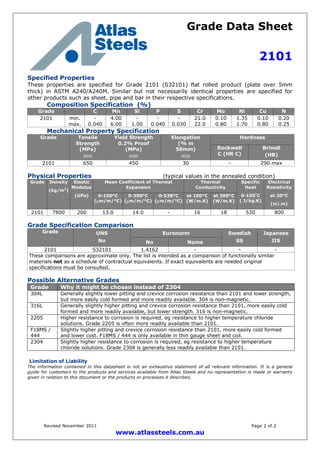
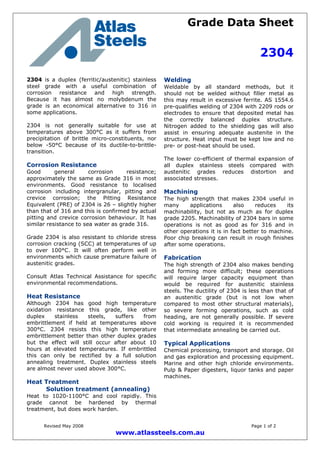
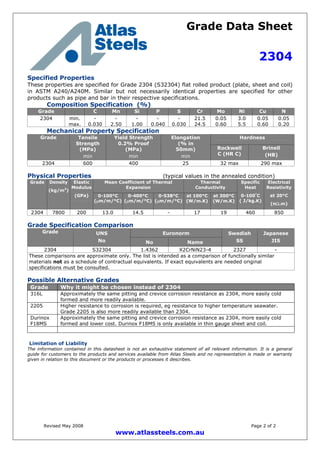
  • 47.
    Grade Data Sheet 410 RevisedMay 2008 Page 2 of 2 www.atlassteels.com.au Specified Properties These properties are specified for bar product in ASTM A276. Similar but not necessarily identical properties are specified for other products such as plate, wire and forgings in their respective specifications. Composition Specification (%) Grade C Mn Si P S Cr Mo Ni N 410 min. max. 0.08 0.15 - 1.00 - 1.00 - 0.040 - 0.030 11.5 13.5 - - - Mechanical Properties - typical and specified values Tempering Temperature (°C) Tensile Strength (MPa) Yield Strength 0.2% Proof (MPa) Elongation (% in 50mm) Hardness Brinell (HB) Impact Charpy V (J) Annealed * 480 min 275 min 16 min - - 204 1310 1000 16 388 30 316 1240 960 14 325 36 427 1405 950 16 401 # 538 985 730 16 321 # 593 870 675 20 255 39 650 755 575 23 225 80 * Annealed properties are specified for Condition A of ASTM A276, for cold finished bar. # Due to associated low impact resistance this steel should not be tempered in the range 425-600°C Physical Properties (typical values in the annealed condition) Mean Coefficient of Thermal Expansion Thermal Conductivity Grade Density (kg/m3 ) Elastic Modulus (GPa) 0-100°C (m/m/°C) 0-315°C (m/m/°C) 0-538°C (m/m/°C) at 100°C (W/m.K) at 500°C (W/m.K) Specific Heat 0-100°C ( J/kg.K) Electrical Resistivity at 20°C (n.m) 410 7700 200 9.9 11.4 11.6 24.9 28.7 460 570 Grade Specification Comparison EuronormGrade UNS No No Name Swedish SS Japanese JIS 410 S41000 1.4006 X12Cr13 2302 SUS410 These comparisons are approximate only. The list is intended as a comparison of functionally similar materials not as a schedule of contractual equivalents. If exact equivalents are needed original specifications must be consulted. Possible Alternative Grades Grade Why it might be chosen instead of 410 416 High machinability is required, and the lower corrosion resistance of 416 is acceptable. AtlasCR12 A non-hardenable alternative with much better availability in flat products. Similar corrosion resistance to 410. 420 A higher hardened strength or hardness than can be obtained from 410 is needed. 440C A higher hardened strength or hardness than can be obtained even from 420 is needed. Limitation of Liability The information contained in this datasheet is not an exhaustive statement of all relevant information. It is a general guide for customers to the products and services available from Atlas Steels and no representation is made or warranty given in relation to this document or the products or processes it describes.
  • 48.
    Grade Data Sheet 416 RevisedMay 2008 Page 1 of 2 www.atlassteels.com.au Grade 416 has the highest machinability of any stainless steel, at about 85% of that of a free-machining carbon steel. As for most other free-machining steels the improvement in machinability is achieved by addition of sulphur which forms manganese sulphide inclusions; this sulphur addition also lowers the corrosion resistance, weldability and formability to below that of its non-free machining equivalent Grade 410. Grade 416 is sometimes used in the unhardened or hardened and highly tempered condition because of its low cost and ready machinability. Martensitic stainless steels are optimised for high hardness, and other properties are to some degree compromised. Fabrication must be by methods that allow for poor weldability and usually also allow for a final harden and temper heat treatment. Corrosion resistance is lower than the common austenitic grades, and their useful operating temperature range is limited by their loss of ductility at sub-zero temperatures and loss of strength by over- tempering at elevated temperatures. Corrosion Resistance Grade 416 has useful resistance to dry atmospheres, fresh water and mild alkalies and acids, but less resistant than the equivalent non-free-machining grades. Less corrosion resistant than the austenitic grades and also less than 17% chromium ferritic alloys such as Grade 430. High sulphur content free machining grades such as 416 are totally unsuitable for marine or other chloride exposure. Maximum corrosion resistance is achieved in the hardened condition, with a smooth surface finish. Consult Atlas Technical Assistance for specific environmental recommendations. Heat Resistance Fair resistance to scaling in intermittent service up to 760°C and up to 675°C in continuous service. Not recommended for use in temperatures above the relevant tempering temperature, if maintenance of mechanical properties is important. Heat Treatment Full Annealing Heat to 815-900°C for ½ hour per 25mm of thickness. Cool at 30°C per hour maximum to 600°C and air cool. Sub-Critical Annealing Heat to 650-760°C and air cool. Hardening Hardened by heating to 925-1010°C, quenching in oil, and tempering to suit the mechanical requirements. See accompanying table. Note: The tempering range 400-580°C should be avoided, due to poor ductility. Welding Grade 416 has poor weldability. If welding is necessary ... use Grade 410 low hydrogen electrodes. Pre-heat to 200-300°C. Follow immediately with annealing or re-hardening, or a stress relief at 650-675°C. A better option if the weld is not required to be hard is to use a Grade 309 austenitic stainless steel filler rod. Machining Grade 416 offers exceptionally good machinability, the highest of any of the commonly available stainless steels. Best machinability is in the sub-critical annealed condition. Typical Applications Valve parts, pump shafts, automatic screw machined parts, motor shafts and washing machine components. Bolts, nuts, studs and gears.
  • 49.
    Grade Data Sheet 416 RevisedMay 2008 Page 2 of 2 www.atlassteels.com.au Specified Properties These properties are specified for bar product in ASTM A582/A582M. Similar but not necessarily identical properties are specified for other products such as wire and forgings in their respective specifications. Composition Specification (%) Grade C Mn Si P S Cr Mo Ni N 416 min. max. - 0.15 - 1.25 - 1.00 - 0.06 0.15 - 12.0 14.0 - - - Mechanical Properties - typical and specified values Tempering Temperature (°C) Tensile Strength (MPa) Yield Strength 0.2% Proof (MPa) Elongation (% in 50mm) Hardness Brinell (HB) Impact Izod (J) Annealed * 517 276 30 262 max * - Condition T ** - - - 248-302 ** - 300 1350 1050 10 410 50 400 1390 1090 12 420 43 500 1400 1100 17 420 15 # 600 870 720 20 280 45 700 710 500 22 210 65 * Annealed Condition A of ASTM A582M - Brinell Hardness is specified maximum, other properties are typical only, and will depend upon exact composition and heat treatment details. ** Hardened and tempered Condition T of ASTM A582M – specified hardness range. # Due to associated low impact resistance this steel should not be tempered in the range 400-580°C Physical Properties (typical values in the annealed condition) Mean Coefficient of Thermal Expansion Thermal Conductivity Grade Density (kg/m3 ) Elastic Modulus (GPa) 0-100°C (m/m/°C) 0-315°C (m/m/°C) 0-538°C (m/m/°C) at 100°C (W/m.K) at 500°C (W/m.K) Specific Heat 0-100°C ( J/kg.K) Electrical Resistivity (n.m) 416 7700 200 9.9 11.0 11.6 24.9 28.7 460 570 Grade Specification Comparison EuronormGrade UNS No No Name Swedish SS Japanese JIS 416 S41600 1.4005 X12CrS13 2380 SUS416 These comparisons are approximate only. The list is intended as a comparison of functionally similar materials not as a schedule of contractual equivalents. If exact equivalents are needed original specifications must be consulted. Possible Alternative Grades Grade Why it might be chosen instead of 416 410 The high machinability of 416 can be sacrificed to gain better corrosion resistance and formability. 303 A slight drop in machinability to gain better availability. Grade 303 is non-hardenable. 182 A free-machining ferritic grade with better "soft magnetic" performance for solenoid shafts. Grade 182 is non-hardenable. Limitation of Liability The information contained in this datasheet is not an exhaustive statement of all relevant information. It is a general guide for customers to the products and services available from Atlas Steels and no representation is made or warranty given in relation to this document or the products or processes it describes.
  • 50.
    Grade Data Sheet 420 RevisedMay 2008 Page 1 of 2 www.atlassteels.com.au Grade 420 stainless steel is a higher carbon version of 410; like most carbon and low alloy steels it can be hardened by heat treatment. It contains a minimum of 12 per cent chromium, just sufficient to give corrosion resistant properties. 420 has good ductility in the annealed condition but is capable of being hardened up to Rockwell Hardness 50HRC, the highest hardness of the 12 per cent chromium grades. Its best corrosion resistance is achieved when hardened and surface ground or polished. Related grades to 420 are high carbon high hardness martensitic stainless steels such as the 440 series (see the Atlas Datasheet on this series of grades) and also variations to 420 containing molybdenum (for increased corrosion resistance and mechanical properties), sulphur (for increased machinability) or vanadium (for higher hardness). A slightly higher carbon version of 420 is the non-standard grade 420C. Martensitic stainless steels are optimised for high hardness, and other properties are to some degree compromised. Fabrication must allow for poor weldability and usually also include a final harden and temper heat treatment. Corrosion resistance is lower than the common austenitic grades, and their useful operating temperature range is limited by their loss of ductility at sub-zero temperatures and loss of strength by over-tempering at elevated temperatures. Corrosion Resistance Grade 420 in the hardened condition has good resistance to the atmosphere, foods, fresh water and mild alkalies or acids. Corrosion resistance is lower in the annealed condition. Less corrosion resistant than the austenitic grades and also less than 17% chromium ferritic alloys such as Grade 430; 420 also has slightly lower resistance than grade 410. Performance is best with a smooth surface finish. This grade is commonly used for cutlery - particularly blades of table knives and for some carving knives and similar. The corrosion resistance is sufficient to resist food and normal washing methods, but prolonged contact with unwashed food residues can result in pitting. Consult Atlas Technical Assistance for specific environmental recommendations. Heat Resistance Not recommended for use in temperatures above the relevant tempering temperature, because of reduction in mechanical properties. The scaling temperature is approximately 650°C. Heat Treatment Annealing Full anneal - 840-900°C, slow furnace cool to 600°C and then air cool. Process Anneal - 735-785°C and air cool. Hardening Heat to 980-1035°C, followed by quenching in oil or air. Oil quenching is necessary for heavy sections. Temper at 150-370°C to obtain a wide variety of hardness values and mechanical properties as indicated in the accompanying table. The tempering range 425-600°C should be avoided. Welding Pre-heat to 150-320°C and post-heat at 610- 760°C. Grade 420 coated welding rods are recommended for high strength joints, where a post-weld hardening and tempering heat treatment is to be carried out. If parts are to be used in the "as welded" condition, a ductile joint can be achieved by using Grade 309 filler rod. AS 1554.6 pre- qualifies welding of 420 with Grade 309 rods or electrodes. Machining In the annealed condition this grade is relatively easily machined, but if hardened to above 30HRC machining becomes more difficult. Free machining grade 416 (refer Atlas Datasheet) is a very readily machined alternative. Typical Applications Cutlery, knife blades, surgical instruments. Needle valves. Shear blades.
  • 51.
    Grade Data Sheet 420 RevisedMay 2008 Page 2 of 2 www.atlassteels.com.au Specified Properties These properties are specified for bar product in ASTM A276. Bar is the most commonly available form of grade 420. Similar but not necessarily identical properties are specified for other products such as plate and forgings in their respective specifications. Composition Specification (%) Grade C Mn Si P S Cr Mo Ni N 420 min. max. 0.15 - - 1.00 - 1.00 - 0.040 - 0.030 12.00 14.00 - - - Mechanical Properties - typical values Tempering Temperature (°C) Tensile Strength (MPa) Yield Strength 0.2% Proof (MPa) Elongation (% in 50mm) Hardness Brinell (HB) Impact Charpy V (J) Annealed * 655 345 25 255 max * - 204 1600 1360 12 444 20 316 1580 1365 14 444 19 427 1620 1420 10 461 # 538 1305 1095 15 375 # 593 1035 810 18 302 22 650 895 680 20 262 42 * Annealed tensile properties are typical for Condition A; annealed hardness is the specified maximum for cold finished Condition A bar, given in ASTM A276-06. # Due to associated low impact resistance this steel should not be tempered in the range 425-600°C Physical Properties (typical values in the annealed condition) Mean Coefficient of Thermal Expansion Thermal Conductivity Grade Density (kg/m3 ) Elastic Modulus (GPa) 0-100°C (m/m/°C) 0-315°C (m/m/°C) at 100°C (W/m.K) at 500°C (W/m.K) Specific Heat 0-100° C ( J/kg.K) Electrical Resistivity (n.m) 420 7700 200 10.3 10.8 24.9 - 460 550 Grade Specification Comparison EuronormGrade UNS No No Name Swedish SS Japanese JIS 420 S42000 1.4021 X20Cr13 2303 SUS 420J1 These comparisons are approximate only. The list is intended as a comparison of functionally similar materials not as a schedule of contractual equivalents. If exact equivalents are needed original specifications must be consulted. Possible Alternative Grades Grade Why it might be chosen instead of 420 410 Only a lower hardened strength is needed. 416 High machinability is required, and the lower hardened strength and lower corrosion resistance of 416 is acceptable. 440C A higher hardened strength or hardness than can be obtained from 420 is needed. "specials" Variations of 420 are available to special order. These offer higher hardness, corrosion resistance and machinability for particular applications. Limitation of Liability The information contained in this datasheet is not an exhaustive statement of all relevant information. It is a general guide for customers to the products and services available from Atlas Steels and no representation is made or warranty given in relation to this document or the products or processes it describes.
  • 52.
    Grade Data Sheet 431 RevisedMay 2008 Page 1 of 2 www.atlassteels.com.au This heat treatable martensitic, nickel-bearing grade has the best corrosion resistance properties of all the martensitic grades. It has excellent tensile and torque strength, and good toughness, making it ideally suited to shafting and bolt applications. It can be hardened to approximately 40HRC. Because of its high yield strength, this grade is not readily cold worked and is therefore not recommended for use in operations such as cold heading, bending, deep drawing or spinning. Martensitic stainless steels are optimised for high hardness, and other properties are to some degree compromised. Fabrication must be by methods that allow for poor weldability and usually also allow for a final harden and temper heat treatment. Corrosion resistance is generally lower than the common austenitic grades, and their useful operating temperature range is limited by their loss of ductility at sub- zero temperatures and loss of strength by over-tempering at elevated temperatures. Corrosion Resistance Grade 431 has excellent resistance to a wide variety of corrosive media. Reasonable resistance to salt water in cold southern waters but is unlikely to be successful in warmer tropical waters. Overall the corrosion resistance of 431 is approximately the same as or slightly below that of Grade 304. Performance is best with a smooth surface finish, in the hardened and tempered condition. Consult Atlas Technical Services for specific environmental recommendations. Heat Resistance Resists scaling in intermittent service to 925°C and in continuous service to 870°C, but is generally not recommended for use in temperatures above the relevant tempering temperature, because of reduction in mechanical properties. Heat Treatment Annealing Full anneal - not practical for this grade - it hardens even when cooled slowly. Process Anneal - heat to 620-660°C and air cool. Hardening Hardened by heating to 980-1065°C, holding for about 1/2 hour then quenching in air or oil. Pre-heating at 760-790°C may be useful for complex parts or those already hardened. Temper to suit mechanical requirements, at temperatures as indicated in the accompanying table. The tempering range 425-600°C should be avoided due to reduced impact toughness, although the effect is less marked than in most other martensitic grades. Welding Welding is difficult due to the risk of cracking. A pre-heat of 200-300°C is recommended prior to welding. Grade 410 filler rod can be used, but Grades 308L, 309 or 310 will provide more ductile welds, so long as matching properties are not required. Post-weld heat treat at 650°C. Machining In the annealed condition this grade is relatively easily machined, but if hardened to above 30HRC machining becomes more difficult. A Ugima Improved Machinability version of Grade 431 offers a significant improvement in achievable machining speeds and tool life. Typical Applications Nuts and bolts. Propeller shafting. Pump shafts. Beater bars. Marine hardware.
  • 53.
    Grade Data Sheet 431 RevisedMay 2008 Page 2 of 2 www.atlassteels.com.au Specified Properties These properties are specified for bar product in ASTM A276. Similar but not necessarily identical properties are specified for other products such as plate and forgings in their respective specifications. Composition Specification (%) Grade C Mn Si P S Cr Mo Ni N 431 min. max. - 0.20 - 1.00 - 1.00 - 0.040 - 0.030 15.00 17.00 - 1.25 2.50 - Mechanical Properties (All values are typical except as noted) Tempering Temperature (°C) Tensile Strength (MPa) Yield Strength 0.2% Proof (MPa) Elongation (% in 50mm) Hardness Brinell (HB) Impact Izod (J) Annealed * 862 655 20 285 max * - Condition T ** 850 - 1000 635 min. 11 min. 248 - 302 300 1320 1020 20 380 75 400 1310 1010 22 395 80 500 1350 1030 20 395 55 # 600 1030 800 20 310 45 # 700 920 700 20 290 70 * Annealed tensile properties are typical for Condition A of ASTM A276; annealed hardness listed is the specified maximum. Grade 431 is only rarely stocked in annealed Condition A. ** Grade 431 is frequently stocked and supplied in "Condition T" to AS 1444 or BS 970, with specified tensile strength of 850 - 1000MPa. Yield and elongation are typically in conformance with the limits listed above. ASTM A276 only lists a Condition A version of Grade 431. # Due to associated low impact resistance this steel should not be tempered in the range 425-600°C Physical Properties (typical values in the annealed condition) Mean Coefficient of Thermal Expansion Thermal Conductivity Grade Density (kg/m3 ) Elastic Modulus (GPa) 0-100°C (m/m/°C) 0-315°C (m/m/°C) 0-538°C (m/m/°C) at 100°C (W/m.K) at 500°C (W/m.K) Specific Heat 0-100° C ( J/kg.K) Electrical Resistivity (n.m) 431 7700 200 10.2 12.1 - 20.2 - 460 720 Grade Specification Comparison EuronormGrade UNS No No Name Swedish SS Japanese JIS 431 S43100 1.4057 X17CrNi16-2 2321 SUS 431 These comparisons are approximate only. The list is intended as a comparison of functionally similar materials not as a schedule of contractual equivalents. If exact equivalents are needed original specifications must be consulted. Possible Alternative Grades Grade Why it might be chosen instead of 431 410 Only a lower hardened strength is needed. 416 High machinability is required, and the lower hardened strength and lower corrosion resistance of 416 is acceptable. 440C A higher hardened strength or hardness than can be obtained from 431 is needed. Limitation of Liability The information contained in this datasheet is not an exhaustive statement of all relevant information. It is a general guide for customers to the products and services available from Atlas Specialty Metals and no representation is made or warranty given in relation to this document or the products or processes it describes.
  • 54.
    Grade Data Sheet 440C RevisedMay 2008 Page 1 of 2 www.atlassteels.com.au Grade 440C is capable of attaining, after heat treatment, the highest strength, hardness (Rockwell C 60) and wear resistance of all the stainless alloys. Its very high carbon content of 1.0% is responsible for these characteristics, which make 440C particularly suited to such applications as ball bearings and valve parts. Grades 440A and 440B are identical except for slightly lower carbon contents (0.60 - 0.75% and 0.75 - 0.95% respectively); these have lower attainable hardnesses but slightly higher corrosion resistances. Although all three versions of this grade are standard, in practice 440C is more available than the A or B variants; none of these are regularly stocked in Australia however. A free-machining variant 440F (UNS S44020) also exists, with the same high carbon content as 440C. Again this grade is not readily available in Australia. Martensitic stainless steels are optimised for high hardness, and other properties are to some degree compromised. Fabrication must be by methods that allow for poor weldability and also allow for a final harden and temper heat treatment. Corrosion resistance is generally lower than the common austenitic grades, and their useful operating temperature range is limited by their loss of ductility at sub- zero temperatures and loss of strength by over-tempering at elevated temperatures. Corrosion Resistance Good resistance to the atmosphere, fresh water, foods, alkalies and mild acids. Best resistance in the hardened and tempered and passivated condition. A smooth polished surface also assists. The corrosion resistance of Grade 440C is close to that of grade 304 in many environments. Consult Atlas Technical Assistance for specific environmental recommendations. Heat Resistance Not recommended for use in temperatures above the relevant tempering temperature, because of reduction in mechanical properties by over-tempering. Heat Treatment Annealing Full anneal - 840-870°C, slow furnace cool to about 600°C and then air cool. Sub-critical Annealing - 735-760°C and slow furnace cool. Hardening Heat to 1010-1065°C, followed by quenching in warm oil or air. Oil quenching is necessary for heavy sections. Immediately temper at 150- 370°C to obtain the hardness values and mechanical properties as indicated in the accompanying table. Best corrosion resistance is when tempered below 425°C. Tempering in the range 425- 565°C is to be avoided because of reduced impact resistance and corrosion resistance. Tempering in the range 600-675°C results in lower hardness – the product becomes machinable. Maximum achievable hardnesses are approximately HRC56 for Grade 440A, HRC58 for 440B and HRC60 for 440C. Welding Welding is seldom carried out because of the grades’ high hardenability. If welding is necessary pre-heat at 250°C and follow welding with a full anneal. Grade 420 filler will give a high hardness weld (although not as high as the 440C), but 309 or 310 will produce soft welds with higher ductility. Machining In the annealed condition this grade is relatively easily machined; approximately the same as for high speed steel. Chips are tough and stringy so chip breakers are important. If these grades are hardened machining becomes more difficult and probably impossible. Typical Applications Rolling element bearings, valve seats, high quality knife blades, surgical instruments and chisels.
  • 55.
    Grade Data Sheet 440C RevisedMay 2008 Page 2 of 2 www.atlassteels.com.au Specified Properties These properties are specified for bar product in ASTM A276. Similar but not necessarily identical properties are specified for other products such as wire and forgings in their respective specifications. These grades are not normally available in flat rolled or fluids products. Composition Specification (%) Grade C Mn Si P S Cr Mo Ni N 440A min. max. 0.65 0.75 - 1.00 - 1.00 - 0.040 - 0.030 16.00 18.00 - 0.75 - - 440B min. max. 0.75 0.95 - 1.00 - 1.00 - 0.040 - 0.030 16.00 18.00 - 0.75 - - 440C min. max. 0.95 1.20 - 1.00 - 1.00 - 0.040 - 0.030 16.00 18.00 - 0.75 - - Mechanical Properties - 440C - typical and specified values Tempering Temperature (°C) Tensile Strength (MPa) Yield Strength 0.2% Proof (MPa) Elongation (% in 50mm) Hardness Rockwell (HR C) Impact Charpy V (J) Annealed * 758 448 14 269HB max # - 204 2030 1900 4 59 9 260 1960 1830 4 57 9 316 1860 1740 4 56 9 371 1790 1660 4 56 9 * Annealed properties are typical for Grade 440C ASTM A276 annealed condition. # Brinell Hardness is ASTM A276 specified maximum for annealed 440A, B and C, hot finished. Physical Properties (typical values in the annealed condition) Mean Coefficient of Thermal Expansion Thermal Conductivity Grade Density (kg/m3 ) Elastic Modulus (GPa) 0-100°C (m/m/°C) 0-200°C (m/m/°C) at 100°C (W/m.K) at 500°C (W/m.K) Specific Heat 0-100°C ( J/kg.K) Electrical Resistivity (n.m) 440A/B/C 7650 200 10.1 10.3 24.2 - 460 600 Grade Specification Comparison EuronormGrade UNS No No Name Swedish SS Japanese JIS 440A S44002 - - SUS 440A 440B S44003 1.4112 X90CrMoV18 SUS 440B 440C S44004 1.4125 X10⁵CrMo17 - SUS 440C These comparisons are approximate only. The list is intended as a comparison of functionally similar materials not as a schedule of contractual equivalents. If exact equivalents are needed original specifications must be consulted. Possible Alternative Grades Grade Why it might be chosen instead of 440C 440A/B Slightly softer and more corrosion resistant grade needed 440F High machinability required, with same hardness and hardenability as 440C 420 Lower strength and hardness needed than any of the 440 grades 416 Higher machinability required, and the much lower hardness and strength is still adequate Limitation of Liability The information contained in this datasheet is not an exhaustive statement of all relevant information. It is a general guide for customers to the products and services available from Atlas Steels and no representation is made or warranty given in relation to this document or the products or processes it describes.
  • 56.
    Grade Data Sheet 630(17-4PH) Revised January 2008 Page 1 of 2 www.atlassteels.com.au Grade 630 martensitic precipitation hardening stainless steel has a combination of high hardness and strength after suitable heat treatment. It also has similar corrosion and heat resistance to Grade 304. The terms "Type 630" and "17-4PH" refer to the same grade. The great benefit of this grade (and of other precipitation hardening grades of stainless steel) is that they are generally supplied in the solution treated condition, in which they are just machinable, and then can be age hardened to achieve quite high strengths. This aging treatment is so low in temperature that there is no significant distortion. These grades are therefore well suited to production of long shafts, which require no re-straightening after heat treatment. Corrosion Resistance Good resistance to a wide range of corrosive environments; approaching that of Grade 304 stainless steel. Like 304, this grade is subject to pitting and crevice corrosion in warm chloride environments. Grade 630 has been used for boat shafting for fresh water, and in sea water with the addition of cathodic protection. Highly resistant to stress corrosion cracking if aged at 550°C or higher. Higher aging temperatures give better SCC resistance. Grade 630 is resistant to sulphide stress cracking (SSC) if highly aged; NACE MR0175 permits the use of 630 but only in a double age hardened condition (refer to MR0175 and ASTM A564M). In solution treated Condition A the grade has lower resistance to stress corrosion cracking, and lower ductility compared to aged conditions. It should not generally be used in the solution treated condition, even if the hardness is considered satisfactory. Consult Atlas Technical Assistance for specific environmental recommendations. Heat Resistance This grade has good oxidation resistance, but to avoid reduction of its mechanical properties and hardness it should not be used above its age hardening temperature. Prolonger exposure in the range 370-480°C should be avoided if ambient temperature toughness is critical. Heat Treatment Solution treatment (Condition A) Heat at 1040°C for ½ hour and cool to 30°C maximum in air. Oil quenching may be used for small non-intricate sections. Hardening (Aging) After solution treatment a single low temperature "age hardening" treatment is employed to achieve required properties, as below. This treatment results in no distortion and only superficial discolouration. A slight decrease in size (shrinkage) takes place during the hardening; this is approximately 0.05% for Condition H900 and 0.10% for H1150. Typical mechanical properties achieved after solution treating and then age hardening at the indicated temperatures are as in the table in the following page. The Condition is designated by the age hardening temperature in °F (Condition A is solution treated, ie not aged). Welding Grade 630 can be successfully welded by all standard methods. Preheating is not necessary. Properties comparable to those of the parent metal may be achieved in the weld metal by post-weld heat treatment. As for other high strength steels precaution should be taken in design and welding procedures to avoid concentration of weldment stresses. Machining This steel is usually supplied in the solution treated condition, in which it can be machined. Machinability is similar to Grade 304. Typical Applications Gears, bolts and valve components. Plastic moulding dies. High strength pump shafts and boat propeller shafts. Engine components. In general applications where some level of corrosion resistance is needed in conjunction with high strength or hardness.
  • 57.
    Grade Data Sheet 630(17-4PH) Revised January 2008 Page 2 of 2 www.atlassteels.com.au Specified Properties These properties are specified for bar products in ASTM A564/A564M; round bar is the most commonly available product form for this grade. Similar but not necessarily identical properties are specified for other products such as plate and forgings in their respective specifications. Composition Specification (%) Grade C Mn Si P S Cr Ni Cu Nb+Ta 630 min. max - 0.07 - 1.00 - 1.00 - 0.040 - 0.030 15.0 17.5 3.0 5.0 3.0 5.0 0.15 0.45 Mechanical Property Specification Hardening HardnessCondition Temp (°C) Time (h) Tensile Strength (MPa) Yield Strength 0.2% Proof (MPa) Elongation (% in 50mm) Rockwell C (HR C) Brinell (HB) A - - 1105 typ. 1000 typ. 15 typ. 38 max 363 max H900 480 1 1310 1170 10 40 388 H925 495 4 1170 1070 10 38 375 H1025 550 4 1070 1000 12 35 331 H1075 580 4 1000 860 13 32 311 H1100 595 4 965 795 14 31 302 H1150 620 4 930 725 16 28 277 Single property values are minima except as noted as typical or maximum. Values from ASTM A564M; these values apply only to certain size ranges. The specification should be consulted for the complete details of these properties and of heat treatment procedures. Solution treatment is at 1040°C followed by cooling as required. Specialist double-aging treatments H1150M and H1150D are also possible – refer to ASTM A564M. Physical Properties (typical values in the annealed condition) Mean Coefficient of Thermal Expansion Thermal Conductivity Grade Density (kg/m3 ) Elastic Modulus (GPa) 0-100°C (m/m/°C) 0-315°C (m/m/°C) 0-538°C (m/m/°C) at 100°C (W/m.K) at 500°C (W/m.K) Specific Heat 0-100° C ( J/kg.K) Electrical Resistivity (n.m) 630 7750 196 10.8 11.6 - 18.4 22.7 460 800 Grade Specification Comparison EuronormGrade UNS No No Name Swedish SS Japanese JIS 630 S17400 1.4542 X5CrNiCuNb16-4 - SUS 630 These comparisons are approximate only. The list is intended as a comparison of functionally similar materials not as a schedule of contractual equivalents. If exact equivalents are needed original specifications must be consulted. Possible Alternative Grades Grade Why it might be chosen instead of 630 (17-4PH) 431 431 has higher toughness than 630. Better availability in some sizes. 416 Free machining martensitic stainless steel - better machinability. Lower cost but lower corrosion resistance. 316 Higher corrosion resistance of 316 is needed, but with much lower strength than 630. 2205 Much better corrosion resistance than 630, with a lower strength (but not as low as 316). Limitation of Liability The information contained in this datasheet is not an exhaustive statement of all relevant information. It is a general guide for customers to the products and services available from Atlas Steels and no representation is made or warranty given in relation to this document or the products or processes it describes.