
American Turkish Association of
Southern California
Rosetta Eun Ryong Lee
Seattle Girls’ School
Parents Against Hate
Rosetta Eun Ryong Lee (http://tiny.cc/rosettalee)
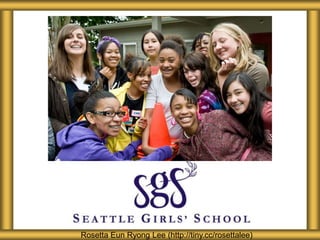
About Seattle Girls’ School
Rosetta Eun Ryong Lee (http://tiny.cc/rosettalee)
Agenda
• Building Context
• Part I: Is it conflict, or is it bullying?
• Part II: Talking to your kids
• Getting Connected and Active
Rosetta Eun Ryong Lee (http://tiny.cc/rosettalee)
A Little Perspective
Rosetta Eun Ryong Lee (http://tiny.cc/rosettalee)
Part I: Conflict and Bullying
Rosetta Eun Ryong Lee (http://tiny.cc/rosettalee)
Definition of Conflict
• A clash between two
individuals or groups
• A disagreement or
argument about
something important
• Etc.
Rosetta Eun Ryong Lee (http://tiny.cc/rosettalee)
When It’s Bullying
• Power is uneven
• Intent to harm
• Repeated and
sustained
• Efforts to hide from
adults
• Advocacy not
changing behaviors
Rosetta Eun Ryong Lee (http://tiny.cc/rosettalee)
Types of Bullying Behavior:
and common characteristics of their perpetrators
• Traditional Bullying
• Clueless Bullying
• Bully-Victim Alternation
• Popular Bullying
• Being a “Facebook Thug”
The agent generally has less empathy,
patience, caring, and forgiveness for others.
Rosetta Eun Ryong Lee (http://tiny.cc/rosettalee)
Common Characteristics or Behaviors of
Youth Who Are Bullied
• They are more sensitive, unhappy, cautious,
anxious, quiet and withdrawn than other youth.
• They are generally insecure and non-assertive, and
react by withdrawing when targeted by other students
(rather than retaliating or asserting).
• They exhibit sudden change in behaviors: showing
signs of depression, not eating, cutting, letting
themselves go, losing interest in favorite things,
quitting teams, etc.
• They may be embarrassed to admit being bullied.
They may blame themselves or feel guilty.
Rosetta Eun Ryong Lee (http://tiny.cc/rosettalee)
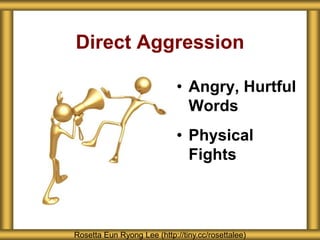
Direct Aggression
• Angry, Hurtful
Words
• Physical
Fights
Rosetta Eun Ryong Lee (http://tiny.cc/rosettalee)
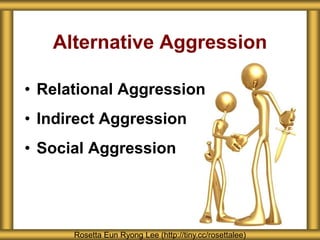
Alternative Aggression
• Relational Aggression
• Indirect Aggression
• Social Aggression
Rosetta Eun Ryong Lee (http://tiny.cc/rosettalee)
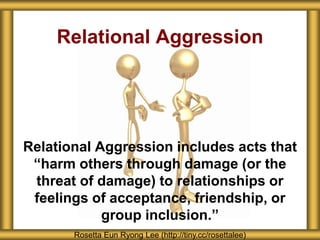
Relational Aggression includes acts that
“harm others through damage (or the
threat of damage) to relationships or
feelings of acceptance, friendship, or
group inclusion.”
Relational Aggression
Rosetta Eun Ryong Lee (http://tiny.cc/rosettalee)
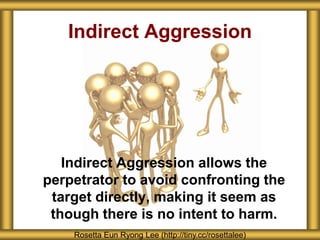
Indirect Aggression allows the
perpetrator to avoid confronting the
target directly, making it seem as
though there is no intent to harm.
Indirect Aggression
Rosetta Eun Ryong Lee (http://tiny.cc/rosettalee)
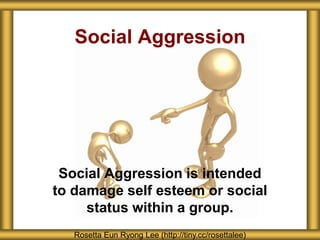
Social Aggression
Social Aggression is intended
to damage self esteem or social
status within a group.
Rosetta Eun Ryong Lee (http://tiny.cc/rosettalee)
Distinguish Conflict and Bullying
Rosetta Eun Ryong Lee (http://tiny.cc/rosettalee)
When It’s Conflict…
Rosetta Eun Ryong Lee (http://tiny.cc/rosettalee)
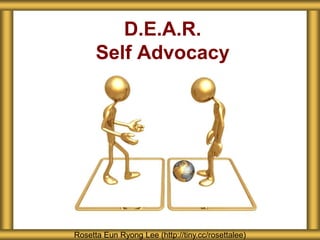
D.E.A.R.
Self Advocacy
Rosetta Eun Ryong Lee (http://tiny.cc/rosettalee)
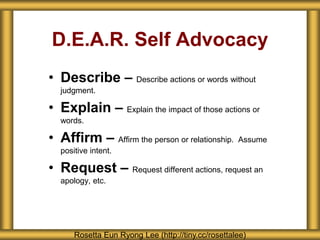
D.E.A.R. Self Advocacy
• Describe – Describe actions or words without
judgment.
• Explain – Explain the impact of those actions or
words.
• Affirm – Affirm the person or relationship. Assume
positive intent.
• Request – Request different actions, request an
apology, etc.
Rosetta Eun Ryong Lee (http://tiny.cc/rosettalee)
V.O.M.P. Conflict Tool
Rosetta Eun Ryong Lee (http://tiny.cc/rosettalee)
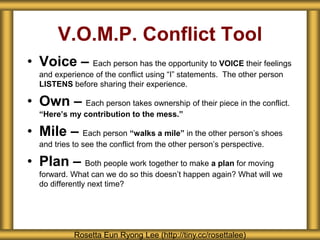
V.O.M.P. Conflict Tool
• Voice – Each person has the opportunity to VOICE their feelings
and experience of the conflict using “I” statements. The other person
LISTENS before sharing their experience.
• Own – Each person takes ownership of their piece in the conflict.
“Here’s my contribution to the mess.”
• Mile – Each person “walks a mile” in the other person’s shoes
and tries to see the conflict from the other person’s perspective.
• Plan – Both people work together to make a plan for moving
forward. What can we do so this doesn’t happen again? What will we
do differently next time?
Rosetta Eun Ryong Lee (http://tiny.cc/rosettalee)
When It’s Bullying…
Rosetta Eun Ryong Lee (http://tiny.cc/rosettalee)
Bullying Intervention
• Know when it is
bullying
• Stand up for
yourself
• Ask them to stop
the behavior
• Seek healthy
support
• Tell an adult
Rosetta Eun Ryong Lee (http://tiny.cc/rosettalee)
Process Break
How are your young people
experiencing conflict and
bullying?
What have you taught (or
would like to) your kids about
conflict and bullying?
Rosetta Eun Ryong Lee (http://tiny.cc/rosettalee)
Part II: Talking To Your Kids
About Complicated and Heated Topics
Current Realities
• Political Polarization
• COVID-19
• Black Lives Matter
• Immigration, Detention Centers, Etc.
• Gun Violence
• Climate Change and Denial
• Rise in Homelessness
• And More…
Rosetta Eun Ryong Lee (http://tiny.cc/rosettalee)
How to Talk to Young People
About Current Events
• What have you heard?
• How do you feel?
• What questions do you have?
• How can I support you?
• Here are our family’s values.
• What positive action can you take?
Rosetta Eun Ryong Lee (http://tiny.cc/rosettalee)
How to Talk to Young People
About Hate and Extremism
• Prepare Yourself
• Be Alert
• Listen
• Reassure
• Be Honest
• Share Values
• Take Action
Rosetta Eun Ryong Lee (http://tiny.cc/rosettalee)
How to Talk to Young People After
Personal Incidents
• “I want to help you feel strong.”
• Affection, correction, protection
• Emotions are always right; not all
action is always right
• Avoid either/or thinking
Rosetta Eun Ryong Lee (http://tiny.cc/rosettalee)
Helping Young People Talk to
One Another
• Create Safety and Courage
• Express Feelings
• Generate Questions
• Share Facts
• Learn More
• Complicate Thinking
• Take Action
Rosetta Eun Ryong Lee (http://tiny.cc/rosettalee)
Talking With Your Kids
Rosetta Eun Ryong Lee (http://tiny.cc/rosettalee)
• Be explicit about values
• Be open about your own
struggles
• Don’t stay silent
• 100 1-Minute
Conversations
• Relationship Based
Interruption
Process Break
What are the conversations
you are having (or would like
to have) with your kids about
what is happening at school
and beyond?
Rosetta Eun Ryong Lee (http://tiny.cc/rosettalee)
Getting Connected
Rosetta Eun Ryong Lee (http://tiny.cc/rosettalee)
Questions and Comments
Rosetta Eun Ryong Lee (http://tiny.cc/rosettalee)
Presenter Information
Rosetta Eun Ryong Lee
6th Faculty and
Professional Outreach
Seattle Girls’ School
2706 S Jackson Street
Seattle WA 98144
(206) 805-6562
rlee@seattlegirlsschool.org
http://tiny.cc/rosettalee
Rosetta Eun Ryong Lee (http://tiny.cc/rosettalee)

ATASC Parents Against Hate

  • 1.
    American Turkish Associationof Southern California Rosetta Eun Ryong Lee Seattle Girls’ School Parents Against Hate Rosetta Eun Ryong Lee (http://tiny.cc/rosettalee)
  • 2.
    About Seattle Girls’School Rosetta Eun Ryong Lee (http://tiny.cc/rosettalee)
  • 3.
    Agenda • Building Context •Part I: Is it conflict, or is it bullying? • Part II: Talking to your kids • Getting Connected and Active Rosetta Eun Ryong Lee (http://tiny.cc/rosettalee)
  • 4.
    A Little Perspective RosettaEun Ryong Lee (http://tiny.cc/rosettalee)
  • 5.
    Part I: Conflictand Bullying Rosetta Eun Ryong Lee (http://tiny.cc/rosettalee)
  • 6.
    Definition of Conflict •A clash between two individuals or groups • A disagreement or argument about something important • Etc. Rosetta Eun Ryong Lee (http://tiny.cc/rosettalee)
  • 7.
    When It’s Bullying •Power is uneven • Intent to harm • Repeated and sustained • Efforts to hide from adults • Advocacy not changing behaviors Rosetta Eun Ryong Lee (http://tiny.cc/rosettalee)
  • 8.
    Types of BullyingBehavior: and common characteristics of their perpetrators • Traditional Bullying • Clueless Bullying • Bully-Victim Alternation • Popular Bullying • Being a “Facebook Thug” The agent generally has less empathy, patience, caring, and forgiveness for others. Rosetta Eun Ryong Lee (http://tiny.cc/rosettalee)
  • 9.
    Common Characteristics orBehaviors of Youth Who Are Bullied • They are more sensitive, unhappy, cautious, anxious, quiet and withdrawn than other youth. • They are generally insecure and non-assertive, and react by withdrawing when targeted by other students (rather than retaliating or asserting). • They exhibit sudden change in behaviors: showing signs of depression, not eating, cutting, letting themselves go, losing interest in favorite things, quitting teams, etc. • They may be embarrassed to admit being bullied. They may blame themselves or feel guilty. Rosetta Eun Ryong Lee (http://tiny.cc/rosettalee)
  • 10.
    Direct Aggression • Angry,Hurtful Words • Physical Fights Rosetta Eun Ryong Lee (http://tiny.cc/rosettalee)
  • 11.
    Alternative Aggression • RelationalAggression • Indirect Aggression • Social Aggression Rosetta Eun Ryong Lee (http://tiny.cc/rosettalee)
  • 12.
    Relational Aggression includesacts that “harm others through damage (or the threat of damage) to relationships or feelings of acceptance, friendship, or group inclusion.” Relational Aggression Rosetta Eun Ryong Lee (http://tiny.cc/rosettalee)
  • 13.
    Indirect Aggression allowsthe perpetrator to avoid confronting the target directly, making it seem as though there is no intent to harm. Indirect Aggression Rosetta Eun Ryong Lee (http://tiny.cc/rosettalee)
  • 14.
    Social Aggression Social Aggressionis intended to damage self esteem or social status within a group. Rosetta Eun Ryong Lee (http://tiny.cc/rosettalee)
  • 15.
    Distinguish Conflict andBullying Rosetta Eun Ryong Lee (http://tiny.cc/rosettalee)
  • 16.
    When It’s Conflict… RosettaEun Ryong Lee (http://tiny.cc/rosettalee)
  • 17.
    D.E.A.R. Self Advocacy Rosetta EunRyong Lee (http://tiny.cc/rosettalee)
  • 18.
    D.E.A.R. Self Advocacy •Describe – Describe actions or words without judgment. • Explain – Explain the impact of those actions or words. • Affirm – Affirm the person or relationship. Assume positive intent. • Request – Request different actions, request an apology, etc. Rosetta Eun Ryong Lee (http://tiny.cc/rosettalee)
  • 19.
    V.O.M.P. Conflict Tool RosettaEun Ryong Lee (http://tiny.cc/rosettalee)
  • 20.
    V.O.M.P. Conflict Tool •Voice – Each person has the opportunity to VOICE their feelings and experience of the conflict using “I” statements. The other person LISTENS before sharing their experience. • Own – Each person takes ownership of their piece in the conflict. “Here’s my contribution to the mess.” • Mile – Each person “walks a mile” in the other person’s shoes and tries to see the conflict from the other person’s perspective. • Plan – Both people work together to make a plan for moving forward. What can we do so this doesn’t happen again? What will we do differently next time? Rosetta Eun Ryong Lee (http://tiny.cc/rosettalee)
  • 21.
    When It’s Bullying… RosettaEun Ryong Lee (http://tiny.cc/rosettalee)
  • 22.
    Bullying Intervention • Knowwhen it is bullying • Stand up for yourself • Ask them to stop the behavior • Seek healthy support • Tell an adult Rosetta Eun Ryong Lee (http://tiny.cc/rosettalee)
  • 23.
    Process Break How areyour young people experiencing conflict and bullying? What have you taught (or would like to) your kids about conflict and bullying? Rosetta Eun Ryong Lee (http://tiny.cc/rosettalee)
  • 24.
    Rosetta Eun RyongLee (http://tiny.cc/rosettalee) Part II: Talking To Your Kids About Complicated and Heated Topics
  • 25.
    Current Realities • PoliticalPolarization • COVID-19 • Black Lives Matter • Immigration, Detention Centers, Etc. • Gun Violence • Climate Change and Denial • Rise in Homelessness • And More… Rosetta Eun Ryong Lee (http://tiny.cc/rosettalee)
  • 26.
    How to Talkto Young People About Current Events • What have you heard? • How do you feel? • What questions do you have? • How can I support you? • Here are our family’s values. • What positive action can you take? Rosetta Eun Ryong Lee (http://tiny.cc/rosettalee)
  • 27.
    How to Talkto Young People About Hate and Extremism • Prepare Yourself • Be Alert • Listen • Reassure • Be Honest • Share Values • Take Action Rosetta Eun Ryong Lee (http://tiny.cc/rosettalee)
  • 28.
    How to Talkto Young People After Personal Incidents • “I want to help you feel strong.” • Affection, correction, protection • Emotions are always right; not all action is always right • Avoid either/or thinking Rosetta Eun Ryong Lee (http://tiny.cc/rosettalee)
  • 29.
    Helping Young PeopleTalk to One Another • Create Safety and Courage • Express Feelings • Generate Questions • Share Facts • Learn More • Complicate Thinking • Take Action Rosetta Eun Ryong Lee (http://tiny.cc/rosettalee)
  • 30.
    Talking With YourKids Rosetta Eun Ryong Lee (http://tiny.cc/rosettalee) • Be explicit about values • Be open about your own struggles • Don’t stay silent • 100 1-Minute Conversations • Relationship Based Interruption
  • 31.
    Process Break What arethe conversations you are having (or would like to have) with your kids about what is happening at school and beyond? Rosetta Eun Ryong Lee (http://tiny.cc/rosettalee)
  • 32.
    Getting Connected Rosetta EunRyong Lee (http://tiny.cc/rosettalee)
  • 33.
    Questions and Comments RosettaEun Ryong Lee (http://tiny.cc/rosettalee)
  • 34.
    Presenter Information Rosetta EunRyong Lee 6th Faculty and Professional Outreach Seattle Girls’ School 2706 S Jackson Street Seattle WA 98144 (206) 805-6562 rlee@seattlegirlsschool.org http://tiny.cc/rosettalee Rosetta Eun Ryong Lee (http://tiny.cc/rosettalee)