Digital Transformation: Breaking Down
Boundaries for Greater Connectivity
Technical Session
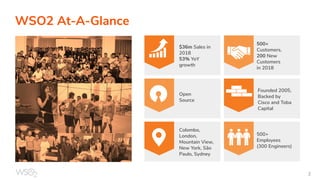
WSO2 At-A-Glance
2
$36m Sales in
2018
53% YoY
growth
500+
Customers,
200 New
Customers
in 2018
Open
Source
Founded 2005,
Backed by
Cisco and Toba
Capital
Colombo,
London,
Mountain View,
New York, São
Paulo, Sydney
500+
Employees
(300 Engineers)
3
#1
6th
Open Source Integration Vendor
Largest Apache Committer
Largest Open Source Vendor
7th
WSO2: Helping Digitally Driven Organizations
Become Integration Agile
“Strong Performer for Hybrid
Integration”
- The Forrester Wave™: Hybrid Integration for
Enterprises, Q4 2016 report, published Nov. 18, 2016
“Strong Performer for API
Management Solutions”
- The Forrester Wave™: API Management Solutions, Q4
2016 report, published November 14, 2016.
“Strong Performer for Big Data
Streaming Analytics”
- The Forrester Wave™: Big Data Streaming Analytics,
Q1 2016 report1, published March 30, 2016.
“Visionary”
- Gartner Cool Vendors in Internet of Things Analytics,
2016 report, published May 11, 2016.
- Gartner Magic Quadrant for Full Life Cycle API
Management, published 2018
“Cool Vendor”
4
Flagship Customer Examples
Applied uses across every industry and geography
Financial Healthcare Governments Education Telecom Retail TechnologyTransport
5
● Problems with running systems in isolation.
● How you can move away from isolated systems.
● Introduction to the concept of services oriented
architecture and integration hub.
● Benefits of sharing information and services.
● Introduction on the concept of API Management.
● Demo.
Agenda
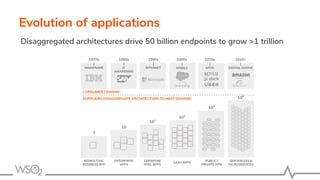
Evolution of applications
Disaggregated architectures drive 50 billion endpoints to grow >1 trillion
CONSUMER DEMAND
SUPPLIERS DISAGGREGATE ARCHITECTURE TO MEET DEMAND
1
10
102
103
105
109
MONOLITHIC
BUSINESS APP
ENTERPRISE
APPS
DEPARTME
NTAL APPS
SAAS APPS
PUBLIC /
PRIVATE APIS
1970s
|
MAINFRAME
1980s
|
IT
AWAKENING
1990s
|
INTERNET
2000s
|
MOBILE
2010s
|
IoT/AI
2020+
|
DIGITAL NATIVE
SERVERLESS &
MICROSERVICES
8
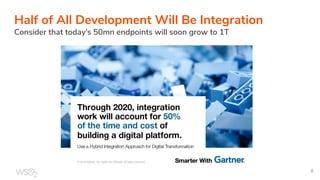
Half of All Development Will Be Integration
Consider that today’s 50mn endpoints will soon grow to 1T
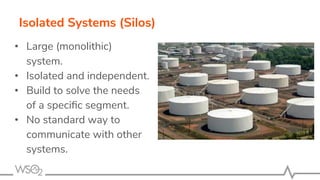
Isolated Systems (Silos)
• Large (monolithic)
system.
• Isolated and independent.
• Build to solve the needs
of a specific segment.
• No standard way to
communicate with other
systems.
Why do Organizations Run Systems in Isolation
• Control and security.
• Effort required to open up systems for other consumers.
• Systems built to run in isolation.
• Lack of business requirement to share access.
• Low emphasis on innovation and building new
capabilities.
Problems in Running Systems in Isolation
• Too much paperwork.
• Difficult to integrate with other systems.
• Duplication of processes.
• Lack of reusability.
• Expensive to maintain.
• Less scalable.
• Slow to adopt change.
• Doesn't suit modern IT landscape
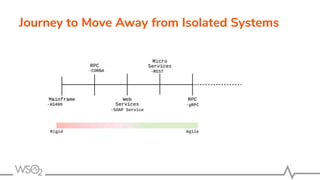
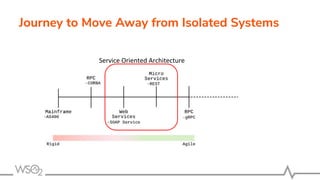
Journey to Move Away from Isolated Systems
Service Oriented Architecture
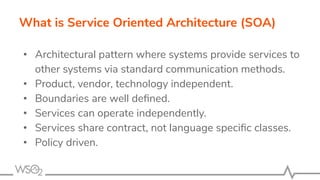
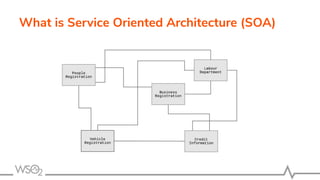
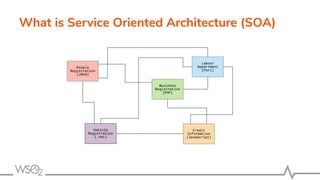
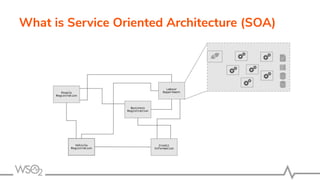
What is Service Oriented Architecture (SOA)
• Architectural pattern where systems provide services to
other systems via standard communication methods.
• Product, vendor, technology independent.
• Boundaries are well defined.
• Services can operate independently.
• Services share contract, not language specific classes.
• Policy driven.
What is Service Oriented Architecture (SOA)
Why is This Beneficial?
• Loose Coupling.
• Easy to maintain.
• Language independent development.
• Re-usable.
• Flexible.
• Agile.
• Scalable.
• Better services for your citizens.
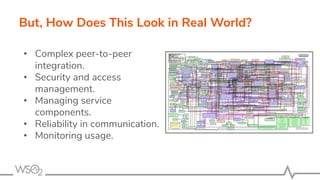
But, How Does This Look in Real World?
• Complex peer-to-peer
integration.
• Security and access
management.
• Managing service
components.
• Reliability in communication.
• Monitoring usage.
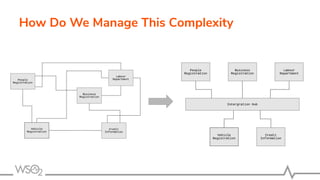
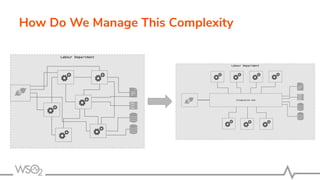
How Do We Manage This Complexity
• Minimize peer-to-peer integration through an
integration bus.
• Standardize integration points.
• Service discovery.
• Secure communication and control access to
components.
• Message storage for ensure guaranteed delivery.
• Analyzing usage of components.
How Do We Manage This Complexity
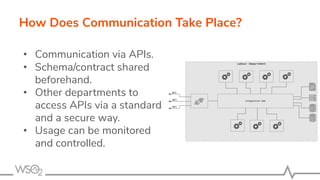
How Does Communication Take Place?
• Communication via APIs.
• Schema/contract shared
beforehand.
• Other departments to
access APIs via a standard
and a secure way.
• Usage can be monitored
and controlled.
Business Benefits
• Cut down duplication of effort and encourage
reusability.
• Reduce time to market when creating new services.
• Better integration with the overall ecosystem.
• Control way of sharing access to other departments
who wants to consume services.
• Better product delivery and satisfaction of employees.
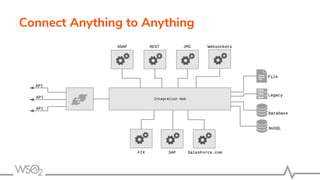
Connect Anything to Anything
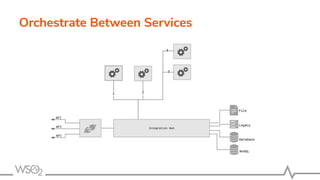
Orchestrate Between Services
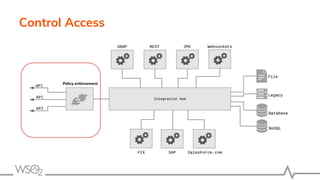
Control Access
Policy enforcement
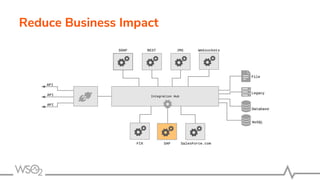
Reduce Business Impact
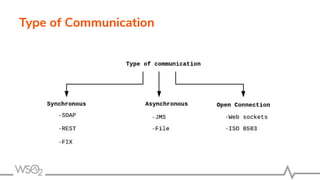
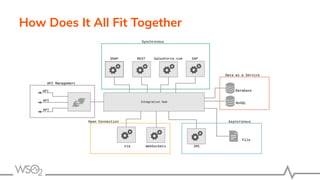
Type of Communication
Synchronous - Sender sends a message and waits for a
response from the receiver (Request - Reply).
Asynchronous - Sender sends a message and close the
connection without waiting for a response.
Open connection - Permanent connection is established
between sender and receiver and messages are sent over
this established connection (until its terminated).
Type of Communication
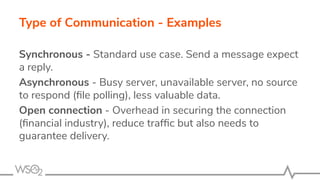
Type of Communication - Examples
Synchronous - Standard use case. Send a message expect
a reply.
Asynchronous - Busy server, unavailable server, no source
to respond (file polling), less valuable data.
Open connection - Overhead in securing the connection
(financial industry), reduce traffic but also needs to
guarantee delivery.
Enterprise Integration Patterns
• Set of documented integration flows that covers
different integration requirements of the organization.
• Gregor Hohpe book on Enterprise Integration Patterns
has become the defacto standard.
• 65 patterns documented patterns for enterprise
application integration and message oriented
middleware.
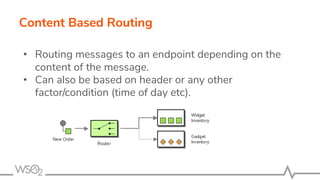
Content Based Routing
• Routing messages to an endpoint depending on the
content of the message.
• Can also be based on header or any other
factor/condition (time of day etc).
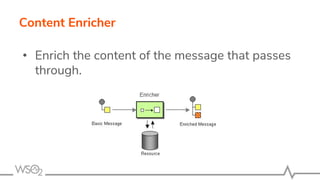
Content Enricher
• Enrich the content of the message that passes
through.
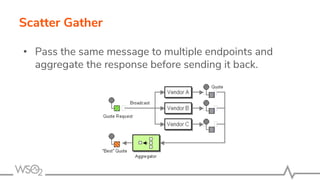
Scatter Gather
• Pass the same message to multiple endpoints and
aggregate the response before sending it back.
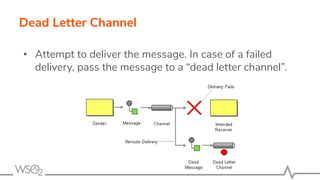
Dead Letter Channel
• Attempt to deliver the message. In case of a failed
delivery, pass the message to a “dead letter channel”.
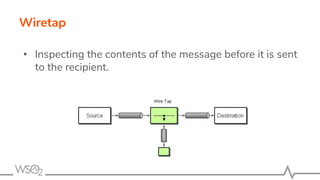
Wiretap
• Inspecting the contents of the message before it is sent
to the recipient.
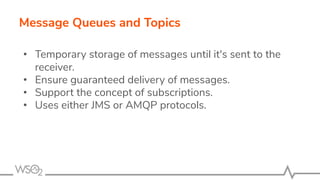
Message Queues and Topics
• Temporary storage of messages until it's sent to the
receiver.
• Ensure guaranteed delivery of messages.
• Support the concept of subscriptions.
• Uses either JMS or AMQP protocols.
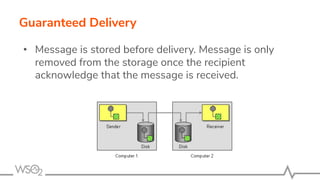
Guaranteed Delivery
• Message is stored before delivery. Message is only
removed from the storage once the recipient
acknowledge that the message is received.
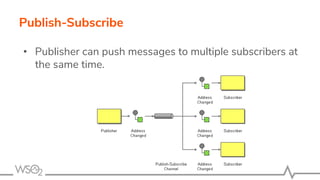
Publish-Subscribe
• Publisher can push messages to multiple subscribers at
the same time.
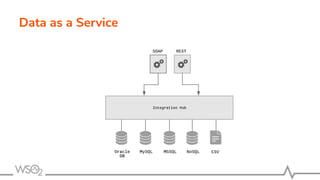
Data as a Service
• Expose data as a service to consume as standard web
services.
• Federate data from multiple sources (response to a
request would contain data from multiple sources).
• Bulk updation of data.
• Data security and filtering.
• Data enrichment with other services.
Data as a Service
API Management
API Management
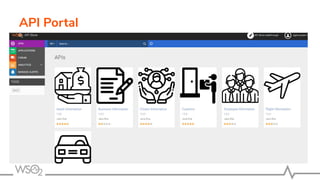
• Gateway thru which services are exposed to outside.
• Acts as a gatekeeper to ensure only legitimate users
can access services.
• Controls “how”, “who” and “when” data is accessed.
• Control the rate at which data is consumed.
• Clear way of managing versions and lifecycle of a
service.
• Easy way to discover services that available.
API Portal
How Does It All Fit Together
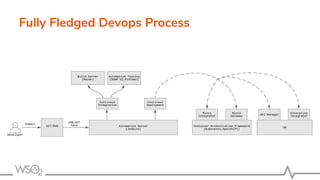
Fully Fledged Devops Process
Future Roadmap
• Micro-fying products (Micro Integrator, Micro Gateway).
• Native support for Kubernetes for all products.
• Better developer experience with both intuitive UI and
powerful CLI tools.
• Seamless integration with service meshes and service
discovery tools.
Demo
Scenario
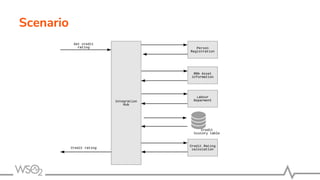
• Royal Monetary Authority (RMA) to provide a service to
check the credit rating of a citizen.
• RMA connects to multiple systems to gather
information of the citizen.
• RMA to calculate the credit score based on the
information.
• RMA offers this service as an API for other agencies to
access.
Scenario
WSO2 Presence in the
Banking Industry
52
Banking Industry
• Majority of customers are from Banking, Finance and
Insurance Industry.
• Fidelity Investment, BNY Mellon, Deutsche Bank,
American Express, Standard Chartered ….
• Pre-built connectors for banking systems.
• Open Banking solution for banks.
Success Stories
54
56
57
THANK YOU
wso2.com

[Workshop] Digital Transformation: Breaking Down Boundaries for Greater Connectivity - Technical Session

  • 1.
    Digital Transformation: BreakingDown Boundaries for Greater Connectivity Technical Session
  • 2.
    WSO2 At-A-Glance 2 $36m Salesin 2018 53% YoY growth 500+ Customers, 200 New Customers in 2018 Open Source Founded 2005, Backed by Cisco and Toba Capital Colombo, London, Mountain View, New York, São Paulo, Sydney 500+ Employees (300 Engineers)
  • 3.
    3 #1 6th Open Source IntegrationVendor Largest Apache Committer Largest Open Source Vendor 7th WSO2: Helping Digitally Driven Organizations Become Integration Agile
  • 4.
    “Strong Performer forHybrid Integration” - The Forrester Wave™: Hybrid Integration for Enterprises, Q4 2016 report, published Nov. 18, 2016 “Strong Performer for API Management Solutions” - The Forrester Wave™: API Management Solutions, Q4 2016 report, published November 14, 2016. “Strong Performer for Big Data Streaming Analytics” - The Forrester Wave™: Big Data Streaming Analytics, Q1 2016 report1, published March 30, 2016. “Visionary” - Gartner Cool Vendors in Internet of Things Analytics, 2016 report, published May 11, 2016. - Gartner Magic Quadrant for Full Life Cycle API Management, published 2018 “Cool Vendor” 4
  • 5.
    Flagship Customer Examples Applieduses across every industry and geography Financial Healthcare Governments Education Telecom Retail TechnologyTransport 5
  • 6.
    ● Problems withrunning systems in isolation. ● How you can move away from isolated systems. ● Introduction to the concept of services oriented architecture and integration hub. ● Benefits of sharing information and services. ● Introduction on the concept of API Management. ● Demo. Agenda
  • 7.
    Evolution of applications Disaggregatedarchitectures drive 50 billion endpoints to grow >1 trillion CONSUMER DEMAND SUPPLIERS DISAGGREGATE ARCHITECTURE TO MEET DEMAND 1 10 102 103 105 109 MONOLITHIC BUSINESS APP ENTERPRISE APPS DEPARTME NTAL APPS SAAS APPS PUBLIC / PRIVATE APIS 1970s | MAINFRAME 1980s | IT AWAKENING 1990s | INTERNET 2000s | MOBILE 2010s | IoT/AI 2020+ | DIGITAL NATIVE SERVERLESS & MICROSERVICES
  • 8.
    8 Half of AllDevelopment Will Be Integration Consider that today’s 50mn endpoints will soon grow to 1T
  • 9.
    Isolated Systems (Silos) •Large (monolithic) system. • Isolated and independent. • Build to solve the needs of a specific segment. • No standard way to communicate with other systems.
  • 10.
    Why do OrganizationsRun Systems in Isolation • Control and security. • Effort required to open up systems for other consumers. • Systems built to run in isolation. • Lack of business requirement to share access. • Low emphasis on innovation and building new capabilities.
  • 11.
    Problems in RunningSystems in Isolation • Too much paperwork. • Difficult to integrate with other systems. • Duplication of processes. • Lack of reusability. • Expensive to maintain. • Less scalable. • Slow to adopt change. • Doesn't suit modern IT landscape
  • 12.
    Journey to MoveAway from Isolated Systems
  • 13.
    Journey to MoveAway from Isolated Systems Service Oriented Architecture
  • 14.
    What is ServiceOriented Architecture (SOA) • Architectural pattern where systems provide services to other systems via standard communication methods. • Product, vendor, technology independent. • Boundaries are well defined. • Services can operate independently. • Services share contract, not language specific classes. • Policy driven.
  • 15.
    What is ServiceOriented Architecture (SOA)
  • 16.
    What is ServiceOriented Architecture (SOA)
  • 17.
    What is ServiceOriented Architecture (SOA)
  • 18.
    Why is ThisBeneficial? • Loose Coupling. • Easy to maintain. • Language independent development. • Re-usable. • Flexible. • Agile. • Scalable. • Better services for your citizens.
  • 19.
    But, How DoesThis Look in Real World? • Complex peer-to-peer integration. • Security and access management. • Managing service components. • Reliability in communication. • Monitoring usage.
  • 20.
    How Do WeManage This Complexity • Minimize peer-to-peer integration through an integration bus. • Standardize integration points. • Service discovery. • Secure communication and control access to components. • Message storage for ensure guaranteed delivery. • Analyzing usage of components.
  • 21.
    How Do WeManage This Complexity
  • 22.
    How Do WeManage This Complexity
  • 23.
    How Does CommunicationTake Place? • Communication via APIs. • Schema/contract shared beforehand. • Other departments to access APIs via a standard and a secure way. • Usage can be monitored and controlled.
  • 24.
    Business Benefits • Cutdown duplication of effort and encourage reusability. • Reduce time to market when creating new services. • Better integration with the overall ecosystem. • Control way of sharing access to other departments who wants to consume services. • Better product delivery and satisfaction of employees.
  • 25.
  • 26.
  • 27.
  • 28.
  • 29.
    Type of Communication Synchronous- Sender sends a message and waits for a response from the receiver (Request - Reply). Asynchronous - Sender sends a message and close the connection without waiting for a response. Open connection - Permanent connection is established between sender and receiver and messages are sent over this established connection (until its terminated).
  • 30.
  • 31.
    Type of Communication- Examples Synchronous - Standard use case. Send a message expect a reply. Asynchronous - Busy server, unavailable server, no source to respond (file polling), less valuable data. Open connection - Overhead in securing the connection (financial industry), reduce traffic but also needs to guarantee delivery.
  • 32.
    Enterprise Integration Patterns •Set of documented integration flows that covers different integration requirements of the organization. • Gregor Hohpe book on Enterprise Integration Patterns has become the defacto standard. • 65 patterns documented patterns for enterprise application integration and message oriented middleware.
  • 33.
    Content Based Routing •Routing messages to an endpoint depending on the content of the message. • Can also be based on header or any other factor/condition (time of day etc).
  • 34.
    Content Enricher • Enrichthe content of the message that passes through.
  • 35.
    Scatter Gather • Passthe same message to multiple endpoints and aggregate the response before sending it back.
  • 36.
    Dead Letter Channel •Attempt to deliver the message. In case of a failed delivery, pass the message to a “dead letter channel”.
  • 37.
    Wiretap • Inspecting thecontents of the message before it is sent to the recipient.
  • 38.
    Message Queues andTopics • Temporary storage of messages until it's sent to the receiver. • Ensure guaranteed delivery of messages. • Support the concept of subscriptions. • Uses either JMS or AMQP protocols.
  • 39.
    Guaranteed Delivery • Messageis stored before delivery. Message is only removed from the storage once the recipient acknowledge that the message is received.
  • 40.
    Publish-Subscribe • Publisher canpush messages to multiple subscribers at the same time.
  • 41.
    Data as aService • Expose data as a service to consume as standard web services. • Federate data from multiple sources (response to a request would contain data from multiple sources). • Bulk updation of data. • Data security and filtering. • Data enrichment with other services.
  • 42.
    Data as aService
  • 43.
  • 44.
    API Management • Gatewaythru which services are exposed to outside. • Acts as a gatekeeper to ensure only legitimate users can access services. • Controls “how”, “who” and “when” data is accessed. • Control the rate at which data is consumed. • Clear way of managing versions and lifecycle of a service. • Easy way to discover services that available.
  • 45.
  • 46.
    How Does ItAll Fit Together
  • 47.
  • 48.
    Future Roadmap • Micro-fyingproducts (Micro Integrator, Micro Gateway). • Native support for Kubernetes for all products. • Better developer experience with both intuitive UI and powerful CLI tools. • Seamless integration with service meshes and service discovery tools.
  • 49.
  • 50.
    Scenario • Royal MonetaryAuthority (RMA) to provide a service to check the credit rating of a citizen. • RMA connects to multiple systems to gather information of the citizen. • RMA to calculate the credit score based on the information. • RMA offers this service as an API for other agencies to access.
  • 51.
  • 52.
    WSO2 Presence inthe Banking Industry 52
  • 53.
    Banking Industry • Majorityof customers are from Banking, Finance and Insurance Industry. • Fidelity Investment, BNY Mellon, Deutsche Bank, American Express, Standard Chartered …. • Pre-built connectors for banking systems. • Open Banking solution for banks.
  • 54.
  • 56.
  • 57.
  • 58.