$ 7absec
-- Aaftab Harun
(7absec)
$ 7absec
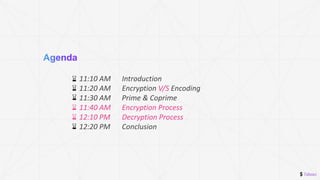
Introduction
Encryption V/S Encoding
Prime & Coprime
Encryption Process
Decryption Process
Conclusion
11:10 AM
11:20 AM
11:30 AM
11:40 AM
12:10 PM
12:20 PM
$ 7absec
Asymmetric cryptography, also known as public-key cryptography, is a process that
uses a pair of related keys -- one public key and one private key -- to encrypt and
decrypt a message and protect it from unauthorized access or use.
$ 7absec
$ 7absec
RSA is an asymmetric public-key encryption system that is very commonly
used in real world applications.
The RSA Encryption algorithm is based primarily around the concept
of Coprimality.
$ 7absec
https://media.geeksforgeeks.org/wp-content/uploads/20200428143327/RSA.png
$ 7absec
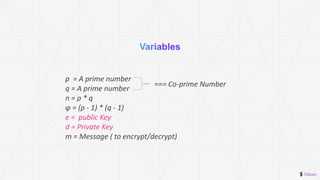
p = A prime number
q = A prime number
n = p * q
φ = (p - 1) * (q - 1)
e = public Key
d = Private Key
m = Message ( to encrypt/decrypt)
=== Co-prime Number
$ 7absec
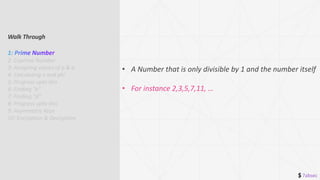
• A Number that is only divisible by 1 and the number itself
• For instance 2,3,5,7,11, …
Walk Through
2: Coprime Number
3: Assigning values of p & q
4: Calculating n and phi
5: Progress upto this
6: Finding “e”
7: Finding “d”
8: Progress upto this
9: Asymmetric Keys
10: Encryption & Decryption
$ 7absec
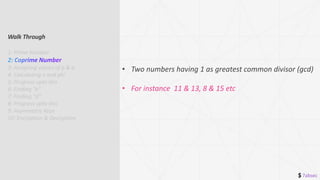
• Two numbers having 1 as greatest common divisor (gcd)
• For instance 11 & 13, 8 & 15 etc
Walk Through
1: Prime Number
3: Assigning values of p & q
4: Calculating n and phi
5: Progress upto this
6: Finding “e”
7: Finding “d”
8: Progress upto this
9: Asymmetric Keys
10: Encryption & Decryption
$ 7absec
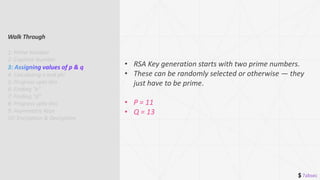
• RSA Key generation starts with two prime numbers.
• These can be randomly selected or otherwise — they
just have to be prime.
• P = 11
• Q = 13
Walk Through
1: Prime Number
2: Coprime Number
4: Calculating n and phi
5: Progress upto this
6: Finding “e”
7: Finding “d”
8: Progress upto this
9: Asymmetric Keys
10: Encryption & Decryption
$ 7absec
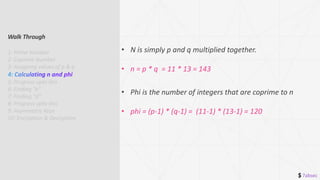
• N is simply p and q multiplied together.
• n = p * q = 11 * 13 = 143
• Phi is the number of integers that are coprime to n
• phi = (p-1) * (q-1) = (11-1) * (13-1) = 120
Walk Through
1: Prime Number
2: Coprime Number
3: Assigning values of p & q
5: Progress upto this
6: Finding “e”
7: Finding “d”
8: Progress upto this
9: Asymmetric Keys
10: Encryption & Decryption
$ 7absec
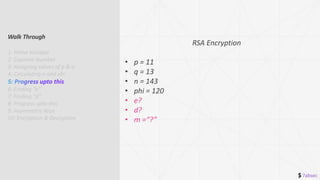
RSA Encryption
• p = 11
• q = 13
• n = 143
• phi = 120
• e?
• d?
• m =“?”
Walk Through
1: Prime Number
2: Coprime Number
3: Assigning values of p & q
4: Calculating n and phi
6: Finding “e”
7: Finding “d”
8: Progress upto this
9: Asymmetric Keys
10: Encryption & Decryption
$ 7absec
• A number that is less than phi, and coprime to both n
and phi.
• The key should be greater than 2 and less than phi
(2<e<phi)
• n = 143
• phi = 120
• possible_bup_keys = []
• for i in range(2, phi):
• if gcd(n, i) == 1 and gcd (phi, i) == 1:
• possible_bup_keys.append(i)
• Print(possible_bup_keys)
Walk Through
1: Prime Number
2: Coprime Number
3: Assigning values of p & q
4: Calculating n and phi
5: Progress upto this
7: Finding “d”
8: Progress upto this
9: Asymmetric Keys
10: Encryption & Decryption
$ 7absec
• A number that is grater than phi
• d*e mod phi = 1 or d*e % phi = 1
• phi = 120
• e = 7
• possible_pvt_keys = []
• for i in range(phi + 1, phi + 1000):
• if i * e % phi == 1:
• possible_pvt_keys.append(i)
• Print(possible_pvt_keys)
Walk Through
1: Prime Number
2: Coprime Number
3: Assigning values of p & q
4: Calculating n and phi
5: Progress upto this
6: Finding “e”
8: Progress upto this
9: Asymmetric Keys
10: Encryption & Decryption
$ 7absec
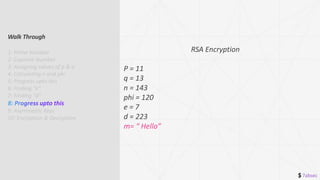
RSA Encryption
P = 11
q = 13
n = 143
phi = 120
e = 7
d = 223
m= “ Hello”
Walk Through
1: Prime Number
2: Coprime Number
3: Assigning values of p & q
4: Calculating n and phi
5: Progress upto this
6: Finding “e”
7: Finding “d”
9: Asymmetric Keys
10: Encryption & Decryption
$ 7absec
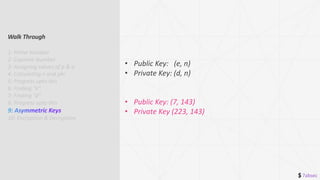
• Public Key: (e, n)
• Private Key: (d, n)
• Public Key: (7, 143)
• Private Key (223, 143)
Walk Through
1: Prime Number
2: Coprime Number
3: Assigning values of p & q
4: Calculating n and phi
5: Progress upto this
6: Finding “e”
7: Finding “d”
8: Progress upto this
10: Encryption & Decryption
$ 7absec
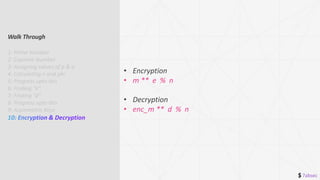
• Encryption
• m ** e % n
• Decryption
• enc_m ** d % n
Walk Through
1: Prime Number
2: Coprime Number
3: Assigning values of p & q
4: Calculating n and phi
5: Progress upto this
6: Finding “e”
7: Finding “d”
8: Progress upto this
9: Asymmetric Keys
$ 7absec
• Asymmetric encryption is more secure than symmetric encryption.

$ 7absec
Questions/Suggestions…

Asymmetric Encryption with RSA

  • 1.
    $ 7absec -- AaftabHarun (7absec)
  • 2.
    $ 7absec Introduction Encryption V/SEncoding Prime & Coprime Encryption Process Decryption Process Conclusion 11:10 AM 11:20 AM 11:30 AM 11:40 AM 12:10 PM 12:20 PM
  • 3.
    $ 7absec Asymmetric cryptography,also known as public-key cryptography, is a process that uses a pair of related keys -- one public key and one private key -- to encrypt and decrypt a message and protect it from unauthorized access or use.
  • 4.
  • 5.
    $ 7absec RSA isan asymmetric public-key encryption system that is very commonly used in real world applications. The RSA Encryption algorithm is based primarily around the concept of Coprimality.
  • 6.
  • 7.
    $ 7absec p =A prime number q = A prime number n = p * q φ = (p - 1) * (q - 1) e = public Key d = Private Key m = Message ( to encrypt/decrypt) === Co-prime Number
  • 8.
    $ 7absec • ANumber that is only divisible by 1 and the number itself • For instance 2,3,5,7,11, … Walk Through 2: Coprime Number 3: Assigning values of p & q 4: Calculating n and phi 5: Progress upto this 6: Finding “e” 7: Finding “d” 8: Progress upto this 9: Asymmetric Keys 10: Encryption & Decryption
  • 9.
    $ 7absec • Twonumbers having 1 as greatest common divisor (gcd) • For instance 11 & 13, 8 & 15 etc Walk Through 1: Prime Number 3: Assigning values of p & q 4: Calculating n and phi 5: Progress upto this 6: Finding “e” 7: Finding “d” 8: Progress upto this 9: Asymmetric Keys 10: Encryption & Decryption
  • 10.
    $ 7absec • RSAKey generation starts with two prime numbers. • These can be randomly selected or otherwise — they just have to be prime. • P = 11 • Q = 13 Walk Through 1: Prime Number 2: Coprime Number 4: Calculating n and phi 5: Progress upto this 6: Finding “e” 7: Finding “d” 8: Progress upto this 9: Asymmetric Keys 10: Encryption & Decryption
  • 11.
    $ 7absec • Nis simply p and q multiplied together. • n = p * q = 11 * 13 = 143 • Phi is the number of integers that are coprime to n • phi = (p-1) * (q-1) = (11-1) * (13-1) = 120 Walk Through 1: Prime Number 2: Coprime Number 3: Assigning values of p & q 5: Progress upto this 6: Finding “e” 7: Finding “d” 8: Progress upto this 9: Asymmetric Keys 10: Encryption & Decryption
  • 12.
    $ 7absec RSA Encryption •p = 11 • q = 13 • n = 143 • phi = 120 • e? • d? • m =“?” Walk Through 1: Prime Number 2: Coprime Number 3: Assigning values of p & q 4: Calculating n and phi 6: Finding “e” 7: Finding “d” 8: Progress upto this 9: Asymmetric Keys 10: Encryption & Decryption
  • 13.
    $ 7absec • Anumber that is less than phi, and coprime to both n and phi. • The key should be greater than 2 and less than phi (2<e<phi) • n = 143 • phi = 120 • possible_bup_keys = [] • for i in range(2, phi): • if gcd(n, i) == 1 and gcd (phi, i) == 1: • possible_bup_keys.append(i) • Print(possible_bup_keys) Walk Through 1: Prime Number 2: Coprime Number 3: Assigning values of p & q 4: Calculating n and phi 5: Progress upto this 7: Finding “d” 8: Progress upto this 9: Asymmetric Keys 10: Encryption & Decryption
  • 14.
    $ 7absec • Anumber that is grater than phi • d*e mod phi = 1 or d*e % phi = 1 • phi = 120 • e = 7 • possible_pvt_keys = [] • for i in range(phi + 1, phi + 1000): • if i * e % phi == 1: • possible_pvt_keys.append(i) • Print(possible_pvt_keys) Walk Through 1: Prime Number 2: Coprime Number 3: Assigning values of p & q 4: Calculating n and phi 5: Progress upto this 6: Finding “e” 8: Progress upto this 9: Asymmetric Keys 10: Encryption & Decryption
  • 15.
    $ 7absec RSA Encryption P= 11 q = 13 n = 143 phi = 120 e = 7 d = 223 m= “ Hello” Walk Through 1: Prime Number 2: Coprime Number 3: Assigning values of p & q 4: Calculating n and phi 5: Progress upto this 6: Finding “e” 7: Finding “d” 9: Asymmetric Keys 10: Encryption & Decryption
  • 16.
    $ 7absec • PublicKey: (e, n) • Private Key: (d, n) • Public Key: (7, 143) • Private Key (223, 143) Walk Through 1: Prime Number 2: Coprime Number 3: Assigning values of p & q 4: Calculating n and phi 5: Progress upto this 6: Finding “e” 7: Finding “d” 8: Progress upto this 10: Encryption & Decryption
  • 17.
    $ 7absec • Encryption •m ** e % n • Decryption • enc_m ** d % n Walk Through 1: Prime Number 2: Coprime Number 3: Assigning values of p & q 4: Calculating n and phi 5: Progress upto this 6: Finding “e” 7: Finding “d” 8: Progress upto this 9: Asymmetric Keys
  • 18.
    $ 7absec • Asymmetricencryption is more secure than symmetric encryption.
  • 19.