RSA Encryption
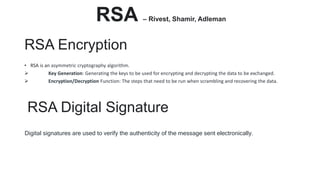
• RSA is an asymmetric cryptography algorithm.
 Key Generation: Generating the keys to be used for encrypting and decrypting the data to be exchanged.
 Encryption/Decryption Function: The steps that need to be run when scrambling and recovering the data.
RSA Digital Signature
Digital signatures are used to verify the authenticity of the message sent electronically.
RSA – Rivest, Shamir, Adleman
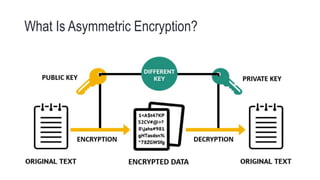
What Is Asymmetric Encryption?
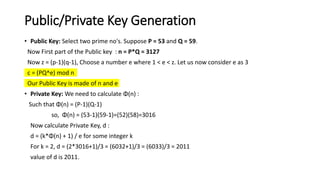
Public/Private Key Generation
• Public Key: Select two prime no's. Suppose P = 53 and Q = 59.
Now First part of the Public key : n = P*Q = 3127
Now z = (p-1)(q-1), Choose a number e where 1 < e < z. Let us now consider e as 3
c = (PQ^e) mod n
Our Public Key is made of n and e
• Private Key: We need to calculate Φ(n) :
Such that Φ(n) = (P-1)(Q-1)
so, Φ(n) = (53-1)(59-1)=(52)(58)=3016
Now calculate Private Key, d :
d = (k*Φ(n) + 1) / e for some integer k
For k = 2, d = (2*3016+1)/3 = (6032+1)/3 = (6033)/3 = 2011
value of d is 2011.
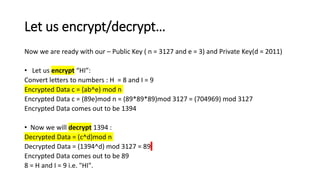
Let us encrypt/decrypt…
Now we are ready with our – Public Key ( n = 3127 and e = 3) and Private Key(d = 2011)
• Let us encrypt “HI”:
Convert letters to numbers : H = 8 and I = 9
Encrypted Data c = (ab^e) mod n
Encrypted Data c = (89e)mod n = (89*89*89)mod 3127 = (704969) mod 3127
Encrypted Data comes out to be 1394
• Now we will decrypt 1394 :
Decrypted Data = (c^d)mod n
Decrypted Data = (1394^d) mod 3127 = 89
Encrypted Data comes out to be 89
8 = H and I = 9 i.e. "HI".
RSA Digital Signature
RSA Digital Signature…
Code pointers
• integ_rsa_encrypt.c
• integ_rsa_decrypt.c
• integ_rsa_keygen.c
typedef struct _CpaCyRsaKeyGenOpData {
CpaFlatBuffer prime1P;
CpaFlatBuffer prime2Q;
Cpa32U modulusLenInBytes;
CpaCyRsaVersion version;
CpaCyRsaPrivateKeyRepType privateKeyRepType;
CpaFlatBuffer publicExponentE;
} CpaCyRsaKeyGenOpData;
Integ code
isg_cid_qat_sal/me_acceleration_layer/access_layer/look_aside_acceleration/integ_test/common/crypto/asym/rsa
typedef struct _CpaCyRsaEncryptOpData {
CpaCyRsaPublicKey *pPublicKey;
/**< Pointer to the public key. */
CpaFlatBuffer inputData;
/**< The input data that the RSA encryption primitive operation is
* performed on. The data pointed to is an integer that MUST be in big-
* endian order. The value MUST be between 0 and the modulus n - 1. */
} CpaCyRsaEncryptOpData;
typedef struct _CpaCyRsaDecryptOpData {
CpaCyRsaPrivateKey *pRecipientPrivateKey;
/**< Pointer to the recipient's RSA private key. */
CpaFlatBuffer inputData;
/**< The input data that the RSA decryption primitive operation is
* performed on. The data pointed to is an integer that MUST be in big-
* endian order. The value MUST be between 0 and the modulus n - 1. */
} CpaCyRsaDecryptOpData;
Code pointers…
Key Generation
LacIntegRsa_AllocKeyGenData
-LacIntegPke_CreatePrivateKey
-LacIntegPke_CreatePublicKey
LacIntegRsa_KeySendReq
-LacIntegRsa_KeySend
-cpaCyRsaGenKey -> SAL code
Encryption
LacIntegRsa_EncryptInt/LacIntegRsa_EncPerfTestInt
-LacIntegRsa_AllocEncData
-LacIntegPke_CreatePublicKey
-LacIntegPke_PopulateFlatBuffer
LacIntegRsa_EncPerfTestInt
-LacIntegRsa_EncSendReq
-LacIntegRsa_EncSend
-cpaCyRsaEncrypt ->SAL code
Decryption
LacIntegRsa_Decrypt1Int
->LacIntegRsa_AllocDec1Data
->LacIntegPke_CreatePrivateKey1
->LacIntegPke_PopulateFlatBuffer
LacIntegRsa_DecPerfTestInt
LacIntegRsa_DecSendReq
->LacIntegRsa_DecSend
->cpaCyRsaDecrypt -> SAL code

RSA.pptx

  • 1.
    RSA Encryption • RSAis an asymmetric cryptography algorithm.  Key Generation: Generating the keys to be used for encrypting and decrypting the data to be exchanged.  Encryption/Decryption Function: The steps that need to be run when scrambling and recovering the data. RSA Digital Signature Digital signatures are used to verify the authenticity of the message sent electronically. RSA – Rivest, Shamir, Adleman
  • 2.
    What Is AsymmetricEncryption?
  • 3.
    Public/Private Key Generation •Public Key: Select two prime no's. Suppose P = 53 and Q = 59. Now First part of the Public key : n = P*Q = 3127 Now z = (p-1)(q-1), Choose a number e where 1 < e < z. Let us now consider e as 3 c = (PQ^e) mod n Our Public Key is made of n and e • Private Key: We need to calculate Φ(n) : Such that Φ(n) = (P-1)(Q-1) so, Φ(n) = (53-1)(59-1)=(52)(58)=3016 Now calculate Private Key, d : d = (k*Φ(n) + 1) / e for some integer k For k = 2, d = (2*3016+1)/3 = (6032+1)/3 = (6033)/3 = 2011 value of d is 2011.
  • 4.
    Let us encrypt/decrypt… Nowwe are ready with our – Public Key ( n = 3127 and e = 3) and Private Key(d = 2011) • Let us encrypt “HI”: Convert letters to numbers : H = 8 and I = 9 Encrypted Data c = (ab^e) mod n Encrypted Data c = (89e)mod n = (89*89*89)mod 3127 = (704969) mod 3127 Encrypted Data comes out to be 1394 • Now we will decrypt 1394 : Decrypted Data = (c^d)mod n Decrypted Data = (1394^d) mod 3127 = 89 Encrypted Data comes out to be 89 8 = H and I = 9 i.e. "HI".
  • 5.
  • 6.
  • 7.
    Code pointers • integ_rsa_encrypt.c •integ_rsa_decrypt.c • integ_rsa_keygen.c typedef struct _CpaCyRsaKeyGenOpData { CpaFlatBuffer prime1P; CpaFlatBuffer prime2Q; Cpa32U modulusLenInBytes; CpaCyRsaVersion version; CpaCyRsaPrivateKeyRepType privateKeyRepType; CpaFlatBuffer publicExponentE; } CpaCyRsaKeyGenOpData; Integ code isg_cid_qat_sal/me_acceleration_layer/access_layer/look_aside_acceleration/integ_test/common/crypto/asym/rsa typedef struct _CpaCyRsaEncryptOpData { CpaCyRsaPublicKey *pPublicKey; /**< Pointer to the public key. */ CpaFlatBuffer inputData; /**< The input data that the RSA encryption primitive operation is * performed on. The data pointed to is an integer that MUST be in big- * endian order. The value MUST be between 0 and the modulus n - 1. */ } CpaCyRsaEncryptOpData; typedef struct _CpaCyRsaDecryptOpData { CpaCyRsaPrivateKey *pRecipientPrivateKey; /**< Pointer to the recipient's RSA private key. */ CpaFlatBuffer inputData; /**< The input data that the RSA decryption primitive operation is * performed on. The data pointed to is an integer that MUST be in big- * endian order. The value MUST be between 0 and the modulus n - 1. */ } CpaCyRsaDecryptOpData;
  • 8.
    Code pointers… Key Generation LacIntegRsa_AllocKeyGenData -LacIntegPke_CreatePrivateKey -LacIntegPke_CreatePublicKey LacIntegRsa_KeySendReq -LacIntegRsa_KeySend -cpaCyRsaGenKey-> SAL code Encryption LacIntegRsa_EncryptInt/LacIntegRsa_EncPerfTestInt -LacIntegRsa_AllocEncData -LacIntegPke_CreatePublicKey -LacIntegPke_PopulateFlatBuffer LacIntegRsa_EncPerfTestInt -LacIntegRsa_EncSendReq -LacIntegRsa_EncSend -cpaCyRsaEncrypt ->SAL code Decryption LacIntegRsa_Decrypt1Int ->LacIntegRsa_AllocDec1Data ->LacIntegPke_CreatePrivateKey1 ->LacIntegPke_PopulateFlatBuffer LacIntegRsa_DecPerfTestInt LacIntegRsa_DecSendReq ->LacIntegRsa_DecSend ->cpaCyRsaDecrypt -> SAL code