Downloaded 33 times
![Home › Blog › Corrosion Testing › ASTM B117 Testing Quality Control
ASTM B117 Tes+ng Quality Control
ASTM B117 Tes+ng
ASTM B117 Testing, also known as a Standard Practice for Operating Salt Spray (Fog) Apparatus, is used to
analyze relative corrosion for specimens of metals and coated metals exposed to various simulated climatic
conditions in a controlled environment. This testing practice was initially published in 1939 and rapidly gained
worldwide acceptance across all major industry segments.
ASTM B117 Testing requires controls over many operational parameters such as:
Fog atomization rate: 1.0-2.0 ml/hour
Cabinet internal temperature 35 +/- 2 C
pH range: 6.5-7.2
Salt concentration: 5 +/- 1%
If all of these parameters are set within the specifications, your corrosion tests should produce meaningful
results. However, it is an act of faith. At Micom, we always promote good laboratory practices and we test
reference materials of known characteristics to insure that overall the test equipment is generating reliable test
results. Such verification is possible for ASTM B117. Indeed in Annex X3 of the ASTM Document – “EVALUATION
OF CORROSIVE CONDITIONS” a procedure is given “for evaluating the corrosive conditions within a salt spray
cabinet”[1]. Furthermore ASTM B117 Document states “the procedure involves the exposure of steel test panels
and the determination of their mass losses in a specified period of time.
Annex X3 specifies the test panels to be used with their dimensions and alloy grade (UNS G10080). It also
includes a pre-test and a post-test chemical cleaning procedure for the panels. A total of 3 control panels are
used for exposure durations of 48, 96 and 168 hours. Upon chemical cleaning and drying the panels are
weighted to 1/10000 of a gram (0,0001g). Annex X3 also contains repeatability and reproducibility statistics
that can be used by laboratories as acceptance criteria for validating their salt spray testing cabinet.
These testing procedures allow testing labs to insure their test results are in line with the expected performance
of a proper ASTM B117 testing protocol. Below you will find a reproducibility study done by our corrosion testing
! May 19, 2016 " webmaster # Corrosion Testing $
o
th](https://image.slidesharecdn.com/astmb117testingqualitycontrol-micomlaboratories-160706170705/75/ASTM-B117-Testing-quality-control-by-Micom-Laboratories-1-2048.jpg)
![laboratory based on the ASTM B117, annex X3 requirements:
Reproducibility Study: ASTM B117 Tes+ng – Opera&ng Salt Spray (Fog) Apparatus
Study Date: January 2014
Salt Spray chamber used: MI-EQ-477 – Model CTT 1100 – 13-1152-40
Panels used: UNS G10080 steel plates 76 x 127 x 0.8 mm
Data source: ASTM B117-11 X3.8 Precision and Bias – Steel Panel Test
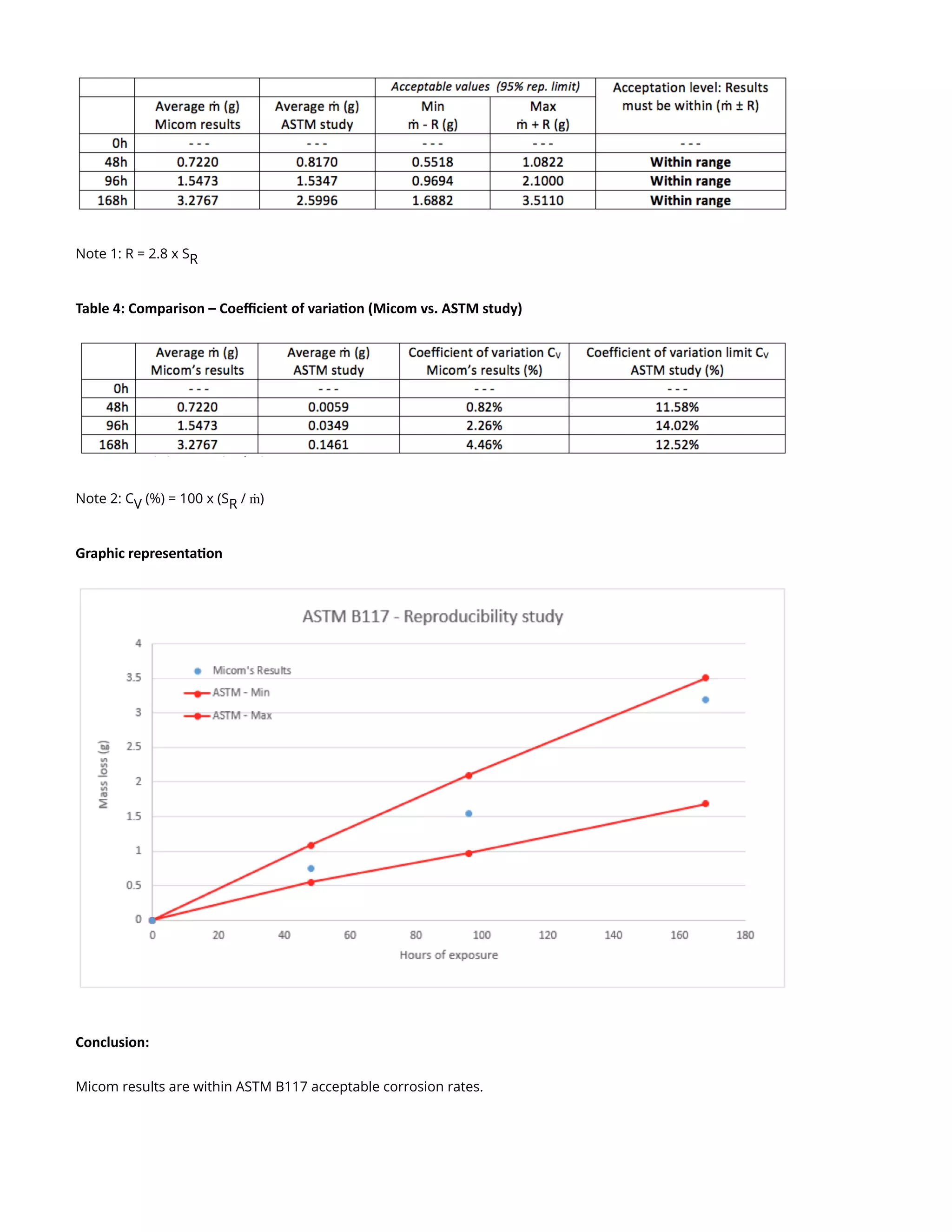
The ASTM reproducibility study gives the acceptable limits (with a 95% reproducibility limit) on the consistency of
mass loss results from different labs and cabinets.
Reference data:
The statistical data used below are from the precision and bias ASTM study detailed in ASTM B117-11
« Operating Salt Spray (Fog) Apparatus ».
Table 1: ASTM[2] reproducibility study
Table 2: Micom results
Table 3: Comparison – Mass loss (Micom vs. ASTM study)](https://image.slidesharecdn.com/astmb117testingqualitycontrol-micomlaboratories-160706170705/75/ASTM-B117-Testing-quality-control-by-Micom-Laboratories-2-2048.jpg)
![Repeatability Study: ASTM B117 Tes+ng– Opera&ng Salt Spray (Fog) Apparatus
Study Date: January 2014
Salt Spray chamber used: MI-EQ-477 – Model CTT 1100 – 13-1152-40
Panels used: UNS G10080 steel plates 76 x 127 x 0.8 mm
Data source: ASTM B117-11 X3.8 Precision and Bias – Steel Panel Test
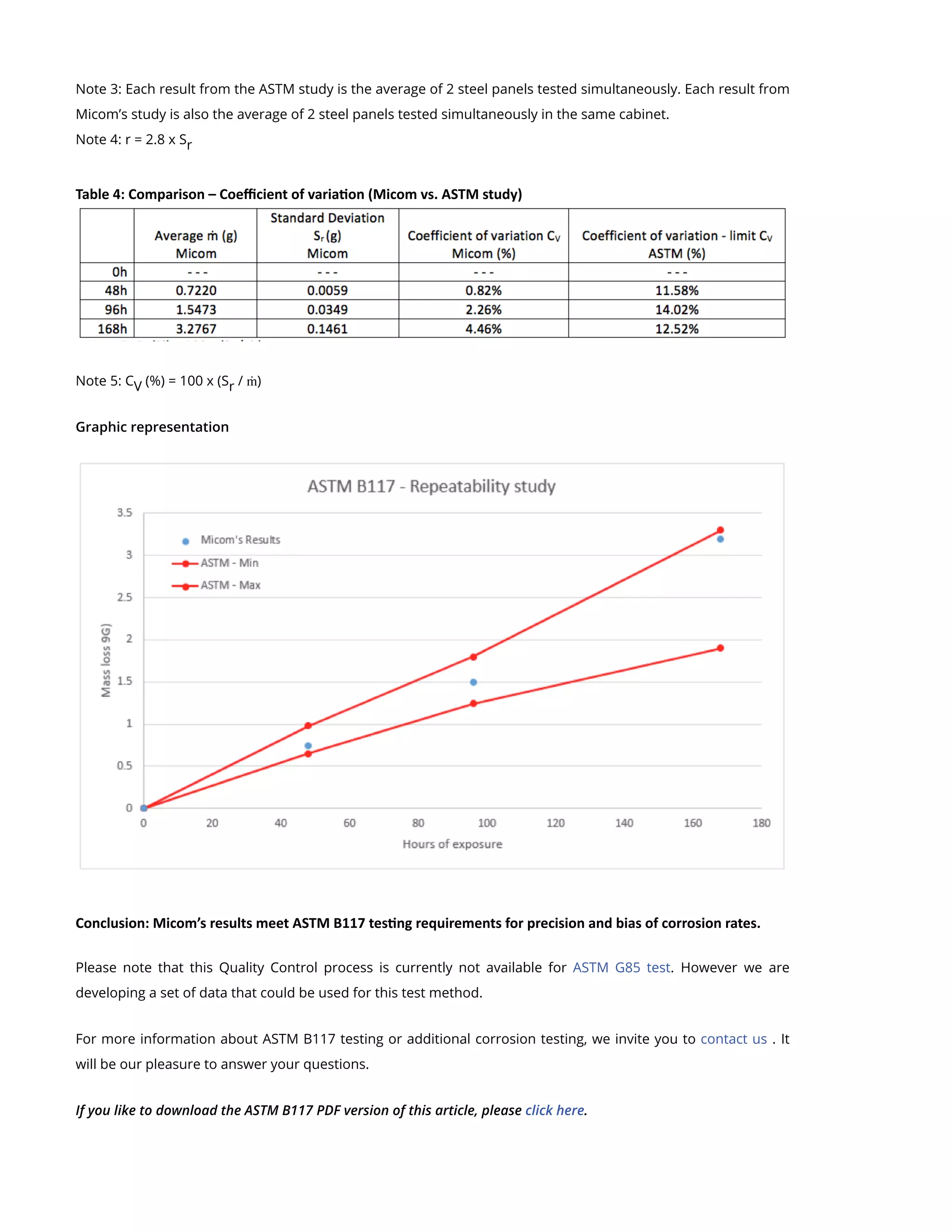
The ASTM repeatability study gives the acceptable limits (with a 95% reproducibility limit) on the consistency of
mass loss results from panels tested simultaneously in a cabinet.
Reference data:
The statistical data used below are from the precision and bias ASTM study detailed in ASTM B117-11
« Operating Salt Spray (Fog) Apparatus ».
Table 1: ASTM[2] repeatability study
Table 2: Micom results
Table 3: Comparison – Mass loss (Micom vs. ASTM study)](https://image.slidesharecdn.com/astmb117testingqualitycontrol-micomlaboratories-160706170705/75/ASTM-B117-Testing-quality-control-by-Micom-Laboratories-4-2048.jpg)
![ASTM B117
Micom Laboratories is happy to
inform you that we have recently
expanded our scope of…
ASTM B117: The most popular
accelerated metal corrosion
test standard
ASTM B117 Standard – A
protocol for operating the Salt
Spray (fog) Apparatus At Micom
Laboratories,…
ASTM B117 Test – Real world
application
ASTM B117 Test – A real life
example of corrosion testing We
mentioned in a…
This article is a preview of the Corrosion Testing white paper that we are currently working on and that will be available
in the following months. If you would like to be notified when our white paper on corrosion comes out, we invite you to
send us an email.
Disclaimer
All of the information and opinions contained in this blog are made with the information, and the understanding
that we have reviewed at the time of publishing. However, despite our efforts, we do not offer any guarantee of
their accuracy, thoroughness of our investigation or validity. The author of this blog is not liable for any
inaccuracies or any losses or damages that may result from the use of the information or data contained
herein. This blog has not been reviewed or verified for its accuracy by any peer group associates prior to
publication.
[1] ASTM International, ASTM B117-11 Standard Practice for Operating Salt Spray (Fog) Apparatus.
[2] The largest ASTM testing study (data from 12 cabinets) was used as reference.
Related Posts](https://image.slidesharecdn.com/astmb117testingqualitycontrol-micomlaboratories-160706170705/75/ASTM-B117-Testing-quality-control-by-Micom-Laboratories-6-2048.jpg)

ASTM B117 testing is a widely accepted practice for evaluating corrosion resistance in metals and coatings through controlled salt spray exposure. Established in 1939, the procedure outlines specific operational parameters to ensure reliable results, including fog atomization rates and chemical cleaning procedures for test panels. Recent reproducibility studies confirm that results from Micom's corrosion tests align with ASTM B117's standards for mass loss and consistency, although quality control for ASTM G85 tests is still under development.


