ASTM D6704 - 08
Standard Test Method for Determining the
Workability of Asphalt Cold Mix Patching
Material
Cold Mix Asphalt
It is a type of asphalt that is commonly
used on rural or low traffic roads.
It is commonly used to repair worn
pavement and potholes.
Workability
- is one of the main factors that
determine the suitability and
performance of the asphalt cold
mix for use as a roadway patching
material.
Objective of the Test:
To be able to identify the potential
characteristics of handling, placing,
compaction, and performance of an
asphalt cold mix.
Apparatus:
Weighing Balance
Freezer(Capable of
maintaining a
temperature of -10
degree celcius
Compaction Hammer
Compression Testing
Machine
Thermometer
Utensils for
transferring of
sample
Procedure:
 Allow the material to stabilize at ambient laboratory
temperature (25°C).
 Weigh the material in three separate boxes the
amount (about 2 kg) that will result in a compacted specimen
height of 48 to 50 mm.
 Spread the mix uniformly over the box and level the mix,
avoiding any segregation. Discard any excess material.
 Place the box with the material on any hard and level
surface, and place the compaction hammer with the modified
foot close to the center of the box and apply two blows with
the hammer.
 Place the compacted material and box in the freezer at -10°C
for a minimum of 12 h but no longer than 24 h.
Procedure:
 Attach the penetration blade to the adapter at the
bottom of the proving ring of the Marshall apparatus
with the blade parallel to the front of the machine.
 Adjust the dial indicator to zero.
 Immediately transfer the box with the
compacted material from the freezer to the
loading jack. Place it under theblade and on
the support stand, ensuring that it is level
and firmly seated on the support stand.
Procedure:
 Switch on the motor and bring the specimen close to the
blade and continue the upward movement of the jack head
and start the timer when the dial indicator begins to
move. Watch the dial carefully and record the
highest reading observed during 30 s of penetration.
 Stop the motor, lower the jack head and remove the
specimen from the apparatus. The elapsed time for the
test from removal of the test specimen from the freezer
to the completion of the 30-s penetration shall not exceed 1
min.
 Repeat the preceding procedure to the other two samples.
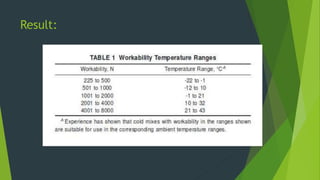
Result:
ASTM D6933 - 13
Standard Test Method for Oversized Particles
in Emulsified Asphalts (Sieve Test)
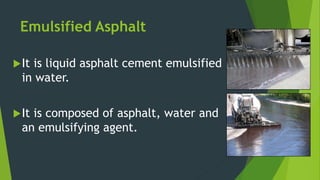
Emulsified Asphalt
It is liquid asphalt cement emulsified
in water.
It is composed of asphalt, water and
an emulsifying agent.
Objective of the Test:
To determine the degree to which
emulsified asphalt may contain
particles of asphalt or other solids that
are retained on a 850µm(76mm) sieve.
Apparatus:
Sieve (850µm/76.2mm)
Pan Weighing
Balances(capable of
weighing 500g and
2500g)
Oven Dessicator Thermometer Water
Procedure:
Calculation:
sample retained, % = (B-A) x 100
where:
A= weight of sieve and pan, g, and
B= weight of sieve, pan, and residue, g.
Result:
 If there are excessive amounts of particles
retained on the sieve (>0.1%), this indicates that
problems may occur in handling and application
of the material.
ASTM D6930 - 10
Standard Test Method for Settlement and
Storage Stability of Emulsified Asphalts
Objective of the Test
To determine the storage stability or
settlement of an emulsified asphalt.
To know the ability of an emulsified
asphalt to remain as a uniform
dispersion during storage.
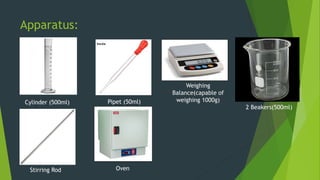
Apparatus:
Cylinder (500ml) Pipet (50ml)
Weighing
Balance(capable of
weighing 1000g)
2 Beakers(500ml)
Stirring Rod Oven
Procedure:
 Bring the emulsified asphalt to room temperature, 22°C to 28°C.
Place a 500-mL representative sample in the glass cylinder.
Stopper the cylinder and allow it to stand undisturbed, at laboratory
air temperature 22°C to 28°C, for 24 h for storage stability or 5
days for settlement test. After standing for this period, remove
approximately 55 mL of emulsified asphalt from the top of the
cylinder by means of the pipet without disturbing the remainder
of the sample. Thoroughly stir the 55-mL portion.
 Weigh 50.0g of the sample into a weighed 1000-mL glass or
metal beaker that has been previously weighed with a glass rod.
Procedure:
 After removal of the top portion, siphon off the next 390mL
(approximate) from the cylinder. Thoroughly stir the
emulsified asphalt remaining in the cylinder. Weigh 50.0g
into a previously weighed 1000-mL glass or metal beaker with
a glass rod.
 Adjust the temperature of the oven to 163°C and place the
beakers containing the rods and sample in the oven for 2hr. At
the end of this period, remove each beaker and
thoroughly stir the residue. Replace in the oven for 1 h, then
remove the beakers from the oven, allow to cool to
ambient temperature, and weigh, with the rods.
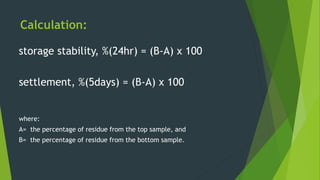
Calculation:
storage stability, %(24hr) = (B-A) x 100
settlement, %(5days) = (B-A) x 100
where:
A= the percentage of residue from the top sample, and
B= the percentage of residue from the bottom sample.

Astm (Asphalt)

  • 1.
    ASTM D6704 -08 Standard Test Method for Determining the Workability of Asphalt Cold Mix Patching Material
  • 2.
    Cold Mix Asphalt Itis a type of asphalt that is commonly used on rural or low traffic roads. It is commonly used to repair worn pavement and potholes.
  • 3.
    Workability - is oneof the main factors that determine the suitability and performance of the asphalt cold mix for use as a roadway patching material.
  • 4.
    Objective of theTest: To be able to identify the potential characteristics of handling, placing, compaction, and performance of an asphalt cold mix.
  • 5.
    Apparatus: Weighing Balance Freezer(Capable of maintaininga temperature of -10 degree celcius Compaction Hammer Compression Testing Machine Thermometer Utensils for transferring of sample
  • 6.
    Procedure:  Allow thematerial to stabilize at ambient laboratory temperature (25°C).  Weigh the material in three separate boxes the amount (about 2 kg) that will result in a compacted specimen height of 48 to 50 mm.  Spread the mix uniformly over the box and level the mix, avoiding any segregation. Discard any excess material.  Place the box with the material on any hard and level surface, and place the compaction hammer with the modified foot close to the center of the box and apply two blows with the hammer.  Place the compacted material and box in the freezer at -10°C for a minimum of 12 h but no longer than 24 h.
  • 7.
    Procedure:  Attach thepenetration blade to the adapter at the bottom of the proving ring of the Marshall apparatus with the blade parallel to the front of the machine.  Adjust the dial indicator to zero.  Immediately transfer the box with the compacted material from the freezer to the loading jack. Place it under theblade and on the support stand, ensuring that it is level and firmly seated on the support stand.
  • 8.
    Procedure:  Switch onthe motor and bring the specimen close to the blade and continue the upward movement of the jack head and start the timer when the dial indicator begins to move. Watch the dial carefully and record the highest reading observed during 30 s of penetration.  Stop the motor, lower the jack head and remove the specimen from the apparatus. The elapsed time for the test from removal of the test specimen from the freezer to the completion of the 30-s penetration shall not exceed 1 min.  Repeat the preceding procedure to the other two samples.
  • 9.
  • 10.
    ASTM D6933 -13 Standard Test Method for Oversized Particles in Emulsified Asphalts (Sieve Test)
  • 11.
    Emulsified Asphalt It isliquid asphalt cement emulsified in water. It is composed of asphalt, water and an emulsifying agent.
  • 12.
    Objective of theTest: To determine the degree to which emulsified asphalt may contain particles of asphalt or other solids that are retained on a 850µm(76mm) sieve.
  • 13.
    Apparatus: Sieve (850µm/76.2mm) Pan Weighing Balances(capableof weighing 500g and 2500g) Oven Dessicator Thermometer Water
  • 14.
  • 15.
    Calculation: sample retained, %= (B-A) x 100 where: A= weight of sieve and pan, g, and B= weight of sieve, pan, and residue, g.
  • 16.
    Result:  If thereare excessive amounts of particles retained on the sieve (>0.1%), this indicates that problems may occur in handling and application of the material.
  • 17.
    ASTM D6930 -10 Standard Test Method for Settlement and Storage Stability of Emulsified Asphalts
  • 18.
    Objective of theTest To determine the storage stability or settlement of an emulsified asphalt. To know the ability of an emulsified asphalt to remain as a uniform dispersion during storage.
  • 19.
    Apparatus: Cylinder (500ml) Pipet(50ml) Weighing Balance(capable of weighing 1000g) 2 Beakers(500ml) Stirring Rod Oven
  • 20.
    Procedure:  Bring theemulsified asphalt to room temperature, 22°C to 28°C. Place a 500-mL representative sample in the glass cylinder. Stopper the cylinder and allow it to stand undisturbed, at laboratory air temperature 22°C to 28°C, for 24 h for storage stability or 5 days for settlement test. After standing for this period, remove approximately 55 mL of emulsified asphalt from the top of the cylinder by means of the pipet without disturbing the remainder of the sample. Thoroughly stir the 55-mL portion.  Weigh 50.0g of the sample into a weighed 1000-mL glass or metal beaker that has been previously weighed with a glass rod.
  • 21.
    Procedure:  After removalof the top portion, siphon off the next 390mL (approximate) from the cylinder. Thoroughly stir the emulsified asphalt remaining in the cylinder. Weigh 50.0g into a previously weighed 1000-mL glass or metal beaker with a glass rod.  Adjust the temperature of the oven to 163°C and place the beakers containing the rods and sample in the oven for 2hr. At the end of this period, remove each beaker and thoroughly stir the residue. Replace in the oven for 1 h, then remove the beakers from the oven, allow to cool to ambient temperature, and weigh, with the rods.
  • 22.
    Calculation: storage stability, %(24hr)= (B-A) x 100 settlement, %(5days) = (B-A) x 100 where: A= the percentage of residue from the top sample, and B= the percentage of residue from the bottom sample.