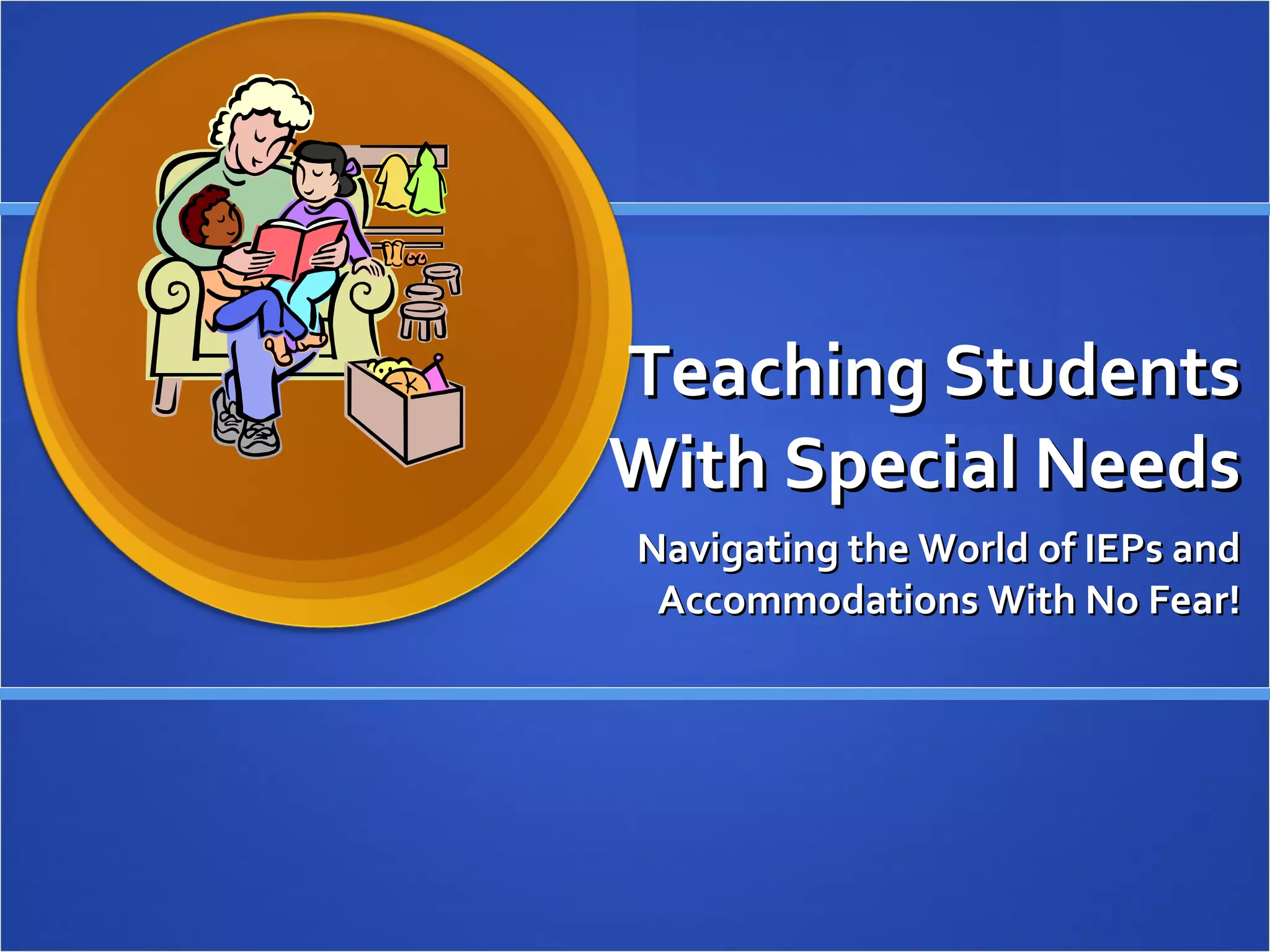
Teaching Students With Special Needs Navigating the World of IEPs and Accommodations With No Fear!
Regular Teachers and Special Children Regular education teachers are expected to teach special education students with as much passion as those who are considered regular education students. Incorporating your special ed students into the positive community of your classroom is not hard!  Sometimes you may need to make minor changes to assignments, procedures, or even the overall look of your classroom. Using some of the techniques listed in this presentation will help you help your students.  Use them with confidence and you will watch your students succeed!
Qualifying for an IEP Students who have an IEP have a variety of disabilities: ADD/ADHD Autism Hearing/Visual Impairment Speech/Language Impairment Mental Retardation Development Delay Emotional/Behavioral Disorder Other Health Impairment (OHI)
IEP Lingo “ Least Restrictive Environment” Students with IEPs are now generally served in the regular classroom, resource classes only being offered to those with extreme disabilities.  They are entitle to the same education and social opportunities as their non-disabled peers. Inclusion This is the term used to describe including special ed students into the regular population.  They attend the same classes as other students, but may receive additional support from inclusion teachers and receive accommodations. Accommodations This term is used to describe the changes educators are expected to make in the child’s daily educational routine.
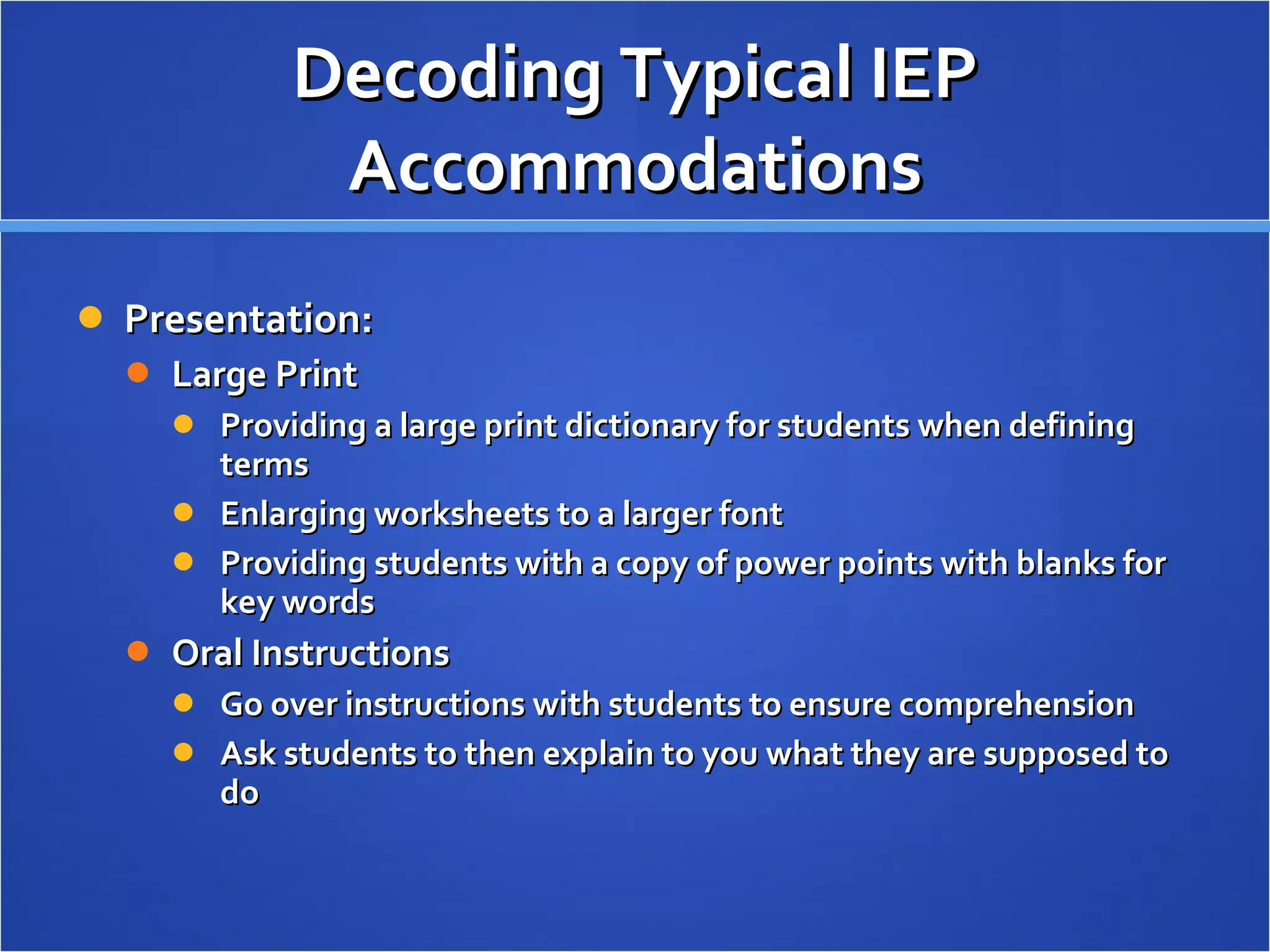
Decoding Typical IEP Accommodations Presentation: Large Print Providing a large print dictionary for students when defining terms Enlarging worksheets to a larger font Providing students with a copy of power points with blanks for key words Oral Instructions Go over instructions with students to ensure comprehension Ask students to then explain to you what they are supposed to do
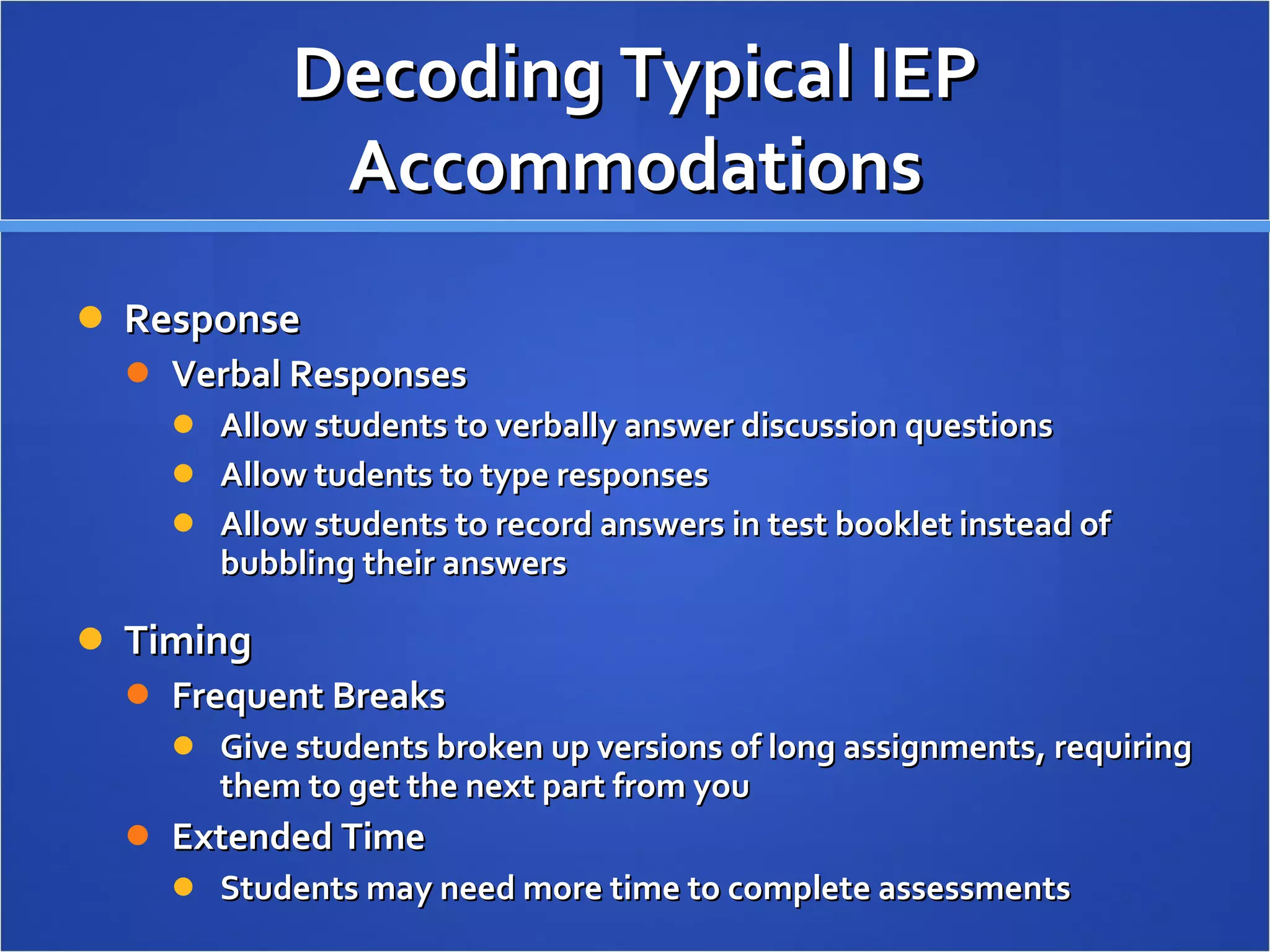
Decoding Typical IEP Accommodations Response Verbal Responses Allow students to verbally answer discussion questions Allow tudents to type responses Allow students to record answers in test booklet instead of bubbling their answers Timing Frequent Breaks Give students broken up versions of long assignments, requiring them to get the next part from you Extended Time Students may need more time to complete assessments
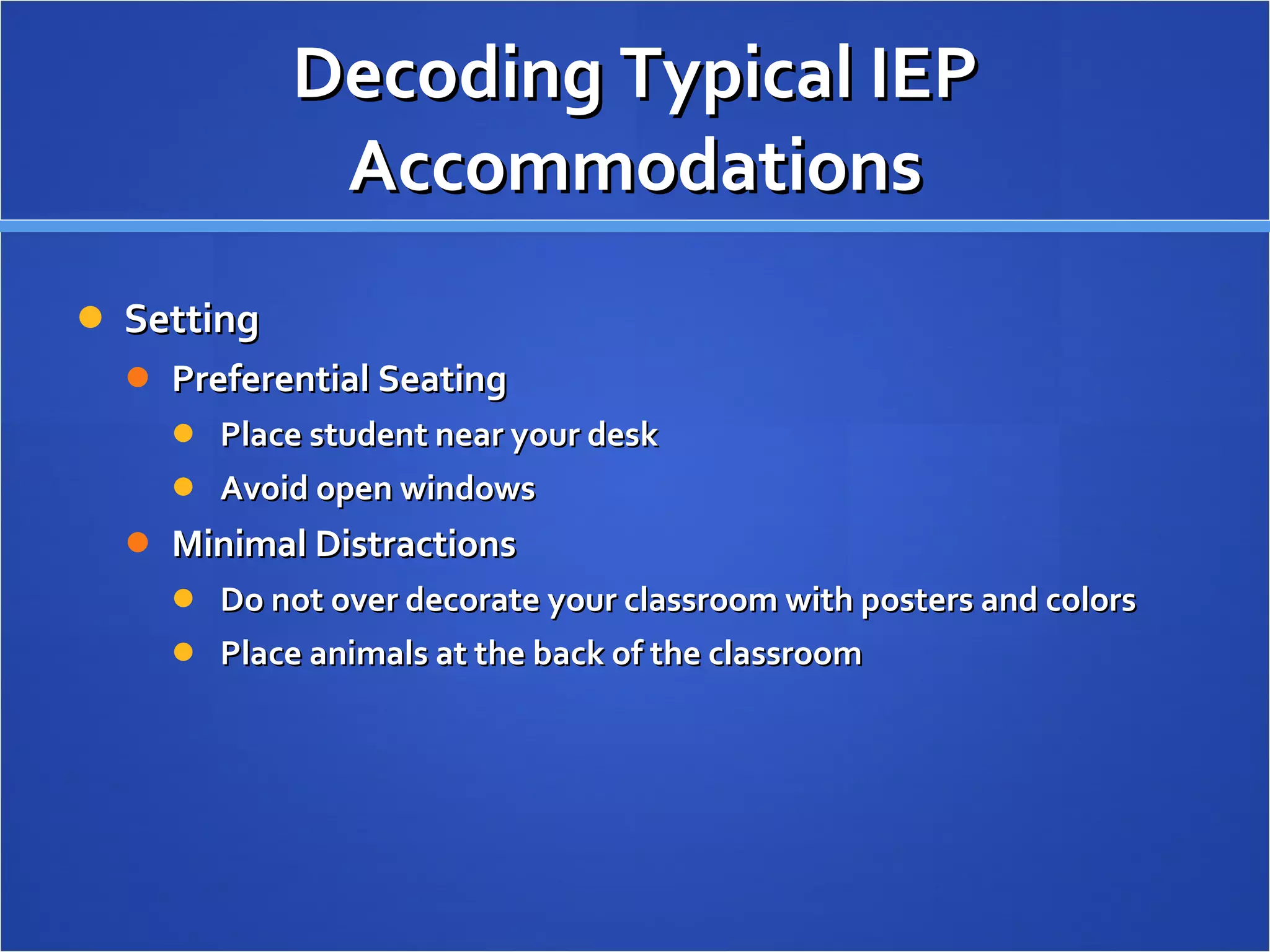
Decoding Typical IEP Accommodations Setting Preferential Seating Place student near your desk  Avoid open windows Minimal Distractions Do not over decorate your classroom with posters and colors Place animals at the back of the classroom
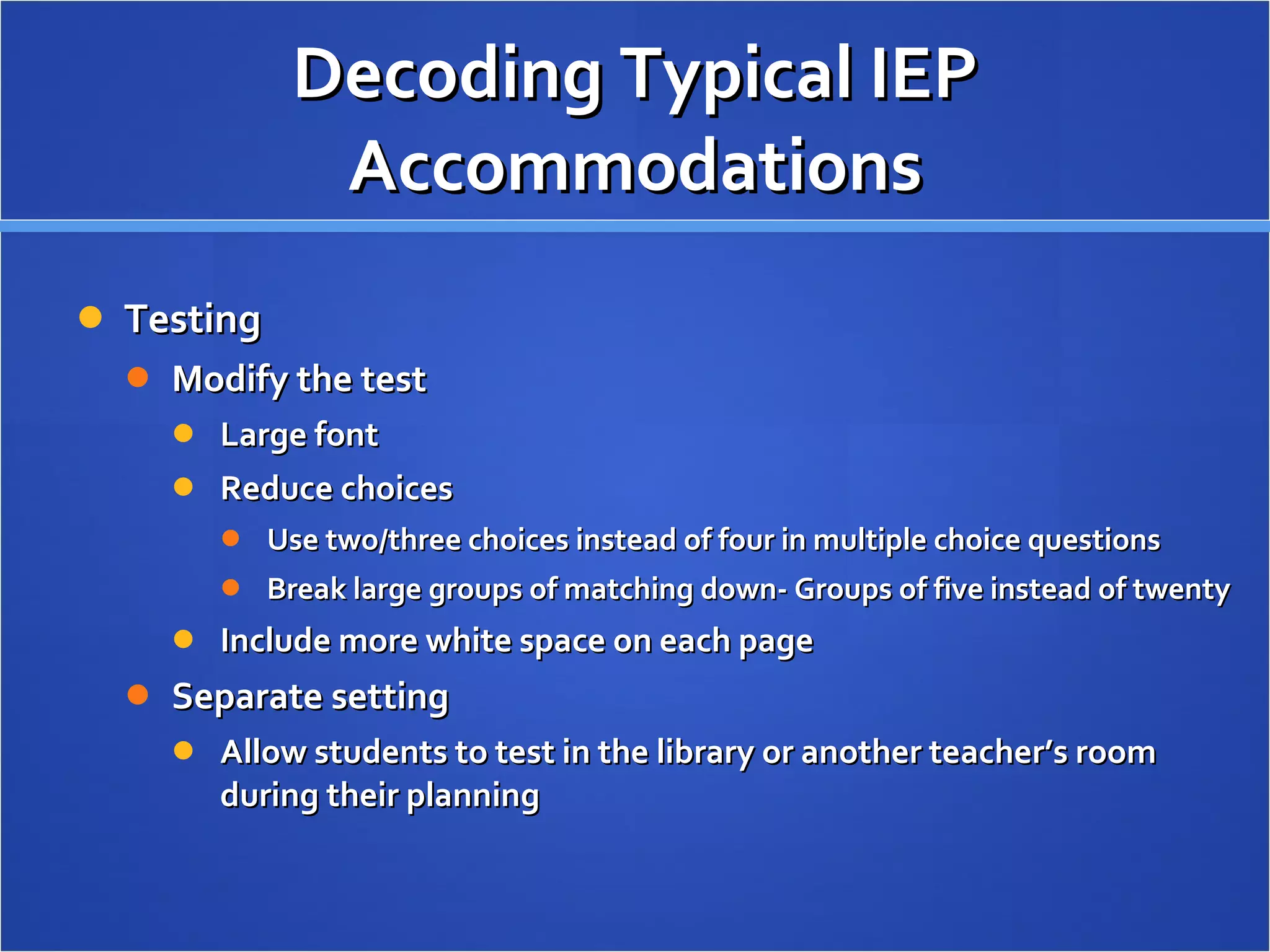
Decoding Typical IEP Accommodations Testing Modify the test Large font Reduce choices Use two/three choices instead of four in multiple choice questions Break large groups of matching down- Groups of five instead of twenty Include more white space on each page Separate setting Allow students to test in the library or another teacher’s room during their planning
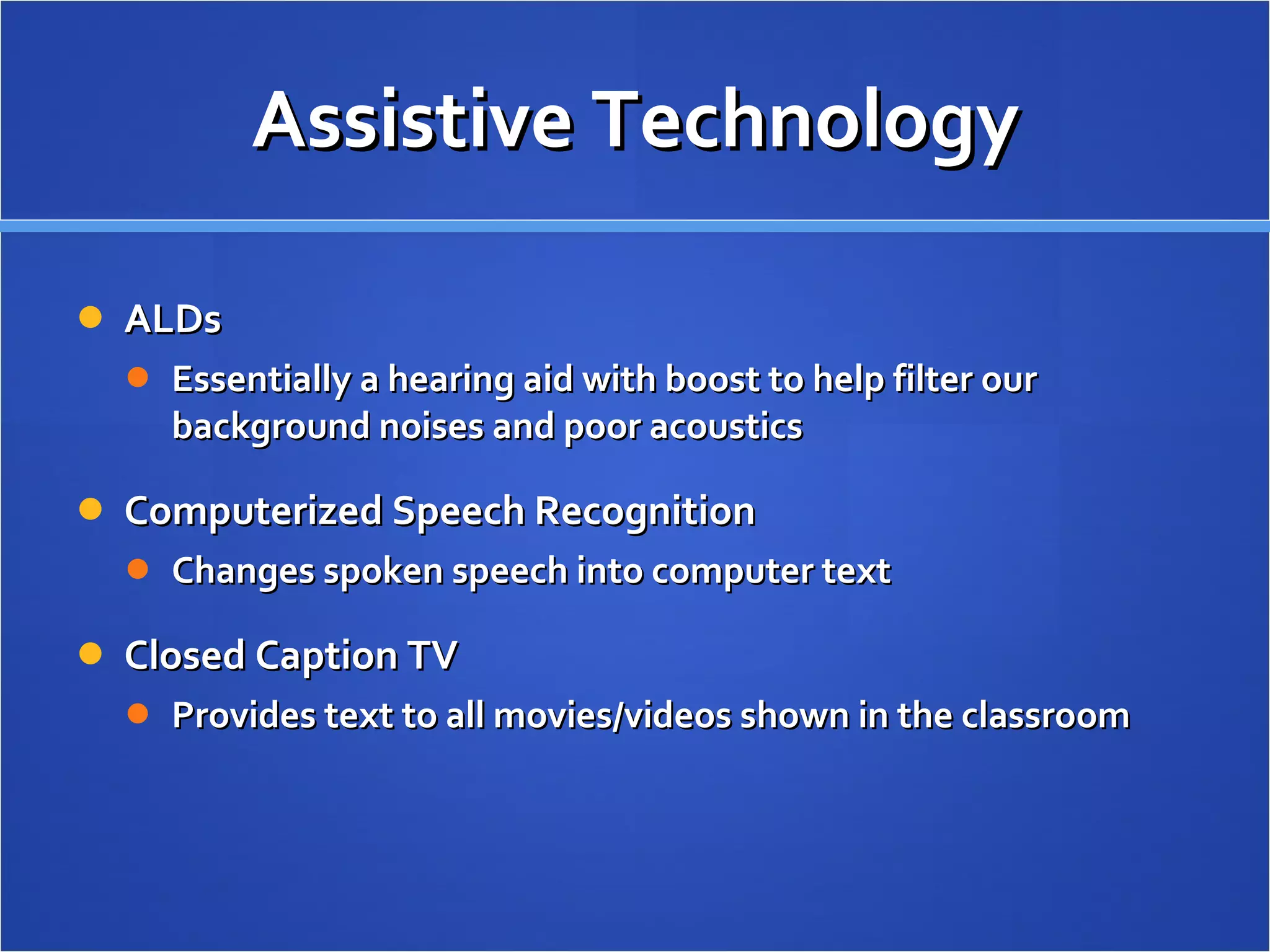
Assistive Technology ALDs Essentially a hearing aid with boost to help filter our background noises and poor acoustics Computerized Speech Recognition Changes spoken speech into computer text Closed Caption TV Provides text to all movies/videos shown in the classroom
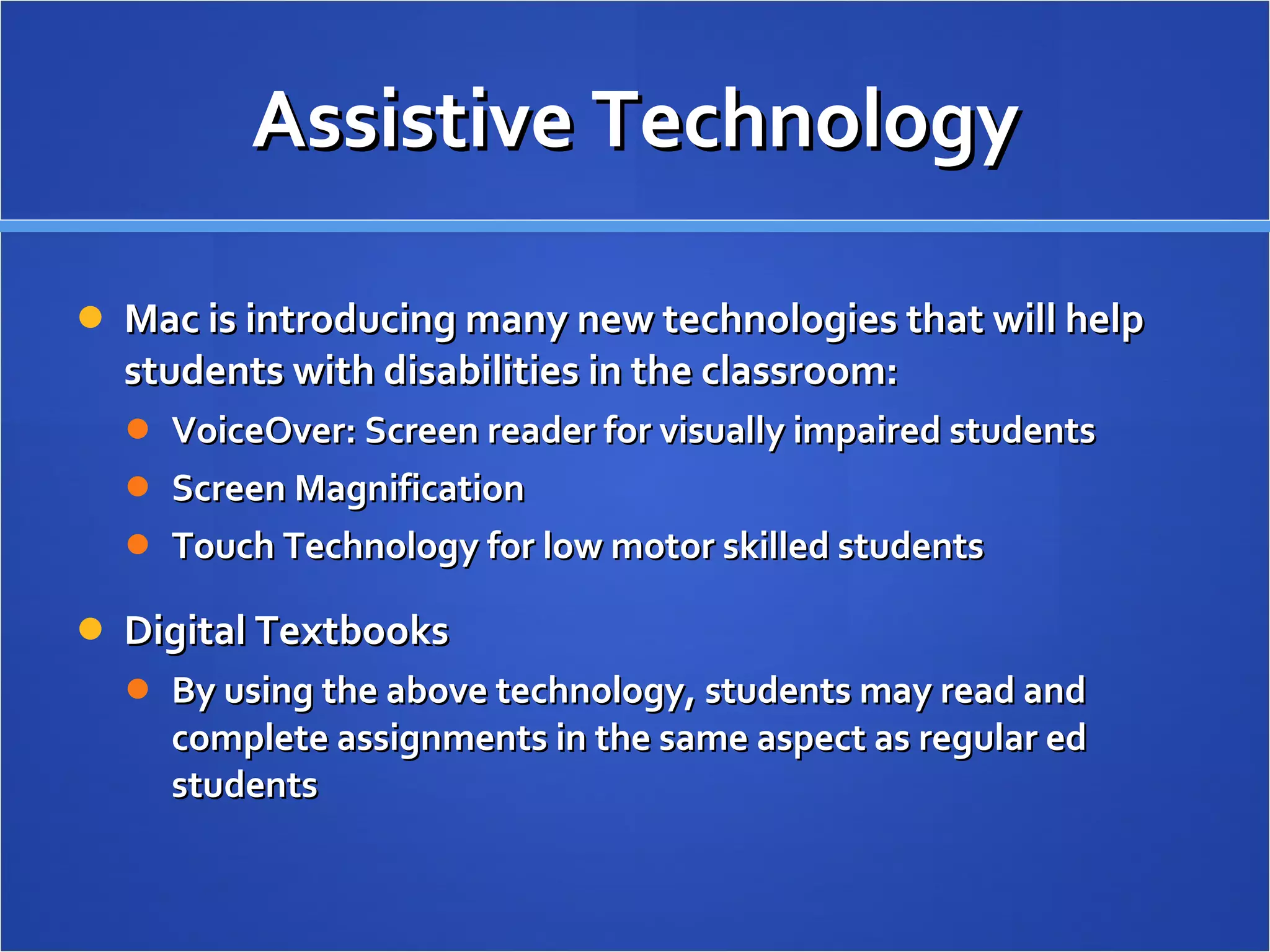
Assistive Technology Mac is introducing many new technologies that will help students with disabilities in the classroom: VoiceOver: Screen reader for visually impaired students Screen Magnification Touch Technology for low motor skilled students Digital Textbooks By using the above technology, students may read and complete assignments in the same aspect as regular ed students
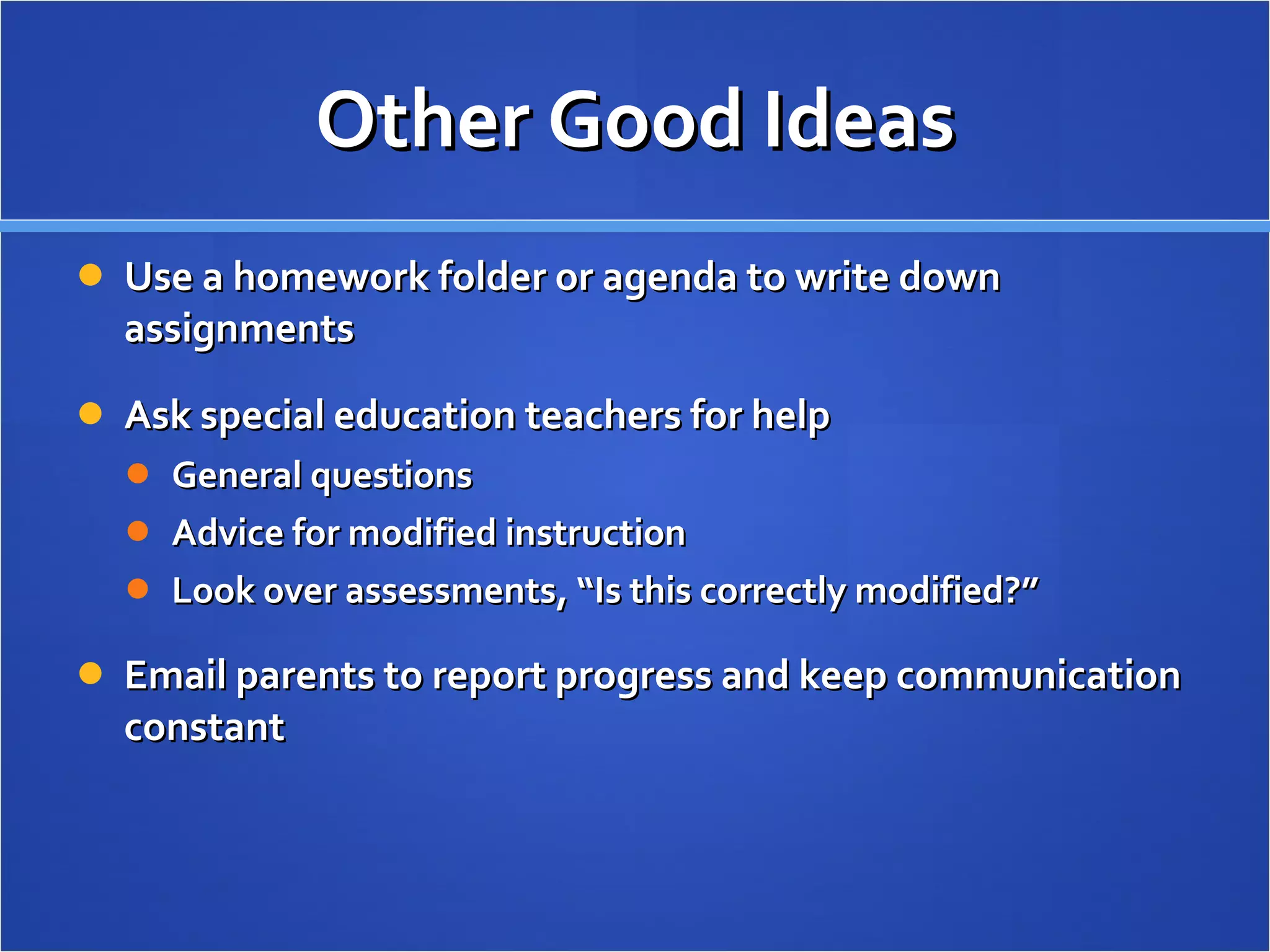
Other Good Ideas Use a homework folder or agenda to write down assignments Ask special education teachers for help General questions Advice for modified instruction Look over assessments, “Is this correctly modified?” Email parents to report progress and keep communication constant
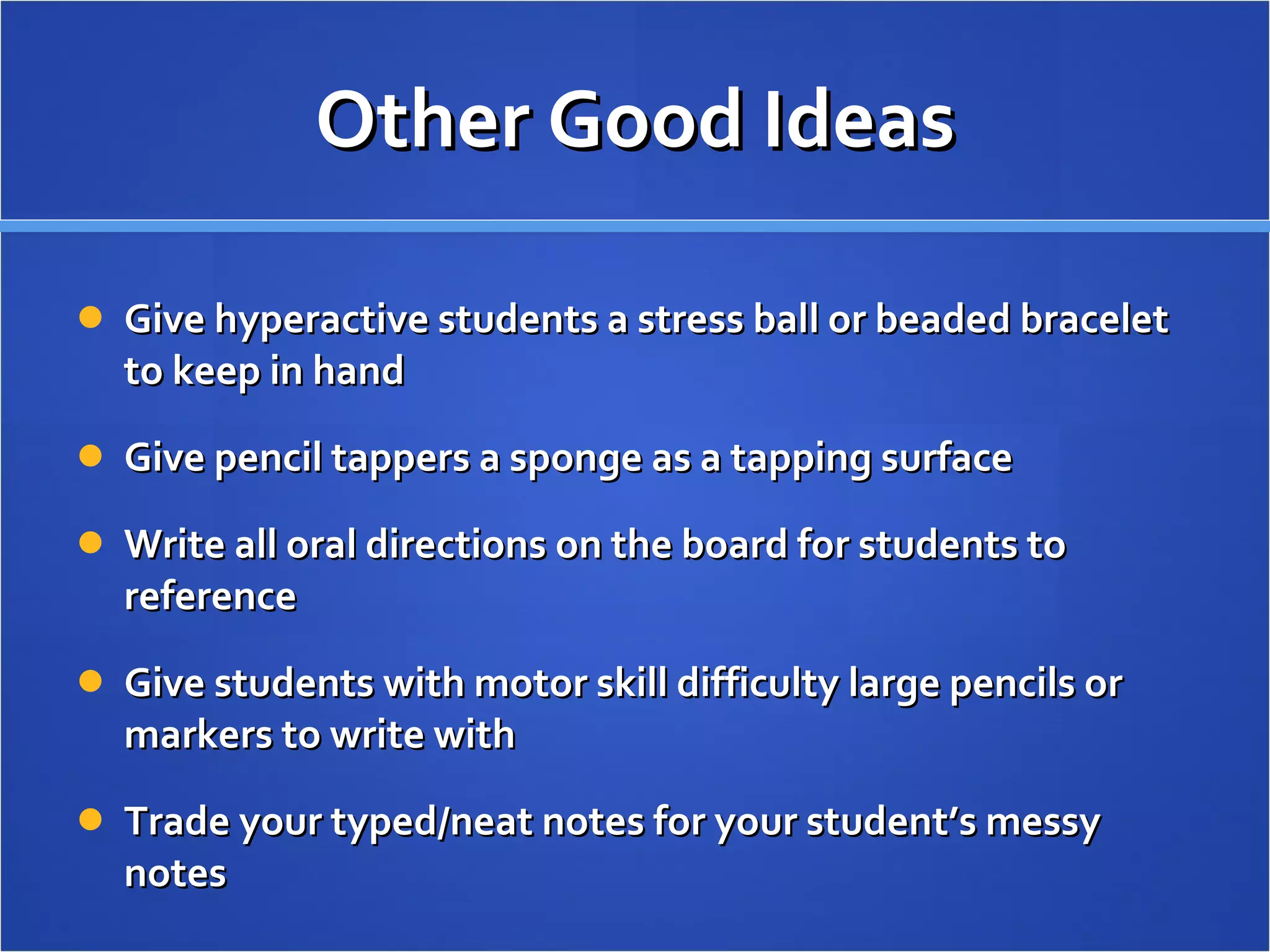
Other Good Ideas Give hyperactive students a stress ball or beaded bracelet to keep in hand Give pencil tappers a sponge as a tapping surface Write all oral directions on the board for students to reference Give students with motor skill difficulty large pencils or markers to write with Trade your typed/neat notes for your student’s messy notes
Other Good Ideas Talk to former/current teachers for techniques they use(d) for a particular student Talk to the student… ask them what they need or what would help them in class Teach study/note taking skills
Resources http://kidshealth.org/parent/positive/learning/iep.html http://kidshealth.org/parent/medical/learning/adhd.html#a_ADHD%20in%20the%20Classroom http://www.ldonline.org/article/8022 http://www.examiner.com/x-13056-West-Palm-Beach-K12-Education-Examiner~y2009m6d14-Assistive-technology-in-the-classroom-for-ADHD-students http://www.asha.org/public/hearing/treatment/assist_tech.htm http://www.tsbvi.edu/technology/principles.htm http://www.apple.com/education/resources/ http://en.wikipedia.org/wiki/Least_Restrictive_Environment

Assistive Technology Webquest

  • 1.
    Teaching Students WithSpecial Needs Navigating the World of IEPs and Accommodations With No Fear!
  • 2.
    Regular Teachers andSpecial Children Regular education teachers are expected to teach special education students with as much passion as those who are considered regular education students. Incorporating your special ed students into the positive community of your classroom is not hard! Sometimes you may need to make minor changes to assignments, procedures, or even the overall look of your classroom. Using some of the techniques listed in this presentation will help you help your students. Use them with confidence and you will watch your students succeed!
  • 3.
    Qualifying for anIEP Students who have an IEP have a variety of disabilities: ADD/ADHD Autism Hearing/Visual Impairment Speech/Language Impairment Mental Retardation Development Delay Emotional/Behavioral Disorder Other Health Impairment (OHI)
  • 4.
    IEP Lingo “Least Restrictive Environment” Students with IEPs are now generally served in the regular classroom, resource classes only being offered to those with extreme disabilities. They are entitle to the same education and social opportunities as their non-disabled peers. Inclusion This is the term used to describe including special ed students into the regular population. They attend the same classes as other students, but may receive additional support from inclusion teachers and receive accommodations. Accommodations This term is used to describe the changes educators are expected to make in the child’s daily educational routine.
  • 5.
    Decoding Typical IEPAccommodations Presentation: Large Print Providing a large print dictionary for students when defining terms Enlarging worksheets to a larger font Providing students with a copy of power points with blanks for key words Oral Instructions Go over instructions with students to ensure comprehension Ask students to then explain to you what they are supposed to do
  • 6.
    Decoding Typical IEPAccommodations Response Verbal Responses Allow students to verbally answer discussion questions Allow tudents to type responses Allow students to record answers in test booklet instead of bubbling their answers Timing Frequent Breaks Give students broken up versions of long assignments, requiring them to get the next part from you Extended Time Students may need more time to complete assessments
  • 7.
    Decoding Typical IEPAccommodations Setting Preferential Seating Place student near your desk Avoid open windows Minimal Distractions Do not over decorate your classroom with posters and colors Place animals at the back of the classroom
  • 8.
    Decoding Typical IEPAccommodations Testing Modify the test Large font Reduce choices Use two/three choices instead of four in multiple choice questions Break large groups of matching down- Groups of five instead of twenty Include more white space on each page Separate setting Allow students to test in the library or another teacher’s room during their planning
  • 9.
    Assistive Technology ALDsEssentially a hearing aid with boost to help filter our background noises and poor acoustics Computerized Speech Recognition Changes spoken speech into computer text Closed Caption TV Provides text to all movies/videos shown in the classroom
  • 10.
    Assistive Technology Macis introducing many new technologies that will help students with disabilities in the classroom: VoiceOver: Screen reader for visually impaired students Screen Magnification Touch Technology for low motor skilled students Digital Textbooks By using the above technology, students may read and complete assignments in the same aspect as regular ed students
  • 11.
    Other Good IdeasUse a homework folder or agenda to write down assignments Ask special education teachers for help General questions Advice for modified instruction Look over assessments, “Is this correctly modified?” Email parents to report progress and keep communication constant
  • 12.
    Other Good IdeasGive hyperactive students a stress ball or beaded bracelet to keep in hand Give pencil tappers a sponge as a tapping surface Write all oral directions on the board for students to reference Give students with motor skill difficulty large pencils or markers to write with Trade your typed/neat notes for your student’s messy notes
  • 13.
    Other Good IdeasTalk to former/current teachers for techniques they use(d) for a particular student Talk to the student… ask them what they need or what would help them in class Teach study/note taking skills
  • 14.
    Resources http://kidshealth.org/parent/positive/learning/iep.html http://kidshealth.org/parent/medical/learning/adhd.html#a_ADHD%20in%20the%20Classroomhttp://www.ldonline.org/article/8022 http://www.examiner.com/x-13056-West-Palm-Beach-K12-Education-Examiner~y2009m6d14-Assistive-technology-in-the-classroom-for-ADHD-students http://www.asha.org/public/hearing/treatment/assist_tech.htm http://www.tsbvi.edu/technology/principles.htm http://www.apple.com/education/resources/ http://en.wikipedia.org/wiki/Least_Restrictive_Environment