Learning Strategies for the ESOL Classroom A Power Point Guide
Overview Teaching ESOL students different learning strategies can help them take responsibility for their own learning. It also gives them a variety of tools to use in their learning and understanding in all subjects. The following concepts are just a few important strategies to employ.
Set Goals ASK :  What is my goal for this task? What do I want to be able to do? Why :  To identify purpose for doing something, and plan steps to achieve it. Strategy 1:
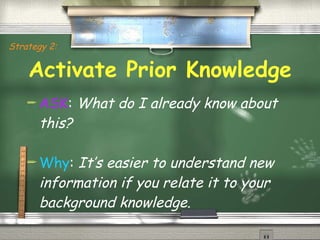
Activate Prior Knowledge ASK :  What do I already know about this? Why :  It’s easier to understand new information if you relate it to your background knowledge. Strategy 2:
Predict ASK :  What do I think will happen? Why :  Thinking about information you might encounter and modifying previous predictions will help with understanding. Strategy 3:
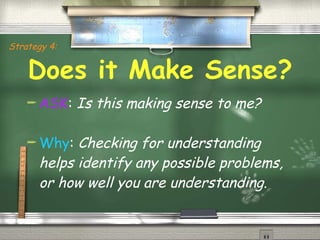
Does it Make Sense? ASK :  Is this making sense to me? Why :  Checking for understanding helps identify any possible problems, or how well you are understanding. Strategy 4:
Use Imagery ASK :  Can I imagine this situation or draw a picture in my head? Why :  Forming mental pictures helps to check for correct information. Strategy 5:
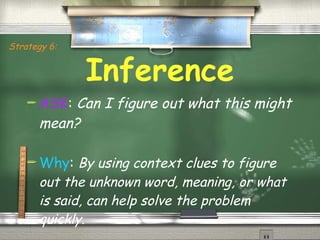
Inference ASK :  Can I figure out what this might mean? Why :  By using context clues to figure out the unknown word, meaning, or what is said, can help solve the problem quickly. Strategy 6:
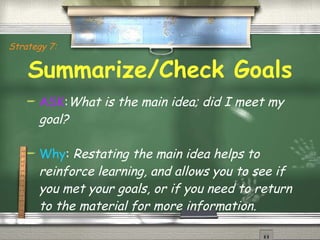
Summarize/Check Goals ASK : What is the main idea; did I meet my goal? Why :  Restating the main idea helps to reinforce learning, and allows you to see if you met your goals, or if you need to return to the material for more information. Strategy 7:
In closing, if the strategies are taught in an ESOL class; Start slowly with 1 strategy (one they may be familiar with in their own language). Write the strategy name and say it out loud. Demonstrate how to use it using simple language, gestures, and repetition. Practice the strategy often before introducing a different one. Happy Learning!

Assignment4a

  • 1.
    Learning Strategies forthe ESOL Classroom A Power Point Guide
  • 2.
    Overview Teaching ESOLstudents different learning strategies can help them take responsibility for their own learning. It also gives them a variety of tools to use in their learning and understanding in all subjects. The following concepts are just a few important strategies to employ.
  • 3.
    Set Goals ASK: What is my goal for this task? What do I want to be able to do? Why : To identify purpose for doing something, and plan steps to achieve it. Strategy 1:
  • 4.
    Activate Prior KnowledgeASK : What do I already know about this? Why : It’s easier to understand new information if you relate it to your background knowledge. Strategy 2:
  • 5.
    Predict ASK : What do I think will happen? Why : Thinking about information you might encounter and modifying previous predictions will help with understanding. Strategy 3:
  • 6.
    Does it MakeSense? ASK : Is this making sense to me? Why : Checking for understanding helps identify any possible problems, or how well you are understanding. Strategy 4:
  • 7.
    Use Imagery ASK: Can I imagine this situation or draw a picture in my head? Why : Forming mental pictures helps to check for correct information. Strategy 5:
  • 8.
    Inference ASK : Can I figure out what this might mean? Why : By using context clues to figure out the unknown word, meaning, or what is said, can help solve the problem quickly. Strategy 6:
  • 9.
    Summarize/Check Goals ASK: What is the main idea; did I meet my goal? Why : Restating the main idea helps to reinforce learning, and allows you to see if you met your goals, or if you need to return to the material for more information. Strategy 7:
  • 10.
    In closing, ifthe strategies are taught in an ESOL class; Start slowly with 1 strategy (one they may be familiar with in their own language). Write the strategy name and say it out loud. Demonstrate how to use it using simple language, gestures, and repetition. Practice the strategy often before introducing a different one. Happy Learning!