Assignment: Interpretation of Financial Statements and
Investment Appraisal
This assignment will provide you with an opportunity to present
evidence of achievement towards the following learning
outcome and criteria.
LO:
1 Understand the relationship between organisational structure
and culture
2 Understand different approaches to management and
leadership
3 Understand ways of using motivational theories in
organisations
4 Understand mechanisms for developing effective teamwork in
organisations
P – Learner should able to demonstrate the ability to explain
each outcome as per to the Assessment information page of this
assignment.
Introduction
This unit will give learners a foundation in financial principles
and techniques
relevant to the strategic management process. It encourages
learners to explore
the nature of cost-based financial data and information, the
impact of the
budgeting process on the organization, and the development of
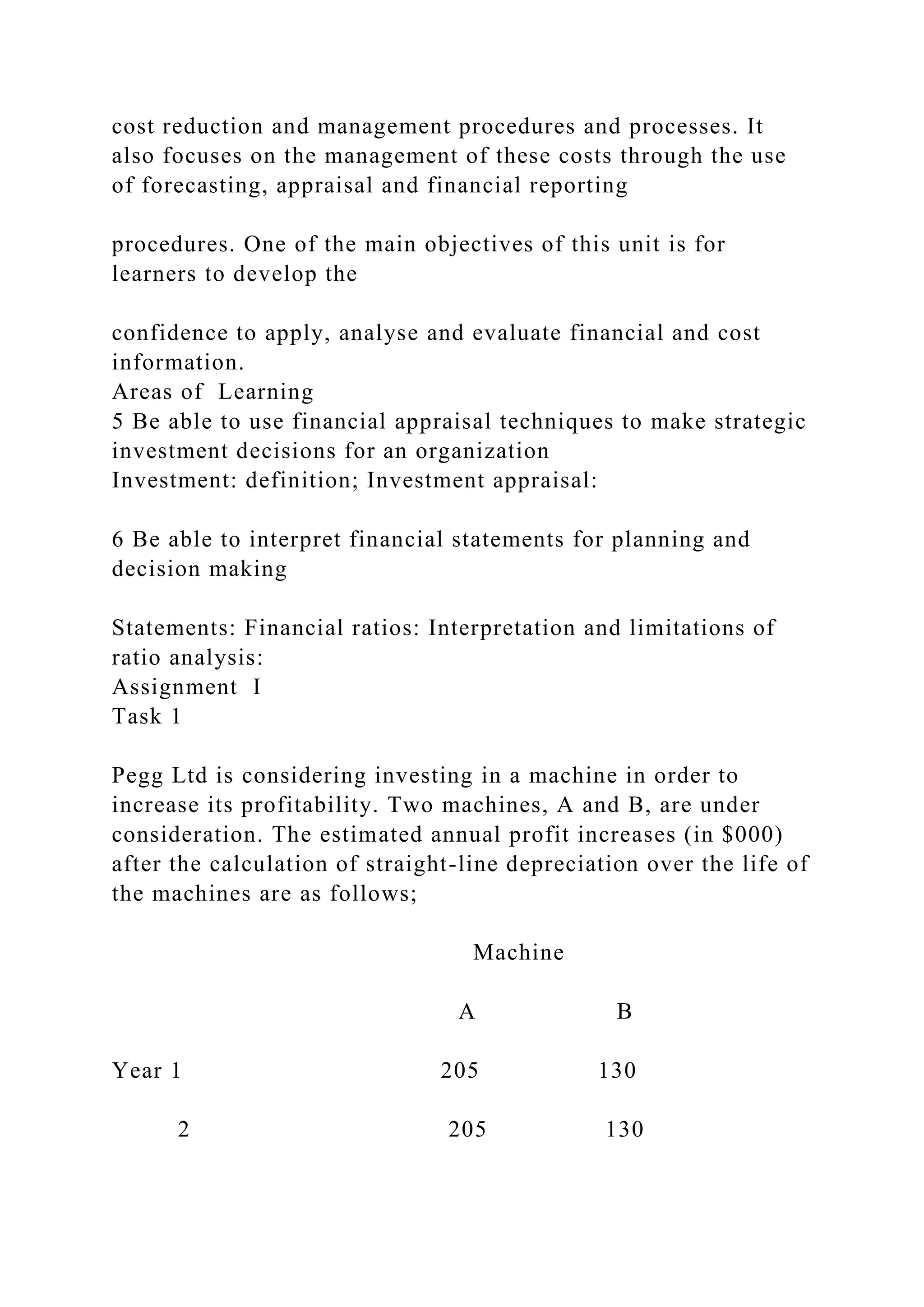
cost reduction and management procedures and processes. It
also focuses on the management of these costs through the use
of forecasting, appraisal and financial reporting
procedures. One of the main objectives of this unit is for
learners to develop the
confidence to apply, analyse and evaluate financial and cost
information.
Areas of Learning
5 Be able to use financial appraisal techniques to make strategic
investment decisions for an organization
Investment: definition; Investment appraisal:
6 Be able to interpret financial statements for planning and
decision making
Statements: Financial ratios: Interpretation and limitations of
ratio analysis:
Assignment I
Task 1
Pegg Ltd is considering investing in a machine in order to
increase its profitability. Two machines, A and B, are under
consideration. The estimated annual profit increases (in $000)
after the calculation of straight-line depreciation over the life of
the machines are as follows;
Machine
A B
Year 1 205 130
2 205 130
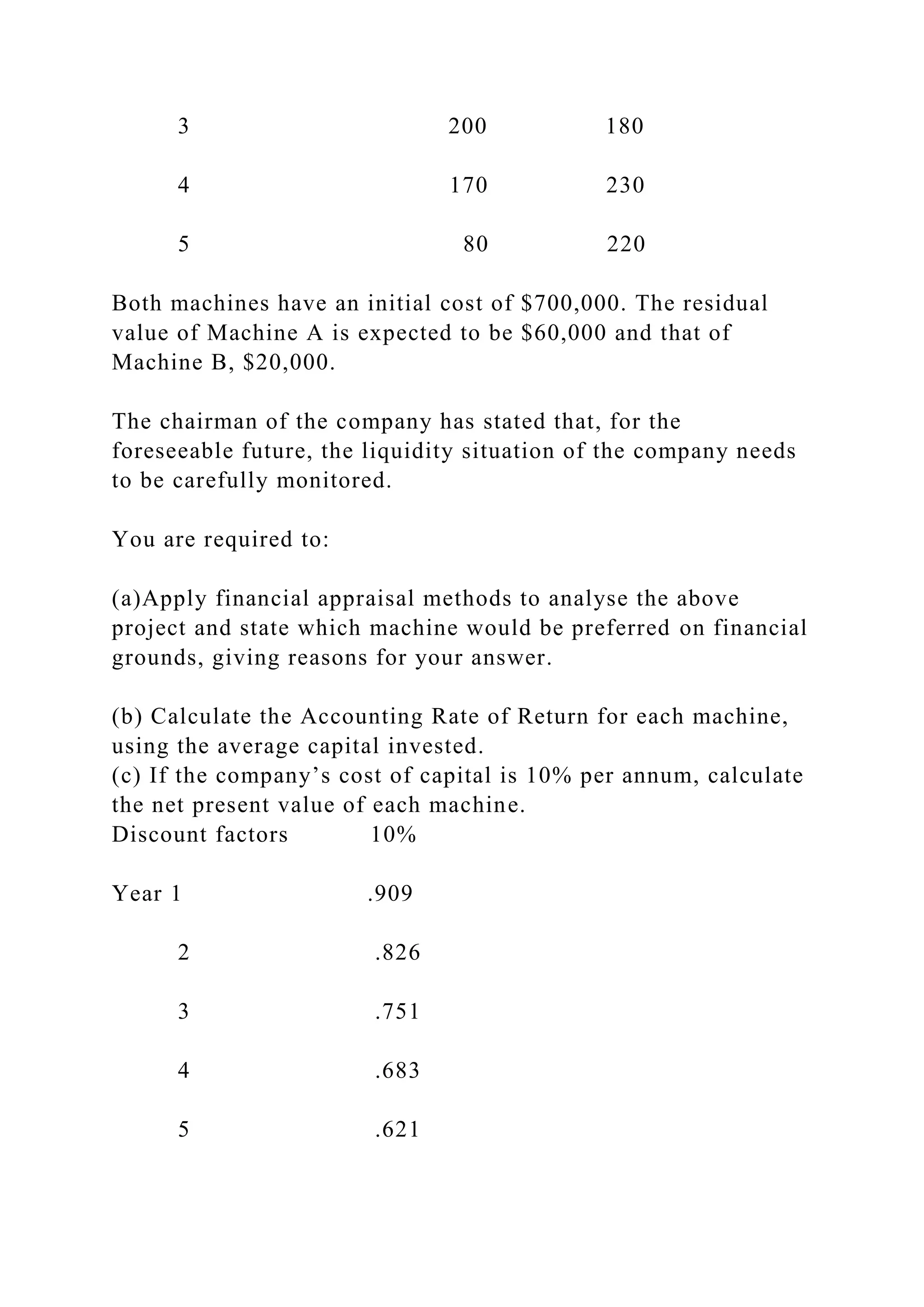
3 200 180
4 170 230
5 80 220
Both machines have an initial cost of $700,000. The residual
value of Machine A is expected to be $60,000 and that of
Machine B, $20,000.
The chairman of the company has stated that, for the
foreseeable future, the liquidity situation of the company needs
to be carefully monitored.
You are required to:
(a)Apply financial appraisal methods to analyse the above
project and state which machine would be preferred on financial
grounds, giving reasons for your answer.
(b) Calculate the Accounting Rate of Return for each machine,
using the average capital invested.
(c) If the company’s cost of capital is 10% per annum, calculate
the net present value of each machine.
Discount factors 10%
Year 1 .909
2 .826
3 .751
4 .683
5 .621
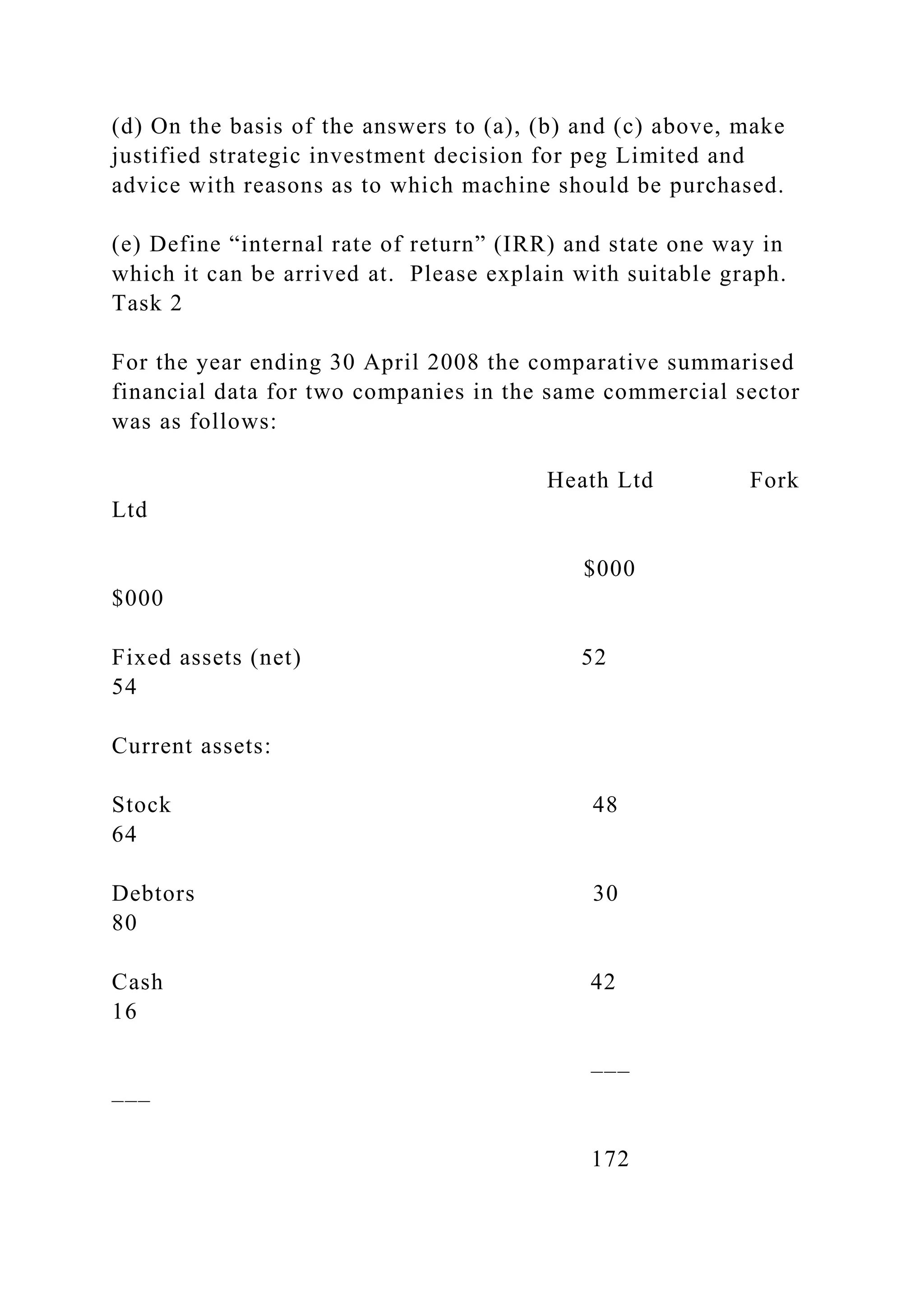
(d) On the basis of the answers to (a), (b) and (c) above, make
justified strategic investment decision for peg Limited and
advice with reasons as to which machine should be purchased.
(e) Define “internal rate of return” (IRR) and state one way in
which it can be arrived at. Please explain with suitable graph.
Task 2
For the year ending 30 April 2008 the comparative summarised
financial data for two companies in the same commercial sector
was as follows:
Heath Ltd Fork
Ltd
$000
$000
Fixed assets (net) 52
54
Current assets:
Stock 48
64
Debtors 30
80
Cash 42
16
–––
–––
172
214
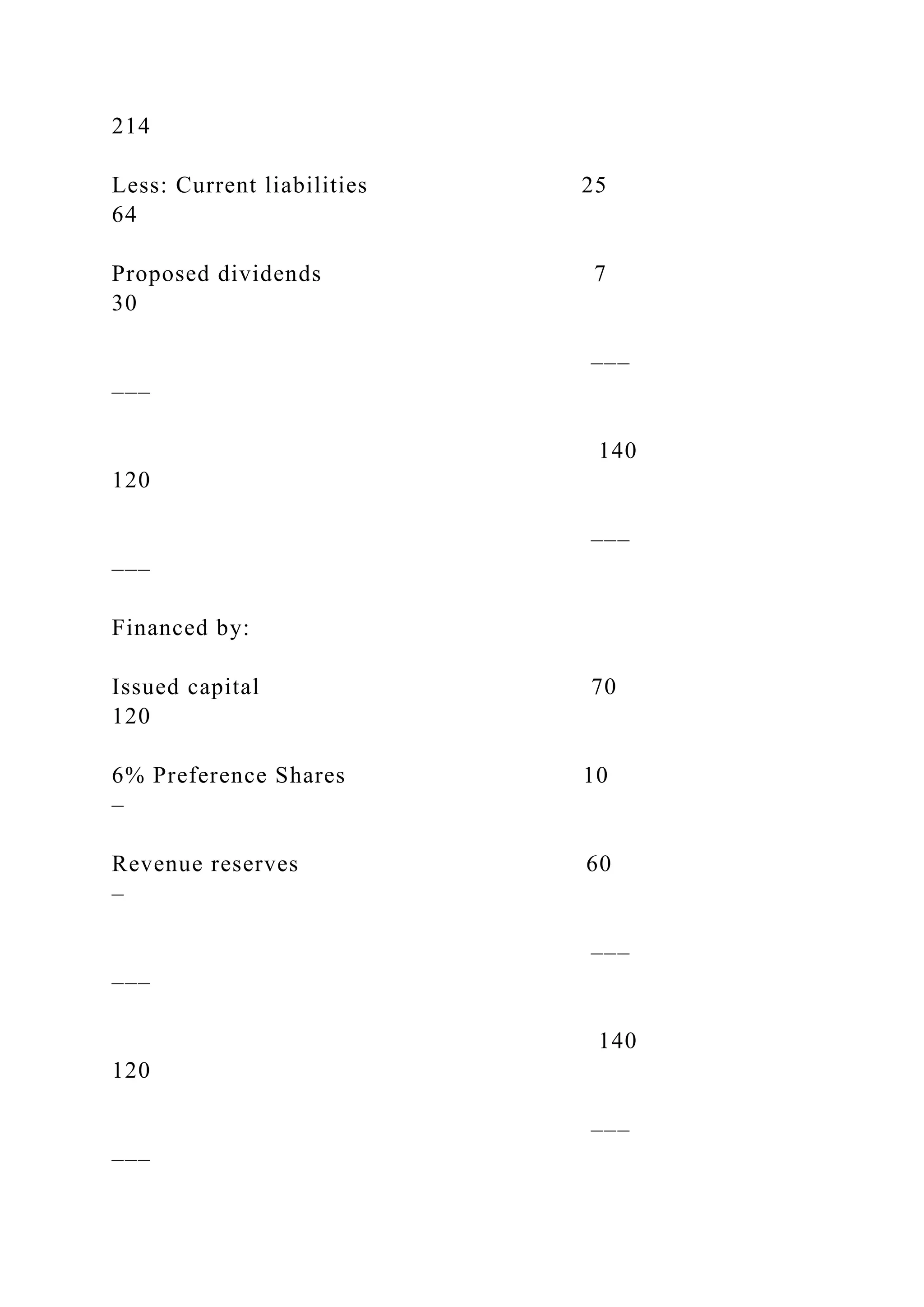
Less: Current liabilities 25
64
Proposed dividends 7
30
–––
–––
140
120
–––
–––
Financed by:
Issued capital 70
120
6% Preference Shares 10
–
Revenue reserves 60
–
–––
–––
140
120
–––
–––
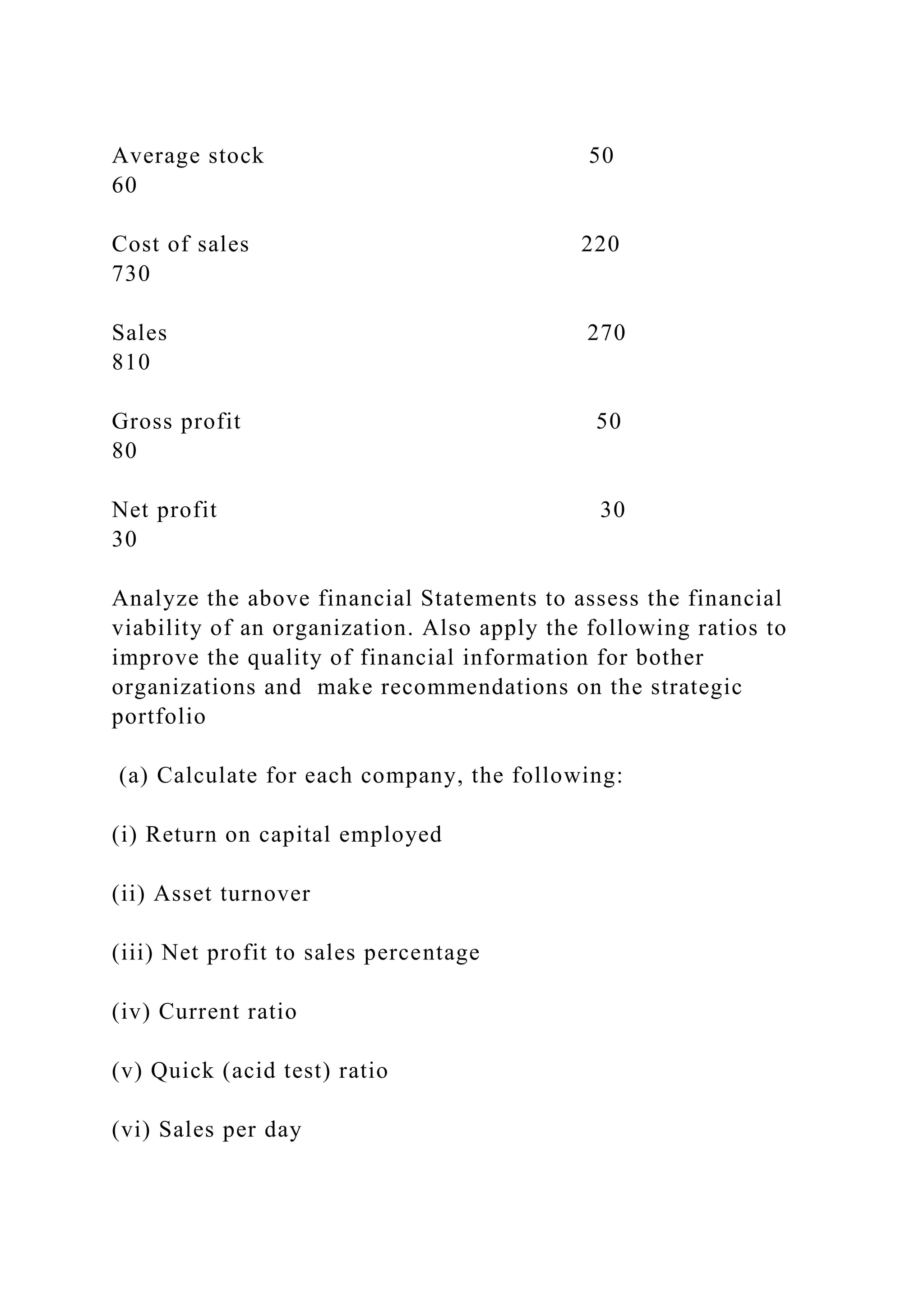
Average stock 50
60
Cost of sales 220
730
Sales 270
810
Gross profit 50
80
Net profit 30
30
Analyze the above financial Statements to assess the financial
viability of an organization. Also apply the following ratios to
improve the quality of financial information for bother
organizations and make recommendations on the strategic
portfolio
(a) Calculate for each company, the following:
(i) Return on capital employed
(ii) Asset turnover
(iii) Net profit to sales percentage
(iv) Current ratio
(v) Quick (acid test) ratio
(vi) Sales per day
(vii) Debtor days (assume 360 days per year)
(viii) Stock turnover ratio
Submissions
There is no stipulated length for the work but it should not
exceed 1500 words for both tasks for 1 & 2. All work must be
delivered in hard copy and soft copy, for your own security it is
important to keep both copies for yourself. All assignments
should be properly referenced.
Assessment Information
Grading Criteria
All Assignments will be assessed according to the following
grading.
Pass:
To achieve each outcome a learner must demonstrate the ability
to:
5 Be able to use financial appraisal techniques to make strategic
investment decisions for an organisation
5.1 apply financial appraisal methods to analyse competing
investment
projects in the public and private sector
5.2 make a justified strategic investment decision for an
organisation using relevant financial information
5.3 report on the appropriateness of a strategic investment
decision
using information from a post audit appraisal
6 Be able to interpret financial statements for planning and
decision
making
6.1 analyse financial statements to assess the financial viability
of an
organisation
6.2 apply financial ratios to improve the quality of financial
information
in an organisation’s financial statements
6.3 make recommendations on the strategic portfolio of an
organisation based on its financial information
Reference
Textbooks
Textbooks
Atrill P and McLaney E – Management Accounting for Non-
specialists, 3rd Edition
(Financial Times/Prentice Hall, 2002) ISBN 0273655914
Berry A and Jarvis R – Accounting in a Business Context, 4th
Edition (Cengage
Learning EMEA, 2005) ISBN 1844802515
Brookson S – Managing Budgets (Dorling Kindersley, 2000)
ISBN 0751307718
Cox D and Fardon M – Management of Finance (Osborne
Books, 1997)
ISBN 872962238
Drury C – Management Accounting for Business, 4th Edition
(Cengage Learning EMEA, 2009) ISBN 1408017717
Glynn J, Perrin J, Murphy M and Abraham A – Accounting for
Managers, 3rd Edition(Thomson Learning, 2003) ISBN
186152904X
Harris R and Sollis R – Applied Time Series Modelling and
Forecasting (John Wiley and Sons, 2003) ISBN 0470844434
Lumby S and Jones C – The Fundamentals of Investment
Appraisal (Thomson
Learning, 2000) ISBN 1861526075
Monden Y – Cost Reduction Systems: Target Costing and
Kaizen Costing
(Productivity Press, 1995) ISBN 1563270684
Makridakis S, Wheelwright S C and Hyndman R J –
Forecasting, 3rd Edition (John Wiley and Sons, 1998) ISBN
0471532339
Pettinger R – Investment Appraisal: A Managerial Approach
(Palgrave Macmillan, 2000) ISBN 0333800591
Secrett M – Mastering Spreadsheets, Budgets and Forecasts, 3rd
Edition (Financial Times/Prentice Hall, 1999) ISBN
0273644912
White G I, Sondhi A C and Fried D – The Analysis and Use of
Financial Statements, 3rd Edition (John Wiley and Sons, 2003)
ISBN 0471375942
Yoshikawa T, Innes J and Mitchell F – Strategic Value Analysis
(Financial
Times/Prentice Hall, 2002) ISBN 0273654292
Journals/newspapers
The Financial Times, The Guardian, The
Independent and The Times.
Management Accounting Quarterly (Institute of Management
Accountants)
Management Today (Haymarket Business Media)
Strategic Finance (Institute of Management Accountants)
Websites
www.aat.co.uk Association of Accounting Technicians
www.bized.co.uk Learning materials and a wide range of
company information
www.cimaglobal.com Chartered Institute of Management
Accountants
www.cipfa.org.uk Chartered Institute of Public Finance and
Accountancy
www.companies-house.gov.uk Companies House
http://corporate.marksandspencer.com Example of company
website containing
information on its published accounts
www.guardian.co.uk Example broadsheet newspaper website
www.icaew.co.uk Institute of Chartered Accountants in
England and Wales
www.icsa.org.uk Institute of Chartered Secretaries and
administration
www.thetimes100.co.uk
Assignment Instructions
Students are requested to comply with the following
instructions on handing in their assignment work
· Do Not Use bullet points and restrict the use of numberings
· Work should be comprehensively referenced
· Sources must be acknowledged fully by reference books,
journals used and URL visited
· Include the Harvard Referencing System (guide is available
on the college resources portal)
· All work should be word-processed, font size of 12 and font
style of Times New Roman. Subtitles of the assignment /
dissertation should be in the font size of 14.
· Pages should be numbered in bottom right hand corner
· Spell check the document and read thoroughly for grammatical
errors
· 1.5-line spacing is preferable
· Bibliography at the end of the assignment
· All paragraphs should be aligned in justified mode.
Assignment Interpretation of Financial Statements and Investment .docx

Assignment Interpretation of Financial Statements and Investment .docx

  • 1.
    Assignment: Interpretation ofFinancial Statements and Investment Appraisal This assignment will provide you with an opportunity to present evidence of achievement towards the following learning outcome and criteria. LO: 1 Understand the relationship between organisational structure and culture 2 Understand different approaches to management and leadership 3 Understand ways of using motivational theories in organisations 4 Understand mechanisms for developing effective teamwork in organisations P – Learner should able to demonstrate the ability to explain each outcome as per to the Assessment information page of this assignment. Introduction This unit will give learners a foundation in financial principles and techniques relevant to the strategic management process. It encourages learners to explore the nature of cost-based financial data and information, the impact of the budgeting process on the organization, and the development of
  • 2.
    cost reduction andmanagement procedures and processes. It also focuses on the management of these costs through the use of forecasting, appraisal and financial reporting procedures. One of the main objectives of this unit is for learners to develop the confidence to apply, analyse and evaluate financial and cost information. Areas of Learning 5 Be able to use financial appraisal techniques to make strategic investment decisions for an organization Investment: definition; Investment appraisal: 6 Be able to interpret financial statements for planning and decision making Statements: Financial ratios: Interpretation and limitations of ratio analysis: Assignment I Task 1 Pegg Ltd is considering investing in a machine in order to increase its profitability. Two machines, A and B, are under consideration. The estimated annual profit increases (in $000) after the calculation of straight-line depreciation over the life of the machines are as follows; Machine A B Year 1 205 130 2 205 130
  • 3.
    3 200 180 4170 230 5 80 220 Both machines have an initial cost of $700,000. The residual value of Machine A is expected to be $60,000 and that of Machine B, $20,000. The chairman of the company has stated that, for the foreseeable future, the liquidity situation of the company needs to be carefully monitored. You are required to: (a)Apply financial appraisal methods to analyse the above project and state which machine would be preferred on financial grounds, giving reasons for your answer. (b) Calculate the Accounting Rate of Return for each machine, using the average capital invested. (c) If the company’s cost of capital is 10% per annum, calculate the net present value of each machine. Discount factors 10% Year 1 .909 2 .826 3 .751 4 .683 5 .621
  • 4.
    (d) On thebasis of the answers to (a), (b) and (c) above, make justified strategic investment decision for peg Limited and advice with reasons as to which machine should be purchased. (e) Define “internal rate of return” (IRR) and state one way in which it can be arrived at. Please explain with suitable graph. Task 2 For the year ending 30 April 2008 the comparative summarised financial data for two companies in the same commercial sector was as follows: Heath Ltd Fork Ltd $000 $000 Fixed assets (net) 52 54 Current assets: Stock 48 64 Debtors 30 80 Cash 42 16 ––– ––– 172
  • 5.
    214 Less: Current liabilities25 64 Proposed dividends 7 30 ––– ––– 140 120 ––– ––– Financed by: Issued capital 70 120 6% Preference Shares 10 – Revenue reserves 60 – ––– ––– 140 120 ––– –––
  • 6.
    Average stock 50 60 Costof sales 220 730 Sales 270 810 Gross profit 50 80 Net profit 30 30 Analyze the above financial Statements to assess the financial viability of an organization. Also apply the following ratios to improve the quality of financial information for bother organizations and make recommendations on the strategic portfolio (a) Calculate for each company, the following: (i) Return on capital employed (ii) Asset turnover (iii) Net profit to sales percentage (iv) Current ratio (v) Quick (acid test) ratio (vi) Sales per day
  • 7.
    (vii) Debtor days(assume 360 days per year) (viii) Stock turnover ratio Submissions There is no stipulated length for the work but it should not exceed 1500 words for both tasks for 1 & 2. All work must be delivered in hard copy and soft copy, for your own security it is important to keep both copies for yourself. All assignments should be properly referenced. Assessment Information Grading Criteria All Assignments will be assessed according to the following grading. Pass: To achieve each outcome a learner must demonstrate the ability to: 5 Be able to use financial appraisal techniques to make strategic investment decisions for an organisation 5.1 apply financial appraisal methods to analyse competing investment projects in the public and private sector 5.2 make a justified strategic investment decision for an organisation using relevant financial information 5.3 report on the appropriateness of a strategic investment decision using information from a post audit appraisal
  • 8.
    6 Be ableto interpret financial statements for planning and decision making 6.1 analyse financial statements to assess the financial viability of an organisation 6.2 apply financial ratios to improve the quality of financial information in an organisation’s financial statements 6.3 make recommendations on the strategic portfolio of an organisation based on its financial information Reference Textbooks Textbooks Atrill P and McLaney E – Management Accounting for Non- specialists, 3rd Edition (Financial Times/Prentice Hall, 2002) ISBN 0273655914 Berry A and Jarvis R – Accounting in a Business Context, 4th Edition (Cengage Learning EMEA, 2005) ISBN 1844802515 Brookson S – Managing Budgets (Dorling Kindersley, 2000) ISBN 0751307718 Cox D and Fardon M – Management of Finance (Osborne
  • 9.
    Books, 1997) ISBN 872962238 DruryC – Management Accounting for Business, 4th Edition (Cengage Learning EMEA, 2009) ISBN 1408017717 Glynn J, Perrin J, Murphy M and Abraham A – Accounting for Managers, 3rd Edition(Thomson Learning, 2003) ISBN 186152904X Harris R and Sollis R – Applied Time Series Modelling and Forecasting (John Wiley and Sons, 2003) ISBN 0470844434 Lumby S and Jones C – The Fundamentals of Investment Appraisal (Thomson Learning, 2000) ISBN 1861526075 Monden Y – Cost Reduction Systems: Target Costing and Kaizen Costing (Productivity Press, 1995) ISBN 1563270684 Makridakis S, Wheelwright S C and Hyndman R J – Forecasting, 3rd Edition (John Wiley and Sons, 1998) ISBN 0471532339 Pettinger R – Investment Appraisal: A Managerial Approach (Palgrave Macmillan, 2000) ISBN 0333800591 Secrett M – Mastering Spreadsheets, Budgets and Forecasts, 3rd Edition (Financial Times/Prentice Hall, 1999) ISBN 0273644912 White G I, Sondhi A C and Fried D – The Analysis and Use of
  • 10.
    Financial Statements, 3rdEdition (John Wiley and Sons, 2003) ISBN 0471375942 Yoshikawa T, Innes J and Mitchell F – Strategic Value Analysis (Financial Times/Prentice Hall, 2002) ISBN 0273654292 Journals/newspapers The Financial Times, The Guardian, The Independent and The Times. Management Accounting Quarterly (Institute of Management Accountants) Management Today (Haymarket Business Media) Strategic Finance (Institute of Management Accountants) Websites www.aat.co.uk Association of Accounting Technicians www.bized.co.uk Learning materials and a wide range of company information www.cimaglobal.com Chartered Institute of Management Accountants www.cipfa.org.uk Chartered Institute of Public Finance and Accountancy www.companies-house.gov.uk Companies House
  • 11.
    http://corporate.marksandspencer.com Example ofcompany website containing information on its published accounts www.guardian.co.uk Example broadsheet newspaper website www.icaew.co.uk Institute of Chartered Accountants in England and Wales www.icsa.org.uk Institute of Chartered Secretaries and administration www.thetimes100.co.uk Assignment Instructions Students are requested to comply with the following instructions on handing in their assignment work · Do Not Use bullet points and restrict the use of numberings · Work should be comprehensively referenced · Sources must be acknowledged fully by reference books, journals used and URL visited · Include the Harvard Referencing System (guide is available on the college resources portal) · All work should be word-processed, font size of 12 and font style of Times New Roman. Subtitles of the assignment / dissertation should be in the font size of 14. · Pages should be numbered in bottom right hand corner · Spell check the document and read thoroughly for grammatical errors · 1.5-line spacing is preferable · Bibliography at the end of the assignment · All paragraphs should be aligned in justified mode.