













1
A PROJECT REPORT
ON
“RATIO ANALYSIS OF ……..”
GURU GOBIND SINGH INDRAPRASTHA UNIVERSITY
In partial fulfillment of the requirement for the award of the degree of
BACHELOR OF BUSINESS ADMINISTRATION
Supervised By: Submitted By:
“Name of Faculty”
(Faculty “college name”)
“COLLEGE NAME”
“COLLEGE ADDRESS”
NEW DELHI
2
ACKNOWLEDGEMENT
In pursuing and completion of my BBA and other commitments, I undertook the task of
completing my project on “Ratio analysis of ……………..”.
I am fortunate in having sought and secured valuable guidance, continuous encouragement
and strong support at every stage of my guide and supervisor “Name of Faculty” and I’m
deeply grateful to her.
I want to acknowledge the help provided by my guide and friends. The precious inputs
provided by them have helped in compiling this report.
I express my deep-hearted thanks and gratitude to all of those who helped me in this
Project.
(NAME)
3
CERTIFICATE
This is to certify that the Project Work entitled “Ratio Analysis of ………” is a record
bonafide work carried out by “NAME OF STUDENT “at Name of College affiliated to
Guru Gobind Singh Indraprastha University, under my supervision towards partial
fulfillment for the award of the degree of “BACHELOR OF BUSINESS
ADMINISTRATION”
Place:
Date:
“Name of Faculty”
PROJECT GUIDE
4
TABLE OF CONTENTS
Particular Page No.
Ch-1: Introduction To The Study
1.1Brief overview of study
1.2 Objectives of the study
1.3Scope & significance of the study
1.4 Limitations of the study
Ch-2: Research Methodology
2.1 Statement of the Research Problem
2.2 Data collection (Primary and secondary)
2.3 Presentation tools used
2.4 Research Tool Used
Ch-3: Industry Overview
3.1 Past, present and future trends
3.2 Major Players and their respective market share
Ch-4: Company Profile
4.1 History
4.2 Vision, Mission and objectives of the industry
4.3 Organizational structure/Management hierarchy
4.4 Products and services offered
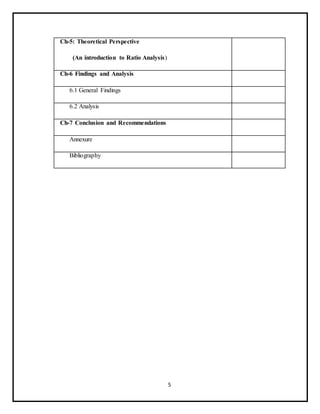
5
Ch-5: Theoretical Perspective
(An introduction to Ratio Analysis)
Ch-6 Findings and Analysis
6.1 General Findings
6.2 Analysis
Ch-7 Conclusion and Recommendations
Annexure
Bibliography
6
Chapter -1
Introduction to theStudy
7
INTRODUCTION
In the era of globalization the utilization of finance is considered as the most important
function of an organization. The firms are facing a stiff competition from the whole
market, so the inflow and outflow of funds will be manage well inflow and outflow of
funds will be manage well. Finance is considered as the life blood of an organization.
The management of sources and application of funds will be done carefully. Every
organization is trying to earn the maximum profit by the effective investment of funds.
Finance is one of the most important aspects of business management. Without proper
financial planning an enterprise is unlikely to be successful. Managing money (a liquid
asset) is essential to ensure a secure future, both for the individual and an organization.
Financial analysis is the process of using financial statements to enable the users to
take economic and investment decisions. Managers use accounting information to ensure
that the enterprise is on the right direction and if not, take decisions to put it on the right
track.
Financial analysis is the process of identifying the financial strengths and weakness of a
firm by properly establishing relationships between the items of Balance Sheet and Profit
and Loss Account. Analysis is the process of critically examining in detail accounting
information given in the financial statements. Analyzing financial statement is a process
of evaluating relationship between component parts of financial statements to obtain a
better understanding of firm’s position and performance. The main aim of the financial
statement analysis is to find out the profitability and financial position of the firm.
There are various methods used in analyzing financial statements such as Ratio analysis,
Comparative statements, Trend analysis, Common statements, Fund flow statements and
Cash flow statements. The purpose of financial analysis is to diagnose the information
contained in financial statements so as to judge the profitability and financial soundness
of the firm.
8
The techniques of financial analysis serve as a tool for the management in determining
the impact of financial decisions on financial conditions and the profitability of the
enterprise. This can be used by the financial manager as the basis to plan future financial
requirements by means of forecasting and budgeting procedures. With the help of tools of
financial manager can rationalize his decision and reach the goal.
Financial analysis is helpful in assessing the financial position and profitability of a
concern. This is done through comparison by ratios for the same concern over a period of
years; or for one concern against another; or for one concern against the pre-determined
standards. Accounting ratios calculated for a number of years show the trend of the
change of position. That is whether the trend is upward or downward or static.
1.1 BREIF OVERVIEW OF STUDY
This study focus on the process of evaluating businesses, projects, budgets and other
finance-related entities to determine their suitability for investment. Typically, financial
analysis is used to analyze whether an entity is stable, solvent, liquid, or profitable
enough to be invested in. When looking at a specific industry, the financial analyst will
often focus on the income statement, balance sheet, and cash flow statement. In addition,
one key area of financial analysis involves extrapolating the industry's past performance
into an estimate of the industry's future performance.
One of the most common ways of analyzing financial data is to calculate ratios from the
data to compare against those of other companies or against the industries own historical
performance. For example, return on assets is a common ratio used to determine how
efficient a industry is at using its assets and as a measure of profitability. This ratio could
be calculated for several similar companies and compared as part of a larger analysis.
9
1.2OBJECTIVE OF STUDY
1. Assessment of Past Performance
Past performance is a good indicator of future performance. Investors or creditors are
interested in the trend of past sales, cost of goods sold, operating expenses, net income,
cash flows and return on investment. These trends offer a means for judging
management's past performance and are possible indicators of future performance.
2. Assessment of current position
Financial statement analysis shows the current position of the firm in terms of the types
of assets owned by a business firm and the different liabilities due against the enterprise.
3. Prediction of profitability and growth prospects
Financial statement analysis helps in assessing and predicting the earning prospects and
growth rates in earning which are used by investors while comparing investment
alternatives and other users in judging earning potential of business enterprise.
4. Prediction of bankruptcy and failure
Financial statement analysis is an important tool in assessing and predicting bankruptcy
and probability of business failure.
1.3SCOPE&SIGNIFICANCE OF THE STUDY
The fund management is the essential function in every organization for the effective
utilization of funds for making profits. The fund management influences the managerial
decisions regarding the investment policies
Scope of the study is limited to the financial ratio Analysis, for the accounting
years 2013-14 to 2014-15 which have been taken as base year. The process of Financial
Statement Analysis involves compilation and study of financial and operating results and
preparation and interpretation of measuring devices such as ratios, source and application
of fund.
10
1.4 LIMITATIONS OF THE STUDY
1. Ignores the qualitative statements – Since the financial statements are concerned to the
monetary matters only, the qualitative elements like quality management, quality of
labor, public relations are ignored while carrying out the analysis financial statement
only.
2. Not free from bias – In many situations, the account has to make choice out of various
alternatives available, e.g. choice in the method of depreciation, choice in the method of
inventory valuation etc. since the subjectivity is inherent in personal judgment, the
financial statement are therefore not free from bias.
3. Estimated position on ongoing concern basis – Since the financial statement are
prepared on a ongoing concern basis as against liquidation basis, they report only the
estimated periodic results and not the true results since the true results can be ascertained
only on the liquidation of the enterprise.
4. Ignores price level changes in the case of financial areas prepared on the historical
costs – In case of financial statements prepared on historical costs, the fixed assets are
shown in balance sheet at historical costs less depreciation and not at the replacement
value which are often far higher than the value stated in the balance sheet.
11
CHAPTER 2
Research Methodology
12
Research Methodology is a way to systematically solve the research problem. The
Research Methodology includes the various methods and techniques for conducting a
Research. “Marketing Research is the systematic design, collection, analysis and
reporting of data and finding relevant solution to a specific marketing situation or
problem”. D. Slazenger and M. Stephenson in the encyclopedia of Social Sciences define
Research as “the manipulation of things, concepts or symbols for the purpose of
generalizing to extend, correct or verify knowledge, whether that knowledge aids in
construction of theory or in the practice of an art”.
Research is, thus, an original contribution to the existing stock of knowledge making for
its advancement. The purpose of Research is to discover answers to the Questions
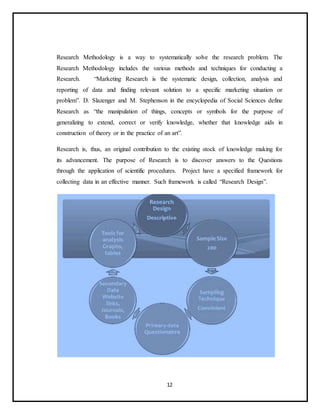
through the application of scientific procedures. Project have a specified framework for
collecting data in an effective manner. Such framework is called “Research Design”.
13
Ratio analysis is being used as the technique for checking the financial health of the
Name of Companies. Secondary data in the form of income statement & the balance
sheets of the industry have been taken for 4years (2012 to 2015). The data has been
analyzed by taking the relevant ratios for achieving the research objectives
The research process followed by us consists of following steps
2.1Research Design:-
2.1.1 Conclusion Oriented Research: - The research was conclusion oriented because
this research aimed at identifying the characteristics of a successful entrepreneur.
In other words it is a research when we give our own views about the research.
2.1.2 Descriptive Research: - The research was a descriptive research as it was
concerned with specific predictions, with narration of facts and characteristics
concerning individuals specially entrepreneurs. In other words descriptive
research is a research where in researcher has no control over variable. He just
presents the picture which has already studied.
2.2 Data collection (Primary and secondary)
1. Primary data
2. Secondary Data
Primary data-Primary data is a type of information that is obtained directly from first-
hand sources by means of surveys, observation or experimentation. It is data that has not
been previously published and is derived from a new or original research study and
collected at the source such as in marketing.
Secondary Data-Secondary data is any information that was collected by someone other
than the person, industry, or party analyzing or using the data. This contrasts with
14
primary data, which is data that is collected by the person conducting the investigation or
research.
Financial data in the form of balance sheet and profit& Loss accounts of four years has
been taken for analysis
2.4 Research Tool Used
Research Tool used is Ratio Analysis
15
CHAPTER 3
Industry Overview
16
3.1 Past Trend
Past trend of industry in 2 pages
3.2Present Trend
Present trend of industry in 2 pages
3.3 The Growth Drivers
The Growth Drivers 2 paragraph
3.4 Future Trend
2PAGES
3.2 Major Players and their respective market share
2 PAGES
17
CHAPTER 4
COMAPANY PROFILE
18
4.1 History
1 PAGE
Timeline
Year wise growth from the year of incorporation 2 pages
Vision:
Mission:
Our Values
19
4.3Company Profile
1 PAGE
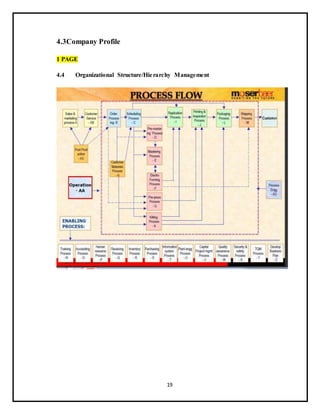
4.4 Organizational Structure/Hierarchy Management
20
4.5Products and services offered
1 PAGE
21
CHAPTER 5
Theoretical Perspective
22
RATIO ANALYSIS
One of the ways in which financial statements can be put to work is through ratio
analysis. Ratios are simply one number divided by another; as such they may or may not
be meaningful. In finance, ratios are usually two financial statement items that may be
related to one another and may provide the prudent user a good deal of information.
Of the myriad of ratios that could be generated, some will be more meaningful than
others. Generally ratios are divided into four areas of classification that provide different
kinds of information: liquidity, turnover, profitability, and debt.
 Liquidity ratios indicate a firm's ability to meet its maturing short-term
obligations.
 Turnover indicates how effectively a firm manages resources at its disposal to
generate sales.
 Profitability indicates the efficiency with which a firm manages resources.
 Debt indicates the extent to which a firm is financed by debt.
Mainly the persons interested in the analysis of the financial statements can be grouped
under three heads (i) Owners or investors, (ii) Creditors and (iii) Financial executives.
The importance of analysis varies materially with the purpose for which it is calculated.
The primary information which seeks to be obtained from these statements differs
considerable reflecting the purpose that the statement is to serve. The significance of
these ratios varies for these three groups as their purpose differs widely. These investors
are mainly concerned with the earning capacity of the industry whereas the creditors
including bankers and financial institutions are interesting in knowing the ability of
enterprise to meet its financial obligations timely. The financial executives are concerned
with evolving analytical tools that will measure and compare costs, efficiency, liquidity
and profitability with a view to making intelligent decisions.
Ratio analysis is a tool used to conduct a quantitative analysis of information in a
industry’s financial statements. Ratios are calculated by individuals from current year
numbers and are these numbers are then used to judge the performance of the industry by
comparing them to previous years, other companies, the industry or even the economy. A
23
ratio analysis can help give a quick indication of how a industry is doing in certain key
areas and the ratios can be categorized as short-term solvency ratios, debt management
ratios, asset management ratios, profitability ratios, and market value ratio
CLASSIFICATION OF RATIOS
The following classification is based on the financial statement from which the ratios are
calculated. Thus, there are:
(A) Liquidity Ratios
(B) Solvency Ratio
(C) Activity Ratio
(D) Profitability Ratios or Income Ratios
Examples of ratios that can be calculated under each of the above categories are as
follows:
(A) Liquidity Ratios
 Current ratio
 Liquid ratio
(B) Leverage or Capital Structure Ratios
 Debt Equity Ratio
 Debt to Total Funds Ratio
 Proprietary Ratio
 Fixed Assets to Proprietor’s Fund Ratio
 Capital Gearing Ratio
 Interest Coverage Ratio
(C) Activity Ratios
 Stock Turnover Ratio
 Debtors Turnover Ratio
 Creditors Turnover Ratio
 Working Capital Turnover Ratio
 Fixed assets-turnover ratio
(D) Profitability Ratios
 Gross Profit Ratio
24
 Net Profit Ratio
 Operating Ratio
 Expenses Ratio
 Return on Capital Employed
ANALSIS FOR SHORT-TERM CREDITORS
The analysis is also called analysis for ‘short-term solvency’ of the industry. Short-term
creditors of the industry are primarily interested in knowing the industry’s ability to pay
its short-term creditors as and when they become due. For this purpose creditors focus
their attention on the industry’s cash- generation power and on industry’s total current
assets in relation to its total current liabilities. Industry must have as much as total current
assets as to be able to meet its obligation on account of current liabilities and have
something to meet day to day requirements of the business. Ratios calculated for this
purpose are liquidity ratios.
(i) LIQUIDITY RATIOS
Liquidity refers to the ability of the industry to meet its current obligations. The liquidity
ratios, therefore, have to do with the size and relationships of current liabilities, which are
the obligations soon becoming due, and current assets, which presumably provide the
source from which these obligations will be met. A industry’s financial position is not
sound unless it has adequate liquidity.
Liquidity ratios include two ratios:
(a) Current ratio.
(b) Quick ratio.
(a) Current ratio
The current ratio is computed by dividing current assets by current liabilities. The
formula for its computation is as follows:
Current assets/ Current liabilities
25
OBJECTIVES:
Current ratio is the relation of a industry’s current assets to its current liabilities. This
ratio establishes the ability of the business to meet its short-term obligations and is,
therefore, of particular significance to short-term creditors. It is always desirable that in a
business there should be a considerable excess of current assets over current liabilities. In
a business, a 2:1 ratio of current assets to current liabilities is treated a satisfactory
relation, which may vary from business to business. The idea of having almost twice as
much asset as liabilities is only to tide over the contingency loss on account of realization
of assets in order to meet liabilities and leave some amounts as working capital in the
business. For example, there may be large amounts of bad debts or stocks may become
unsalable or losses may occur in realization of short-term investments.
(b) QUICK RATIO
Quick ratio is calculated by dividing quick current assets by current liabilities. The
formula for its computation is as follows:
= Quick current assets
Current liabilities
OBJECTIVES:
This ratio is a better test of financial strength than the current ratio as its gives no
consideration to stocks which may be very slow moving and may not be easily
convertible into cash. Stock in trade may take a lot of time before it is converted into
debtors or bill receivable and finally into cash. Similarly, ‘prepaid or unexpired expenses’
do not provide cash at all; they merely reduce the amount of cash required in one period
because of payment in a prior period. Quick ratio is a measure of the instant debt paying
capacity of the business enterprise. It is, therefore, a measure of the extent to which liquid
resources are immediately available to meet current obligations. It is a supplementary
measure of liquidity and places more emphasis on immediate conversion of assets into
cash than does the current ratio. A quick ratio of 1:1 has usually been considered
favorable since for every rupee of current liabilities there is a rupee of quick assets. But
26
accounts receivable (or sundry debtors) may not be convertible into cash at face value on
a short notice.
SOLVENCY RATIO- AN ANALYSIS FOR LONG-TERM CREDITORS
Long-term creditors include debenture holders, vendors selling equipment in installment
basis and other financiers supplying long-term loans. Long- term creditors are primarily
interested in whether the industry has ability to pay regular interest due to them and to
repay the principal at the maturity date. Solvency ratios indicate ability of the industry to
meet its interest costs and repayment schedules associated with its long-term indebt ness.
The lenders are mainly interested in:
Security of their loans
Interest payable thereon
Repayment of their loans at maturity date
Thus, solvency ratios primarily include.
(a) Debt-equity ratio
(b) Interest coverage ratio
(c) Debt to total fund ratio.
(A) DEBT-EQUITY RATIO
This ratio expresses the relationships of long term liability to net worth. Long-term
liabilities are those which are repayable after one year and these are other than those
appearing under ‘current liabilities’. The long-term or term liabilities include debentures
and other secured and unsecured loans which are repayable after one year. Net worth or
equity represents equity share capital, reserves, irredeemable preference share capital and
preference share capital not redeemable within a period of 12years from the date of the
balance sheet. Preference shares redeemable within 12 years are considered as debt. It is
computed as follows:
27
= Debt
Equity
OBJECTIVES:
This ratio is a measure of owner’s stake in the business. Proprietors are always keen to
have more funds from borrowings because:
1. Their stake in the business is reduced and subsequently their risk too.
2. Interest on loans or borrowings is a deductible expenditure while computing taxable
profits. Dividend on shares is not so allowed by income tax authorities.
But creditors always like proprietors to have more stakes in the venture, because it
provides a margin of safety to them. Moreover, excessive outside debt may cause
insolvency of the business and is harmful. The normally acceptable debt-equity ratio is
2:1 but relaxations are allowed. If an analyst looks at this ratio and finds that the debt has
reached its maximum level, he may expect rights issue of shares depending upon the
industry’s expansion/ modernization performance. On net worth is possible, provided the
growth plans are to be funded from untapped borrowings. The other aspect of high debt is
that profits would be adversely affected in case of a fall in sales.
(B) INTEREST COVERAGE RATIO
Here, ‘net income’ stands for net income before charging income tax and interest on
long-term debts and ‘debt service’ stands for interest on long-term debts. This ratio is
calculated as follows
= Net income before charging interest and income tax
Periodic interest on long-term debt
OBJECTIVES:
Since the borrower has earned 5 times the fixed interest to be paid to long-term creditors
after meeting out his usual business expenses, he is likely to pay off his liability on
account of interest and other periodic fixed profits are calculated keeping future in mind,
this type of ratio can serve as a good index on long-term solvency. The interest coverage
28
ratio of debt-service ratio indicates how much interest charges are covered by operating
profits available to pay the interest charges. A higher ratio is desirable, but too higher a
ratio indicates that the firm is very conservative in using debt and that it is not using
credit to the best advantage of shareholders. A low ratio indicates excessive use of debt or
inadequate operations. Thus, both these ratios- debt-equity ratio and interest coverage
ratio- help the creditors and investors of the industry to assess the financial status of the
industry in order to take a rational decision for long-term investment of their funds in the
business.
(C) DEBTS TO TOTAL FUNDS RATIO
The ratio compares the total liabilities to total assets. it is computed by the formula:
Debt to total funds ratio = DEBT *100
Total assets
OBJECTIVES:
This ratio indicates the extent of trading on equity and measures the percentage of assets
financed through borrowings.
ACTIVITY RATIOS- AN ANALSIS FOR MEASURING THE MOVEMENT OF
CURRENT ASSETS
Both the current ratio ant the acid test ratio will be misleading if debtors are too high
because of slow credit collections. Similarly, the current ratio will be misleading if stock
is too high because it is not being turned over (sold) as fast as it should be. Since liquidity
ratio (i.e., current ratio and acid test ratio) ignore the movement of current assets, it is
necessary for short-term creditors to focus their attention on the analysis of policy for
collection of debtors and turnover of stock. Activity ratios signify the effective utilization
of a concern of its available resources. Mainly, activity ratios include:
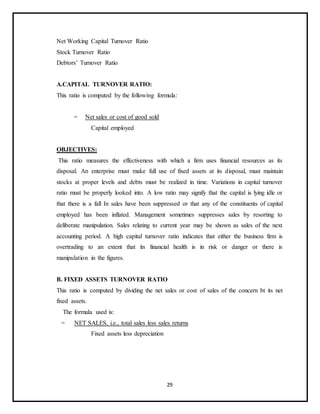
Capital Turnover Ratio
Fixed Assets Turnover Ratio
29
Net Working Capital Turnover Ratio
Stock Turnover Ratio
Debtors’ Turnover Ratio
A.CAPITAL TURNOVER RATIO:
This ratio is computed by the following formula:
= Net sales or cost of good sold
Capital employed
OBJECTIVES:
This ratio measures the effectiveness with which a firm uses financial resources as its
disposal. An enterprise must make full use of fixed assets at its disposal, must maintain
stocks at proper levels and debts must be realized in time. Variations in capital turnover
ratio must be properly looked into. A low ratio may signify that the capital is lying idle or
that there is a fall In sales have been suppressed or that any of the constituents of capital
employed has been inflated. Management sometimes suppresses sales by resorting to
deliberate manipulation. Sales relating to current year may be shown as sales of the next
accounting period. A high capital turnover ratio indicates that either the business firm is
overtrading to an extent that its financial health is in risk or danger or there is
manipulation in the figures.
B. FIXED ASSETS TURNOVER RATIO
This ratio is computed by dividing the net sales or cost of sales of the concern bt its net
fixed assets.
The formula used is:
= NET SALES, i.e., total sales less sales returns
Fixed assets less depreciation
30
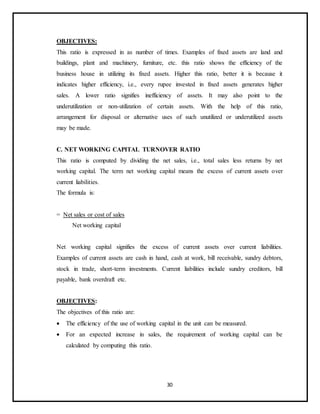
OBJECTIVES:
This ratio is expressed in as number of times. Examples of fixed assets are land and
buildings, plant and machinery, furniture, etc. this ratio shows the efficiency of the
business house in utilizing its fixed assets. Higher this ratio, better it is because it
indicates higher efficiency, i.e., every rupee invested in fixed assets generates higher
sales. A lower ratio signifies inefficiency of assets. It may also point to the
underutilization or non-utilization of certain assets. With the help of this ratio,
arrangement for disposal or alternative uses of such unutilized or underutilized assets
may be made.
C. NET WORKING CAPITAL TURNOVER RATIO
This ratio is computed by dividing the net sales, i.e., total sales less returns by net
working capital. The term net working capital means the excess of current assets over
current liabilities.
The formula is:
= Net sales or cost of sales
Net working capital
Net working capital signifies the excess of current assets over current liabilities.
Examples of current assets are cash in hand, cash at work, bill receivable, sundry debtors,
stock in trade, short-term investments. Current liabilities include sundry creditors, bill
payable, bank overdraft etc.
OBJECTIVES:
The objectives of this ratio are:
 The efficiency of the use of working capital in the unit can be measured.
 For an expected increase in sales, the requirement of working capital can be
calculated by computing this ratio.
31
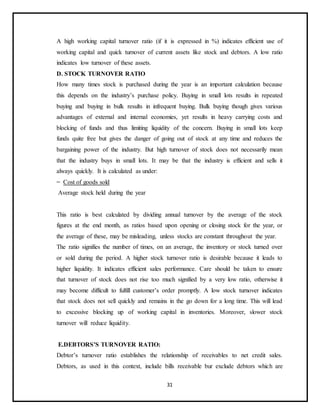
A high working capital turnover ratio (if it is expressed in %) indicates efficient use of
working capital and quick turnover of current assets like stock and debtors. A low ratio
indicates low turnover of these assets.
D. STOCK TURNOVER RATIO
How many times stock is purchased during the year is an important calculation because
this depends on the industry’s purchase policy. Buying in small lots results in repeated
buying and buying in bulk results in infrequent buying. Bulk buying though gives various
advantages of external and internal economies, yet results in heavy carrying costs and
blocking of funds and thus limiting liquidity of the concern. Buying in small lots keep
funds quite free but gives the danger of going out of stock at any time and reduces the
bargaining power of the industry. But high turnover of stock does not necessarily mean
that the industry buys in small lots. It may be that the industry is efficient and sells it
always quickly. It is calculated as under:
= Cost of goods sold
Average stock held during the year
This ratio is best calculated by dividing annual turnover by the average of the stock
figures at the end month, as ratios based upon opening or closing stock for the year, or
the average of these, may be misleading, unless stocks are constant throughout the year.
The ratio signifies the number of times, on an average, the inventory or stock turned over
or sold during the period. A higher stock turnover ratio is desirable because it leads to
higher liquidity. It indicates efficient sales performance. Care should be taken to ensure
that turnover of stock does not rise too much signified by a very low ratio, otherwise it
may become difficult to fulfill customer’s order promptly. A low stock turnover indicates
that stock does not sell quickly and remains in the go down for a long time. This will lead
to excessive blocking up of working capital in inventories. Moreover, slower stock
turnover will reduce liquidity.
E.DEBTORS’S TURNOVER RATIO:
Debtor’s turnover ratio establishes the relationship of receivables to net credit sales.
Debtors, as used in this context, include bills receivable bur exclude debtors which are
32
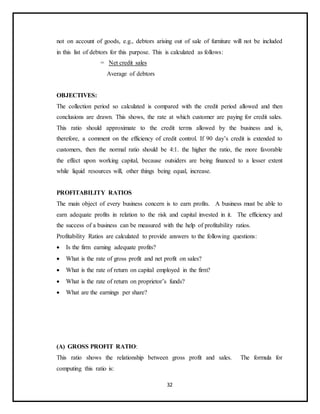
not on account of goods, e.g., debtors arising out of sale of furniture will not be included
in this list of debtors for this purpose. This is calculated as follows:
= Net credit sales
Average of debtors
OBJECTIVES:
The collection period so calculated is compared with the credit period allowed and then
conclusions are drawn. This shows, the rate at which customer are paying for credit sales.
This ratio should approximate to the credit terms allowed by the business and is,
therefore, a comment on the efficiency of credit control. If 90 day’s credit is extended to
customers, then the normal ratio should be 4:1. the higher the ratio, the more favorable
the effect upon working capital, because outsiders are being financed to a lesser extent
while liquid resources will, other things being equal, increase.
PROFITABILITY RATIOS
The main object of every business concern is to earn profits. A business must be able to
earn adequate profits in relation to the risk and capital invested in it. The efficiency and
the success of a business can be measured with the help of profitability ratios.
Profitability Ratios are calculated to provide answers to the following questions:
 Is the firm earning adequate profits?
 What is the rate of gross profit and net profit on sales?
 What is the rate of return on capital employed in the firm?
 What is the rate of return on proprietor’s funds?
 What are the earnings per share?
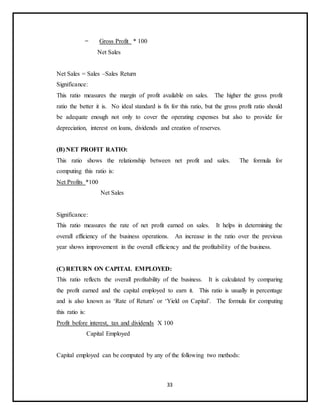
(A) GROSS PROFIT RATIO:
This ratio shows the relationship between gross profit and sales. The formula for
computing this ratio is:
33
= Gross Profit * 100
Net Sales
Net Sales = Sales –Sales Return
Significance:
This ratio measures the margin of profit available on sales. The higher the gross profit
ratio the better it is. No ideal standard is fix for this ratio, but the gross profit ratio should
be adequate enough not only to cover the operating expenses but also to provide for
depreciation, interest on loans, dividends and creation of reserves.
(B) NET PROFIT RATIO:
This ratio shows the relationship between net profit and sales. The formula for
computing this ratio is:
Net Profits *100
Net Sales
Significance:
This ratio measures the rate of net profit earned on sales. It helps in determining the
overall efficiency of the business operations. An increase in the ratio over the previous
year shows improvement in the overall efficiency and the profitability of the business.
(C) RETURN ON CAPITAL EMPLOYED:
This ratio reflects the overall profitability of the business. It is calculated by comparing
the profit earned and the capital employed to earn it. This ratio is usually in percentage
and is also known as ‘Rate of Return’ or ‘Yield on Capital’. The formula for computing
this ratio is:
Profit before interest, tax and dividends X 100
Capital Employed
Capital employed can be computed by any of the following two methods:
34
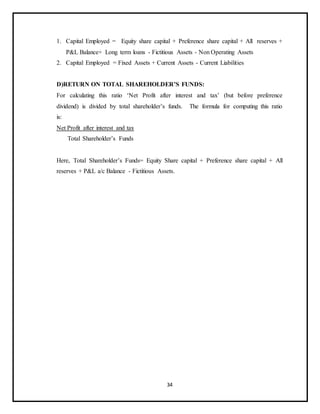
1. Capital Employed = Equity share capital + Preference share capital + All reserves +
P&L Balance+ Long term loans - Fictitious Assets - Non Operating Assets
2. Capital Employed = Fixed Assets + Current Assets - Current Liabilities
D)RETURN ON TOTAL SHAREHOLDER’S FUNDS:
For calculating this ratio ‘Net Profit after interest and tax’ (but before preference
dividend) is divided by total shareholder’s funds. The formula for computing this ratio
is:
Net Profit after interest and tax
Total Shareholder’s Funds
Here, Total Shareholder’s Funds= Equity Share capital + Preference share capital + All
reserves + P&L a/c Balance - Fictitious Assets.
35
CHAPTER-6
Findingsand Analysis
36
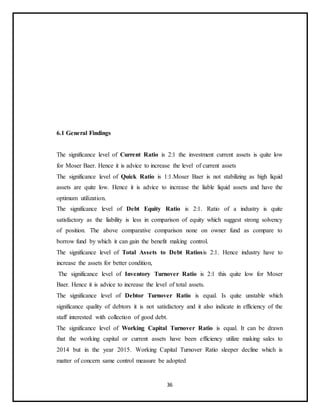
6.1 General Findings
The significance level of Current Ratio is 2:1 the investment current assets is quite low
for Moser Baer. Hence it is advice to increase the level of current assets
The significance level of Quick Ratio is 1:1.Moser Baer is not stabilizing as high liquid
assets are quite low. Hence it is advice to increase the liable liquid assets and have the
optimum utilization.
The significance level of Debt Equity Ratio is 2:1. Ratio of a industry is quite
satisfactory as the liability is less in comparison of equity which suggest strong solvency
of position. The above comparative comparison none on owner fund as compare to
borrow fund by which it can gain the benefit making control.
The significance level of Total Assets to Debt Ratiosis 2:1. Hence industry have to
increase the assets for better condition,
The significance level of Inventory Turnover Ratio is 2:1 this quite low for Moser
Baer. Hence it is advice to increase the level of total assets.
The significance level of Debtor Turnover Ratio is equal. Is quite unstable which
significance quality of debtors it is not satisfactory and it also indicate in efficiency of the
staff interested with collection of good debt.
The significance level of Working Capital Turnover Ratio is equal. It can be drawn
that the working capital or current assets have been efficiency utilize making sales to
2014 but in the year 2015. Working Capital Turnover Ratio sleeper decline which is
matter of concern same control measure be adopted
37
Is on a decline trend all though absolute figure sales have gone up. It means increase in
investment in fixed assets have not brought about commensurate gain. It is advised to the
management to go for the optimum of fixed assets.
It is indicating about the promptness of Moser Baer in making payment of credit
purchase, thus enhancing worthiness of the industry. It also indicate the industry is not
taking full advantage of the credit period allow buy the industry.
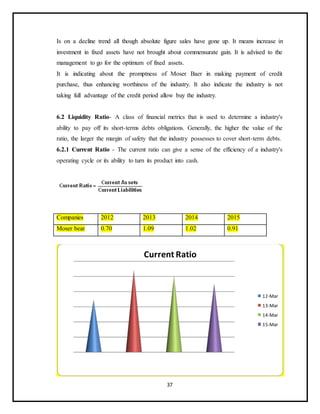
6.2 Liquidity Ratio- A class of financial metrics that is used to determine a industry's
ability to pay off its short-terms debts obligations. Generally, the higher the value of the
ratio, the larger the margin of safety that the industry possesses to cover short-term debts.
6.2.1 Current Ratio - The current ratio can give a sense of the efficiency of a industry's
operating cycle or its ability to turn its product into cash.
Current Ratio
12-Mar
13-Mar
14-Mar
15-Mar
Companies 2012 2013 2014 2015
Moser bear 0.70 1.09 1.02 0.91
38
INTREPETATION: Using the above data we analysis that the Current Ratios for
Moser Baer. The significance level of current ratio is 2:1 the investment current assets is
quite low for Moser Baer. Hence it is advice to increase the level of current assets
6.2.1.2 QUICK RATIO
This ratio is a better test of financial strength than the current ratio as its gives no
consideration to stocks which may be very slow moving and may not be easily
convertible into cash.
QUICK RATO = QUICK ASSETS/CURRENT LIABILITY
Company 2012 2013 2014 2015
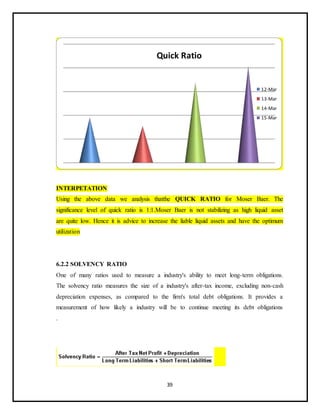
Moser bear 0.96 0.78 1.71 2.04
39
INTERPETATION
Using the above data we analysis thatthe QUICK RATIO for Moser Baer. The
significance level of quick ratio is 1:1.Moser Baer is not stabilizing as high liquid asset
are quite low. Hence it is advice to increase the liable liquid assets and have the optimum
utilization
6.2.2 SOLVENCY RATIO
One of many ratios used to measure a industry's ability to meet long-term obligations.
The solvency ratio measures the size of a industry's after-tax income, excluding non-cash
depreciation expenses, as compared to the firm's total debt obligations. It provides a
measurement of how likely a industry will be to continue meeting its debt obligations
.
Quick Ratio
12-Mar
13-Mar
14-Mar
15-Mar
40
6.2.2.1 DEBT-EQUITY RATIO-A measure of a industry's financial leverage calculated
by dividing its total liabilities by stockholders' equity. It indicates what proportion of
equity and debt the industry is using to finance its assets.
Company 2012 2013 2014 2015
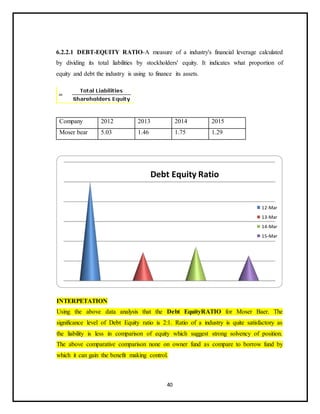
Moser bear 5.03 1.46 1.75 1.29
INTERPETATION
Using the above data analysis that the Debt EquityRATIO for Moser Baer. The
significance level of Debt Equity ratio is 2:1. Ratio of a industry is quite satisfactory as
the liability is less in comparison of equity which suggest strong solvency of position.
The above comparative comparison none on owner fund as compare to borrow fund by
which it can gain the benefit making control.
Debt Equity Ratio
12-Mar
13-Mar
14-Mar
15-Mar
41
6.2.2.2 Total Assets To Debt Ratio-A relationship between total assets and total long
term debt
= Total Assets/Long Term Debt
Company 2012 2013 2014 2015
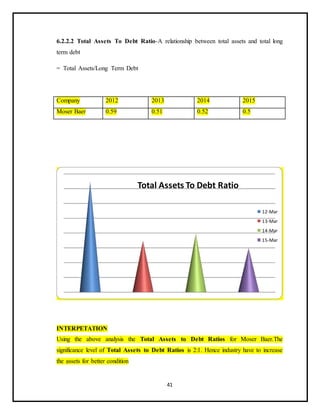
Moser Baer 0.59 0.51 0.52 0.5
INTERPETATION
Using the above analysis the Total Assets to Debt Ratios for Moser Baer.The
significance level of Total Assets to Debt Ratios is 2:1. Hence industry have to increase
the assets for better condition
Total Assets To Debt Ratio
12-Mar
13-Mar
14-Mar
15-Mar
42
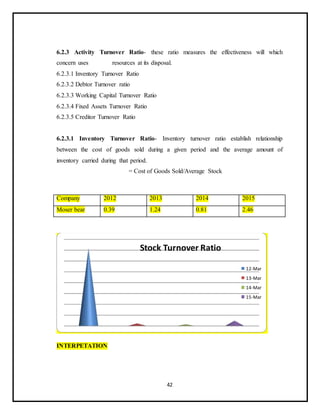
6.2.3 Activity Turnover Ratio- these ratio measures the effectiveness will which
concern uses resources at its disposal.
6.2.3.1 Inventory Turnover Ratio
6.2.3.2 Debtor Turnover ratio
6.2.3.3 Working Capital Turnover Ratio
6.2.3.4 Fixed Assets Turnover Ratio
6.2.3.5 Creditor Turnover Ratio
6.2.3.1 Inventory Turnover Ratio- Inventory turnover ratio establish relationship
between the cost of goods sold during a given period and the average amount of
inventory carried during that period.
= Cost of Goods Sold/Average Stock
Company 2012 2013 2014 2015
Moser bear 0.39 1.24 0.81 2.46
INTERPETATION
Stock Turnover Ratio
12-Mar
13-Mar
14-Mar
15-Mar
43
Using the above analysis the Total Assets to Debt Ratios for Moser Baer. The
significance level of Total Assets to Debt Ratios is 2:1. Hence industry have to increase
the assets for better condition
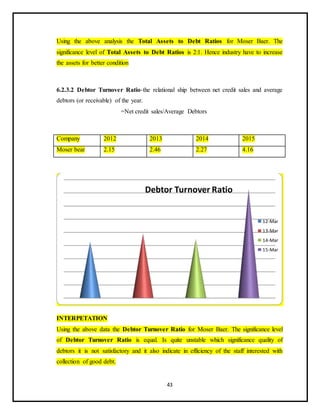
6.2.3.2 Debtor Turnover Ratio-the relational ship between net credit sales and average
debtors (or receivable) of the year.
=Net credit sales/Average Debtors
Company 2012 2013 2014 2015
Moser bear 2.15 2.46 2.27 4.16
INTERPETATION
Using the above data the Debtor Turnover Ratio for Moser Baer. The significance level
of Debtor Turnover Ratio is equal. Is quite unstable which significance quality of
debtors it is not satisfactory and it also indicate in efficiency of the staff interested with
collection of good debt.
Debtor Turnover Ratio
12-Mar
13-Mar
14-Mar
15-Mar
44
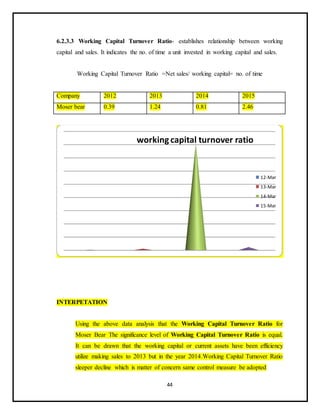
6.2.3.3 Working Capital Turnover Ratio- establishes relationship between working
capital and sales. It indicates the no. of time a unit invested in working capital and sales.
Working Capital Turnover Ratio =Net sales/ working capital= no. of time
Company 2012 2013 2014 2015
Moser bear 0.39 1.24 0.81 2.46
INTERPETATION
Using the above data analysis that the Working Capital Turnover Ratio for
Moser Bear The significance level of Working Capital Turnover Ratio is equal.
It can be drawn that the working capital or current assets have been efficiency
utilize making sales to 2013 but in the year 2014.Working Capital Turnover Ratio
sleeper decline which is matter of concern same control measure be adopted
working capital turnover ratio
12-Mar
13-Mar
14-Mar
15-Mar
45
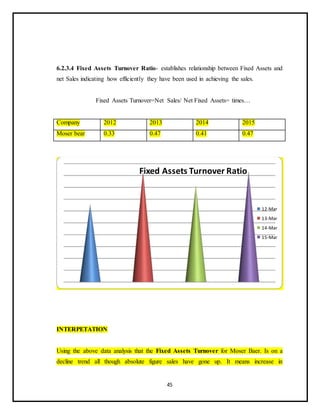
6.2.3.4 Fixed Assets Turnover Ratio- establishes relationship between Fixed Assets and
net Sales indicating how efficiently they have been used in achieving the sales.
Fixed Assets Turnover=Net Sales/ Net Fixed Assets= times…
Company 2012 2013 2014 2015
Moser bear 0.33 0.47 0.41 0.47
INTERPETATION
Using the above data analysis that the Fixed Assets Turnover for Moser Baer. Is on a
decline trend all though absolute figure sales have gone up. It means increase in
Fixed Assets Turnover Ratio
12-Mar
13-Mar
14-Mar
15-Mar
46
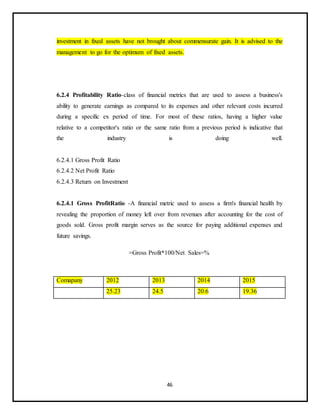
investment in fixed assets have not brought about commensurate gain. It is advised to the
management to go for the optimum of fixed assets.
6.2.4 Profitability Ratio-class of financial metrics that are used to assess a business's
ability to generate earnings as compared to its expenses and other relevant costs incurred
during a specific ex period of time. For most of these ratios, having a higher value
relative to a competitor's ratio or the same ratio from a previous period is indicative that
the industry is doing well.
6.2.4.1 Gross Profit Ratio
6.2.4.2 Net Profit Ratio
6.2.4.3 Return on Investment
6.2.4.1 Gross ProfitRatio -A financial metric used to assess a firm's financial health by
revealing the proportion of money left over from revenues after accounting for the cost of
goods sold. Gross profit margin serves as the source for paying additional expenses and
future savings.
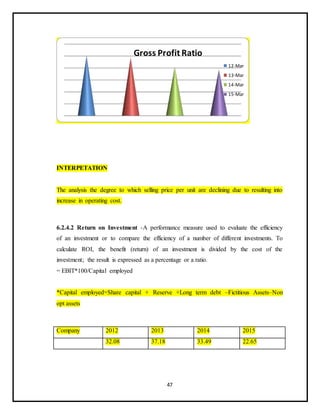
=Gross Profit*100/Net Sales=%
Comapany 2012 2013 2014 2015
25.23 24.5 20.6 19.36
47
INTERPETATION
The analysis the degree to which selling price per unit are declining due to resulting into
increase in operating cost.
6.2.4.2 Return on Investment -A performance measure used to evaluate the efficiency
of an investment or to compare the efficiency of a number of different investments. To
calculate ROI, the benefit (return) of an investment is divided by the cost of the
investment; the result is expressed as a percentage or a ratio.
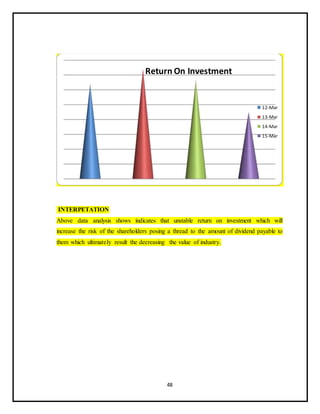
= EBIT*100/Capital employed
*Capital employed=Share capital + Reserve +Long term debt –Fictitious Assets–Non
opt assets
Company 2012 2013 2014 2015
32.08 37.18 33.49 22.65
Gross Profit Ratio
12-Mar
13-Mar
14-Mar
15-Mar
48
INTERPETATION
Above data analysis shows indicates that unstable return on investment which will
increase the risk of the shareholders posing a thread to the amount of dividend payable to
them which ultimately result the decreasing the value of industry.
Return On Investment
12-Mar
13-Mar
14-Mar
15-Mar
49
CHAPTER-7
Conclusion
and
Recommendations.
Conclusion and Recommendations
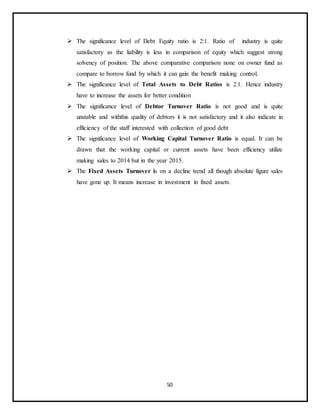
 The significance level of current ratio is 2:1 the investment current assets is quite
low for Moser Baer. Hence it is adviced to increase the level of current assets
50
 The significance level of Debt Equity ratio is 2:1. Ratio of industry is quite
satisfactory as the liability is less in comparison of equity which suggest strong
solvency of position. The above comparative comparison none on owner fund as
compare to borrow fund by which it can gain the benefit making control.
 The significance level of Total Assets to Debt Ratios is 2:1. Hence industry
have to increase the assets for better condition
 The significance level of Debtor Turnover Ratio is not good and is quite
unstable and withthis quality of debtors it is not satisfactory and it also indicate in
efficiency of the staff interested with collection of good debt
 The significance level of Working Capital Turnover Ratio is equal. It can be
drawn that the working capital or current assets have been efficiency utilize
making sales to 2014 but in the year 2015.
 The Fixed Assets Turnover is on a decline trend all though absolute figure sales
have gone up. It means increase in investment in fixed assets.
51
ANNEXURE
Bibliography
Books Referred
1) Pandey I. M. - Financial Management- Vikas PublishingHouse Pvt. Ltd. - Ninth
Edition 2006
2) Srivastava R., Financial management(2014) , Oxford Publications
Websites:
 www.moserbaer.com
 http://www.moneycontrol.com/
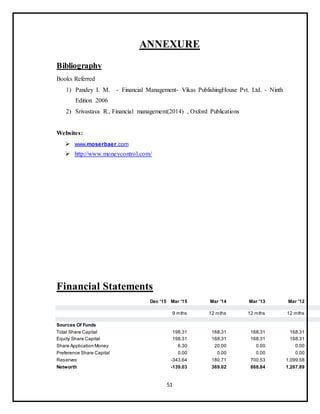
Financial Statements
Dec '15 Mar '15 Mar '14 Mar '13 Mar '12
9 mths 12 mths 12 mths 12 mths
Sources Of Funds
Total Share Capital 198.31 168.31 168.31 168.31
Equity Share Capital 198.31 168.31 168.31 168.31
Share Application Money 6.30 20.00 0.00 0.00
Preference Share Capital 0.00 0.00 0.00 0.00
Reserves -343.64 180.71 700.53 1,099.58
Networth -139.03 369.02 868.84 1,267.89
52
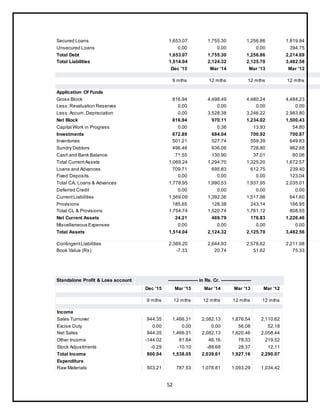
Secured Loans 1,653.07 1,755.30 1,256.86 1,819.94
Unsecured Loans 0.00 0.00 0.00 394.75
Total Debt 1,653.07 1,755.30 1,256.86 2,214.69
Total Liabilities 1,514.04 2,124.32 2,125.70 3,482.58
Dec '15 Mar '14 Mar '13 Mar '12
9 mths 12 mths 12 mths 12 mths
Application Of Funds
Gross Block 816.94 4,498.49 4,480.24 4,484.23
Less:Revaluation Reserves 0.00 0.00 0.00 0.00
Less:Accum.Depreciation 0.00 3,528.38 3,246.22 2,983.80
Net Block 816.94 970.11 1,234.02 1,500.43
Capital Work in Progress 0.00 0.38 13.93 54.80
Investments 672.89 684.04 700.92 700.87
Inventories 501.21 527.74 559.39 649.83
Sundry Debtors 496.48 636.06 728.80 962.68
Cash and Bank Balance 71.55 130.90 37.01 60.06
Total CurrentAssets 1,069.24 1,294.70 1,325.20 1,672.57
Loans and Advances 709.71 695.83 612.75 239.40
Fixed Deposits 0.00 0.00 0.00 123.04
Total CA, Loans & Advances 1,778.95 1,990.53 1,937.95 2,035.01
Deferred Credit 0.00 0.00 0.00 0.00
CurrentLiabilities 1,569.09 1,392.36 1,517.98 641.60
Provisions 185.65 128.38 243.14 166.95
Total CL & Provisions 1,754.74 1,520.74 1,761.12 808.55
Net Current Assets 24.21 469.79 176.83 1,226.46
Miscellaneous Expenses 0.00 0.00 0.00 0.00
Total Assets 1,514.04 2,124.32 2,125.70 3,482.56
ContingentLiabilities 2,369.20 2,644.93 2,578.62 2,211.98
Book Value (Rs) -7.33 20.74 51.62 75.33
Standalone Profit & Loss account ------------------- in Rs. Cr. -------------------
Dec '15 Mar '15 Mar '14 Mar '13 Mar '12
9 mths 12 mths 12 mths 12 mths 12 mths
Income
Sales Turnover 944.35 1,466.31 2,082.13 1,876.54 2,110.62
Excise Duty 0.00 0.00 0.00 56.08 52.18
Net Sales 944.35 1,466.31 2,082.13 1,820.46 2,058.44
Other Income -144.02 81.84 46.16 78.33 219.52
Stock Adjustments -0.29 -10.10 -88.68 28.37 12.11
Total Income 800.04 1,538.05 2,039.61 1,927.16 2,290.07
Expenditure
Raw Materials 503.21 787.53 1,078.81 1,093.29 1,034.42
53
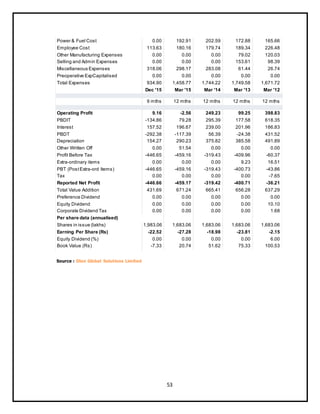
Power & Fuel Cost 0.00 192.91 202.59 172.88 165.66
Employee Cost 113.63 180.16 179.74 189.34 226.48
Other Manufacturing Expenses 0.00 0.00 0.00 79.02 120.03
Selling and Admin Expenses 0.00 0.00 0.00 153.61 98.39
Miscellaneous Expenses 318.06 298.17 283.08 61.44 26.74
Preoperative ExpCapitalised 0.00 0.00 0.00 0.00 0.00
Total Expenses 934.90 1,458.77 1,744.22 1,749.58 1,671.72
Dec '15 Mar '15 Mar '14 Mar '13 Mar '12
9 mths 12 mths 12 mths 12 mths 12 mths
Operating Profit 9.16 -2.56 249.23 99.25 398.83
PBDIT -134.86 79.28 295.39 177.58 618.35
Interest 157.52 196.67 239.00 201.96 186.83
PBDT -292.38 -117.39 56.39 -24.38 431.52
Depreciation 154.27 290.23 375.82 385.58 491.89
Other Written Off 0.00 51.54 0.00 0.00 0.00
Profit Before Tax -446.65 -459.16 -319.43 -409.96 -60.37
Extra-ordinary items 0.00 0.00 0.00 9.23 16.51
PBT (PostExtra-ord Items) -446.65 -459.16 -319.43 -400.73 -43.86
Tax 0.00 0.00 0.00 0.00 -7.65
Reported Net Profit -446.66 -459.17 -319.42 -400.71 -36.21
Total Value Addition 431.69 671.24 665.41 656.28 637.29
Preference Dividend 0.00 0.00 0.00 0.00 0.00
Equity Dividend 0.00 0.00 0.00 0.00 10.10
Corporate Dividend Tax 0.00 0.00 0.00 0.00 1.68
Per share data (annualised)
Shares in issue (lakhs) 1,983.06 1,683.06 1,683.06 1,683.06 1,683.06
Earning Per Share (Rs) -22.52 -27.28 -18.98 -23.81 -2.15
Equity Dividend (%) 0.00 0.00 0.00 0.00 6.00
Book Value (Rs) -7.33 20.74 51.62 75.33 100.53
Source : Dion Global Solutions Limited
54
THANK YOU

minor project on ratio analysis of "......"

  • 1.
    1 A PROJECT REPORT ON “RATIOANALYSIS OF ……..” GURU GOBIND SINGH INDRAPRASTHA UNIVERSITY In partial fulfillment of the requirement for the award of the degree of BACHELOR OF BUSINESS ADMINISTRATION Supervised By: Submitted By: “Name of Faculty” (Faculty “college name”) “COLLEGE NAME” “COLLEGE ADDRESS” NEW DELHI
  • 2.
    2 ACKNOWLEDGEMENT In pursuing andcompletion of my BBA and other commitments, I undertook the task of completing my project on “Ratio analysis of ……………..”. I am fortunate in having sought and secured valuable guidance, continuous encouragement and strong support at every stage of my guide and supervisor “Name of Faculty” and I’m deeply grateful to her. I want to acknowledge the help provided by my guide and friends. The precious inputs provided by them have helped in compiling this report. I express my deep-hearted thanks and gratitude to all of those who helped me in this Project. (NAME)
  • 3.
    3 CERTIFICATE This is tocertify that the Project Work entitled “Ratio Analysis of ………” is a record bonafide work carried out by “NAME OF STUDENT “at Name of College affiliated to Guru Gobind Singh Indraprastha University, under my supervision towards partial fulfillment for the award of the degree of “BACHELOR OF BUSINESS ADMINISTRATION” Place: Date: “Name of Faculty” PROJECT GUIDE
  • 4.
    4 TABLE OF CONTENTS ParticularPage No. Ch-1: Introduction To The Study 1.1Brief overview of study 1.2 Objectives of the study 1.3Scope & significance of the study 1.4 Limitations of the study Ch-2: Research Methodology 2.1 Statement of the Research Problem 2.2 Data collection (Primary and secondary) 2.3 Presentation tools used 2.4 Research Tool Used Ch-3: Industry Overview 3.1 Past, present and future trends 3.2 Major Players and their respective market share Ch-4: Company Profile 4.1 History 4.2 Vision, Mission and objectives of the industry 4.3 Organizational structure/Management hierarchy 4.4 Products and services offered
  • 5.
    5 Ch-5: Theoretical Perspective (Anintroduction to Ratio Analysis) Ch-6 Findings and Analysis 6.1 General Findings 6.2 Analysis Ch-7 Conclusion and Recommendations Annexure Bibliography
  • 6.
  • 7.
    7 INTRODUCTION In the eraof globalization the utilization of finance is considered as the most important function of an organization. The firms are facing a stiff competition from the whole market, so the inflow and outflow of funds will be manage well inflow and outflow of funds will be manage well. Finance is considered as the life blood of an organization. The management of sources and application of funds will be done carefully. Every organization is trying to earn the maximum profit by the effective investment of funds. Finance is one of the most important aspects of business management. Without proper financial planning an enterprise is unlikely to be successful. Managing money (a liquid asset) is essential to ensure a secure future, both for the individual and an organization. Financial analysis is the process of using financial statements to enable the users to take economic and investment decisions. Managers use accounting information to ensure that the enterprise is on the right direction and if not, take decisions to put it on the right track. Financial analysis is the process of identifying the financial strengths and weakness of a firm by properly establishing relationships between the items of Balance Sheet and Profit and Loss Account. Analysis is the process of critically examining in detail accounting information given in the financial statements. Analyzing financial statement is a process of evaluating relationship between component parts of financial statements to obtain a better understanding of firm’s position and performance. The main aim of the financial statement analysis is to find out the profitability and financial position of the firm. There are various methods used in analyzing financial statements such as Ratio analysis, Comparative statements, Trend analysis, Common statements, Fund flow statements and Cash flow statements. The purpose of financial analysis is to diagnose the information contained in financial statements so as to judge the profitability and financial soundness of the firm.
  • 8.
    8 The techniques offinancial analysis serve as a tool for the management in determining the impact of financial decisions on financial conditions and the profitability of the enterprise. This can be used by the financial manager as the basis to plan future financial requirements by means of forecasting and budgeting procedures. With the help of tools of financial manager can rationalize his decision and reach the goal. Financial analysis is helpful in assessing the financial position and profitability of a concern. This is done through comparison by ratios for the same concern over a period of years; or for one concern against another; or for one concern against the pre-determined standards. Accounting ratios calculated for a number of years show the trend of the change of position. That is whether the trend is upward or downward or static. 1.1 BREIF OVERVIEW OF STUDY This study focus on the process of evaluating businesses, projects, budgets and other finance-related entities to determine their suitability for investment. Typically, financial analysis is used to analyze whether an entity is stable, solvent, liquid, or profitable enough to be invested in. When looking at a specific industry, the financial analyst will often focus on the income statement, balance sheet, and cash flow statement. In addition, one key area of financial analysis involves extrapolating the industry's past performance into an estimate of the industry's future performance. One of the most common ways of analyzing financial data is to calculate ratios from the data to compare against those of other companies or against the industries own historical performance. For example, return on assets is a common ratio used to determine how efficient a industry is at using its assets and as a measure of profitability. This ratio could be calculated for several similar companies and compared as part of a larger analysis.
  • 9.
    9 1.2OBJECTIVE OF STUDY 1.Assessment of Past Performance Past performance is a good indicator of future performance. Investors or creditors are interested in the trend of past sales, cost of goods sold, operating expenses, net income, cash flows and return on investment. These trends offer a means for judging management's past performance and are possible indicators of future performance. 2. Assessment of current position Financial statement analysis shows the current position of the firm in terms of the types of assets owned by a business firm and the different liabilities due against the enterprise. 3. Prediction of profitability and growth prospects Financial statement analysis helps in assessing and predicting the earning prospects and growth rates in earning which are used by investors while comparing investment alternatives and other users in judging earning potential of business enterprise. 4. Prediction of bankruptcy and failure Financial statement analysis is an important tool in assessing and predicting bankruptcy and probability of business failure. 1.3SCOPE&SIGNIFICANCE OF THE STUDY The fund management is the essential function in every organization for the effective utilization of funds for making profits. The fund management influences the managerial decisions regarding the investment policies Scope of the study is limited to the financial ratio Analysis, for the accounting years 2013-14 to 2014-15 which have been taken as base year. The process of Financial Statement Analysis involves compilation and study of financial and operating results and preparation and interpretation of measuring devices such as ratios, source and application of fund.
  • 10.
    10 1.4 LIMITATIONS OFTHE STUDY 1. Ignores the qualitative statements – Since the financial statements are concerned to the monetary matters only, the qualitative elements like quality management, quality of labor, public relations are ignored while carrying out the analysis financial statement only. 2. Not free from bias – In many situations, the account has to make choice out of various alternatives available, e.g. choice in the method of depreciation, choice in the method of inventory valuation etc. since the subjectivity is inherent in personal judgment, the financial statement are therefore not free from bias. 3. Estimated position on ongoing concern basis – Since the financial statement are prepared on a ongoing concern basis as against liquidation basis, they report only the estimated periodic results and not the true results since the true results can be ascertained only on the liquidation of the enterprise. 4. Ignores price level changes in the case of financial areas prepared on the historical costs – In case of financial statements prepared on historical costs, the fixed assets are shown in balance sheet at historical costs less depreciation and not at the replacement value which are often far higher than the value stated in the balance sheet.
  • 11.
  • 12.
    12 Research Methodology isa way to systematically solve the research problem. The Research Methodology includes the various methods and techniques for conducting a Research. “Marketing Research is the systematic design, collection, analysis and reporting of data and finding relevant solution to a specific marketing situation or problem”. D. Slazenger and M. Stephenson in the encyclopedia of Social Sciences define Research as “the manipulation of things, concepts or symbols for the purpose of generalizing to extend, correct or verify knowledge, whether that knowledge aids in construction of theory or in the practice of an art”. Research is, thus, an original contribution to the existing stock of knowledge making for its advancement. The purpose of Research is to discover answers to the Questions through the application of scientific procedures. Project have a specified framework for collecting data in an effective manner. Such framework is called “Research Design”.
  • 13.
    13 Ratio analysis isbeing used as the technique for checking the financial health of the Name of Companies. Secondary data in the form of income statement & the balance sheets of the industry have been taken for 4years (2012 to 2015). The data has been analyzed by taking the relevant ratios for achieving the research objectives The research process followed by us consists of following steps 2.1Research Design:- 2.1.1 Conclusion Oriented Research: - The research was conclusion oriented because this research aimed at identifying the characteristics of a successful entrepreneur. In other words it is a research when we give our own views about the research. 2.1.2 Descriptive Research: - The research was a descriptive research as it was concerned with specific predictions, with narration of facts and characteristics concerning individuals specially entrepreneurs. In other words descriptive research is a research where in researcher has no control over variable. He just presents the picture which has already studied. 2.2 Data collection (Primary and secondary) 1. Primary data 2. Secondary Data Primary data-Primary data is a type of information that is obtained directly from first- hand sources by means of surveys, observation or experimentation. It is data that has not been previously published and is derived from a new or original research study and collected at the source such as in marketing. Secondary Data-Secondary data is any information that was collected by someone other than the person, industry, or party analyzing or using the data. This contrasts with
  • 14.
    14 primary data, whichis data that is collected by the person conducting the investigation or research. Financial data in the form of balance sheet and profit& Loss accounts of four years has been taken for analysis 2.4 Research Tool Used Research Tool used is Ratio Analysis
  • 15.
  • 16.
    16 3.1 Past Trend Pasttrend of industry in 2 pages 3.2Present Trend Present trend of industry in 2 pages 3.3 The Growth Drivers The Growth Drivers 2 paragraph 3.4 Future Trend 2PAGES 3.2 Major Players and their respective market share 2 PAGES
  • 17.
  • 18.
    18 4.1 History 1 PAGE Timeline Yearwise growth from the year of incorporation 2 pages Vision: Mission: Our Values
  • 19.
    19 4.3Company Profile 1 PAGE 4.4Organizational Structure/Hierarchy Management
  • 20.
  • 21.
  • 22.
    22 RATIO ANALYSIS One ofthe ways in which financial statements can be put to work is through ratio analysis. Ratios are simply one number divided by another; as such they may or may not be meaningful. In finance, ratios are usually two financial statement items that may be related to one another and may provide the prudent user a good deal of information. Of the myriad of ratios that could be generated, some will be more meaningful than others. Generally ratios are divided into four areas of classification that provide different kinds of information: liquidity, turnover, profitability, and debt.  Liquidity ratios indicate a firm's ability to meet its maturing short-term obligations.  Turnover indicates how effectively a firm manages resources at its disposal to generate sales.  Profitability indicates the efficiency with which a firm manages resources.  Debt indicates the extent to which a firm is financed by debt. Mainly the persons interested in the analysis of the financial statements can be grouped under three heads (i) Owners or investors, (ii) Creditors and (iii) Financial executives. The importance of analysis varies materially with the purpose for which it is calculated. The primary information which seeks to be obtained from these statements differs considerable reflecting the purpose that the statement is to serve. The significance of these ratios varies for these three groups as their purpose differs widely. These investors are mainly concerned with the earning capacity of the industry whereas the creditors including bankers and financial institutions are interesting in knowing the ability of enterprise to meet its financial obligations timely. The financial executives are concerned with evolving analytical tools that will measure and compare costs, efficiency, liquidity and profitability with a view to making intelligent decisions. Ratio analysis is a tool used to conduct a quantitative analysis of information in a industry’s financial statements. Ratios are calculated by individuals from current year numbers and are these numbers are then used to judge the performance of the industry by comparing them to previous years, other companies, the industry or even the economy. A
  • 23.
    23 ratio analysis canhelp give a quick indication of how a industry is doing in certain key areas and the ratios can be categorized as short-term solvency ratios, debt management ratios, asset management ratios, profitability ratios, and market value ratio CLASSIFICATION OF RATIOS The following classification is based on the financial statement from which the ratios are calculated. Thus, there are: (A) Liquidity Ratios (B) Solvency Ratio (C) Activity Ratio (D) Profitability Ratios or Income Ratios Examples of ratios that can be calculated under each of the above categories are as follows: (A) Liquidity Ratios  Current ratio  Liquid ratio (B) Leverage or Capital Structure Ratios  Debt Equity Ratio  Debt to Total Funds Ratio  Proprietary Ratio  Fixed Assets to Proprietor’s Fund Ratio  Capital Gearing Ratio  Interest Coverage Ratio (C) Activity Ratios  Stock Turnover Ratio  Debtors Turnover Ratio  Creditors Turnover Ratio  Working Capital Turnover Ratio  Fixed assets-turnover ratio (D) Profitability Ratios  Gross Profit Ratio
  • 24.
    24  Net ProfitRatio  Operating Ratio  Expenses Ratio  Return on Capital Employed ANALSIS FOR SHORT-TERM CREDITORS The analysis is also called analysis for ‘short-term solvency’ of the industry. Short-term creditors of the industry are primarily interested in knowing the industry’s ability to pay its short-term creditors as and when they become due. For this purpose creditors focus their attention on the industry’s cash- generation power and on industry’s total current assets in relation to its total current liabilities. Industry must have as much as total current assets as to be able to meet its obligation on account of current liabilities and have something to meet day to day requirements of the business. Ratios calculated for this purpose are liquidity ratios. (i) LIQUIDITY RATIOS Liquidity refers to the ability of the industry to meet its current obligations. The liquidity ratios, therefore, have to do with the size and relationships of current liabilities, which are the obligations soon becoming due, and current assets, which presumably provide the source from which these obligations will be met. A industry’s financial position is not sound unless it has adequate liquidity. Liquidity ratios include two ratios: (a) Current ratio. (b) Quick ratio. (a) Current ratio The current ratio is computed by dividing current assets by current liabilities. The formula for its computation is as follows: Current assets/ Current liabilities
  • 25.
    25 OBJECTIVES: Current ratio isthe relation of a industry’s current assets to its current liabilities. This ratio establishes the ability of the business to meet its short-term obligations and is, therefore, of particular significance to short-term creditors. It is always desirable that in a business there should be a considerable excess of current assets over current liabilities. In a business, a 2:1 ratio of current assets to current liabilities is treated a satisfactory relation, which may vary from business to business. The idea of having almost twice as much asset as liabilities is only to tide over the contingency loss on account of realization of assets in order to meet liabilities and leave some amounts as working capital in the business. For example, there may be large amounts of bad debts or stocks may become unsalable or losses may occur in realization of short-term investments. (b) QUICK RATIO Quick ratio is calculated by dividing quick current assets by current liabilities. The formula for its computation is as follows: = Quick current assets Current liabilities OBJECTIVES: This ratio is a better test of financial strength than the current ratio as its gives no consideration to stocks which may be very slow moving and may not be easily convertible into cash. Stock in trade may take a lot of time before it is converted into debtors or bill receivable and finally into cash. Similarly, ‘prepaid or unexpired expenses’ do not provide cash at all; they merely reduce the amount of cash required in one period because of payment in a prior period. Quick ratio is a measure of the instant debt paying capacity of the business enterprise. It is, therefore, a measure of the extent to which liquid resources are immediately available to meet current obligations. It is a supplementary measure of liquidity and places more emphasis on immediate conversion of assets into cash than does the current ratio. A quick ratio of 1:1 has usually been considered favorable since for every rupee of current liabilities there is a rupee of quick assets. But
  • 26.
    26 accounts receivable (orsundry debtors) may not be convertible into cash at face value on a short notice. SOLVENCY RATIO- AN ANALYSIS FOR LONG-TERM CREDITORS Long-term creditors include debenture holders, vendors selling equipment in installment basis and other financiers supplying long-term loans. Long- term creditors are primarily interested in whether the industry has ability to pay regular interest due to them and to repay the principal at the maturity date. Solvency ratios indicate ability of the industry to meet its interest costs and repayment schedules associated with its long-term indebt ness. The lenders are mainly interested in: Security of their loans Interest payable thereon Repayment of their loans at maturity date Thus, solvency ratios primarily include. (a) Debt-equity ratio (b) Interest coverage ratio (c) Debt to total fund ratio. (A) DEBT-EQUITY RATIO This ratio expresses the relationships of long term liability to net worth. Long-term liabilities are those which are repayable after one year and these are other than those appearing under ‘current liabilities’. The long-term or term liabilities include debentures and other secured and unsecured loans which are repayable after one year. Net worth or equity represents equity share capital, reserves, irredeemable preference share capital and preference share capital not redeemable within a period of 12years from the date of the balance sheet. Preference shares redeemable within 12 years are considered as debt. It is computed as follows:
  • 27.
    27 = Debt Equity OBJECTIVES: This ratiois a measure of owner’s stake in the business. Proprietors are always keen to have more funds from borrowings because: 1. Their stake in the business is reduced and subsequently their risk too. 2. Interest on loans or borrowings is a deductible expenditure while computing taxable profits. Dividend on shares is not so allowed by income tax authorities. But creditors always like proprietors to have more stakes in the venture, because it provides a margin of safety to them. Moreover, excessive outside debt may cause insolvency of the business and is harmful. The normally acceptable debt-equity ratio is 2:1 but relaxations are allowed. If an analyst looks at this ratio and finds that the debt has reached its maximum level, he may expect rights issue of shares depending upon the industry’s expansion/ modernization performance. On net worth is possible, provided the growth plans are to be funded from untapped borrowings. The other aspect of high debt is that profits would be adversely affected in case of a fall in sales. (B) INTEREST COVERAGE RATIO Here, ‘net income’ stands for net income before charging income tax and interest on long-term debts and ‘debt service’ stands for interest on long-term debts. This ratio is calculated as follows = Net income before charging interest and income tax Periodic interest on long-term debt OBJECTIVES: Since the borrower has earned 5 times the fixed interest to be paid to long-term creditors after meeting out his usual business expenses, he is likely to pay off his liability on account of interest and other periodic fixed profits are calculated keeping future in mind, this type of ratio can serve as a good index on long-term solvency. The interest coverage
  • 28.
    28 ratio of debt-serviceratio indicates how much interest charges are covered by operating profits available to pay the interest charges. A higher ratio is desirable, but too higher a ratio indicates that the firm is very conservative in using debt and that it is not using credit to the best advantage of shareholders. A low ratio indicates excessive use of debt or inadequate operations. Thus, both these ratios- debt-equity ratio and interest coverage ratio- help the creditors and investors of the industry to assess the financial status of the industry in order to take a rational decision for long-term investment of their funds in the business. (C) DEBTS TO TOTAL FUNDS RATIO The ratio compares the total liabilities to total assets. it is computed by the formula: Debt to total funds ratio = DEBT *100 Total assets OBJECTIVES: This ratio indicates the extent of trading on equity and measures the percentage of assets financed through borrowings. ACTIVITY RATIOS- AN ANALSIS FOR MEASURING THE MOVEMENT OF CURRENT ASSETS Both the current ratio ant the acid test ratio will be misleading if debtors are too high because of slow credit collections. Similarly, the current ratio will be misleading if stock is too high because it is not being turned over (sold) as fast as it should be. Since liquidity ratio (i.e., current ratio and acid test ratio) ignore the movement of current assets, it is necessary for short-term creditors to focus their attention on the analysis of policy for collection of debtors and turnover of stock. Activity ratios signify the effective utilization of a concern of its available resources. Mainly, activity ratios include: Capital Turnover Ratio Fixed Assets Turnover Ratio
  • 29.
    29 Net Working CapitalTurnover Ratio Stock Turnover Ratio Debtors’ Turnover Ratio A.CAPITAL TURNOVER RATIO: This ratio is computed by the following formula: = Net sales or cost of good sold Capital employed OBJECTIVES: This ratio measures the effectiveness with which a firm uses financial resources as its disposal. An enterprise must make full use of fixed assets at its disposal, must maintain stocks at proper levels and debts must be realized in time. Variations in capital turnover ratio must be properly looked into. A low ratio may signify that the capital is lying idle or that there is a fall In sales have been suppressed or that any of the constituents of capital employed has been inflated. Management sometimes suppresses sales by resorting to deliberate manipulation. Sales relating to current year may be shown as sales of the next accounting period. A high capital turnover ratio indicates that either the business firm is overtrading to an extent that its financial health is in risk or danger or there is manipulation in the figures. B. FIXED ASSETS TURNOVER RATIO This ratio is computed by dividing the net sales or cost of sales of the concern bt its net fixed assets. The formula used is: = NET SALES, i.e., total sales less sales returns Fixed assets less depreciation
  • 30.
    30 OBJECTIVES: This ratio isexpressed in as number of times. Examples of fixed assets are land and buildings, plant and machinery, furniture, etc. this ratio shows the efficiency of the business house in utilizing its fixed assets. Higher this ratio, better it is because it indicates higher efficiency, i.e., every rupee invested in fixed assets generates higher sales. A lower ratio signifies inefficiency of assets. It may also point to the underutilization or non-utilization of certain assets. With the help of this ratio, arrangement for disposal or alternative uses of such unutilized or underutilized assets may be made. C. NET WORKING CAPITAL TURNOVER RATIO This ratio is computed by dividing the net sales, i.e., total sales less returns by net working capital. The term net working capital means the excess of current assets over current liabilities. The formula is: = Net sales or cost of sales Net working capital Net working capital signifies the excess of current assets over current liabilities. Examples of current assets are cash in hand, cash at work, bill receivable, sundry debtors, stock in trade, short-term investments. Current liabilities include sundry creditors, bill payable, bank overdraft etc. OBJECTIVES: The objectives of this ratio are:  The efficiency of the use of working capital in the unit can be measured.  For an expected increase in sales, the requirement of working capital can be calculated by computing this ratio.
  • 31.
    31 A high workingcapital turnover ratio (if it is expressed in %) indicates efficient use of working capital and quick turnover of current assets like stock and debtors. A low ratio indicates low turnover of these assets. D. STOCK TURNOVER RATIO How many times stock is purchased during the year is an important calculation because this depends on the industry’s purchase policy. Buying in small lots results in repeated buying and buying in bulk results in infrequent buying. Bulk buying though gives various advantages of external and internal economies, yet results in heavy carrying costs and blocking of funds and thus limiting liquidity of the concern. Buying in small lots keep funds quite free but gives the danger of going out of stock at any time and reduces the bargaining power of the industry. But high turnover of stock does not necessarily mean that the industry buys in small lots. It may be that the industry is efficient and sells it always quickly. It is calculated as under: = Cost of goods sold Average stock held during the year This ratio is best calculated by dividing annual turnover by the average of the stock figures at the end month, as ratios based upon opening or closing stock for the year, or the average of these, may be misleading, unless stocks are constant throughout the year. The ratio signifies the number of times, on an average, the inventory or stock turned over or sold during the period. A higher stock turnover ratio is desirable because it leads to higher liquidity. It indicates efficient sales performance. Care should be taken to ensure that turnover of stock does not rise too much signified by a very low ratio, otherwise it may become difficult to fulfill customer’s order promptly. A low stock turnover indicates that stock does not sell quickly and remains in the go down for a long time. This will lead to excessive blocking up of working capital in inventories. Moreover, slower stock turnover will reduce liquidity. E.DEBTORS’S TURNOVER RATIO: Debtor’s turnover ratio establishes the relationship of receivables to net credit sales. Debtors, as used in this context, include bills receivable bur exclude debtors which are
  • 32.
    32 not on accountof goods, e.g., debtors arising out of sale of furniture will not be included in this list of debtors for this purpose. This is calculated as follows: = Net credit sales Average of debtors OBJECTIVES: The collection period so calculated is compared with the credit period allowed and then conclusions are drawn. This shows, the rate at which customer are paying for credit sales. This ratio should approximate to the credit terms allowed by the business and is, therefore, a comment on the efficiency of credit control. If 90 day’s credit is extended to customers, then the normal ratio should be 4:1. the higher the ratio, the more favorable the effect upon working capital, because outsiders are being financed to a lesser extent while liquid resources will, other things being equal, increase. PROFITABILITY RATIOS The main object of every business concern is to earn profits. A business must be able to earn adequate profits in relation to the risk and capital invested in it. The efficiency and the success of a business can be measured with the help of profitability ratios. Profitability Ratios are calculated to provide answers to the following questions:  Is the firm earning adequate profits?  What is the rate of gross profit and net profit on sales?  What is the rate of return on capital employed in the firm?  What is the rate of return on proprietor’s funds?  What are the earnings per share? (A) GROSS PROFIT RATIO: This ratio shows the relationship between gross profit and sales. The formula for computing this ratio is:
  • 33.
    33 = Gross Profit* 100 Net Sales Net Sales = Sales –Sales Return Significance: This ratio measures the margin of profit available on sales. The higher the gross profit ratio the better it is. No ideal standard is fix for this ratio, but the gross profit ratio should be adequate enough not only to cover the operating expenses but also to provide for depreciation, interest on loans, dividends and creation of reserves. (B) NET PROFIT RATIO: This ratio shows the relationship between net profit and sales. The formula for computing this ratio is: Net Profits *100 Net Sales Significance: This ratio measures the rate of net profit earned on sales. It helps in determining the overall efficiency of the business operations. An increase in the ratio over the previous year shows improvement in the overall efficiency and the profitability of the business. (C) RETURN ON CAPITAL EMPLOYED: This ratio reflects the overall profitability of the business. It is calculated by comparing the profit earned and the capital employed to earn it. This ratio is usually in percentage and is also known as ‘Rate of Return’ or ‘Yield on Capital’. The formula for computing this ratio is: Profit before interest, tax and dividends X 100 Capital Employed Capital employed can be computed by any of the following two methods:
  • 34.
    34 1. Capital Employed= Equity share capital + Preference share capital + All reserves + P&L Balance+ Long term loans - Fictitious Assets - Non Operating Assets 2. Capital Employed = Fixed Assets + Current Assets - Current Liabilities D)RETURN ON TOTAL SHAREHOLDER’S FUNDS: For calculating this ratio ‘Net Profit after interest and tax’ (but before preference dividend) is divided by total shareholder’s funds. The formula for computing this ratio is: Net Profit after interest and tax Total Shareholder’s Funds Here, Total Shareholder’s Funds= Equity Share capital + Preference share capital + All reserves + P&L a/c Balance - Fictitious Assets.
  • 35.
  • 36.
    36 6.1 General Findings Thesignificance level of Current Ratio is 2:1 the investment current assets is quite low for Moser Baer. Hence it is advice to increase the level of current assets The significance level of Quick Ratio is 1:1.Moser Baer is not stabilizing as high liquid assets are quite low. Hence it is advice to increase the liable liquid assets and have the optimum utilization. The significance level of Debt Equity Ratio is 2:1. Ratio of a industry is quite satisfactory as the liability is less in comparison of equity which suggest strong solvency of position. The above comparative comparison none on owner fund as compare to borrow fund by which it can gain the benefit making control. The significance level of Total Assets to Debt Ratiosis 2:1. Hence industry have to increase the assets for better condition, The significance level of Inventory Turnover Ratio is 2:1 this quite low for Moser Baer. Hence it is advice to increase the level of total assets. The significance level of Debtor Turnover Ratio is equal. Is quite unstable which significance quality of debtors it is not satisfactory and it also indicate in efficiency of the staff interested with collection of good debt. The significance level of Working Capital Turnover Ratio is equal. It can be drawn that the working capital or current assets have been efficiency utilize making sales to 2014 but in the year 2015. Working Capital Turnover Ratio sleeper decline which is matter of concern same control measure be adopted
  • 37.
    37 Is on adecline trend all though absolute figure sales have gone up. It means increase in investment in fixed assets have not brought about commensurate gain. It is advised to the management to go for the optimum of fixed assets. It is indicating about the promptness of Moser Baer in making payment of credit purchase, thus enhancing worthiness of the industry. It also indicate the industry is not taking full advantage of the credit period allow buy the industry. 6.2 Liquidity Ratio- A class of financial metrics that is used to determine a industry's ability to pay off its short-terms debts obligations. Generally, the higher the value of the ratio, the larger the margin of safety that the industry possesses to cover short-term debts. 6.2.1 Current Ratio - The current ratio can give a sense of the efficiency of a industry's operating cycle or its ability to turn its product into cash. Current Ratio 12-Mar 13-Mar 14-Mar 15-Mar Companies 2012 2013 2014 2015 Moser bear 0.70 1.09 1.02 0.91
  • 38.
    38 INTREPETATION: Using theabove data we analysis that the Current Ratios for Moser Baer. The significance level of current ratio is 2:1 the investment current assets is quite low for Moser Baer. Hence it is advice to increase the level of current assets 6.2.1.2 QUICK RATIO This ratio is a better test of financial strength than the current ratio as its gives no consideration to stocks which may be very slow moving and may not be easily convertible into cash. QUICK RATO = QUICK ASSETS/CURRENT LIABILITY Company 2012 2013 2014 2015 Moser bear 0.96 0.78 1.71 2.04
  • 39.
    39 INTERPETATION Using the abovedata we analysis thatthe QUICK RATIO for Moser Baer. The significance level of quick ratio is 1:1.Moser Baer is not stabilizing as high liquid asset are quite low. Hence it is advice to increase the liable liquid assets and have the optimum utilization 6.2.2 SOLVENCY RATIO One of many ratios used to measure a industry's ability to meet long-term obligations. The solvency ratio measures the size of a industry's after-tax income, excluding non-cash depreciation expenses, as compared to the firm's total debt obligations. It provides a measurement of how likely a industry will be to continue meeting its debt obligations . Quick Ratio 12-Mar 13-Mar 14-Mar 15-Mar
  • 40.
    40 6.2.2.1 DEBT-EQUITY RATIO-Ameasure of a industry's financial leverage calculated by dividing its total liabilities by stockholders' equity. It indicates what proportion of equity and debt the industry is using to finance its assets. Company 2012 2013 2014 2015 Moser bear 5.03 1.46 1.75 1.29 INTERPETATION Using the above data analysis that the Debt EquityRATIO for Moser Baer. The significance level of Debt Equity ratio is 2:1. Ratio of a industry is quite satisfactory as the liability is less in comparison of equity which suggest strong solvency of position. The above comparative comparison none on owner fund as compare to borrow fund by which it can gain the benefit making control. Debt Equity Ratio 12-Mar 13-Mar 14-Mar 15-Mar
  • 41.
    41 6.2.2.2 Total AssetsTo Debt Ratio-A relationship between total assets and total long term debt = Total Assets/Long Term Debt Company 2012 2013 2014 2015 Moser Baer 0.59 0.51 0.52 0.5 INTERPETATION Using the above analysis the Total Assets to Debt Ratios for Moser Baer.The significance level of Total Assets to Debt Ratios is 2:1. Hence industry have to increase the assets for better condition Total Assets To Debt Ratio 12-Mar 13-Mar 14-Mar 15-Mar
  • 42.
    42 6.2.3 Activity TurnoverRatio- these ratio measures the effectiveness will which concern uses resources at its disposal. 6.2.3.1 Inventory Turnover Ratio 6.2.3.2 Debtor Turnover ratio 6.2.3.3 Working Capital Turnover Ratio 6.2.3.4 Fixed Assets Turnover Ratio 6.2.3.5 Creditor Turnover Ratio 6.2.3.1 Inventory Turnover Ratio- Inventory turnover ratio establish relationship between the cost of goods sold during a given period and the average amount of inventory carried during that period. = Cost of Goods Sold/Average Stock Company 2012 2013 2014 2015 Moser bear 0.39 1.24 0.81 2.46 INTERPETATION Stock Turnover Ratio 12-Mar 13-Mar 14-Mar 15-Mar
  • 43.
    43 Using the aboveanalysis the Total Assets to Debt Ratios for Moser Baer. The significance level of Total Assets to Debt Ratios is 2:1. Hence industry have to increase the assets for better condition 6.2.3.2 Debtor Turnover Ratio-the relational ship between net credit sales and average debtors (or receivable) of the year. =Net credit sales/Average Debtors Company 2012 2013 2014 2015 Moser bear 2.15 2.46 2.27 4.16 INTERPETATION Using the above data the Debtor Turnover Ratio for Moser Baer. The significance level of Debtor Turnover Ratio is equal. Is quite unstable which significance quality of debtors it is not satisfactory and it also indicate in efficiency of the staff interested with collection of good debt. Debtor Turnover Ratio 12-Mar 13-Mar 14-Mar 15-Mar
  • 44.
    44 6.2.3.3 Working CapitalTurnover Ratio- establishes relationship between working capital and sales. It indicates the no. of time a unit invested in working capital and sales. Working Capital Turnover Ratio =Net sales/ working capital= no. of time Company 2012 2013 2014 2015 Moser bear 0.39 1.24 0.81 2.46 INTERPETATION Using the above data analysis that the Working Capital Turnover Ratio for Moser Bear The significance level of Working Capital Turnover Ratio is equal. It can be drawn that the working capital or current assets have been efficiency utilize making sales to 2013 but in the year 2014.Working Capital Turnover Ratio sleeper decline which is matter of concern same control measure be adopted working capital turnover ratio 12-Mar 13-Mar 14-Mar 15-Mar
  • 45.
    45 6.2.3.4 Fixed AssetsTurnover Ratio- establishes relationship between Fixed Assets and net Sales indicating how efficiently they have been used in achieving the sales. Fixed Assets Turnover=Net Sales/ Net Fixed Assets= times… Company 2012 2013 2014 2015 Moser bear 0.33 0.47 0.41 0.47 INTERPETATION Using the above data analysis that the Fixed Assets Turnover for Moser Baer. Is on a decline trend all though absolute figure sales have gone up. It means increase in Fixed Assets Turnover Ratio 12-Mar 13-Mar 14-Mar 15-Mar
  • 46.
    46 investment in fixedassets have not brought about commensurate gain. It is advised to the management to go for the optimum of fixed assets. 6.2.4 Profitability Ratio-class of financial metrics that are used to assess a business's ability to generate earnings as compared to its expenses and other relevant costs incurred during a specific ex period of time. For most of these ratios, having a higher value relative to a competitor's ratio or the same ratio from a previous period is indicative that the industry is doing well. 6.2.4.1 Gross Profit Ratio 6.2.4.2 Net Profit Ratio 6.2.4.3 Return on Investment 6.2.4.1 Gross ProfitRatio -A financial metric used to assess a firm's financial health by revealing the proportion of money left over from revenues after accounting for the cost of goods sold. Gross profit margin serves as the source for paying additional expenses and future savings. =Gross Profit*100/Net Sales=% Comapany 2012 2013 2014 2015 25.23 24.5 20.6 19.36
  • 47.
    47 INTERPETATION The analysis thedegree to which selling price per unit are declining due to resulting into increase in operating cost. 6.2.4.2 Return on Investment -A performance measure used to evaluate the efficiency of an investment or to compare the efficiency of a number of different investments. To calculate ROI, the benefit (return) of an investment is divided by the cost of the investment; the result is expressed as a percentage or a ratio. = EBIT*100/Capital employed *Capital employed=Share capital + Reserve +Long term debt –Fictitious Assets–Non opt assets Company 2012 2013 2014 2015 32.08 37.18 33.49 22.65 Gross Profit Ratio 12-Mar 13-Mar 14-Mar 15-Mar
  • 48.
    48 INTERPETATION Above data analysisshows indicates that unstable return on investment which will increase the risk of the shareholders posing a thread to the amount of dividend payable to them which ultimately result the decreasing the value of industry. Return On Investment 12-Mar 13-Mar 14-Mar 15-Mar
  • 49.
    49 CHAPTER-7 Conclusion and Recommendations. Conclusion and Recommendations The significance level of current ratio is 2:1 the investment current assets is quite low for Moser Baer. Hence it is adviced to increase the level of current assets
  • 50.
    50  The significancelevel of Debt Equity ratio is 2:1. Ratio of industry is quite satisfactory as the liability is less in comparison of equity which suggest strong solvency of position. The above comparative comparison none on owner fund as compare to borrow fund by which it can gain the benefit making control.  The significance level of Total Assets to Debt Ratios is 2:1. Hence industry have to increase the assets for better condition  The significance level of Debtor Turnover Ratio is not good and is quite unstable and withthis quality of debtors it is not satisfactory and it also indicate in efficiency of the staff interested with collection of good debt  The significance level of Working Capital Turnover Ratio is equal. It can be drawn that the working capital or current assets have been efficiency utilize making sales to 2014 but in the year 2015.  The Fixed Assets Turnover is on a decline trend all though absolute figure sales have gone up. It means increase in investment in fixed assets.
  • 51.
    51 ANNEXURE Bibliography Books Referred 1) PandeyI. M. - Financial Management- Vikas PublishingHouse Pvt. Ltd. - Ninth Edition 2006 2) Srivastava R., Financial management(2014) , Oxford Publications Websites:  www.moserbaer.com  http://www.moneycontrol.com/ Financial Statements Dec '15 Mar '15 Mar '14 Mar '13 Mar '12 9 mths 12 mths 12 mths 12 mths Sources Of Funds Total Share Capital 198.31 168.31 168.31 168.31 Equity Share Capital 198.31 168.31 168.31 168.31 Share Application Money 6.30 20.00 0.00 0.00 Preference Share Capital 0.00 0.00 0.00 0.00 Reserves -343.64 180.71 700.53 1,099.58 Networth -139.03 369.02 868.84 1,267.89
  • 52.
    52 Secured Loans 1,653.071,755.30 1,256.86 1,819.94 Unsecured Loans 0.00 0.00 0.00 394.75 Total Debt 1,653.07 1,755.30 1,256.86 2,214.69 Total Liabilities 1,514.04 2,124.32 2,125.70 3,482.58 Dec '15 Mar '14 Mar '13 Mar '12 9 mths 12 mths 12 mths 12 mths Application Of Funds Gross Block 816.94 4,498.49 4,480.24 4,484.23 Less:Revaluation Reserves 0.00 0.00 0.00 0.00 Less:Accum.Depreciation 0.00 3,528.38 3,246.22 2,983.80 Net Block 816.94 970.11 1,234.02 1,500.43 Capital Work in Progress 0.00 0.38 13.93 54.80 Investments 672.89 684.04 700.92 700.87 Inventories 501.21 527.74 559.39 649.83 Sundry Debtors 496.48 636.06 728.80 962.68 Cash and Bank Balance 71.55 130.90 37.01 60.06 Total CurrentAssets 1,069.24 1,294.70 1,325.20 1,672.57 Loans and Advances 709.71 695.83 612.75 239.40 Fixed Deposits 0.00 0.00 0.00 123.04 Total CA, Loans & Advances 1,778.95 1,990.53 1,937.95 2,035.01 Deferred Credit 0.00 0.00 0.00 0.00 CurrentLiabilities 1,569.09 1,392.36 1,517.98 641.60 Provisions 185.65 128.38 243.14 166.95 Total CL & Provisions 1,754.74 1,520.74 1,761.12 808.55 Net Current Assets 24.21 469.79 176.83 1,226.46 Miscellaneous Expenses 0.00 0.00 0.00 0.00 Total Assets 1,514.04 2,124.32 2,125.70 3,482.56 ContingentLiabilities 2,369.20 2,644.93 2,578.62 2,211.98 Book Value (Rs) -7.33 20.74 51.62 75.33 Standalone Profit & Loss account ------------------- in Rs. Cr. ------------------- Dec '15 Mar '15 Mar '14 Mar '13 Mar '12 9 mths 12 mths 12 mths 12 mths 12 mths Income Sales Turnover 944.35 1,466.31 2,082.13 1,876.54 2,110.62 Excise Duty 0.00 0.00 0.00 56.08 52.18 Net Sales 944.35 1,466.31 2,082.13 1,820.46 2,058.44 Other Income -144.02 81.84 46.16 78.33 219.52 Stock Adjustments -0.29 -10.10 -88.68 28.37 12.11 Total Income 800.04 1,538.05 2,039.61 1,927.16 2,290.07 Expenditure Raw Materials 503.21 787.53 1,078.81 1,093.29 1,034.42
  • 53.
    53 Power & FuelCost 0.00 192.91 202.59 172.88 165.66 Employee Cost 113.63 180.16 179.74 189.34 226.48 Other Manufacturing Expenses 0.00 0.00 0.00 79.02 120.03 Selling and Admin Expenses 0.00 0.00 0.00 153.61 98.39 Miscellaneous Expenses 318.06 298.17 283.08 61.44 26.74 Preoperative ExpCapitalised 0.00 0.00 0.00 0.00 0.00 Total Expenses 934.90 1,458.77 1,744.22 1,749.58 1,671.72 Dec '15 Mar '15 Mar '14 Mar '13 Mar '12 9 mths 12 mths 12 mths 12 mths 12 mths Operating Profit 9.16 -2.56 249.23 99.25 398.83 PBDIT -134.86 79.28 295.39 177.58 618.35 Interest 157.52 196.67 239.00 201.96 186.83 PBDT -292.38 -117.39 56.39 -24.38 431.52 Depreciation 154.27 290.23 375.82 385.58 491.89 Other Written Off 0.00 51.54 0.00 0.00 0.00 Profit Before Tax -446.65 -459.16 -319.43 -409.96 -60.37 Extra-ordinary items 0.00 0.00 0.00 9.23 16.51 PBT (PostExtra-ord Items) -446.65 -459.16 -319.43 -400.73 -43.86 Tax 0.00 0.00 0.00 0.00 -7.65 Reported Net Profit -446.66 -459.17 -319.42 -400.71 -36.21 Total Value Addition 431.69 671.24 665.41 656.28 637.29 Preference Dividend 0.00 0.00 0.00 0.00 0.00 Equity Dividend 0.00 0.00 0.00 0.00 10.10 Corporate Dividend Tax 0.00 0.00 0.00 0.00 1.68 Per share data (annualised) Shares in issue (lakhs) 1,983.06 1,683.06 1,683.06 1,683.06 1,683.06 Earning Per Share (Rs) -22.52 -27.28 -18.98 -23.81 -2.15 Equity Dividend (%) 0.00 0.00 0.00 0.00 6.00 Book Value (Rs) -7.33 20.74 51.62 75.33 100.53 Source : Dion Global Solutions Limited
  • 54.