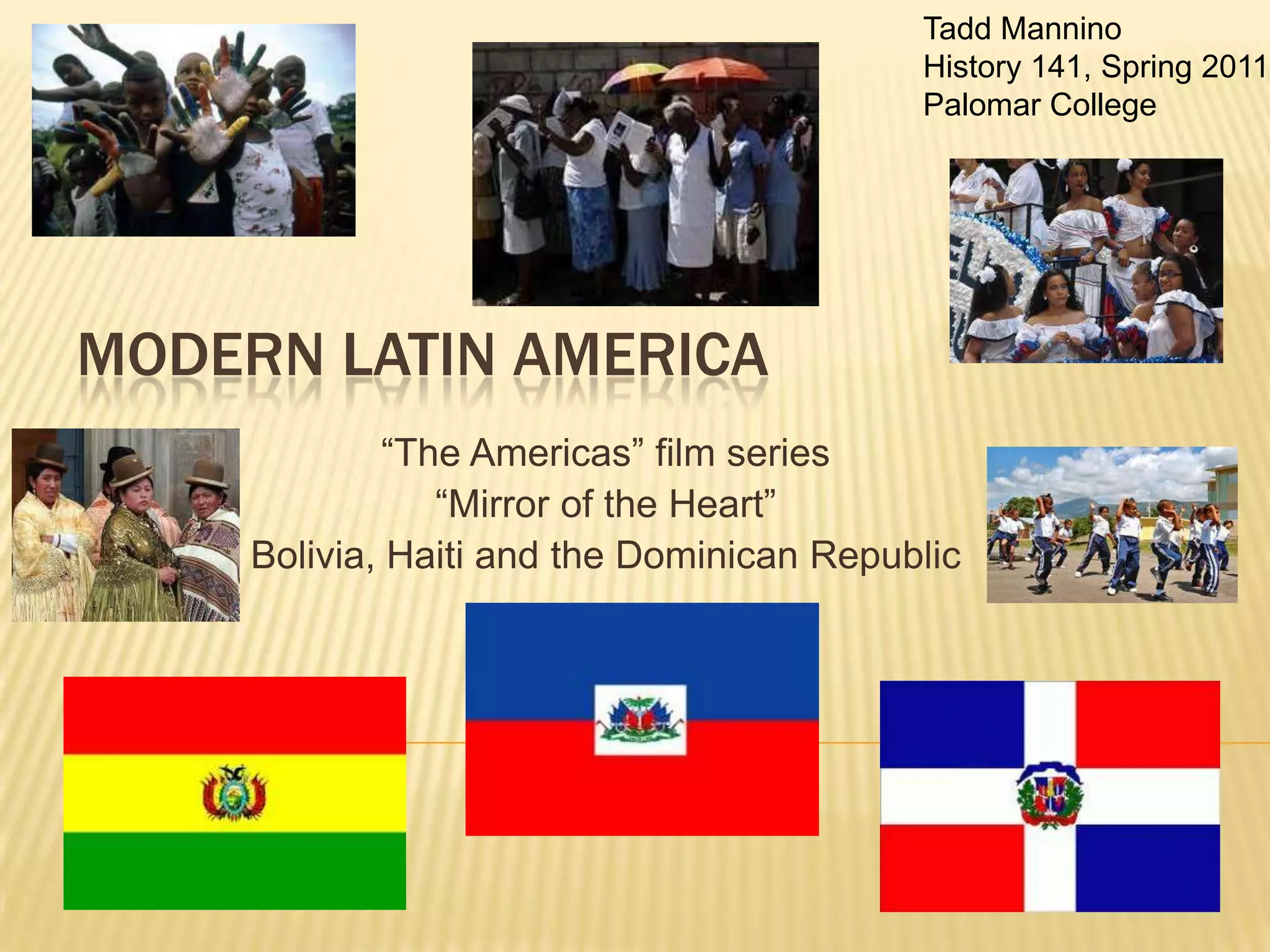
Tadd ManninoHistory 141, Spring 2011Palomar CollegeModern Latin America“The Americas” film series“Mirror of the Heart”Bolivia, Haiti and the Dominican Republic
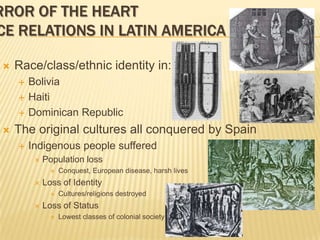
Mirror of the HeartRace Relations in Latin AmericaRace/class/ethnic identity in:BoliviaHaitiDominican RepublicThe original cultures all conquered by SpainIndigenous people sufferedPopulation lossConquest, European disease, harsh livesLoss of IdentityCultures/religions destroyedLoss of StatusLowest classes of colonial society
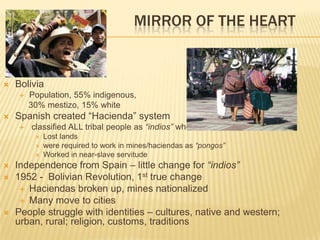
Mirror of the HeartBoliviaPopulation, 55% indigenous,   30% mestizo, 15% whiteSpanish created “Hacienda” system classified ALL tribal people as “indios” whoLost landswere required to work in mines/haciendas as “pongos”Worked in near-slave servitudeIndependence from Spain – little change for “indios”1952 -  Bolivian Revolution, 1st true changeHaciendas broken up, mines nationalizedMany move to citiesPeople struggle with identities – cultures, native and western; urban, rural; religion, customs, traditions
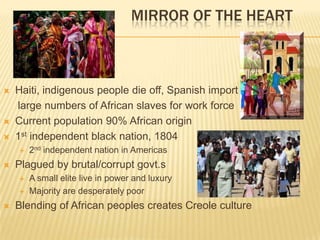
Mirror of the HeartHaiti, indigenous people die off, Spanish import    large numbers of African slaves for work forceCurrent population 90% African origin1st independent black nation, 18042nd independent nation in AmericasPlagued by brutal/corrupt govt.sA small elite live in power and luxuryMajority are desperately poorBlending of African peoples creates Creole culture
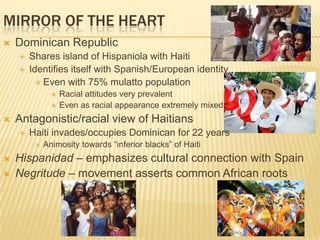
Mirror of the HeartDominican RepublicShares island of Hispaniola with HaitiIdentifies itself with Spanish/European identityEven with 75% mulatto populationRacial attitudes very prevalentEven as racial appearance extremely mixedAntagonistic/racial view of HaitiansHaiti invades/occupies Dominican for 22 yearsAnimosity towards “inferior blacks” of HaitiHispanidad – emphasizes cultural connection with SpainNegritude – movement asserts common African roots
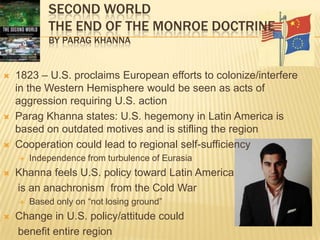
Second WorldThe End of the Monroe Doctrineby Parag Khanna1823 – U.S. proclaims European efforts to colonize/interfere in the Western Hemisphere would be seen as acts of aggression requiring U.S. actionParag Khanna states: U.S. hegemony in Latin America is based on outdated motives and is stifling the regionCooperation could lead to regional self-sufficiencyIndependence from turbulence of EurasiaKhanna feels U.S. policy toward Latin America     is an anachronism  from the Cold WarBased only on “not losing ground”Change in U.S. policy/attitude could    benefit entire region
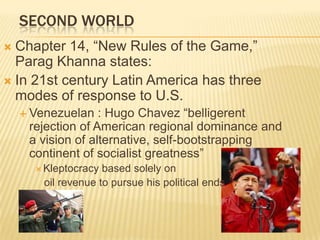
Second WorldChapter 14, “New Rules of the Game,” Parag Khanna states:In 21st century Latin America has three modes of response to U.S.Venezuelan : Hugo Chavez “belligerent rejection of American regional dominance and a vision of alternative, self-bootstrapping continent of socialist greatness”Kleptocracy based solely on   oil revenue to pursue his political ends
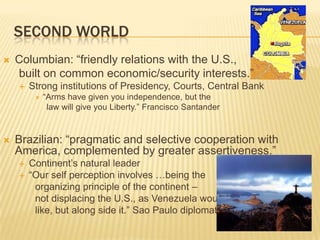
Second WorldColumbian: “friendly relations with the U.S.,     built on common economic/security interests.”Strong institutions of Presidency, Courts, Central Bank“Arms have given you independence, but the     law will give you Liberty.” Francisco SantanderBrazilian: “pragmatic and selective cooperation with America, complemented by greater assertiveness.”Continent’s natural leader“Our self perception involves …being the      organizing principle of the continent –      not displacing the U.S., as Venezuela would     like, but along side it.” Sao Paulo diplomat
Second WorldConclusionParag Khanna states that Western Hemispheric shared energy, trade and self-sufficiency will not occur until the national pride that runs throughout Latin American politics is satisfied with a “balanced mutual recognition” with the U.S.A new alliance for Western Hemisphere nations but not U.S. centered, or Latin America may take its business elsewhere
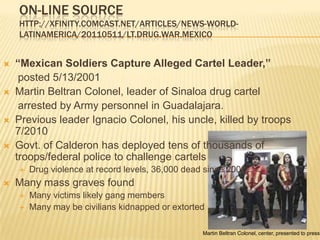
On-line sourcehttp://xfinity.comcast.net/articles/news-world-latinamerica/20110511/LT.Drug.War.Mexico“Mexican Soldiers Capture Alleged Cartel Leader,”posted 5/13/2001Martin Beltran Colonel, leader of Sinaloa drug cartel    arrested by Army personnel in Guadalajara. Previous leader Ignacio Colonel, his uncle, killed by troops 7/2010Govt. of Calderon has deployed tens of thousands of troops/federal police to challenge cartelsDrug violence at record levels, 36,000 dead since 2006Many mass graves foundMany victims likely gang membersMany may be civilians kidnapped or extortedMartin Beltran Colonel, center, presented to press
On-line sourceshttp://latinamericacurrentevents.com/mexican-government-begins-overhaul-corrupt-immigration-service“Mexican Government Begins Overhaul of Corrupt Immigration Service,” posted May 13, 2011 Mexico’s Instituto Nacional de Migration (INM) agency purge all personnel in seven states, 5/12/11Central American migrants rescued by Mexican Army allege INM agents kidnapped them and handed them over to organized-crime elementsAlso allege corruption by INM officials8/2010 – 72 migrants found dead in TamaulipasSuspected to be slain for refusing to work for drug cartelEst. 300,000 US-bound Central Americans    cross Mexico each year

Assignment 7 - Modern Latin America

  • 1.
    Tadd ManninoHistory 141,Spring 2011Palomar CollegeModern Latin America“The Americas” film series“Mirror of the Heart”Bolivia, Haiti and the Dominican Republic
  • 2.
    Mirror of theHeartRace Relations in Latin AmericaRace/class/ethnic identity in:BoliviaHaitiDominican RepublicThe original cultures all conquered by SpainIndigenous people sufferedPopulation lossConquest, European disease, harsh livesLoss of IdentityCultures/religions destroyedLoss of StatusLowest classes of colonial society
  • 3.
    Mirror of theHeartBoliviaPopulation, 55% indigenous, 30% mestizo, 15% whiteSpanish created “Hacienda” system classified ALL tribal people as “indios” whoLost landswere required to work in mines/haciendas as “pongos”Worked in near-slave servitudeIndependence from Spain – little change for “indios”1952 - Bolivian Revolution, 1st true changeHaciendas broken up, mines nationalizedMany move to citiesPeople struggle with identities – cultures, native and western; urban, rural; religion, customs, traditions
  • 4.
    Mirror of theHeartHaiti, indigenous people die off, Spanish import large numbers of African slaves for work forceCurrent population 90% African origin1st independent black nation, 18042nd independent nation in AmericasPlagued by brutal/corrupt govt.sA small elite live in power and luxuryMajority are desperately poorBlending of African peoples creates Creole culture
  • 5.
    Mirror of theHeartDominican RepublicShares island of Hispaniola with HaitiIdentifies itself with Spanish/European identityEven with 75% mulatto populationRacial attitudes very prevalentEven as racial appearance extremely mixedAntagonistic/racial view of HaitiansHaiti invades/occupies Dominican for 22 yearsAnimosity towards “inferior blacks” of HaitiHispanidad – emphasizes cultural connection with SpainNegritude – movement asserts common African roots
  • 6.
    Second WorldThe Endof the Monroe Doctrineby Parag Khanna1823 – U.S. proclaims European efforts to colonize/interfere in the Western Hemisphere would be seen as acts of aggression requiring U.S. actionParag Khanna states: U.S. hegemony in Latin America is based on outdated motives and is stifling the regionCooperation could lead to regional self-sufficiencyIndependence from turbulence of EurasiaKhanna feels U.S. policy toward Latin America is an anachronism from the Cold WarBased only on “not losing ground”Change in U.S. policy/attitude could benefit entire region
  • 7.
    Second WorldChapter 14,“New Rules of the Game,” Parag Khanna states:In 21st century Latin America has three modes of response to U.S.Venezuelan : Hugo Chavez “belligerent rejection of American regional dominance and a vision of alternative, self-bootstrapping continent of socialist greatness”Kleptocracy based solely on oil revenue to pursue his political ends
  • 8.
    Second WorldColumbian: “friendlyrelations with the U.S., built on common economic/security interests.”Strong institutions of Presidency, Courts, Central Bank“Arms have given you independence, but the law will give you Liberty.” Francisco SantanderBrazilian: “pragmatic and selective cooperation with America, complemented by greater assertiveness.”Continent’s natural leader“Our self perception involves …being the organizing principle of the continent – not displacing the U.S., as Venezuela would like, but along side it.” Sao Paulo diplomat
  • 9.
    Second WorldConclusionParag Khannastates that Western Hemispheric shared energy, trade and self-sufficiency will not occur until the national pride that runs throughout Latin American politics is satisfied with a “balanced mutual recognition” with the U.S.A new alliance for Western Hemisphere nations but not U.S. centered, or Latin America may take its business elsewhere
  • 10.
    On-line sourcehttp://xfinity.comcast.net/articles/news-world-latinamerica/20110511/LT.Drug.War.Mexico“Mexican SoldiersCapture Alleged Cartel Leader,”posted 5/13/2001Martin Beltran Colonel, leader of Sinaloa drug cartel arrested by Army personnel in Guadalajara. Previous leader Ignacio Colonel, his uncle, killed by troops 7/2010Govt. of Calderon has deployed tens of thousands of troops/federal police to challenge cartelsDrug violence at record levels, 36,000 dead since 2006Many mass graves foundMany victims likely gang membersMany may be civilians kidnapped or extortedMartin Beltran Colonel, center, presented to press
  • 11.
    On-line sourceshttp://latinamericacurrentevents.com/mexican-government-begins-overhaul-corrupt-immigration-service“Mexican GovernmentBegins Overhaul of Corrupt Immigration Service,” posted May 13, 2011 Mexico’s Instituto Nacional de Migration (INM) agency purge all personnel in seven states, 5/12/11Central American migrants rescued by Mexican Army allege INM agents kidnapped them and handed them over to organized-crime elementsAlso allege corruption by INM officials8/2010 – 72 migrants found dead in TamaulipasSuspected to be slain for refusing to work for drug cartelEst. 300,000 US-bound Central Americans cross Mexico each year