Modern Latin America

       Brooke Soto
        M. Arguello
Britain & Latin America
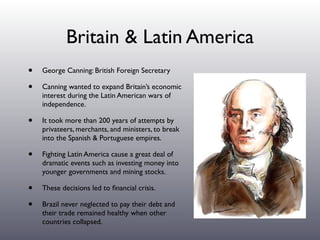
•   George Canning: British Foreign Secretary

•   Canning wanted to expand Britain’s economic
    interest during the Latin American wars of
    independence.

•   It took more than 200 years of attempts by
    privateers, merchants, and ministers, to break
    into the Spanish & Portuguese empires.

•   Fighting Latin America cause a great deal of
    dramatic events such as investing money into
    younger governments and mining stocks.

•   These decisions led to financial crisis.

•   Brazil never neglected to pay their debt and
    their trade remained healthy when other
    countries collapsed.
Mirrors of the Heart


•   This documentary examines the issue of race in Latin America & how it
    interacts with gender, class, occupation, and family.

•   Latin American identity has been affected by many things such as
    urbanization, changing occupations, the media, & consumer culture.

•   From civilizations being overthrown by Europeans & the importing African
    slaves, the impact on these countries was like never before.

•   Three different countries share the identity crisis: Bolivia, Haiti, & the
    Dominican Republic.
Mirrors of the Heart
                           Identity Crisis


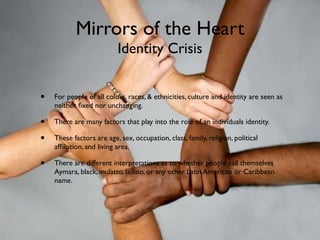
•   For people of all colors, races, & ethnicities, culture and identity are seen as
    neither fixed nor unchanging.

•   There are many factors that play into the role of an individuals identity.

•   These factors are age, sex, occupation, class, family, religion, political
    affiliation, and living area.

•   There are different interpretations as to whether people call themselves
    Aymara, black, mulatto, ladino, or any other Latin American or Caribbean
    name.
Mirrors of the Heart
                                 Bolivia

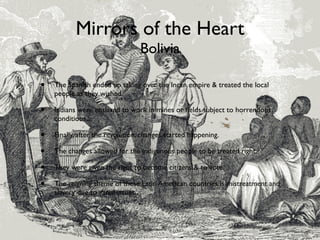
•   The Spanish ended up taking over the Incan empire & treated the local
    people as they wished.

•   Indians were enslaved to work in mines or fields subject to horrendous
    conditions.

•   Finally, after the revolution, changes started happening.

•   The changes allowed for the indigenous people to be treated right.

•   They were given the right to become citizens & to vote.

•   The reigning theme of these Latin American countries is mistreatment and
    slavery due to racial issues.
The Second World
                           Chapter 14
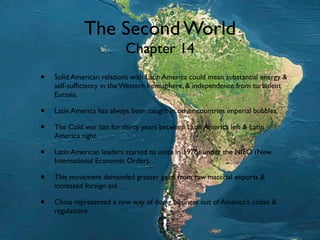
•   Solid American relations with Latin America could mean substantial energy &
    self-sufficiency in the Western hemisphere, & independence from turbulent
    Eurasia.

•   Latin America has always been caught in other countries imperial bubbles.

•   The Cold war last for thirty years between Latin America left & Latin
    America right.

•   Latin American leaders started to unite in 1970s under the NIEO (New
    International Economic Order).

•   This movement demanded greater gains from raw material exports &
    increased foreign aid.

•   China represented a new way of doing business out of America’s codes &
    regulations.
The Second World
    Chapter 15


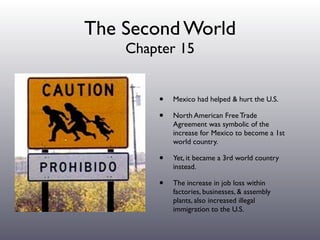
        •   Mexico had helped & hurt the U.S.

        •   North American Free Trade
            Agreement was symbolic of the
            increase for Mexico to become a 1st
            world country.

        •   Yet, it became a 3rd world country
            instead.

        •   The increase in job loss within
            factories, businesses, & assembly
            plants, also increased illegal
            immigration to the U.S.
The Second World
                             Chapter 18
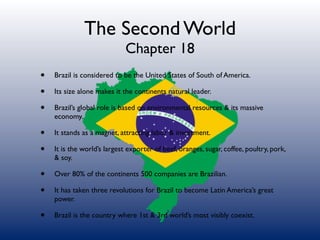
•   Brazil is considered to be the United States of South of America.

•   Its size alone makes it the continents natural leader.

•   Brazil’s global role is based on environmental resources & its massive
    economy.

•   It stands as a magnet, attracting labor & investment.

•   It is the world’s largest exporter of beef, oranges, sugar, coffee, poultry, pork,
    & soy.

•   Over 80% of the continents 500 companies are Brazilian.

•   It has taken three revolutions for Brazil to become Latin America’s great
    power.

•   Brazil is the country where 1st & 3rd world’s most visibly coexist.
The Second World
                                       Chapter 19
•   Globalization has labeled Argentina an emerging
    market prone to vicious cycles like liberalization
    of enterprise, booming investment, rapid growth,
    failed rescue packages, & economic & political
    unraveling.

•   Argentina has become a geopolitical welfare case
    that can’t stand on its own two feet.

•   Few people are willing to risk investing in this
    country due to its stature.

•   Brazil & Argentina have been past rivals, yet now
    they co-produce most of the automobiles they
    export.

•   Argentina envies Chile because it is the region’s
    most vibrant economy.

•   Child is the only country that stands a chance in
    joining the 1st world.
Shakira
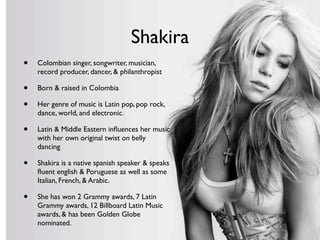
•   Colombian singer, songwriter, musician,
    record producer, dancer, & philanthropist

•   Born & raised in Colombia

•   Her genre of music is Latin pop, pop rock,
    dance, world, and electronic.

•   Latin & Middle Eastern influences her music
    with her own original twist on belly
    dancing

•   Shakira is a native spanish speaker & speaks
    fluent english & Poruguese as well as some
    Italian, French, & Arabic.

•   She has won 2 Grammy awards, 7 Latin
    Grammy awards, 12 Billboard Latin Music
    awards, & has been Golden Globe
    nominated.
Salma Hayek
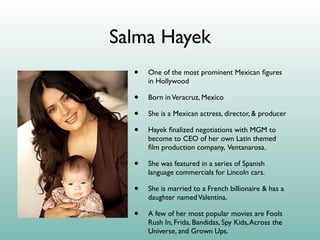
  •   One of the most prominent Mexican figures
      in Hollywood

  •   Born in Veracruz, Mexico

  •   She is a Mexican actress, director, & producer

  •   Hayek finalized negotiations with MGM to
      become to CEO of her own Latin themed
      film production company, Ventanarosa.

  •   She was featured in a series of Spanish
      language commercials for Lincoln cars.

  •   She is married to a French billionaire & has a
      daughter named Valentina.

  •   A few of her most popular movies are Fools
      Rush In, Frida, Bandidas, Spy Kids, Across the
      Universe, and Grown Ups.

Latin america

  • 1.
    Modern Latin America Brooke Soto M. Arguello
  • 2.
    Britain & LatinAmerica • George Canning: British Foreign Secretary • Canning wanted to expand Britain’s economic interest during the Latin American wars of independence. • It took more than 200 years of attempts by privateers, merchants, and ministers, to break into the Spanish & Portuguese empires. • Fighting Latin America cause a great deal of dramatic events such as investing money into younger governments and mining stocks. • These decisions led to financial crisis. • Brazil never neglected to pay their debt and their trade remained healthy when other countries collapsed.
  • 3.
    Mirrors of theHeart • This documentary examines the issue of race in Latin America & how it interacts with gender, class, occupation, and family. • Latin American identity has been affected by many things such as urbanization, changing occupations, the media, & consumer culture. • From civilizations being overthrown by Europeans & the importing African slaves, the impact on these countries was like never before. • Three different countries share the identity crisis: Bolivia, Haiti, & the Dominican Republic.
  • 4.
    Mirrors of theHeart Identity Crisis • For people of all colors, races, & ethnicities, culture and identity are seen as neither fixed nor unchanging. • There are many factors that play into the role of an individuals identity. • These factors are age, sex, occupation, class, family, religion, political affiliation, and living area. • There are different interpretations as to whether people call themselves Aymara, black, mulatto, ladino, or any other Latin American or Caribbean name.
  • 5.
    Mirrors of theHeart Bolivia • The Spanish ended up taking over the Incan empire & treated the local people as they wished. • Indians were enslaved to work in mines or fields subject to horrendous conditions. • Finally, after the revolution, changes started happening. • The changes allowed for the indigenous people to be treated right. • They were given the right to become citizens & to vote. • The reigning theme of these Latin American countries is mistreatment and slavery due to racial issues.
  • 6.
    The Second World Chapter 14 • Solid American relations with Latin America could mean substantial energy & self-sufficiency in the Western hemisphere, & independence from turbulent Eurasia. • Latin America has always been caught in other countries imperial bubbles. • The Cold war last for thirty years between Latin America left & Latin America right. • Latin American leaders started to unite in 1970s under the NIEO (New International Economic Order). • This movement demanded greater gains from raw material exports & increased foreign aid. • China represented a new way of doing business out of America’s codes & regulations.
  • 7.
    The Second World Chapter 15 • Mexico had helped & hurt the U.S. • North American Free Trade Agreement was symbolic of the increase for Mexico to become a 1st world country. • Yet, it became a 3rd world country instead. • The increase in job loss within factories, businesses, & assembly plants, also increased illegal immigration to the U.S.
  • 8.
    The Second World Chapter 18 • Brazil is considered to be the United States of South of America. • Its size alone makes it the continents natural leader. • Brazil’s global role is based on environmental resources & its massive economy. • It stands as a magnet, attracting labor & investment. • It is the world’s largest exporter of beef, oranges, sugar, coffee, poultry, pork, & soy. • Over 80% of the continents 500 companies are Brazilian. • It has taken three revolutions for Brazil to become Latin America’s great power. • Brazil is the country where 1st & 3rd world’s most visibly coexist.
  • 9.
    The Second World Chapter 19 • Globalization has labeled Argentina an emerging market prone to vicious cycles like liberalization of enterprise, booming investment, rapid growth, failed rescue packages, & economic & political unraveling. • Argentina has become a geopolitical welfare case that can’t stand on its own two feet. • Few people are willing to risk investing in this country due to its stature. • Brazil & Argentina have been past rivals, yet now they co-produce most of the automobiles they export. • Argentina envies Chile because it is the region’s most vibrant economy. • Child is the only country that stands a chance in joining the 1st world.
  • 10.
    Shakira • Colombian singer, songwriter, musician, record producer, dancer, & philanthropist • Born & raised in Colombia • Her genre of music is Latin pop, pop rock, dance, world, and electronic. • Latin & Middle Eastern influences her music with her own original twist on belly dancing • Shakira is a native spanish speaker & speaks fluent english & Poruguese as well as some Italian, French, & Arabic. • She has won 2 Grammy awards, 7 Latin Grammy awards, 12 Billboard Latin Music awards, & has been Golden Globe nominated.
  • 11.
    Salma Hayek • One of the most prominent Mexican figures in Hollywood • Born in Veracruz, Mexico • She is a Mexican actress, director, & producer • Hayek finalized negotiations with MGM to become to CEO of her own Latin themed film production company, Ventanarosa. • She was featured in a series of Spanish language commercials for Lincoln cars. • She is married to a French billionaire & has a daughter named Valentina. • A few of her most popular movies are Fools Rush In, Frida, Bandidas, Spy Kids, Across the Universe, and Grown Ups.

Editor's Notes