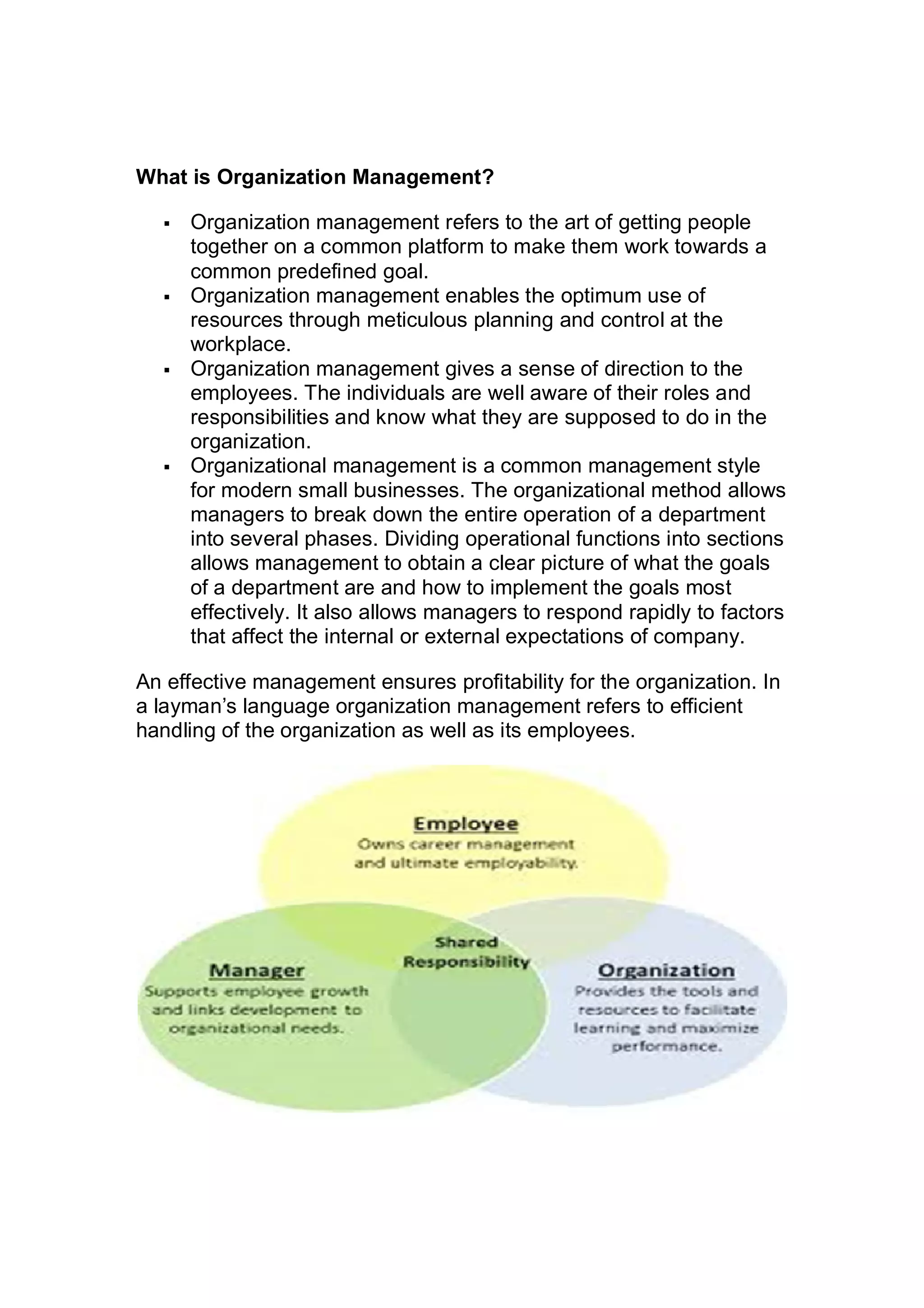
What is Organization Management?
 Organization management refers to the art of getting people
together on a common platform to make them work towards a
common predefined goal.
 Organization management enables the optimum use of
resources through meticulous planning and control at the
workplace.
 Organization management gives a sense of direction to the
employees. The individuals are well aware of their roles and
responsibilities and know what they are supposed to do in the
organization.
 Organizational management is a common management style
for modern small businesses. The organizational method allows
managers to break down the entire operation of a department
into several phases. Dividing operational functions into sections
allows management to obtain a clear picture of what the goals
of a department are and how to implement the goals most
effectively. It also allows managers to respond rapidly to factors
that affect the internal or external expectations of company.
An effective management ensures profitability for the organization. In
a layman’s language organization management refers to efficient
handling of the organization as well as its employees.
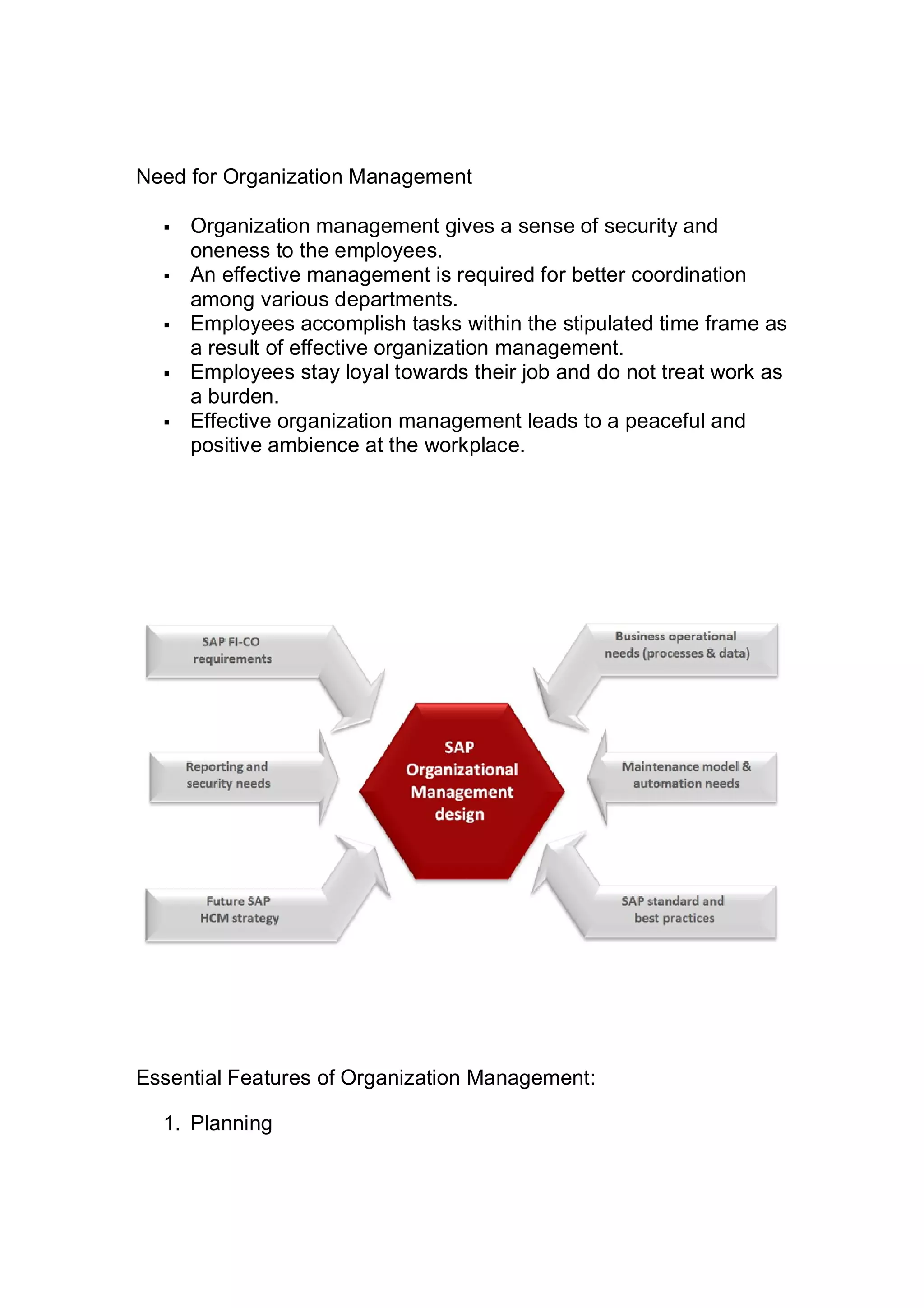
Need for Organization Management
 Organization management gives a sense of security and
oneness to the employees.
 An effective management is required for better coordination
among various departments.
 Employees accomplish tasks within the stipulated time frame as
a result of effective organization management.
 Employees stay loyal towards their job and do not treat work as
a burden.
 Effective organization management leads to a peaceful and
positive ambience at the workplace.
Essential Features of Organization Management:
1. Planning
 Prepare an effective business plan. It is essential to
decide on the future course of action to avoid confusions
later on.
 Plan out how you intend to do things.
2. Organizing
 Organizing refers to the judicious use of resources to
achieve the best out of the employees.
 Prepare a monthly budget for smooth cash flow.
3. Staffing
 Poor organization management leads to unhappy
employees who eventually create problems for
themselves as well as the organization.
 Recruit the right talent for the organization.
4. Leading
 The managers or superiors must set clear targets for the
team members.
 A leader must make sure his team members work in
unison towards a common objective. He is the one who
decides what would be right in a particular situation.
5. Control
 The superiors must be aware of what is happening
around them.
 Hierarchies should be well defined for an effective
management.
 The reporting bosses must review the performance and
progress of their subordinates and guide them whenever
required.
6. Time Management
 An effective time management helps the employees to do
the right thing at the right time.
 Managing time effectively always pays in the long run.
7. Motivation
 Motivation goes a long way in binding the employees
together.
 Appreciating the employees for their good work or
lucrative incentive schemes go a long way in motivating
the employees and make them work for a longer span of
time.
8. Resource Control
 The control process is the final stage of the organizational
management system. In this step, managers set controls to
analyze the progress and effectiveness of each plan made
during the planning phase.
 A control is a system that uses data compilations to determine if
goals are met. If results are inefficient or show over-
achievement based on initial plans, adjustments can be made
to the organization process to ensure resources are used in
the most effective manner. Data for the control process may
be delivered in company financial statements, labor reports,
internal and external complaint systems or regulatory
agencies.
The importance of a good organization and management team:
One of the most important parts of running a successful business is
that you have to have a good management team. Not only that but
you have to have your business organized in a way that your
management team can be most effective. Making sure of this can be
tricky but it has to happen if your business is going to be successful.
The reason that you need to make sure that you have a good
organization and management team for your business is that it will
keep things running smoothly. It will ensure that everybody knows
what they are supposed to be doing and what the goals of the
business are. This will keep everyone on the same page and working
towards the same goals. Most companies know that they have to
have a good management team and organization, the problem is that
they don't know how to create it.
Creating the organizational structure of your company should be fairly
straightforward. What you need to make sure of is that you have clear
lines of both communication and responsibility.
Everybody has to know who is responsible for what, this is the only
way to ensure that things get done properly. It is also important that
information get passed in an efficient manner which is why you need
to have a clear line of communication. This has to be a two way
street, it can't just be about management telling employees what to
do, there has to be a way for employees to bring issues to the
attention of management.
There are all kinds of ways that a business can be organized but
most of them use a pyramid structure with senior management on top
each supervising a group of middle managers and each of these
managers leading a group of employees. Of course for larger
companies the pyramid will be much larger. This is the way that most
companies do things but it can be altered to meet your needs and
there are many examples of successful companies that have used
different approaches
Creating a good management team can be a bit more of a challenge,
there is no doubt that good managers are critical to your business.
They are the ones who will make the important decisions so they
have to have the experience and the judgement to make good ones.
Determining whether they do or not can be a challenge and the truth
is that you may find that you do hire managers who are not up to the
job. If that is the case you have to get rid of them, bad managers can
do an enormous amount of damage to your business. A bad manager
will make bad decisions, will hurt the morale of the employees and
your relationship with customers, you can't afford to keep them
around.
Personnel Administration
 Though relevant information can be found throughout the human
resources site, the following links will guide you directly to
that which is geared toward personnel administrators.
 Administration, better known as human resources (HR) management,
is the coordination and regulation of employees in a company. It
involves organizing, recruiting, hiring, training, and assessing
workers.
 Conflict resolution and legal compliance also are important aspects.
With a good HR team doing their jobs well, a company will often be
ultimately more efficient and competitive, generating additional
revenue.
 Organization
 In most businesses, a well-organized workforce translates to greater
efficiency, productivity, and revenue. The first goal of personnel
administration, therefore, is to organize all employees in such a way
that allows them to cooperate and complete tasks in the best way
possible.
Examples of issues in this area include how many departments are
necessary, how many individuals should be in each department, what
the manager to employee ratio should be, and what alternate chains
of command should be used when managers cannot be contacted.
Organization also deals with how to assign individuals to specific
projects, as well as keeping the employees healthy and safe in the
work environment.
 Recruitment and Hiring
 Once those in a company’s personnel administration team
know how to organize workers and their projects, they begin to
recruit and hire employees actively.
 They post notices about positions available, organize or take
part in events such as job fairs, and conduct initial interviews to
find the most qualified and experienced candidates.
 They then pass on information about the final candidates to
department managers, who often conduct the last interviews
and make the call about whom to hire.
 Social equity guarantees that groups that can not compete fairly
are given preferences in job selection and promotion decisions.
 Public personnel administration consists of three general
systems.
 The first, civil service, helps to protect employee rights and
safeguard efficiency.
 What is personnel administration?
 Personnel administration is that part of administration which is
concerned with people at work and with an organization.
 It refers to the entire spectrum of an organization's interaction
with its human resources from recruitment activity to retirement
process.
 It involves personnel planning and forecasting, appraising
human performance, selection and staffing, training and
development and maintenance and improvement of
performance and productivity.
 personnel administration is closely related to an organization's
overall effectiveness.
 personnel administration aims at:
 effective utilization of human resources.
 desirable working relations among all members of the
organization
 Maximum development
 Meeting the organization's social and legal responsibilities.
 Personnel function is concerned with the procurement,
development, compensation,
integration and maintenance of the personnel of an organization for
the purpose of contributing towards the accomplishment of that
organization's major goals and objectives.
Recruitment
Job analysis
In situations such as where one or more new jobs are to be created
and recruited to for the first time, a job analysis and/or in some cases
a task analysis might be undertaken to document the actual or
intended requirements of the job. From these the relevant information
is captured in such documents as job descriptions and job
specifications. Often a company will already have job descriptions
that represent a historical collection of tasks performed. Where
already drawn up, these documents need to be reviewed or updated
to reflect present day requirements. Prior to initiating the recruitment
stages a person specification should be finalised to provide the
recruiters commissioned with the requirements and objectives of the
project.[1]
Sourcing:-
Sourcing is the use of one or more strategies to attract or identify
candidates to fill job vacancies. It may involve internal and/or external
advertising, using appropriate media, such as local or national
newspapers, specialist recruitment media, professional publications,
window advertisements, job centers, or in a variety of ways via the
internet. Alternatively, employers may use recruitment consultancies
or agencies to find otherwise scarce candidates who may be content
in their current positions and are not actively looking to move
companies may be proactively identified. This initial research for so-
called passive candidates, also called name generation, results in a
contact information of potential candidates who can then be
contacted discreetly to be screened and approached.
Screening and selection:-
Suitability for a job is typically assessed by looking for relevant skills,
knowledge, aptitude, qualifications and educational or job related
experience. These can be determined via: screening résumés (also
known as CVs); job applications; interviews. More proactive
identification methods include performance assessments,
psychological, aptitude, numeracy, physical and literacy testing. Many
recruiters and agencies use applicant tracking systems to perform the
filtering process, along with software tools for psychometric testing
and performance based assessment. [2] Performance based
assessment is a process to find out if job applicants perform the
responsibilities for which they are applying. [3] In many countries,
employers are legally mandated to ensure their screening and
selection processes meet equal opportunity and ethical standards.
In addition to the above selection assessment criteria, employers are
likely to recognize the value of candidates who also have the so-
called 'soft skills', such as interpersonal or team leadership and have
the ability to reinforce the company brand through their behavior in
front of customers and suppliers. Multinational organizations and
those that recruit from a range of nationalities are also concerned
candidates will fit into the prevailing company 'culture'.[4]
A British Armed Forces recruitment centre in Oxford.
Lateral hiring:-
"Lateral hiring" refers to a form of recruiting; the term is used with two
different, almost opposite meanings. In one meaning, the hiring
organization targets employees of another, similar organization,
possibly luring them with a better salary and the promise of better
career opportunities. An example is the recruiting of a partner of a law
firm by another law firm. The new lateral hire then has specific
applicable expertise and can make a running start in the new job. In
some professional branches such lateral hiring was traditionally
frowned upon, but the practice has become increasingly more
common. An employee's contract may have a non-compete clause
preventing such lateral hiring.
In another meaning, a lateral hire is a newly hired employee who has
no prior specific applicable expertise for the new job, and for whom
this job move is a radical change of career. An example is the
recruiting of a university professor to become chairman of the board
of a company.
On boarding
For more details on this topic, see on boarding."On boarding" is a
term which describes the process of helping new employees become
productive members of an organization. A well-planned introduction
helps new employees become fully operational quickly and is often
integrated with a new company and environment. On-boarding is
included in the recruitment process for retention purposes. Many
companies have on boarding campaigns in hopes to retain top talent
that is new to the company; campaigns may last anywhere from 1
week to 6 months.
Recruitment approaches
There are a variety of recruitment approaches and most
organizations will utilize a combination of two or more of these as part
of a recruitment exercise or to deliver their overall recruitment
strategy. In summary five basic models more commonly found are:-
An in-house personnel or human resources function may in some
case still conduct all stages of the recruitment process. In the
smallest organizations recruitment may be left to individual
managers. More frequently whilst managing the overall recruitment
exercise and the decision-making at the final stages of the selection
process external service providers may undertake the more
specialized aspects of the recruitment process.
Outsourcing of recruitment to an external provider may be the
solution for some small businesses and at the other extreme very
large organizations.
Employment agencies are established as both publicly funded
services and as commercial private sector operations. Services may
support permanent, temporary, or casual worker recruitment. They
may be generic agencies that deal with providing unskilled workers
through to highly skilled managerial or technical staff or so-called
niche agencies that specialize in a particular industrial sector or
professional group.
Executive search firms for executive and professional positions.
These firms operate across a range of models such as contingency
or retained approaches and also hybrid models where advertising is
also used to ensure a flow of candidates alongside relying on
networking as their main source of candidates.
Internet recruitment services including recruitment websites and job
search engines used to gather as many candidates as possible by
advertising a position over a wide geographic area. In addition social
network sourced recruitment has emerged as a major method of
sourcing candidates.
Recruitment:
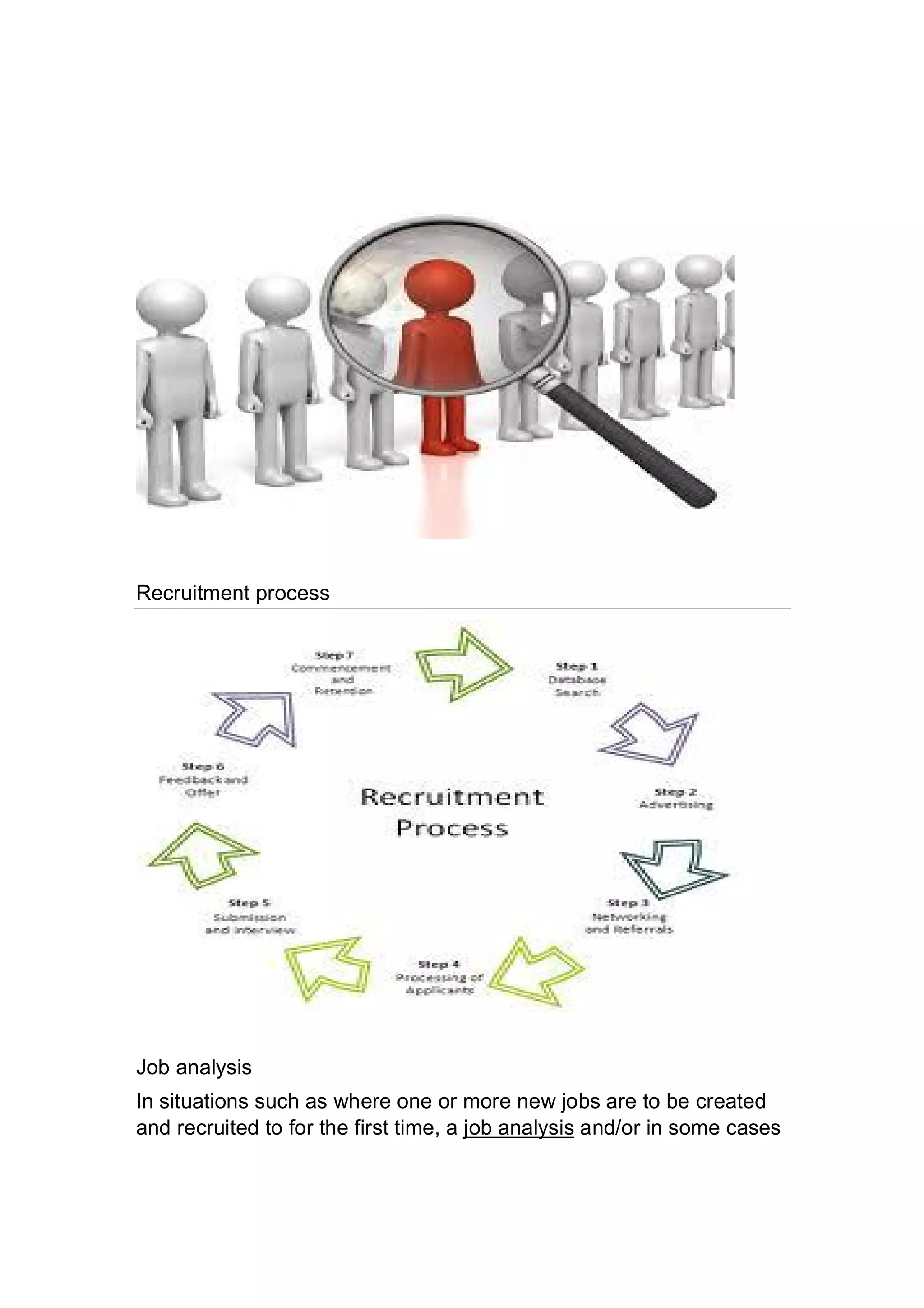
Recruitment refers to the process of attracting, screening, selecting,
and on boarding a qualified person for a job. At the strategic level it
may involve the development of an employer brand which includes an
'employee offering'.
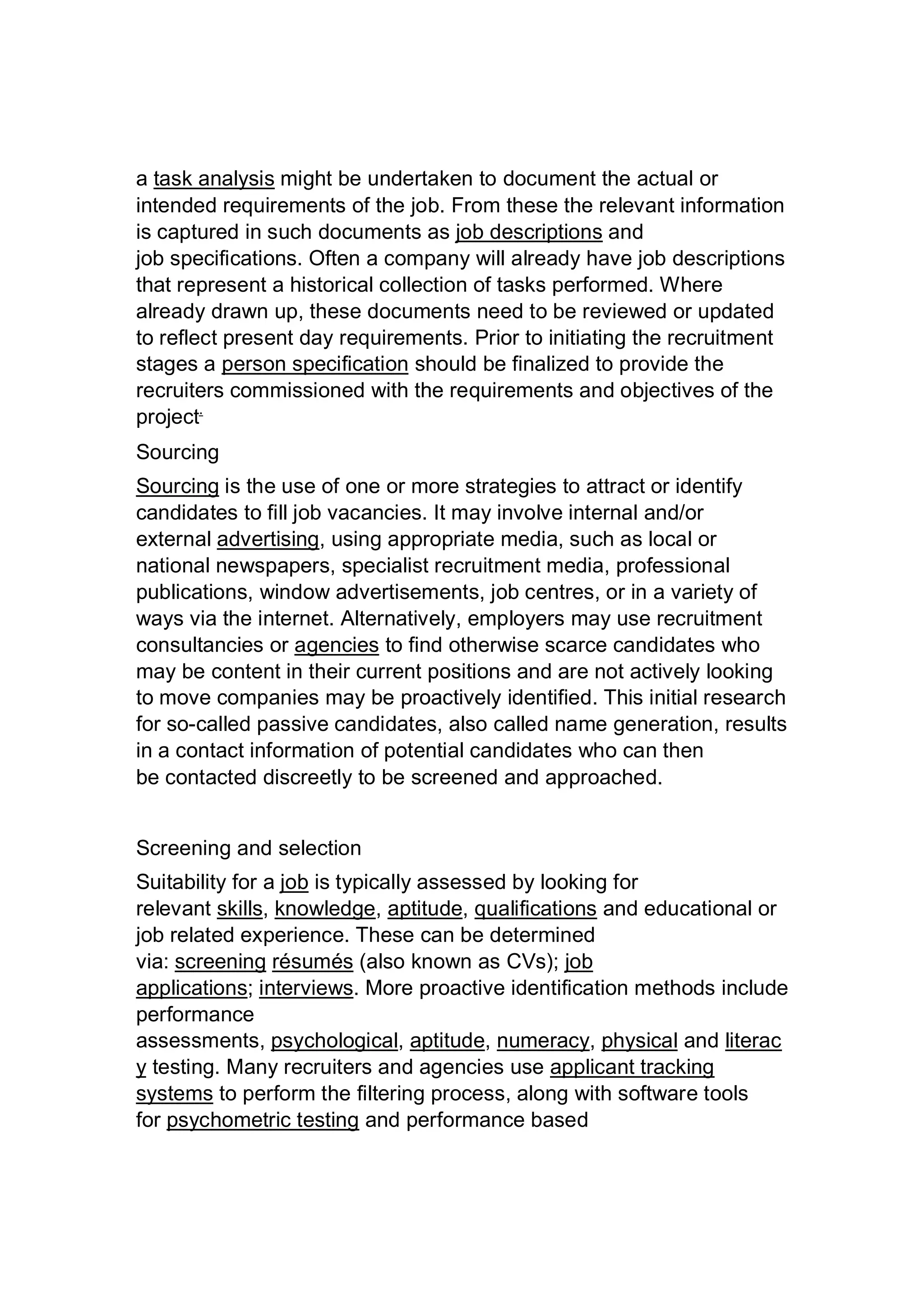
Recruitment process
Job analysis
In situations such as where one or more new jobs are to be created
and recruited to for the first time, a job analysis and/or in some cases
a task analysis might be undertaken to document the actual or
intended requirements of the job. From these the relevant information
is captured in such documents as job descriptions and
job specifications. Often a company will already have job descriptions
that represent a historical collection of tasks performed. Where
already drawn up, these documents need to be reviewed or updated
to reflect present day requirements. Prior to initiating the recruitment
stages a person specification should be finalized to provide the
recruiters commissioned with the requirements and objectives of the
project.
Sourcing
Sourcing is the use of one or more strategies to attract or identify
candidates to fill job vacancies. It may involve internal and/or
external advertising, using appropriate media, such as local or
national newspapers, specialist recruitment media, professional
publications, window advertisements, job centres, or in a variety of
ways via the internet. Alternatively, employers may use recruitment
consultancies or agencies to find otherwise scarce candidates who
may be content in their current positions and are not actively looking
to move companies may be proactively identified. This initial research
for so-called passive candidates, also called name generation, results
in a contact information of potential candidates who can then
be contacted discreetly to be screened and approached.
Screening and selection
Suitability for a job is typically assessed by looking for
relevant skills, knowledge, aptitude, qualifications and educational or
job related experience. These can be determined
via: screening résumés (also known as CVs); job
applications; interviews. More proactive identification methods include
performance
assessments, psychological, aptitude, numeracy, physical and literac
y testing. Many recruiters and agencies use applicant tracking
systems to perform the filtering process, along with software tools
for psychometric testing and performance based
assessment. [2]
Performance based assessment is a process to find
out if job applicants perform the responsibilities for which they are
applying. In many countries, employers are legally mandated to
ensure their screening and selection processes meet equal
opportunity and ethical standards.
In addition to the above selection assessment criteria, employers are
likely to recognize the value of candidates who also have the so-
called 'soft skills', such as interpersonal or team leadership and have
the ability to reinforce the company brand through their behavior in
front of customers and suppliers. Multinational organizations and
those that recruit from a range of nationalities are also concerned
candidates will fit into the prevailing company 'culture'.
Lateral hiring
"Lateral hiring" refers to a form of recruiting; the term is used with two
different, almost opposite meanings. In one meaning, the hiring
organization targets employees of another, similar organization,
possibly luring them with a better salary and the promise of better
career opportunities. An example is the recruiting of a partner of a law
firmly another law firm. The new lateral hire then has specific
applicable expertise and can make a running start in the new job. In
some professional branches such lateral hiring was traditionally
frowned upon, but the practice has become increasingly more
common. An employee's contract may have a non-compete
clause preventing such lateral hiring.
In another meaning, a lateral hire is a newly hired employee who has
no prior specific applicable expertise for the new job, and for whom
this job move is a radical change of career. An example is the
recruiting of a university professor to become chairman of the board
of a company.
On boarding
"On boarding" is a term which describes the process of helping new
employees become productive members of an organization. A well-
planned introduction helps new employees become fully operational
quickly and is often integrated with a new company and environment.
On-boarding is included in the recruitment process for retention
purposes. Many companies have on boarding campaigns in hopes to
retain top talent that is new to the company; campaigns may last
anywhere from 1 week to 6 months.
METHODS OF RECRUITMENT:
The following are the mostcommonly used methods ofrecruiting people.
INTERNAL METHODS:
1. Promotions and Transfers
This is a method of filling vacancies from within through transfers and
Promotions.
A transfer is a lateral movement within the same grade, from one job
to another. It may lead to changes in duties and responsibilities,
working conditions, etc., but not necessarily salary. Promotion, on the
other hand, involves movement of employee from a lower level
position to a higher level position accompanied by (usually) changes
in duties, responsibilities, status and value. Organizations
generally prepare badly lists or a central pool of persons
from which v acancies can be filled for manual jobs.
Such persons ar e usually passed on to v arious
departments, depending on internal requirements. If a person
remains on such rolls for 240days or more, he gets the status of a
permanent employee as per the Industrial Disputes act
and is ther efore entitled to all relev ant benefits, inclu
ding provident fund, gratuity, retrenchment compensation.
2. Job Posting:
Job posting is another way of hiring people from within. In
this method, the organization publicizes job opening on bulletin
boards, electronic method and similar outlets. One of the important
advantages of this method is that it offers a chance to highly qualified
applicants working within the company to look for growth
opportunities within the company to look for growth opportunities within
the company withoutlooking for greener pastures outside.
3. Employee Referrals:
Emp loyee referral means using personal contacts to l
ocate job opportunities. It is ar ecommendation from a
current employee regar ding a job applicant. The logic
behindemployee referral is that “it takes one to know one”.
Employees working in the organization, in this case, are
encouraged to recommend the names of their friends,
working in other organizations for a possible vacancy in the near
future. In fact, this has become a popular way of recruiting people in
the highly competitive Information Technology industry nowadays.
Companies offer rich rewards also to employees whose
recommendations are accepted –
after the routine screening and examining process is o
v er andjob offers extended to thes u g g e s t e d c a n d i d a
t e s . A s a g o o d w i l l g e s t u r e s , c o m p a n i e s a l s o c o n
s i d e r t h e n a m e s recommended byunions fromtime to time.
External Methods:
Direct methods:
1. Campus Recruitment
It is a method of recruiting by visiting and participating in college
campuses and their placement centers. Here the recruiters
visit reputed educational institutions such as IITs, IIMs, colleges and
universities with a view to pick up job aspirants having requisite
technical or professional skills. Job seekers are provided information
about the jobs and the recruiters,in turn, get asnapshot ofjob seekers
throughconstantinterchange ofinformation with respective institutions.A
preliminaryscreeningis done within thecampus and theshort listed students
are then subjected to the remainder of the selection process. In view
of the growing demand for young managers,most reputed organizations (such
as Hindustan Lever Ltd., Proctor &Cable, Citibank, State Bank ofIndia, Tata and
Birla groupcompanies)visit IIMs and IITs regularly andeven sponsor certain
popular campus activities with a viewtoearn goodwillin the job market.
Advantages ofthis method include:the placement centre helps locate
applicants and provides resumes to organizations; applicants can be
prescreened; applicants willnothave tobe lured away from a currentjob and
lower salaryexpectations.On the negativefront,campusrecruitingmeans hiring
people with little orno work experience.The organizations will have to offer some
kind of training to theapplicants, almost immediately after hiring. It
demands careful advance planning, looking into the placement weeks of
variousinstitutionsin different parts ofthe country. Further, campusrecruiting can
be costly for organizations situated in another city(airfare,boardingand lodging
expenses of recruiters, site visit of applicants if allowed, etc.). If
campus recruitmentis used,steps shouldbe taken byhumanresource
departmentto ensure thatrecruiters are knowledgeable concerning thejobs that
are to befilled and the organizations and understandand employ effective
interviewing skills.
Guidelines for campus recruiting: companies using college campuses
as recruitment source should considerthe following guidelines: Identifythe
potential candidates early:The earlier thatcandidate with top potential can be
 Identified,the more likely the organization willbein a position to attract
them. Employvarious meansto attractcandidates:These may include
providingresearch grants;
 Consulting opportunities to faculty members,funding university
infrastructuralrequirementsinternships to students, etc. in the long
run these will enhance the prestige of the company in the eyes of
potentialjob seekers.
 Use effective recruitment material: Attractive brochures,films, computer
diskettes,
Followed byenthusiastic and effective presentations by company officials,
correspondence with placement offices inrespectivecampusin a friendly way –
willhelp booting thecompanyimage in the eyes ofthe applicants.The company
must providedetailed information about the characteristics of entry –
level positions, especially those thathave hada major positive impact on
prior applicants’decisions to join the company.
 Offer training to campus interviews: It’s betterto devotemore time and
resources to trainon campus interviewers to answer specificjobrelated
questions of applicants.
 Come out with a competitive offer: Keep the keyjob attributes that
influence the decisions
of applicants such as promotional avenues, challenging
assignments, long term income potential, etc., while talking
to candidates.
Indirect methods:
1. Advertisements:
These include advertisements in newspapers;trade, professionalandtechnical
journals;radio and television; etc. in recent times, this medium has
become just as colorful, lively andimaginative as consumer advertising.The
adsgenerally give a briefoutline ofthe jobresponsibilities, compensation
package, prospects in organizations, etc. this method is appropriate
when (a) the organization intends to reach a largetarget group and(b) the
organizations wants a fairly good number oftalented people– who are
geographicallyspread out.To apply for advertisedvacancies let’s brieflyexamine
the wide variety ofalternatives availableto a company- as far as ads are
concerned:
 Newspaper Ads:
Here it is easy to place job ads without much of a lead time. It
has flexibility in terms of information and can conveniently
target a specific geographic location. On the negative side,
newspaper ads tend to attract only those who are actively
seeking employment at that point of time, while some of the
best candidates who are well paid and challenged by their
currentjobs maynot be aware ofsuch openings.As aresult, the
company may be bombarded with applicationsfroma large number of
candidates who are marginally qualified forthejob-adding to
its administrative burden.
 Television and radio ads:
These ads are more likely to each individual who are not
actively seeking employment;theyare morelikely to stand out
distinctly, theyhelp the organizationto targettheaudience more
selectively and they offer considerable scope for designing ads
creatively .However, these ads are expensive. Also, because
the television or radio is simply seen or heard, potential
candidates mayhave atough time rememberingthe details, making
application difficult.
2. Third Party Methods:
 Private Employment Search Firms:
Assearchfirmis a private employment agencythatmaintains computerized lists
of qualified applicants and supplies these to employers willing to hire
people from the list for a fee. Firms like Arthur Anderson,Boble and Hewitt,
ABC consultants, SB Billimoria, KPMG;Ferguson Associates offersspecialized
employment-related services to corporatehouses for a fee, especially for
top and middle level executive vacancies. AT the lower end,a number
of search firms operate– providing multifariousservices to both recruiters and the
recruitees.
 Employment Exchanges:
ASa statutoryrequirement,companies are alsoexpectedto notify(wherever the
EmploymentExchanges Act,1959, applies) theirvacancies throughthe
respective Employment Exchanges,created allover Indiafor helping
unemployed youth,displaced persons, ex-military personnel, physically
handicapped, etc. AS per the Act all employers are supposedto notify
thevacancies arisingin their establishmentsform time totime – with certain
exemptions– tothe prescribedemployment exchanges beforethey are filled.
The Act covers all establishments in public sector and nonagricultural
establishments employing25 or more workersinthe privatesector. However,
inviewofthe practicaldifficultiesinvolvedin implementingthe provisionsofthe
Act(such as filinga quarterlyreturn in respectof their staffstrength,vacancies
andshortages, returns showingoccupationaldistributionoftheir employees,etc.)
many organizationshave successfully fought court battles when they
were asked to pick up candidates from amongthose sponsoredby the
employmentexchanges.
Factors affectingrecruitment---
1. Internal Factors
For the internal mechanism of the organization, some of internal
factors that affect recruitment are as follows:
i. Size of the organization
Recruitment process is affected by the size of the organization to a
large extent. Experience suggests that larger organizations recruit
more candidates than small ones. Large organizations find
recruitment less problematic than small organizations.
ii. Recruiting Policy
The recruitment policy of the firm also affects the recruitment
process. This policy is concerned with candidates from outside the
organization, whereas others want to recruit from internal sources.
iii. Image of the organization
Image or goodwill of the organization also affects the recruitment.
Organizations having good image can attract potential and competent
candidates to a large extent. Good public relation, rendering public
services, etc. help to enhance the image and reputation of the
organization.
iv. Image of job
Jobs having good image in terms of better remuneration, working
condition, promotion, career development opportunities etc can
attract the potential and qualified candidates to a large extent.
2. External Factors
External factors are concerned with the environmental changes that
will take place in the external environment of organization. Some of
the external factors that affect recruitment policy are as follows:
i. Demographic factors
Demography is the study of human population in terms of age, sex,
occupation, religion, composition, ethnicity etc. The demographic
factors have profound influence on recruitment process.
ii. Labor market
Labor market constitutes the force of demand and supply of labor of
particular importance. For instance, if demand for a particular skill is
high relative to its supply, the recruitment process evolves more
efforts. Contrary to it, if supply is more than demand, the recruitment
process will be easier.
iii. Unemployment situations
Unemployment rate of particular area is yet another influencing factor
of recruitment process. If the unemployment rate is high, the
recruitment process will be simpler and vice versa.
iv. Social and political environment
The forces of social and political environment also influence
recruitment policy. For instance, the change in government can have
a direct impact upon recruitment policy of the company due to change
in government rules and regulations.
vi. Legal considerations
Legal considerations with regard to employment provision for under-
privileged castes etc. will have a positive impact on recruitment policy
of the organization.
Purpose & Importance of Recruitment
Attract and encourage more and more candidates to apply in
the organization.
Create a talent pool of candidates to enable the selection of
best candidates for the organization.
Determine present and future requirements of the organization
in conjunction with its personnel planning and job analysis
activities.
Recruitment is the process which links the employers with the
employees.
Increase the pool of job candidates at minimum cost.
Help increase the success rate of selection process by
decreasing number of visibly under qualified or overqualified job
applicants.
Help reduce the probability that job applicants once recruited
and selected will leave the organization only after a short period of
time.
Meet the organizations legal and social obligations regarding the
composition of its workforce.
Begin identifying and preparing potential job applicants who will
be appropriate candidates.
Increase organization and individual effectiveness of various
recruiting techniques and sources for all types of job applicants.
PERSONAL DEVLOPEMENT :
" it is the method of developing potentialities of employees so that
they can max satisfaction out of their work and give their best
efforts "
* it is an extension of general management, that of prompting and
simulating every employee to make his fullest contribution to the
purpose of a business.
* it is a function concerned with developing and utilizing the
manpower resources of the business to the optimum extent in
achieving the objectives of that business.
* first, personnel management is connected with managing people
to rank and the file employees at work. Such people or personnel do
not simply refer to rank of the file employees. The shape and form
that personnel administrative activity takes , however may differ
greatly from company and to be effective, it is tailored to fit the
individual needs of each organization.
* second, it is concerned with employees , both as individuals as
well as a group, the aim being to get better result with their
collaboration and active involvement in the organizations activities.
e.x. : it is a function or process or activity adding and
directing individual in maximizing their personal contribution.
* third, personnel management is connected with helping the
employees to develop their potentialities and capacities to the max
possible extent, so that they may derive great satisfaction from their
job. this task takes into contribution four basics element namely ,
* personality
* opportunities
* interests
* capacities
* personality : the sum total of workers reaction to his experience
and environment, personality is manifest by an individual reception by
others.
* opportunities : not only opportunities for advancement, but
opportunities to exercise his capacities and safely his interests.
* interests : not only an individual desire and ambitions but also his
instinctive impulsive tendencies, vague earning and ill defined
cravings that may or not stir him to his fullest action in performing his
duties.
* capacities : referring to those abilities or attainments, inherited or
acquired, that a worker has, is capable of and must to an certain
degree at lease exercise in his work
Since the employee is both the social and economy entity,
processing different type of various work situation; there can be
perfect adjustment of the workers in this work unit if the workers
process the exact capacity require for the work. The best or ideal
personnel management therefore recognize the individual difference
involving this element and tries to eliminate. Or reduce them. Forth,
since recruitment, selection development and utilization of and
accomodation to people are an integral [art of any organize effort,
personnel management is inherent in all organize.
Therefore it is rightly the centre pervassive system of all organization
. these point has been summerized by pigors and myers in this world:
“ personnel administration permits all types of function management ,
such as production management, financial management sales
management research management in short every member of the
management group from the top to bottom , must be effective
personnel administrator because he depends on co operative effort of
his subordinates”
Fifth, personnel management is a continuous nature in the words of
george r terry “it cannot be turned on and off water from the faucet ”it
cannot be practiced only one hour each day or one day of week.
personnel management are requires a constant alertness and
awareness of human relation and their importance in everyday
operations.
Finally, personnel management attempts at getting the willing co
operations of the people for the attainment of the device goals , for
work cannot be effective performed in isolation without promotion and
development of an a spirit de crops. Personnel management can be
of full valve to an organized only when it is consistency throughout
and applied at all levels and to all management functions in corporate
policy in the system procedures and in employment practice, etc.
this integrative aspect of personnel management is , therefore of vital
importance.
Time Management
Definition : Time management is the act or process of planning and
exercising conscious control over the amount of time spent on
specific activities, especially to increase effectiveness, efficiency or
productivity. Time management may be aided by a range of skills,
tools, and techniques used to manage time when accomplishing
specific tasks, projects and goals complying with a due date.
Main themes of time management :
The major themes arising from the literature on time management
include the following:
 Creating an environment conducive to effectiveness
 Setting of priorities
 Carrying out activity around those priorities
The related process of reduction of time spent on non-priorities.
More about time management:
Time management is the art of arranging, organizing, scheduling,
and budgeting one’s time for the purpose of generating more effective
work and productivity. There are an abundance of books, classes,
workshops, day-planners, and seminars on time management, which
teach individuals and corporations how to be more organized and
more productive. Time management has become crucial in recent
years thanks to the 24/7, busy world in which we live.
Time management is important for everyone. While time
management books and seminars often place their focus on business
leaders and corporations, time management is also crucial for
students, teachers, factory workers, professionals, and home makers.
Time management is perhaps most essential for the person who
owns his or her own business or who runs a business out of the
home. Managing work and home responsibilities under the same
roof takes a special type of time management.
An important aspect of time management is planning ahead.
Sometimes, successful time management involves putting in more
time at the outset in order to reorganize one’s life. Though many time
management books and teachings differ in their suggestions, most
agree that the first step in efficient time management is to organize
the workspace or home. Even if one's schedule is well-ordered, but
the office and filing system are a disaster, time will be wasted trying
to work efficiently in a disorderly place.
After cleaning, purging, and reorganizing the home or office, the next
step in time management is to look at all the activities one
participates in during a week. Every last detail should be written
down, including the time it takes to shower, dress, commute, attend
meetings, make phone calls, clean the house, cook dinner, pick up
the children from school, take them to after-school activities, and eat
meals. Also include time for entertainment or exercise, such as
driving to the gym, going for a walk, watching television, or surfing the
Internet.
Often, when individuals write down every last activity, they find that
there is very little time left for sleeping. The end result is that many
activities must be pared down, eliminated, consolidated, or delegated.
Prioritizing activities on a scale of one to three – one being the most
important and three being the least – can help with this task.
Lastly, good time management involves keeping a schedule of the
tasks and activities that have been deemed important. Keeping a
calendar or daily planner is helpful to stay on task, but self-discipline
is also required. The most efficient to-do list in the world will not help
someone who does not look at or follow his own daily planner.
Of course, the other side of the argument is to remember to live Get
on top of your time management, get organized, and stay on task, but
live your life. Schedule some time off every day and at least one day
off each week. Be organized, but do not be a slave to time
management.
Training and Event Management
:::: Training Management
“Training is a temporary endeavor to create unique service in relation
to capacity building.”
Training shares two critical features with a project. Training has a
definite beginning and end and the service created by training is
distinguishable from other activities. Of course, this definition does
not necessarily apply to some training programs.
For example, in on-the-job training (OJT), the period of the training is
unclear and created service is not necessary distinguishable from
other activities. Thus this definition has limits in applicability.
Nevertheless, it is still useful for examining the meaning of training in
view of management.
When do we start considering training?
When we must solve a difficult situation in the organization, we may
start considering training as a countermeasure. Before concluding
that training is the best or most practical solution, it is
recommendable to examine whether training is a solution for the
difficult situation we face.
The point of this examination is to measure the possible impact of the
training on the situation. In other words, is training able to contribute
to improving the present difficult situation?
A simple exercise is to identify five major causes of the present
difficult situation. If the person in charge is not sure whether he or she
knows the causes well, it is better to hold a meeting with people who
are familiar with the present situation.
Here are the steps in this exercise:
First, try identifying more than five causes that bring about the
present difficult situation.
Second, once you cannot find any more causes, choose the most
influential five causes.
Third, rank the selected five causes from more influential to less. If
possible, give the percentage to show the degree of influence of each
cause. The total percentage is to be adjusted to 100%.
Fourth, check whether there are any causes closely related to the
quality of human resources. Any cause related to quantitative issues
such as inadequate manpower is not relevant.
When the most influential cause is closely related to the quality of
human resources, we can go to the next step. If none of the causes
are related to the quality of human resources, it would be
recommendable to reconsider the training. In practice, however, the
result is not always clear. Sometimes the third or fourth cause may be
related to the quality of human resources but the relationship is not
very clear. In another instance, the fifth cause is closely related but
the influence from it seems very limited.
Unfortunately, there is no general rule on when you can go to the
next step in practice. If the causes are ranked as third or fourth, it
would be better to inquire the degree of the impact from the training
to the improvement of the situation. If the cause is fifth, you are
recommended to consider whether there is an alternative
countermeasure besides the training before going to the next steps.
Training Preparation
Training preparation is often not seen as substantial because it is
considered the accumulation of various tiresome tasks. However, it is
one of the crucial pitfalls that may lead to a poor result. It is fair to say
that a well-organized work plan is indispensible. Thus useful tools
such as Work Breakdown Structure
(WBS) and the Gantt chart are available. The knowledge on how to
use those tools is very important to make a well-organized work plan.
Human Capital Management
Human capital management is an approach to employee staffing that
perceives people as assets whose current value can be measured
and whose future value can be enhanced through investment.
An organization that supports human capital management provides
employees with clearly defined and consistently communicated
performance expectations. Managers are responsible for rating,
rewarding, and holding employees accountable for achieving specific
business goals, creating innovation and supporting.
In the back office, human capital management is the part of
enterprise resource planning that deals with employee records. The
records provide managers with the information they need to make
decisions that are based on data. Human capital management
software streamlines and automates many of the day-to-day record-
keeping processes and provides a framework for HR staff to manage
benefits administration and payroll, create map out succession
planning and document such things as personnel actions
and compliance with industry and government regulations.
Importance of Human Capital Management
The concept of Human capital has relatively more importance in
labor-surplus countries. These countries are naturally endowed with
more of labor due to high birth rate under the given climatic
conditions. The surplus labor in these countries is the human
resource available in more abundance than the tangible capital
resource. This human resource can be transformed into Human
capital with effective inputs of education, health and moral values.
The transformation of raw human resource into highly productive
human resource with these inputs is the process of human capital
formation. The problem of scarcity of tangible capital in the labor
surplus countries can be resolved by accelerating the rate of human
capital formation with both private and public investment in education
and health sectors of their National economies. The tangible financial
capital is an effective instrument of promoting economic growth of the
nation. The intangible human capital, on the other hand, is an
instrument of promoting comprehensive development of the nation
because human capital is directly related to human development, and
when there is human development, the qualitative and quantitative
progress of the nation is inevitable.
Services definition
• Reflecting the physical nature of their activities, manufacturing,
mining and agriculture are easier to describe and define then
are services ,which embrace a huge diversity of activities and
involve many intangible inputs and outputs.
• Consider the following attempts to define services:-
A service is an act or performance offered by one party to another.
Although the process may be tied to a physical
II. A service is an economical activity that creates value and
provides benefits for customers at specific times and places by
bringing about a desired change in, or on behalf of, the
recipient of the service.
III. .A service is consumed at the point of sale. Services are one of
the two key components of economics, the other being goods.
Examples of services include the transfer of goods, such as the
postal service delivering mail, and the use of expertise or
experience, such as a person visiting a doctor.
IV. .In marketing, Services is a sub field of marketing, which can be
split into the two main areas of goods marketing (which
includes the marketing of fast moving consumer goods (FMCG)
and durables) and the marketing of services.
V. .Services are economic activities offered by one party to
another. Often time-based, performances bring about desired
results to recipients, objects, or other assets for which
purchasers have responsibility.
VI. .Service is a valuable action, deed, or effort performed to satisfy
a need or to full-fill a demand.
VII. More amusingly services have also been described as
something that can be bought and sold, but which cannot be
dropped on your foot.
TYPES OF SERVICES
• A service type is a category of related services that share the
same schemas.
• It defines the schema attributes that are common across a set
of similar managed resources.
• Service types are used to create services for specific instances
of managed resources. For example, you might have several
Lotus Domino servers that users need access to; you might
create one service for each Lotus Domino server using the
Lotus Domino service type.
That is, service types are created from adapters that define how Tivoli
Identity Manager Express communicates with the managed
resources.
A service type is defined in the service definition file of an adapter,
which is a file that contains the profile. For example, a service type is
defined in the WinLocalProfile.jar file.
• Types of service-learning activities include direct service,
indirect service, advocacy, and how they are served,
distinguishes the different types.
• community-based research. Who is served, and Direct Service
Direct service activities are those that require personal contact with
people in need. This type of service is generally the most rewarding
for students because they receive immediate positive feedback
during the process of helping others.
Different types of services that are offered in the community:
• Household services include the services such as household
repairs or maintenance. These include the services offered by
the electricians, carpenters, masons, plumber, house painters,
appliance repair shops, and several others.
• There are many types of services that are offered in the
community by different organizations either by companies,
private agencies or by the government sector. Some of these
services are;
• Education
• Communication
• Transportation
• Trade
• Healthcare
• Real State
• Food Service
• Utilities
• Legal Services,
• Beauty Care
• Household Services
• Professional Services
• Medical Care.
• Education is among of the basic needs of society; the reason why
there are lots and growing numbers of schools that offer educational
services in pre-school, in elementary, in secondary and in college
levels. They all serve the needs of our community in the field of
education.
* Communication services are very much evident in our community
today. These services includes the use of telephones, cell phones,
computers and the internet, fax machines, telegrams, post office,
post office, news papers, radio, magazines, televisions and other
communication media.
* Transportation is among the basic needs of the people in the
community. These services include the transportation by the land, by
the air and by the sea. Transportation by lands includes the services
of public utility vehicles, taxi’s and buses. Transportation by air
includes the services offered by several air lines.
* Trade services are very much evident; the establishments that offer
these services are the malls, department stores, shopping stores,
groceries stores as well as others.
* Healthcare and medical are a service which is concerned for the
public’s health. These are the services that are offered by the
hospitals, the clinics, nursing homes, maternity homes, health
insurance companies and the like.
* Real State involves the services that are related to the sale of
property such as lots, houses, and many else.
* Utility services include the services that are needed inside the
house. These services include the electricity, the water, garbage
collections and several others.
SSeerrvviiccee PPrroocceesssseess::
Numerous proposals have been made for services. A particularly
significant classification is based on the nature of the processes by
which services are created and delivered. Marketers don’t usually
need to know the Specifics of how physical goods are manufactured;
that’s the responsibility of the people who run the factory. However,
the situation is different in services. Because customers are often
involved in service production, marketers do need to understand the
nature of the processes to which their customers may be exposed;
process is a particular method of operation or a series of actions,
typically involving multiple steps that often need to take place in
adefi.ied sequence. Service processes range from relatively simple
procedures involving only a few steps, such as filling a car's tank with
fuel, to highly complex activities, such as transporting passengers on
an international flight. Later, we show how these processes can be
represented in flowcharts, diagrams that help us to understand what
is going on and perhaps how a specific process might be improved.
A process implies taking an input and transforming it into output, but if
that's the case. What is each service organization .actually
processing, and how does it perform this task? Two broad categories
of things get processed in services: people and objects. In many
cases, ranging from passenger transportation to education,
customers themselves are the principal input to the service process.
In other instances, the key input is an object, such as a
malfunctioning computer that needs repair or a piece of financial data
that needs to be associated with a particular account. In some
services, the process is physical and something tangible takes place.
In information-based services, however, the process can be
intangible.
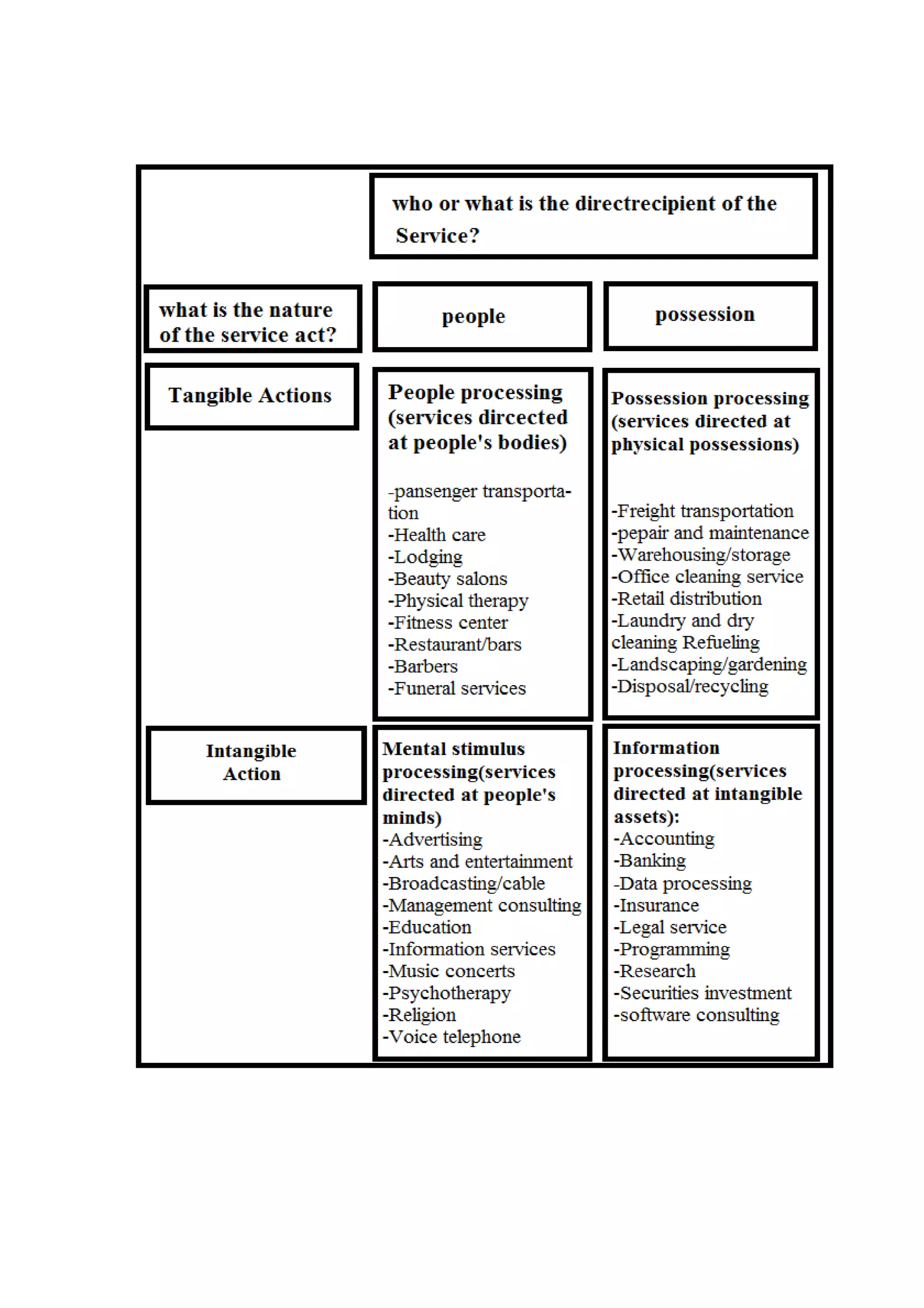
By looking at service processes from a purely operational
perspective, we see that they can be categorized into four broad
groups. Figure shows a four-way classification scheme based on
tangible actions to either people's bodies or customers-physical
possessions and intangible actions to either people's minds or their
intangible assets.
Each category involves fundamentally different processes, with vital
implications for marketing, operations, and human resource
managers. We refer to the categories as people processing,
possession processing, mental stimulus- processing and information
processing. Although the industries within each category may appear
to be very different, analysis will show that they do, in fact, share
important process-related characteristics. As a result, managers from
different industries within the same category may obtain useful
insights from studying one another and then create valued
innovations for their own organization.
Let's examine why these four different types of processes often have
distinctive implications for marketing, operations and human resource
strategies.
People Processing:
People Processing Since ancient times, people have sought out
services directed at themselves; being transported, fed, lodged,
restored to health, or made to look more beautiful. To receive these
types of services, customers must physically enter the service
system. Because they are an integral part of the process, they cannot
obtain the benefits they desire by dealing at arm’s length with service
suppliers; instead, they must be prepared to spend time interacting
and actively cooperating with service providers. The level of
involvement required of customers may entail anything from boarding
a city bus for a five-minute ride to undergoing a lengthy course of
treatments at a hospital. The output from these services is a
customer who has reached his or her destination or is now sporting
clean and stylishly cut hair or is now in physically better health.
It's important for managers to think about process and output in
terms of what happens to the customer because it helps them to
identify what benefits are being created. Reflecting on the service
process itself helps to identify some of the nonfinancial costs, such as
time and mental and physical effort that customers incur in obtaining
these benefits.
Possession Processing:
Possession Processing Often customers ask a service organization
to provide treatment to a physical possession, which could be
anything from a house to a computer or even a dog.
Customers are less physically involved with this type of service
than with people-processing services. Consider the differences in
your role between using passenger and freight transportation. In the
first instance, you have 10 go along for the ride in order to obtain the
benefit of getting from one location to another. With freight service,
however, you can request that the firm go to your home or office to
pick up the shipment and then wait for confirmation that it has been
delivered.
In most possession -processing services, the customer's
involvement is usually limited to dropping off the item that needs
treatment, requesting the service, explaining the problem, and later
returning to pick up the item and pay the bill. If the object to be
processed is something that is difficult or impossible to move, such as
landscaping, heavy equipment, or part of a building, the "service
factory" must come to the customer, with service personnel bringing
the tools and materials necessary to complete the job on site. In all
instances, the output should be a satisfactory solution to a customer's
problem or some tangible enhancement of the item ill question.
Mental Stimulus Processing:
Mental Stimulus Processing Services that interact with people’s
minds include education, news and information, professional advice,
psychotherapy, entertainment, and certain religious practices.
Anything touching people's minds has the power to shape attitudes
and influence behaviour. Thus, if customers are in a position of
dependency or if there is potential for manipulation, strong ethical
standards and careful monitoring are required. Receiving these
services requires an investment of time on the customer's part.
However, recipients do not necessarily have to be physically present
in a service factory. They simply have to be mentally in
communication with the information being presented. There is an
interesting contrast here with people-processing services. Although
passengers can sleep through a flight and still obtain the benefit of
arriving at their desired destination a student who falls asleep in class
will not be any wiser at the end than at the beginning!
Services such as entertainment and education are often
created in one place and transmitted by TV or radio to individual
customers in distant locations. However, these services can also be
delivered "live and in person" to groups of customers from such
locations as theatres or lecture halls. We need to recognize mat
watching a live concert on TV in one's home is not the same
experience us watching the concert in a concert hall in the company
of hundreds or even thousands of other people. In the latter instance,
managers of concert halls find themselves facing many of the same
challenges as their colleagues in people-processing services.
The core content of all services in this category is information
based-whether it's music, voice, or visual images. Therefore, such
services can easily be converted to digital format, recorded, and
made available for subsequent replay through electronic channels or
transformed into a manufactured product, such as a disk or a tape.
Information Processing:
Information Processing Information is the most intangible form
of service output, but it may be transformed into the more enduring,
tangible forms, represented by letters, reports, boots, tapes, or disks.
Among the services that are highly dependent on effective collection
and processing of information are financial and professional services,
such as accounting, law, Market -research, management consulting,
and medical diagnosis.
The extent of customer" involvement in both information and
mental stimulus- processing services is often determined more by
tradition and a personal desire to .meet the supplier face-to-face than
by the needs of the operational process, Strictly speaking, personal
contact is quite unnecessary
in such industries as banking or insurance. Why should managers
subject their firms to all the complexities of managing a people-
processing service when they could deliver the same core product at
arm's length? As a customer, why go to the service factory when
there's no compelling need to do so?
Habit and tradition often lie at the root of existing service
delivery systems and service use patterns. Professionals and their
clients may, say they prefer to meet face to face because they feel
they learn more about each other's needs, capabilities and
personalities that way. However, experience shows that successful
personal relationships, built on trust, can be created and maintained
purely through telephone, Web sites, or e-mail contact. As technology
improves and people continue to become more comfortable with
videophones or the Internet, we can expect to see a continuing shift
to arm's-length transactions.
Effects of Services
Service is the provision of service to customers before, during and
after a purchase. Service is a series of activities designed to enhance
the level of customer satisfaction – that is, the feeling that a product
or service has met the customer expectation.
7 Rules for Good Service:
Good customer service is the lifeblood of any business. You can offer
promotions and slash prices to bring in as many new customers as
you want, but unless you can get some of those customers to come
back, your business won't be profitable for long.
Good customer service is all about bringing customers back. And
about sending them away happy - happy enough to pass positive
feedback about your business along to others, who may then try the
product or service you offer for themselves and in their turn become
repeat customers.
I know this verge on the kind of statement that's often seen on a
sampler, but providing good customer service IS a simple thing. If you
truly want to have good customer service, all you have to do is
ensure that your business consistently does these things:
1) Answer your phone.
Get call forwarding. Or an answering service. Hire staff if you need to.
But make sure that someone is picking up the phone when someone
calls your business.
2) Don't make promises unless you will keep them.
Not plan to keep them. Will keep them. Reliability is one of the keys
to any good relationship, and good customer service is no exception.
If you say, “Your new bedroom furniture will be delivered on
Tuesday”, make sure it is delivered on Tuesday. Otherwise, don't say
it. The same rule applies to client appointments, deadlines, etc..
Think before you give any promise - because nothing annoys
customers more than a broken one.
3) Listen to your customers.
Is there anything more exasperating than telling someone what you
want or what your problem is and then discovering that that person
hasn't been paying attention and needs to have it explained again?
From a customer's point of view, I doubt it. Can the sales pitches and
the product babble. Let your customer talk and show him that you are
listening by making the appropriate responses, such as suggesting
how to solve the problem.
4) Deal with complaints.
No one likes hearing complaints, and many of us have developed a
reflex shrug, saying, "You can't please all the people all the time".
Maybe not, but if you give the complaint your attention, you may be
able to please this one person this one time - and position your
business to reap the benefits of good customer service.
5) Be helpful - even if there's no immediate profit in it.
The other day I popped into a local watch shop because I had lost the
small piece that clips the pieces of my watch band together. When I
explained the problem, the proprietor said that he thought he might
have one lying around. He found it, attached it to my watch band –
and charged me nothing! Where do you think I'll go when I need a
new watch band or even a new watch? And how many people do you
think I've told this story to?
6) Train your staff (if you have any) to be always helpful, courteous,
and knowledgeable.
Do it yourself or hire someone to train them. Talk to them about good
customer service and what it is (and isn't) regularly. Most importantly,
give every member of your staff enough information and power to
make those small customer-pleasing decisions, so he never has to
say, "I don't know, but so-and-so will be back at..."
7) Throw in something extra.
Whether it's a coupon for a future discount, additional information on
how to use the product, or a genuine smile, people love to get more
than they thought they were getting. And don’t think that a gesture
has to be large to be effective. The local art framer that we use
attaches a package of picture hangers to every picture he frames. A
small thing, but so appreciated.
Effects of Good Service:
The customer service has a huge impact on your overall business.
This is the only way through which you can keep in touch with your
clients and make sure that they are happy with your services and
products. Dubai Customer Service has evolved in the past decade
and it is still showing great progress. However, the small companies
and organizations got more benefits from better customer service
than any international or large scale company.
1) Client Loyalty and Retention:
Retaining clients is the biggest challenge in the online business
world. A company must have some loyal and trustworthy clients who
will keep coming back for more. Attracting customer is easier than
retaining them. That is why, most of the small businesses in the UAE
are spending more money on their current clients rather than on
advertisements to get new clients. More than that, these companies
are investing their time and marketing budget on their existing clients.
This simple process helps these companies to manage their clients
and make them loyal with their company.
2) New Business and Referrals:
This is actually an understood effect. If you keep your existing
customers happy then they will bring their business to you. These
small-scale companies show that you need not to spend thousands of
dollars on advertisement to keep your business going. If your
customer care system is good then your retained clients will do
enough advertisement for you. You should believe in word of mouth
advertisement. Several small-scale companies have become brands
in their respective fields because of their clients.
3) Sales Increase:
This is perhaps the best and most important benefit of customer
care systems. Every company wants to succeed and make more
money; and a good service to the customers can do that for you. If
you can amaze your clients and visitors with efficient and organized
services then they will definitely do business with you. If your
operators can handle the service then your prospective clients can
become your regular clients. All you have to do is make your clients
feel good and they will spend their money on your products and
services.
Effects of Poor Service:
If a company provides poor customer service, it will have many
disgruntled customers. Many companies have gone out of business
because of poor customer service. More than ever, customers want
to be treated with respect.
1) Lost Market Share
When you provide poor customer service, you will lose market share.
Your competitors will begin to take over your customers. A
disgruntled customer will quickly spread the word about the poor
service he received from your company.
2) Decreased Profits
Bad customer service can lead to decreased company profits. When
profits tumble, stock value can decrease as well. This will adversely
affect shareholders.
3) Low Morale
Your customer service department will become inefficient and
ineffective. They will spend the majority of their time on the phone
arguing with customers. This can lead to low morale and high
turnover. No one wants to work for a company that is not top-notch.
4) Change in Management
Poor customer service can lead to a change in management.
Sometimes a new leader can exercise a certain amount of discipline,
which will turn things around.
5) Increased Training Expenses
If a company provides poor customer service, it will incur expenses to
train employees on new techniques and procedures for customer
service. The company will also have to train new employees as a
result of the turnover. Expenses will increase, and sales will
decrease.
Software As a Service: -
What is SaaS?
Software as a service (or SaaS) is a way of delivering applications
over the Internet—as a service. Instead of installing and maintaining
software, you simply access it via the Internet, freeing yourself from
complex software and hardware management. SaaS is a new model
of how software is delivered. SaaS refers to software that is accessed
via a web browser and is paid on a subscription basis (monthly or
yearly). Different from the traditional model where a customer buys a
license to software and assumes ownership for its maintenance and
installation, SaaS presents significant advantages to the customer.
SaaS is faster and a cost effective way to getting implemented. There
are no hardware, implementation or acquisition costs involved to run
the application from the customer's side. It's the responsibility of the
SaaS vendor (us) to manage and run the application with utmost
security, performance and reliability.
Since customers pay a subscription, they have immediate access to
the new features and functionality. Unlike traditional software where
upgrades would happen once a year or once in 6 months (with the
vendor coming to your office with a CD), the SaaS vendor
continuously pushes new updates, fixes to the application, which is
immediately accessible by the customer. This reduces the length of
time it takes a customer to recognize value from the software.
Since the software application is delivered as a service, its important
for the vendor to focus on customer service and experience. Since
this is on a subscription model, the vendor is judged on a month-
month basis and the pressure to innovate or risk losing business is
greater. SaaS can be used by Windows, Linux, or Mac users,
providing true platform independence over the Internet.
SaaS applications are sometimes called Web-based software, on-
demand software, or hosted software. Whatever the name, SaaS
applications run on a SaaS provider’s servers. The provider manages
access to the application, including security, availability, and
performance.
SaaS: The Payoff
SaaS customers have no hardware or software to buy, install,
maintain, or update. Access to applications is easy: You just need an
Internet connection.
New to SaaS? Welcome!
If you’re just starting to explore the concept of SaaS, this is the place
to find out what SaaS can do for you, see how SaaS is different,
identify questions about SaaS, and learn more about developing
SaaS applications.
SaaS Characteristics : A good way to understand the SaaS model is
by thinking of a bank, which protects the privacy of each customer
while providing service that is reliable and secure—on a massive
scale. A bank’s customers all use the same financial systems and
technology without worrying about anyone accessing their personal
information without authorization.
A “bank” meets the key characteristics of the SaaS model:
Multitenant Architecture
A multitenant architecture, in which all users and applications share a
single, common infrastructure and code base that is centrally
maintained. Because SaaS vendor clients are all on the same
infrastructure and code base, vendors can innovate more quickly and
save the valuable development time previously spent on maintaining
numerous versions of outdated code.
Easy Customization
The ability for each user to easily customize applications to fit their
business processes without affecting the common infrastructure.
Because of the way SaaS is architected, these customizations are
unique to each company or user and are always preserved through
upgrades. That means SaaS providers can make upgrades more
often, with less customer risk and much lower adoption cost.
Better Access
Improved access to data from any networked device while making it
easier to manage privileges, monitor data use, and ensure everyone
sees the same information at the same time.
SOFTWARE AS A SERVICE
 INTRODUCTION
 Software as a service is a model of software delivery where the
software company provides maintenance, daily technical operation,
and support for the software provided to their client.
Software delivered to home consumers, small business, medium and
large business. It assumes the software is delivered over the internet.
The SaaS vendor assumes all the support, training, infrastructure and
security risks in exchange for the recurring subscription fees. The
SaaS service model is designed to deliver business applications
anywhere, anytime which in turn requires the SaaS vendor to employ
dedicated support teams and staff that make themselves available to
customers on short notice.
Along with the personnel comes reserve capacity to handle any
spikes in usage, outages or network mishaps and to do this
continuously, globally and securely.
A typical SaaS deployment does not require any hardware and can
run over the existing Internet access infrastructure. Sometimes,
changes to firewall rules and settings may be required to allow the
SOFTWARE
INTERNET
SERVICE
SERVICE
SaaS application to run smoothly. A SaaS application can be
configured using APIs but multi-tenant SaaS applications cannot be
completely customized.
Architecturally, the preferred SaaS model is multi-tenant.
 What Are the Requirements that Drive the Acquisition of a New
Software Application?
i. End-User Requirements
ii. Business Requirements
iii. Company/Corporate Requirements
iv. Operational and IT Requirements
 In summary the key characteristics of a SaaS application are:
1. No difference between the license fee and the hosting fee.
2. The application is delivered over a web browser or other thin client.
3. The application is configurable, but not customizable.
 What are the cost drivers companies need to look at when
completing a TCO analysis?
1. Capital Expenses
With SaaS, there are no perpetual software licenses to buy.
The nature of SaaS is that you pay for what you use. Most SaaS
models have a recurring cost structure. You pay a monthly or annual
service fee for as long as you use the service. This service fee
typically includes maintenance, support, training and upgrades and is
inclusive of all hardware, networking, storage, database,
administration and other costs associated with SaaS delivery.
2. Design and Deployment Costs
Most SaaS applications can be deployed and put into
production much faster and for a fraction of the cost compared to a
traditional software solution. This is very important when the
opportunity costs of getting the application out are high. On the flip
side, because a SaaS application is a multi-tenant application, there
are less ways to customize the application to fit the business process.
3. Ongoing Infrastructure Costs
Other than additional Internet bandwidth needs, there are
almost no incremental infrastructure costs to handle the growth of a
SaaS application. Depending on the SaaS application, the IT
organization may also have to deploy a desktop application to allow
the end-user to communicate with the application.
4. Ongoing Operations, Training and Support Costs
SaaS vendors are responsible for the end-to-end delivery of the
application. The only responsibility of the IT organization is to make
sure that the necessary ports on the firewall are open and that there
is enough Internet access capacity available to allow the end-user
base to communicate with the application.
SaaS is a recurring service, so for a SaaS vendor the sale does
not end when the initial contract is signed. If a customer does not use
the application, they can simply choose not to renew the contract at
the end of the contract term. This is called churn.
A traditional software vendor does not have to worry about
churn, since customers buy upfront perpetual user licenses. As a
result, SaaS vendors have a vested interest in seeing customers
widely adopt and use the application. It is for this reason that almost
all SaaS vendors focus on making their products easy to use and
offer initial and ongoing end-user training, and this training is in most
cases included in the service fees. This is for the same reasons they
offer ongoing 19training services; if customers churn because of
training or support issues, it will have an immediate impact to the
SaaS vendor’s bottom line.
PAYROLL SYSTEM
Payroll Definition:
Payroll is defined as a method of administrating employees’ salaries in the
organizations. The process consists of calculation of salaries and tax
deductions of the employees, administrating the retirement benefits and
disbursements(payment) of salaries to employees. It can also be called as an
accounts activity which undertakes the salary administration of employees in
the organization.
Administrating the employees’ salaries is not an easy task, the HR and
accounts department work together to calculate and disburse the salary to the
employees. Thus, payroll management can be further subdivided into two
sub processes, i.e. Payroll accounting and payroll administration.
Payroll accounting calculates the payment of work done by an employee.
Payroll function does the following:
1. Compute employees gross salary
2. Make necessary deductions
3. Calculate Net salary
4. Generate Cheques or direct deposits.
Payroll Accounting:
Payroll accounting involves calculations of employees’ salaries and tax
deductions. It also undertakes the activities such as preparation of tax
returns, maintaining the payroll records, etc.
Payroll Administration:
Payroll Administration involves managerial activities such as maintaining
employees’ records, referring employment laws. Here, the HR comes into
picture which maintains the daily record if employees attendance.
Database of employees is maintained. Employee’s details such as name,
employee ID, basic salary, daily attendance, etc are recorded. Gross Salary is
calculated after adding the allowances and incentives to the basic salary of
the employees. Net salary is calculated by deducting the tax and other
calculated deductions (loan installments, etc).
Payroll refers to the administration of employees' salaries, wages, bonuses,
net pay, and deductions. It consist of the employee ID, employee name, date
of joining, daily attendance record, basic salary, allowances, overtime pay,
bonus, commissions, incentives, pay for holidays, vacations and sickness,
value of meals and lodging etc. There are some deductions such as PF, taxes,
loan installments or advances taken by employee.
Payroll is administered on monthly basis and annual basis.
While administrating the monthly payroll basic salary, HRA, conveyance,
and other special allowances such mobile, etc are considered. There are
some deductions
which are provident fund (12%) of the salary, taxes and other deductions.
Deductions such as tax and loan/advances taken by the employee from
organizations are deducted only where applicable. Dearness Allowance and
House rent allowance is provided at a fixed rate stated by the employment
law. Provident fund is deducted from the gross salary of employee on the
monthly basis as per the employment law, which is provided later to the
employee. Organizations also contribute the same amount to the provident
fund of the employee.
Annual payroll consists of leave travel allowances, incentives, annual
bonuses, meal vouchers/reimbursements, and medical
reimbursements(compensations for loss).
Allowances, incentives, bonuses and reimbursements are based on
organizational policies. Some organizations provided the allowances on a
fixed rate say 10% or 12% of the basic salary. Some organizations go for
performance based incentives.
Calculation of gross salaries and deductible amounts is a tedious task which
involves risk. Some of the organizations use the traditional manual method
of payroll processing and some go for the advanced payroll processing
software. An organization opts for any of the following payroll processing
methods available::
Manual System:
Manual payroll system is the traditional payroll system which involves pen
and ink, adding machine, spreadsheet, etc instead of computers, software
and other computerized aids. The process was very popular when there were
no computerized means for payroll processing.
Now-a-days it is only few small scale organizations in the remote(far) areas
that use the manual payroll. Sometimes the construction industry and
manufacturing industry also use the manual payroll systems for the
contractual labour, as theses contracts are on daily/weekly basis.
There is full control in the hands of owner. But the process is tedious, time
consuming and risky as it is more prone to errors.
Accountant:
Accountant is a professional having a degree/diploma course in
finance/accountancy. He/she is responsible for all the activities related to
payroll accounting. He/she has the sound knowledge of accounting
principles and globally accepted standards.
The process adds costs to the organization. It involves paying someone who
is responsible for calculating the salaries of others. The financial control
regarding salary goes in the hand of accountant.
Payroll Software:
In today’s computerized environment, payroll system has also developed
itself into automated software that performs every action needed by the
payroll process. It helps in calculating the payable amounts and deductions
very easily. It also helps in generating the pay slips in lesser time.
Automated calculations result in no errors. Data is validated automatically
by the software.
It needs professionals to make use of the software for its efficient working.
Payroll Outsourcing:
Payroll outsourcing involves a third party (an outsourcing company) in the
calculations of salaries and deductions. The outsourcing organization is
responsible for all the activities of the payroll accounting. It saves time and
cost for the organization. If there is more number of employees (say more
than 900-1000) in the organization, payroll outsourcing would be very much
beneficial.
The data is provided to the consultants/outsourcing firms. The various
payroll functions undertaken by the outsourcing organizations are as
follows:
1. Analysis of Payroll records, payroll taxes
2. Medical claim processing
3. Employee Insurance & Provident fund processing
4. Quality Audit procedures & planning
Introduction to logistics
The key components of distribution have been an important feature of
industrial and economic life for countless years, but it is only in the
relatively recent past that distribution has been recognized as a major
function in its own right. The main reason for this has probably been
the nature of distribution itself. If is a function made up of many sub-
system, each of which has been, and may still be, treated as a
distinct management operation.
Both the academic and the business world now accept that there is a
need to adopt a more holistic view of these different operations in
order to take into account how they interrelate and interact with one
another.
The appreciation of the scope and important of distribution and
logistics has led to a more scientific approach being adopted towards
the subject. This approach has been aimed at the overall concept of
the logistics function as a whole and also at the individual sub-
system. Much of this approach had addressed the need for, and
means of, planning distribution and logistics, but has also considered
some of the major operational issues.
This first chapter of the book provides an introduction of some of the
very basic aspects of distribution and logistics. It begins with a
consideration of the scope and definition of distribution and logistics,
and then looks at some of the main elements that are keys to the
function itself. A review of the historical growth of distribution and
logistics is followed by an assessment of its importance throughout
the world. Finally, a typical distribution and logistics structure is
described and discussed.
Scope and definition
Parallel to the growth in the importance of distribution and logistics
has been the growth in the number of associated names and different
definitions that are used. Some of the different names that have been
applied to distribution and logistics include:
 Physical distribution;
 Logistics;
 Business logistics;
 Materials management;
 Procurement and supply;
 Product flow;
 Marketing logistics;
 Supply chain management;
 Demand chain management;
And there are several more.
There is, realistically, no “true” name or “true” definition that should
be pedantically applied, because products differ, companies differ
system differ. Logistics is a diverse and dynamic function that has to
be flexible and has to change according to the various constraints
and demand imposed upon it and with respect to the environment in
which it works.
So these many terms are used, often interchangeably, in literature
and in literature and in the business world. One quite widely
accepted view shows the relationship as follows:
Logistics = Supply + Materials management + Distribution
As well as this, logistics is concerned with physical and information
flow and storage from raw material through to the final distribution of
the finished product. Thus, supply and materials management
represents the storage and flows into and through the production
process, while distribution represents the storage and flows from the
final production point through to the customer or end user. Major
emphasis is now placed on the importance of information as well as
physical flows and storage and an additional and very relevant factor
is that of reverse logistics –the flow of used products and returnable
packaging back through the system.
Importance of logistics and distribution
It is useful at this point to consider logistics in the context of
business and the economy as a whole. Logistics is an important
activity making extensive use of the human and material resources
that affect a national economy. Several investigations have been
undertaken to try to estimate the extent of the impact o logistics on
the economy.
One such study indicated that about 30 per cent of the working
population in the UK are associated with work that is related to
logistics. A recent study undertaken in the USA indicated that
logistics alone represented between 10 and 15 per cent of the gross
domestic product of most major. North American, European and
Asia/Pacific economics. The two lowest-cost countries are the UK
and the United states, probably because there has been a greater
recognition of the importance of logistics in these two particular
countries for many years now. The average for all countries is only
about 2.5 percentage point higher, relatively low, because in recent
years the importance of logistics has been recognized in many more
countries.
LOGISTIC PROCESSES
INTRODUCTION:
These processes are the methods used to ensure that the business
operates effectively so that all the major objectives are achieved. The
aim is for a streamlined operation that works across the various
functional boundaries existing within any company. Thus, processes
need to be supply-chain oriented. One of the main problems with
logistic processes is that they are very often tied in with a number of
different functional elements of the business and so it is difficult for
them to operate efficiently.
THE IMPORTANCE OF LOGISTIC PROCESSES:
The reason that the concept of logistics process has been highlighted
in recent years is a development of the move away from the
functional view of logistics. The chief beneficiary of this has been the
final customer.The aim of any supply-chain is to ensure that cross-
company and cross-supply-chain activities are directed at achieving
customer satisfaction for the end user.
Processes have generally been derived to enable each separate
function within an organization to undertake its particular role, but
they are not streamlined to act across all company functions as a
united whole. The aim of order fulfillment should be to ensure that a
customer’s order is received, checked, selected and delivered
according to the customer’s requirements, with no disruption and with
complete accuracy.
Typical functional errors might be:
Incorrect transcription of the original order requirements;
Incorrect notification of availability;
Damage to the goods;
Late delivery;
Delivery to an incorrect address;
Invoicing to the incorrect address;
To avoid problems such as these, some companies now seek
to redesign their key logistics processes. There are three
essential elements. Properly designed processes should be
customer-facing, that is, they should aim specifically to satisfy
customer demands and expectations. They should also be
cross-functional or indeed where possible they should be
supply-chain-oriented in that they cross not just company
functions but also the boundary between companies. Finally,
they should be time-based in that they need to reflect the
importance of time as a key element in the logistics offering.
KEY LOGISTICS PROCESSES:
Typical examples are:

Order fulfillment: It is concerned with the ability to turn a customer’s
specified requirements into an actual delivered order. Thus, it
embraces many of the traditional functions usually recognized as
being a part of the logistics operation. It will involve the information
elements of receiving and documenting an order through to the
physical means of selecting and delivering the goods. This is
reasonable first step in process redesign, but ultimately there should
ideally be a seamless process for the operation as a whole.
New product introduction: This is an area where many companies
find they have problems. There are many logistics issues related to
the introduction of new products into the marketplace. The
consequence of introducing new products using existing processes
is usually existing processes is usually one of two possibilities.
New product development: In this example, the idea is to design the
product so that it can reach the market as quickly as possible from
the initial design plan through to availability. The aim is to link the
development of the product with the logistical requirements so that all
secondary developments can be identified and re-engineered in the
shortest possible time.
Product returns: There is a growing requirement in many businesses
to provide an effective process for the return of products. This may be
for returns that come back through the existing distribution network or
through a new one that is specifically set up. It may also be for
product returns that will be reworked or repackaged to go into stock,
product returns for subsequent disposal or packaging returns that
may be reused or scrapped.
Provision of spaces: For many companies the supply of a product or
series of products is inextricably linked to the subsequent provision of
space parts to support the continuous use of the initial products .For
many logistic operations, neither the physical structure nor the
associated processes are really capable of providing a suitable
support mechanism for space parts as well as for original equipment.
Information management: Advances in information technology have
enabled a vast amount of detailed data and manipulated very easily.
This has led some companies to recognize the need to devise
suitable processes to ensure that data are collected and used in a
positive and organized way. This enables a much more positive,
proactive approach to be adopted when considering particular
customer relationship.
There are other associated processes that could also be relevant,
such as:
Supplier integration;
Quality;
Strategic management;
Maintenance
Human resource management
Environmental management
A number of different concepts have been proposed to try to help
differentiate the type and importance of the various processed that
might be relevant to any given company as it tries to position itself
with its customers. Perhaps the most useful of these is known as the
process triangle. The process triangle is based on three different
process categories are as follows:
Basic processes: Those processes that are not really recognized as
essential to a business but are nevertheless a prerequisite.
Benchmark processes: Those processes that are seen to be
important to the customer and must be of at least an acceptable
standard even to begin to complete satisfactorily in a given market.
Procurement
Definition:
In this narrow sense the term ‘Purchasing’ refers merely to
the act of buying an item at a price. This very narrow conception of
purchasing has been gradually widened during the last 70 years.
A broader meaning of purchasing makes it a managerial
activity, which goes beyond the simple act of buying and includes the
planning and policy activities covering a wide range of related and
complementary activities. included in such activities are the research
and development strategies required for the proper selection of
materials and sources from which those materials may be bought, the
follow-up to insure proper delivery, the development of proper
procedures, methods, and forms to enable the purchasing
department to carry out the established policies; the co-ordination of
activities of the purchasing department with such other internal
division of the concern as traffic, receiving, store-keeping, and
accounting, so as to facilitate smooth operations; and the
development of a technique of effective communication with the top
management of the company so that, a true picture of the
performance of the purchasing function is presented.
Some writers use the term ‘Procurement’ instead of
purchasing. The term procurement is broad in its meaning and covers
the duties performed by purchasing as well as such additional
function of materials supervision and management as inventory
control, receiving, incoming inspection and salvage operations.
The term procurement is too broad and hence is not used
by many writers on the subject and by people who practice the
profession. The term purchasing is most appropriate and hence in
popular usage.
The buyer or purchasing officers are the people responsible
for discharging purchasing functions. They are the full time staff of the
company. The head of the section or the department is purchasing
agent also variously known as the purchasing officer, purchasing
manager or simply buyer. The department where all the purchases
operate is called the purchasing department.
The purchasing department is often called the supply
department when the former is also responsible for storing things
bought and stock control of what is stored.
We prefer to use the term purchasing department to supply
department. For us, storing and stock or inventory control is
independent functions to be handled by separate staff. They cannot,
be attached to purchasing department.
Importance of Purchasing:
1. Purchasing function provide materials to the factory without
which wheels of machines cannot move.
2. A one percent saving in materials cost is equivalent to a 10
percent increase in turnover. Efficient buying can archive this.
3. Purchasing manager is the custodian of his/her firm’s purse
as he/she spends more than 50 per cent of his/her company’s
earning on purchases.
4. Increasing proportion of one’s requirements is now bought
instead of being made as was the practice in the earlier days.
Buying, therefore, assumes significance.
5. Purchasing can contribute to import substitution and save
foreign exchange.
6. Purchasing is the main factor in timely execution of industrial
projects.
7. Materials management organizations that exist now have
evolved out of purchasing departments.
8. The stream of salesmen and direct mail advertisement
entering the purchasing department day-in and day-out brings
information about new products, materials and new ways of
doing old jobs.
9. Other factors like : (i) Post-war shortages,(ii) cyclical
swimming of surpluses and shortages and the first rising
materials costs,(iii) heavy competition, and
(iv) Growing world- wide markets have contributed to the
importance of purchasing.
Setting the Procurement objectives:
When using Procurement objectives, consideration should be
given to the following:
- Ensuring the supply of raw materials and other supplies.
- Vendors- managed inventory (VMI)
- The quality of supplies
- Product specification
- The price
- The origin of the supplies
- The method of supply, e.g. IIT-style deliveries
- The method of transport used
- A hierarchy of importance, e.g. Key raw materials would have
precedence over office stationary
- Whether to make yourself or buy from a supplier
Functions of purchasing department:
The definition given for purchasing at the beginning of this
topic should give us an idea about the function of purchasing
department. For greater clarity we list the functions below. It may be
emphasized that some of the functions are sole responsibility of the
purchasing department, some are shard with other departments, and
the remaining are the responsibilities in which the purchasing
department has considerable interest.
1. Responsibilities often fully delegated to the purchasing function
:
(a) Obtaining prices
(b) Selecting vendors.
(c) Awarding purchase orders.
(d) Following up on delivery promises.
(e) Adjusting and settling complaints.
(f) Selecting and training of purchasing personnel.
(g) Vendor relations.
Supply Chain Management
The term Supply Chain Managementis now commonly used. The
total logistics concept advocates the benefits of viewing the various
elements of logistics as an integrated whole.Supply chain
management is similar, but also includes the supplier and the end
user in the process, the upstream (supply side) and downstream
(demand side) partners in the supply chain. This is the major
difference between supply chain management and traditional
logistics.
There are four distinct differences claimed for supply chain
management over the more classic view of logistics, although some
of these elements have also been recognized as key to the
successful planning of logistics operations. These four are:
1. The supply chain is viewed as a single entity rather than a
series of fragmented elements such as procurement,
manufacturing distribution etc. This is also how logistics is
viewed in most forward-looking companies. The real change is
that both the suppliers and the end users are included in the
planning process, thus going outside the boundaries of a single
organization in an attempt to plan for the supply chain as a
whole.
2. Supply chain management is very much a strategic planning
process, with a particular emphasis on the strategic decision
making rather than on the operational systems.
3. Supply chain management provides for a very difficult approach
to dealing with inventory. Traditionally inventory has been used
as a safety value between separate components within the
pipeline – thus leading to large and expensive stocks of
products. Supply chain management aims to alter this
perspective so that inventory is used as a last resort to balance
the integrated flow of product through the pipeline.
4. Central to the success of effective supply chain management is
the use of integrated information systems that are a part of
whole supply chain rather than merely acting in isolation for
each of the separate components. This enables visibility of
product demand and stock levels through the full length of the
pipeline. This has only become a possibility with the recent
advances in information systems technology.
The move towards integration within different supply chain has
been relatively slow, indeed, most companies have fairly limited
integration within their own organizations. Full external integration is
thus still a ‘Hoil Grail’ that many organizations are striving to achieve.
Many companies have moved to functional integration, with some
achieving an element of full internal integration.
Logistic
 Logistics is the management of the flow of resources between
the point of origin and the point of consumption in order to meet
some requirements, for example, of customers or corporations.
The resources managed in logistics can include physical items,
such as food, materials, equipment, liquids, and staff, as well as
abstract items, such as time, information, particles, and energy.
The logistics of physical items usually involves the integration of
information flow, material
handling, production, packaging, inventory, transportation, ware
housing, and often security. The complexity of logistics can be
modeled, analyzed, visualized, and optimized by dedicated
simulation software. The minimization of the use of resources is
a common motivation. It is essentially a planning process and
an information activity,So A integrative process that optimizes
the flow of material and supplies through the organization and
its operations to the customer.
 Logistic recognizes that all the activities of material movement
across the business process are interdependent and needs
close coordination and these are to be maintained as a system
and not the functional Silos.
 Logistics is the process ofplanning, implementing and
controlling the efficient, cost-effective flow and storage of raw
materials, in- process inventory, finished goods and related
information from point of origin to point of consumption for the
purpose of conforming to customer requirementsThe mission of
logistics is to get the right goods or services to the right place,
at the right time, and in the desired condition and quantity in
relation to customers order
 Logistic Mix including following functional Areas
 Materials Management:
The materials management component is the foundation for the
logistics functions of a company. The component includes
purchasing functionality, inventory movements, accounts
payable and the material master file, which contains the
information on all materials and services used at a company.
 Sales and Distribution:
The sales and distribution component incorporates the
processes from customer order to the delivery of the product to
the customer. The component includes the sales functions,
pricing, picking, packing and shipping.
 Quality Management:
The quality management component is used to ensure and
improve on the quality of your company’s products. The
functions of this component include the planning and execution
of quality inspections of purchased and finished products.
 Plant Maintenance:
The plant maintenance component is used to maintain the
equipment that is used in the production of your company’s
finished products. The component focuses on the planning and
execution of preventive maintenance on equipment and tools
used in the production process.
 Production Planning:
The production planning component manages a company’s
production process. The functions of this component include
capacity planning of a company’s production, master production
scheduling (MPS), material requirements planning (MRP) and
the shop floor functions of producing a company’s finished
products.
 Customer Service:
The customer service component manages a company’s
service that it provides to customers for repairs and warranties.
Items can be sent back for repair or visits made by staff to
customer facilities. If a company makes finished products that
are sold with warranties, then the SAP customer service
component will help a company to service and repair those
items with maximum efficiency.
WAREHOUSE MANAGEMENT SYSTEM
“A Warehouse Management System(WMS) is a key part
of the supply chain and primarily aims to control the movement and
storage of materials within a warehouse and process the associated
transactions, including shipping, receiving, put ways and packing.”
 To meet the increasingly stringent demands retailers are
placing on their vendors to meet specific delivery times for floor
ready merchandise, many vendors must store merchandise
close to their retail customers.
 Rather than owning these warehouses themselves, vendors
typically use public warehouses that are owned and operated
by a third party, By using public warehouses, vendors can
provide their retailers with the level of services demanded
without having to invest in warehousing facilities.
 The system also direct and optimize stock put way based on
real time information about the status of bin utilization.
 A WMS monitors the progress of products through the
warehouse; it involves the physical warehouse infrastructure,
tracking system, and communication between product stations.
 “Warehouse is referred as transportation at zero miles per
hour.”
 Warehousing provides time and place utility for raw materials
industrial goods and finished products allowing firm to use
customers service a dynamic value adding competitive too.
 The warehouse is where the supply chain holds or stores goods
function of warehousing includes transportation consolidation
product mixing docking service protection against
contingencies.
 Warehouse Management Systems often utilize automatic
identification and data capture technology, such as barcode
scanners, mobile captures, wireless LANs and potentially radio-
frequency identification (RFID) to efficiently monitor the flow of
products.
 Once a data has been collected, there is either batch
synchronization with or a real time wireless transmission to a
central database.
 The database can then provide useful reports about the status
of goods in the warehouse.
 Warehouse design and process design within the warehouse is
also part of warehouse management.
 Warehouse Management is an aspect of logistics and supply
chain management.
 More precisely, warehouse management involves the receipt
storage and movement of goods (normally finished goods), to
intermediate storage location or to a final customer.
 In the multi-echelon model for distribution, there may be
multiple levels of warehouses.
 This includes central warehouse (serviced by the central
warehouse) a regional warehouses potentially retail
warehouses.
OBJECTIVES
The objective of a warehouse management system is to
provide a set of computerized procedures for management of
warehouse inventory with the goal of minimizing cost and
fulfillment times.
This includes:
 A standard receiving process to properly handle a shipment
when it arrives. This process can be individualized to each
warehouse or product type.
 This receipt of stock and returns in to a warehouse facility.
 An effective warehouse management system helps companies
cut expresses by minimizing the amount of unnecessary parts
and product in storage.
 It also helps companies keep lost sales to minimize by having
enough stock on hand to meet demand.
 Modeling and Managing the logical representation of the
physical storage facilities.
 Alone warehouse management cannot automate the process. It
also involves the combination of business process to be
followed along with system to achieve 100% productivity and
accuracy.
Warehouse management
Introduction:
Warehouses are crucial components of most modern supply
chains.
They are likely to be involved in various stages of sourcing,
production and distribution of goods, from the handling of raw-
material and work-in-progress through to finished products.
Warehouses are an integral part of supply chains in which they
are operates and therefore recent trends, such as increasing
market volatility, product range and proliferation, shortening
customer lead times, all have an impact on the roles that
warehouses are required to performed.
Warehouses need to be designed and operated in line with the
specific requirements of the supply chain as a whole.
The nature of warehouses within supply chains may vary
tremendously, and they are many different types of
classification that can be adopted.
For example:
By the stage in the supply chain:
 Materials, work in progress or finished goods.
By geographic area :
 A parts warehouse may serve the whole world, a regional
warehouse may serve a number of countries, a national
warehouse may serve just one country, or a local
warehouse may serve a specific region of a country.
By product type:
 Small parts, large assemblies, frozen foods, perishables,
security items and hazardous goods.
By function:
 Inventory holding or sortation.
By ownership:
 Owned by the user or by the third party logistics
company.
By area:
 Ranging from 100 square meters or less to well over
100,000 square meters.
By equipment:
 From a largely manual operation to a highly automated
warehouses.
Benefits:
 Warehouse management increases quality and efficiency.
 Organized warehouses provide the foundation for quality and
efficiencyin an environment that is often fast-paced and chaotic.
 Warehouse management improves overall business
operations and profitability.
 Improved warehouse organization and accuracy enabled by a
warehouse management solution allow businesses to optimize
resources.
 Improves decision-making
 Accurate inventory and warehousing information enables every
member of the organization to gain the knowledge they need to
make better decisions– whether dealing with vendors, prospects,
customers or employees.
 Increases customer satisfaction
 Having the right products in stock for customers, properly identified
an available to quickly ship to customers is the key to customer
satisfaction.
WarehouseOperators:
 Every warehouse should be designed to meets the specific
requirements of the supply chain of which it is a part.
 These tend to apply whether the warehouse is manual in nature
with fairly basic equipment or whether it is highly automated
with sophisticated storage and handling system.
 These functions are as follows:
I. Receiving:
This involves the physical unloading of incoming transport and recording
of receipts. It can also include such activities as unpacking and
repackaging in a format suitable for the subsequent warehouse
operations.
II. Reserve storage:
Goods are normally taken to the reserve or back-
up storage areas, which is the largest space user in many
warehouses. This area holds the bulk of warehouse
inventory in identifiable locations. When required, the
goods are taken from reserve storage either directly to
marshaling or to replenish a picking location.
III. Order picking:
Goods are selected from order picking stock in the required
quantities and at the required time to meet customerorders.
Picking often involves break-bulk operations, when goods are
received from suppliers in, say, whole pallet quantities, but are
concerned by customers in less than pallet quantities. The
goods design and management of picking systems and
operations are consequently vital to effective warehouse
performance.
IV. Sortation:
For small size of order, it is sometimes
appropriate to batch a number of orders together and
treat them as ‘one’ order for picking purposes.
V. Collation and added value services:
After picking, goods are brought together and
consolidated as complete orders made ready for dispatch
to customers. It may also involve final production
postponement
Activities and value added services, such as kitting and
labeling.
THE ROLE OF WAREHOUSES:
 The prime objective of most warehouses is to facilitate the
movement of goods through the supply chain to the end
consumer.
 There many techniques used to reduce the need to hold inventory,
such as flexible manufacturing system, supply chain visibility and
express delivery, and many of these have been encompassed in a
range of supply chain initiatives
 For example: Just-in-time, efficient consumer response etc.
Freight Transport:
The changing nature of logistics and the supply chain, particularly the
more by many companies towards global operations, has had an
obvious impact on the relative importance of the different modes of
transport. In a global context, more products are moved far greater
distances because companies have developed concepts such as
focus factories, with a single global manufacturing point for certain
products, and because of the concentration of production facilities in
low-cost manufacturing locations. Long distance modes of transport
have thus become much more important to the development of
efficient logistics operations that have a global perspective.Thus,the
need to understand the relative merits of,say,sea freight as against
air freight is crucial although,for many localized final delivery
operations, it is still road freight transport that offers the only real
option. All of these developments serve to emphasize the need to
appreciate the many different facts of transport modal choice for
international logistics.
In Europe, road freight transport continues to be the dominant mode of
transport, together with coastal transport for bulk movements. A look at
recent European statistics confirms this. The upward trend in the use of
road transport has continued for many years, and it seems unlikely that
the importance of road freight transport will diminish in near future. Rail
freight has declined for many years, but is now holding its decline. Inland
waterways are still important. The use of pipelines has continued for
certain specialized movements. Figure below, based on statistics for the
15 longest standing members of the EU indicates the relative
importance of the different modes for freight transportation within
Euope.Deep-sea and air freight transport are not represented in these
particular statistics because they are mainly concerned with
intercontinental freight movements.
The importance of road freight transport is also emphasized
when the modal split is compared for freight transport movements within
individual countries, as figure below illustrates.However,it is also clear
from this figure that for some countries rail freight transport does still
play a major role. This applies particularly to the USA, Switzerland,
Hungary and Austria. Rail freight transport tends to be more prevalent in
countries with a large geographical spread or where there are significant
environmental issues and restrictions.
All of the
major
modes of transport can be considered for the movement of goods
internationally. The selection of the most appropriate transport mode is
thus a fundamental decision for international distribution and logistics,
the main criterion being the need to balance costs with customer
service. There are very significant trade-offs to be made when
examining the alternatives available between the different logistics
factors and the different transport modes.
CONVENTIONAL SEA FREIGHT
Of the main alternative types of sea freight, both the
conventional load and the unit load are relevant. The unit load
(container) is considered later. For conventional sea freight, the main
points to note are:
 Cost economics. For some products, the most economic means
of carriage remains that of conventional sea freight. This
particularly applies to bulk goods and to large packaged
consignments that are going long distances. Where speed of
service is completely unimportant, then the cheapness of sea
freight makes it very competitive.
 Availability. Services are widely available, and most types of
cargo can be accommodated.
 Speed. Sea freight tends to be very slow for several reasons.
These include the fact that the turnaround time in port is still quite
slow, as is the actual voyage time.
 Need for double handling. Conventional sea freight is
disadvantaged by the slow handling methods still used. This is
especially true when compared with the more competitive
‘through transport’ systems with which sea freight must compete.
The problem is particularly apparent on some of the short sea
routes.
 Delay problems. There are three major delay factors that can
lead to bad and irregular services, as well as helping to slow up
the transport time itself. These are over and above the journey
time. They are pre-shipment delays, delays due to bad weather,
missed tides, etc.
 Damage. The need to double-handle cargo on conventional
ships tends to make this mode more prone to damage for both
products and packaging.
INTERNATIONAL ROAD FREIGHT
Compared with the other forms of international freight transport, the
major advantages and disadvantages of road freight transport services
are as follows:
 They can provide a very quick service (ferry and tunnel
schedules can be carefully timed into route plans if they are a
necessary part of the journey).
 For complete unit loads with single origin and destination points,
they can be very competitive from the cost viewpoint.
 There is a greatly reduced need to double-handle and trans-ship
goods and packages, and for direct, full-load deliveries this is
completely eliminated. This saves time and minimizes the
likelihood of damage.
 Packaging cost can be kept to a minimum because loads are
less susceptible to the extreme transit ‘shocks’ that other modes
can cause.
 The system can provide regular, scheduled services due to the
flexibility of road vehicle scheduling.
 Road freight transport can lose its speed advantage when used
for less than lorry-sized loads. These entail group age and so
involve double-handling (at both ends of the journey), additional
packaging and time delay.
RAIL FREIGHT
This is particularly true for bulky and heavy consignments that require
movement over medium to long distances and where speed is not
vital. The principal disadvantages of conventional rail freight are as
follows:
 Rail wagons are prone to some very severe shocks as they are
shunted around goods yards. Shunting shocks can cause
damage to products. To overcome this, costly packaging needs
to be used.
 There is a need to double-handle many loads because the first
and last leg of a ‘through’ journey often needs to be by road
transport.
 There are a limited number of railheads available at factories and
depots, making direct origin-to-destination journeys very rare. In
recent years, many companies with railway sidings on their
premises have closed them down due to their high cost of
upkeep and operation.
 In general, rail transport is a very slow means of carriage-
particularly. When the whole journey is taken into account.
Many freight trains have to fit their schedules around passenger
trains, which take priority. This can cause significant time delays
to the rail freight.
 Rail freight transport can be very unreliable. Batches of wagons
may arrive at irregular intervals. This can cause further delays
for international traffic if a complete shipment is on a single
customs document.
 For international movements, there are significant compatibility
issues (especially across Europe). These include variations in
track gauge sizes, bridge heights and (lack of) electrification.
Material Management
Materials management is an important and integral part of logistics
management. Material management has emerged as a new and complex
science evolving rapidly. For moving the material in and out of
warehouse, various kinds of equipments and systems are used
depending on the type of products and volumes to be handled. These
equipments are used for the movement of goods over a short distance for
the purpose of loading and unloading operations. Material management in
warehouse is restricted to unitized form, which requires smaller size
equipment. However, for bulk handling material at logistics nodes, such
as shipyards, ports and airports, different types of equipments are used.
In warehouse, the material handling operation is performed at the
following stages:
1) Unloading the incoming material from transport vehicles;
2) Moving the unloaded material to the assigned storage place in
the warehouse;
3) Lifting the material from its storage place during order picking;
4) Moving the material for inspection and packing;
5) Loading the packages, boxes or cartons on to the transport
vehicles.
Efficiency of the material handling equipment adds to the performance
level of the warehouse. The internal movement of goods has a direct
bearing on the order picking and fulfillment cycle. The warehouse is
considered more labor intensive, if the material handling equipments are
more sensitive to labor productivity than the manufacturing. There is
much scope to reduce the labor and enhance the productivity by using the
emerging technologies in material handling. A good material handling
system will definitely enhance the speed and throughput of the material
movement through the supply chain.
Material Management Guidelines:-
Material management function has an effect on the efficiency and the
speed of the warehousing operations, which ultimately result in either
elongated or compressed order completion cycle. Hence, investment in
material management system is strategic in nature and is always based
on the long-term requirements, considering the product volumes and
varieties. Normally, the following guidelines are being followed for
designing an effective and efficient material management system:
 Design the system for continuous flow of material, that is idle time
should be zero.
 Go in for standard equipments that ensure low investment and flexibility
in case of changes in material management requirements in future, if
any
 Incorporate gravity flow in the material flow system, if possible
 Ensure that ratio of deadweight to pay load of the material management
equipment is minimum.
There are various material handling systems in use, right from fully
manuals to the fully automatic ones. However, the selection of a particular
system depends on the factors such as:
 Volumes to be handled
 Speed in handling
 Productivity
 Product characteristics( weight, size, shape)
 Nature of the product( hazardous, perishable, crushable)
Recent trends show the preference for designers’ system with higher
logistical productivity. However, the investment cost goes up for such
material management system using sophisticated equipments. Hence,
in majority of the cases the usage of both manual and mechanized
systems in combination is quite common.
Material Management Equipments And Systems:-
Material management system is classified on the basis of its degree of
sophistication. The most preferred way of material management is doing
manually where the volumes handled are less and the investment in
handling equipment do not ensure more benefits. In such cases, the idle
time of the equipment will be more and equipments are underutilized.
The classification the handling system can be done as follows:
 Manual
 Mechanized
 Semiautomatic
 Automatic
 Guided information
The major criteria for selection of the right system are units moved per
hour and the distance of the movement covered. Higher volumes moved
over large distance call for more sophisticated systems, which attract
higher investment. These sophisticated systems enhance speed for
material management ensuring reliability and productivity.
Introduction to retailing:-
What is retailing?
Retailing is the set of business activities that adds value to the
products and services sold to consumers for their personal or family
use.
 People think of retailing only as the sale of products in
stores,but retailing also involves the sale of services:-overnight
loading in a motel,
A doctor’s exam,
A haircut,
A home delivered pizza.
 The world retail has its origin in French word retailliex & means
to cut a piece or “to break bulk”.
 Retailing is the sale of goods & services to the ultimate
consumer for personal family or household use.
 According to kotler:-“ Retailing includes all the activites involved
in selling goods or services to the final consumers for personal
non business use”.
 Retailing is such a common part of our everyday lives that it’s
often taken for granted.Retail managers make complex decisions
in selecting their target markets and retail locations;determinding
what merchandise and services to offer,negotiating with
suppliers,distributing merchandise to stores ,training and
motivating sales associates and deciding how to
price,promote,and present merchandise.
Function performed by retailers:-
[1] Providing an assortment of products and services.
 Supermarkets typically carry 20,000 to 30,000 different items
made by over 500 companies.offering an assortment enables
their customers to choose from a wide selection of
brands,size,designs,colors and prices at one
location.manufacturers specialize in producing specific types of
products.
Example:-Campbell’s makes soup,kraft makes dairy
products,kellogg makes breakfast cereals and McCormick
makes spices.
[2] Breaking bulk.
 To reduce transportation costs,manufacturers and wholesalers
typically ship cases of frozen dinners or cartons of blouses to
retailers.retailers then offer the products in smaller quantities
tailored to individual consumer’s and households’ consumption
patterns.This is called breaking bulk.
[3] Holding inventory.
 A major function of retailers is to keep inventory that is already
broken into user-friendly sizes so that products will be available
when consumers want them.thus consumers can keep a
smaller inventory of products at home because they know local
retailers will have the products available when they need
more.By maintaining an inventory,retailers provide a benefit to
consumers ,they reduce the consumers’ cost of storing
products.this is particularly important to consumers with limited
storage space and who want to purchase perishable
merchandise like meat and produse.
[4] Providing services.
 Retailers provide services that make it easier for consumers to
buy and use products.thet offer credit so consumers can have a
product now and pay for it later. They display products so
consumers can see and test them before buying.some retailers
have salespeople in stores or use their web-sites to answer
questions and provide additional information about products.
[5] Form.
 First is utility regarding the form of a product that is acceptable
to the customer.the retailer does not supply raw material but
rather offers finished goods & services in a form that the
customers want.the retailers performs the function of sorting the
goods and providing us with an assortment of product in
various categories.
[6] Promotional support
 Small manufacturers can use retailers to provide assistance
with transport,storage,advertising and pre-payment of
merchandise.
[7] Place.
 By being available at a convenient location ,he creates place
utility.apart from these functions retailer performes.
Retailing in India:-
 Retail is the new buzzword in india.
 The global retail development index has ranked india first,among
the top 30 emerging market in the world.
 India retail trade increased from rs- 2200 billion in 2000 to rs-3300
billion by the year 2005.
 India’s first true shopping mall complete with food courts,recreation
facilities & large car parking space-recreation war inaugurated as
lately as in 1999 in mumbai(This mall is called “gossroades”).
Social and economic significance of retailing:-
[1] Support for community.
[2] Retail sales.
[3] Employment.
Opportunities in retailing:-
Management opportunities
To cope with highly competitive and challenging environment,retailers
are hiring and promoting people with a wide range of skills and
interests.
Students often view retailing is a part of marketing because of
management of distribution channels is part of a manufacturer’s
marketing function.
Entrepreneurial opportunities
Retailing also provides opportunities for people who wish to start their
own business.
Some of the world’s richest people are retailing entrepreneurs.
Many are well known because their names appear over the store’s
door;others we may not recognize.
The marketing retail equation:-
AIR FREIGHT
Manufacturer
Wholesaler
Retailer
Consumer
Manufacture
r
Consumer
Retailer
Manufactur
er
Consumer
The use of air freight as an alternative transport mode has grown
rapidly in recent years. Major developments in the areas of integrated
unit loads, improved handling systems and additional cargo space,
together with the proliferation of scheduled cargo flights, have
increased the competitiveness and service capability of air freight.
The major attributes of air freight are as follows:
 Air freight compares very well with other transport modes over
longer international movements. This is because it has very rapid
airport-to-airport transit times over these longer distances.
 Although air freight is very quick from airport-to-airport, there can
be a tendency for this speed factor to become less of an
advantage because time can be lost due to airport congestion
and handling, paperwork and customs delays.
 One particular advantage is known as ‘lead-time economy’. This
is where the ability to move goods very quickly over long
distances means that it is unnecessary to hold stocks of these
items in the countries in question (spare parts, etc).The short
lead time required between the ordering and receiving of goods,
and the resultant saving in inventory holding costs give this
benefit its name of ‘lead-time economy’.
 The air freighting of products allows for a great deal of market
flexibility, because any number of countries and markets can be
reached very quickly and easily. This is particularly
advantageous for a company that wishes either to test a product
in a given area or to launch a new product. The flexibility of air
freight means that a company need not necessarily set up
extensive stock-holding networks in these areas.
 The movement of goods by air freight can result in a marked
reduction in packaging requirements. The air freight mode is not
one that experiences severe physical conditions, and so its
consignments are not prone to damage and breakages.
CRM (Customer Relationship Management)
Customer relationship management is a business philosophy and set
of strategies programs and systems that focues on identifying and
building loyalty with a retailer’s most valued cutomers.
Based on the philosophy that retailers can increase their profitability
by building relationships with their better customers , the goal of CRM
is to develop a base of loyal customers who partronize the retailers
frequently.
 The CRM Process
 Traditionally retailers have focused their attention on
encouraging customers to visit their stores, look through
their catalogs, and visit their websites.
 To accomplish this objectives, they have used media
advertising and promotions, treating all of their customers
the same.
 Now, retailers are beginning to concentrate on providing
more value to their best customers using targeted
promotions and services to increase their share of wallet-the
percentage of the customers’ purchase made from the
retailer-from these customers.
 This change in perspective is supported by research
indicating that it costs three to six times more to sell products
and services to new customers than to existing customers
and that small increases in customer retention can lead to
dramatic increases in profits.
 For instance , at the furniture retailer domain , the typical
first-time purchase by a customer is about $1500. Repeat
purchasers with domain spend 3.5 times what a one – time.
Only customer purchase. Their “most valuable“ customers
have spent over $1,40,000.
 What is Customer Loyalty?
 Customer loyalty, the objective of CRM is more than having
customers make repeat visits to a retailer and being
satisfied with their experiences.
 Customer loyalty to a retailer means that customers are
committed to purchasing merchandise and services from the
retailer and will resist the activities of competitors attempting
to attract their patronage.
 They have a bond with the retailer, and the bond is based
on more than a positive feeling about the retailer.
 Loyal customers have an emotional connection with the
retailer. Their reasons for continuing to patronize a retailer
go beyond the low prices and specific brands offered by the
retailer.
 Programs that encourage repeat buying by simply offering
price discounts can be easily copied by competitors.
 In addition , these types of price-promotion programs
encourage customers to always look for the best deal rather
than develop a relationship with one retailer.
 However , when a retailer develops an emotional connection
with a customer , it is difficult for a competitor to attract that
customer.
 Overview of the CRM process cycle :
 CRM is an iterative process that customer data into
customer loyalty through four activities :
i. Collecting customer data.
ii. Analyzing the customer data & identifying target
customers.
iii. Developing CRM programs.
iv. Implementing CRM programs.
 The process begins with the collection and analysis of data
about a retailer’s customers and the identification of target
customers.
 The always translate the customer information into activites
that offer value to the targeted customers.
 Then these activities are executed through communication programs
undertake by the marketing department and customer service
programs implemented by customer contact employees , typically
sales associates.
 Collecting Customer data :
 The first step in the CRM process is to construct a customer
database is part of the data warehouse.
 It contains all of the data the firm has collected about its
customers and is the foundation for subsequent CRM
activities.
 Customer Database :
 Transactions :
o A complete history of the purchase made by the
customer , including the purchase date , the price paid
, the SKUs , purchased and whether the merchandise
was special promotion or marketing activity.
 Customer Contacts :
o A record of the interactions that the customer has had
with the retailer , including digits to the retailer’s web –
site , inquiries made through in – store kiosks ,
telephone calls made to the retailer’s call center , plus
information about contacts initiated by the retailer ,
such as catalogs and direct mail sent to the customer.
 Customer Preferences :
o What the customer likes , such as favorite colors ,
brands , fabrics and flavors as well as apparel sizes.
 Descriptive Information :
o Demographic & psychographic data describing the
customer that can be used in developing market
segments.
 Responses to marketing activities :
o The analysis of transaction and contact data provides
information about the customer’s responsiveness to
marketing activities.
 Different members of the same house – hold also might also
have interactions with a retailer.
 Identifying Information :
 Constructing a database for catalog and internet shoppers
and customers who use the retailer’s credit-card when
buying merchandise in stores is relatively easy.
 Customers buying merchandise through non-store channels
must provide their contact information name and address so
that the purchase can be sent to them.
 When retailers issue their own credit-cards, they can collect
the contact information for billing when customers apply for
the card.
 In these cases, the identification of the customer is linked to
the transaction.
 However, identifying most customers who are difficult in-
store transactions more difficult because they often pay for
the merchandise with a check , or a third-party credit-card
such as visa & master card.
 Three approaches that store-based retailers use to
overcomes this problem are :
 Asking customers for their identifying information.
 Offering frequent shopper cards.
 Connecting internet purchasing data with the stores.
 Privacy Concerns :
 The degree to which consumers feel their privacy has been
violated depends on.
 Their control over their personal information when engaging
in market place transactions.
 Their knowledge about the collection and use of personal
information.
 These concerns are particularly acute for customers
because many of them do not realize the extensive amount
of information that can be collected without their knowledge.
 In addition to collecting transaction data , electronic cookies
on visitor’s hard drives.
 Cookies are text files that identifying visitors when they
return to a websites.
 Due to the data in the cookies customers do not have to
identifying themselves or use passwords every time they
visit a site.
 However, the cookies also collect information about other
sites the person has visited and what pages they have
downloaded.
 The fedral trade commission has developed the following set of
principles for fair information practices :
 Notice and Awareness :
o Covers the disclosure of information practices
including a comprehensive statement of information
use such as information storage, manipulation and
dissemination.
 Choice / Consent :
o Includes both opt out and opt in options and allows
consumers the opportunity to trade information for
benefits.
 Access / Participation :
o Allows for the confirmation of information accuracy
by consumers.
 Integrity / Security :
o Controls for the theft of and tampering with personal
information.
 Enforcement / Redress :
o Provides a mechanism to ensure compliance by
participating companies.
 Analyzing customer data and identifying target customers.
 The next step in CRM process is to analyze the customer
database and convert the data into information that will
help retailers develop programs for building customer
loyalty.
 Data mining, one approach commonly used to develop
this information identifies patterns in data , unaware of
prior to searching through the data.
 Market Basket Analysis :
o Market Basket Analysis is a specific type of data
analysis that focuses on the composition of the
basket, or bundle of products purchased by a
household during a single shopping occasion.
 This analysis is often useful for suggesting where to place
merchandise in a store.
 Uses :
o Adjacencies for displaying merchandise.
 Joint promotions :
o Bananas in the cereal aisle as well as in the
produce section.
o Beer with baby dippers.
o Tissues with cold medicine.
 Identifying Best Customers:
 Using information in the customer database retailers can
develop a score pr number indication how valuable customers
are to the firm.
 This score can then be used to determine which customer to
target determine which customer to target.
 Lifetime Value:
 A commonly used measure to score each customer is called
lifetime customer value. Lifetime customer value (LIV) is the
expected contribution from the over his or her entire
relationship with the retailer.
 To estimate LTV, retailers use past behaviors to forecast future
purchases the gross margin from these purchases and the
costs associated with servicing the customers.
 Some of the costs associated with a customer include the costs
of advertising used to acquire the customer, and processing
merchandise that the customer has returned.
 A customer who buys apparel only when it is sale in a
department
Store would have a lower LTV than a customer who typically
pays full price and buys the same amount of merchandise.
 Customer Pyramid:
 Most retailers realize that their customer differ in terms of their
profitability or LTV.
 They know that a relatively small number of customers account
for the majority of their profits.
 This retailer is often called the 80-20 rule-80 percent of the
sales or profits come from 20 percent of the customers.
 Thus, retailers could group their customers into two groups om
the basis of the LTV scores.
 One group would be the 20 percent of the customers with the
highest LTV scores, and the other group would be the rest.
 There is four segments is described below.
o Platinum segment :
 This segment is composed of the retailer’s
customers with the top 25 percent LTVs. Typically,
these are the most loyal customers who are not
overly concerned about merchandise price and
place more value on customer service.
o Gold segment :
 The next 25 percent of customers in terms of their
LTV make up the gold segment. These customers
have a lower LTV than platinum customers because
they are more price sensitive.
o Iron segment :
 Customers in this third tier probably do no t deserve
much special attention from the retailer due to their
modest LTV.
o Lead segment :
 Customer in the lowest segment can cost the company money. They
often demand a lot of attention but do not buy much from the retailer.
Most Profitable
customers
Platinum
Gold
 Customer retention:
 Four approaches that retailers use to retain their best
customers are :
o Frequent Shopper Programs :
 Frequent shopper programs are used to both
build a customer database by identifying
customers by their transactions and encourage
repeat purchase behavior and retailer loyalty.
 Retailers provide incentives to encourage
customers to enroll in the programs and use the
card.
 These incentives are either discount on purchase
made from the retailer or points for every dollar
of merchandise purchased.
o Special Customer Services :
 Retailers provide unusually high-quality customer
service to build and maintain the loyalty of their
best customers.
 At mitchells / Richards in Connecticut, it is not
unusual for a salesperson to open the store after
hours or bring an item to a customer home.
 It is this type of special attention that facilitates
success in a detail sector that has seen difficult
times in recent years.
 Personalization:
Least Profitable
Customers
Iron
Lead
 The personalized rewards or benefits that customers
receive are based on unique information processed by
the retailer and its sales associates.
 This information in the retailer’s customers database, can
not be accessed or used by competitiors .
 Thus, it provides an opportunity to develop a sustainable
ampetitive advantage.
 Personalization:
 The personalized rewards or benefits that customers receive
are based on unique information processed by the retailer
and its sales associates.
 This information in the retailer’s customer database, can not
be accessed or used by competitors.
 Thus, it provides an opportunity to develop a sustainable
competitive advantage.
 Community:
 A fourth approach for building customer retention and loyalty
is to develop a sense of community among customers.
 The internet channel offers an opportunity for customers to
exchange information using bulletin boards and develop
more personal relationships with one another the retailer.
 By participating in such a community, sutomers are more
reluctant to leave the “ family” of other people patronizing the
retailer.
 Implementing CRM programs:
 Increasing sales and profits through CRM programs is a
challenge.
 For example, according to a study, 52 percent of retailers
indicated that they were engaged in some type of data
mining, but 76 percent of those retailers undertaking data
mining indicated that the activity had made no contribution to
their bottom line.
 This experience of retailers emphasizes that effective CRM
requires more than appointing a CRM manager, installing a
computer system to database and analyze a customer
database and making speeches about the importance of
customers.
 The effective implementation of CR programs requires the
close co-ordination of activity by different function in a
retailer’s organization.
 The MIS department needs to collect, analyze make the
relevant information readily accessible to the employees
implementing the programs.
 Store operations and human resource management needs
to hire train & motivate the employees who will be using the
information to deliver personalized services.
Merchandising and Inventory Management
What is merchandising?
Merchandising can be termed as the planning, buying and the selling
of merchandise.
The American Marketing Association has defined merchandising is
“planning involved in marketing the right merchandise at the right
place at the right time in the right quantities at the right price”.
The Merchandise challenges of consistently having the right
product in the right quantity, available at the right place, at the right
price becomes increasingly difficult as more selling and fulfilling
orders for multiple sales channels- including stores, e-commerce and
catalogue operations, increase the likelihood and magnitude of errors
and sub-optimal allocations.
Merchandise management can be termed as the analysis,
planning, acquisition, handling and control of the merchandise
investments of a retail operation.
 Analysis: Because retailers must be able to correctly identify
their customers before the can ascertain consumer desires and
their needs/requirements to make a good buying decision.
 Planning: Is important because merchandise to be sold in the
future must be bought now!
 Acquisition: Because the merchandise need to be procures
from other-either distributors or manufacturers.
 Handling: Involves seeing that the merchandise is where it is
needed and in the proper condition to be sold.
 Control: As the function of merchandising involves spending
money for acquiring products, it is necessary to control the
amount of money spent on buying.
The process of merchandise management includes developing
strategies to ensure that the right product is bought at the right
price and is available at the right place at the right time in the right
amount to satisfy the needs of the target customer. no one in retail
can completely avoid contact with merchandising activities.
Merchandise is day to day business of all retailers. As inventory is
sold, new stock needs to be purchased, displayed and sold.
Hence, merchandising is often said to be the core of retail.
The evolution of Merchandising
This function traces its growth to the rise of organized retail in the
world. Initially, as the retailers operated one or two stores, the
function of buying the merchandise, pricing it, etc. was much simpler.
In many cases, the retailer himself did it. However, when retailers
started adding stores and categories, the workload on the buyers
increased significantly. Often, buyers had little information or time and
they ended up using approximations based on sales volumes to
allocate merchandise between stores. This sometimes resulted in
stores exchanging merchandise among them!
In order to overcome this limitation, the function of a planner came
into being; the planner’s job was to act as a link between stores and
the buyer. The de-linking of functions allowed better interaction with
the stores. Planners were able to devote more time to collecting and
studying store level data, the buyers on the other hand, were
Able to spend more time with the vendors.
The concept of Merchandise Planning
The retailer’s reason for existence or his vision and mission for being,
largely dictates the business strategy adopted. A part of this strategy
is also the retail model that he chooses to operate in, which in turn
determines the type of product, the price, etc., that is retailed in the
store. Therefore, while the retailer’s business mission dictates
merchandise planning, the starting point of merchandise planning is
in analysis. Merchandise planning can therefore, be defined as the
planning and control of the merchandise inventory of the retail firm, in
a manner which balances the expectations of the target customers
and the strategy of the firm.
Merchandise planning is beneficial to the customer and to the retailer.
It benefits the retailer as it enhances the possibility of the right
assortment of goods, with the adequate amount of depth, to be
available at the stores where it is needed. The process of
merchandise planning further enhances the possibilities of increased
stock turns, thereby releasing important working capital. From the
point of view of the customer, it is beneficial as it increases the choice
available to him and reduces the possibility of facing a situation when
the store is out of the merchandise needed.
Types of Merchandise
 Staple/ Basic Merchandise
 Fashion Merchandise
 Seasonal Merchandise
 Fad Merchandise
Staple / Basic Merchandise
Staple merchandise is those products which are always in demand.
They may be the basic necessities of life like sugar, salt, dal, etc.
Alternately, they may be products for which there is always a steady
demand. Depending on the type of the retail model, the retailer has to
determine the staple products for the store. In many cases, these
products may also be termed as Classics.
Example of products that may be classified as staples are: men’s
While shirts, socks, handkerchiefs, stationery, etc.
Fashion Merchandise
Merchandise that has high demand for a relatively short period of
time is referred to as fashion merchandise. Buying the right quantities
at the right time is of great importance for this category of products as
the demand for the product is for a limited time. Excess buying may
result in heavy markdowns at the end of the season or when the
product goes out of style. Example of such products includes various
cuts in jeans, which may be in style for a season, short lengths in
kurtas, etcs.
Seasonal Merchandise
Seasonal products include products that sell well over
nonconsecutive time periods. Examples of such products include
rainwear like umbrellas and raincoats, winter wear, thermal clothing
etc.
Fad Merchandise
Fads, in contrast to fashions, enjoy popularity for a limited period of
time and usually generate a high level of sales for a short time.
Inventory Management
Meaning of Inventory
Inventory cannot the value of raw materials, consumables, spares,
work-in- progress, finished goods and scrap in which a company’s
funds have been invested. Inventory management is a science based
on the art of ensuring that enough inventory is held by an enterprise
to meet both its internal and external demand commitment
economically!
“Inventory connotes the value of raw materials, stores, spares,
consumables, components, work-in-progress, finished goods and
scrap”.
Concept of Inventory Management Inventory management is an
important area of production management and plays a vital role in the
economic operation of a business firm. Different authorities have
defined the concept of inventory management in a variety of ways
and most of the definitions lay stress on the importance of control
element in achieving cost effectiveness, irrespective of the range of
particular discipline to be applied within this functional field in meeting
the needs of an individual concern.
Inventory management can be defined as the sum total of those
activities necessary for the acquisition, storage, sale, disposal or use
of inventories.
It can also be said that inventory management is that
branch of business management concerned with the development of
policies to which the firm’s inventory is meant to concern.
The above definitions of inventory management reveal
that there are two guiding principles of inventory management. These
are:
1. Adequate inventory has to be maintained to avoid stock out
and causing consequent production hold up and customer
dissatisfaction; and
2. Excessive investment in inventory items must be avoided as it
increases carrying cost and result in loss of profit.
Importance of Inventory Management
Inventory constitutes the largest proportion of current assets in a
business organization. In India, inventories are generally
approximately 60 percent of current assets in public limited
companies. Hence, it calls for efficient management of inventory.
Good inventory management is good financial management. One
must agree with the observation that “When you need money, look at
your inventories before you look to your banks.”
A company should maintain an adequate stock of materials
of right quality at the minimum cost so that are issue to production
when needed in order to have an uninterrupted flow of production.
Inventory management is the basic function of any
organization that produces a product or services of economic value. It
is essential not only in manufacturing concerns and service industries
but it is also prevalent in public and private sector undertakings
whether there is profit or not.
Inventory management is more important because
inventory cost is the only area which can afford an easy scope for
cost reduction and cost control. Inventory management can go a long
way in improving the productivity and production of a manufacturing
organization and raising its volume of profit. In the words of toy O.M
“It may permit a better utilization of visible stocks by facilitating
interdepartmental transfer within a company and provide a check
against losses of materials through carelessness or pilferage.”
Problems of Inventory Management
There are internal as well as external problems so far as inventory
management is concerned.
Internal problems
i. Delay in lead-time;
ii. Improper specifications of material leading to surplus
or obsolescence of materials;
iii. Lack of coordination among departments dealing
with materials, production, sales, maintenance and
finance;
iv. Overstocking;
v. Overbuying on account of quantity discounts; and
vi. Improper storage facilities.
 External Problems
i. Lack of full knowledge of demand, risk and
uncertainly;
ii. Difficulties in obtaining a commodity because of
sellers’ market;
iii. Delay by suppliers;
iv. Improper market research; and
v. Higher consumption due to poor quality materials.
 Inventory Management in Retail Industry - Need and Important
Terminologies:
 What is Inventory Management ?
“Inventory refers to the goods stocked for future use. Every retail
chain has its own warehouse to stock the merchandise to be used
when the existing stock replenishes.”
 Inventory management is upleep ans department maintainance
assignment are frequently made on the basis of the prochid
assortment.
 Retail management is a process & methods used to keep
tracks of the stock in retail business.It controls
ordering,receiving etc…
Function of inventory management:
1.track &manage all the inventory for business.
2.Keep up with for comparison shopping with competition.
3.Provide analysis for comparison.
4.Evalutr how well some groups of products do in sales.
Role of inventory in service:
1.Decoupling inventory:
Inventory accumulated between 2 inter dependent operations as a
bubber against break downs .
2. Seasonal Inventory:
This inventory is kept in certain seasons for example if rainy
season is running with rain are kept in inventory.
3.Specalative inventory:
An inventory acquired for the purpose of resale to any willing
buyers.
4.safety stock:
Safety stock is a term used by inventory specialist to describe a level
id main trained below the cycle stock to buffer against.
Inventory management refers to the storage of products to be used at
the time of crisis.
The retailer keeps a track of the stocked goods and makes sure there
is surplus inventory to avoid being “out of stock”. Such a process is
called as inventory
Production process
Product are good and service produced and process are the facilities
skills and technologies
Used to produced them.
1.manufacturing operation and services operation
Manufacturing operation convent input like material, and capital into
some tangible output.
1.forming process Include casting , forging , stamping , embossing,
etc.
2.machining process Involved basically metal ranoval by turning
,drilling , milling , etc.
3.assembly process Involved the joining of component or piece part
to produce a signal component that has a specific function.
Forming process
1.casting
2.forging
3.stamping
4.spinning
Machining process
Machining process removes the metal the work piece during the
cutting operation performed by a cutting tool
1.turning
2.drilling and boring
3.milling
4.shapping and planning
5.chemical milling
Assembly process
1.welding processes
2.brazing
3.soldering
4.riveting
5.fasting by bolts and nuts
6.assembly using adherives
Processing having two types
1.heavy processing
2.light processing
1. heavy processing
industries include processing industries for material metal such
as steel and copper and also heavy chemical industries
manufacturing sulphuric acid and heavy alkalies
2. light processing
Industries include processing that produced chemical component ,
drugs and some metal.e.g boron and titanium it also include
industries manufacturing plastic.
CAPCITY PLANNING
It is very common for an IT organization to manage system
performance in a reactionary fashion ,analyzing &correcting
performance problems as user report them.When problems occur
,hopefully system administrators have tools necessary to quickly
analyze & remedy the situation.
THREE STEPS FOR CAPACITY PLANNING
1.Service level requirement
The first step in the capacity planning process is to categorize
the work done by system & to quantify users expectations for
how that work gets done.
2.Analayze Current capacity
The current capacity of system must be analyzed to determine
how it is meeting the needs of the users.
3.Planning for the future
finally using forecasts of future business activity ,future system
requirements are determined . Implementing the required
changes is system configuration will ensure the sufficient
capacity will be available to maintain service levels,even as
circumstances change in the future.
TYPES OF CAPACITY PLANNING
1.PRODUCTION CAPACITY::
It is the maximum rate of production for output of an
organisation .for e.g 100 cars per day or 200 refrigerator per day etc.
But several factors underlying the concept of capacity makes its
understanding & use somewhat complex . variation in employee
absenteeism ,equipment breakdowns, vacation, holidays,delay in
material etc. Must be taken into account when estimating the
production capacity .
2.DESIGN CAPACITY::
Design capacity refers to the maximum output that can
possibly be attained . It is the maximum rate of output achieved under
ideal conditions.
3.EFFECTIVE CAPACITY::
Effective capacity is the maximum possible output given a
productmix, scheduling difficulties ,machine maintenance ,quality
factors, absenteeism etc. Effective capacity is usually less than
design capacity .
4.MAXIMUM CAPACITY::
Also known as peak capacity .it is the maximum output that
a facility can achieve under ideal condition. Where capacity is
measured relative to equipment alone, it is known as rated capacity.
5.MEASURES OF CAPACITY::
Different measures of capacity are applicable in different
situation . capacity of a facility can either measured in terms of output
or in terms of inputs.
Capacity planning is long term strategic decision that establishes a
firm’s overall level of resources. capacity mzy be defined as the
amount of resource inputs available relative to output requirement
over a particular period of time.
The objective of strategic capacity planning is to provide an
approach for determining the overall level of capacity intensive
resources facility ,machinery, equipment & overall size of labour force
that best support the firm’s long-range competitive strategy. The level
of capacity selected has a critical impact on the firm’s ability to
respond to customer demand.
Capacity decisions effect product lead time, customer
responsiveness, operating costs & a firm ability to complete .
Major capacity decision involved are::
1. How much capacity to be installed.
2. when to increase capacity .
3. How much to increase .
Shop Floor :-
A shop floor management system plays a key role in managing the
flow of materials inside the plant.
An effectively implemented shop floor management system serves as
a mediator between production control and the shop floor.
The PeopleSoft EnterpriseOne Shop Floor Management system
provides an effective way to maintain and communicate information
that the system requires to complete production requests.
An effectively-implemented Shop Floor Management system serves
as a mediator between production control and the shop floor.
It allows you to manage and track manufacturing work orders.
It uses data from the shop floor to maintain and communicate status
information regarding materials, work centers, routing instructions,
and end operations that are required to complete the production
requests.
A traditional shop floor uses dispatch lists, capacity requirements,
finite scheduling, capacity planning, capacity simulation, and
optimization. Some companies might also use bar coding, kanban,
and just-in-time manufacturing processes on the shop floor.
This section provides overview information about shop floor
management in the manufacturing industry, as well as information
about how the EnterpriseOne Shop Floor Management system
integrates with other EnterpriseOne systems.
Shop Floor Process
The process of scheduling production begins with managing the
release of orders to the shop floor.
Scheduling production involves setting realistic priorities and
adjusting schedules based on required dates and actual dates.
The next step is to manage production by controlling work that is in
progress on the shop floor.
This means that you must track production on the shop floor to
update the system.
Updating your system entails tracking the status of jobs and obtaining
the most up-to-date information about production activity.
After a company is set up to monitor the shop floor, the system
reports information that is required by various departments.
Shop Floor System Integration
Shop Floor Management is one of many systems that is used for
Supply Chain Management.
Supply Chain Management enables you to coordinate your inventory,
raw material, and labor resources to deliver products according to a
managed schedule.
The systems within Supply Chain Management are fully-integrated,
which ensures that information is current and accurate throughout all
of your business operations.
It is a manufacturing system that formalizes the activities of company
and operations planning, as well as the execution of those plans.
The Shop Floor Management system integrates with other
PeopleSoft EnterpriseOne systems to take advantage of single
entries, information sharing, and data consistency between systems.
Evolution of ERP:-
* ERP stands for :
* Enterprise Resource Planning
The three inpportant factors for any successful business
venture are
1. An enterprise
2. Its Resources
3. planning the management of the resources of the enterprise.
1.An enterprise :
An enterprice is a group of people with a common goal , which
has certain resources at its disposal to achive the goal.
2.Resources :
It include money , manpower , materials and all other thing that
are required to run the enterprise.
3.Planning:
Planning is done to ensure that all necessary function are
performed in the right manner at the right time.
Thus Enterprise Resource Planning or ERP is a method of
effective planning of all the resources in an enterprise or
organisation
Enterprise Resources Planning includes the technique and
concepts employed for an integrated management of business
as a whole , from the view point of the effective use of
resources , to improve the efficiency and effectiveness of an
enterprise.
ERP is software package that organiser and manages a
company’ s business processes by sharing information across all
functional area in the organisation.
It encompasses all business areas such as sales , disrtibution
accounting , costing , maintenance etc. It includes all from
suppliers to coustemer . it transforms transactional data likes
sales into useful information that supports business process suh
as invoicing , distribution and accounting . in addtion ERP
information both inside and outside the enterprices . In this way
, ERP serves as the backbone for an organisation ‘ s information
needs , as well as its e-business initiatives.
Evolution of ERP
Prior to the development of ERP , most companies
employed program developers who developed program for their
business application from scratch or developed complicated
interfaces to allow pre – packaged applications from several
venders for flow of data back and forth as necessary to
complete business transaction throughout the enterprises.
The drawbacks of this process were :
1 . Costly :
Time cosuming and error prone.
2 . communication among various areas of business was
difficult and.
3 . managers could not get a comprehensive view of how the
business was doing at any point of time.
SAP AG a german software company created generic ERP
software package to integrate all business processes together
for use by any business in the world . The software was
updated to client server architecture in the 1990s and wih
essentially one product ,SAP became the third largest software
company in the world.
An ERP system is a set of integrated business applications or
modules which carryout common business funcation such as :
- General ledger accounting
- Accounts payble
- Account receivable
- Material requirment planning
- Order management
- Inventary control
- Human resource management
Usually these modules are purchased from a software vender .
In same cases ,a company chooes to buy any only a subset
of these modules from a particular venderas.
In one sentence ,ERP is a combination of business ,
management prectice and technology where information
technology integrates with your company’s core business
processes to enable the achivement of specific business
objective.
* Key components
- Business management practices
- Information technology
-Specific business objective
* Qulifying an ERP
- flexiblity
- Modular and open
- comprehensive
- Best business practices
- world wide cus
* ERP building blocks
- financials
AR | AP
GL
Fixed assets
Billing contracts
Definition of ERP(enterprising resources planning)
A process of which a company manages and
integrates the important part of its business. An ERP system
managements information system integrates areas such as planning
,purchasing,inventory,sales,marketing,finance,human resources ,etc.
ERP most frequently used in the context of software. As the
methodology has become more popular, large software applications
have been developed to help companies implement ERP into their
organization.
ERP is an acronym or enterprise resources planning , a term that is
used for business management system which are design to
integrates the data sources and process of entire organization into a
unified system.
“ERP”, a coined by gartner that covered a growing range of rebuts
database application with relevance as world economic evolved from
manufacturing to what we call from manufacturing to what we call a
knowledge – base economy. Global business become not only a
reality but also the need of hours.
Enter resources planning ERP is a “framework for organizing ,
defining , and standardizing the business process necessary to
effectively plan and control an organization so the organization can
use it internal the knowledge to speak external advantages .
Accounting oriented,relational database based. Multi-module but
integrated software system for identifying and planning the resources
needs of an enterprises. ERP provides one user-interface.for entire
organization to manage product planning , materials and parts
purchasing , inventory control , distribution , production scheduling ,
capacity utilization , order tracking ,as well as planning for finance
and human resources. It is an extension of the manufacturing
resources planning also called enterprises requirement planning.
advantages of ERP
1. ERP system help companies manages their resources
efficiently and at the same time , better serve their
customers.
2. ERP simplifies customers interaction and speeds production
with its configure to-order capabilities. Customer ordering
on-line or through a sales persons can quickly choose from a
variety of options, for which bill of materials is automatically
generated and send to production.
3. Data entered once into an ERP system , say from
manufacturing, need not be reconciled with accounting or
warehouses records because the records are all the same.
4. With broader more timely access to operating and financial
data. ERP system encourage flatter organizational structures
and more decentralized decision making.
5. ERP system also centralized control over information and
standardized process standardized transaction make
business more efficient and shared data makes them more
creative.
6. The direct advantages of ERP include improved efficiently.
Integration of information for better decision making faster
response time to customer queries etc.,
7. The indirect benefits includes better corporate images ,
improved customer good-will , customer satisfaction etc.,
disadvantages of ERP:-
1. Implementation of an ERP system is extremely difficult because
the company must change its way of doing business.
2. ERP systems are very expensive. A typical .several crore of
rupees and takes a year or more. These implementation
costs include not only the software licenses but also
hardware and network investment and consulting costs.
3. Choosing the right ERP software is a difficult task. The leading
vendors are SAP, bann,TD Edwards , oracle and people soft
several small companies also after ERP software .for ERP
purchases , choosing a single . vendors may provides the
advantages of light integration of applications and
standardization of process but it will reduce flexibility for
adopting company “A” best of breed or mix and match
approach with multiple vendors may enable the company. To
meet more of its unique needs and reduce reliance on a
single vendor, but such an approach typically makes
implementation more than consuming and complicates
system maintenance.
4. For multi devotional firm, implementing. An ERP system is a
very complex, challenging tasks that needs the best minds
and careful attention of internal information system
specialists, internal business managers and external
consultant.
Visuals of ERP system
ERP:-
o ERP (enterprise resource planning) is an industry term for the
broad set of activities supported by multi-module application
software that help a manufacturer or other business manage
the important parts of its business, including product planning,
parts purchasing, maintaining inventories, interacting with
suppliers, providing customer service, and tracking orders.
o ERP can also include application modules for the finance and
human resources aspects of a business.
o An ERP system uses or is integrated with a relational
databasesystem.
o The deployment of an ERP system can involve considerable
business process analysis, employee retraining, and new work
procedures.
Visuals of ERP system
VISUAL DASHBOARDS
o It’s completely customizable and YOU decide what live data
is displayed on your dashboard.
o You can drag-and-drop pre-configured widgets or build your
own custom displays such as:
 Top Selling Products, inventory levels, and most active
customers
 Competitive information and industry news feeds
 Dashboards for HR, Accounts Receivable, Finance and
more
 Social media, videos, and just about any business data
you need, internal or external to the company
VISUAL PROCESS FLOWS
o Visual Processes provide you with a glimpse of the “big picture”
and help you navigate through it step-by-step.
o With this graphical user interface, you can create a flow chart of
every process in your company along with its role within your
ERP application.
o Visual Processes provide you with a clear view of tasks to
accomplish and a direct interface to every point in your Sage
X3system.
o Dashboards and Visual Processes provide you with more than
just a pretty picture. They help you navigate ERP functionality
with typical ERP complexity.
Visual Jobshop
o Visual Jobshop is a streamlined, lighter version of its larger
brother Infor VISUAL and is designed specifically to handle
tasks for the smallest manufacturers.
o With its intuitive design, Infor ERP Visual Jobshop puts smaller
manufacturers on the cutting edge by offering complete control
over operations, eliminating redundant data entry, and ensuring
consistency and accuracy across the shop floor.
o It contains rich functionality to help you manage your operations
from quoting though manufacturing to invoicing.
o Tailored precisely to the needs of engineer-to-order and make-
to-order manufacturers, job shop offers fully integrated tools for
quoting, order entry, inventory control, production, labor
collection, shipping, and invoicing.
 Sales Management
 Inventory Management
 Procurement
 Engineering Management
 Shop Floor Control
 Barcode Data Collection
 Scheduling & Planning
 Financial Management
 User Management
o In order to be an end-to-end ERP solution, the "E" in ERP
states that the application should encompass the entire
business enterprise.
o It is for this reason that Visual Jobshop is not, and will never be
a full ERP solution in the true sense of the word, as it would
need to provide integrated functionality that includes Accounts
Payable, Accounts Receivable, General Ledger, Cash Book,
Budgeting and all of the other features which are required by
the company's Account Department.
o It allows these users to enjoy the same flexible and powerful
manufacturing features of Infor ERP Express, whilst continuing
to use the existing software for the company's financial
accounting.
o Jobshop has built-in integration with popular accounting
software such as Quickbooks and Peachtree accounting and
can also be adapted to integrate with most other accounting
packages.
o Effective resource planning is often more important to small
manufacturers than to larger ones.
o When you gain the ability to manage your internal resources at
peak efficiency, you can adapt effectively to business
conditions, serve customers effectively, and keep your small
manufacturing operation on track for future growth.
Function and feature
o Infor ERP Visual Jobshop helps you manage important
business functions, streamlines workflow and eliminates
redundant data entry by integrating quoting, order entry,
inventory control, production, shipping, and invoicing.
o functional area from the module map below are:
 Module Map
 Sales Management
 Inventory Management
 Purchase Management
 Engineering Management
 Shop Floor Control
 Scheduling & Planning
 Financial Management
 User Management
Quoting & Estimating
o Develop cost estimates quickly and accurately from scratch,
established parts, or "the same thing only different"
requirements.
o Account for supplier price breaks and your economies of scale
automatically when developing quotes for multiple quantities.
o Mark-up your material, labor, burden, and service costs at their
own rates.
o Quickly add lines to a quote by selecting multiple parts from a
list and adding them in one step Sales Order Management.
Sales Order Management
o Create a sales order from a quote, then generate an
acknowledgment with a few clicks of the mouse.
o Accept and track orders for identical parts with multiple delivery
dates.
o Create SOP orders automatically from, and link them to,
individual sales order lines.
o Generate pack lists automatically.
o Quickly add lines to a sales order by selecting multiple parts
from a list and adding them in one step.
o Add or edit notes based on authority control.
o Define sales commissions, designate whether individual sales
lines are commissionable, and use the sales rep commission
report to track sales commissions based on invoiced sales
order lines.
Info visual
o Infor VISUAL quickly converts customer requirements into
manufacturing requirements and then executes them efficiently.
o Lean concepts eliminate redundant or wasteful steps that you
are often forced to go through with other manufacturing
software.
o True to its name, Infor VISUAL provides a compelling visual
presentation that shows how each part of the manufacturing
process relates to the others—helping to resolve bottlenecks,
schedule effectively, and price jobs accurately.
o Infor VISUAL supports mixed-mode production strategies,
including engineer-to-order, make-to-order, assemble-to-order,
and make-to-stock.
o Infor VISUAL's core capabilities include:
 Manufacturing visibility
Create an engineering plan or bill of material (BOM) quickly and
easily with a full-color, graphical interface, and then use the
design to automatically create a quote and/or work order.
 Quoting and estimating
Create professional and comprehensive quotations, determine
realistic delivery dates based on material and resource
availability, and turn quotes into sales orders.
 Material requirements planning (MRP)
Manage the balance between supply and demand using a
comprehensive analysis of your material situation.
 Shop floor control
Take complete control over production operations, eliminating
redundant data entry and ensuring consistency and accuracy
throughout the shop floor.
 Business intelligence
Allow decision makers to view and analyze key factors and
performance trends in the areas of sales, purchasing,
production, and finance.
 Inventory control
Improve accuracy and gain immediate access to inventory
information throughout the company.
 Workflow
Allow information to pass from one person or department to
another through an automated process cycle, integrating
policies and procedures with information flow according to
predefined conditions and rules.
 Data import utility
Generate properly formatted files with a BOM and part-import
interface for 3PL applications.
 Messages
Ensure important information is transmitted to appropriate
persons within or outside the company using familiar email
features.
 Management reporting
Analyze and manages enterprise and accounting data, build
customized queries and forms, define business graphics, and
create complex cross-tabular reports.
 Lot and serial traceability
Create trace records for each lot number, serial number, or
other grouping of a part, and automatically track each part as it
flows through your plant.
What is the reason for ERP market growth in India?
ERP market in India steadily growing for the last few years and the
main reason for this enormous growth can be attributed to the
inability of order system to manage the conversion to year 2000.
There are also other factors such as industry best practices, easy and
faster implementation and good cost predictions.
Another factor behind the growth is that already existing clients
acquire more licenses and modules. The number of employees using
the ERP system is increasing and the ERP clients who have started
with the basic modules are going for subsequent applications. There
is also a trend to replace customized system with standard
application packages, like an ERP system.
India is expected to present ERP suppliers an important marketplace
as manufacturing companies are significantly investing in technology
solutions to improve their manufacturing operations.
According to observation made by some experts in the field, the ERP
market started showing solid organic growth since 2004 as IT
spending improved.
The Indian ERP market experienced CAGR (compounded annual
growth rate) of 25.2 during the period of 2004-2009. The market was
$83 million in 2004, and is projected to be over $250 million in 2009,
according to a research report.
The report further clarifies that manufacturers in India are increasingly
implementing ERP solutions to ensure that decision makers have the
required information visibility across the value chain.
Majority of Indian manufacturers are small by global standards,
requiring easy-to-use ERP solutions to meet their specific process
requirements, including localization needs to address the continually
evolving tax and statutory requirements. Small and medium
enterprises across industry verticals and micro verticals, such as
automotive, pharmaceuticals, and textiles, are leveraging ERP
solutions to gain sustainable competitive advantages.
Disadvantage: Startup Cost
 1 . Costly :
A major disadvantage of ERP is its overall startup cost. The
implementation requires new hardware, training and
consultants to give instruction in addition to the software itself.
This creates a high price tag that may not be acceptable to a
company, especially for a system that cannot guarantee profit.
Time cosuming and error prone.
 2 .communication among various areas of business
was difficult.
 3 . managers could not get a comprehensive view of
how the business was doing at any point of time.
The ERP scenario in India
 There are several positive and negative factors as far as the
ERP scenario in India is concerned. Though having ERP in
companies of India mostly provides a profitable source of
income and quality customer service, there are several
challenges to the introduction of ERP in India. This includes
change management, organizational intervention, replacing
outdated software, shifting from function view to process view,
hiring ERP-literate staff and faith in package software in the
place of custom-built software.
 Certain concerns that have never used ERP software are
intimidated whereas some view ERP as a takeover to there IS
professionals. Most of the Indian corporations have large in-
house IS shops and they consider ERP as a threat to their very
existence. Moreover, ERP places more value on the domain
knowledge of functions rather than IT skills. The communication
infrastructure needed to implement ERP are lacking in some of
the indigenous companies.
 In spite of all these, the growth of ERP in India is quite
promising. Several well-known business houses in India like
Cadbury India, Mercedes Benz India, Siemens, Haldia
Petrochemicals, L&T, TISCO, and UTI use SAP while Kellogg’s
India Ltd., Maruti Udyog Ltd., Sony India Pvt Ltd. and CESC are
Oracle users. India’s most valuable contribution to ERP came in
1980s when the country launched the world class ERP product
Marshall from Ramco Systems, by using the technology of the
80’s. Marshall is the first successful large scale software from
India and several companies like HDFC Bank, Hyundai, Nestle
Limited and Standard Chartered Bank use this ERP package.
 Actually, this product is a formative ERP called virtual splat. A
virtual splat enables merging of accounting and manufacturing
practices in an easy-to-use, implemented package and is used
by small start-up companies.
Various types of ERP Modules:
SAP R/3 is a integrated system consisting of several modules under
the following categories:
1) Supply chain management category
2) Product life-management category
3) Human capital management caytegory
4) Financials category
5) Customer relationship management
6) Business intelligence category
7) Electronic commerce
Supply chain management category
The strength of the sap system originated with supply chain
management .The logistics subcategory of the supply chain
management area includes eight major modules. Five modules relate
primarily to manufacturing. Production planning ,project system
,materials management quality management and plant
maintenance. Two other modules in the logistics category relates
largely to sales and distribution and product data management.
The final module logistics information system provides reports
Relevant to both manufacturing and sales. These modules provide a
complete set of components to monitor and report on the entire
logistics process from sourcing of materials and manufacturing
through sales and service
Human capital management:
The modules in the human capital management category provide the
full set of capabilities needed to hire, manage schedule and pay
company to employees . The modules under this category are:
organizational management ,Personal management ,employee self-
service, recruitment, personal development, training and event
management, compensation management , benefits administration,
personnel cost planning , time management ,pay roll and travel
management.
The HR management module is a component covering many other
HR aspects from application to retirement. The system records basic
demographic and address data, selection, training and development,
capabilities and skills management, compensation planning records
and other related activities.
Product life –cycle management category:
Product life-cycle management includes modules such as program
management, life cycle data management ,change and configuration
management ,life cycle collaboration and environmental, health and
safety management
Production plan for machines with optimum utilization of all available
resources like raw materials and machines
Option to revoke production plan to change input parameters/
production priority/ quantity using fresh production advice
Generation of production schedule for machines detailing inputs and
outputs
Business intelligence category:
Business intelligence category includes modules such as business
information warehouse, knowledge management and strategic
enterprise management.
Electronic commerce:
Electronic commerce category includes modules such as buying,
selling and open catalog interface.
Companies may choose to implement some or all of the SAP R/3
modules. ERP implementation is such a challenging task that most
companies employ a consulting firm to assist them.
· Financials category:
The module in the financial category are designed to permit
managers to interpret and work with company financial data-
effectively. The remaining categories include product life cycle
management, customer relationship management, business
intelligence and electronic commerce.
Advantages of ERP:-
Installing an ERP system has many advantages—both direct
and indirect.
1->The direct advantages include improved efficiency, information for
better decision-making, faster response time to customer queries,etc.
2->the indirect benefits include better corporate image, improved
customer goodwill, customer satisfaction and so on.
The benefits—both tangible and intangible-of the ERP
System. They are:
Tangible benefits of ERP
1. Inventory reduction
2. Personnel Red
3. Productivity improvements
4. Other management improvements
5.Financial close cycle Reduction
6.It cost Reduction
7.cash management improvements
8.Revenue /profit increases
9.Transportation /logistics cost reduction
10.Maintenance Reduction
11.On-time delivery improvements
Intangible Benefits of ERP
1.Information visibility
2.New improved process
3.Customer Responsiveness
4.Cost Reduction
5.Integration
6.Standardization
7.Flexibility
8.Globalization
9.Technology
10.Business Performance
11.Supply demand chain
Visuals of ERP
o ERP (enterprise resource planning) is an industry term for the
broad set of activities supported by multi-module application
software that help a manufacturer or other business manage
the important parts of its business, including product planning,
parts purchasing, maintaining inventories, interacting with
suppliers, providing customer service, and tracking orders.
o ERP can also include application modules for the finance and
human resources aspects of a business.
o An ERP system uses or is integrated with a relational
databasesystem.
o The deployment of an ERP system can involve considerable
business process analysis, employee retraining, and new work
procedures.
Visuals of ERP system:-
VISUAL DASHBOARDS
o It’s completely customizable and YOU decide what live data
is displayed on your dashboard.
o You can drag-and-drop pre-configured widgets or build your
own custom displays such as:
 Top Selling Products, inventory levels, and most active
customers
 Competitive information and industry news feeds
 Dashboards for HR, Accounts Receivable, Finance and
more
 Social media, videos, and just about any business data
you need, internal or external to the company
VISUAL PROCESS FLOWS
o Visual Processes provide you with a glimpse of the “big picture”
and help you navigate through it step-by-step.
o With this graphical user interface, you can create a flow chart of
every process in your company along with its role within your
ERP application.
o Visual Processes provide you with a clear view of tasks to
accomplish and a direct interface to every point in your Sage
X3system.
o Dashboards and Visual Processes provide you with more than
just a pretty picture. They help you navigate ERP functionality
with typical ERP complexity.
Visual Jobshop
o Visual Jobshop is a streamlined, lighter version of its larger
brother Infor VISUAL and is designed specifically to handle
tasks for the smallest manufacturers.
o With its intuitive design, Infor ERP Visual Jobshop puts smaller
manufacturers on the cutting edge by offering complete control
over operations, eliminating redundant data entry, and ensuring
consistency and accuracy across the shop floor.
o It contains rich functionality to help you manage your operations
from quoting though manufacturing to invoicing.
o Tailored precisely to the needs of engineer-to-order and make-
to-order manufacturers, job shop offers fully integrated tools for
quoting, order entry, inventory control, production, labor
collection, shipping, and invoicing.
 Sales Management
 Inventory Management
 Procurement
 Engineering Management
 Shop Floor Control
 Barcode Data Collection
 Scheduling & Planning
 Financial Management
 User Management
o In order to be an end-to-end ERP solution, the "E" in ERP
states that the application should encompass the entire
business enterprise.
o It is for this reason that Visual Jobshop is not, and will never be
a full ERP solution in the true sense of the word, as it would
need to provide integrated functionality that includes Accounts
Payable, Accounts Receivable, General Ledger, Cash Book,
Budgeting and all of the other features which are required by
the company's Account Department.
o It allows these users to enjoy the same flexible and powerful
manufacturing features of Infor ERP Express, whilst continuing
to use the existing software for the company's financial
accounting.
o Jobshop has built-in integration with popular accounting
software such as Quickbooks and Peachtree accounting and
can also be adapted to integrate with most other accounting
packages.
o Effective resource planning is often more important to small
manufacturers than to larger ones.
o When you gain the ability to manage your internal resources at
peak efficiency, you can adapt effectively to business
conditions, serve customers effectively, and keep your small
manufacturing operation on track for future growth.
Function and feature
o Infor ERP Visual Jobshop helps you manage important
business functions, streamlines workflow and eliminates
redundant data entry by integrating quoting, order entry,
inventory control, production, shipping, and invoicing.
o functional area from the module map below are:
 Module Map
 Sales Management
 Inventory Management
 Purchase Management
 Engineering Management
 Shop Floor Control
 Scheduling & Planning
 Financial Management
 User Management
Quoting & Estimating
o Develop cost estimates quickly and accurately from scratch,
established parts, or "the same thing only different"
requirements.
o Account for supplier price breaks and your economies of scale
automatically when developing quotes for multiple quantities.
o Mark-up your material, labor, burden, and service costs at their
own rates.
o Quickly add lines to a quote by selecting multiple parts from a
list and adding them in one step Sales Order Management.
Sales Order Management
o Create a sales order from a quote, then generate an
acknowledgment with a few clicks of the mouse.
o Accept and track orders for identical parts with multiple delivery
dates.
o Create SOP orders automatically from, and link them to,
individual sales order lines.
o Generate pack lists automatically.
o Quickly add lines to a sales order by selecting multiple parts
from a list and adding them in one step.
o Add or edit notes based on authority control.
o Define sales commissions, designate whether individual sales
lines are commissionable, and use the sales rep commission
report to track sales commissions based on invoiced sales
order lines.
Info visual
o Info VISUAL quickly converts customer requirements into
manufacturing requirements and then executes them efficiently.
o Lean concepts eliminate redundant or wasteful steps that you
are often forced to go through with other manufacturing
software.
o True to its name, Infor VISUAL provides a compelling visual
presentation that shows how each part of the manufacturing
process relates to the others—helping to resolve bottlenecks,
schedule effectively, and price jobs accurately.
o Infor VISUAL supports mixed-mode production strategies,
including engineer-to-order, make-to-order, assemble-to-order,
and make-to-stock.
o Infor VISUAL's core capabilities include
 Manufacturing visibility
Create an engineering plan or bill of material (BOM) quickly and
easily with a full-color, graphical interface, and then use the
design to automatically create a quote and/or work order.
 Quoting and estimating
Create professional and comprehensive quotations, determine
realistic delivery dates based on material and resource
availability, and turn quotes into sales orders.
 Material requirements planning (MRP)
Manage the balance between supply and demand using a
comprehensive analysis of your material situation.
 Shop floor control
Take complete control over production operations, eliminating
redundant data entry and ensuring consistency and accuracy
throughout the shop floor.
 Business intelligence
Allow decision makers to view and analyze key factors and
performance trends in the areas of sales, purchasing,
production, and finance.
 Inventory control
Improve accuracy and gain immediate access to inventory
information throughout the company.
 Workflow
Allow information to pass from one person or department to
another through an automated process cycle, integrating
policies and procedures with information flow according to
predefined conditions and rules.
 Data import utility
Generate properly formatted files with a BOM and part-import
interface for 3PL applications.
 Messages
Ensure important information is transmitted to appropriate persons
within or outside the company using familiar email features.
 Management reporting
Analyze and manages enterprise and accounting data, build
customized queries and forms, define business graphics, and
create complex cross-tabular reports.
 Lot and serial traceability
Create trace records for each lot number, serial number, or
other grouping of a part, and automatically track each part as it
flows through your plant.
Assignment

Assignment

  • 1.
    What is OrganizationManagement?  Organization management refers to the art of getting people together on a common platform to make them work towards a common predefined goal.  Organization management enables the optimum use of resources through meticulous planning and control at the workplace.  Organization management gives a sense of direction to the employees. The individuals are well aware of their roles and responsibilities and know what they are supposed to do in the organization.  Organizational management is a common management style for modern small businesses. The organizational method allows managers to break down the entire operation of a department into several phases. Dividing operational functions into sections allows management to obtain a clear picture of what the goals of a department are and how to implement the goals most effectively. It also allows managers to respond rapidly to factors that affect the internal or external expectations of company. An effective management ensures profitability for the organization. In a layman’s language organization management refers to efficient handling of the organization as well as its employees.
  • 2.
    Need for OrganizationManagement  Organization management gives a sense of security and oneness to the employees.  An effective management is required for better coordination among various departments.  Employees accomplish tasks within the stipulated time frame as a result of effective organization management.  Employees stay loyal towards their job and do not treat work as a burden.  Effective organization management leads to a peaceful and positive ambience at the workplace. Essential Features of Organization Management: 1. Planning
  • 3.
     Prepare aneffective business plan. It is essential to decide on the future course of action to avoid confusions later on.  Plan out how you intend to do things. 2. Organizing  Organizing refers to the judicious use of resources to achieve the best out of the employees.  Prepare a monthly budget for smooth cash flow. 3. Staffing  Poor organization management leads to unhappy employees who eventually create problems for themselves as well as the organization.  Recruit the right talent for the organization. 4. Leading  The managers or superiors must set clear targets for the team members.  A leader must make sure his team members work in unison towards a common objective. He is the one who decides what would be right in a particular situation. 5. Control  The superiors must be aware of what is happening around them.  Hierarchies should be well defined for an effective management.  The reporting bosses must review the performance and progress of their subordinates and guide them whenever required. 6. Time Management  An effective time management helps the employees to do the right thing at the right time.  Managing time effectively always pays in the long run. 7. Motivation  Motivation goes a long way in binding the employees together.  Appreciating the employees for their good work or lucrative incentive schemes go a long way in motivating
  • 4.
    the employees andmake them work for a longer span of time. 8. Resource Control  The control process is the final stage of the organizational management system. In this step, managers set controls to analyze the progress and effectiveness of each plan made during the planning phase.  A control is a system that uses data compilations to determine if goals are met. If results are inefficient or show over- achievement based on initial plans, adjustments can be made to the organization process to ensure resources are used in the most effective manner. Data for the control process may be delivered in company financial statements, labor reports, internal and external complaint systems or regulatory agencies. The importance of a good organization and management team: One of the most important parts of running a successful business is that you have to have a good management team. Not only that but you have to have your business organized in a way that your management team can be most effective. Making sure of this can be tricky but it has to happen if your business is going to be successful. The reason that you need to make sure that you have a good organization and management team for your business is that it will keep things running smoothly. It will ensure that everybody knows what they are supposed to be doing and what the goals of the business are. This will keep everyone on the same page and working towards the same goals. Most companies know that they have to have a good management team and organization, the problem is that they don't know how to create it.
  • 5.
    Creating the organizationalstructure of your company should be fairly straightforward. What you need to make sure of is that you have clear lines of both communication and responsibility. Everybody has to know who is responsible for what, this is the only way to ensure that things get done properly. It is also important that information get passed in an efficient manner which is why you need to have a clear line of communication. This has to be a two way street, it can't just be about management telling employees what to do, there has to be a way for employees to bring issues to the attention of management. There are all kinds of ways that a business can be organized but most of them use a pyramid structure with senior management on top each supervising a group of middle managers and each of these managers leading a group of employees. Of course for larger companies the pyramid will be much larger. This is the way that most companies do things but it can be altered to meet your needs and there are many examples of successful companies that have used different approaches Creating a good management team can be a bit more of a challenge, there is no doubt that good managers are critical to your business. They are the ones who will make the important decisions so they have to have the experience and the judgement to make good ones. Determining whether they do or not can be a challenge and the truth is that you may find that you do hire managers who are not up to the job. If that is the case you have to get rid of them, bad managers can do an enormous amount of damage to your business. A bad manager will make bad decisions, will hurt the morale of the employees and your relationship with customers, you can't afford to keep them around.
  • 6.
    Personnel Administration  Thoughrelevant information can be found throughout the human resources site, the following links will guide you directly to that which is geared toward personnel administrators.  Administration, better known as human resources (HR) management, is the coordination and regulation of employees in a company. It involves organizing, recruiting, hiring, training, and assessing workers.  Conflict resolution and legal compliance also are important aspects. With a good HR team doing their jobs well, a company will often be ultimately more efficient and competitive, generating additional revenue.  Organization  In most businesses, a well-organized workforce translates to greater efficiency, productivity, and revenue. The first goal of personnel administration, therefore, is to organize all employees in such a way that allows them to cooperate and complete tasks in the best way possible. Examples of issues in this area include how many departments are necessary, how many individuals should be in each department, what the manager to employee ratio should be, and what alternate chains of command should be used when managers cannot be contacted. Organization also deals with how to assign individuals to specific projects, as well as keeping the employees healthy and safe in the work environment.  Recruitment and Hiring  Once those in a company’s personnel administration team know how to organize workers and their projects, they begin to recruit and hire employees actively.  They post notices about positions available, organize or take part in events such as job fairs, and conduct initial interviews to find the most qualified and experienced candidates.  They then pass on information about the final candidates to department managers, who often conduct the last interviews and make the call about whom to hire.
  • 7.
     Social equityguarantees that groups that can not compete fairly are given preferences in job selection and promotion decisions.  Public personnel administration consists of three general systems.  The first, civil service, helps to protect employee rights and safeguard efficiency.  What is personnel administration?  Personnel administration is that part of administration which is concerned with people at work and with an organization.  It refers to the entire spectrum of an organization's interaction with its human resources from recruitment activity to retirement process.  It involves personnel planning and forecasting, appraising human performance, selection and staffing, training and development and maintenance and improvement of performance and productivity.  personnel administration is closely related to an organization's overall effectiveness.  personnel administration aims at:  effective utilization of human resources.  desirable working relations among all members of the organization  Maximum development  Meeting the organization's social and legal responsibilities.  Personnel function is concerned with the procurement, development, compensation, integration and maintenance of the personnel of an organization for the purpose of contributing towards the accomplishment of that organization's major goals and objectives. Recruitment
  • 8.
    Job analysis In situationssuch as where one or more new jobs are to be created and recruited to for the first time, a job analysis and/or in some cases a task analysis might be undertaken to document the actual or intended requirements of the job. From these the relevant information is captured in such documents as job descriptions and job specifications. Often a company will already have job descriptions that represent a historical collection of tasks performed. Where already drawn up, these documents need to be reviewed or updated to reflect present day requirements. Prior to initiating the recruitment stages a person specification should be finalised to provide the recruiters commissioned with the requirements and objectives of the project.[1] Sourcing:- Sourcing is the use of one or more strategies to attract or identify candidates to fill job vacancies. It may involve internal and/or external advertising, using appropriate media, such as local or national newspapers, specialist recruitment media, professional publications, window advertisements, job centers, or in a variety of ways via the internet. Alternatively, employers may use recruitment consultancies or agencies to find otherwise scarce candidates who may be content in their current positions and are not actively looking to move companies may be proactively identified. This initial research for so- called passive candidates, also called name generation, results in a contact information of potential candidates who can then be contacted discreetly to be screened and approached. Screening and selection:- Suitability for a job is typically assessed by looking for relevant skills, knowledge, aptitude, qualifications and educational or job related
  • 9.
    experience. These canbe determined via: screening résumés (also known as CVs); job applications; interviews. More proactive identification methods include performance assessments, psychological, aptitude, numeracy, physical and literacy testing. Many recruiters and agencies use applicant tracking systems to perform the filtering process, along with software tools for psychometric testing and performance based assessment. [2] Performance based assessment is a process to find out if job applicants perform the responsibilities for which they are applying. [3] In many countries, employers are legally mandated to ensure their screening and selection processes meet equal opportunity and ethical standards. In addition to the above selection assessment criteria, employers are likely to recognize the value of candidates who also have the so- called 'soft skills', such as interpersonal or team leadership and have the ability to reinforce the company brand through their behavior in front of customers and suppliers. Multinational organizations and those that recruit from a range of nationalities are also concerned candidates will fit into the prevailing company 'culture'.[4] A British Armed Forces recruitment centre in Oxford. Lateral hiring:- "Lateral hiring" refers to a form of recruiting; the term is used with two different, almost opposite meanings. In one meaning, the hiring organization targets employees of another, similar organization, possibly luring them with a better salary and the promise of better career opportunities. An example is the recruiting of a partner of a law firm by another law firm. The new lateral hire then has specific applicable expertise and can make a running start in the new job. In some professional branches such lateral hiring was traditionally frowned upon, but the practice has become increasingly more
  • 10.
    common. An employee'scontract may have a non-compete clause preventing such lateral hiring. In another meaning, a lateral hire is a newly hired employee who has no prior specific applicable expertise for the new job, and for whom this job move is a radical change of career. An example is the recruiting of a university professor to become chairman of the board of a company. On boarding For more details on this topic, see on boarding."On boarding" is a term which describes the process of helping new employees become productive members of an organization. A well-planned introduction helps new employees become fully operational quickly and is often integrated with a new company and environment. On-boarding is included in the recruitment process for retention purposes. Many companies have on boarding campaigns in hopes to retain top talent that is new to the company; campaigns may last anywhere from 1 week to 6 months. Recruitment approaches There are a variety of recruitment approaches and most organizations will utilize a combination of two or more of these as part of a recruitment exercise or to deliver their overall recruitment strategy. In summary five basic models more commonly found are:- An in-house personnel or human resources function may in some case still conduct all stages of the recruitment process. In the smallest organizations recruitment may be left to individual managers. More frequently whilst managing the overall recruitment exercise and the decision-making at the final stages of the selection
  • 11.
    process external serviceproviders may undertake the more specialized aspects of the recruitment process. Outsourcing of recruitment to an external provider may be the solution for some small businesses and at the other extreme very large organizations. Employment agencies are established as both publicly funded services and as commercial private sector operations. Services may support permanent, temporary, or casual worker recruitment. They may be generic agencies that deal with providing unskilled workers through to highly skilled managerial or technical staff or so-called niche agencies that specialize in a particular industrial sector or professional group. Executive search firms for executive and professional positions. These firms operate across a range of models such as contingency or retained approaches and also hybrid models where advertising is also used to ensure a flow of candidates alongside relying on networking as their main source of candidates. Internet recruitment services including recruitment websites and job search engines used to gather as many candidates as possible by advertising a position over a wide geographic area. In addition social network sourced recruitment has emerged as a major method of sourcing candidates. Recruitment: Recruitment refers to the process of attracting, screening, selecting, and on boarding a qualified person for a job. At the strategic level it may involve the development of an employer brand which includes an 'employee offering'.
  • 12.
    Recruitment process Job analysis Insituations such as where one or more new jobs are to be created and recruited to for the first time, a job analysis and/or in some cases
  • 13.
    a task analysismight be undertaken to document the actual or intended requirements of the job. From these the relevant information is captured in such documents as job descriptions and job specifications. Often a company will already have job descriptions that represent a historical collection of tasks performed. Where already drawn up, these documents need to be reviewed or updated to reflect present day requirements. Prior to initiating the recruitment stages a person specification should be finalized to provide the recruiters commissioned with the requirements and objectives of the project. Sourcing Sourcing is the use of one or more strategies to attract or identify candidates to fill job vacancies. It may involve internal and/or external advertising, using appropriate media, such as local or national newspapers, specialist recruitment media, professional publications, window advertisements, job centres, or in a variety of ways via the internet. Alternatively, employers may use recruitment consultancies or agencies to find otherwise scarce candidates who may be content in their current positions and are not actively looking to move companies may be proactively identified. This initial research for so-called passive candidates, also called name generation, results in a contact information of potential candidates who can then be contacted discreetly to be screened and approached. Screening and selection Suitability for a job is typically assessed by looking for relevant skills, knowledge, aptitude, qualifications and educational or job related experience. These can be determined via: screening résumés (also known as CVs); job applications; interviews. More proactive identification methods include performance assessments, psychological, aptitude, numeracy, physical and literac y testing. Many recruiters and agencies use applicant tracking systems to perform the filtering process, along with software tools for psychometric testing and performance based
  • 14.
    assessment. [2] Performance basedassessment is a process to find out if job applicants perform the responsibilities for which they are applying. In many countries, employers are legally mandated to ensure their screening and selection processes meet equal opportunity and ethical standards. In addition to the above selection assessment criteria, employers are likely to recognize the value of candidates who also have the so- called 'soft skills', such as interpersonal or team leadership and have the ability to reinforce the company brand through their behavior in front of customers and suppliers. Multinational organizations and those that recruit from a range of nationalities are also concerned candidates will fit into the prevailing company 'culture'. Lateral hiring "Lateral hiring" refers to a form of recruiting; the term is used with two different, almost opposite meanings. In one meaning, the hiring organization targets employees of another, similar organization, possibly luring them with a better salary and the promise of better career opportunities. An example is the recruiting of a partner of a law firmly another law firm. The new lateral hire then has specific applicable expertise and can make a running start in the new job. In some professional branches such lateral hiring was traditionally frowned upon, but the practice has become increasingly more common. An employee's contract may have a non-compete clause preventing such lateral hiring. In another meaning, a lateral hire is a newly hired employee who has no prior specific applicable expertise for the new job, and for whom this job move is a radical change of career. An example is the recruiting of a university professor to become chairman of the board of a company. On boarding "On boarding" is a term which describes the process of helping new employees become productive members of an organization. A well-
  • 15.
    planned introduction helpsnew employees become fully operational quickly and is often integrated with a new company and environment. On-boarding is included in the recruitment process for retention purposes. Many companies have on boarding campaigns in hopes to retain top talent that is new to the company; campaigns may last anywhere from 1 week to 6 months. METHODS OF RECRUITMENT: The following are the mostcommonly used methods ofrecruiting people. INTERNAL METHODS: 1. Promotions and Transfers This is a method of filling vacancies from within through transfers and Promotions. A transfer is a lateral movement within the same grade, from one job to another. It may lead to changes in duties and responsibilities, working conditions, etc., but not necessarily salary. Promotion, on the other hand, involves movement of employee from a lower level position to a higher level position accompanied by (usually) changes in duties, responsibilities, status and value. Organizations generally prepare badly lists or a central pool of persons from which v acancies can be filled for manual jobs. Such persons ar e usually passed on to v arious departments, depending on internal requirements. If a person remains on such rolls for 240days or more, he gets the status of a permanent employee as per the Industrial Disputes act and is ther efore entitled to all relev ant benefits, inclu ding provident fund, gratuity, retrenchment compensation. 2. Job Posting: Job posting is another way of hiring people from within. In this method, the organization publicizes job opening on bulletin boards, electronic method and similar outlets. One of the important advantages of this method is that it offers a chance to highly qualified applicants working within the company to look for growth
  • 16.
    opportunities within thecompany to look for growth opportunities within the company withoutlooking for greener pastures outside. 3. Employee Referrals: Emp loyee referral means using personal contacts to l ocate job opportunities. It is ar ecommendation from a current employee regar ding a job applicant. The logic behindemployee referral is that “it takes one to know one”. Employees working in the organization, in this case, are encouraged to recommend the names of their friends, working in other organizations for a possible vacancy in the near future. In fact, this has become a popular way of recruiting people in the highly competitive Information Technology industry nowadays. Companies offer rich rewards also to employees whose recommendations are accepted – after the routine screening and examining process is o v er andjob offers extended to thes u g g e s t e d c a n d i d a t e s . A s a g o o d w i l l g e s t u r e s , c o m p a n i e s a l s o c o n s i d e r t h e n a m e s recommended byunions fromtime to time. External Methods: Direct methods: 1. Campus Recruitment It is a method of recruiting by visiting and participating in college campuses and their placement centers. Here the recruiters visit reputed educational institutions such as IITs, IIMs, colleges and universities with a view to pick up job aspirants having requisite technical or professional skills. Job seekers are provided information about the jobs and the recruiters,in turn, get asnapshot ofjob seekers throughconstantinterchange ofinformation with respective institutions.A preliminaryscreeningis done within thecampus and theshort listed students are then subjected to the remainder of the selection process. In view of the growing demand for young managers,most reputed organizations (such as Hindustan Lever Ltd., Proctor &Cable, Citibank, State Bank ofIndia, Tata and Birla groupcompanies)visit IIMs and IITs regularly andeven sponsor certain popular campus activities with a viewtoearn goodwillin the job market.
  • 17.
    Advantages ofthis methodinclude:the placement centre helps locate applicants and provides resumes to organizations; applicants can be prescreened; applicants willnothave tobe lured away from a currentjob and lower salaryexpectations.On the negativefront,campusrecruitingmeans hiring people with little orno work experience.The organizations will have to offer some kind of training to theapplicants, almost immediately after hiring. It demands careful advance planning, looking into the placement weeks of variousinstitutionsin different parts ofthe country. Further, campusrecruiting can be costly for organizations situated in another city(airfare,boardingand lodging expenses of recruiters, site visit of applicants if allowed, etc.). If campus recruitmentis used,steps shouldbe taken byhumanresource departmentto ensure thatrecruiters are knowledgeable concerning thejobs that are to befilled and the organizations and understandand employ effective interviewing skills. Guidelines for campus recruiting: companies using college campuses as recruitment source should considerthe following guidelines: Identifythe potential candidates early:The earlier thatcandidate with top potential can be  Identified,the more likely the organization willbein a position to attract them. Employvarious meansto attractcandidates:These may include providingresearch grants;  Consulting opportunities to faculty members,funding university infrastructuralrequirementsinternships to students, etc. in the long run these will enhance the prestige of the company in the eyes of potentialjob seekers.  Use effective recruitment material: Attractive brochures,films, computer diskettes, Followed byenthusiastic and effective presentations by company officials, correspondence with placement offices inrespectivecampusin a friendly way – willhelp booting thecompanyimage in the eyes ofthe applicants.The company must providedetailed information about the characteristics of entry – level positions, especially those thathave hada major positive impact on prior applicants’decisions to join the company.
  • 18.
     Offer trainingto campus interviews: It’s betterto devotemore time and resources to trainon campus interviewers to answer specificjobrelated questions of applicants.  Come out with a competitive offer: Keep the keyjob attributes that influence the decisions of applicants such as promotional avenues, challenging assignments, long term income potential, etc., while talking to candidates. Indirect methods: 1. Advertisements: These include advertisements in newspapers;trade, professionalandtechnical journals;radio and television; etc. in recent times, this medium has become just as colorful, lively andimaginative as consumer advertising.The adsgenerally give a briefoutline ofthe jobresponsibilities, compensation package, prospects in organizations, etc. this method is appropriate when (a) the organization intends to reach a largetarget group and(b) the organizations wants a fairly good number oftalented people– who are geographicallyspread out.To apply for advertisedvacancies let’s brieflyexamine the wide variety ofalternatives availableto a company- as far as ads are concerned:  Newspaper Ads: Here it is easy to place job ads without much of a lead time. It has flexibility in terms of information and can conveniently target a specific geographic location. On the negative side, newspaper ads tend to attract only those who are actively seeking employment at that point of time, while some of the best candidates who are well paid and challenged by their currentjobs maynot be aware ofsuch openings.As aresult, the company may be bombarded with applicationsfroma large number of candidates who are marginally qualified forthejob-adding to its administrative burden.  Television and radio ads: These ads are more likely to each individual who are not actively seeking employment;theyare morelikely to stand out distinctly, theyhelp the organizationto targettheaudience more selectively and they offer considerable scope for designing ads
  • 19.
    creatively .However, theseads are expensive. Also, because the television or radio is simply seen or heard, potential candidates mayhave atough time rememberingthe details, making application difficult. 2. Third Party Methods:  Private Employment Search Firms: Assearchfirmis a private employment agencythatmaintains computerized lists of qualified applicants and supplies these to employers willing to hire people from the list for a fee. Firms like Arthur Anderson,Boble and Hewitt, ABC consultants, SB Billimoria, KPMG;Ferguson Associates offersspecialized employment-related services to corporatehouses for a fee, especially for top and middle level executive vacancies. AT the lower end,a number of search firms operate– providing multifariousservices to both recruiters and the recruitees.  Employment Exchanges: ASa statutoryrequirement,companies are alsoexpectedto notify(wherever the EmploymentExchanges Act,1959, applies) theirvacancies throughthe respective Employment Exchanges,created allover Indiafor helping unemployed youth,displaced persons, ex-military personnel, physically handicapped, etc. AS per the Act all employers are supposedto notify thevacancies arisingin their establishmentsform time totime – with certain exemptions– tothe prescribedemployment exchanges beforethey are filled. The Act covers all establishments in public sector and nonagricultural establishments employing25 or more workersinthe privatesector. However, inviewofthe practicaldifficultiesinvolvedin implementingthe provisionsofthe Act(such as filinga quarterlyreturn in respectof their staffstrength,vacancies andshortages, returns showingoccupationaldistributionoftheir employees,etc.) many organizationshave successfully fought court battles when they were asked to pick up candidates from amongthose sponsoredby the employmentexchanges. Factors affectingrecruitment---
  • 20.
    1. Internal Factors Forthe internal mechanism of the organization, some of internal factors that affect recruitment are as follows: i. Size of the organization Recruitment process is affected by the size of the organization to a large extent. Experience suggests that larger organizations recruit more candidates than small ones. Large organizations find recruitment less problematic than small organizations. ii. Recruiting Policy The recruitment policy of the firm also affects the recruitment process. This policy is concerned with candidates from outside the organization, whereas others want to recruit from internal sources. iii. Image of the organization Image or goodwill of the organization also affects the recruitment. Organizations having good image can attract potential and competent candidates to a large extent. Good public relation, rendering public services, etc. help to enhance the image and reputation of the organization. iv. Image of job Jobs having good image in terms of better remuneration, working condition, promotion, career development opportunities etc can attract the potential and qualified candidates to a large extent. 2. External Factors External factors are concerned with the environmental changes that will take place in the external environment of organization. Some of the external factors that affect recruitment policy are as follows:
  • 21.
    i. Demographic factors Demographyis the study of human population in terms of age, sex, occupation, religion, composition, ethnicity etc. The demographic factors have profound influence on recruitment process. ii. Labor market Labor market constitutes the force of demand and supply of labor of particular importance. For instance, if demand for a particular skill is high relative to its supply, the recruitment process evolves more efforts. Contrary to it, if supply is more than demand, the recruitment process will be easier. iii. Unemployment situations Unemployment rate of particular area is yet another influencing factor of recruitment process. If the unemployment rate is high, the recruitment process will be simpler and vice versa. iv. Social and political environment The forces of social and political environment also influence recruitment policy. For instance, the change in government can have a direct impact upon recruitment policy of the company due to change in government rules and regulations. vi. Legal considerations Legal considerations with regard to employment provision for under- privileged castes etc. will have a positive impact on recruitment policy of the organization. Purpose & Importance of Recruitment
  • 22.
    Attract and encouragemore and more candidates to apply in the organization. Create a talent pool of candidates to enable the selection of best candidates for the organization. Determine present and future requirements of the organization in conjunction with its personnel planning and job analysis activities. Recruitment is the process which links the employers with the employees. Increase the pool of job candidates at minimum cost. Help increase the success rate of selection process by decreasing number of visibly under qualified or overqualified job applicants. Help reduce the probability that job applicants once recruited and selected will leave the organization only after a short period of time. Meet the organizations legal and social obligations regarding the composition of its workforce. Begin identifying and preparing potential job applicants who will be appropriate candidates. Increase organization and individual effectiveness of various recruiting techniques and sources for all types of job applicants. PERSONAL DEVLOPEMENT : " it is the method of developing potentialities of employees so that they can max satisfaction out of their work and give their best efforts "
  • 23.
    * it isan extension of general management, that of prompting and simulating every employee to make his fullest contribution to the purpose of a business. * it is a function concerned with developing and utilizing the manpower resources of the business to the optimum extent in achieving the objectives of that business. * first, personnel management is connected with managing people to rank and the file employees at work. Such people or personnel do not simply refer to rank of the file employees. The shape and form that personnel administrative activity takes , however may differ greatly from company and to be effective, it is tailored to fit the individual needs of each organization. * second, it is concerned with employees , both as individuals as well as a group, the aim being to get better result with their collaboration and active involvement in the organizations activities. e.x. : it is a function or process or activity adding and directing individual in maximizing their personal contribution. * third, personnel management is connected with helping the employees to develop their potentialities and capacities to the max possible extent, so that they may derive great satisfaction from their job. this task takes into contribution four basics element namely , * personality * opportunities * interests * capacities
  • 24.
    * personality :the sum total of workers reaction to his experience and environment, personality is manifest by an individual reception by others. * opportunities : not only opportunities for advancement, but opportunities to exercise his capacities and safely his interests. * interests : not only an individual desire and ambitions but also his instinctive impulsive tendencies, vague earning and ill defined cravings that may or not stir him to his fullest action in performing his duties. * capacities : referring to those abilities or attainments, inherited or acquired, that a worker has, is capable of and must to an certain degree at lease exercise in his work Since the employee is both the social and economy entity, processing different type of various work situation; there can be perfect adjustment of the workers in this work unit if the workers process the exact capacity require for the work. The best or ideal personnel management therefore recognize the individual difference involving this element and tries to eliminate. Or reduce them. Forth, since recruitment, selection development and utilization of and accomodation to people are an integral [art of any organize effort, personnel management is inherent in all organize. Therefore it is rightly the centre pervassive system of all organization . these point has been summerized by pigors and myers in this world: “ personnel administration permits all types of function management ,
  • 25.
    such as productionmanagement, financial management sales management research management in short every member of the management group from the top to bottom , must be effective personnel administrator because he depends on co operative effort of his subordinates” Fifth, personnel management is a continuous nature in the words of george r terry “it cannot be turned on and off water from the faucet ”it cannot be practiced only one hour each day or one day of week. personnel management are requires a constant alertness and awareness of human relation and their importance in everyday operations. Finally, personnel management attempts at getting the willing co operations of the people for the attainment of the device goals , for work cannot be effective performed in isolation without promotion and development of an a spirit de crops. Personnel management can be of full valve to an organized only when it is consistency throughout and applied at all levels and to all management functions in corporate policy in the system procedures and in employment practice, etc. this integrative aspect of personnel management is , therefore of vital importance. Time Management Definition : Time management is the act or process of planning and exercising conscious control over the amount of time spent on specific activities, especially to increase effectiveness, efficiency or productivity. Time management may be aided by a range of skills,
  • 26.
    tools, and techniquesused to manage time when accomplishing specific tasks, projects and goals complying with a due date. Main themes of time management : The major themes arising from the literature on time management include the following:  Creating an environment conducive to effectiveness  Setting of priorities  Carrying out activity around those priorities The related process of reduction of time spent on non-priorities. More about time management: Time management is the art of arranging, organizing, scheduling, and budgeting one’s time for the purpose of generating more effective work and productivity. There are an abundance of books, classes, workshops, day-planners, and seminars on time management, which teach individuals and corporations how to be more organized and more productive. Time management has become crucial in recent years thanks to the 24/7, busy world in which we live. Time management is important for everyone. While time management books and seminars often place their focus on business leaders and corporations, time management is also crucial for students, teachers, factory workers, professionals, and home makers. Time management is perhaps most essential for the person who owns his or her own business or who runs a business out of the home. Managing work and home responsibilities under the same roof takes a special type of time management.
  • 27.
    An important aspectof time management is planning ahead. Sometimes, successful time management involves putting in more time at the outset in order to reorganize one’s life. Though many time management books and teachings differ in their suggestions, most agree that the first step in efficient time management is to organize the workspace or home. Even if one's schedule is well-ordered, but the office and filing system are a disaster, time will be wasted trying to work efficiently in a disorderly place. After cleaning, purging, and reorganizing the home or office, the next step in time management is to look at all the activities one participates in during a week. Every last detail should be written down, including the time it takes to shower, dress, commute, attend meetings, make phone calls, clean the house, cook dinner, pick up the children from school, take them to after-school activities, and eat meals. Also include time for entertainment or exercise, such as driving to the gym, going for a walk, watching television, or surfing the Internet. Often, when individuals write down every last activity, they find that there is very little time left for sleeping. The end result is that many activities must be pared down, eliminated, consolidated, or delegated. Prioritizing activities on a scale of one to three – one being the most important and three being the least – can help with this task. Lastly, good time management involves keeping a schedule of the tasks and activities that have been deemed important. Keeping a calendar or daily planner is helpful to stay on task, but self-discipline is also required. The most efficient to-do list in the world will not help someone who does not look at or follow his own daily planner.
  • 28.
    Of course, theother side of the argument is to remember to live Get on top of your time management, get organized, and stay on task, but live your life. Schedule some time off every day and at least one day off each week. Be organized, but do not be a slave to time management. Training and Event Management :::: Training Management “Training is a temporary endeavor to create unique service in relation to capacity building.” Training shares two critical features with a project. Training has a definite beginning and end and the service created by training is distinguishable from other activities. Of course, this definition does not necessarily apply to some training programs. For example, in on-the-job training (OJT), the period of the training is unclear and created service is not necessary distinguishable from other activities. Thus this definition has limits in applicability. Nevertheless, it is still useful for examining the meaning of training in view of management. When do we start considering training? When we must solve a difficult situation in the organization, we may start considering training as a countermeasure. Before concluding that training is the best or most practical solution, it is recommendable to examine whether training is a solution for the difficult situation we face. The point of this examination is to measure the possible impact of the training on the situation. In other words, is training able to contribute to improving the present difficult situation? A simple exercise is to identify five major causes of the present difficult situation. If the person in charge is not sure whether he or she knows the causes well, it is better to hold a meeting with people who
  • 29.
    are familiar withthe present situation. Here are the steps in this exercise: First, try identifying more than five causes that bring about the present difficult situation. Second, once you cannot find any more causes, choose the most influential five causes. Third, rank the selected five causes from more influential to less. If possible, give the percentage to show the degree of influence of each cause. The total percentage is to be adjusted to 100%. Fourth, check whether there are any causes closely related to the quality of human resources. Any cause related to quantitative issues such as inadequate manpower is not relevant. When the most influential cause is closely related to the quality of human resources, we can go to the next step. If none of the causes are related to the quality of human resources, it would be recommendable to reconsider the training. In practice, however, the result is not always clear. Sometimes the third or fourth cause may be related to the quality of human resources but the relationship is not very clear. In another instance, the fifth cause is closely related but the influence from it seems very limited. Unfortunately, there is no general rule on when you can go to the next step in practice. If the causes are ranked as third or fourth, it would be better to inquire the degree of the impact from the training to the improvement of the situation. If the cause is fifth, you are recommended to consider whether there is an alternative countermeasure besides the training before going to the next steps. Training Preparation Training preparation is often not seen as substantial because it is considered the accumulation of various tiresome tasks. However, it is one of the crucial pitfalls that may lead to a poor result. It is fair to say
  • 30.
    that a well-organizedwork plan is indispensible. Thus useful tools such as Work Breakdown Structure (WBS) and the Gantt chart are available. The knowledge on how to use those tools is very important to make a well-organized work plan. Human Capital Management Human capital management is an approach to employee staffing that perceives people as assets whose current value can be measured and whose future value can be enhanced through investment. An organization that supports human capital management provides employees with clearly defined and consistently communicated performance expectations. Managers are responsible for rating, rewarding, and holding employees accountable for achieving specific business goals, creating innovation and supporting. In the back office, human capital management is the part of enterprise resource planning that deals with employee records. The records provide managers with the information they need to make decisions that are based on data. Human capital management software streamlines and automates many of the day-to-day record- keeping processes and provides a framework for HR staff to manage benefits administration and payroll, create map out succession planning and document such things as personnel actions and compliance with industry and government regulations. Importance of Human Capital Management The concept of Human capital has relatively more importance in labor-surplus countries. These countries are naturally endowed with more of labor due to high birth rate under the given climatic conditions. The surplus labor in these countries is the human
  • 31.
    resource available inmore abundance than the tangible capital resource. This human resource can be transformed into Human capital with effective inputs of education, health and moral values. The transformation of raw human resource into highly productive human resource with these inputs is the process of human capital formation. The problem of scarcity of tangible capital in the labor surplus countries can be resolved by accelerating the rate of human capital formation with both private and public investment in education and health sectors of their National economies. The tangible financial capital is an effective instrument of promoting economic growth of the nation. The intangible human capital, on the other hand, is an instrument of promoting comprehensive development of the nation because human capital is directly related to human development, and when there is human development, the qualitative and quantitative progress of the nation is inevitable. Services definition • Reflecting the physical nature of their activities, manufacturing, mining and agriculture are easier to describe and define then are services ,which embrace a huge diversity of activities and involve many intangible inputs and outputs. • Consider the following attempts to define services:- A service is an act or performance offered by one party to another. Although the process may be tied to a physical II. A service is an economical activity that creates value and provides benefits for customers at specific times and places by bringing about a desired change in, or on behalf of, the recipient of the service. III. .A service is consumed at the point of sale. Services are one of the two key components of economics, the other being goods. Examples of services include the transfer of goods, such as the
  • 32.
    postal service deliveringmail, and the use of expertise or experience, such as a person visiting a doctor. IV. .In marketing, Services is a sub field of marketing, which can be split into the two main areas of goods marketing (which includes the marketing of fast moving consumer goods (FMCG) and durables) and the marketing of services. V. .Services are economic activities offered by one party to another. Often time-based, performances bring about desired results to recipients, objects, or other assets for which purchasers have responsibility. VI. .Service is a valuable action, deed, or effort performed to satisfy a need or to full-fill a demand. VII. More amusingly services have also been described as something that can be bought and sold, but which cannot be dropped on your foot. TYPES OF SERVICES • A service type is a category of related services that share the same schemas. • It defines the schema attributes that are common across a set of similar managed resources. • Service types are used to create services for specific instances of managed resources. For example, you might have several Lotus Domino servers that users need access to; you might create one service for each Lotus Domino server using the Lotus Domino service type.
  • 33.
    That is, servicetypes are created from adapters that define how Tivoli Identity Manager Express communicates with the managed resources. A service type is defined in the service definition file of an adapter, which is a file that contains the profile. For example, a service type is defined in the WinLocalProfile.jar file. • Types of service-learning activities include direct service, indirect service, advocacy, and how they are served, distinguishes the different types. • community-based research. Who is served, and Direct Service Direct service activities are those that require personal contact with people in need. This type of service is generally the most rewarding for students because they receive immediate positive feedback during the process of helping others. Different types of services that are offered in the community: • Household services include the services such as household repairs or maintenance. These include the services offered by the electricians, carpenters, masons, plumber, house painters, appliance repair shops, and several others. • There are many types of services that are offered in the community by different organizations either by companies, private agencies or by the government sector. Some of these services are; • Education • Communication • Transportation
  • 34.
    • Trade • Healthcare •Real State • Food Service • Utilities • Legal Services, • Beauty Care • Household Services • Professional Services • Medical Care. • Education is among of the basic needs of society; the reason why there are lots and growing numbers of schools that offer educational services in pre-school, in elementary, in secondary and in college levels. They all serve the needs of our community in the field of education. * Communication services are very much evident in our community today. These services includes the use of telephones, cell phones, computers and the internet, fax machines, telegrams, post office, post office, news papers, radio, magazines, televisions and other communication media. * Transportation is among the basic needs of the people in the community. These services include the transportation by the land, by the air and by the sea. Transportation by lands includes the services of public utility vehicles, taxi’s and buses. Transportation by air includes the services offered by several air lines.
  • 35.
    * Trade servicesare very much evident; the establishments that offer these services are the malls, department stores, shopping stores, groceries stores as well as others. * Healthcare and medical are a service which is concerned for the public’s health. These are the services that are offered by the hospitals, the clinics, nursing homes, maternity homes, health insurance companies and the like. * Real State involves the services that are related to the sale of property such as lots, houses, and many else. * Utility services include the services that are needed inside the house. These services include the electricity, the water, garbage collections and several others. SSeerrvviiccee PPrroocceesssseess:: Numerous proposals have been made for services. A particularly significant classification is based on the nature of the processes by which services are created and delivered. Marketers don’t usually need to know the Specifics of how physical goods are manufactured; that’s the responsibility of the people who run the factory. However, the situation is different in services. Because customers are often involved in service production, marketers do need to understand the nature of the processes to which their customers may be exposed; process is a particular method of operation or a series of actions, typically involving multiple steps that often need to take place in adefi.ied sequence. Service processes range from relatively simple procedures involving only a few steps, such as filling a car's tank with fuel, to highly complex activities, such as transporting passengers on an international flight. Later, we show how these processes can be represented in flowcharts, diagrams that help us to understand what is going on and perhaps how a specific process might be improved.
  • 36.
    A process impliestaking an input and transforming it into output, but if that's the case. What is each service organization .actually processing, and how does it perform this task? Two broad categories of things get processed in services: people and objects. In many cases, ranging from passenger transportation to education, customers themselves are the principal input to the service process. In other instances, the key input is an object, such as a malfunctioning computer that needs repair or a piece of financial data that needs to be associated with a particular account. In some services, the process is physical and something tangible takes place. In information-based services, however, the process can be intangible. By looking at service processes from a purely operational perspective, we see that they can be categorized into four broad groups. Figure shows a four-way classification scheme based on tangible actions to either people's bodies or customers-physical possessions and intangible actions to either people's minds or their intangible assets. Each category involves fundamentally different processes, with vital implications for marketing, operations, and human resource managers. We refer to the categories as people processing, possession processing, mental stimulus- processing and information processing. Although the industries within each category may appear to be very different, analysis will show that they do, in fact, share important process-related characteristics. As a result, managers from different industries within the same category may obtain useful insights from studying one another and then create valued innovations for their own organization. Let's examine why these four different types of processes often have distinctive implications for marketing, operations and human resource strategies.
  • 37.
    People Processing: People ProcessingSince ancient times, people have sought out services directed at themselves; being transported, fed, lodged, restored to health, or made to look more beautiful. To receive these types of services, customers must physically enter the service system. Because they are an integral part of the process, they cannot obtain the benefits they desire by dealing at arm’s length with service suppliers; instead, they must be prepared to spend time interacting and actively cooperating with service providers. The level of involvement required of customers may entail anything from boarding a city bus for a five-minute ride to undergoing a lengthy course of treatments at a hospital. The output from these services is a customer who has reached his or her destination or is now sporting clean and stylishly cut hair or is now in physically better health. It's important for managers to think about process and output in terms of what happens to the customer because it helps them to identify what benefits are being created. Reflecting on the service process itself helps to identify some of the nonfinancial costs, such as time and mental and physical effort that customers incur in obtaining these benefits. Possession Processing: Possession Processing Often customers ask a service organization to provide treatment to a physical possession, which could be anything from a house to a computer or even a dog. Customers are less physically involved with this type of service than with people-processing services. Consider the differences in your role between using passenger and freight transportation. In the first instance, you have 10 go along for the ride in order to obtain the benefit of getting from one location to another. With freight service,
  • 38.
    however, you canrequest that the firm go to your home or office to pick up the shipment and then wait for confirmation that it has been delivered. In most possession -processing services, the customer's involvement is usually limited to dropping off the item that needs treatment, requesting the service, explaining the problem, and later returning to pick up the item and pay the bill. If the object to be processed is something that is difficult or impossible to move, such as landscaping, heavy equipment, or part of a building, the "service factory" must come to the customer, with service personnel bringing the tools and materials necessary to complete the job on site. In all instances, the output should be a satisfactory solution to a customer's problem or some tangible enhancement of the item ill question.
  • 40.
    Mental Stimulus Processing: MentalStimulus Processing Services that interact with people’s minds include education, news and information, professional advice, psychotherapy, entertainment, and certain religious practices. Anything touching people's minds has the power to shape attitudes and influence behaviour. Thus, if customers are in a position of dependency or if there is potential for manipulation, strong ethical standards and careful monitoring are required. Receiving these services requires an investment of time on the customer's part. However, recipients do not necessarily have to be physically present in a service factory. They simply have to be mentally in communication with the information being presented. There is an interesting contrast here with people-processing services. Although passengers can sleep through a flight and still obtain the benefit of arriving at their desired destination a student who falls asleep in class will not be any wiser at the end than at the beginning! Services such as entertainment and education are often created in one place and transmitted by TV or radio to individual customers in distant locations. However, these services can also be delivered "live and in person" to groups of customers from such locations as theatres or lecture halls. We need to recognize mat watching a live concert on TV in one's home is not the same experience us watching the concert in a concert hall in the company of hundreds or even thousands of other people. In the latter instance, managers of concert halls find themselves facing many of the same challenges as their colleagues in people-processing services. The core content of all services in this category is information based-whether it's music, voice, or visual images. Therefore, such services can easily be converted to digital format, recorded, and made available for subsequent replay through electronic channels or transformed into a manufactured product, such as a disk or a tape.
  • 41.
    Information Processing: Information ProcessingInformation is the most intangible form of service output, but it may be transformed into the more enduring, tangible forms, represented by letters, reports, boots, tapes, or disks. Among the services that are highly dependent on effective collection and processing of information are financial and professional services, such as accounting, law, Market -research, management consulting, and medical diagnosis. The extent of customer" involvement in both information and mental stimulus- processing services is often determined more by tradition and a personal desire to .meet the supplier face-to-face than by the needs of the operational process, Strictly speaking, personal contact is quite unnecessary in such industries as banking or insurance. Why should managers subject their firms to all the complexities of managing a people- processing service when they could deliver the same core product at arm's length? As a customer, why go to the service factory when there's no compelling need to do so? Habit and tradition often lie at the root of existing service delivery systems and service use patterns. Professionals and their clients may, say they prefer to meet face to face because they feel they learn more about each other's needs, capabilities and personalities that way. However, experience shows that successful personal relationships, built on trust, can be created and maintained purely through telephone, Web sites, or e-mail contact. As technology improves and people continue to become more comfortable with videophones or the Internet, we can expect to see a continuing shift to arm's-length transactions.
  • 42.
    Effects of Services Serviceis the provision of service to customers before, during and after a purchase. Service is a series of activities designed to enhance the level of customer satisfaction – that is, the feeling that a product or service has met the customer expectation. 7 Rules for Good Service: Good customer service is the lifeblood of any business. You can offer promotions and slash prices to bring in as many new customers as you want, but unless you can get some of those customers to come back, your business won't be profitable for long. Good customer service is all about bringing customers back. And about sending them away happy - happy enough to pass positive feedback about your business along to others, who may then try the product or service you offer for themselves and in their turn become repeat customers. I know this verge on the kind of statement that's often seen on a sampler, but providing good customer service IS a simple thing. If you truly want to have good customer service, all you have to do is ensure that your business consistently does these things: 1) Answer your phone. Get call forwarding. Or an answering service. Hire staff if you need to. But make sure that someone is picking up the phone when someone calls your business. 2) Don't make promises unless you will keep them. Not plan to keep them. Will keep them. Reliability is one of the keys to any good relationship, and good customer service is no exception.
  • 43.
    If you say,“Your new bedroom furniture will be delivered on Tuesday”, make sure it is delivered on Tuesday. Otherwise, don't say it. The same rule applies to client appointments, deadlines, etc.. Think before you give any promise - because nothing annoys customers more than a broken one. 3) Listen to your customers. Is there anything more exasperating than telling someone what you want or what your problem is and then discovering that that person hasn't been paying attention and needs to have it explained again? From a customer's point of view, I doubt it. Can the sales pitches and the product babble. Let your customer talk and show him that you are listening by making the appropriate responses, such as suggesting how to solve the problem. 4) Deal with complaints. No one likes hearing complaints, and many of us have developed a reflex shrug, saying, "You can't please all the people all the time". Maybe not, but if you give the complaint your attention, you may be able to please this one person this one time - and position your business to reap the benefits of good customer service. 5) Be helpful - even if there's no immediate profit in it. The other day I popped into a local watch shop because I had lost the small piece that clips the pieces of my watch band together. When I explained the problem, the proprietor said that he thought he might have one lying around. He found it, attached it to my watch band – and charged me nothing! Where do you think I'll go when I need a new watch band or even a new watch? And how many people do you think I've told this story to? 6) Train your staff (if you have any) to be always helpful, courteous, and knowledgeable. Do it yourself or hire someone to train them. Talk to them about good customer service and what it is (and isn't) regularly. Most importantly,
  • 44.
    give every memberof your staff enough information and power to make those small customer-pleasing decisions, so he never has to say, "I don't know, but so-and-so will be back at..." 7) Throw in something extra. Whether it's a coupon for a future discount, additional information on how to use the product, or a genuine smile, people love to get more than they thought they were getting. And don’t think that a gesture has to be large to be effective. The local art framer that we use attaches a package of picture hangers to every picture he frames. A small thing, but so appreciated. Effects of Good Service: The customer service has a huge impact on your overall business. This is the only way through which you can keep in touch with your clients and make sure that they are happy with your services and products. Dubai Customer Service has evolved in the past decade and it is still showing great progress. However, the small companies and organizations got more benefits from better customer service than any international or large scale company. 1) Client Loyalty and Retention: Retaining clients is the biggest challenge in the online business world. A company must have some loyal and trustworthy clients who will keep coming back for more. Attracting customer is easier than retaining them. That is why, most of the small businesses in the UAE are spending more money on their current clients rather than on advertisements to get new clients. More than that, these companies are investing their time and marketing budget on their existing clients. This simple process helps these companies to manage their clients and make them loyal with their company. 2) New Business and Referrals: This is actually an understood effect. If you keep your existing customers happy then they will bring their business to you. These small-scale companies show that you need not to spend thousands of
  • 45.
    dollars on advertisementto keep your business going. If your customer care system is good then your retained clients will do enough advertisement for you. You should believe in word of mouth advertisement. Several small-scale companies have become brands in their respective fields because of their clients. 3) Sales Increase: This is perhaps the best and most important benefit of customer care systems. Every company wants to succeed and make more money; and a good service to the customers can do that for you. If you can amaze your clients and visitors with efficient and organized services then they will definitely do business with you. If your operators can handle the service then your prospective clients can become your regular clients. All you have to do is make your clients feel good and they will spend their money on your products and services. Effects of Poor Service: If a company provides poor customer service, it will have many disgruntled customers. Many companies have gone out of business because of poor customer service. More than ever, customers want to be treated with respect. 1) Lost Market Share When you provide poor customer service, you will lose market share. Your competitors will begin to take over your customers. A disgruntled customer will quickly spread the word about the poor service he received from your company. 2) Decreased Profits Bad customer service can lead to decreased company profits. When profits tumble, stock value can decrease as well. This will adversely affect shareholders. 3) Low Morale
  • 46.
    Your customer servicedepartment will become inefficient and ineffective. They will spend the majority of their time on the phone arguing with customers. This can lead to low morale and high turnover. No one wants to work for a company that is not top-notch. 4) Change in Management Poor customer service can lead to a change in management. Sometimes a new leader can exercise a certain amount of discipline, which will turn things around. 5) Increased Training Expenses If a company provides poor customer service, it will incur expenses to train employees on new techniques and procedures for customer service. The company will also have to train new employees as a result of the turnover. Expenses will increase, and sales will decrease. Software As a Service: - What is SaaS? Software as a service (or SaaS) is a way of delivering applications over the Internet—as a service. Instead of installing and maintaining software, you simply access it via the Internet, freeing yourself from complex software and hardware management. SaaS is a new model of how software is delivered. SaaS refers to software that is accessed via a web browser and is paid on a subscription basis (monthly or yearly). Different from the traditional model where a customer buys a license to software and assumes ownership for its maintenance and installation, SaaS presents significant advantages to the customer. SaaS is faster and a cost effective way to getting implemented. There are no hardware, implementation or acquisition costs involved to run the application from the customer's side. It's the responsibility of the SaaS vendor (us) to manage and run the application with utmost security, performance and reliability.
  • 47.
    Since customers paya subscription, they have immediate access to the new features and functionality. Unlike traditional software where upgrades would happen once a year or once in 6 months (with the vendor coming to your office with a CD), the SaaS vendor continuously pushes new updates, fixes to the application, which is immediately accessible by the customer. This reduces the length of time it takes a customer to recognize value from the software. Since the software application is delivered as a service, its important for the vendor to focus on customer service and experience. Since this is on a subscription model, the vendor is judged on a month- month basis and the pressure to innovate or risk losing business is greater. SaaS can be used by Windows, Linux, or Mac users, providing true platform independence over the Internet. SaaS applications are sometimes called Web-based software, on- demand software, or hosted software. Whatever the name, SaaS applications run on a SaaS provider’s servers. The provider manages access to the application, including security, availability, and performance. SaaS: The Payoff SaaS customers have no hardware or software to buy, install, maintain, or update. Access to applications is easy: You just need an Internet connection. New to SaaS? Welcome! If you’re just starting to explore the concept of SaaS, this is the place to find out what SaaS can do for you, see how SaaS is different, identify questions about SaaS, and learn more about developing SaaS applications.
  • 48.
    SaaS Characteristics :A good way to understand the SaaS model is by thinking of a bank, which protects the privacy of each customer while providing service that is reliable and secure—on a massive scale. A bank’s customers all use the same financial systems and technology without worrying about anyone accessing their personal information without authorization. A “bank” meets the key characteristics of the SaaS model: Multitenant Architecture A multitenant architecture, in which all users and applications share a single, common infrastructure and code base that is centrally maintained. Because SaaS vendor clients are all on the same infrastructure and code base, vendors can innovate more quickly and save the valuable development time previously spent on maintaining numerous versions of outdated code. Easy Customization The ability for each user to easily customize applications to fit their business processes without affecting the common infrastructure. Because of the way SaaS is architected, these customizations are unique to each company or user and are always preserved through upgrades. That means SaaS providers can make upgrades more often, with less customer risk and much lower adoption cost. Better Access Improved access to data from any networked device while making it easier to manage privileges, monitor data use, and ensure everyone sees the same information at the same time. SOFTWARE AS A SERVICE  INTRODUCTION
  • 49.
     Software asa service is a model of software delivery where the software company provides maintenance, daily technical operation, and support for the software provided to their client. Software delivered to home consumers, small business, medium and large business. It assumes the software is delivered over the internet. The SaaS vendor assumes all the support, training, infrastructure and security risks in exchange for the recurring subscription fees. The SaaS service model is designed to deliver business applications anywhere, anytime which in turn requires the SaaS vendor to employ dedicated support teams and staff that make themselves available to customers on short notice. Along with the personnel comes reserve capacity to handle any spikes in usage, outages or network mishaps and to do this continuously, globally and securely. A typical SaaS deployment does not require any hardware and can run over the existing Internet access infrastructure. Sometimes, changes to firewall rules and settings may be required to allow the SOFTWARE INTERNET SERVICE SERVICE
  • 50.
    SaaS application torun smoothly. A SaaS application can be configured using APIs but multi-tenant SaaS applications cannot be completely customized. Architecturally, the preferred SaaS model is multi-tenant.  What Are the Requirements that Drive the Acquisition of a New Software Application? i. End-User Requirements ii. Business Requirements iii. Company/Corporate Requirements iv. Operational and IT Requirements  In summary the key characteristics of a SaaS application are: 1. No difference between the license fee and the hosting fee. 2. The application is delivered over a web browser or other thin client. 3. The application is configurable, but not customizable.  What are the cost drivers companies need to look at when completing a TCO analysis? 1. Capital Expenses With SaaS, there are no perpetual software licenses to buy. The nature of SaaS is that you pay for what you use. Most SaaS models have a recurring cost structure. You pay a monthly or annual service fee for as long as you use the service. This service fee typically includes maintenance, support, training and upgrades and is
  • 51.
    inclusive of allhardware, networking, storage, database, administration and other costs associated with SaaS delivery. 2. Design and Deployment Costs Most SaaS applications can be deployed and put into production much faster and for a fraction of the cost compared to a traditional software solution. This is very important when the opportunity costs of getting the application out are high. On the flip side, because a SaaS application is a multi-tenant application, there are less ways to customize the application to fit the business process. 3. Ongoing Infrastructure Costs Other than additional Internet bandwidth needs, there are almost no incremental infrastructure costs to handle the growth of a SaaS application. Depending on the SaaS application, the IT organization may also have to deploy a desktop application to allow the end-user to communicate with the application. 4. Ongoing Operations, Training and Support Costs SaaS vendors are responsible for the end-to-end delivery of the application. The only responsibility of the IT organization is to make sure that the necessary ports on the firewall are open and that there is enough Internet access capacity available to allow the end-user base to communicate with the application. SaaS is a recurring service, so for a SaaS vendor the sale does not end when the initial contract is signed. If a customer does not use the application, they can simply choose not to renew the contract at the end of the contract term. This is called churn. A traditional software vendor does not have to worry about churn, since customers buy upfront perpetual user licenses. As a result, SaaS vendors have a vested interest in seeing customers widely adopt and use the application. It is for this reason that almost all SaaS vendors focus on making their products easy to use and offer initial and ongoing end-user training, and this training is in most
  • 52.
    cases included inthe service fees. This is for the same reasons they offer ongoing 19training services; if customers churn because of training or support issues, it will have an immediate impact to the SaaS vendor’s bottom line. PAYROLL SYSTEM Payroll Definition: Payroll is defined as a method of administrating employees’ salaries in the organizations. The process consists of calculation of salaries and tax deductions of the employees, administrating the retirement benefits and disbursements(payment) of salaries to employees. It can also be called as an accounts activity which undertakes the salary administration of employees in the organization. Administrating the employees’ salaries is not an easy task, the HR and accounts department work together to calculate and disburse the salary to the employees. Thus, payroll management can be further subdivided into two sub processes, i.e. Payroll accounting and payroll administration. Payroll accounting calculates the payment of work done by an employee. Payroll function does the following: 1. Compute employees gross salary 2. Make necessary deductions 3. Calculate Net salary 4. Generate Cheques or direct deposits. Payroll Accounting: Payroll accounting involves calculations of employees’ salaries and tax deductions. It also undertakes the activities such as preparation of tax returns, maintaining the payroll records, etc. Payroll Administration: Payroll Administration involves managerial activities such as maintaining employees’ records, referring employment laws. Here, the HR comes into
  • 53.
    picture which maintainsthe daily record if employees attendance. Database of employees is maintained. Employee’s details such as name, employee ID, basic salary, daily attendance, etc are recorded. Gross Salary is calculated after adding the allowances and incentives to the basic salary of the employees. Net salary is calculated by deducting the tax and other calculated deductions (loan installments, etc). Payroll refers to the administration of employees' salaries, wages, bonuses, net pay, and deductions. It consist of the employee ID, employee name, date of joining, daily attendance record, basic salary, allowances, overtime pay, bonus, commissions, incentives, pay for holidays, vacations and sickness, value of meals and lodging etc. There are some deductions such as PF, taxes, loan installments or advances taken by employee. Payroll is administered on monthly basis and annual basis. While administrating the monthly payroll basic salary, HRA, conveyance, and other special allowances such mobile, etc are considered. There are some deductions which are provident fund (12%) of the salary, taxes and other deductions. Deductions such as tax and loan/advances taken by the employee from organizations are deducted only where applicable. Dearness Allowance and House rent allowance is provided at a fixed rate stated by the employment law. Provident fund is deducted from the gross salary of employee on the monthly basis as per the employment law, which is provided later to the employee. Organizations also contribute the same amount to the provident fund of the employee. Annual payroll consists of leave travel allowances, incentives, annual
  • 54.
    bonuses, meal vouchers/reimbursements,and medical reimbursements(compensations for loss). Allowances, incentives, bonuses and reimbursements are based on organizational policies. Some organizations provided the allowances on a fixed rate say 10% or 12% of the basic salary. Some organizations go for performance based incentives. Calculation of gross salaries and deductible amounts is a tedious task which involves risk. Some of the organizations use the traditional manual method of payroll processing and some go for the advanced payroll processing software. An organization opts for any of the following payroll processing methods available:: Manual System: Manual payroll system is the traditional payroll system which involves pen and ink, adding machine, spreadsheet, etc instead of computers, software and other computerized aids. The process was very popular when there were no computerized means for payroll processing. Now-a-days it is only few small scale organizations in the remote(far) areas that use the manual payroll. Sometimes the construction industry and manufacturing industry also use the manual payroll systems for the contractual labour, as theses contracts are on daily/weekly basis. There is full control in the hands of owner. But the process is tedious, time consuming and risky as it is more prone to errors. Accountant: Accountant is a professional having a degree/diploma course in finance/accountancy. He/she is responsible for all the activities related to payroll accounting. He/she has the sound knowledge of accounting principles and globally accepted standards. The process adds costs to the organization. It involves paying someone who is responsible for calculating the salaries of others. The financial control regarding salary goes in the hand of accountant.
  • 55.
    Payroll Software: In today’scomputerized environment, payroll system has also developed itself into automated software that performs every action needed by the payroll process. It helps in calculating the payable amounts and deductions very easily. It also helps in generating the pay slips in lesser time. Automated calculations result in no errors. Data is validated automatically by the software. It needs professionals to make use of the software for its efficient working. Payroll Outsourcing: Payroll outsourcing involves a third party (an outsourcing company) in the calculations of salaries and deductions. The outsourcing organization is responsible for all the activities of the payroll accounting. It saves time and cost for the organization. If there is more number of employees (say more than 900-1000) in the organization, payroll outsourcing would be very much beneficial. The data is provided to the consultants/outsourcing firms. The various payroll functions undertaken by the outsourcing organizations are as follows: 1. Analysis of Payroll records, payroll taxes 2. Medical claim processing 3. Employee Insurance & Provident fund processing 4. Quality Audit procedures & planning Introduction to logistics The key components of distribution have been an important feature of industrial and economic life for countless years, but it is only in the relatively recent past that distribution has been recognized as a major function in its own right. The main reason for this has probably been
  • 56.
    the nature ofdistribution itself. If is a function made up of many sub- system, each of which has been, and may still be, treated as a distinct management operation. Both the academic and the business world now accept that there is a need to adopt a more holistic view of these different operations in order to take into account how they interrelate and interact with one another. The appreciation of the scope and important of distribution and logistics has led to a more scientific approach being adopted towards the subject. This approach has been aimed at the overall concept of the logistics function as a whole and also at the individual sub- system. Much of this approach had addressed the need for, and means of, planning distribution and logistics, but has also considered some of the major operational issues. This first chapter of the book provides an introduction of some of the very basic aspects of distribution and logistics. It begins with a consideration of the scope and definition of distribution and logistics, and then looks at some of the main elements that are keys to the function itself. A review of the historical growth of distribution and logistics is followed by an assessment of its importance throughout the world. Finally, a typical distribution and logistics structure is described and discussed. Scope and definition Parallel to the growth in the importance of distribution and logistics has been the growth in the number of associated names and different definitions that are used. Some of the different names that have been applied to distribution and logistics include:  Physical distribution;  Logistics;  Business logistics;
  • 57.
     Materials management; Procurement and supply;  Product flow;  Marketing logistics;  Supply chain management;  Demand chain management; And there are several more. There is, realistically, no “true” name or “true” definition that should be pedantically applied, because products differ, companies differ system differ. Logistics is a diverse and dynamic function that has to be flexible and has to change according to the various constraints and demand imposed upon it and with respect to the environment in which it works. So these many terms are used, often interchangeably, in literature and in literature and in the business world. One quite widely accepted view shows the relationship as follows: Logistics = Supply + Materials management + Distribution As well as this, logistics is concerned with physical and information flow and storage from raw material through to the final distribution of the finished product. Thus, supply and materials management represents the storage and flows into and through the production process, while distribution represents the storage and flows from the final production point through to the customer or end user. Major emphasis is now placed on the importance of information as well as physical flows and storage and an additional and very relevant factor is that of reverse logistics –the flow of used products and returnable packaging back through the system.
  • 58.
    Importance of logisticsand distribution It is useful at this point to consider logistics in the context of business and the economy as a whole. Logistics is an important activity making extensive use of the human and material resources that affect a national economy. Several investigations have been undertaken to try to estimate the extent of the impact o logistics on the economy. One such study indicated that about 30 per cent of the working population in the UK are associated with work that is related to logistics. A recent study undertaken in the USA indicated that logistics alone represented between 10 and 15 per cent of the gross domestic product of most major. North American, European and Asia/Pacific economics. The two lowest-cost countries are the UK and the United states, probably because there has been a greater recognition of the importance of logistics in these two particular countries for many years now. The average for all countries is only about 2.5 percentage point higher, relatively low, because in recent years the importance of logistics has been recognized in many more countries. LOGISTIC PROCESSES INTRODUCTION: These processes are the methods used to ensure that the business operates effectively so that all the major objectives are achieved. The aim is for a streamlined operation that works across the various functional boundaries existing within any company. Thus, processes need to be supply-chain oriented. One of the main problems with
  • 59.
    logistic processes isthat they are very often tied in with a number of different functional elements of the business and so it is difficult for them to operate efficiently. THE IMPORTANCE OF LOGISTIC PROCESSES: The reason that the concept of logistics process has been highlighted in recent years is a development of the move away from the functional view of logistics. The chief beneficiary of this has been the final customer.The aim of any supply-chain is to ensure that cross- company and cross-supply-chain activities are directed at achieving customer satisfaction for the end user. Processes have generally been derived to enable each separate function within an organization to undertake its particular role, but they are not streamlined to act across all company functions as a united whole. The aim of order fulfillment should be to ensure that a customer’s order is received, checked, selected and delivered according to the customer’s requirements, with no disruption and with complete accuracy. Typical functional errors might be: Incorrect transcription of the original order requirements; Incorrect notification of availability; Damage to the goods; Late delivery; Delivery to an incorrect address; Invoicing to the incorrect address; To avoid problems such as these, some companies now seek to redesign their key logistics processes. There are three essential elements. Properly designed processes should be
  • 60.
    customer-facing, that is,they should aim specifically to satisfy customer demands and expectations. They should also be cross-functional or indeed where possible they should be supply-chain-oriented in that they cross not just company functions but also the boundary between companies. Finally, they should be time-based in that they need to reflect the importance of time as a key element in the logistics offering. KEY LOGISTICS PROCESSES: Typical examples are:  Order fulfillment: It is concerned with the ability to turn a customer’s specified requirements into an actual delivered order. Thus, it embraces many of the traditional functions usually recognized as being a part of the logistics operation. It will involve the information elements of receiving and documenting an order through to the physical means of selecting and delivering the goods. This is reasonable first step in process redesign, but ultimately there should ideally be a seamless process for the operation as a whole. New product introduction: This is an area where many companies find they have problems. There are many logistics issues related to the introduction of new products into the marketplace. The consequence of introducing new products using existing processes is usually existing processes is usually one of two possibilities. New product development: In this example, the idea is to design the product so that it can reach the market as quickly as possible from the initial design plan through to availability. The aim is to link the development of the product with the logistical requirements so that all secondary developments can be identified and re-engineered in the shortest possible time.
  • 61.
    Product returns: Thereis a growing requirement in many businesses to provide an effective process for the return of products. This may be for returns that come back through the existing distribution network or through a new one that is specifically set up. It may also be for product returns that will be reworked or repackaged to go into stock, product returns for subsequent disposal or packaging returns that may be reused or scrapped. Provision of spaces: For many companies the supply of a product or series of products is inextricably linked to the subsequent provision of space parts to support the continuous use of the initial products .For many logistic operations, neither the physical structure nor the associated processes are really capable of providing a suitable support mechanism for space parts as well as for original equipment. Information management: Advances in information technology have enabled a vast amount of detailed data and manipulated very easily. This has led some companies to recognize the need to devise suitable processes to ensure that data are collected and used in a positive and organized way. This enables a much more positive, proactive approach to be adopted when considering particular customer relationship. There are other associated processes that could also be relevant, such as: Supplier integration; Quality; Strategic management; Maintenance Human resource management Environmental management A number of different concepts have been proposed to try to help differentiate the type and importance of the various processed that might be relevant to any given company as it tries to position itself with its customers. Perhaps the most useful of these is known as the
  • 62.
    process triangle. Theprocess triangle is based on three different process categories are as follows: Basic processes: Those processes that are not really recognized as essential to a business but are nevertheless a prerequisite. Benchmark processes: Those processes that are seen to be important to the customer and must be of at least an acceptable standard even to begin to complete satisfactorily in a given market. Procurement Definition: In this narrow sense the term ‘Purchasing’ refers merely to the act of buying an item at a price. This very narrow conception of purchasing has been gradually widened during the last 70 years.
  • 63.
    A broader meaningof purchasing makes it a managerial activity, which goes beyond the simple act of buying and includes the planning and policy activities covering a wide range of related and complementary activities. included in such activities are the research and development strategies required for the proper selection of materials and sources from which those materials may be bought, the follow-up to insure proper delivery, the development of proper procedures, methods, and forms to enable the purchasing department to carry out the established policies; the co-ordination of activities of the purchasing department with such other internal division of the concern as traffic, receiving, store-keeping, and accounting, so as to facilitate smooth operations; and the development of a technique of effective communication with the top management of the company so that, a true picture of the performance of the purchasing function is presented. Some writers use the term ‘Procurement’ instead of purchasing. The term procurement is broad in its meaning and covers the duties performed by purchasing as well as such additional function of materials supervision and management as inventory control, receiving, incoming inspection and salvage operations. The term procurement is too broad and hence is not used by many writers on the subject and by people who practice the profession. The term purchasing is most appropriate and hence in popular usage. The buyer or purchasing officers are the people responsible for discharging purchasing functions. They are the full time staff of the company. The head of the section or the department is purchasing agent also variously known as the purchasing officer, purchasing manager or simply buyer. The department where all the purchases operate is called the purchasing department.
  • 64.
    The purchasing departmentis often called the supply department when the former is also responsible for storing things bought and stock control of what is stored. We prefer to use the term purchasing department to supply department. For us, storing and stock or inventory control is independent functions to be handled by separate staff. They cannot, be attached to purchasing department. Importance of Purchasing: 1. Purchasing function provide materials to the factory without which wheels of machines cannot move. 2. A one percent saving in materials cost is equivalent to a 10 percent increase in turnover. Efficient buying can archive this. 3. Purchasing manager is the custodian of his/her firm’s purse as he/she spends more than 50 per cent of his/her company’s earning on purchases. 4. Increasing proportion of one’s requirements is now bought instead of being made as was the practice in the earlier days. Buying, therefore, assumes significance. 5. Purchasing can contribute to import substitution and save foreign exchange. 6. Purchasing is the main factor in timely execution of industrial projects. 7. Materials management organizations that exist now have evolved out of purchasing departments. 8. The stream of salesmen and direct mail advertisement entering the purchasing department day-in and day-out brings
  • 65.
    information about newproducts, materials and new ways of doing old jobs. 9. Other factors like : (i) Post-war shortages,(ii) cyclical swimming of surpluses and shortages and the first rising materials costs,(iii) heavy competition, and (iv) Growing world- wide markets have contributed to the importance of purchasing. Setting the Procurement objectives: When using Procurement objectives, consideration should be given to the following: - Ensuring the supply of raw materials and other supplies. - Vendors- managed inventory (VMI) - The quality of supplies - Product specification - The price - The origin of the supplies - The method of supply, e.g. IIT-style deliveries - The method of transport used - A hierarchy of importance, e.g. Key raw materials would have precedence over office stationary - Whether to make yourself or buy from a supplier Functions of purchasing department:
  • 66.
    The definition givenfor purchasing at the beginning of this topic should give us an idea about the function of purchasing department. For greater clarity we list the functions below. It may be emphasized that some of the functions are sole responsibility of the purchasing department, some are shard with other departments, and the remaining are the responsibilities in which the purchasing department has considerable interest. 1. Responsibilities often fully delegated to the purchasing function : (a) Obtaining prices (b) Selecting vendors. (c) Awarding purchase orders. (d) Following up on delivery promises. (e) Adjusting and settling complaints. (f) Selecting and training of purchasing personnel. (g) Vendor relations. Supply Chain Management The term Supply Chain Managementis now commonly used. The total logistics concept advocates the benefits of viewing the various elements of logistics as an integrated whole.Supply chain management is similar, but also includes the supplier and the end user in the process, the upstream (supply side) and downstream (demand side) partners in the supply chain. This is the major difference between supply chain management and traditional logistics. There are four distinct differences claimed for supply chain management over the more classic view of logistics, although some
  • 67.
    of these elementshave also been recognized as key to the successful planning of logistics operations. These four are: 1. The supply chain is viewed as a single entity rather than a series of fragmented elements such as procurement, manufacturing distribution etc. This is also how logistics is viewed in most forward-looking companies. The real change is that both the suppliers and the end users are included in the planning process, thus going outside the boundaries of a single organization in an attempt to plan for the supply chain as a whole. 2. Supply chain management is very much a strategic planning process, with a particular emphasis on the strategic decision making rather than on the operational systems. 3. Supply chain management provides for a very difficult approach to dealing with inventory. Traditionally inventory has been used as a safety value between separate components within the pipeline – thus leading to large and expensive stocks of products. Supply chain management aims to alter this perspective so that inventory is used as a last resort to balance the integrated flow of product through the pipeline. 4. Central to the success of effective supply chain management is the use of integrated information systems that are a part of whole supply chain rather than merely acting in isolation for each of the separate components. This enables visibility of product demand and stock levels through the full length of the pipeline. This has only become a possibility with the recent advances in information systems technology. The move towards integration within different supply chain has been relatively slow, indeed, most companies have fairly limited
  • 68.
    integration within theirown organizations. Full external integration is thus still a ‘Hoil Grail’ that many organizations are striving to achieve. Many companies have moved to functional integration, with some achieving an element of full internal integration. Logistic  Logistics is the management of the flow of resources between the point of origin and the point of consumption in order to meet some requirements, for example, of customers or corporations. The resources managed in logistics can include physical items, such as food, materials, equipment, liquids, and staff, as well as abstract items, such as time, information, particles, and energy. The logistics of physical items usually involves the integration of information flow, material handling, production, packaging, inventory, transportation, ware housing, and often security. The complexity of logistics can be modeled, analyzed, visualized, and optimized by dedicated simulation software. The minimization of the use of resources is a common motivation. It is essentially a planning process and an information activity,So A integrative process that optimizes the flow of material and supplies through the organization and its operations to the customer.  Logistic recognizes that all the activities of material movement across the business process are interdependent and needs close coordination and these are to be maintained as a system and not the functional Silos.
  • 69.
     Logistics isthe process ofplanning, implementing and controlling the efficient, cost-effective flow and storage of raw materials, in- process inventory, finished goods and related information from point of origin to point of consumption for the purpose of conforming to customer requirementsThe mission of logistics is to get the right goods or services to the right place, at the right time, and in the desired condition and quantity in relation to customers order  Logistic Mix including following functional Areas  Materials Management: The materials management component is the foundation for the logistics functions of a company. The component includes purchasing functionality, inventory movements, accounts payable and the material master file, which contains the information on all materials and services used at a company.  Sales and Distribution: The sales and distribution component incorporates the processes from customer order to the delivery of the product to the customer. The component includes the sales functions, pricing, picking, packing and shipping.  Quality Management: The quality management component is used to ensure and improve on the quality of your company’s products. The functions of this component include the planning and execution of quality inspections of purchased and finished products.  Plant Maintenance: The plant maintenance component is used to maintain the equipment that is used in the production of your company’s finished products. The component focuses on the planning and execution of preventive maintenance on equipment and tools used in the production process.  Production Planning:
  • 70.
    The production planningcomponent manages a company’s production process. The functions of this component include capacity planning of a company’s production, master production scheduling (MPS), material requirements planning (MRP) and the shop floor functions of producing a company’s finished products.  Customer Service: The customer service component manages a company’s service that it provides to customers for repairs and warranties. Items can be sent back for repair or visits made by staff to customer facilities. If a company makes finished products that are sold with warranties, then the SAP customer service component will help a company to service and repair those items with maximum efficiency. WAREHOUSE MANAGEMENT SYSTEM “A Warehouse Management System(WMS) is a key part of the supply chain and primarily aims to control the movement and storage of materials within a warehouse and process the associated transactions, including shipping, receiving, put ways and packing.”  To meet the increasingly stringent demands retailers are placing on their vendors to meet specific delivery times for floor ready merchandise, many vendors must store merchandise close to their retail customers.  Rather than owning these warehouses themselves, vendors typically use public warehouses that are owned and operated by a third party, By using public warehouses, vendors can provide their retailers with the level of services demanded without having to invest in warehousing facilities.  The system also direct and optimize stock put way based on real time information about the status of bin utilization.
  • 71.
     A WMSmonitors the progress of products through the warehouse; it involves the physical warehouse infrastructure, tracking system, and communication between product stations.  “Warehouse is referred as transportation at zero miles per hour.”  Warehousing provides time and place utility for raw materials industrial goods and finished products allowing firm to use customers service a dynamic value adding competitive too.  The warehouse is where the supply chain holds or stores goods function of warehousing includes transportation consolidation product mixing docking service protection against contingencies.  Warehouse Management Systems often utilize automatic identification and data capture technology, such as barcode scanners, mobile captures, wireless LANs and potentially radio- frequency identification (RFID) to efficiently monitor the flow of products.  Once a data has been collected, there is either batch synchronization with or a real time wireless transmission to a central database.  The database can then provide useful reports about the status of goods in the warehouse.  Warehouse design and process design within the warehouse is also part of warehouse management.  Warehouse Management is an aspect of logistics and supply chain management.
  • 72.
     More precisely,warehouse management involves the receipt storage and movement of goods (normally finished goods), to intermediate storage location or to a final customer.  In the multi-echelon model for distribution, there may be multiple levels of warehouses.  This includes central warehouse (serviced by the central warehouse) a regional warehouses potentially retail warehouses. OBJECTIVES The objective of a warehouse management system is to provide a set of computerized procedures for management of warehouse inventory with the goal of minimizing cost and fulfillment times. This includes:  A standard receiving process to properly handle a shipment when it arrives. This process can be individualized to each warehouse or product type.  This receipt of stock and returns in to a warehouse facility.  An effective warehouse management system helps companies cut expresses by minimizing the amount of unnecessary parts and product in storage.  It also helps companies keep lost sales to minimize by having enough stock on hand to meet demand.
  • 73.
     Modeling andManaging the logical representation of the physical storage facilities.  Alone warehouse management cannot automate the process. It also involves the combination of business process to be followed along with system to achieve 100% productivity and accuracy. Warehouse management Introduction: Warehouses are crucial components of most modern supply chains. They are likely to be involved in various stages of sourcing, production and distribution of goods, from the handling of raw- material and work-in-progress through to finished products. Warehouses are an integral part of supply chains in which they are operates and therefore recent trends, such as increasing market volatility, product range and proliferation, shortening customer lead times, all have an impact on the roles that warehouses are required to performed. Warehouses need to be designed and operated in line with the specific requirements of the supply chain as a whole. The nature of warehouses within supply chains may vary tremendously, and they are many different types of classification that can be adopted. For example:
  • 74.
    By the stagein the supply chain:  Materials, work in progress or finished goods. By geographic area :  A parts warehouse may serve the whole world, a regional warehouse may serve a number of countries, a national warehouse may serve just one country, or a local warehouse may serve a specific region of a country. By product type:  Small parts, large assemblies, frozen foods, perishables, security items and hazardous goods. By function:  Inventory holding or sortation. By ownership:  Owned by the user or by the third party logistics company. By area:  Ranging from 100 square meters or less to well over 100,000 square meters.
  • 75.
    By equipment:  Froma largely manual operation to a highly automated warehouses. Benefits:  Warehouse management increases quality and efficiency.  Organized warehouses provide the foundation for quality and efficiencyin an environment that is often fast-paced and chaotic.  Warehouse management improves overall business operations and profitability.  Improved warehouse organization and accuracy enabled by a warehouse management solution allow businesses to optimize resources.  Improves decision-making  Accurate inventory and warehousing information enables every member of the organization to gain the knowledge they need to make better decisions– whether dealing with vendors, prospects, customers or employees.  Increases customer satisfaction  Having the right products in stock for customers, properly identified an available to quickly ship to customers is the key to customer satisfaction. WarehouseOperators:
  • 76.
     Every warehouseshould be designed to meets the specific requirements of the supply chain of which it is a part.  These tend to apply whether the warehouse is manual in nature with fairly basic equipment or whether it is highly automated with sophisticated storage and handling system.  These functions are as follows: I. Receiving: This involves the physical unloading of incoming transport and recording of receipts. It can also include such activities as unpacking and repackaging in a format suitable for the subsequent warehouse operations. II. Reserve storage: Goods are normally taken to the reserve or back- up storage areas, which is the largest space user in many warehouses. This area holds the bulk of warehouse inventory in identifiable locations. When required, the goods are taken from reserve storage either directly to marshaling or to replenish a picking location. III. Order picking: Goods are selected from order picking stock in the required quantities and at the required time to meet customerorders. Picking often involves break-bulk operations, when goods are received from suppliers in, say, whole pallet quantities, but are concerned by customers in less than pallet quantities. The goods design and management of picking systems and operations are consequently vital to effective warehouse performance.
  • 77.
    IV. Sortation: For smallsize of order, it is sometimes appropriate to batch a number of orders together and treat them as ‘one’ order for picking purposes. V. Collation and added value services: After picking, goods are brought together and consolidated as complete orders made ready for dispatch to customers. It may also involve final production postponement Activities and value added services, such as kitting and labeling. THE ROLE OF WAREHOUSES:  The prime objective of most warehouses is to facilitate the movement of goods through the supply chain to the end consumer.  There many techniques used to reduce the need to hold inventory, such as flexible manufacturing system, supply chain visibility and express delivery, and many of these have been encompassed in a range of supply chain initiatives  For example: Just-in-time, efficient consumer response etc. Freight Transport: The changing nature of logistics and the supply chain, particularly the more by many companies towards global operations, has had an obvious impact on the relative importance of the different modes of
  • 78.
    transport. In aglobal context, more products are moved far greater distances because companies have developed concepts such as focus factories, with a single global manufacturing point for certain products, and because of the concentration of production facilities in low-cost manufacturing locations. Long distance modes of transport have thus become much more important to the development of efficient logistics operations that have a global perspective.Thus,the need to understand the relative merits of,say,sea freight as against air freight is crucial although,for many localized final delivery operations, it is still road freight transport that offers the only real option. All of these developments serve to emphasize the need to appreciate the many different facts of transport modal choice for international logistics. In Europe, road freight transport continues to be the dominant mode of transport, together with coastal transport for bulk movements. A look at recent European statistics confirms this. The upward trend in the use of road transport has continued for many years, and it seems unlikely that the importance of road freight transport will diminish in near future. Rail freight has declined for many years, but is now holding its decline. Inland waterways are still important. The use of pipelines has continued for certain specialized movements. Figure below, based on statistics for the 15 longest standing members of the EU indicates the relative importance of the different modes for freight transportation within Euope.Deep-sea and air freight transport are not represented in these particular statistics because they are mainly concerned with intercontinental freight movements.
  • 79.
    The importance ofroad freight transport is also emphasized when the modal split is compared for freight transport movements within individual countries, as figure below illustrates.However,it is also clear from this figure that for some countries rail freight transport does still play a major role. This applies particularly to the USA, Switzerland, Hungary and Austria. Rail freight transport tends to be more prevalent in countries with a large geographical spread or where there are significant environmental issues and restrictions. All of the major modes of transport can be considered for the movement of goods internationally. The selection of the most appropriate transport mode is thus a fundamental decision for international distribution and logistics, the main criterion being the need to balance costs with customer service. There are very significant trade-offs to be made when examining the alternatives available between the different logistics factors and the different transport modes. CONVENTIONAL SEA FREIGHT
  • 80.
    Of the mainalternative types of sea freight, both the conventional load and the unit load are relevant. The unit load (container) is considered later. For conventional sea freight, the main points to note are:  Cost economics. For some products, the most economic means of carriage remains that of conventional sea freight. This particularly applies to bulk goods and to large packaged consignments that are going long distances. Where speed of service is completely unimportant, then the cheapness of sea freight makes it very competitive.  Availability. Services are widely available, and most types of cargo can be accommodated.  Speed. Sea freight tends to be very slow for several reasons. These include the fact that the turnaround time in port is still quite slow, as is the actual voyage time.  Need for double handling. Conventional sea freight is disadvantaged by the slow handling methods still used. This is especially true when compared with the more competitive ‘through transport’ systems with which sea freight must compete. The problem is particularly apparent on some of the short sea routes.  Delay problems. There are three major delay factors that can lead to bad and irregular services, as well as helping to slow up the transport time itself. These are over and above the journey time. They are pre-shipment delays, delays due to bad weather, missed tides, etc.  Damage. The need to double-handle cargo on conventional ships tends to make this mode more prone to damage for both products and packaging. INTERNATIONAL ROAD FREIGHT
  • 81.
    Compared with theother forms of international freight transport, the major advantages and disadvantages of road freight transport services are as follows:  They can provide a very quick service (ferry and tunnel schedules can be carefully timed into route plans if they are a necessary part of the journey).  For complete unit loads with single origin and destination points, they can be very competitive from the cost viewpoint.  There is a greatly reduced need to double-handle and trans-ship goods and packages, and for direct, full-load deliveries this is completely eliminated. This saves time and minimizes the likelihood of damage.  Packaging cost can be kept to a minimum because loads are less susceptible to the extreme transit ‘shocks’ that other modes can cause.  The system can provide regular, scheduled services due to the flexibility of road vehicle scheduling.  Road freight transport can lose its speed advantage when used for less than lorry-sized loads. These entail group age and so involve double-handling (at both ends of the journey), additional packaging and time delay. RAIL FREIGHT This is particularly true for bulky and heavy consignments that require movement over medium to long distances and where speed is not vital. The principal disadvantages of conventional rail freight are as follows:  Rail wagons are prone to some very severe shocks as they are shunted around goods yards. Shunting shocks can cause
  • 82.
    damage to products.To overcome this, costly packaging needs to be used.  There is a need to double-handle many loads because the first and last leg of a ‘through’ journey often needs to be by road transport.  There are a limited number of railheads available at factories and depots, making direct origin-to-destination journeys very rare. In recent years, many companies with railway sidings on their premises have closed them down due to their high cost of upkeep and operation.  In general, rail transport is a very slow means of carriage- particularly. When the whole journey is taken into account. Many freight trains have to fit their schedules around passenger trains, which take priority. This can cause significant time delays to the rail freight.  Rail freight transport can be very unreliable. Batches of wagons may arrive at irregular intervals. This can cause further delays for international traffic if a complete shipment is on a single customs document.  For international movements, there are significant compatibility issues (especially across Europe). These include variations in track gauge sizes, bridge heights and (lack of) electrification. Material Management Materials management is an important and integral part of logistics management. Material management has emerged as a new and complex science evolving rapidly. For moving the material in and out of warehouse, various kinds of equipments and systems are used depending on the type of products and volumes to be handled. These
  • 83.
    equipments are usedfor the movement of goods over a short distance for the purpose of loading and unloading operations. Material management in warehouse is restricted to unitized form, which requires smaller size equipment. However, for bulk handling material at logistics nodes, such as shipyards, ports and airports, different types of equipments are used. In warehouse, the material handling operation is performed at the following stages: 1) Unloading the incoming material from transport vehicles; 2) Moving the unloaded material to the assigned storage place in the warehouse; 3) Lifting the material from its storage place during order picking; 4) Moving the material for inspection and packing; 5) Loading the packages, boxes or cartons on to the transport vehicles. Efficiency of the material handling equipment adds to the performance level of the warehouse. The internal movement of goods has a direct bearing on the order picking and fulfillment cycle. The warehouse is considered more labor intensive, if the material handling equipments are more sensitive to labor productivity than the manufacturing. There is much scope to reduce the labor and enhance the productivity by using the emerging technologies in material handling. A good material handling system will definitely enhance the speed and throughput of the material movement through the supply chain. Material Management Guidelines:- Material management function has an effect on the efficiency and the speed of the warehousing operations, which ultimately result in either elongated or compressed order completion cycle. Hence, investment in material management system is strategic in nature and is always based on the long-term requirements, considering the product volumes and varieties. Normally, the following guidelines are being followed for designing an effective and efficient material management system:
  • 84.
     Design thesystem for continuous flow of material, that is idle time should be zero.  Go in for standard equipments that ensure low investment and flexibility in case of changes in material management requirements in future, if any  Incorporate gravity flow in the material flow system, if possible  Ensure that ratio of deadweight to pay load of the material management equipment is minimum. There are various material handling systems in use, right from fully manuals to the fully automatic ones. However, the selection of a particular system depends on the factors such as:  Volumes to be handled  Speed in handling  Productivity  Product characteristics( weight, size, shape)  Nature of the product( hazardous, perishable, crushable) Recent trends show the preference for designers’ system with higher logistical productivity. However, the investment cost goes up for such material management system using sophisticated equipments. Hence, in majority of the cases the usage of both manual and mechanized systems in combination is quite common. Material Management Equipments And Systems:- Material management system is classified on the basis of its degree of sophistication. The most preferred way of material management is doing manually where the volumes handled are less and the investment in handling equipment do not ensure more benefits. In such cases, the idle time of the equipment will be more and equipments are underutilized.
  • 85.
    The classification thehandling system can be done as follows:  Manual  Mechanized  Semiautomatic  Automatic  Guided information The major criteria for selection of the right system are units moved per hour and the distance of the movement covered. Higher volumes moved over large distance call for more sophisticated systems, which attract higher investment. These sophisticated systems enhance speed for material management ensuring reliability and productivity. Introduction to retailing:- What is retailing? Retailing is the set of business activities that adds value to the products and services sold to consumers for their personal or family use.  People think of retailing only as the sale of products in stores,but retailing also involves the sale of services:-overnight loading in a motel, A doctor’s exam, A haircut, A home delivered pizza.  The world retail has its origin in French word retailliex & means to cut a piece or “to break bulk”.
  • 86.
     Retailing isthe sale of goods & services to the ultimate consumer for personal family or household use.  According to kotler:-“ Retailing includes all the activites involved in selling goods or services to the final consumers for personal non business use”.  Retailing is such a common part of our everyday lives that it’s often taken for granted.Retail managers make complex decisions in selecting their target markets and retail locations;determinding what merchandise and services to offer,negotiating with suppliers,distributing merchandise to stores ,training and motivating sales associates and deciding how to price,promote,and present merchandise. Function performed by retailers:- [1] Providing an assortment of products and services.  Supermarkets typically carry 20,000 to 30,000 different items made by over 500 companies.offering an assortment enables their customers to choose from a wide selection of brands,size,designs,colors and prices at one location.manufacturers specialize in producing specific types of products. Example:-Campbell’s makes soup,kraft makes dairy products,kellogg makes breakfast cereals and McCormick makes spices. [2] Breaking bulk.  To reduce transportation costs,manufacturers and wholesalers typically ship cases of frozen dinners or cartons of blouses to retailers.retailers then offer the products in smaller quantities
  • 87.
    tailored to individualconsumer’s and households’ consumption patterns.This is called breaking bulk. [3] Holding inventory.  A major function of retailers is to keep inventory that is already broken into user-friendly sizes so that products will be available when consumers want them.thus consumers can keep a smaller inventory of products at home because they know local retailers will have the products available when they need more.By maintaining an inventory,retailers provide a benefit to consumers ,they reduce the consumers’ cost of storing products.this is particularly important to consumers with limited storage space and who want to purchase perishable merchandise like meat and produse. [4] Providing services.  Retailers provide services that make it easier for consumers to buy and use products.thet offer credit so consumers can have a product now and pay for it later. They display products so consumers can see and test them before buying.some retailers have salespeople in stores or use their web-sites to answer questions and provide additional information about products. [5] Form.  First is utility regarding the form of a product that is acceptable to the customer.the retailer does not supply raw material but rather offers finished goods & services in a form that the customers want.the retailers performs the function of sorting the goods and providing us with an assortment of product in various categories.
  • 88.
    [6] Promotional support Small manufacturers can use retailers to provide assistance with transport,storage,advertising and pre-payment of merchandise. [7] Place.  By being available at a convenient location ,he creates place utility.apart from these functions retailer performes. Retailing in India:-  Retail is the new buzzword in india.  The global retail development index has ranked india first,among the top 30 emerging market in the world.  India retail trade increased from rs- 2200 billion in 2000 to rs-3300 billion by the year 2005.  India’s first true shopping mall complete with food courts,recreation facilities & large car parking space-recreation war inaugurated as lately as in 1999 in mumbai(This mall is called “gossroades”). Social and economic significance of retailing:- [1] Support for community. [2] Retail sales. [3] Employment.
  • 89.
    Opportunities in retailing:- Managementopportunities To cope with highly competitive and challenging environment,retailers are hiring and promoting people with a wide range of skills and interests. Students often view retailing is a part of marketing because of management of distribution channels is part of a manufacturer’s marketing function. Entrepreneurial opportunities Retailing also provides opportunities for people who wish to start their own business. Some of the world’s richest people are retailing entrepreneurs. Many are well known because their names appear over the store’s door;others we may not recognize. The marketing retail equation:- AIR FREIGHT Manufacturer Wholesaler Retailer Consumer Manufacture r Consumer Retailer Manufactur er Consumer
  • 90.
    The use ofair freight as an alternative transport mode has grown rapidly in recent years. Major developments in the areas of integrated unit loads, improved handling systems and additional cargo space, together with the proliferation of scheduled cargo flights, have increased the competitiveness and service capability of air freight. The major attributes of air freight are as follows:  Air freight compares very well with other transport modes over longer international movements. This is because it has very rapid airport-to-airport transit times over these longer distances.  Although air freight is very quick from airport-to-airport, there can be a tendency for this speed factor to become less of an advantage because time can be lost due to airport congestion and handling, paperwork and customs delays.  One particular advantage is known as ‘lead-time economy’. This is where the ability to move goods very quickly over long distances means that it is unnecessary to hold stocks of these items in the countries in question (spare parts, etc).The short lead time required between the ordering and receiving of goods, and the resultant saving in inventory holding costs give this benefit its name of ‘lead-time economy’.  The air freighting of products allows for a great deal of market flexibility, because any number of countries and markets can be reached very quickly and easily. This is particularly advantageous for a company that wishes either to test a product in a given area or to launch a new product. The flexibility of air freight means that a company need not necessarily set up extensive stock-holding networks in these areas.  The movement of goods by air freight can result in a marked reduction in packaging requirements. The air freight mode is not one that experiences severe physical conditions, and so its consignments are not prone to damage and breakages.
  • 91.
    CRM (Customer RelationshipManagement) Customer relationship management is a business philosophy and set of strategies programs and systems that focues on identifying and building loyalty with a retailer’s most valued cutomers. Based on the philosophy that retailers can increase their profitability by building relationships with their better customers , the goal of CRM is to develop a base of loyal customers who partronize the retailers frequently.  The CRM Process  Traditionally retailers have focused their attention on encouraging customers to visit their stores, look through their catalogs, and visit their websites.  To accomplish this objectives, they have used media advertising and promotions, treating all of their customers the same.  Now, retailers are beginning to concentrate on providing more value to their best customers using targeted promotions and services to increase their share of wallet-the percentage of the customers’ purchase made from the retailer-from these customers.  This change in perspective is supported by research indicating that it costs three to six times more to sell products and services to new customers than to existing customers and that small increases in customer retention can lead to dramatic increases in profits.
  • 92.
     For instance, at the furniture retailer domain , the typical first-time purchase by a customer is about $1500. Repeat purchasers with domain spend 3.5 times what a one – time. Only customer purchase. Their “most valuable“ customers have spent over $1,40,000.  What is Customer Loyalty?  Customer loyalty, the objective of CRM is more than having customers make repeat visits to a retailer and being satisfied with their experiences.  Customer loyalty to a retailer means that customers are committed to purchasing merchandise and services from the retailer and will resist the activities of competitors attempting to attract their patronage.  They have a bond with the retailer, and the bond is based on more than a positive feeling about the retailer.  Loyal customers have an emotional connection with the retailer. Their reasons for continuing to patronize a retailer go beyond the low prices and specific brands offered by the retailer.  Programs that encourage repeat buying by simply offering price discounts can be easily copied by competitors.  In addition , these types of price-promotion programs encourage customers to always look for the best deal rather than develop a relationship with one retailer.  However , when a retailer develops an emotional connection with a customer , it is difficult for a competitor to attract that customer.
  • 93.
     Overview ofthe CRM process cycle :  CRM is an iterative process that customer data into customer loyalty through four activities : i. Collecting customer data. ii. Analyzing the customer data & identifying target customers. iii. Developing CRM programs. iv. Implementing CRM programs.  The process begins with the collection and analysis of data about a retailer’s customers and the identification of target customers.  The always translate the customer information into activites that offer value to the targeted customers.
  • 94.
     Then theseactivities are executed through communication programs undertake by the marketing department and customer service programs implemented by customer contact employees , typically sales associates.  Collecting Customer data :  The first step in the CRM process is to construct a customer database is part of the data warehouse.  It contains all of the data the firm has collected about its customers and is the foundation for subsequent CRM activities.  Customer Database :  Transactions : o A complete history of the purchase made by the customer , including the purchase date , the price paid , the SKUs , purchased and whether the merchandise was special promotion or marketing activity.  Customer Contacts : o A record of the interactions that the customer has had with the retailer , including digits to the retailer’s web – site , inquiries made through in – store kiosks , telephone calls made to the retailer’s call center , plus information about contacts initiated by the retailer , such as catalogs and direct mail sent to the customer.
  • 95.
     Customer Preferences: o What the customer likes , such as favorite colors , brands , fabrics and flavors as well as apparel sizes.  Descriptive Information : o Demographic & psychographic data describing the customer that can be used in developing market segments.  Responses to marketing activities : o The analysis of transaction and contact data provides information about the customer’s responsiveness to marketing activities.  Different members of the same house – hold also might also have interactions with a retailer.  Identifying Information :  Constructing a database for catalog and internet shoppers and customers who use the retailer’s credit-card when buying merchandise in stores is relatively easy.  Customers buying merchandise through non-store channels must provide their contact information name and address so that the purchase can be sent to them.
  • 96.
     When retailersissue their own credit-cards, they can collect the contact information for billing when customers apply for the card.  In these cases, the identification of the customer is linked to the transaction.  However, identifying most customers who are difficult in- store transactions more difficult because they often pay for the merchandise with a check , or a third-party credit-card such as visa & master card.  Three approaches that store-based retailers use to overcomes this problem are :  Asking customers for their identifying information.  Offering frequent shopper cards.  Connecting internet purchasing data with the stores.  Privacy Concerns :  The degree to which consumers feel their privacy has been violated depends on.  Their control over their personal information when engaging in market place transactions.  Their knowledge about the collection and use of personal information.  These concerns are particularly acute for customers because many of them do not realize the extensive amount of information that can be collected without their knowledge.  In addition to collecting transaction data , electronic cookies on visitor’s hard drives.
  • 97.
     Cookies aretext files that identifying visitors when they return to a websites.  Due to the data in the cookies customers do not have to identifying themselves or use passwords every time they visit a site.  However, the cookies also collect information about other sites the person has visited and what pages they have downloaded.  The fedral trade commission has developed the following set of principles for fair information practices :  Notice and Awareness : o Covers the disclosure of information practices including a comprehensive statement of information use such as information storage, manipulation and dissemination.  Choice / Consent : o Includes both opt out and opt in options and allows consumers the opportunity to trade information for benefits.  Access / Participation : o Allows for the confirmation of information accuracy by consumers.  Integrity / Security : o Controls for the theft of and tampering with personal information.  Enforcement / Redress :
  • 98.
    o Provides amechanism to ensure compliance by participating companies.  Analyzing customer data and identifying target customers.  The next step in CRM process is to analyze the customer database and convert the data into information that will help retailers develop programs for building customer loyalty.  Data mining, one approach commonly used to develop this information identifies patterns in data , unaware of prior to searching through the data.  Market Basket Analysis : o Market Basket Analysis is a specific type of data analysis that focuses on the composition of the basket, or bundle of products purchased by a household during a single shopping occasion.  This analysis is often useful for suggesting where to place merchandise in a store.  Uses : o Adjacencies for displaying merchandise.  Joint promotions : o Bananas in the cereal aisle as well as in the produce section. o Beer with baby dippers. o Tissues with cold medicine.
  • 99.
     Identifying BestCustomers:  Using information in the customer database retailers can develop a score pr number indication how valuable customers are to the firm.  This score can then be used to determine which customer to target determine which customer to target.  Lifetime Value:  A commonly used measure to score each customer is called lifetime customer value. Lifetime customer value (LIV) is the expected contribution from the over his or her entire relationship with the retailer.  To estimate LTV, retailers use past behaviors to forecast future purchases the gross margin from these purchases and the costs associated with servicing the customers.  Some of the costs associated with a customer include the costs of advertising used to acquire the customer, and processing merchandise that the customer has returned.  A customer who buys apparel only when it is sale in a department Store would have a lower LTV than a customer who typically pays full price and buys the same amount of merchandise.  Customer Pyramid:  Most retailers realize that their customer differ in terms of their profitability or LTV.  They know that a relatively small number of customers account for the majority of their profits.
  • 100.
     This retaileris often called the 80-20 rule-80 percent of the sales or profits come from 20 percent of the customers.  Thus, retailers could group their customers into two groups om the basis of the LTV scores.  One group would be the 20 percent of the customers with the highest LTV scores, and the other group would be the rest.  There is four segments is described below. o Platinum segment :  This segment is composed of the retailer’s customers with the top 25 percent LTVs. Typically, these are the most loyal customers who are not overly concerned about merchandise price and place more value on customer service. o Gold segment :  The next 25 percent of customers in terms of their LTV make up the gold segment. These customers have a lower LTV than platinum customers because they are more price sensitive. o Iron segment :  Customers in this third tier probably do no t deserve much special attention from the retailer due to their modest LTV. o Lead segment :  Customer in the lowest segment can cost the company money. They often demand a lot of attention but do not buy much from the retailer. Most Profitable customers Platinum Gold
  • 101.
     Customer retention: Four approaches that retailers use to retain their best customers are : o Frequent Shopper Programs :  Frequent shopper programs are used to both build a customer database by identifying customers by their transactions and encourage repeat purchase behavior and retailer loyalty.  Retailers provide incentives to encourage customers to enroll in the programs and use the card.  These incentives are either discount on purchase made from the retailer or points for every dollar of merchandise purchased. o Special Customer Services :  Retailers provide unusually high-quality customer service to build and maintain the loyalty of their best customers.  At mitchells / Richards in Connecticut, it is not unusual for a salesperson to open the store after hours or bring an item to a customer home.  It is this type of special attention that facilitates success in a detail sector that has seen difficult times in recent years.  Personalization: Least Profitable Customers Iron Lead
  • 102.
     The personalizedrewards or benefits that customers receive are based on unique information processed by the retailer and its sales associates.  This information in the retailer’s customers database, can not be accessed or used by competitiors .  Thus, it provides an opportunity to develop a sustainable ampetitive advantage.  Personalization:  The personalized rewards or benefits that customers receive are based on unique information processed by the retailer and its sales associates.  This information in the retailer’s customer database, can not be accessed or used by competitors.  Thus, it provides an opportunity to develop a sustainable competitive advantage.  Community:  A fourth approach for building customer retention and loyalty is to develop a sense of community among customers.  The internet channel offers an opportunity for customers to exchange information using bulletin boards and develop more personal relationships with one another the retailer.  By participating in such a community, sutomers are more reluctant to leave the “ family” of other people patronizing the retailer.
  • 103.
     Implementing CRMprograms:  Increasing sales and profits through CRM programs is a challenge.  For example, according to a study, 52 percent of retailers indicated that they were engaged in some type of data mining, but 76 percent of those retailers undertaking data mining indicated that the activity had made no contribution to their bottom line.  This experience of retailers emphasizes that effective CRM requires more than appointing a CRM manager, installing a computer system to database and analyze a customer database and making speeches about the importance of customers.  The effective implementation of CR programs requires the close co-ordination of activity by different function in a retailer’s organization.  The MIS department needs to collect, analyze make the relevant information readily accessible to the employees implementing the programs.  Store operations and human resource management needs to hire train & motivate the employees who will be using the information to deliver personalized services. Merchandising and Inventory Management What is merchandising? Merchandising can be termed as the planning, buying and the selling of merchandise.
  • 104.
    The American MarketingAssociation has defined merchandising is “planning involved in marketing the right merchandise at the right place at the right time in the right quantities at the right price”. The Merchandise challenges of consistently having the right product in the right quantity, available at the right place, at the right price becomes increasingly difficult as more selling and fulfilling orders for multiple sales channels- including stores, e-commerce and catalogue operations, increase the likelihood and magnitude of errors and sub-optimal allocations. Merchandise management can be termed as the analysis, planning, acquisition, handling and control of the merchandise investments of a retail operation.  Analysis: Because retailers must be able to correctly identify their customers before the can ascertain consumer desires and their needs/requirements to make a good buying decision.  Planning: Is important because merchandise to be sold in the future must be bought now!  Acquisition: Because the merchandise need to be procures from other-either distributors or manufacturers.  Handling: Involves seeing that the merchandise is where it is needed and in the proper condition to be sold.  Control: As the function of merchandising involves spending money for acquiring products, it is necessary to control the amount of money spent on buying.
  • 105.
    The process ofmerchandise management includes developing strategies to ensure that the right product is bought at the right price and is available at the right place at the right time in the right amount to satisfy the needs of the target customer. no one in retail can completely avoid contact with merchandising activities. Merchandise is day to day business of all retailers. As inventory is sold, new stock needs to be purchased, displayed and sold. Hence, merchandising is often said to be the core of retail. The evolution of Merchandising This function traces its growth to the rise of organized retail in the world. Initially, as the retailers operated one or two stores, the function of buying the merchandise, pricing it, etc. was much simpler. In many cases, the retailer himself did it. However, when retailers started adding stores and categories, the workload on the buyers increased significantly. Often, buyers had little information or time and they ended up using approximations based on sales volumes to allocate merchandise between stores. This sometimes resulted in stores exchanging merchandise among them! In order to overcome this limitation, the function of a planner came into being; the planner’s job was to act as a link between stores and the buyer. The de-linking of functions allowed better interaction with the stores. Planners were able to devote more time to collecting and studying store level data, the buyers on the other hand, were Able to spend more time with the vendors. The concept of Merchandise Planning The retailer’s reason for existence or his vision and mission for being, largely dictates the business strategy adopted. A part of this strategy
  • 106.
    is also theretail model that he chooses to operate in, which in turn determines the type of product, the price, etc., that is retailed in the store. Therefore, while the retailer’s business mission dictates merchandise planning, the starting point of merchandise planning is in analysis. Merchandise planning can therefore, be defined as the planning and control of the merchandise inventory of the retail firm, in a manner which balances the expectations of the target customers and the strategy of the firm. Merchandise planning is beneficial to the customer and to the retailer. It benefits the retailer as it enhances the possibility of the right assortment of goods, with the adequate amount of depth, to be available at the stores where it is needed. The process of merchandise planning further enhances the possibilities of increased stock turns, thereby releasing important working capital. From the point of view of the customer, it is beneficial as it increases the choice available to him and reduces the possibility of facing a situation when the store is out of the merchandise needed.
  • 107.
    Types of Merchandise Staple/ Basic Merchandise  Fashion Merchandise  Seasonal Merchandise  Fad Merchandise Staple / Basic Merchandise Staple merchandise is those products which are always in demand. They may be the basic necessities of life like sugar, salt, dal, etc. Alternately, they may be products for which there is always a steady demand. Depending on the type of the retail model, the retailer has to determine the staple products for the store. In many cases, these products may also be termed as Classics. Example of products that may be classified as staples are: men’s While shirts, socks, handkerchiefs, stationery, etc. Fashion Merchandise Merchandise that has high demand for a relatively short period of time is referred to as fashion merchandise. Buying the right quantities at the right time is of great importance for this category of products as the demand for the product is for a limited time. Excess buying may result in heavy markdowns at the end of the season or when the product goes out of style. Example of such products includes various cuts in jeans, which may be in style for a season, short lengths in kurtas, etcs. Seasonal Merchandise
  • 108.
    Seasonal products includeproducts that sell well over nonconsecutive time periods. Examples of such products include rainwear like umbrellas and raincoats, winter wear, thermal clothing etc. Fad Merchandise Fads, in contrast to fashions, enjoy popularity for a limited period of time and usually generate a high level of sales for a short time. Inventory Management Meaning of Inventory Inventory cannot the value of raw materials, consumables, spares, work-in- progress, finished goods and scrap in which a company’s funds have been invested. Inventory management is a science based on the art of ensuring that enough inventory is held by an enterprise to meet both its internal and external demand commitment economically! “Inventory connotes the value of raw materials, stores, spares, consumables, components, work-in-progress, finished goods and scrap”. Concept of Inventory Management Inventory management is an important area of production management and plays a vital role in the economic operation of a business firm. Different authorities have defined the concept of inventory management in a variety of ways and most of the definitions lay stress on the importance of control element in achieving cost effectiveness, irrespective of the range of particular discipline to be applied within this functional field in meeting the needs of an individual concern. Inventory management can be defined as the sum total of those activities necessary for the acquisition, storage, sale, disposal or use of inventories.
  • 109.
    It can alsobe said that inventory management is that branch of business management concerned with the development of policies to which the firm’s inventory is meant to concern. The above definitions of inventory management reveal that there are two guiding principles of inventory management. These are: 1. Adequate inventory has to be maintained to avoid stock out and causing consequent production hold up and customer dissatisfaction; and 2. Excessive investment in inventory items must be avoided as it increases carrying cost and result in loss of profit. Importance of Inventory Management Inventory constitutes the largest proportion of current assets in a business organization. In India, inventories are generally approximately 60 percent of current assets in public limited companies. Hence, it calls for efficient management of inventory. Good inventory management is good financial management. One must agree with the observation that “When you need money, look at your inventories before you look to your banks.” A company should maintain an adequate stock of materials of right quality at the minimum cost so that are issue to production when needed in order to have an uninterrupted flow of production. Inventory management is the basic function of any organization that produces a product or services of economic value. It is essential not only in manufacturing concerns and service industries but it is also prevalent in public and private sector undertakings whether there is profit or not. Inventory management is more important because inventory cost is the only area which can afford an easy scope for
  • 110.
    cost reduction andcost control. Inventory management can go a long way in improving the productivity and production of a manufacturing organization and raising its volume of profit. In the words of toy O.M “It may permit a better utilization of visible stocks by facilitating interdepartmental transfer within a company and provide a check against losses of materials through carelessness or pilferage.” Problems of Inventory Management There are internal as well as external problems so far as inventory management is concerned. Internal problems i. Delay in lead-time; ii. Improper specifications of material leading to surplus or obsolescence of materials; iii. Lack of coordination among departments dealing with materials, production, sales, maintenance and finance; iv. Overstocking; v. Overbuying on account of quantity discounts; and vi. Improper storage facilities.  External Problems i. Lack of full knowledge of demand, risk and uncertainly; ii. Difficulties in obtaining a commodity because of sellers’ market; iii. Delay by suppliers; iv. Improper market research; and v. Higher consumption due to poor quality materials.
  • 111.
     Inventory Managementin Retail Industry - Need and Important Terminologies:  What is Inventory Management ? “Inventory refers to the goods stocked for future use. Every retail chain has its own warehouse to stock the merchandise to be used when the existing stock replenishes.”
  • 112.
     Inventory managementis upleep ans department maintainance assignment are frequently made on the basis of the prochid assortment.  Retail management is a process & methods used to keep tracks of the stock in retail business.It controls ordering,receiving etc… Function of inventory management: 1.track &manage all the inventory for business. 2.Keep up with for comparison shopping with competition. 3.Provide analysis for comparison. 4.Evalutr how well some groups of products do in sales. Role of inventory in service: 1.Decoupling inventory: Inventory accumulated between 2 inter dependent operations as a bubber against break downs . 2. Seasonal Inventory: This inventory is kept in certain seasons for example if rainy season is running with rain are kept in inventory. 3.Specalative inventory:
  • 113.
    An inventory acquiredfor the purpose of resale to any willing buyers. 4.safety stock: Safety stock is a term used by inventory specialist to describe a level id main trained below the cycle stock to buffer against. Inventory management refers to the storage of products to be used at the time of crisis. The retailer keeps a track of the stocked goods and makes sure there is surplus inventory to avoid being “out of stock”. Such a process is called as inventory Production process Product are good and service produced and process are the facilities skills and technologies Used to produced them. 1.manufacturing operation and services operation Manufacturing operation convent input like material, and capital into some tangible output. 1.forming process Include casting , forging , stamping , embossing, etc. 2.machining process Involved basically metal ranoval by turning ,drilling , milling , etc. 3.assembly process Involved the joining of component or piece part to produce a signal component that has a specific function.
  • 114.
    Forming process 1.casting 2.forging 3.stamping 4.spinning Machining process Machiningprocess removes the metal the work piece during the cutting operation performed by a cutting tool 1.turning 2.drilling and boring 3.milling 4.shapping and planning 5.chemical milling Assembly process 1.welding processes 2.brazing 3.soldering 4.riveting 5.fasting by bolts and nuts 6.assembly using adherives
  • 115.
    Processing having twotypes 1.heavy processing 2.light processing 1. heavy processing industries include processing industries for material metal such as steel and copper and also heavy chemical industries manufacturing sulphuric acid and heavy alkalies 2. light processing Industries include processing that produced chemical component , drugs and some metal.e.g boron and titanium it also include industries manufacturing plastic. CAPCITY PLANNING It is very common for an IT organization to manage system performance in a reactionary fashion ,analyzing &correcting performance problems as user report them.When problems occur ,hopefully system administrators have tools necessary to quickly analyze & remedy the situation. THREE STEPS FOR CAPACITY PLANNING 1.Service level requirement The first step in the capacity planning process is to categorize the work done by system & to quantify users expectations for how that work gets done.
  • 116.
    2.Analayze Current capacity Thecurrent capacity of system must be analyzed to determine how it is meeting the needs of the users. 3.Planning for the future finally using forecasts of future business activity ,future system requirements are determined . Implementing the required changes is system configuration will ensure the sufficient capacity will be available to maintain service levels,even as circumstances change in the future. TYPES OF CAPACITY PLANNING 1.PRODUCTION CAPACITY:: It is the maximum rate of production for output of an organisation .for e.g 100 cars per day or 200 refrigerator per day etc. But several factors underlying the concept of capacity makes its understanding & use somewhat complex . variation in employee absenteeism ,equipment breakdowns, vacation, holidays,delay in material etc. Must be taken into account when estimating the production capacity . 2.DESIGN CAPACITY:: Design capacity refers to the maximum output that can possibly be attained . It is the maximum rate of output achieved under ideal conditions. 3.EFFECTIVE CAPACITY::
  • 117.
    Effective capacity isthe maximum possible output given a productmix, scheduling difficulties ,machine maintenance ,quality factors, absenteeism etc. Effective capacity is usually less than design capacity . 4.MAXIMUM CAPACITY:: Also known as peak capacity .it is the maximum output that a facility can achieve under ideal condition. Where capacity is measured relative to equipment alone, it is known as rated capacity. 5.MEASURES OF CAPACITY:: Different measures of capacity are applicable in different situation . capacity of a facility can either measured in terms of output or in terms of inputs. Capacity planning is long term strategic decision that establishes a firm’s overall level of resources. capacity mzy be defined as the amount of resource inputs available relative to output requirement over a particular period of time. The objective of strategic capacity planning is to provide an approach for determining the overall level of capacity intensive resources facility ,machinery, equipment & overall size of labour force that best support the firm’s long-range competitive strategy. The level of capacity selected has a critical impact on the firm’s ability to respond to customer demand. Capacity decisions effect product lead time, customer responsiveness, operating costs & a firm ability to complete .
  • 118.
    Major capacity decisioninvolved are:: 1. How much capacity to be installed. 2. when to increase capacity . 3. How much to increase . Shop Floor :- A shop floor management system plays a key role in managing the flow of materials inside the plant. An effectively implemented shop floor management system serves as a mediator between production control and the shop floor. The PeopleSoft EnterpriseOne Shop Floor Management system provides an effective way to maintain and communicate information that the system requires to complete production requests. An effectively-implemented Shop Floor Management system serves as a mediator between production control and the shop floor. It allows you to manage and track manufacturing work orders. It uses data from the shop floor to maintain and communicate status information regarding materials, work centers, routing instructions, and end operations that are required to complete the production requests. A traditional shop floor uses dispatch lists, capacity requirements, finite scheduling, capacity planning, capacity simulation, and optimization. Some companies might also use bar coding, kanban, and just-in-time manufacturing processes on the shop floor.
  • 119.
    This section providesoverview information about shop floor management in the manufacturing industry, as well as information about how the EnterpriseOne Shop Floor Management system integrates with other EnterpriseOne systems. Shop Floor Process The process of scheduling production begins with managing the release of orders to the shop floor. Scheduling production involves setting realistic priorities and adjusting schedules based on required dates and actual dates. The next step is to manage production by controlling work that is in progress on the shop floor. This means that you must track production on the shop floor to update the system. Updating your system entails tracking the status of jobs and obtaining the most up-to-date information about production activity. After a company is set up to monitor the shop floor, the system reports information that is required by various departments. Shop Floor System Integration Shop Floor Management is one of many systems that is used for Supply Chain Management. Supply Chain Management enables you to coordinate your inventory, raw material, and labor resources to deliver products according to a managed schedule.
  • 120.
    The systems withinSupply Chain Management are fully-integrated, which ensures that information is current and accurate throughout all of your business operations. It is a manufacturing system that formalizes the activities of company and operations planning, as well as the execution of those plans. The Shop Floor Management system integrates with other PeopleSoft EnterpriseOne systems to take advantage of single entries, information sharing, and data consistency between systems. Evolution of ERP:- * ERP stands for : * Enterprise Resource Planning The three inpportant factors for any successful business venture are 1. An enterprise 2. Its Resources 3. planning the management of the resources of the enterprise. 1.An enterprise : An enterprice is a group of people with a common goal , which has certain resources at its disposal to achive the goal. 2.Resources : It include money , manpower , materials and all other thing that are required to run the enterprise. 3.Planning: Planning is done to ensure that all necessary function are performed in the right manner at the right time.
  • 121.
    Thus Enterprise ResourcePlanning or ERP is a method of effective planning of all the resources in an enterprise or organisation Enterprise Resources Planning includes the technique and concepts employed for an integrated management of business as a whole , from the view point of the effective use of resources , to improve the efficiency and effectiveness of an enterprise. ERP is software package that organiser and manages a company’ s business processes by sharing information across all functional area in the organisation. It encompasses all business areas such as sales , disrtibution accounting , costing , maintenance etc. It includes all from suppliers to coustemer . it transforms transactional data likes sales into useful information that supports business process suh as invoicing , distribution and accounting . in addtion ERP information both inside and outside the enterprices . In this way , ERP serves as the backbone for an organisation ‘ s information needs , as well as its e-business initiatives. Evolution of ERP Prior to the development of ERP , most companies employed program developers who developed program for their business application from scratch or developed complicated interfaces to allow pre – packaged applications from several venders for flow of data back and forth as necessary to complete business transaction throughout the enterprises. The drawbacks of this process were : 1 . Costly :
  • 122.
    Time cosuming anderror prone. 2 . communication among various areas of business was difficult and. 3 . managers could not get a comprehensive view of how the business was doing at any point of time. SAP AG a german software company created generic ERP software package to integrate all business processes together for use by any business in the world . The software was updated to client server architecture in the 1990s and wih essentially one product ,SAP became the third largest software company in the world. An ERP system is a set of integrated business applications or modules which carryout common business funcation such as : - General ledger accounting - Accounts payble - Account receivable - Material requirment planning - Order management - Inventary control - Human resource management Usually these modules are purchased from a software vender . In same cases ,a company chooes to buy any only a subset of these modules from a particular venderas. In one sentence ,ERP is a combination of business , management prectice and technology where information technology integrates with your company’s core business
  • 123.
    processes to enablethe achivement of specific business objective. * Key components - Business management practices - Information technology -Specific business objective * Qulifying an ERP - flexiblity - Modular and open - comprehensive - Best business practices - world wide cus * ERP building blocks - financials AR | AP GL Fixed assets Billing contracts Definition of ERP(enterprising resources planning) A process of which a company manages and integrates the important part of its business. An ERP system
  • 124.
    managements information systemintegrates areas such as planning ,purchasing,inventory,sales,marketing,finance,human resources ,etc. ERP most frequently used in the context of software. As the methodology has become more popular, large software applications have been developed to help companies implement ERP into their organization. ERP is an acronym or enterprise resources planning , a term that is used for business management system which are design to integrates the data sources and process of entire organization into a unified system. “ERP”, a coined by gartner that covered a growing range of rebuts database application with relevance as world economic evolved from manufacturing to what we call from manufacturing to what we call a knowledge – base economy. Global business become not only a reality but also the need of hours. Enter resources planning ERP is a “framework for organizing , defining , and standardizing the business process necessary to effectively plan and control an organization so the organization can use it internal the knowledge to speak external advantages . Accounting oriented,relational database based. Multi-module but integrated software system for identifying and planning the resources needs of an enterprises. ERP provides one user-interface.for entire organization to manage product planning , materials and parts purchasing , inventory control , distribution , production scheduling , capacity utilization , order tracking ,as well as planning for finance and human resources. It is an extension of the manufacturing resources planning also called enterprises requirement planning.
  • 125.
    advantages of ERP 1.ERP system help companies manages their resources efficiently and at the same time , better serve their customers. 2. ERP simplifies customers interaction and speeds production with its configure to-order capabilities. Customer ordering on-line or through a sales persons can quickly choose from a variety of options, for which bill of materials is automatically generated and send to production. 3. Data entered once into an ERP system , say from manufacturing, need not be reconciled with accounting or warehouses records because the records are all the same. 4. With broader more timely access to operating and financial data. ERP system encourage flatter organizational structures and more decentralized decision making. 5. ERP system also centralized control over information and standardized process standardized transaction make business more efficient and shared data makes them more creative. 6. The direct advantages of ERP include improved efficiently. Integration of information for better decision making faster response time to customer queries etc., 7. The indirect benefits includes better corporate images , improved customer good-will , customer satisfaction etc., disadvantages of ERP:- 1. Implementation of an ERP system is extremely difficult because the company must change its way of doing business. 2. ERP systems are very expensive. A typical .several crore of rupees and takes a year or more. These implementation costs include not only the software licenses but also hardware and network investment and consulting costs. 3. Choosing the right ERP software is a difficult task. The leading vendors are SAP, bann,TD Edwards , oracle and people soft several small companies also after ERP software .for ERP purchases , choosing a single . vendors may provides the
  • 126.
    advantages of lightintegration of applications and standardization of process but it will reduce flexibility for adopting company “A” best of breed or mix and match approach with multiple vendors may enable the company. To meet more of its unique needs and reduce reliance on a single vendor, but such an approach typically makes implementation more than consuming and complicates system maintenance. 4. For multi devotional firm, implementing. An ERP system is a very complex, challenging tasks that needs the best minds and careful attention of internal information system specialists, internal business managers and external consultant. Visuals of ERP system ERP:- o ERP (enterprise resource planning) is an industry term for the broad set of activities supported by multi-module application software that help a manufacturer or other business manage the important parts of its business, including product planning, parts purchasing, maintaining inventories, interacting with suppliers, providing customer service, and tracking orders. o ERP can also include application modules for the finance and human resources aspects of a business. o An ERP system uses or is integrated with a relational databasesystem. o The deployment of an ERP system can involve considerable business process analysis, employee retraining, and new work procedures. Visuals of ERP system VISUAL DASHBOARDS
  • 127.
    o It’s completelycustomizable and YOU decide what live data is displayed on your dashboard. o You can drag-and-drop pre-configured widgets or build your own custom displays such as:  Top Selling Products, inventory levels, and most active customers  Competitive information and industry news feeds  Dashboards for HR, Accounts Receivable, Finance and more  Social media, videos, and just about any business data you need, internal or external to the company VISUAL PROCESS FLOWS o Visual Processes provide you with a glimpse of the “big picture” and help you navigate through it step-by-step. o With this graphical user interface, you can create a flow chart of every process in your company along with its role within your ERP application. o Visual Processes provide you with a clear view of tasks to accomplish and a direct interface to every point in your Sage X3system. o Dashboards and Visual Processes provide you with more than just a pretty picture. They help you navigate ERP functionality with typical ERP complexity. Visual Jobshop o Visual Jobshop is a streamlined, lighter version of its larger brother Infor VISUAL and is designed specifically to handle tasks for the smallest manufacturers. o With its intuitive design, Infor ERP Visual Jobshop puts smaller manufacturers on the cutting edge by offering complete control over operations, eliminating redundant data entry, and ensuring consistency and accuracy across the shop floor.
  • 128.
    o It containsrich functionality to help you manage your operations from quoting though manufacturing to invoicing. o Tailored precisely to the needs of engineer-to-order and make- to-order manufacturers, job shop offers fully integrated tools for quoting, order entry, inventory control, production, labor collection, shipping, and invoicing.  Sales Management  Inventory Management  Procurement  Engineering Management  Shop Floor Control  Barcode Data Collection  Scheduling & Planning  Financial Management  User Management o In order to be an end-to-end ERP solution, the "E" in ERP states that the application should encompass the entire business enterprise. o It is for this reason that Visual Jobshop is not, and will never be a full ERP solution in the true sense of the word, as it would need to provide integrated functionality that includes Accounts Payable, Accounts Receivable, General Ledger, Cash Book, Budgeting and all of the other features which are required by the company's Account Department. o It allows these users to enjoy the same flexible and powerful manufacturing features of Infor ERP Express, whilst continuing to use the existing software for the company's financial accounting. o Jobshop has built-in integration with popular accounting software such as Quickbooks and Peachtree accounting and can also be adapted to integrate with most other accounting packages. o Effective resource planning is often more important to small manufacturers than to larger ones. o When you gain the ability to manage your internal resources at peak efficiency, you can adapt effectively to business conditions, serve customers effectively, and keep your small manufacturing operation on track for future growth.
  • 129.
    Function and feature oInfor ERP Visual Jobshop helps you manage important business functions, streamlines workflow and eliminates redundant data entry by integrating quoting, order entry, inventory control, production, shipping, and invoicing. o functional area from the module map below are:  Module Map  Sales Management  Inventory Management  Purchase Management  Engineering Management  Shop Floor Control  Scheduling & Planning  Financial Management  User Management Quoting & Estimating o Develop cost estimates quickly and accurately from scratch, established parts, or "the same thing only different" requirements. o Account for supplier price breaks and your economies of scale automatically when developing quotes for multiple quantities. o Mark-up your material, labor, burden, and service costs at their own rates. o Quickly add lines to a quote by selecting multiple parts from a list and adding them in one step Sales Order Management. Sales Order Management o Create a sales order from a quote, then generate an acknowledgment with a few clicks of the mouse. o Accept and track orders for identical parts with multiple delivery dates. o Create SOP orders automatically from, and link them to, individual sales order lines. o Generate pack lists automatically.
  • 130.
    o Quickly addlines to a sales order by selecting multiple parts from a list and adding them in one step. o Add or edit notes based on authority control. o Define sales commissions, designate whether individual sales lines are commissionable, and use the sales rep commission report to track sales commissions based on invoiced sales order lines. Info visual o Infor VISUAL quickly converts customer requirements into manufacturing requirements and then executes them efficiently. o Lean concepts eliminate redundant or wasteful steps that you are often forced to go through with other manufacturing software. o True to its name, Infor VISUAL provides a compelling visual presentation that shows how each part of the manufacturing process relates to the others—helping to resolve bottlenecks, schedule effectively, and price jobs accurately. o Infor VISUAL supports mixed-mode production strategies, including engineer-to-order, make-to-order, assemble-to-order, and make-to-stock. o Infor VISUAL's core capabilities include:  Manufacturing visibility Create an engineering plan or bill of material (BOM) quickly and easily with a full-color, graphical interface, and then use the design to automatically create a quote and/or work order.  Quoting and estimating Create professional and comprehensive quotations, determine realistic delivery dates based on material and resource availability, and turn quotes into sales orders.  Material requirements planning (MRP)
  • 131.
    Manage the balancebetween supply and demand using a comprehensive analysis of your material situation.  Shop floor control Take complete control over production operations, eliminating redundant data entry and ensuring consistency and accuracy throughout the shop floor.  Business intelligence Allow decision makers to view and analyze key factors and performance trends in the areas of sales, purchasing, production, and finance.  Inventory control Improve accuracy and gain immediate access to inventory information throughout the company.  Workflow Allow information to pass from one person or department to another through an automated process cycle, integrating policies and procedures with information flow according to predefined conditions and rules.  Data import utility Generate properly formatted files with a BOM and part-import interface for 3PL applications.  Messages Ensure important information is transmitted to appropriate persons within or outside the company using familiar email features.  Management reporting
  • 132.
    Analyze and managesenterprise and accounting data, build customized queries and forms, define business graphics, and create complex cross-tabular reports.  Lot and serial traceability Create trace records for each lot number, serial number, or other grouping of a part, and automatically track each part as it flows through your plant. What is the reason for ERP market growth in India? ERP market in India steadily growing for the last few years and the main reason for this enormous growth can be attributed to the inability of order system to manage the conversion to year 2000. There are also other factors such as industry best practices, easy and faster implementation and good cost predictions. Another factor behind the growth is that already existing clients acquire more licenses and modules. The number of employees using the ERP system is increasing and the ERP clients who have started with the basic modules are going for subsequent applications. There is also a trend to replace customized system with standard application packages, like an ERP system. India is expected to present ERP suppliers an important marketplace as manufacturing companies are significantly investing in technology solutions to improve their manufacturing operations. According to observation made by some experts in the field, the ERP market started showing solid organic growth since 2004 as IT spending improved. The Indian ERP market experienced CAGR (compounded annual growth rate) of 25.2 during the period of 2004-2009. The market was $83 million in 2004, and is projected to be over $250 million in 2009, according to a research report. The report further clarifies that manufacturers in India are increasingly implementing ERP solutions to ensure that decision makers have the required information visibility across the value chain.
  • 133.
    Majority of Indianmanufacturers are small by global standards, requiring easy-to-use ERP solutions to meet their specific process requirements, including localization needs to address the continually evolving tax and statutory requirements. Small and medium enterprises across industry verticals and micro verticals, such as automotive, pharmaceuticals, and textiles, are leveraging ERP solutions to gain sustainable competitive advantages. Disadvantage: Startup Cost  1 . Costly : A major disadvantage of ERP is its overall startup cost. The implementation requires new hardware, training and consultants to give instruction in addition to the software itself. This creates a high price tag that may not be acceptable to a company, especially for a system that cannot guarantee profit. Time cosuming and error prone.  2 .communication among various areas of business was difficult.  3 . managers could not get a comprehensive view of how the business was doing at any point of time. The ERP scenario in India  There are several positive and negative factors as far as the ERP scenario in India is concerned. Though having ERP in companies of India mostly provides a profitable source of income and quality customer service, there are several challenges to the introduction of ERP in India. This includes change management, organizational intervention, replacing outdated software, shifting from function view to process view, hiring ERP-literate staff and faith in package software in the place of custom-built software.
  • 134.
     Certain concernsthat have never used ERP software are intimidated whereas some view ERP as a takeover to there IS professionals. Most of the Indian corporations have large in- house IS shops and they consider ERP as a threat to their very existence. Moreover, ERP places more value on the domain knowledge of functions rather than IT skills. The communication infrastructure needed to implement ERP are lacking in some of the indigenous companies.  In spite of all these, the growth of ERP in India is quite promising. Several well-known business houses in India like Cadbury India, Mercedes Benz India, Siemens, Haldia Petrochemicals, L&T, TISCO, and UTI use SAP while Kellogg’s India Ltd., Maruti Udyog Ltd., Sony India Pvt Ltd. and CESC are Oracle users. India’s most valuable contribution to ERP came in 1980s when the country launched the world class ERP product Marshall from Ramco Systems, by using the technology of the 80’s. Marshall is the first successful large scale software from India and several companies like HDFC Bank, Hyundai, Nestle Limited and Standard Chartered Bank use this ERP package.  Actually, this product is a formative ERP called virtual splat. A virtual splat enables merging of accounting and manufacturing practices in an easy-to-use, implemented package and is used by small start-up companies. Various types of ERP Modules: SAP R/3 is a integrated system consisting of several modules under the following categories:
  • 135.
    1) Supply chainmanagement category 2) Product life-management category 3) Human capital management caytegory 4) Financials category 5) Customer relationship management 6) Business intelligence category 7) Electronic commerce Supply chain management category The strength of the sap system originated with supply chain management .The logistics subcategory of the supply chain management area includes eight major modules. Five modules relate primarily to manufacturing. Production planning ,project system ,materials management quality management and plant maintenance. Two other modules in the logistics category relates largely to sales and distribution and product data management. The final module logistics information system provides reports Relevant to both manufacturing and sales. These modules provide a complete set of components to monitor and report on the entire logistics process from sourcing of materials and manufacturing through sales and service Human capital management: The modules in the human capital management category provide the full set of capabilities needed to hire, manage schedule and pay company to employees . The modules under this category are: organizational management ,Personal management ,employee self-
  • 136.
    service, recruitment, personaldevelopment, training and event management, compensation management , benefits administration, personnel cost planning , time management ,pay roll and travel management. The HR management module is a component covering many other HR aspects from application to retirement. The system records basic demographic and address data, selection, training and development, capabilities and skills management, compensation planning records and other related activities. Product life –cycle management category: Product life-cycle management includes modules such as program management, life cycle data management ,change and configuration management ,life cycle collaboration and environmental, health and safety management Production plan for machines with optimum utilization of all available resources like raw materials and machines Option to revoke production plan to change input parameters/ production priority/ quantity using fresh production advice Generation of production schedule for machines detailing inputs and outputs Business intelligence category: Business intelligence category includes modules such as business information warehouse, knowledge management and strategic enterprise management.
  • 137.
    Electronic commerce: Electronic commercecategory includes modules such as buying, selling and open catalog interface. Companies may choose to implement some or all of the SAP R/3 modules. ERP implementation is such a challenging task that most companies employ a consulting firm to assist them. · Financials category: The module in the financial category are designed to permit managers to interpret and work with company financial data- effectively. The remaining categories include product life cycle management, customer relationship management, business intelligence and electronic commerce.
  • 138.
    Advantages of ERP:- Installingan ERP system has many advantages—both direct and indirect. 1->The direct advantages include improved efficiency, information for better decision-making, faster response time to customer queries,etc. 2->the indirect benefits include better corporate image, improved customer goodwill, customer satisfaction and so on. The benefits—both tangible and intangible-of the ERP System. They are: Tangible benefits of ERP 1. Inventory reduction 2. Personnel Red 3. Productivity improvements 4. Other management improvements 5.Financial close cycle Reduction 6.It cost Reduction 7.cash management improvements 8.Revenue /profit increases 9.Transportation /logistics cost reduction 10.Maintenance Reduction 11.On-time delivery improvements Intangible Benefits of ERP
  • 139.
    1.Information visibility 2.New improvedprocess 3.Customer Responsiveness 4.Cost Reduction 5.Integration 6.Standardization 7.Flexibility 8.Globalization 9.Technology 10.Business Performance 11.Supply demand chain Visuals of ERP o ERP (enterprise resource planning) is an industry term for the broad set of activities supported by multi-module application software that help a manufacturer or other business manage the important parts of its business, including product planning, parts purchasing, maintaining inventories, interacting with suppliers, providing customer service, and tracking orders. o ERP can also include application modules for the finance and human resources aspects of a business. o An ERP system uses or is integrated with a relational databasesystem. o The deployment of an ERP system can involve considerable business process analysis, employee retraining, and new work procedures.
  • 140.
    Visuals of ERPsystem:- VISUAL DASHBOARDS o It’s completely customizable and YOU decide what live data is displayed on your dashboard. o You can drag-and-drop pre-configured widgets or build your own custom displays such as:  Top Selling Products, inventory levels, and most active customers  Competitive information and industry news feeds  Dashboards for HR, Accounts Receivable, Finance and more  Social media, videos, and just about any business data you need, internal or external to the company VISUAL PROCESS FLOWS o Visual Processes provide you with a glimpse of the “big picture” and help you navigate through it step-by-step. o With this graphical user interface, you can create a flow chart of every process in your company along with its role within your ERP application. o Visual Processes provide you with a clear view of tasks to accomplish and a direct interface to every point in your Sage X3system. o Dashboards and Visual Processes provide you with more than just a pretty picture. They help you navigate ERP functionality with typical ERP complexity. Visual Jobshop o Visual Jobshop is a streamlined, lighter version of its larger brother Infor VISUAL and is designed specifically to handle tasks for the smallest manufacturers. o With its intuitive design, Infor ERP Visual Jobshop puts smaller manufacturers on the cutting edge by offering complete control
  • 141.
    over operations, eliminatingredundant data entry, and ensuring consistency and accuracy across the shop floor. o It contains rich functionality to help you manage your operations from quoting though manufacturing to invoicing. o Tailored precisely to the needs of engineer-to-order and make- to-order manufacturers, job shop offers fully integrated tools for quoting, order entry, inventory control, production, labor collection, shipping, and invoicing.  Sales Management  Inventory Management  Procurement  Engineering Management  Shop Floor Control  Barcode Data Collection  Scheduling & Planning  Financial Management  User Management o In order to be an end-to-end ERP solution, the "E" in ERP states that the application should encompass the entire business enterprise. o It is for this reason that Visual Jobshop is not, and will never be a full ERP solution in the true sense of the word, as it would need to provide integrated functionality that includes Accounts Payable, Accounts Receivable, General Ledger, Cash Book, Budgeting and all of the other features which are required by the company's Account Department. o It allows these users to enjoy the same flexible and powerful manufacturing features of Infor ERP Express, whilst continuing to use the existing software for the company's financial accounting. o Jobshop has built-in integration with popular accounting software such as Quickbooks and Peachtree accounting and can also be adapted to integrate with most other accounting packages. o Effective resource planning is often more important to small manufacturers than to larger ones. o When you gain the ability to manage your internal resources at peak efficiency, you can adapt effectively to business
  • 142.
    conditions, serve customerseffectively, and keep your small manufacturing operation on track for future growth. Function and feature o Infor ERP Visual Jobshop helps you manage important business functions, streamlines workflow and eliminates redundant data entry by integrating quoting, order entry, inventory control, production, shipping, and invoicing. o functional area from the module map below are:  Module Map  Sales Management  Inventory Management  Purchase Management  Engineering Management  Shop Floor Control  Scheduling & Planning  Financial Management  User Management Quoting & Estimating o Develop cost estimates quickly and accurately from scratch, established parts, or "the same thing only different" requirements. o Account for supplier price breaks and your economies of scale automatically when developing quotes for multiple quantities. o Mark-up your material, labor, burden, and service costs at their own rates. o Quickly add lines to a quote by selecting multiple parts from a list and adding them in one step Sales Order Management. Sales Order Management o Create a sales order from a quote, then generate an acknowledgment with a few clicks of the mouse.
  • 143.
    o Accept andtrack orders for identical parts with multiple delivery dates. o Create SOP orders automatically from, and link them to, individual sales order lines. o Generate pack lists automatically. o Quickly add lines to a sales order by selecting multiple parts from a list and adding them in one step. o Add or edit notes based on authority control. o Define sales commissions, designate whether individual sales lines are commissionable, and use the sales rep commission report to track sales commissions based on invoiced sales order lines. Info visual o Info VISUAL quickly converts customer requirements into manufacturing requirements and then executes them efficiently. o Lean concepts eliminate redundant or wasteful steps that you are often forced to go through with other manufacturing software. o True to its name, Infor VISUAL provides a compelling visual presentation that shows how each part of the manufacturing process relates to the others—helping to resolve bottlenecks, schedule effectively, and price jobs accurately. o Infor VISUAL supports mixed-mode production strategies, including engineer-to-order, make-to-order, assemble-to-order, and make-to-stock. o Infor VISUAL's core capabilities include  Manufacturing visibility Create an engineering plan or bill of material (BOM) quickly and easily with a full-color, graphical interface, and then use the design to automatically create a quote and/or work order.  Quoting and estimating
  • 144.
    Create professional andcomprehensive quotations, determine realistic delivery dates based on material and resource availability, and turn quotes into sales orders.  Material requirements planning (MRP) Manage the balance between supply and demand using a comprehensive analysis of your material situation.  Shop floor control Take complete control over production operations, eliminating redundant data entry and ensuring consistency and accuracy throughout the shop floor.  Business intelligence Allow decision makers to view and analyze key factors and performance trends in the areas of sales, purchasing, production, and finance.  Inventory control Improve accuracy and gain immediate access to inventory information throughout the company.  Workflow Allow information to pass from one person or department to another through an automated process cycle, integrating policies and procedures with information flow according to predefined conditions and rules.  Data import utility Generate properly formatted files with a BOM and part-import interface for 3PL applications.  Messages Ensure important information is transmitted to appropriate persons within or outside the company using familiar email features.
  • 145.
     Management reporting Analyzeand manages enterprise and accounting data, build customized queries and forms, define business graphics, and create complex cross-tabular reports.  Lot and serial traceability Create trace records for each lot number, serial number, or other grouping of a part, and automatically track each part as it flows through your plant.