· Assignment 1. Linear Programming Case Study
Your instructor will assign a linear programming project for this
assignment according to the following specifications.
It will be a problem with at least three (3) constraints and at
least two (2) decision variables. The problem will be bounded
and feasible. It will also have a single optimum solution (in
other words, it won’t have alternate optimal solutions). The
problem will also include a component that involves sensitivity
analysis and the use of the shadow price.
You will be turning in two (2) deliverables, a short writeup of
the project and the spreadsheet showing your work.
Writeup.
Your writeup should introduce your solution to the project by
describing the problem. Correctly identify what type of problem
this is. For example, you should note if the problem is a
maximization or minimization problem, as well as identify the
resources that constrain the solution. Identify each variable and
explain the criteria involved in setting up the model. This
should be encapsulated in one (1) or two (2) succinct
paragraphs.
After the introductory paragraph, write out the L.P. model for
the problem. Include the objective function and all constraints,
including any non-negativity constraints. Then, you should
present the optimal solution, based on your work in Excel.
Explain what the results mean.
Finally, write a paragraph addressing the part of the problem
pertaining to sensitivity analysis and shadow price.
Excel.
As previously noted, please set up your problem in Excel and
find the solution using Solver. Clearly label the cells in your
spreadsheet. You will turn in the entire spreadsheet, showing
the setup of the model, and the results.
Below is the grading rubric for this assignment.
Your work will be graded according to the following rubric.
Points: 110
Assignment 1: Linear Programming Case Study
Criteria
Unacceptable
Below 60% F
Meets Minimum Expectations
60-69% D
Fair
70-79% C
Proficient
80-89% B
Exemplary
90-100% A
Explain what type of problem this is and the approach you are
taking (20%)
Did not explain what type of problem this is and the approach
taken, or did so insufficiently.
Insufficiently explained what type of problem this is and the
approach taken
Partially explained what type of problem this is and the
approach taken
Satisfactorily explained what type of problem this is and the
approach taken
Thoroughly explained what type of problem this is and the
approach taken
Objective function specified correctly in writeup (10%)
Objective function is specified incorrectly, with both
coefficients incorrect or missing.
Objective function is specified, but one (1) coefficient is
incorrect.
Coefficients for objective function are correct, but whether this
is a max or min problem is incorrect.
Objective function is specified correctly.
Constraints are specified correctly in writeup (10%)
Constraints are specified incorrectly or missing.
Some constraints are correctly specified.
Most constraints are correctly specified.
All constraints are correctly specified, buy applicable
nonnegativity constraints are omitted.
All constraints are correctly specified, including nonnegativity
constraints, if applicable.
Specified L.P. Model is correctly translated to Excel (10%)
Specified L.P. Model is incorrectly translated into Excel
Specified model is translated to Excel in a partially correct
manner
Specified model is translated to Excel in a mostly correct
manner
Specified model is correctly translated to Excel
Correct Answer is Obtained (10%)
Correct optimum is not obtained
Correct optimum is obtained
Correctly answer the sensitivity analysis part of the problem.
(15%)
Did not attempt the sensitivity analysis part of the problem or
did so with less than 60% accuracy and completeness
Insufficiently explained and/or provided a partially correct
answer to the sensitivity analysis part of the problem
Partially explained and/or provided a partially correct answer
to the sensitivity analysis part of the problem
Satisfactorily explained and correctly answered the sensitivity
analysis part of the problem
Thoroughly explained and correctly answered the sensitivity
analysis part of the problem
Correctly answer the surplus price part of the problem. (15%)
Did not attempt the sensitivity analysis part of the problem or
did so with less than 60% accuracy and completeness
Insufficiently explained and/or provided a partially correct
answer to the sensitivity analysis part of the problem
Partially explained and/or provided a partially correct answer
to the sensitivity analysis part of the problem
Satisfactorily explained and correctly answered the sensitivity
analysis part of the problem
Thoroughly explained and correctly answered the sensitivity
analysis part of the problem
5. Writing / Grammar and mechanics
(10%)
Serious and persistent errors in grammar, spelling, and
punctuation.
Numerous errors in grammar, spelling, and punctuation.
Partially free of errors in grammar, spelling, and punctuation.
Mostly free of errors in grammar, spelling, and punctuation.
Free of errors in grammar, spelling, and punctuation.
Sheet1VARIABLES REPRESENTING THE 12 SEQUENCES
OF FLIGHTSX1X2X3X4X5X6X7X8X9X10X11X12Left Hand
SideRight Hand SideConstraint on Flight 111111>=1Constraint
on Flight 211111>=1Constraint on Flight 311111>=1Constraint
on Flight 4111112>=1Constraint on Flight
511111>=1Constraint on Flight 61111>=1Constraint on Flight
7111111>=1Constraint on Flight 811111>=1Constraint on
Flight 91111>=1Constraint on Flight 1011111>=1Constraint on
Flight 11111111>=1Assigning 3 crews, for
example1111111111113=3Optimal
Variables001100000010Costs in 1000's234675789989Objective
in 1000's18
Sheet2
Sheet3
STRAYER UNIVERSITY
SUMMER QUARTER 2014
MAT 540
PROBLEM FOR WEEK 8 ASSIGNMENT
SOUTHWEST AIRWAYS needs to assign its crews to cover all
its upcoming flights. We will focus on the problem of assigning
three crews based in San Francisco to the flights listed in the
first column of the following Table. The other 12 columns show
the 12 feasible sequences of flights for a crew. (The numbers in
each column indicate the order of the flights.) Exactly three of
the sequences need to be chosen (one per crew) in such a way
that every flight is covered. It is permissible to have than one
crew on a flight, where the extra crew would fly as passengers,
but union contracts require that the extra crews would still need
to be paid for their time as if they were working.) The cost of
assigning a crew to a particular sequence of flights is given (in
thousands of dollars) in the bottom row of the Table. The
objective is to minimize the total cost of the three crew
assignments that cover all the flights.
TABLE . Data for Southwest Airways
Feasible Sequence of Flights
Flight
1
2
3
4
5
6
7
8
9
10
11
12
1. San Francisco to Los Angeles
1
1
1
1
2. San Francisco to Denver
1
1
1
1
3. San Francisco to Seattle
1
1
1
1
4. Los Angeles to Chicago
2
2
3
2
3
5. Los Angeles to San Francisco
2
3
5
5
6. Chicago to Denver
3
3
4
7. Chicago to Seattle
3
3
3
3
4
8. Denver to San Francisco
2
4
4
5
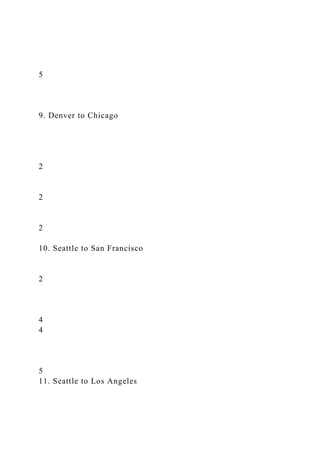
9. Denver to Chicago
2
2
2
10. Seattle to San Francisco
2
4
4
5
11. Seattle to Los Angeles
2
2
4
4
2
Cost, $1,000’s
2
3
4
6
7
5
7
8
9
9
8
9
FORMULATION WITH BINARY VARIABLES
With 12 feasible sequences of flights, we have 12 yes-or-no
decisions:
Should sequence j be assigned to a crew? (j=1, 2, …, 12)
Therefore, we use 12 binary variables to represent these
respective decisions:
Xj = 1 if sequence j is assigned to a crew
Xj = 0 otherwise
The most interesting part of this formulation is the nature of
each that ensures that a corresponding flight is covered. For
example, consider the last flight in the Table (Seattle to Los
Angeles]. Five sequences (namely, sequences 6, 9, 10, 11, and
12) include this flight. Therefore, at least one of these five
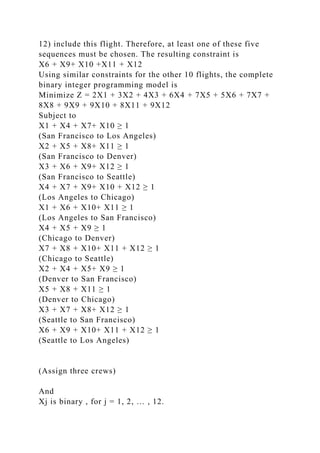
sequences must be chosen. The resulting constraint is
X6 + X9+ X10 +X11 + X12
Using similar constraints for the other 10 flights, the complete
binary integer programming model is
Minimize Z = 2X1 + 3X2 + 4X3 + 6X4 + 7X5 + 5X6 + 7X7 +
8X8 + 9X9 + 9X10 + 8X11 + 9X12
Subject to
X1 + X4 + X7+ X10 ≥ 1
(San Francisco to Los Angeles)
X2 + X5 + X8+ X11 ≥ 1
(San Francisco to Denver)
X3 + X6 + X9+ X12 ≥ 1
(San Francisco to Seattle)
X4 + X7 + X9+ X10 + X12 ≥ 1
(Los Angeles to Chicago)
X1 + X6 + X10+ X11 ≥ 1
(Los Angeles to San Francisco)
X4 + X5 + X9 ≥ 1
(Chicago to Denver)
X7 + X8 + X10+ X11 + X12 ≥ 1
(Chicago to Seattle)
X2 + X4 + X5+ X9 ≥ 1
(Denver to San Francisco)
X5 + X8 + X11 ≥ 1
(Denver to Chicago)
X3 + X7 + X8+ X12 ≥ 1
(Seattle to San Francisco)
X6 + X9 + X10+ X11 + X12 ≥ 1
(Seattle to Los Angeles)
(Assign three crews)
And
Xj is binary , for j = 1, 2, … , 12.
The model is already formulated. You need to use binary integer
programming to solve for the minimum cost and present the
optimal solution.
There are 8 criteria specified in the course guide that you
follow. The level of grade for each criterion is also specified in
the course guide. DO YOUR BEST!

· Assignment 1. Linear Programming Case StudyYour instruct.docx

  • 1.
    · Assignment 1.Linear Programming Case Study Your instructor will assign a linear programming project for this assignment according to the following specifications. It will be a problem with at least three (3) constraints and at least two (2) decision variables. The problem will be bounded and feasible. It will also have a single optimum solution (in other words, it won’t have alternate optimal solutions). The problem will also include a component that involves sensitivity analysis and the use of the shadow price. You will be turning in two (2) deliverables, a short writeup of the project and the spreadsheet showing your work. Writeup. Your writeup should introduce your solution to the project by describing the problem. Correctly identify what type of problem this is. For example, you should note if the problem is a maximization or minimization problem, as well as identify the resources that constrain the solution. Identify each variable and explain the criteria involved in setting up the model. This should be encapsulated in one (1) or two (2) succinct paragraphs. After the introductory paragraph, write out the L.P. model for the problem. Include the objective function and all constraints, including any non-negativity constraints. Then, you should present the optimal solution, based on your work in Excel. Explain what the results mean. Finally, write a paragraph addressing the part of the problem pertaining to sensitivity analysis and shadow price. Excel. As previously noted, please set up your problem in Excel and find the solution using Solver. Clearly label the cells in your spreadsheet. You will turn in the entire spreadsheet, showing
  • 2.
    the setup ofthe model, and the results. Below is the grading rubric for this assignment. Your work will be graded according to the following rubric. Points: 110 Assignment 1: Linear Programming Case Study Criteria Unacceptable Below 60% F Meets Minimum Expectations 60-69% D Fair 70-79% C Proficient 80-89% B Exemplary 90-100% A Explain what type of problem this is and the approach you are taking (20%) Did not explain what type of problem this is and the approach taken, or did so insufficiently. Insufficiently explained what type of problem this is and the approach taken Partially explained what type of problem this is and the approach taken Satisfactorily explained what type of problem this is and the approach taken Thoroughly explained what type of problem this is and the approach taken
  • 3.
    Objective function specifiedcorrectly in writeup (10%) Objective function is specified incorrectly, with both coefficients incorrect or missing. Objective function is specified, but one (1) coefficient is incorrect. Coefficients for objective function are correct, but whether this is a max or min problem is incorrect. Objective function is specified correctly. Constraints are specified correctly in writeup (10%) Constraints are specified incorrectly or missing. Some constraints are correctly specified. Most constraints are correctly specified. All constraints are correctly specified, buy applicable nonnegativity constraints are omitted. All constraints are correctly specified, including nonnegativity constraints, if applicable. Specified L.P. Model is correctly translated to Excel (10%) Specified L.P. Model is incorrectly translated into Excel Specified model is translated to Excel in a partially correct manner Specified model is translated to Excel in a mostly correct manner Specified model is correctly translated to Excel Correct Answer is Obtained (10%) Correct optimum is not obtained Correct optimum is obtained Correctly answer the sensitivity analysis part of the problem. (15%) Did not attempt the sensitivity analysis part of the problem or did so with less than 60% accuracy and completeness Insufficiently explained and/or provided a partially correct
  • 4.
    answer to thesensitivity analysis part of the problem Partially explained and/or provided a partially correct answer to the sensitivity analysis part of the problem Satisfactorily explained and correctly answered the sensitivity analysis part of the problem Thoroughly explained and correctly answered the sensitivity analysis part of the problem Correctly answer the surplus price part of the problem. (15%) Did not attempt the sensitivity analysis part of the problem or did so with less than 60% accuracy and completeness Insufficiently explained and/or provided a partially correct answer to the sensitivity analysis part of the problem Partially explained and/or provided a partially correct answer to the sensitivity analysis part of the problem Satisfactorily explained and correctly answered the sensitivity analysis part of the problem Thoroughly explained and correctly answered the sensitivity analysis part of the problem 5. Writing / Grammar and mechanics (10%) Serious and persistent errors in grammar, spelling, and punctuation. Numerous errors in grammar, spelling, and punctuation. Partially free of errors in grammar, spelling, and punctuation. Mostly free of errors in grammar, spelling, and punctuation. Free of errors in grammar, spelling, and punctuation. Sheet1VARIABLES REPRESENTING THE 12 SEQUENCES OF FLIGHTSX1X2X3X4X5X6X7X8X9X10X11X12Left Hand SideRight Hand SideConstraint on Flight 111111>=1Constraint on Flight 211111>=1Constraint on Flight 311111>=1Constraint
  • 5.
    on Flight 4111112>=1Constrainton Flight 511111>=1Constraint on Flight 61111>=1Constraint on Flight 7111111>=1Constraint on Flight 811111>=1Constraint on Flight 91111>=1Constraint on Flight 1011111>=1Constraint on Flight 11111111>=1Assigning 3 crews, for example1111111111113=3Optimal Variables001100000010Costs in 1000's234675789989Objective in 1000's18 Sheet2 Sheet3 STRAYER UNIVERSITY SUMMER QUARTER 2014 MAT 540 PROBLEM FOR WEEK 8 ASSIGNMENT SOUTHWEST AIRWAYS needs to assign its crews to cover all its upcoming flights. We will focus on the problem of assigning three crews based in San Francisco to the flights listed in the first column of the following Table. The other 12 columns show the 12 feasible sequences of flights for a crew. (The numbers in each column indicate the order of the flights.) Exactly three of the sequences need to be chosen (one per crew) in such a way that every flight is covered. It is permissible to have than one crew on a flight, where the extra crew would fly as passengers, but union contracts require that the extra crews would still need to be paid for their time as if they were working.) The cost of assigning a crew to a particular sequence of flights is given (in thousands of dollars) in the bottom row of the Table. The objective is to minimize the total cost of the three crew assignments that cover all the flights. TABLE . Data for Southwest Airways Feasible Sequence of Flights Flight 1
  • 6.
    2 3 4 5 6 7 8 9 10 11 12 1. San Franciscoto Los Angeles 1 1 1 1 2. San Francisco to Denver 1 1 1 1
  • 7.
    3. San Franciscoto Seattle 1 1 1 1 4. Los Angeles to Chicago 2 2 3 2 3 5. Los Angeles to San Francisco 2 3
  • 8.
    5 5 6. Chicago toDenver 3 3 4 7. Chicago to Seattle 3 3 3 3 4 8. Denver to San Francisco 2 4 4
  • 9.
    5 9. Denver toChicago 2 2 2 10. Seattle to San Francisco 2 4 4 5 11. Seattle to Los Angeles
  • 10.
    2 2 4 4 2 Cost, $1,000’s 2 3 4 6 7 5 7 8 9 9 8 9 FORMULATION WITHBINARY VARIABLES With 12 feasible sequences of flights, we have 12 yes-or-no decisions: Should sequence j be assigned to a crew? (j=1, 2, …, 12) Therefore, we use 12 binary variables to represent these respective decisions: Xj = 1 if sequence j is assigned to a crew Xj = 0 otherwise The most interesting part of this formulation is the nature of each that ensures that a corresponding flight is covered. For example, consider the last flight in the Table (Seattle to Los Angeles]. Five sequences (namely, sequences 6, 9, 10, 11, and
  • 11.
    12) include thisflight. Therefore, at least one of these five sequences must be chosen. The resulting constraint is X6 + X9+ X10 +X11 + X12 Using similar constraints for the other 10 flights, the complete binary integer programming model is Minimize Z = 2X1 + 3X2 + 4X3 + 6X4 + 7X5 + 5X6 + 7X7 + 8X8 + 9X9 + 9X10 + 8X11 + 9X12 Subject to X1 + X4 + X7+ X10 ≥ 1 (San Francisco to Los Angeles) X2 + X5 + X8+ X11 ≥ 1 (San Francisco to Denver) X3 + X6 + X9+ X12 ≥ 1 (San Francisco to Seattle) X4 + X7 + X9+ X10 + X12 ≥ 1 (Los Angeles to Chicago) X1 + X6 + X10+ X11 ≥ 1 (Los Angeles to San Francisco) X4 + X5 + X9 ≥ 1 (Chicago to Denver) X7 + X8 + X10+ X11 + X12 ≥ 1 (Chicago to Seattle) X2 + X4 + X5+ X9 ≥ 1 (Denver to San Francisco) X5 + X8 + X11 ≥ 1 (Denver to Chicago) X3 + X7 + X8+ X12 ≥ 1 (Seattle to San Francisco) X6 + X9 + X10+ X11 + X12 ≥ 1 (Seattle to Los Angeles) (Assign three crews) And Xj is binary , for j = 1, 2, … , 12.
  • 12.
    The model isalready formulated. You need to use binary integer programming to solve for the minimum cost and present the optimal solution. There are 8 criteria specified in the course guide that you follow. The level of grade for each criterion is also specified in the course guide. DO YOUR BEST!