Disabled ‘R’ All
Bridging the gap between Health and
             Situational Impairments


                        Hugo Nicolau
                        hman@vimmi.inesc-id.pt

                      Prof. Joaquim Jorge
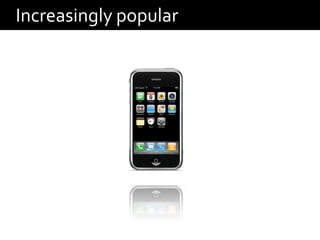
Increasingly popular
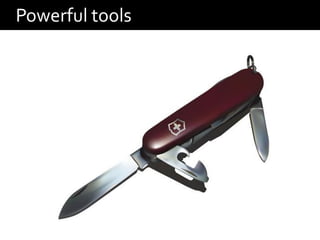
Powerful tools
Always near us
@ Home
@ Work
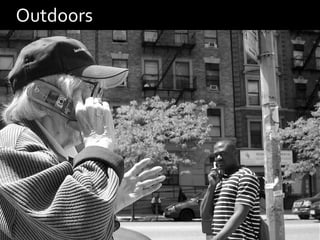
Outdoors
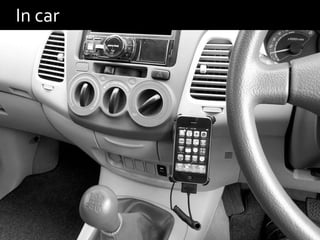
In car
@ Coffee shop
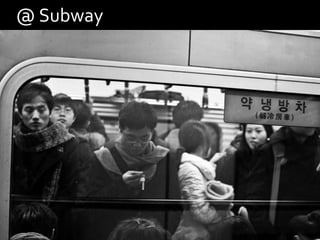
@ Subway
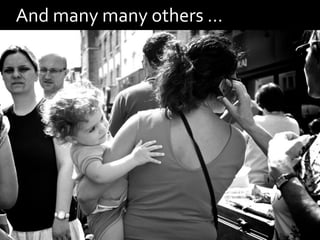
And many many others …
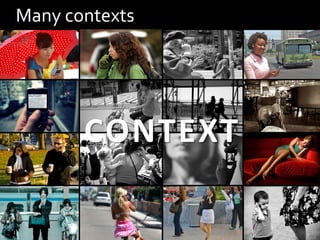
Many contexts


       CONTEXT
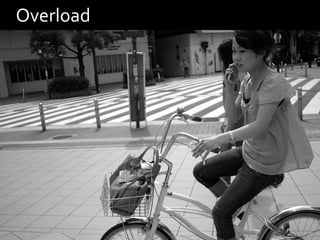
Overload
Leading to …


Situationally-Induced Impairments and Disabilities [Sears, 2003]
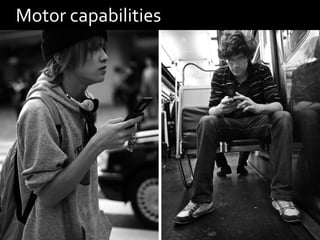
Motor capabilities
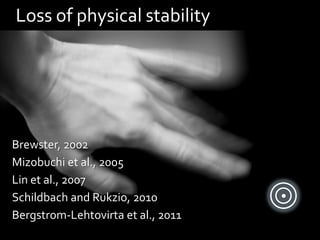
Loss of physical stability


Brewster, 2002
Mizobuchi et al., 2005
Lin et al., 2007
Schildbach and Rukzio, 2010
Bergstrom-Lehtovirta et al., 2011
Same old challenges
                               Brown, 1992
                        Vanderheiden, 1993
                             Edwards, 1995
                         Poulson et al. 1996
                      Trewin and Pain, 1999
Do they share …


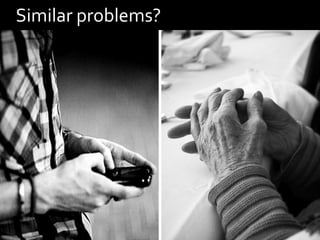
 Similar problems?
           [Yesilada et al., 2010]
Do they benefit from …


  Similar solutions?
Goal
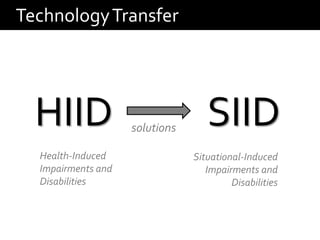
Technology Transfer


  HIID              solutions      SIID
  Health-Induced                Situational-Induced
  Impairments and                  Impairments and
  Disabilities                           Disabilities
Knowledge sharing and reuse
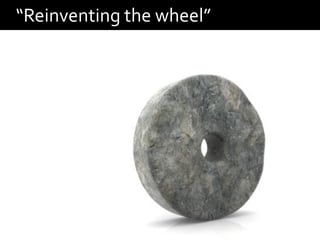
“Reinventing the wheel”
More and better research
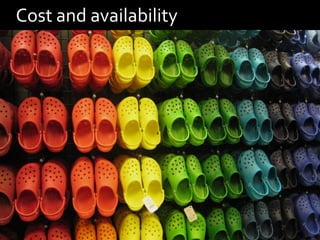
Cost and availability
New connotation
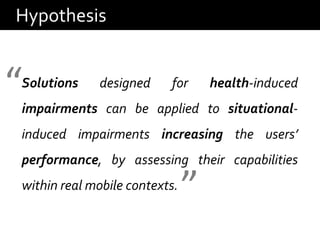
Hypothesis


“
Solutions    designed     for      health-induced
impairments can be applied to situational-
induced impairments increasing the users’
performance, by assessing their capabilities
within real mobile contexts.
                               ”
APPROACH
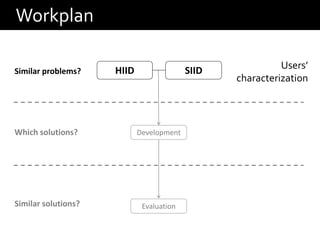
Workplan

                     HIID                 SIID             Users’
Similar problems?
                                                 characterization


Which solutions?            Development


Similar solutions?           Evaluation
Similar problems?
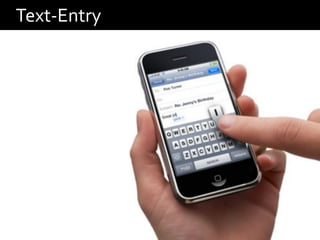
Text-Entry
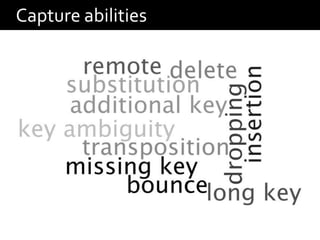
Capture abilities
Differences and Similarities
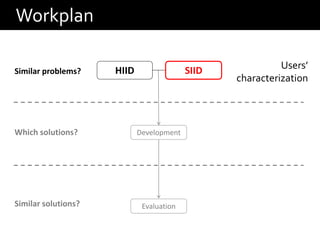
Workplan

                     HIID                 SIID             Users’
Similar problems?
                                                 characterization


Which solutions?            Development


Similar solutions?           Evaluation
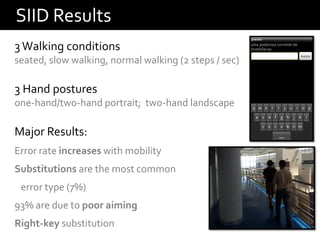
SIID Results
3 Walking conditions
seated, slow walking, normal walking (2 steps / sec)

3 Hand postures
one-hand/two-hand portrait; two-hand landscape

Major Results:
Error rate increases with mobility
Substitutions are the most common
 error type (7%)
93% are due to poor aiming
Right-key substitution
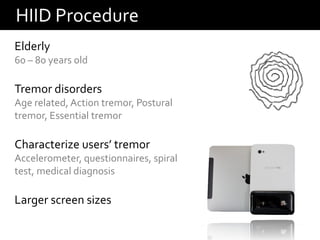
HIID Procedure
Elderly
60 – 80 years old

Tremor disorders
Age related, Action tremor, Postural
tremor, Essential tremor

Characterize users’ tremor
Accelerometer, questionnaires, spiral
test, medical diagnosis

Larger screen sizes
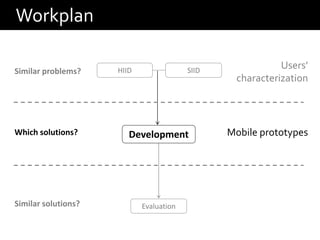
Workplan

                     HIID                SIID
                                                           Users’
Similar problems?
                                                 characterization


Which solutions?        Development             Mobile prototypes


Similar solutions?          Evaluation
Text-entry Solutions
Filters e.g. [Trewin, 2002]


Orthographic correctors e.g. [Kane et al., 2008]


Adaptive keyboards e.g. [Merlin and Raynal, 2010]


Alternative techniques e.g. [Wobbrock et al., 2003]
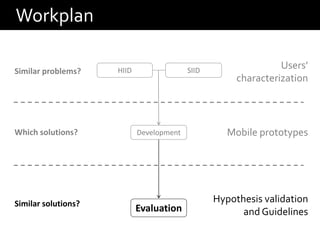
Workplan

                     HIID                 SIID
                                                                Users’
Similar problems?
                                                      characterization


Which solutions?            Development             Mobile prototypes


Similar solutions?                               Hypothesis validation
                            Evaluation                 and Guidelines
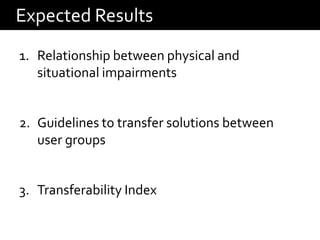
Expected Results
1. Relationship between physical and
   situational impairments


2. Guidelines to transfer solutions between
   user groups


3. Transferability Index
Questions to the Consortium
Is this a valid approach (technology transfer)?


Should I develop novel solutions?


          ?
? ??
THE END
Hugo Nicolau
hman@vimmi.inesc-id.pt
Discussion

ASSETS'11 Doctoral Consortium