Slide 110/02/2012 Slide 1
Asset Management
Gas Meter Farms:
New Tool for Managing AMI Meter Populations and
Testing Continuously Evolving Communication
Technology in a Post Deployment World
Prepared by Philip E. Clark, TESCO
Paul Fratellone, TESCO
The Eastern Specialty Company
For NYS Gas Measurement Group Meeting
October 04, 2017
Slide 2
• Define a Meter Farm
• Discuss how to size and format
a meter farm
– Discuss what features should be
included in your meter farm
• Discuss Uses of a Meter Farm
– Before deployment
– During deployment
– After deployment
– As a new way to do old tasks in a Post
AMI/AMR world
Session Overview
Slide 3
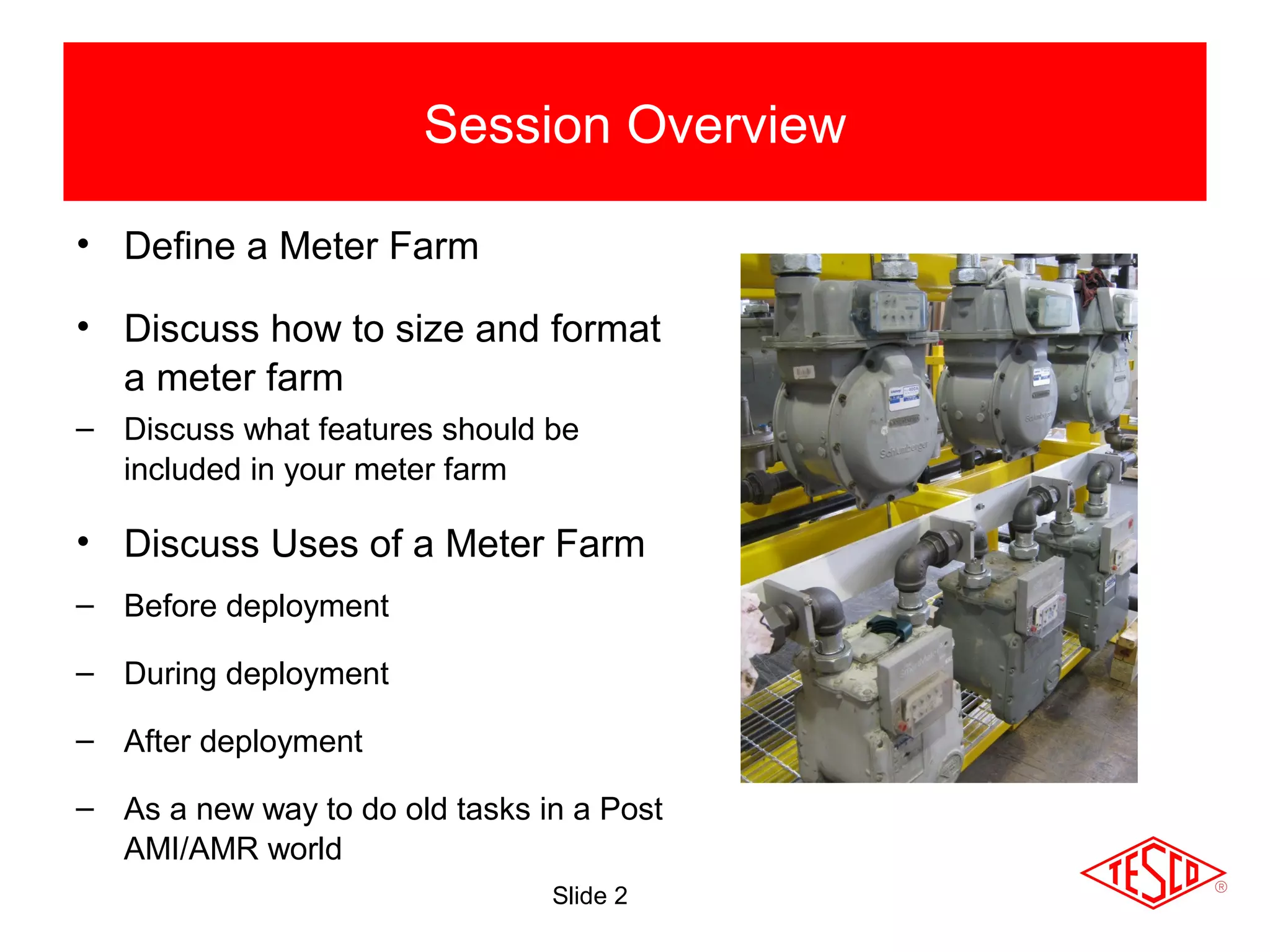
• A meter farm is a representation of your
meter population in the field
• The meter farm is designed to be a tool
to measure base line performance of
your meters
• Meter farms are typically located
outside so meters are exposed to the
same temperatures, sun and elements
as your meter population
• Meter farms should include a simulation
of the entire communication network
back to the head end
What is a Meter Farm?
Slide 4
How Big? How Many? What Types?
A Meter farm needs to have a statistically significant representation of your
meter population in the field.
•This means a minimum of 30 meters regardless of population.
•Typical farms have 50 to 100 meters for populations up to 50,000 meters
•Several thousand meters for populations over two million.
The breakdown of Meter Types should be roughly representative of the
breakdown of meters within your population:
•Residential meters will occupy 85 to 90% of the headers in a meter farm.
•Larger Diaphragm and Rotary meters should have a space to load a
minimum of two to three meters if possible.
Slide 5
What Features to Build-in?
Shop Testing
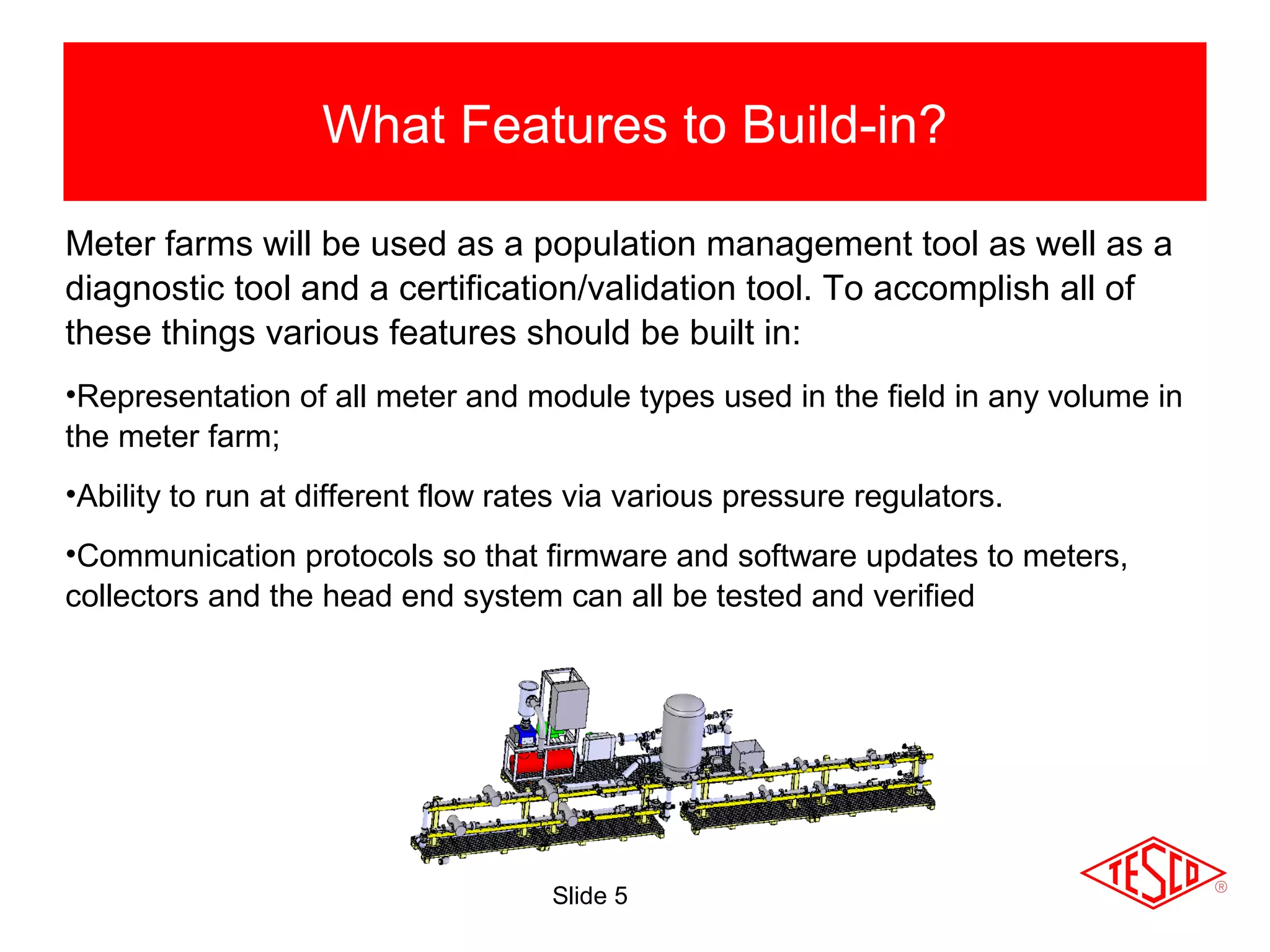
Meter farms will be used as a population management tool as well as a
diagnostic tool and a certification/validation tool. To accomplish all of
these things various features should be built in:
•Representation of all meter and module types used in the field in any volume in
the meter farm;
•Ability to run at different flow rates via various pressure regulators.
•Communication protocols so that firmware and software updates to meters,
collectors and the head end system can all be tested and verified
Slide 6
Initial Uses of a Gas Meter Farm
Shop Testing
• Perform and validate meter data accuracy, communication functional
reliability, and new meter/module firmware certification tests without
selecting a group of in-service billing meters for such tests.
• Perform testing and tracking of the performance of battery life cycle of
gas modules.
• Perform compatibility of gas meters and modules and firmware
certification tests.
• Help the utility ensure and protect the integrity of the metering system by
testing new product installations, software and firmware upgrades, and
troubleshooting of various metering issues (i.e. causing billing issues,
system crashes, etc.) before such software, firmware and meters are
put in service.
• Perform tests on new metering technologies and functionalities in
support of other projects such as mobile Data Collecting Unit (DCU), new
gas meter certification, meter network optimization, new module
certification, accelerated life test, and disaster recovery.
Slide 7
Using a Meter Farm Prior to Deployment
Shop Testing
• Prior to deployment you are still in Meter Certification
mode.
• Much of this work is done either on a prover for
relatively short periods of time or the longer duration
tests are run on some sort of home made set up that is
cumbersome to run and difficult to repeat at a later
date.
• Typically once the work in the meter lab is completed
utilities will jump directly to a pilot program for a limited
number of installations in the field. The weakness with
this is that the pilot program is not dynamic.
• The assumption had been made that the meters used
in full deployment would be static. What was tested
during the initial portion of the Meter Certification
phase would be representative of what was eventually
deployed. Experience has shown this to be an
incorrect assumption.
Slide 8
Meter Farm’s Prior to Deployment (con’t)
Shop Testing
• Inaccurate assumption. Modules, firmware and even meters change.
Communication protocols and information passed change. A meter farm allows you
to perform a mini-pilot and to control and modify this pilot multiple times during meter
certification.
• The meters in this meter farm also allow for longer term observation of the new
meters/modules performance in the field. Any anomalies reported from the field
during your pilot can be more readily identified and diagnosed.
• This is a precursor to some of the ways in which you will use the meter farm after
deployment.
Slide 9
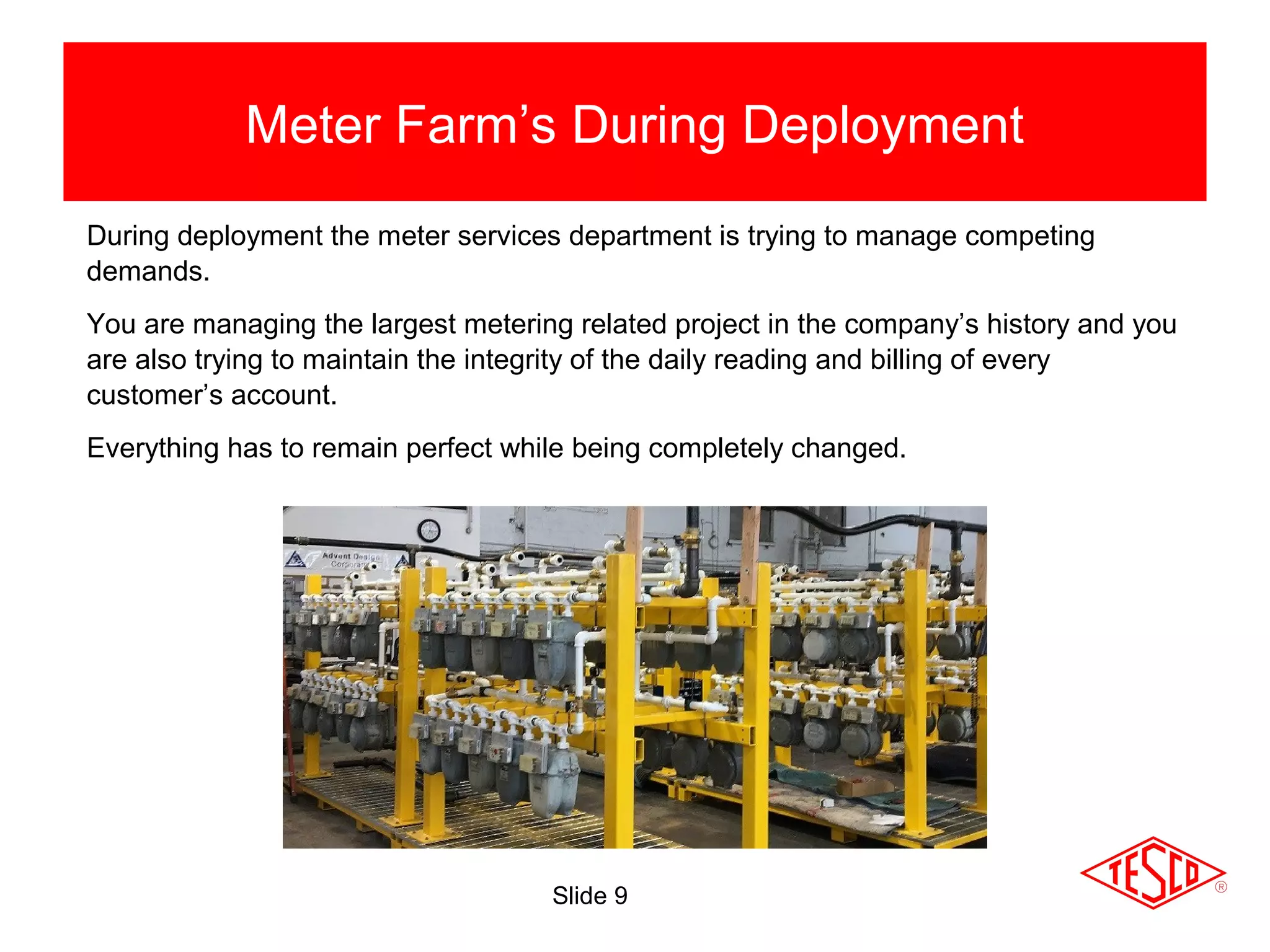
Meter Farm’s During Deployment
Shop Testing
During deployment the meter services department is trying to manage competing
demands.
You are managing the largest metering related project in the company’s history and you
are also trying to maintain the integrity of the daily reading and billing of every
customer’s account.
Everything has to remain perfect while being completely changed.
Slide 10
Meter Farm’s During Deployment
Shop Testing
The meter farm gives you a microcosm of
your population and as a result can be
used as a baseline to ensure the longer
term stability of the meters being delivered
and to ensure that they are not changing
over the course of the deployment.
Functional testing and accuracy testing
allow you to do this as well. The meter farm
allows longer term performance
comparison between delivered meters over
the course of the deployment.
Slide 11
Meter Farm’s After Deployment
Shop Testing
This is where meter farms are the most valuable. The meter farm becomes your
most valuable tool in managing your AMI population.
Prior to a full scale AMI or AMR roll out you had a variety of meter types in the field
with meter vintages that often ranged over a forty year time period and sometimes
longer.
To assess the performance of these meters and to look for potential systemic issues
within a particular family of meters statistic methods were used.
.
Slide 12
In Service Testing Programs after AMI
Shop Testing
• In-Service testing programs are typically based on ANSI Z1.4 or Z1.9. In-
Service test programs are intended to determine as far in advance issues
within a meter population through statistical sampling.
• This methodology is typically used with the larger meter populations (e.g.
residential) as they have the most statistically relevant populations and the
ones best managed in this way.
• But after an AMI deployment a utility has a single module type of a single
vintage. A systemic issue within a population would be found far too late
with a traditional In-service test plan. Too many false positives would be
found if trying to use this on the front end and too many other issues missed.
• And meter or module issues are now just as likely to be a communication
issue.
Slide 13
Meter Farms as base line performance
indicators
Shop Testing
How well is a particular meter/module
combination performing in the field? Walk
through the meter farm. That is a pretty good
initial indicator.
•Communication issues? – You should see
them.
•Battery recovery issues? You can check for
them.
•System recovery issues? You can test for them.
•Component failures? You should see them.
In a perfect world you should see issues before
the field reports them or in the same time frame.
Slide 14
Meter Farms as Diagnostic Tools
Metering issues in the field are a constant part of our lives. Most are
readily dealt with. Some are not.
Issues traditionally could be identified as either a meter issue, a module
issue or an installation issue.
Now the issue can be a meter issue, a module issue, an installation
issue, or a communication issue (which can be in the module, can be
site specific or be further up the communication chain).
And yet most utilities still send a meter tech out to change a meter
module as the first line of defense.
Slide 15
Meter Farms as Diagnostic Tools (con’t)
Shop Testing
• When a meter or a module is brought
back to the shop a series of diagnostics
can and are run in the meter lab.
• Testing and evaluation of the module (or
meter) is performed in the meter shop.
And often there is no definitive result.
• Now this meter/module can be put out
onto the meter farm and run against
other meters of a similar age or older
and checked for any anomaly over time.
Acceptance protocols can be run and
performance checked one meter/module
against the others.
Slide 18
Meter Farms as Acceptance Testing
Environments (con’t)
Shop Testing
Use these same protocols when testing over the air upgrades or new
communication protocols of any sort.
Anything new – check before deploying to the field. This is your test
environment.
Slide 21
Meter Farms
Slide 22
Questions and Discussion
Philip E. Clark
TESCO – The Eastern Specialty Company
Bristol, PA
1-800-762-8211
www.tesco-advent.com

Asset Management Gas Meter Farms

  • 1.
    Slide 110/02/2012 Slide1 Asset Management Gas Meter Farms: New Tool for Managing AMI Meter Populations and Testing Continuously Evolving Communication Technology in a Post Deployment World Prepared by Philip E. Clark, TESCO Paul Fratellone, TESCO The Eastern Specialty Company For NYS Gas Measurement Group Meeting October 04, 2017
  • 2.
    Slide 2 • Definea Meter Farm • Discuss how to size and format a meter farm – Discuss what features should be included in your meter farm • Discuss Uses of a Meter Farm – Before deployment – During deployment – After deployment – As a new way to do old tasks in a Post AMI/AMR world Session Overview
  • 3.
    Slide 3 • Ameter farm is a representation of your meter population in the field • The meter farm is designed to be a tool to measure base line performance of your meters • Meter farms are typically located outside so meters are exposed to the same temperatures, sun and elements as your meter population • Meter farms should include a simulation of the entire communication network back to the head end What is a Meter Farm?
  • 4.
    Slide 4 How Big?How Many? What Types? A Meter farm needs to have a statistically significant representation of your meter population in the field. •This means a minimum of 30 meters regardless of population. •Typical farms have 50 to 100 meters for populations up to 50,000 meters •Several thousand meters for populations over two million. The breakdown of Meter Types should be roughly representative of the breakdown of meters within your population: •Residential meters will occupy 85 to 90% of the headers in a meter farm. •Larger Diaphragm and Rotary meters should have a space to load a minimum of two to three meters if possible.
  • 5.
    Slide 5 What Featuresto Build-in? Shop Testing Meter farms will be used as a population management tool as well as a diagnostic tool and a certification/validation tool. To accomplish all of these things various features should be built in: •Representation of all meter and module types used in the field in any volume in the meter farm; •Ability to run at different flow rates via various pressure regulators. •Communication protocols so that firmware and software updates to meters, collectors and the head end system can all be tested and verified
  • 6.
    Slide 6 Initial Usesof a Gas Meter Farm Shop Testing • Perform and validate meter data accuracy, communication functional reliability, and new meter/module firmware certification tests without selecting a group of in-service billing meters for such tests. • Perform testing and tracking of the performance of battery life cycle of gas modules. • Perform compatibility of gas meters and modules and firmware certification tests. • Help the utility ensure and protect the integrity of the metering system by testing new product installations, software and firmware upgrades, and troubleshooting of various metering issues (i.e. causing billing issues, system crashes, etc.) before such software, firmware and meters are put in service. • Perform tests on new metering technologies and functionalities in support of other projects such as mobile Data Collecting Unit (DCU), new gas meter certification, meter network optimization, new module certification, accelerated life test, and disaster recovery.
  • 7.
    Slide 7 Using aMeter Farm Prior to Deployment Shop Testing • Prior to deployment you are still in Meter Certification mode. • Much of this work is done either on a prover for relatively short periods of time or the longer duration tests are run on some sort of home made set up that is cumbersome to run and difficult to repeat at a later date. • Typically once the work in the meter lab is completed utilities will jump directly to a pilot program for a limited number of installations in the field. The weakness with this is that the pilot program is not dynamic. • The assumption had been made that the meters used in full deployment would be static. What was tested during the initial portion of the Meter Certification phase would be representative of what was eventually deployed. Experience has shown this to be an incorrect assumption.
  • 8.
    Slide 8 Meter Farm’sPrior to Deployment (con’t) Shop Testing • Inaccurate assumption. Modules, firmware and even meters change. Communication protocols and information passed change. A meter farm allows you to perform a mini-pilot and to control and modify this pilot multiple times during meter certification. • The meters in this meter farm also allow for longer term observation of the new meters/modules performance in the field. Any anomalies reported from the field during your pilot can be more readily identified and diagnosed. • This is a precursor to some of the ways in which you will use the meter farm after deployment.
  • 9.
    Slide 9 Meter Farm’sDuring Deployment Shop Testing During deployment the meter services department is trying to manage competing demands. You are managing the largest metering related project in the company’s history and you are also trying to maintain the integrity of the daily reading and billing of every customer’s account. Everything has to remain perfect while being completely changed.
  • 10.
    Slide 10 Meter Farm’sDuring Deployment Shop Testing The meter farm gives you a microcosm of your population and as a result can be used as a baseline to ensure the longer term stability of the meters being delivered and to ensure that they are not changing over the course of the deployment. Functional testing and accuracy testing allow you to do this as well. The meter farm allows longer term performance comparison between delivered meters over the course of the deployment.
  • 11.
    Slide 11 Meter Farm’sAfter Deployment Shop Testing This is where meter farms are the most valuable. The meter farm becomes your most valuable tool in managing your AMI population. Prior to a full scale AMI or AMR roll out you had a variety of meter types in the field with meter vintages that often ranged over a forty year time period and sometimes longer. To assess the performance of these meters and to look for potential systemic issues within a particular family of meters statistic methods were used. .
  • 12.
    Slide 12 In ServiceTesting Programs after AMI Shop Testing • In-Service testing programs are typically based on ANSI Z1.4 or Z1.9. In- Service test programs are intended to determine as far in advance issues within a meter population through statistical sampling. • This methodology is typically used with the larger meter populations (e.g. residential) as they have the most statistically relevant populations and the ones best managed in this way. • But after an AMI deployment a utility has a single module type of a single vintage. A systemic issue within a population would be found far too late with a traditional In-service test plan. Too many false positives would be found if trying to use this on the front end and too many other issues missed. • And meter or module issues are now just as likely to be a communication issue.
  • 13.
    Slide 13 Meter Farmsas base line performance indicators Shop Testing How well is a particular meter/module combination performing in the field? Walk through the meter farm. That is a pretty good initial indicator. •Communication issues? – You should see them. •Battery recovery issues? You can check for them. •System recovery issues? You can test for them. •Component failures? You should see them. In a perfect world you should see issues before the field reports them or in the same time frame.
  • 14.
    Slide 14 Meter Farmsas Diagnostic Tools Metering issues in the field are a constant part of our lives. Most are readily dealt with. Some are not. Issues traditionally could be identified as either a meter issue, a module issue or an installation issue. Now the issue can be a meter issue, a module issue, an installation issue, or a communication issue (which can be in the module, can be site specific or be further up the communication chain). And yet most utilities still send a meter tech out to change a meter module as the first line of defense.
  • 15.
    Slide 15 Meter Farmsas Diagnostic Tools (con’t) Shop Testing • When a meter or a module is brought back to the shop a series of diagnostics can and are run in the meter lab. • Testing and evaluation of the module (or meter) is performed in the meter shop. And often there is no definitive result. • Now this meter/module can be put out onto the meter farm and run against other meters of a similar age or older and checked for any anomaly over time. Acceptance protocols can be run and performance checked one meter/module against the others.
  • 16.
    Slide 18 Meter Farmsas Acceptance Testing Environments (con’t) Shop Testing Use these same protocols when testing over the air upgrades or new communication protocols of any sort. Anything new – check before deploying to the field. This is your test environment.
  • 17.
  • 18.
    Slide 22 Questions andDiscussion Philip E. Clark TESCO – The Eastern Specialty Company Bristol, PA 1-800-762-8211 www.tesco-advent.com