1
10/02/2012 Slide 1
Meter Testing 101
Prepared by Tom Lawton
TESCO
For North Carolina Electric Meter School
Thursday, June 29, 2017 at 9:00 a.m.
2
Questions to Answer
• Why do we test?
• How do we test?
• What types of meter tests are there?
• How do utility tests differ from customer request
tests?
• What is In-Service Testing?
• How do we know meter tests are good?
• What do we do with the test data?
3
Why Do We Test?
Our regulatory commissions require us to test meters.
But only for accuracy. State regulatory commissions
want electric utilities to ensure that no customer is being
billed unfairly and that no subset of customers is being
unfairly subsidized by the rest of the rate payers. Some
states mandate only accuracy tests and others require
demand and time of use accuracy tests.
Any tests beyond accuracy tests are tests that are simply
good business practice.
4
Complaint Testing
Customers always have the right to request a meter test.
Some utilities and some jurisdictions allow for testing at
the customer site, others require a test in a laboratory
environment.
Some allow the customer to witness the test and others
require the utility commission to witness the test.
Utilities must show that the meter tests well and must
demonstrate that they have a test program in place to
ensure the meters in service are performing well.
5
General Meter Testing Requirements
• New Meters
– Manufacturers tests
– In-house tests on new
shipments
• Return to Service Testing
• In-Service Meters
– Periodic Tests
– Selective, random, or
statistical testing
• Retirement tests
• Testing of related metering equipment
6
New Meter Testing Programs
• Accept the Manufacturer’s Test results
• Perform a Statistical Test of an incoming shipment
• Perform a 100% test of an incoming shipment
7
Return to Service Testing
• Meters to be returned to
service must always
(virtually every utility
commission requires this)
be accuracy tested before
being returned to service.
• Best business practices
also require that the meter
is functionally tested as
well.
8
In Service Testing
Meter Testing for new and in-service meters is specified
in ANSI C12.1-2015, American National Standard for
Electric Meters, Code for Electricity Metering. Most utility
commissions use this Standard a reference or the basis
for their meter testing requirements.
9
Test Plans for Meters
Four test plan options available:
• Periodic
• Statistical
10
Periodic Test Plans
• Periodic
– Varies by State
– Example provided by ANSI C12.1:
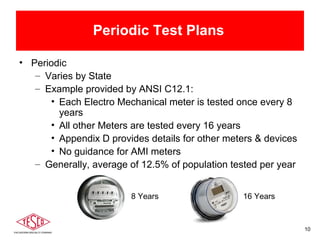
• Each Electro Mechanical meter is tested once every 8
years
• All other Meters are tested every 16 years
• Appendix D provides details for other meters & devices
• No guidance for AMI meters
– Generally, average of 12.5% of population tested per year
8 Years 16 Years
11
Statistical Test Plans
The Best Approach
ANSI C12.1-2001 Code for Electricity Metering Guidance
Paragraph 5.1.4.3.3 Statistical sampling plan
“The statistical sampling plan used shall conform to accepted principles of
statistical sampling based on either variables or attributes methods. Meters shall
be divided into homogeneous groups, such as manufacturer and manufacturer’s
type. The groups may be further divided into subdivision within the
manufacturer’s type by major design modifications.”
NOTE - Examples of statistical sampling plans
can be found in ANSI/ASQC Z1.9, the ANSI
version of MIL-STD-414 and ANSI/ASQC Z1.4,
the ANSI version of MIL-STD-105.
12
Why Use a Statistical Testing Plan?
• Focuses testing on the proper meters
• Minimizes number of meters to be tested; usually requires
less than 30% of what a periodic testing plan requires
• Provides data and analysis tools for use in
understanding what is happening with installed meters
or for use in the purchasing of new meters
13
Homogeneous Population(s)
• The groups or populations being sampled and tested
are made up of the same or similar items, items
which operate in the same way and were made in the
same manner.
• For electric meters, this has traditionally been
interpreted as being meters of a specific meter
type from a manufacturer (i.e. AB1, J5S, MX, etc.).
• AMR & AMI programs have helped to make the
overall populations more homogenous. This makes a
utility with AMR & AMI meters better prepared to
take advantage of a statistical sampling plan.
14
Testing of a Meter vs
Testing a Site
Test an installation and system and not just a meter!
Test programs may need to involve testing and checking the
meter performance as well as checking and testing the
installation. This more extensive test check list needs to be
done especially for the higher revenue C&I customers.
15
16
Meter Testing Traceability
• Test equipment to NIST standards
• Tracking number of meters to be tested per State
Commission requirements
• Tracking meter test data
• Meter Records
• Meter Data Management
System (MDMS)
17
• Traceability is defined as ability to link the results of the
calibration and measurement to related standard and/or
reference (preferably national or international standard)
through an unbroken chain of comparisons.
• Calibration is typically performed by measuring a test unit
against a known standard or reference.
• Master standard (i.e. gages) are kept by National
Measurement Institute (NMI) of each country.
Meter Testing Traceability
18
18
• National Institute of Standards and Technology (NIST)
provides internal tracking numbers, which are often used as
evidence of traceability.
• WARNING! NIST does not certify or guarantee that
calibration and measurements are correct, nor does it provide
any kind of certification of accuracy and calibration and the
internal number does mean that the test unit calibrated is
indeed valid. NIST only provides certifications for the work
performed by them.
Meter Testing Traceability
19
Meter Testing Traceability - Standards
20
20
• National Standard
In US, it is maintained by NIST, and it is a standard formed by
one or many groups within one country (or only few
countries = adapted).
• Reference or Master Standard
Item of highest metrological quality located at a site where
calibration is being conducted.
Lower level of Reference Standard and used for calibration of
lower level calibration requirements measuring devices.
• Working Standard (working master)
Should be compared to Master Standard or Reference
Standard on regular basis; used for daily checks comparisons
of the calibrated devices.
Meter Testing Traceability - Standards
21
Test Equipment Calibration
Primary Requirement: Traceable to NIST Standards
• Meter Test Boards, Field Test Kits calibrated to a known
master standard maintained at Meter Shop.
 Some periodicity such as monthly or quarterly
• Reference or Master standard calibrated by outside vendor
traceable to NIST or directly by NIST.
 Usually annually
22
Tracking Meter Records
• AMI programs help to update and overhaul meter record
systems.
• Having the records for the entire meter population updated
allows for a better chance that test data is available to answer
questions and that any meter may be selected as part of the
sample for testing.
23
Meter Test Data Tracking
Test data should be tracked throughout meter life
– Certification testing, first article, acceptance testing, in-service
(field & shop), retirement
• Meter test data should be linked to meter record data such as meter
form, amps, voltage, display type, etc.
• Best time to start to develop the
program is before the meters are being
installed.
• Accuracy test data is usually collected
automatically as new meters are tested
in meter shops or cross docks.
24
Meter Test Data Tracking
• Need to consider tracking non-accuracy functional testing (meter
software configuration, service disconnect testing, voltage, etc.)
• Use installation reports to determine if there is any initial concerns
about the meters being installed.
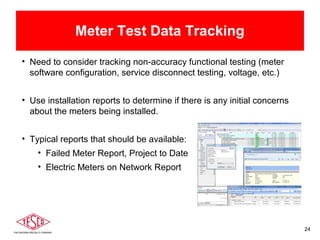
• Typical reports that should be available:
• Failed Meter Report, Project to Date
• Electric Meters on Network Report
25
Meter Test Data Tracking System
• System should track meter test results for ease of future
reference or for response to public or Utility Commission
inquiries.
• Maybe part of Meter Data Management System (MDMS) or
a separate Meter Records system.
• Requires discipline in collecting & entering data, especially
field tests.
26
Questions to Answer
• Why do we test?
• How do we test?
• What types of meter tests are there?
• How do utility tests differ from customer request
tests?
• What is In-Service Testing?
• How do we know meter tests are good?
• What do we do with the test data?
27
Questions?
Please feel free to call or e-mail any questions.
This presentation can be found and downloaded at
www.tesco-advent.com
Tom Lawton
Tom.Lawton@tescometering.com · 215-688-0298 (cell)

Meter Testing 101

  • 1.
    1 10/02/2012 Slide 1 MeterTesting 101 Prepared by Tom Lawton TESCO For North Carolina Electric Meter School Thursday, June 29, 2017 at 9:00 a.m.
  • 2.
    2 Questions to Answer •Why do we test? • How do we test? • What types of meter tests are there? • How do utility tests differ from customer request tests? • What is In-Service Testing? • How do we know meter tests are good? • What do we do with the test data?
  • 3.
    3 Why Do WeTest? Our regulatory commissions require us to test meters. But only for accuracy. State regulatory commissions want electric utilities to ensure that no customer is being billed unfairly and that no subset of customers is being unfairly subsidized by the rest of the rate payers. Some states mandate only accuracy tests and others require demand and time of use accuracy tests. Any tests beyond accuracy tests are tests that are simply good business practice.
  • 4.
    4 Complaint Testing Customers alwayshave the right to request a meter test. Some utilities and some jurisdictions allow for testing at the customer site, others require a test in a laboratory environment. Some allow the customer to witness the test and others require the utility commission to witness the test. Utilities must show that the meter tests well and must demonstrate that they have a test program in place to ensure the meters in service are performing well.
  • 5.
    5 General Meter TestingRequirements • New Meters – Manufacturers tests – In-house tests on new shipments • Return to Service Testing • In-Service Meters – Periodic Tests – Selective, random, or statistical testing • Retirement tests • Testing of related metering equipment
  • 6.
    6 New Meter TestingPrograms • Accept the Manufacturer’s Test results • Perform a Statistical Test of an incoming shipment • Perform a 100% test of an incoming shipment
  • 7.
    7 Return to ServiceTesting • Meters to be returned to service must always (virtually every utility commission requires this) be accuracy tested before being returned to service. • Best business practices also require that the meter is functionally tested as well.
  • 8.
    8 In Service Testing MeterTesting for new and in-service meters is specified in ANSI C12.1-2015, American National Standard for Electric Meters, Code for Electricity Metering. Most utility commissions use this Standard a reference or the basis for their meter testing requirements.
  • 9.
    9 Test Plans forMeters Four test plan options available: • Periodic • Statistical
  • 10.
    10 Periodic Test Plans •Periodic – Varies by State – Example provided by ANSI C12.1: • Each Electro Mechanical meter is tested once every 8 years • All other Meters are tested every 16 years • Appendix D provides details for other meters & devices • No guidance for AMI meters – Generally, average of 12.5% of population tested per year 8 Years 16 Years
  • 11.
    11 Statistical Test Plans TheBest Approach ANSI C12.1-2001 Code for Electricity Metering Guidance Paragraph 5.1.4.3.3 Statistical sampling plan “The statistical sampling plan used shall conform to accepted principles of statistical sampling based on either variables or attributes methods. Meters shall be divided into homogeneous groups, such as manufacturer and manufacturer’s type. The groups may be further divided into subdivision within the manufacturer’s type by major design modifications.” NOTE - Examples of statistical sampling plans can be found in ANSI/ASQC Z1.9, the ANSI version of MIL-STD-414 and ANSI/ASQC Z1.4, the ANSI version of MIL-STD-105.
  • 12.
    12 Why Use aStatistical Testing Plan? • Focuses testing on the proper meters • Minimizes number of meters to be tested; usually requires less than 30% of what a periodic testing plan requires • Provides data and analysis tools for use in understanding what is happening with installed meters or for use in the purchasing of new meters
  • 13.
    13 Homogeneous Population(s) • Thegroups or populations being sampled and tested are made up of the same or similar items, items which operate in the same way and were made in the same manner. • For electric meters, this has traditionally been interpreted as being meters of a specific meter type from a manufacturer (i.e. AB1, J5S, MX, etc.). • AMR & AMI programs have helped to make the overall populations more homogenous. This makes a utility with AMR & AMI meters better prepared to take advantage of a statistical sampling plan.
  • 14.
    14 Testing of aMeter vs Testing a Site Test an installation and system and not just a meter! Test programs may need to involve testing and checking the meter performance as well as checking and testing the installation. This more extensive test check list needs to be done especially for the higher revenue C&I customers.
  • 15.
  • 16.
    16 Meter Testing Traceability •Test equipment to NIST standards • Tracking number of meters to be tested per State Commission requirements • Tracking meter test data • Meter Records • Meter Data Management System (MDMS)
  • 17.
    17 • Traceability isdefined as ability to link the results of the calibration and measurement to related standard and/or reference (preferably national or international standard) through an unbroken chain of comparisons. • Calibration is typically performed by measuring a test unit against a known standard or reference. • Master standard (i.e. gages) are kept by National Measurement Institute (NMI) of each country. Meter Testing Traceability
  • 18.
    18 18 • National Instituteof Standards and Technology (NIST) provides internal tracking numbers, which are often used as evidence of traceability. • WARNING! NIST does not certify or guarantee that calibration and measurements are correct, nor does it provide any kind of certification of accuracy and calibration and the internal number does mean that the test unit calibrated is indeed valid. NIST only provides certifications for the work performed by them. Meter Testing Traceability
  • 19.
  • 20.
    20 20 • National Standard InUS, it is maintained by NIST, and it is a standard formed by one or many groups within one country (or only few countries = adapted). • Reference or Master Standard Item of highest metrological quality located at a site where calibration is being conducted. Lower level of Reference Standard and used for calibration of lower level calibration requirements measuring devices. • Working Standard (working master) Should be compared to Master Standard or Reference Standard on regular basis; used for daily checks comparisons of the calibrated devices. Meter Testing Traceability - Standards
  • 21.
    21 Test Equipment Calibration PrimaryRequirement: Traceable to NIST Standards • Meter Test Boards, Field Test Kits calibrated to a known master standard maintained at Meter Shop.  Some periodicity such as monthly or quarterly • Reference or Master standard calibrated by outside vendor traceable to NIST or directly by NIST.  Usually annually
  • 22.
    22 Tracking Meter Records •AMI programs help to update and overhaul meter record systems. • Having the records for the entire meter population updated allows for a better chance that test data is available to answer questions and that any meter may be selected as part of the sample for testing.
  • 23.
    23 Meter Test DataTracking Test data should be tracked throughout meter life – Certification testing, first article, acceptance testing, in-service (field & shop), retirement • Meter test data should be linked to meter record data such as meter form, amps, voltage, display type, etc. • Best time to start to develop the program is before the meters are being installed. • Accuracy test data is usually collected automatically as new meters are tested in meter shops or cross docks.
  • 24.
    24 Meter Test DataTracking • Need to consider tracking non-accuracy functional testing (meter software configuration, service disconnect testing, voltage, etc.) • Use installation reports to determine if there is any initial concerns about the meters being installed. • Typical reports that should be available: • Failed Meter Report, Project to Date • Electric Meters on Network Report
  • 25.
    25 Meter Test DataTracking System • System should track meter test results for ease of future reference or for response to public or Utility Commission inquiries. • Maybe part of Meter Data Management System (MDMS) or a separate Meter Records system. • Requires discipline in collecting & entering data, especially field tests.
  • 26.
    26 Questions to Answer •Why do we test? • How do we test? • What types of meter tests are there? • How do utility tests differ from customer request tests? • What is In-Service Testing? • How do we know meter tests are good? • What do we do with the test data?
  • 27.
    27 Questions? Please feel freeto call or e-mail any questions. This presentation can be found and downloaded at www.tesco-advent.com Tom Lawton Tom.Lawton@tescometering.com · 215-688-0298 (cell)

Editor's Notes

  • #10 UMPIRE is a Universal Meter Programming and Reading System It reads all meters and recorders It can control all manufactures software