Fundamentals of
AMI Testing
Prepared by Tom Lawton
For North Carolina Meter School
Advanced
Tuesday, June 25, 2019 at 1:00 p.m.
2
What We Will Cover
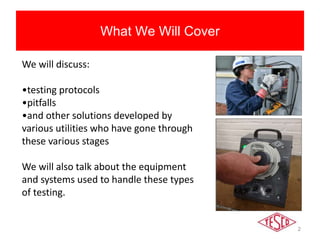
We will discuss:
•testing protocols
•pitfalls
•and other solutions developed by
various utilities who have gone through
these various stages
We will also talk about the equipment
and systems used to handle these types
of testing.
3
Why Develop Protocols?
The first Question is really
Why do we Test?
Because things fail.
Why do we develop protocols?
So we can capture all of the ways that meters have
failed in the past and make sure we are rigorously
checking them going forward.
4
Before – Preparing for AMI
Certification Testing – This is not the most detailed testing we will perform on a meter. The goal of this testing is to
determine that the meter has the features that the utility is looking for, that the manufacturer says the meter has and
that the communication system is working as advertised.
Note: And what are the back up plans? How well does the meter under consideration handle other communication
protocols should the primary protocol fail? Can an antennae be added? Cellular solution added? PLC potential?
First Article Testing – This is the most detailed testing that the utility will perform on the meter. What most people do
not realize is that the meter manufacturers will be delivering them a series of “First Articles” as the production meter
being delivered will change over the course of the AMI deployment.
Pilot Test – This will allow the utility to test the entire system and begin to identify and fill some of the process holes
identified.
Do your internal systems need to be upgraded or augmented to allow the system the ability to handle the stress of an
AMI deployment?
Acceptance testing – this will be a part of the pilot test
•Accuracy testing – the shorter part of the acceptance test
•Functional testing – the longer part of the acceptance test
Equipment Used in this phase – Functional Test boards (Meter Qualification Boards), Accuracy Test Boards, Meter
Engineering/Demand Boards, Meter Farms, Meter Asset Management and Meter Record System
upgrades/replacement
5
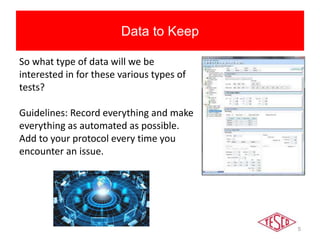
Data to Keep
So what type of data will we be
interested in for these various types of
tests?
Guidelines: Record everything and make
everything as automated as possible.
Add to your protocol every time you
encounter an issue.
6
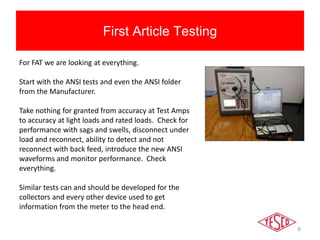
First Article Testing
For FAT we are looking at everything.
Start with the ANSI tests and even the ANSI folder
from the Manufacturer.
Take nothing for granted from accuracy at Test Amps
to accuracy at light loads and rated loads. Check for
performance with sags and swells, disconnect under
load and reconnect, ability to detect and not
reconnect with back feed, introduce the new ANSI
waveforms and monitor performance. Check
everything.
Similar tests can and should be developed for the
collectors and every other device used to get
information from the meter to the head end.
7
Pilot and Acceptance Testing Protocols
Examples of things to check (i.e. have gone wrong)
The Meter Box label: Company header, meter attributes listed, part # listed, meter
model listed
The PO: Line items and descriptions and ID’s all matching between the Manufacturer's
system and the utilities system. Barcodes include, start and stop on a pallet correct, all bar
codes scanable, # of meters on a pallet
Meter Nameplate: Correct format for SN, bar code, part number
Meter File: PO match between manufacturer and utility (down to and including individual
line numbers), text file format correct, file format processes in Utility CIS and meter record
systems, file can flow to inventory and be released for work management system
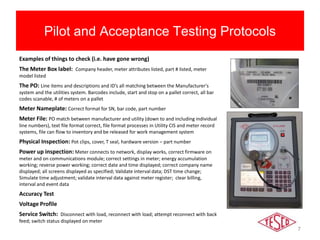
Physical Inspection: Pot clips, cover, T seal, hardware version – part number
Power up inspection: Meter connects to network, display works, correct firmware on
meter and on communications module; correct settings in meter; energy accumulation
working; reverse power working; correct date and time displayed; correct company name
displayed; all screens displayed as specified; Validate interval data; DST time change;
Simulate time adjustment; validate interval data against meter register; clear billing,
interval and event data
Accuracy Test
Voltage Profile
Service Switch: Disconnect with load, reconnect with load; attempt reconnect with back
feed; switch status displayed on meter
8
Pitfalls and Protocols
Discussion of problems encountered.
•Not all features advertised were present
•Data issues and reporting issues
•Problems identified in internal systems to
receive and deploy meters. This is
potentially the most serious, the most time
consuming and the most costly to address
•Do we have the personnel and the training
capabilities needed before deployment
begins? Will we need more of both after
deployment ends?
9
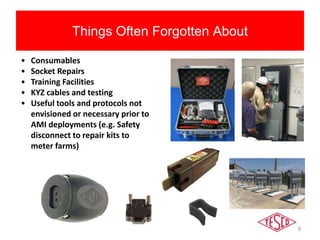
Things Often Forgotten About
• Consumables
• Socket Repairs
• Training Facilities
• KYZ cables and testing
• Useful tools and protocols not
envisioned or necessary prior to
AMI deployments (e.g. Safety
disconnect to repair kits to
meter farms)
10
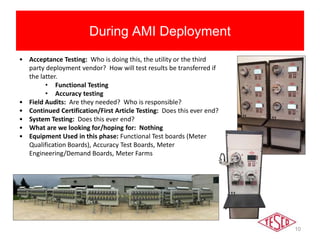
During AMI Deployment
• Acceptance Testing: Who is doing this, the utility or the third
party deployment vendor? How will test results be transferred if
the latter.
• Functional Testing
• Accuracy testing
• Field Audits: Are they needed? Who is responsible?
• Continued Certification/First Article Testing: Does this ever end?
• System Testing: Does this ever end?
• What are we looking for/hoping for: Nothing
• Equipment Used in this phase: Functional Test boards (Meter
Qualification Boards), Accuracy Test Boards, Meter
Engineering/Demand Boards, Meter Farms
11
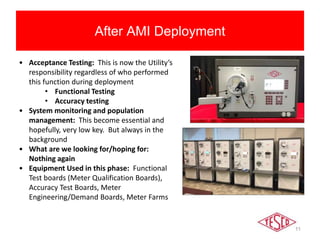
After AMI Deployment
• Acceptance Testing: This is now the Utility’s
responsibility regardless of who performed
this function during deployment
• Functional Testing
• Accuracy testing
• System monitoring and population
management: This become essential and
hopefully, very low key. But always in the
background
• What are we looking for/hoping for:
Nothing again
• Equipment Used in this phase: Functional
Test boards (Meter Qualification Boards),
Accuracy Test Boards, Meter
Engineering/Demand Boards, Meter Farms
12
AMI 2.0
Can we use our existing infrastructure?
Do we have to rip out and replace with
a new infrastructure?
What about LTL back haul or a Private
Network?
What about Power Line Carrier? Is there life there for my most
remote service areas?
And what do we have to do this testing? Does the testing ever end?
Will this be meter accuracy testing? Meter Functional Testing?
Communication Testing?
The shape of metering to come
2020 and beyond
Meters that do not look like meters as we know them,
will become a part of our world.
• Street lights
• Smart Poles
• Electric vehicle chargers
• Sub meters – which may now become our meters
The Shape of Metering to Come –
2020 and Beyond
13
Summary
• Test but verify has never been more true than as you
– Prepare for AMI
– During AMI deployment
– After AMI deployment
• When working properly AMI is a tremendous boon to Electric Utility
Operations reducing ongoing Operational costs and improving the
system performance for the customer. However, one issue getting
past the meter Service department and into the field is quickly
multiplied during an AMI deployment and both costs and delays can
quickly spin out of control.
• We need to embrace change as we have never had to embrace
change before but at the same time we have to enhance our in-
house testing capabilities (personnel and equipment) to carry out this
testing in a difficult and fast paced environment
14
Questions and Discussion
Tom Lawton
TESCO – The Eastern Specialty Company
Bristol, PA
1-215-785-2338
This presentation can also be found under Meter
Conferences and Schools on the TESCO website:
www.tescometering.com
15

Fundamentals of AMI Testing

  • 1.
    Fundamentals of AMI Testing Preparedby Tom Lawton For North Carolina Meter School Advanced Tuesday, June 25, 2019 at 1:00 p.m.
  • 2.
    2 What We WillCover We will discuss: •testing protocols •pitfalls •and other solutions developed by various utilities who have gone through these various stages We will also talk about the equipment and systems used to handle these types of testing.
  • 3.
    3 Why Develop Protocols? Thefirst Question is really Why do we Test? Because things fail. Why do we develop protocols? So we can capture all of the ways that meters have failed in the past and make sure we are rigorously checking them going forward.
  • 4.
    4 Before – Preparingfor AMI Certification Testing – This is not the most detailed testing we will perform on a meter. The goal of this testing is to determine that the meter has the features that the utility is looking for, that the manufacturer says the meter has and that the communication system is working as advertised. Note: And what are the back up plans? How well does the meter under consideration handle other communication protocols should the primary protocol fail? Can an antennae be added? Cellular solution added? PLC potential? First Article Testing – This is the most detailed testing that the utility will perform on the meter. What most people do not realize is that the meter manufacturers will be delivering them a series of “First Articles” as the production meter being delivered will change over the course of the AMI deployment. Pilot Test – This will allow the utility to test the entire system and begin to identify and fill some of the process holes identified. Do your internal systems need to be upgraded or augmented to allow the system the ability to handle the stress of an AMI deployment? Acceptance testing – this will be a part of the pilot test •Accuracy testing – the shorter part of the acceptance test •Functional testing – the longer part of the acceptance test Equipment Used in this phase – Functional Test boards (Meter Qualification Boards), Accuracy Test Boards, Meter Engineering/Demand Boards, Meter Farms, Meter Asset Management and Meter Record System upgrades/replacement
  • 5.
    5 Data to Keep Sowhat type of data will we be interested in for these various types of tests? Guidelines: Record everything and make everything as automated as possible. Add to your protocol every time you encounter an issue.
  • 6.
    6 First Article Testing ForFAT we are looking at everything. Start with the ANSI tests and even the ANSI folder from the Manufacturer. Take nothing for granted from accuracy at Test Amps to accuracy at light loads and rated loads. Check for performance with sags and swells, disconnect under load and reconnect, ability to detect and not reconnect with back feed, introduce the new ANSI waveforms and monitor performance. Check everything. Similar tests can and should be developed for the collectors and every other device used to get information from the meter to the head end.
  • 7.
    7 Pilot and AcceptanceTesting Protocols Examples of things to check (i.e. have gone wrong) The Meter Box label: Company header, meter attributes listed, part # listed, meter model listed The PO: Line items and descriptions and ID’s all matching between the Manufacturer's system and the utilities system. Barcodes include, start and stop on a pallet correct, all bar codes scanable, # of meters on a pallet Meter Nameplate: Correct format for SN, bar code, part number Meter File: PO match between manufacturer and utility (down to and including individual line numbers), text file format correct, file format processes in Utility CIS and meter record systems, file can flow to inventory and be released for work management system Physical Inspection: Pot clips, cover, T seal, hardware version – part number Power up inspection: Meter connects to network, display works, correct firmware on meter and on communications module; correct settings in meter; energy accumulation working; reverse power working; correct date and time displayed; correct company name displayed; all screens displayed as specified; Validate interval data; DST time change; Simulate time adjustment; validate interval data against meter register; clear billing, interval and event data Accuracy Test Voltage Profile Service Switch: Disconnect with load, reconnect with load; attempt reconnect with back feed; switch status displayed on meter
  • 8.
    8 Pitfalls and Protocols Discussionof problems encountered. •Not all features advertised were present •Data issues and reporting issues •Problems identified in internal systems to receive and deploy meters. This is potentially the most serious, the most time consuming and the most costly to address •Do we have the personnel and the training capabilities needed before deployment begins? Will we need more of both after deployment ends?
  • 9.
    9 Things Often ForgottenAbout • Consumables • Socket Repairs • Training Facilities • KYZ cables and testing • Useful tools and protocols not envisioned or necessary prior to AMI deployments (e.g. Safety disconnect to repair kits to meter farms)
  • 10.
    10 During AMI Deployment •Acceptance Testing: Who is doing this, the utility or the third party deployment vendor? How will test results be transferred if the latter. • Functional Testing • Accuracy testing • Field Audits: Are they needed? Who is responsible? • Continued Certification/First Article Testing: Does this ever end? • System Testing: Does this ever end? • What are we looking for/hoping for: Nothing • Equipment Used in this phase: Functional Test boards (Meter Qualification Boards), Accuracy Test Boards, Meter Engineering/Demand Boards, Meter Farms
  • 11.
    11 After AMI Deployment •Acceptance Testing: This is now the Utility’s responsibility regardless of who performed this function during deployment • Functional Testing • Accuracy testing • System monitoring and population management: This become essential and hopefully, very low key. But always in the background • What are we looking for/hoping for: Nothing again • Equipment Used in this phase: Functional Test boards (Meter Qualification Boards), Accuracy Test Boards, Meter Engineering/Demand Boards, Meter Farms
  • 12.
    12 AMI 2.0 Can weuse our existing infrastructure? Do we have to rip out and replace with a new infrastructure? What about LTL back haul or a Private Network? What about Power Line Carrier? Is there life there for my most remote service areas? And what do we have to do this testing? Does the testing ever end? Will this be meter accuracy testing? Meter Functional Testing? Communication Testing?
  • 13.
    The shape ofmetering to come 2020 and beyond Meters that do not look like meters as we know them, will become a part of our world. • Street lights • Smart Poles • Electric vehicle chargers • Sub meters – which may now become our meters The Shape of Metering to Come – 2020 and Beyond 13
  • 14.
    Summary • Test butverify has never been more true than as you – Prepare for AMI – During AMI deployment – After AMI deployment • When working properly AMI is a tremendous boon to Electric Utility Operations reducing ongoing Operational costs and improving the system performance for the customer. However, one issue getting past the meter Service department and into the field is quickly multiplied during an AMI deployment and both costs and delays can quickly spin out of control. • We need to embrace change as we have never had to embrace change before but at the same time we have to enhance our in- house testing capabilities (personnel and equipment) to carry out this testing in a difficult and fast paced environment 14
  • 15.
    Questions and Discussion TomLawton TESCO – The Eastern Specialty Company Bristol, PA 1-215-785-2338 This presentation can also be found under Meter Conferences and Schools on the TESCO website: www.tescometering.com 15