AMI Case Studies

Notes from the Field
Prepared by Tom Lawton,TESCO
for the Southeastern Electricity Metering Association (SEMA)
Abstract
•

As many utilities have elected to deploy advanced metering systems
and millions of new solid-state, microprocessor based end-points
with communications under glass, there has been a dramatic shift in
the approach to qualifying and certifying electricity meters.

•

This presentation will highlight the need for a rigorous approach to
meter certification as well as continued testing as both the meter
and the communication module and the firmware to run both are
upgraded and changed over the course of deployment.

•

Examples of issues which have arisen over the course of various
deployments along with varying approaches to and interpretations of
the same ANSI tests by manufacturers will be discussed.
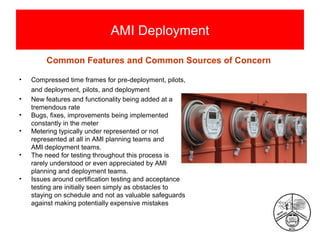
AMI Deployment
Common Features and Common Sources of Concern
•
•
•
•
•
•

Compressed time frames for pre-deployment, pilots,
and deployment, pilots, and deployment
New features and functionality being added at a
tremendous rate
Bugs, fixes, improvements being implemented
constantly in the meter
Metering typically under represented or not
represented at all in AMI planning teams and
AMI deployment teams.
The need for testing throughout this process is
rarely understood or even appreciated by AMI
planning and deployment teams.
Issues around certification testing and acceptance
testing are initially seen simply as obstacles to
staying on schedule and not as valuable safeguards
against making potentially expensive mistakes
The Difference Between Meter Qualification, Meter
Certification & Meter Acceptance Testing
•

Meter Qualification – the easiest and least time consuming aspect
of putting a new AMI technology in the field.

•

Meter Certification – typically underestimated for the initial effort
and unanticipated over the course of deployment.

•

Meter Acceptance Testing – more than just accuracy testing.
Includes functional, firmware and communication testing of all
incoming shipments.
Managing Change – at the utility, at the vendor
and from the suppliers to our vendor
•

Every change is potentially important and should be treated this
way.

•

There is no “small change”.

•

There is rarely the same level of testing done for both the meter and
the communication device and never for the meter and the
communication module as an integrated device.

•

Are ANSI tests without the communication module integrated always
suitable from a business, commission and customer view point.
Who Should be Doing What?
And who is left standing that can do some
of these things at each step in the process?
•Meter Vendors
•Communication device vendors
•AMI Team
•Metering Group
•Third Party test Labs
- Where are the risks?
- How closely should each
participant be held accountable
and at which steps?
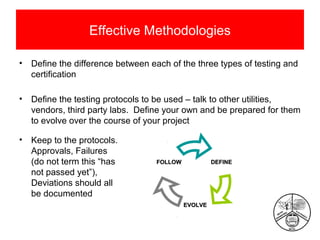
Effective Methodologies
•

Define the difference between each of the three types of testing and
certification

•

Define the testing protocols to be used – talk to other utilities,
vendors, third party labs. Define your own and be prepared for them
to evolve over the course of your project

•

Keep to the protocols.
Approvals, Failures
(do not term this “has
not passed yet”),
Deviations should all
be documented

FOLLOW

DEFINE

EVOLVE
Qualification Testing
Typical Protocols:
•
•

AMI Teams typically do a good job of defining what they expect the meters and
communications devices to do.
Meter Services can take this specifications document and check to see if the
devices proposed can handle these tasks.

Ways to stay out of trouble and to set yourself up for success in the subsequent
steps:
• Define the testing protocols to be used – talk to other utilities, vendors, third
party labs. Define your own and be prepared for them to evolve over the
course of your project.
• Keep to the protocols. Approvals, Failures (do not term this “has not passed
yet”), Deviations should all be documented.
• Check for yourself. If a feature is advertised then you should be able to verify
the feature is functional and whether this feature meets your needs. When
purchasing a “Smart” meter, know what you are getting.
Pre-deployment Certification Testing
•
•
•
•
•
•
•
•

ANSI Testing
Meter Functionality
Meter Data Acquisition Accuracy for Each Form
Dual Socket Meter Comparison – Data Collection & Accuracy
(Energy, Demand, Load Profile)
Large Test Platform Meter Comparison –
Data Collection & Accuracy
Disconnect/Reconnect Functionality
Outage Performance
Meter Communications Performance
Deployment and Post-Deployment
Certification Testing
•
•
•
•
•
•
•
•

ANSI Testing
Meter Functionality
Meter Data Acquisition Accuracy for Each Form
Dual Socket Meter Comparison – Data Collection & Accuracy
(Energy, Demand, Load Profile)
Large Test Platform Meter Comparison –
Data Collection & Accuracy
Disconnect/Reconnect Functionality
Outage Performance
Meter Communications Performance
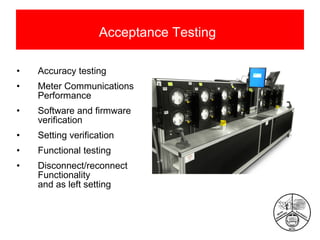
Acceptance Testing
•

Accuracy testing

•

Meter Communications
Performance

•

Software and firmware
verification

•

Setting verification

•

Functional testing

•

Disconnect/reconnect
Functionality
and as left setting
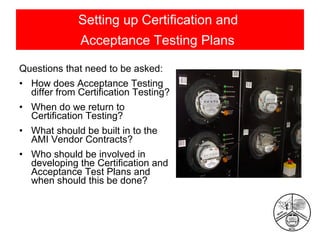
Setting up Certification and
Acceptance Testing Plans
Questions that need to be asked:
• How does Acceptance Testing
differ from Certification Testing?
• When do we return to
Certification Testing?
• What should be built in to the
AMI Vendor Contracts?
• Who should be involved in
developing the Certification and
Acceptance Test Plans and
when should this be done?
Useful Tools & Potential Resources
• ISO 9001
• Quality System Documentation if not ISO 9001
• Quality systems and test reports from vendors
• ANSI Test results, and protocols used by various
manufacturers for these tests. Insist upon
additional testing where you feel necessary
• Third Party Labs for your own certification testing
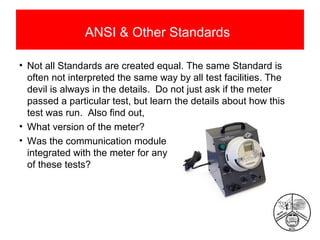
ANSI & Other Standards
• Not all Standards are created equal. The same Standard is
often not interpreted the same way by all test facilities. The
devil is always in the details. Do not just ask if the meter
passed a particular test, but learn the details about how this
test was run. Also find out,
• What version of the meter?
• Was the communication module
integrated with the meter for any
of these tests?
Vendors, Consultants, Independent Labs,
Other Utilities, Networking
• You are not the first Utility to go through this process. At this point several others
utilities have completed or are nearing completion of a deployment with your
meter of choice or one of the meters you are considering choosing. There may
even be utilities who have deployed the same meter with the same
communication device. Ask your peers. Pick their brains. Talk to the metering
folks. We are pretty friendly individuals.
• Most of the vendors have gotten better about no
longer stone walling with “we have never seen
that issue before”. We are asking our meter
vendors to deploy new technology and new
features very rapidly. They generally want to
learn of any issues as quickly as possible and
address these issues as quickly as possible.
• You always have a first or a final resort to go to
an independent test facility – new feature never
used in the industry or a problem that crops
up after deployment has begun
Quality Audits
•

Schedule these for your meter manufacturer and your communication device
manufacturer.

•

Objective is to understand how they tested the product in the first place as well as
how any concerns that come up will be addressed. What is the mechanism, who are
the people, what capabilities do they have to investigate and determine root cause.
How and when are these responses fed back to you the customer and to the
manufacturing and supply chain.

•

In plant final inspection and testing

•

Plant first pass test results… if the number is less than 95% (which is typical),
validating and auditing the off-line repair process becomes equally as important as
auditing the main line quality checks

•

Vendor supply change management

•

Validation testing of firm ware changes
RMA’s and Self-Audits
•

In conjunction with auditing your vendor you should
audit your own procedures for identifying, reporting and
following up on issues.

•

For many this is simply a review of their RMA
procedures. These procedures need to be
strengthened and personnel assigned to them as the
number of issues will skyrocket over the course of a
deployment. Most will be of no or little consequence.
Some will be important and one or more may have
catastrophic results if not addressed quickly and
followed-up forcefully and with persistence.

•

Regardless of the extent of the self-audit, your quality
system will have to be strengthened and staffed to
handle the demands and the rigors of an AMI
deployment. Clear chains of command and reporting
protocols and decision matrixes will be as important as
any testing protocols.
Post-Deployment
Meter Farms as a Tool

•
•
•
•
•
•
•
•

Once deployment is complete the certification and acceptance testing does not
stop.
Everyone understands the importance of acceptance testing, but future
generations of a smart meter also require certification testing.
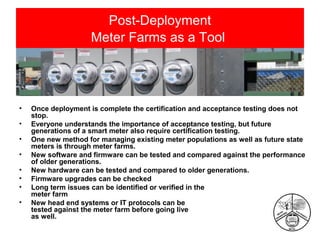
One new method for managing existing meter populations as well as future state
meters is through meter farms.
New software and firmware can be tested and compared against the performance
of older generations.
New hardware can be tested and compared to older generations.
Firmware upgrades can be checked
Long term issues can be identified or verified in the
meter farm
New head end systems or IT protocols can be
tested against the meter farm before going live
as well.
Real Life Examples of Change
Management in Action
•

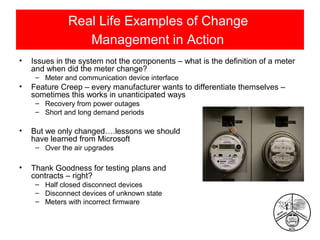
Issues in the system not the components – what is the definition of a meter
and when did the meter change?
– Meter and communication device interface

•

Feature Creep – every manufacturer wants to differentiate themselves –
sometimes this works in unanticipated ways
– Recovery from power outages
– Short and long demand periods

•

But we only changed….lessons we should
have learned from Microsoft
– Over the air upgrades

•

Thank Goodness for testing plans and
contracts – right?
– Half closed disconnect devices
– Disconnect devices of unknown state
– Meters with incorrect firmware
Expected & Unexpected Trends Toward
the End of Deployment
Expected:
• The AMI deployment team will declare victory at some point and move on.
Clean-up will be left for the meter service department
• Change Management continues to be a tremendous challenge for every
vendor through every deployment
• Meter Acceptance testing including far more than accuracy testing for every
deployment
• Firmware upgrades must be checked and tested before mass deployment
Unexpected:
• Not all forms are available by the end of
deployment and must be installed as
part of normal operations by the meter
service department
• Meter Certification Testing never slowed
down over the course of any of the
deployments
Summary
• There are no bad manufacturers. Everyone is moving very
fast to meet the market demands. Without adequate checks
and balances there will be problems. Even with them, there
may still be problems – that is why we call this Risk Mitigation
and not Risk Elimination
• Each Utility must take a far more active role as part of this
system of checks and balances
Questions and Discussion
Tom Lawton
TESCO – The Eastern Specialty Company
Bristol, PA
215-688-0298 (cell) · 1-800-762-8211
Tom.Lawton@tescometermanager.com
This presentation can also be found under Meter
Conferences and Schools on the TESCO web site:
www.tesco-advent.com

AMI Case Studies

  • 1.
    AMI Case Studies Notesfrom the Field Prepared by Tom Lawton,TESCO for the Southeastern Electricity Metering Association (SEMA)
  • 2.
    Abstract • As many utilitieshave elected to deploy advanced metering systems and millions of new solid-state, microprocessor based end-points with communications under glass, there has been a dramatic shift in the approach to qualifying and certifying electricity meters. • This presentation will highlight the need for a rigorous approach to meter certification as well as continued testing as both the meter and the communication module and the firmware to run both are upgraded and changed over the course of deployment. • Examples of issues which have arisen over the course of various deployments along with varying approaches to and interpretations of the same ANSI tests by manufacturers will be discussed.
  • 3.
    AMI Deployment Common Featuresand Common Sources of Concern • • • • • • Compressed time frames for pre-deployment, pilots, and deployment, pilots, and deployment New features and functionality being added at a tremendous rate Bugs, fixes, improvements being implemented constantly in the meter Metering typically under represented or not represented at all in AMI planning teams and AMI deployment teams. The need for testing throughout this process is rarely understood or even appreciated by AMI planning and deployment teams. Issues around certification testing and acceptance testing are initially seen simply as obstacles to staying on schedule and not as valuable safeguards against making potentially expensive mistakes
  • 4.
    The Difference BetweenMeter Qualification, Meter Certification & Meter Acceptance Testing • Meter Qualification – the easiest and least time consuming aspect of putting a new AMI technology in the field. • Meter Certification – typically underestimated for the initial effort and unanticipated over the course of deployment. • Meter Acceptance Testing – more than just accuracy testing. Includes functional, firmware and communication testing of all incoming shipments.
  • 5.
    Managing Change –at the utility, at the vendor and from the suppliers to our vendor • Every change is potentially important and should be treated this way. • There is no “small change”. • There is rarely the same level of testing done for both the meter and the communication device and never for the meter and the communication module as an integrated device. • Are ANSI tests without the communication module integrated always suitable from a business, commission and customer view point.
  • 6.
    Who Should beDoing What? And who is left standing that can do some of these things at each step in the process? •Meter Vendors •Communication device vendors •AMI Team •Metering Group •Third Party test Labs - Where are the risks? - How closely should each participant be held accountable and at which steps?
  • 7.
    Effective Methodologies • Define thedifference between each of the three types of testing and certification • Define the testing protocols to be used – talk to other utilities, vendors, third party labs. Define your own and be prepared for them to evolve over the course of your project • Keep to the protocols. Approvals, Failures (do not term this “has not passed yet”), Deviations should all be documented FOLLOW DEFINE EVOLVE
  • 8.
    Qualification Testing Typical Protocols: • • AMITeams typically do a good job of defining what they expect the meters and communications devices to do. Meter Services can take this specifications document and check to see if the devices proposed can handle these tasks. Ways to stay out of trouble and to set yourself up for success in the subsequent steps: • Define the testing protocols to be used – talk to other utilities, vendors, third party labs. Define your own and be prepared for them to evolve over the course of your project. • Keep to the protocols. Approvals, Failures (do not term this “has not passed yet”), Deviations should all be documented. • Check for yourself. If a feature is advertised then you should be able to verify the feature is functional and whether this feature meets your needs. When purchasing a “Smart” meter, know what you are getting.
  • 9.
    Pre-deployment Certification Testing • • • • • • • • ANSITesting Meter Functionality Meter Data Acquisition Accuracy for Each Form Dual Socket Meter Comparison – Data Collection & Accuracy (Energy, Demand, Load Profile) Large Test Platform Meter Comparison – Data Collection & Accuracy Disconnect/Reconnect Functionality Outage Performance Meter Communications Performance
  • 10.
    Deployment and Post-Deployment CertificationTesting • • • • • • • • ANSI Testing Meter Functionality Meter Data Acquisition Accuracy for Each Form Dual Socket Meter Comparison – Data Collection & Accuracy (Energy, Demand, Load Profile) Large Test Platform Meter Comparison – Data Collection & Accuracy Disconnect/Reconnect Functionality Outage Performance Meter Communications Performance
  • 11.
    Acceptance Testing • Accuracy testing • MeterCommunications Performance • Software and firmware verification • Setting verification • Functional testing • Disconnect/reconnect Functionality and as left setting
  • 12.
    Setting up Certificationand Acceptance Testing Plans Questions that need to be asked: • How does Acceptance Testing differ from Certification Testing? • When do we return to Certification Testing? • What should be built in to the AMI Vendor Contracts? • Who should be involved in developing the Certification and Acceptance Test Plans and when should this be done?
  • 13.
    Useful Tools &Potential Resources • ISO 9001 • Quality System Documentation if not ISO 9001 • Quality systems and test reports from vendors • ANSI Test results, and protocols used by various manufacturers for these tests. Insist upon additional testing where you feel necessary • Third Party Labs for your own certification testing
  • 14.
    ANSI & OtherStandards • Not all Standards are created equal. The same Standard is often not interpreted the same way by all test facilities. The devil is always in the details. Do not just ask if the meter passed a particular test, but learn the details about how this test was run. Also find out, • What version of the meter? • Was the communication module integrated with the meter for any of these tests?
  • 15.
    Vendors, Consultants, IndependentLabs, Other Utilities, Networking • You are not the first Utility to go through this process. At this point several others utilities have completed or are nearing completion of a deployment with your meter of choice or one of the meters you are considering choosing. There may even be utilities who have deployed the same meter with the same communication device. Ask your peers. Pick their brains. Talk to the metering folks. We are pretty friendly individuals. • Most of the vendors have gotten better about no longer stone walling with “we have never seen that issue before”. We are asking our meter vendors to deploy new technology and new features very rapidly. They generally want to learn of any issues as quickly as possible and address these issues as quickly as possible. • You always have a first or a final resort to go to an independent test facility – new feature never used in the industry or a problem that crops up after deployment has begun
  • 16.
    Quality Audits • Schedule thesefor your meter manufacturer and your communication device manufacturer. • Objective is to understand how they tested the product in the first place as well as how any concerns that come up will be addressed. What is the mechanism, who are the people, what capabilities do they have to investigate and determine root cause. How and when are these responses fed back to you the customer and to the manufacturing and supply chain. • In plant final inspection and testing • Plant first pass test results… if the number is less than 95% (which is typical), validating and auditing the off-line repair process becomes equally as important as auditing the main line quality checks • Vendor supply change management • Validation testing of firm ware changes
  • 17.
    RMA’s and Self-Audits • Inconjunction with auditing your vendor you should audit your own procedures for identifying, reporting and following up on issues. • For many this is simply a review of their RMA procedures. These procedures need to be strengthened and personnel assigned to them as the number of issues will skyrocket over the course of a deployment. Most will be of no or little consequence. Some will be important and one or more may have catastrophic results if not addressed quickly and followed-up forcefully and with persistence. • Regardless of the extent of the self-audit, your quality system will have to be strengthened and staffed to handle the demands and the rigors of an AMI deployment. Clear chains of command and reporting protocols and decision matrixes will be as important as any testing protocols.
  • 18.
    Post-Deployment Meter Farms asa Tool • • • • • • • • Once deployment is complete the certification and acceptance testing does not stop. Everyone understands the importance of acceptance testing, but future generations of a smart meter also require certification testing. One new method for managing existing meter populations as well as future state meters is through meter farms. New software and firmware can be tested and compared against the performance of older generations. New hardware can be tested and compared to older generations. Firmware upgrades can be checked Long term issues can be identified or verified in the meter farm New head end systems or IT protocols can be tested against the meter farm before going live as well.
  • 19.
    Real Life Examplesof Change Management in Action • Issues in the system not the components – what is the definition of a meter and when did the meter change? – Meter and communication device interface • Feature Creep – every manufacturer wants to differentiate themselves – sometimes this works in unanticipated ways – Recovery from power outages – Short and long demand periods • But we only changed….lessons we should have learned from Microsoft – Over the air upgrades • Thank Goodness for testing plans and contracts – right? – Half closed disconnect devices – Disconnect devices of unknown state – Meters with incorrect firmware
  • 20.
    Expected & UnexpectedTrends Toward the End of Deployment Expected: • The AMI deployment team will declare victory at some point and move on. Clean-up will be left for the meter service department • Change Management continues to be a tremendous challenge for every vendor through every deployment • Meter Acceptance testing including far more than accuracy testing for every deployment • Firmware upgrades must be checked and tested before mass deployment Unexpected: • Not all forms are available by the end of deployment and must be installed as part of normal operations by the meter service department • Meter Certification Testing never slowed down over the course of any of the deployments
  • 21.
    Summary • There areno bad manufacturers. Everyone is moving very fast to meet the market demands. Without adequate checks and balances there will be problems. Even with them, there may still be problems – that is why we call this Risk Mitigation and not Risk Elimination • Each Utility must take a far more active role as part of this system of checks and balances
  • 22.
    Questions and Discussion TomLawton TESCO – The Eastern Specialty Company Bristol, PA 215-688-0298 (cell) · 1-800-762-8211 Tom.Lawton@tescometermanager.com This presentation can also be found under Meter Conferences and Schools on the TESCO web site: www.tesco-advent.com